
How Much Does Disability Insurance Cost
As an Independent Disability Insurance Broker, we have access to exclusive discounts and negotiated pricing most captive agents can’t offer — see the full breakdown near the end of this page.
How Much Does Disability Insurance Cost

Jason Stolz CLTC, CRPC, DIA, CAA
Disability insurance typically costs between one and three percent of annual income for a well-structured individual long-term policy — a range that covers most of the market for professional and skilled-trade buyers, though the actual premium depends on eight specific variables that interact in ways most buyers do not expect. That one-to-three percent range is a useful starting point, not a destination. A 35-year-old physician buying a comprehensive own-occupation policy with multiple riders, a to-age-65 benefit period, and a 90-day elimination period pays meaningfully more than a 35-year-old office worker buying a modified definition policy with a 180-day wait and a 5-year benefit period — even if both are getting coverage for the same monthly benefit amount. The variables that move the premium are well-defined and largely within the buyer’s control, which means a buyer who understands the levers can design a policy that delivers genuine income protection at a premium that fits the budget. Our resource on is disability insurance expensive covers the value-per-dollar question in detail, and our resource on why you need disability insurance even if you’re young and healthy covers the risk context that makes the cost worth evaluating seriously at any age.
The starting frame for understanding DI cost is what the premium is protecting. Life insurance protects against the financial impact of death. Disability insurance protects against the financial impact of a prolonged inability to earn income while still living — a risk that is statistically more probable for working-age adults than premature death. The income that disability insurance protects is the source of everything else in the financial plan: mortgage payments, retirement savings contributions, family living expenses, debt payoff, and every other financial obligation that assumes continued earnings. When that income is interrupted for months or years, the disruption compounds in ways that a simple monthly benefit comparison does not fully capture — forced portfolio withdrawals at unfavorable times, paused retirement contributions, reduced wealth-building momentum. Disability insurance transfers that specific financial risk to an insurance carrier for a defined, predictable premium. Our resource on what is the primary reason people buy disability insurance covers the planning rationale that justifies the cost comparison, and our resource on is disability insurance worth it covers the evaluation framework for weighing premium against protection value.
The occupational dimension of disability insurance pricing is one of the most misunderstood aspects of the product. Unlike life insurance, which prices primarily on age, gender, and health, disability insurance prices heavily on what you do for a living — because what you do determines both the probability of a disabling event and the difficulty of performing your specific work while impaired. A roofing contractor and a financial analyst may have identical health profiles, identical ages, and identical desired benefit amounts, yet face premiums that differ by 50-150% or more because their occupational hazard and the specificity of their required job functions are categorically different. This is why disability insurance for specialists with very specific skill requirements — like the specialized risk involved in occupations discussed on pages like our resource on life insurance for offshore oil workers — reflects the actual risk profile of the work being performed rather than a generic average. Our resource on disability insurance by occupation covers the full occupational classification landscape.
Get a Real Price Range for Your Occupation
We compare multiple top-rated carriers and show how the biggest pricing levers affect your monthly cost — so you see real numbers, not averages that don’t apply to your situation.
Eight Factors That Determine Disability Insurance Cost
Every disability insurance premium is the product of eight variables. Understanding how each one moves the price — and which ones are within the buyer’s control — is how to design coverage that is strong where it needs to be and efficient where it can be.
| Pricing Factor | How It Affects Premium | Typical Premium Impact | Buyer Control |
|---|---|---|---|
| Occupation class | The single largest pricing variable for most buyers — carriers assign occupation classes (commonly 1-6 or similar scale) based on physical hazard, specific skill requirements, and income replaceability; higher class = lower premium | A policy for a blue-collar tradesperson can cost 50-150% more than the same policy for a white-collar professional at identical age, health, and benefit amount | None — determined by occupation; carriers may classify the same occupation differently, making carrier comparison essential |
| Monthly benefit amount | Premium scales roughly proportionally with benefit amount — doubling the monthly benefit approximately doubles the premium for all else equal; coverage is limited to a percentage of pre-disability income (typically 60-70%) | Direct: a $5,000/month benefit costs approximately half of a $10,000/month benefit under the same policy structure | High — the buyer selects the benefit amount up to carrier maximums; partial income replacement is a legitimate budget management strategy |
| Age at application | Older applicants pay higher premiums because the statistical probability of a disabling event increases with age; the relationship is not linear — premiums can increase significantly between early thirties and mid-forties | Buying at 30 vs. 40 can reduce lifetime premium cost significantly; each year of delay also increases the risk that a new health condition closes the underwriting window | Moderate — the buyer controls timing; early purchase is the single most effective cost management decision available |
| Health at application | Select (preferred) health classification saves 15-25% over standard classification; certain conditions result in exclusion riders (specific conditions excluded from coverage), rated policies (higher premium), or outright declines | Health rating differences of 15-25% are common; poor health can make coverage unavailable, making early application the strongest health management strategy | Limited — current health is fixed; applying before conditions develop is the only way to lock in favorable health classification permanently |
| Elimination period (waiting period) | The number of days the disability must persist before benefits begin; longer elimination periods produce lower premiums because the buyer is self-insuring the early period of a claim | Extending from a 30-day to a 90-day elimination period can reduce premium by 20-30%; extending to 180 days adds another 10-15% reduction; the savings must be weighed against the ability to self-fund the waiting period | High — buyers with adequate emergency reserves or employer short-term disability coverage can elect longer elimination periods and reduce ongoing premium meaningfully |
| Benefit period | How long benefits can be paid; options range from 2-5 years to a benefit period extending to age 65 (or 67); longer benefit periods cost more but protect against the permanent disability scenario that creates the most financial devastation | A to-age-65 benefit period costs 30-60% more than a 5-year benefit period for the same monthly benefit; the difference is most consequential for permanent total disabilities that would exhaust a shorter period | High — buyer selects; for most working-age professionals, a to-age-65 benefit period is strongly preferred because it protects against the low-probability but financially catastrophic permanent disability scenario |
| Disability definition type | True own-occupation policies cost more than modified or any-occupation policies because the carrier accepts a more liberal trigger for benefit payments; the premium premium for the stronger definition is typically 10-25% | A 10-25% premium differential between true own-occupation and modified definition; for specialized professionals, the claim-time value of the stronger definition can represent hundreds of thousands of dollars in preserved benefits | High — the buyer selects the definition; for most professionals with specialized skills, the premium for a stronger own-occupation definition is among the best risk-adjusted expenditures in the entire policy |
| Optional riders | COLA, FIO, residual/partial, and catastrophic riders each add to the base premium; riders represent additional layers of protection layered on top of the base policy | Each rider typically adds 5-20% to base premium; the combined cost of a full rider package can add 30-50% or more to the base policy cost; individual riders should be evaluated for value relative to the specific planning profile | High — the buyer selects which riders to add; the residual rider and FIO are the most broadly valuable; COLA adds the most to long-duration claim value; each can be added or excluded based on budget and priority |
Premium ranges above reflect general market patterns for the individual long-term disability insurance market. Specific premiums depend on carrier underwriting, state of residence, exact benefit design, and individual health and occupational profile. The same benefit design can produce significantly different premiums across carriers — carrier comparison is always the appropriate basis for a purchasing decision. This table is for educational reference and does not constitute a quote for any specific buyer.
The Occupation Class — The Factor Most Buyers Don’t See Coming
Most buyers approach disability insurance assuming the premium calculation works like auto insurance — primarily driven by individual risk characteristics. The occupation class is the variable that most often surprises buyers, because it operates as a multiplier on the entire premium structure rather than a simple add-on. Carriers segment occupations into classes based on physical hazard, income replaceability, the specificity of skills required, and the typical disability profile of the occupation. A surgeon and a construction foreman may be identical in age, health, and desired benefit amount, but the surgeon’s occupation class qualification produces a premium that is a fraction of the foreman’s — because the physical hazard, claim frequency, and claim duration patterns for the two occupations are categorically different. Within white-collar occupations, even smaller distinctions matter: an attorney and an accountant typically receive similar classification, while a pharmacist who fills prescriptions may be rated differently from a hospital pharmacy manager who primarily supervises and manages. Our resource on disability insurance for white collar professionals covers the favorable occupation class dynamics for professional office-based workers, and our resource on disability insurance for high earners and business owners covers the income documentation and coverage design framework for senior earners whose compensation exceeds standard benefit formulas.
The Elimination Period — The Most Underused Cost Lever
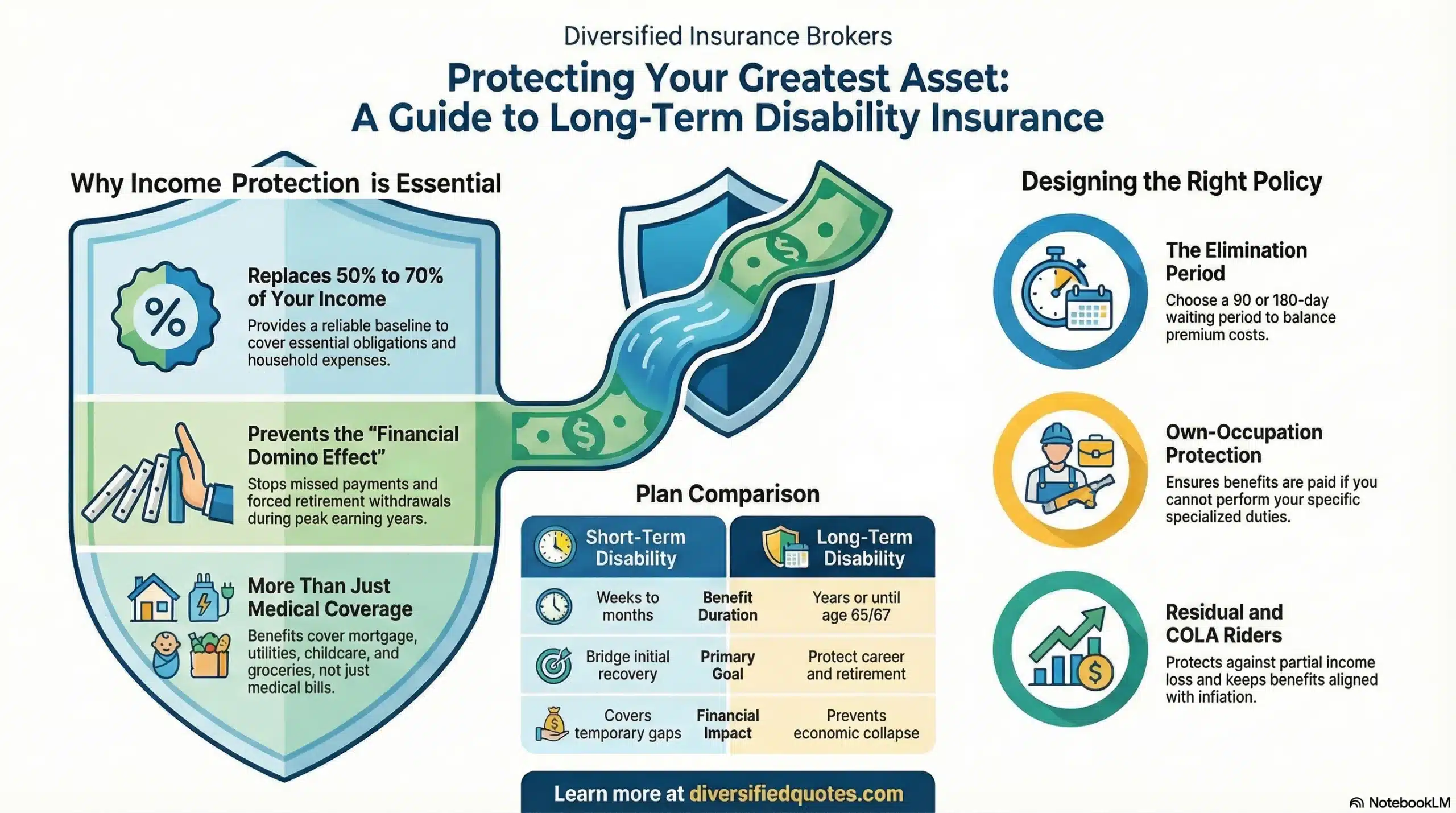
The elimination period — the waiting period between the onset of disability and the first benefit payment — is the most controllable premium lever available after the benefit amount itself. Most buyers default to a 90-day elimination period, which is the most common selection and represents a reasonable balance between premium cost and the self-insured period. But buyers with strong emergency reserves, significant accumulated savings, or employer-provided short-term disability coverage may be able to sustain a 180-day or even 365-day waiting period without meaningful financial risk — and extending the elimination period from 90 to 180 days can reduce annual premium by 10-15% depending on the carrier and benefit design. The key analysis is simple: can you fund your essential expenses for the elimination period without drawing down savings that would significantly damage long-term financial plans? If yes, the premium reduction from a longer elimination period is essentially free savings. Our resource on disability insurance elimination periods explained covers the mechanics and planning considerations in detail, and our resource on short-term disability covers the short-term product that can cover the elimination period when personal savings are insufficient.
The Benefit Period — Why Short Benefit Periods Are Usually a False Economy
Selecting a 5-year benefit period instead of a to-age-65 benefit period reduces premium by 30-60% depending on the buyer’s age at purchase. For a 32-year-old, that premium reduction represents real money over a decade of ownership. The question is what risk the premium reduction creates. A five-year benefit period protects against the typical short-to-medium-duration disability — an illness or injury that disrupts work for two or three years and is followed by recovery and return. It provides zero protection against the permanent or long-duration disability that exhausts five years of benefits and continues for another fifteen or twenty years. That permanent disability scenario is statistically unlikely for any individual, but when it occurs it is the most financially devastating outcome in the entire disability spectrum — an earner in their thirties or forties facing permanent income loss without the benefit protection to sustain financial stability for the remaining working years. The actuarial logic favors to-age-65 for most working-age professionals: the additional premium cost is modest relative to the catastrophic risk it covers. Our resource on long-term disability insurance covers the product landscape for policies with extended benefit periods, and our resource on how much disability insurance do I need covers the benefit sizing methodology that determines how much monthly coverage is appropriate for a given income level.
The Own-Occupation Definition — The Premium That Is Almost Always Worth Paying
True own-occupation disability insurance — the definition that pays benefits when you cannot perform the material and substantial duties of your specific occupation, even if you can work in another role — costs 10-25% more than modified or any-occupation definitions. For buyers in specialized professions, this premium differential is among the most efficiently spent dollars in the policy. The claim-time difference between own-occupation and any-occupation language can amount to years of additional benefit payments for a professional whose specific occupational capabilities are impaired but who remains capable of other work. An attorney who can no longer practice law due to cognitive impairment collects full own-occupation benefits even while teaching law part-time. The same attorney on an any-occupation policy after 24 months receives nothing because they are capable of being gainfully employed. For specialists, executives, technical professionals, and any buyer whose income derives from a highly specific and difficult-to-replicate skill set, the stronger definition is not optional — it is the reason the policy provides meaningful protection. Our resource on own occupation disability insurance covers the definition spectrum from true own-occupation through modified and any-occupation language.
How Riders Affect Premium and When Each Is Worth Adding
Riders are optional coverage enhancements added to the base policy at additional premium cost. The four riders most commonly evaluated for working-age professionals are the residual or partial disability rider, the cost of living adjustment (COLA) rider, the future increase option (FIO) rider, and the catastrophic disability rider. The residual rider — which pays proportional benefits when income is reduced but not eliminated by disability — is the most broadly valuable for professionals because partial disability is the most common disability claim scenario for office-based workers. The COLA rider increases the monthly benefit during a long-duration claim, maintaining real purchasing power for buyers who claim for many years. The FIO rider allows coverage to be increased without new medical underwriting as income grows — critical for early-career buyers whose income will grow significantly. The catastrophic rider provides an additional benefit layer for the most severe disability outcomes. Each rider adds premium but addresses a specific risk dimension that the base policy does not fully cover. Our resource on disability insurance riders explained covers all rider types and their planning applications, our resource on disability income insurance with COLA covers the COLA rider in detail, our resource on disability insurance future insurability rider covers the FIO mechanics, and our resource on residual disability insurance benefits explained covers partial benefit calculation and triggering.
Individual vs. Group DI — Why Individual Costs More and What You Get for It
Individual disability insurance policies cost more than employer group long-term disability plans for reasons that are structural, not arbitrary. Group LTD is priced for a broad employee population, uses less favorable disability definitions, caps benefits at amounts that leave high earners underinsured, excludes variable compensation, and provides benefits that are taxable as ordinary income when the employer pays the premium. Individual own-occupation DI is priced for an individually underwritten applicant, uses stronger definitions, can be sized to include the full income picture, and pays benefits tax-free when the individual pays the premium with after-tax dollars. The individual premium is higher; the net income protection delivered is also substantially higher. For most professionals, the appropriate structure is to use group LTD as a baseline and supplement it with an individual policy that fills the definition, amount, portability, and tax gaps that group coverage leaves open. Our resource on are disability insurance payments taxable covers the tax treatment that determines net benefit value, our resource on disability insurance for the self-employed covers the entirely individual-policy context for business owners who have no group plan at all, our resource on high-income disability insurance covers the full income protection design for senior earners, and our resources on how to get the best disability insurance rates, best disability insurance rates, disability insurance services, and get a 2nd opinion on your disability insurance quote cover the comparison and evaluation process.
Talk With an Advisor Today
Choose how you’d like to connect—call or message us, then book a time that works for you.
Schedule here:
calendly.com/jason-dibcompanies/diversified-quotes
Licensed in all 50 states • Fiduciary, family-owned since 1980
FAQs: How Much Does Disability Insurance Cost?
What is the general rule of thumb for disability insurance cost?
Individual long-term disability insurance typically costs between one and three percent of annual income for a well-structured policy. The lower end of that range applies to younger professionals in favorable occupational classes with longer elimination periods and moderate rider selections. The upper end applies to older buyers, higher-hazard occupations, comprehensive rider packages, and shorter elimination periods. This range covers the majority of working-age professional and skilled-trade buyers, though specific premiums vary significantly based on the eight pricing factors that drive individual DI cost. The only way to determine your specific premium is to obtain carrier-specific quotes based on your occupation, income, age, health, and desired benefit design.
What is the single most effective way to reduce disability insurance premium without gutting coverage?
Extending the elimination period is typically the most efficient premium lever for buyers with adequate emergency reserves. Moving from a 30-day elimination period to a 90-day period can reduce premium by 20-30%; moving to 180 days adds another 10-15% reduction. The savings are real and permanent — the premium paid every year for the life of the policy reflects the longer waiting period. The cost is the need to self-fund the waiting period from savings or income continuation. For buyers who already have three to six months of living expenses in liquid savings, extending the elimination period is often a straightforward premium reduction with manageable risk. Beyond the elimination period, selecting a 5-year benefit period instead of to-age-65 saves 30-60% but creates meaningful coverage risk for permanent disabilities — a trade that most financial planners advise against for core income protection.
Does disability insurance cost the same from all carriers for the same benefit?
No — premium can vary by 30-100% or more across carriers for the same age, occupation, benefit amount, and policy design. Carriers classify occupations differently, price risk differently, and compete differently by market segment. The same financial analyst applying for $6,000 per month in own-occupation coverage with a 90-day elimination period and to-age-65 benefit period can receive quotes that differ by thousands of dollars annually from different carriers. Carrier comparison is not optional for disability insurance — it is the primary mechanism for finding both the best price and the strongest contract language, because those two variables often move independently. One carrier may offer the lowest rate but a weaker definition; another may offer a slightly higher rate with meaningfully stronger own-occupation language and rider availability.
Why does disability insurance cost more for some occupations than others?
Disability insurance is priced heavily on occupational risk because what you do for a living determines the probability of a disabling event, the severity when it occurs, and the difficulty of continuing to work in your specific role while impaired. A roofer has a materially higher probability of a disabling injury than an accountant, and the nature of roofing work means even partial impairment eliminates the ability to work safely. The accountant’s disability risk is dominated by illness and cognitive conditions that may allow some work capacity — triggering residual rather than total disability claims. These different risk profiles produce different premium structures. Carriers assign occupational classes that reflect these patterns, with the highest classes (5A, 6A, depending on carrier scale) reserved for indoor professional and white-collar roles with minimal physical hazard and high income replaceability through cognitive work.
Is disability insurance more expensive than life insurance?
For the same working-age buyer, disability insurance typically costs more than a comparable amount of term life insurance — because the probability of a disabling event during working years is higher than the probability of death during the same period. A disability that lasts for years also generates repeated monthly benefit payments, while life insurance pays once. The product difference is also structural: disability insurance pays while you are alive and unable to work, covering the risk that most working-age adults face most immediately. Term life insurance protects against premature death, which is a lower probability event at most working ages. Both products serve essential planning roles; the higher disability insurance premium reflects the higher claim probability it is pricing for.
About the Author:
Jason Stolz, CLTC, CRPC, DIA, CAA and Chief Underwriter at Diversified Insurance Brokers (NPN 20471358), is a senior insurance and retirement professional with more than 25 years of real-world experience helping individuals, families, and business owners protect their income, assets, and long-term financial stability. As a long-time partner of the nationally licensed independent agency Diversified Insurance Brokers, Jason provides trusted guidance across multiple specialties—including fixed and indexed annuities, long-term care planning, personal and business disability insurance, life insurance solutions, Group Health, Travel Medical and Evacuation Insurance, and short-term health coverage. Diversified Insurance Brokers maintains active contracts with over 100 highly rated insurance carriers, ensuring clients have access to a broad and competitive marketplace.
His practical, education-first approach has earned recognition in publications such as VoyageATL, and contributions from his agency featured in Kiplinger and GoBankingRates— highlighting his commitment to financial clarity and client-focused planning. Drawing on deep product knowledge and years of hands-on field experience, Jason helps clients evaluate carriers, compare strategies, and build retirement and protection plans that are both secure and cost-efficient. Visitors who want to explore current annuity rates and compare options across multiple insurers can also use this annuity quote and comparison tool.
Browse More Resources: Return to our complete Health Insurance, Dental, Vision & Disability guide — covering short term health, dental, vision, group health & disability.
Last Reviewed: June 5, 2026 |
Reviewed by: Jason Stolz, CLTC, CRPC, DIA, CAA
Chief Underwriter, Diversified Insurance Brokers, Inc. | NPN: 20471358 | Diversified Insurance Brokers, Inc. — Licensed in all 50 states
Fact Checked by: Tonia Pettitt, CMIP©
Medicare Specialist, Diversified Insurance Brokers, Inc. | NPN: 14374308 | Diversified Insurance Brokers, Inc. — Licensed in all 50 states
Did you find this content helpful? Leave us a Google review — it helps others find trustworthy guidance too.
Editorial Standards: Diversified Insurance Brokers maintains rigorous editorial standards to ensure accuracy, clarity, and independence in all content. Learn more about our editorial standards and commitment to transparency.
