
Disability Insurance for Domestic Servants
As an Independent Disability Insurance Broker, we have access to exclusive discounts and negotiated pricing most captive agents can’t offer — see the full breakdown near the end of this page.
Disability Insurance for Domestic Servants

Jason Stolz CLTC, CRPC, DIA, CAA
Disability insurance for domestic servants is one of the most critically underserved areas of income protection in the American workforce. Housekeepers, nannies, private chefs, butlers, personal assistants, estate managers, chauffeurs, live-in caregivers, gardeners, and laundry workers all fall within the broad category of domestic service — and all share a common vulnerability: when illness or injury takes them off the job, there is rarely an employer-sponsored disability plan, a union benefit, or any meaningful government program standing between them and an immediate loss of income.
The term “domestic servant” is an older designation that today encompasses a wide range of private household roles performed in the homes of families, estates, and high-net-worth employers. These are skilled professionals who earn their income through the physical and practical demands of private household service — and those demands carry real, documented occupational risks that most people outside the profession never consider. Chemical exposure, musculoskeletal injuries, slip and fall accidents, caregiver-related illness, and the physical demands of lifting, bending, and performing repetitive tasks over long shifts all create genuine disability exposure for domestic workers.
At Diversified Insurance Brokers, we work with domestic service professionals across all household roles to structure disability insurance coverage that reflects the realities of private household employment. Understanding the unique income documentation challenges, the absence of employer-sponsored group plans, and the occupational risk profile of domestic work requires expertise that a standard insurance application process simply does not provide — and we bring that expertise to every client in domestic service.
Protect Your Income as a Domestic Service Professional
Compare disability insurance options designed for housekeepers, nannies, private chefs, caregivers, butlers, and all household professionals.
Who Domestic Servants and Household Professionals Are
Disability insurance for domestic servants addresses a workforce that is far larger and more economically significant than most people realize. Private household employment encompasses millions of workers in roles that range from daily housekeeping and childcare to the management of large private estates with complex staffing structures. Understanding the specific role and its demands is the first step toward structuring appropriate income protection.
Housekeepers and house cleaners perform the physical labor of maintaining private residences — vacuuming, scrubbing, lifting furniture, managing laundry, and working with chemical cleaning agents for extended periods. Nannies and private childcare providers manage the physical demands of child supervision, lifting, and caregiving in a home environment where the scope of duties frequently expands beyond original job descriptions. Private chefs work long hours in kitchen environments with heat, sharp instruments, and the physical demands of food preparation at a professional level.
Estate managers and butlers coordinate the operational and administrative functions of large private households, often managing multiple staff members, vendor relationships, and complex logistical responsibilities. Private chauffeurs face the vehicle accident risk that accompanies professional driving as a primary job function. Live-in caregivers working with elderly or disabled household members perform some of the most physically demanding work in any domestic role — patient transfers, lifting, personal care, and sustained physical assistance that closely mirrors the occupational demands of formal healthcare roles. All of these domestic service professionals share the defining characteristic that makes disability insurance for domestic servants so important: they have no employer-sponsored group disability plan, no union benefits, and often limited awareness of the individual disability insurance market. The parallel to other self-directed income earners is clear — similar coverage gaps affect independent contractors managing their own income protection across many industries.
The Occupational Risks Facing Domestic Servants
Disability insurance for domestic servants is built around an understanding of the specific occupational hazards that private household work involves. These hazards are real, well-documented, and capable of producing disabling injuries and illnesses that interrupt or permanently end a domestic service career.
Musculoskeletal injuries are the most prevalent occupational health concern for domestic workers. Housekeepers and cleaners perform physically demanding tasks that mirror the occupational demands of hotel housekeeping — repetitive lifting, carrying, reaching, bending, and twisting motions performed across extended shifts in environments that rarely have the ergonomic accommodations available in commercial facilities. Back injuries, shoulder strains, rotator cuff tears, and repetitive stress conditions of the hands and wrists are all documented outcomes of the physical demands of domestic cleaning work. For nannies and in-home caregivers, the physical demands of lifting children or assisting mobility-limited household members add an additional musculoskeletal burden that compounds over years of service.
Chemical exposure is a significant and underappreciated occupational health risk for domestic servants who work with household cleaning products daily. Research documenting the health experiences of domestic cleaners consistently identifies higher rates of respiratory irritation, skin conditions, and breathing difficulties among workers who use cleaning products regularly compared to those who do not. The chemicals in standard household cleaning products — bleach, ammonia, disinfectants, and aerosol agents — create cumulative exposure effects over a career of domestic service that can produce chronic respiratory conditions capable of limiting work capacity over time.
Slip and fall accidents represent an acute injury risk in domestic work environments where wet floors, polished surfaces, ladders for high cleaning, and stairways in large private residences create hazard conditions that a domestic worker cannot avoid or control. A serious fall resulting in fractures, spinal injury, or head trauma can produce extended or permanent disability regardless of how experienced or cautious the domestic worker involved. The unregulated nature of private household workplaces — where OSHA protections do not apply to self-employed domestic workers — means that hazard conditions are often not addressed with the rigor applied in commercial settings. This regulatory gap parallels the occupational safety challenges facing other physically active self-employed professionals, such as window cleaners working at heights without safety oversight.
Burns and kitchen injuries affect private chefs, cooks, and domestic workers who perform cooking duties as part of their household role. Professional kitchen work involves sustained exposure to heat, open flames, boiling liquids, and sharp instruments in environments where serious burns and lacerations are documented occupational outcomes. A significant hand injury affecting dexterity and grip strength can permanently compromise a private chef’s ability to perform professional cooking duties at the level a private household employer requires.
Infectious disease exposure is a meaningful occupational health risk for nannies, caregivers, and domestic workers who work in close proximity to children or elderly and immune-compromised household members. Sustained close-contact work creates exposure to respiratory illnesses, gastrointestinal infections, and other communicable conditions that, in some circumstances, produce serious complications requiring extended medical recovery.
Why Domestic Servants Are Among the Most Uninsured Workers in America
Disability insurance for domestic servants addresses a workforce that sits in a particularly vulnerable position relative to income protection. Most domestic workers are employed directly by private individuals or families — not by businesses subject to group benefits requirements. Private household employers are not required to offer disability insurance, health insurance, or any form of income replacement beyond what state workers’ compensation laws may require — and in many states, workers’ compensation requirements for domestic employees are minimal or nonexistent for part-time arrangements.
Social Security Disability Insurance exists as a government backstop, but qualifying for SSDI requires a demonstrated inability to perform any substantial gainful activity — a very high bar that many disabled domestic workers cannot meet even when they are clearly unable to continue in their specific role. SSDI also takes months or years to obtain, pays modest benefits, and provides no income during the waiting period. For a domestic servant who depends on their paycheck to meet monthly financial obligations, the SSDI process is not a functional income replacement strategy.
Many domestic workers — particularly those employed on a cash or informal basis — have never had access to employer-sponsored disability coverage of any kind, making individual disability insurance not merely a supplement but the only income protection available to them. Understanding how to obtain that coverage, how to document income for underwriting purposes, and how to structure a policy that reflects the actual demands of domestic work is precisely what Diversified Insurance Brokers provides to household professionals navigating the individual disability insurance market for the first time.
Income Documentation Challenges for Domestic Servants
One of the most practically significant challenges in obtaining disability insurance for domestic servants is income documentation. Disability insurance carriers base benefit amounts on verified earned income — typically using two to three years of tax returns, W-2 statements, or Schedule C filings. For domestic workers whose income is paid on a cash basis, informally, or by private household employers who may not have consistently issued proper tax documentation, this creates a genuine underwriting challenge.
Domestic workers who are paid as household employees — with proper payroll documentation, W-2 issuance, and Social Security and Medicare tax withholding — present the cleanest income documentation profile for disability insurance underwriting. These workers can document their income through standard channels and typically have the most straightforward path to securing coverage based on their actual earnings.
Domestic workers paid as independent contractors, or those who have historically received cash payments without formal documentation, face a more complex underwriting situation. Schedule C filings, bank statements demonstrating regular income deposits, employer letters confirming compensation arrangements, and other supporting documentation may all play a role in establishing an insurable income base. Working with an independent broker who has experience presenting non-traditional income documentation to disability insurance underwriters is essential for domestic servants whose employment arrangements fall outside the standard W-2 framework. The income documentation challenge facing domestic workers is shared by many self-employed professionals — including caterers and event food professionals whose variable household service income requires similar underwriting navigation.
Case Study: Housekeeper Earning $48,000 Per Year
Consider a private housekeeper employed by a high-net-worth family, earning $48,000 annually through a combination of base wages and live-in housing benefits. After developing a serious shoulder injury from years of physical cleaning work requiring surgery and eight months of recovery, this worker has no employer disability plan, no union benefits, and no meaningful government income replacement during the recovery period.
| Scenario | Without Disability Insurance | With Disability Insurance |
|---|---|---|
| Monthly Income During Recovery | $0 | $2,000–$2,500 |
| 8-Month Total Income | $0 | $16,000–$20,000 |
| Employment Status Risk | Position may be filled during extended absence | Financial stability maintained regardless of employment outcome |
| Financial Outcome | Savings depleted, financial crisis during recovery | Income maintained, recovery supported |
This scenario reflects the financial reality facing most domestic servants who experience a significant disabling condition without individual disability insurance in place. The absence of any employer income protection mechanism makes individual disability coverage not an optional supplement but the only meaningful financial safety net available.
Disability Insurance for Domestic Servants — Policy Structure and Key Features
Disability insurance for domestic servants should be structured around the specific characteristics of private household employment. The benefit amount should reflect verified annual income — including any non-cash compensation such as live-in housing, meals, or transportation benefits that may constitute a meaningful portion of total compensation for some domestic workers. Working with a broker who understands how to document and represent non-cash compensation components to underwriters can meaningfully increase the insurable benefit amount available.
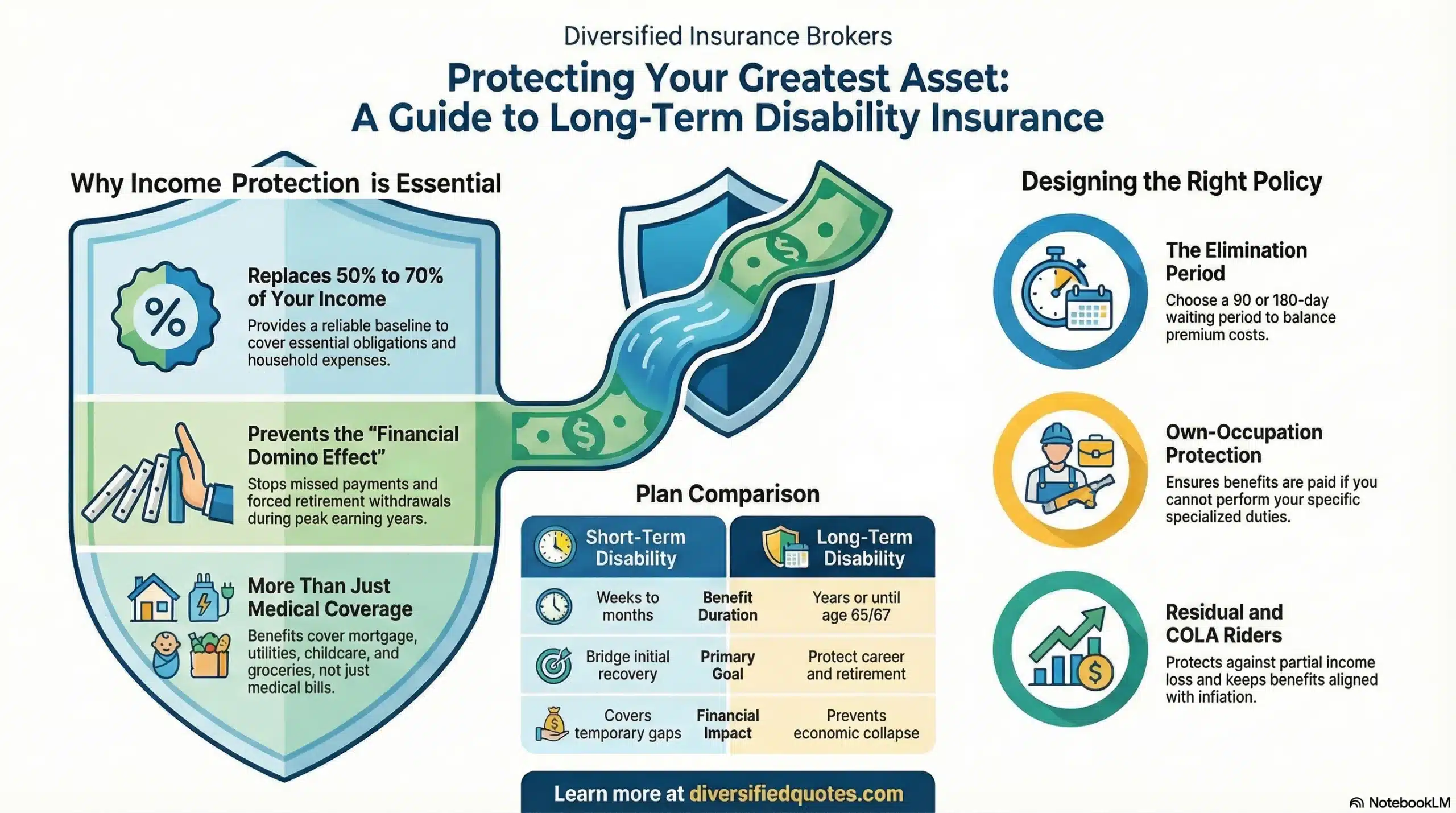
The elimination period — the waiting time before benefits begin — should be calibrated to the domestic worker’s actual financial reserves. Many domestic servants have limited savings and no employer sick pay to draw on during a disability’s early weeks. For workers in this situation, a 30 or 60-day elimination period provides faster benefit access at a higher premium cost — a worthwhile trade-off when the alternative is depleting limited savings during the early months of a recovery. Workers with stronger financial cushions may choose a 90-day elimination period to reduce premiums.
A residual disability rider is particularly valuable for domestic servants whose recovery from physical injuries often involves a gradual return to full household duties. A housekeeper returning to limited cleaning activities at reduced hours, or a caregiver returning to partial shifts during recovery, earns below normal income without being totally unable to work. Residual disability coverage supplements that reduced income proportionally, ensuring the policy provides financial support throughout the entire recovery rather than only during the most acute phase. For domestic servants concerned about how disability insurance fits into their broader financial planning, our resource on whether disability insurance is worth the cost addresses this question directly.
Live-In Domestic Servants and the Housing Dependency Risk
Disability insurance for domestic servants who live in the homes of their employers carries an additional dimension of financial vulnerability that deserves specific attention. Live-in housekeepers, nannies, estate managers, and caregivers often receive housing as part of their total compensation — a benefit that is financially meaningful but that immediately disappears if the employment relationship ends due to disability.
When a live-in domestic servant becomes disabled and can no longer perform their household duties, the employer may reasonably need to find a replacement. This creates a situation where the disabling injury or illness simultaneously ends both the income and the housing arrangement, producing a compound financial emergency that most disabled workers in other employment situations do not face. Individual disability insurance provides income replacement regardless of what happens to the employment relationship — ensuring that a live-in domestic servant who loses both income and housing due to disability has the financial resources to secure alternative housing and sustain living expenses during recovery.
The housing dependency risk is unique to live-in domestic employment and is rarely addressed in standard disability planning discussions. At Diversified Insurance Brokers, we specifically consider this vulnerability when structuring disability insurance for domestic servants who live in employer-provided housing, ensuring that benefit amounts and elimination periods reflect the true financial exposure of this employment arrangement. This type of nuanced financial planning mirrors the approach required for other professionals with non-standard compensation structures, such as bed and breakfast owners whose housing and income are intertwined.
Disability Insurance for Nannies and In-Home Caregivers
Within the broad category of domestic service, nannies and in-home caregivers warrant specific attention because their occupational risk profile is particularly significant and their access to income protection is particularly limited. Nannies perform physical childcare work — lifting infants and toddlers, managing active children, bending, squatting, and sustaining the physical demands of childcare across full work days — that creates meaningful musculoskeletal exposure over years of service.
In-home caregivers working with elderly or disabled household members face an even more physically demanding occupational profile. Patient transfers, repositioning, assisting with mobility, and performing personal care tasks require physical capacities that closely mirror those of formal healthcare workers — yet caregivers in private household settings typically have none of the formal occupational health protections that hospital and nursing home employees receive. Back injuries, shoulder injuries, and repetitive strain conditions are documented outcomes of in-home caregiving work that can permanently end a domestic service career.
For nannies and caregivers who are also managing their own financial independence — often without a partner’s income as a safety net — disability insurance is the one tool that ensures a disabling injury or illness does not produce both a health crisis and a financial crisis simultaneously. The stakes of being uninsured are particularly high for sole-income households, a reality that resonates equally with other single-income service professionals such as cleaning and dry cleaning professionals whose income depends entirely on physical capability.
How Disability Insurance Underwriting Works for Domestic Servants
Carriers evaluate domestic service occupations within physical labor occupational class tiers — classifications that reflect the genuine physical demands and injury exposure of household work compared to desk-based professional roles. This classification affects the maximum monthly benefit available, the definition of disability that can be offered, and the policy features accessible to domestic service applicants. Most domestic workers fall within the lower occupational class tiers, which means some premium loading and potential restrictions on benefit amounts compared to professional class applicants.
However, disability insurance for domestic servants is obtainable — and for workers whose only income protection is the individual market, obtainable coverage is infinitely better than no coverage at all. Working with an independent broker who understands how to present a domestic worker’s application accurately, who knows which carriers are most receptive to household employment occupational classes, and who can navigate the income documentation requirements of informal employment arrangements is the essential resource for domestic servants entering the individual disability insurance market. Our page on why an independent disability insurance broker matters explains this value in full detail.
Integrating Disability Insurance Into a Domestic Servant’s Financial Plan
For domestic service professionals, income is the singular financial resource from which all other goals flow. Monthly expenses, retirement savings, family support obligations, and emergency fund contributions all depend on that income continuing without interruption. Disability insurance for domestic servants is the foundational layer that ensures a single health event does not permanently derail the financial life that years of household service employment have built.
Once disability coverage is in place, domestic servants can begin building additional layers of financial resilience. Understanding how tools such as affordable burial insurance for long-term security and supplemental coverage products fit alongside disability insurance creates a more complete financial protection picture for workers whose employer never provides these benefits directly. For domestic servants approaching the later stages of their careers, exploring how guaranteed retirement income products can complement limited Social Security benefits is also a meaningful financial planning priority.
The combination of individual disability insurance, proper income documentation, and a thoughtful approach to the unique financial vulnerabilities of private household employment creates the most resilient financial position available to domestic service professionals. Disability insurance for domestic servants is not a luxury — it is the financial foundation that makes every other financial goal achievable, even when illness or injury intervenes.
Final Thoughts on Disability Insurance for Domestic Servants
Domestic servants and private household professionals provide skilled, essential services to the families and estates that employ them. The physical demands of their work are real, the occupational risks are documented, and the financial consequences of a disabling injury or illness are immediate and severe — particularly in the absence of any employer-sponsored income protection.
Disability insurance for domestic servants is the tool that fills the protection gap that private household employment consistently leaves open. A well-structured policy — built around the actual income, the specific occupational risks, the employment arrangement, and the individual financial situation of each domestic service worker — provides the income replacement that allows recovery to happen from a position of financial stability rather than financial crisis. At Diversified Insurance Brokers, we are committed to helping domestic service professionals secure the income protection they deserve and that their employment arrangement rarely provides.
Related Pages
Talk With an Advisor Today
Choose how you’d like to connect—call or message us, then book a time that works for you.
Schedule here:
calendly.com/jason-dibcompanies/diversified-quotes
Licensed in all 50 states • Fiduciary, family-owned since 1980
Disability Insurance for Domestic Servants FAQs
Yes, domestic servants and private household workers can obtain individual disability insurance, though the process requires attention to occupational classification and income documentation that differs from standard professional applications. Housekeepers, nannies, private chefs, caregivers, butlers, chauffeurs, and estate managers are all insurable occupational categories, though they are typically classified in physical labor tiers that affect premium costs and maximum benefit amounts. The most important factor in securing the best available coverage for a domestic servant is working with an independent broker who understands the specific underwriting considerations of private household employment — including how to document non-traditional income arrangements and how to identify carriers that write household occupational classifications at competitive terms.
Social Security Disability Insurance is the primary government disability program available to domestic workers who have paid Social Security taxes over sufficient work history. However, SSDI has significant limitations as a practical income protection tool for domestic servants. Qualifying requires demonstrating an inability to perform any substantial gainful activity — not just the inability to continue in domestic service — which is a very high bar that many disabled workers cannot meet. The SSDI application and approval process typically takes many months to over a year, during which time no income replacement is provided. SSDI benefit amounts are modest and rarely approach the income level a working domestic servant was earning. Individual disability insurance fills all of these gaps — providing faster benefit access, higher benefit amounts, and coverage that responds to an inability to perform domestic service duties specifically rather than requiring complete incapacity for all work.
Musculoskeletal injuries are the most prevalent occupational health concern for domestic workers, stemming from the repetitive physical demands of cleaning, lifting, carrying, bending, and reaching performed across extended shifts. Back injuries, shoulder conditions, and repetitive strain injuries of the hands and wrists are all documented outcomes of domestic service work. Chemical exposure from cleaning agents creates respiratory and skin conditions that can develop over a career of regular use. Slip and fall accidents on wet floors, polished surfaces, and staircases in private residences produce acute injury risk. For nannies and in-home caregivers, the physical demands of childcare and patient assistance — including lifting, transfers, and sustained physical caregiving — create additional musculoskeletal exposure. Burns and kitchen injuries affect private chefs and domestic workers who cook as part of their role. Infectious disease exposure from close-contact work with children or health-compromised household members rounds out the primary risk profile.
Income documentation for disability insurance underwriting depends on how the domestic employment arrangement is structured. Workers employed as formal household employees — with proper payroll documentation, W-2 issuance, and Social Security and Medicare withholding — can document income through standard tax return channels, making the underwriting process straightforward. Domestic workers paid as independent contractors can document income through Schedule C filings on federal tax returns. Workers who have historically been paid informally or on a cash basis face the greatest documentation challenge and may need to support their application with bank statements showing regular income deposits, employer letters confirming compensation arrangements, or other supporting evidence of consistent earnings. An experienced independent broker understands how to present non-traditional income documentation to underwriters effectively, maximizing the insurable benefit amount available regardless of the payment arrangement. Learn more on our page about why working with an independent disability broker matters.
This is one of the most financially significant and least discussed risks facing live-in domestic servants. When a live-in housekeeper, nanny, estate manager, or caregiver becomes disabled and can no longer perform their household duties, the employer may reasonably need to hire a replacement — which typically means the live-in arrangement ends simultaneously with the employment income. A domestic servant who becomes disabled may therefore lose both their paycheck and their housing in the same event, creating a compound financial emergency that most workers in other employment situations never face. Individual disability insurance provides income replacement that is completely independent of the employment relationship — ensuring that a live-in domestic servant who loses both income and housing has the financial resources to secure alternative housing and sustain living expenses throughout the recovery period, regardless of what happens to the household employment arrangement itself.
Some carriers do allow non-cash compensation components — including live-in housing, meals, and transportation benefits that represent genuine economic value to the domestic worker — to be factored into the insurable income calculation, though the treatment varies between carriers and requires specific documentation. For domestic servants whose total compensation package includes meaningful non-cash benefits, working with an independent broker who knows how to represent and document these components to underwriters can meaningfully increase the insurable benefit amount available. This is an area where broker expertise directly translates into a higher monthly benefit — the difference between a policy sized to cash wages only and one that reflects total compensation can be substantial for live-in domestic servants whose housing benefit alone may represent the equivalent of several hundred dollars per month in economic value.
Domestic servants who have no employer sick pay, no union benefits, and limited financial reserves should carefully consider a shorter elimination period than the standard 90-day option commonly used by workers with greater financial cushions. A 30 or 60-day elimination period means benefits begin sooner — reducing the period during which the domestic worker must sustain living expenses entirely from savings or other sources before disability benefits begin. The trade-off is a higher monthly premium, which must be weighed against the financial reality of how long the worker could realistically sustain expenses without income. For domestic servants in live-in arrangements where housing is tied to employment, the financial urgency of a disability event may be particularly acute, making a shorter elimination period an especially important consideration even at a higher premium cost.
Individual disability insurance typically costs between 1% and 3% of annual income in premiums, depending on age, health, occupational class, benefit amount, and policy features selected. For a domestic servant earning $40,000 per year, this range translates to roughly $400 to $1,200 annually — approximately $33 to $100 per month. The actual cost depends on the specific policy structure, and working with an independent broker who can compare options across multiple carriers is the most effective way to find the most competitive premium for a given benefit amount. For domestic servants weighing the cost, the calculation is straightforward: a monthly premium of $50 to $80 is a small fraction of the $2,000 to $3,000 monthly income that a disability policy could replace during an extended recovery. The cost of being uninsured — bearing the full financial impact of a disabling condition without income replacement — is orders of magnitude larger than any premium.
Residual disability coverage pays proportional benefits when a disabling condition reduces earning capacity without eliminating the ability to work entirely. For domestic servants recovering from physical injuries, return to full household duties often happens gradually — beginning with lighter tasks or reduced hours before returning to the full scope of service responsibilities. During this transition, income is reduced but not eliminated. Without a residual disability rider, a policy that only pays for total disability provides nothing during the partial recovery period. A residual disability rider ensures the policy supplements reduced earnings proportionally throughout the entire return-to-work phase, not just during the most acute period of complete inability to work. For domestic workers whose recovery from musculoskeletal injuries typically involves weeks or months of restricted activity, this rider provides essential financial continuity.
The best time to apply for disability insurance is early in a domestic service career, before occupational health conditions have accumulated in the medical record. A housekeeper or nanny who applies while young and in excellent health — before documented back conditions, shoulder injuries, chemical exposure history, or other work-related health findings have appeared — secures the most comprehensive coverage at the most favorable rates. As a career in domestic service progresses, the physical demands of the work accumulate in the body and in the medical record. Health conditions that develop over years of domestic service can result in exclusion riders, premium increases, or more restricted policy definitions at the time of application. Applying early, before these conditions develop, is the single most important timing decision a domestic servant can make regarding their disability insurance coverage.
Diversified Insurance Brokers is an independent brokerage with access to multiple carriers across the full occupational class spectrum, including carriers that write physical labor and private household employment classifications at competitive terms. We are not tied to any single carrier, which means our recommendations reflect what is genuinely best for each domestic servant’s specific situation — not what a single company happens to offer. We have experience navigating the income documentation challenges unique to private household employment, understanding how to present informal or non-traditional compensation arrangements to underwriters effectively. We also evaluate the specific occupational risks of each domestic service role — housekeeper, nanny, caregiver, private chef, chauffeur — to ensure the policy features selected are appropriate for the actual work being performed. For domestic servants, having a broker who understands the nuances of private household employment is the difference between a policy that works and one that falls short precisely when it is needed most.
About the Author:
Jason Stolz, CLTC, CRPC, DIA, CAA and Chief Underwriter at Diversified Insurance Brokers (NPN 20471358), is a senior insurance and retirement professional with more than 25 years of real-world experience helping individuals, families, and business owners protect their income, assets, and long-term financial stability. As a long-time partner of the nationally licensed independent agency Diversified Insurance Brokers, Jason provides trusted guidance across multiple specialties—including fixed and indexed annuities, long-term care planning, personal and business disability insurance, life insurance solutions, Group Health, Travel Medical and Evacuation Insurance, and short-term health coverage. Diversified Insurance Brokers maintains active contracts with over 100 highly rated insurance carriers, ensuring clients have access to a broad and competitive marketplace.
His practical, education-first approach has earned recognition in publications such as VoyageATL, and contributions from his agency featured in Kiplinger and GoBankingRates— highlighting his commitment to financial clarity and client-focused planning. Drawing on deep product knowledge and years of hands-on field experience, Jason helps clients evaluate carriers, compare strategies, and build retirement and protection plans that are both secure and cost-efficient. Visitors who want to explore current annuity rates and compare options across multiple insurers can also use this annuity quote and comparison tool.
Explore More Disability Insurance Options: Browse our complete guide to Disability Insurance for Food, Hospitality, Arts & Entertainment — covering chefs, musicians, actors, bartenders, hospitality workers & entertainment professionals from 100+ carriers.
Last Reviewed: June 7, 2026 |
Reviewed by: Jason Stolz, CLTC, CRPC, DIA, CAA
Chief Underwriter, Diversified Insurance Brokers, Inc. | NPN: 20471358 | Diversified Insurance Brokers, Inc. — Licensed in all 50 states
Fact Checked by: Tonia Pettitt, CMIP©
Medicare Specialist, Diversified Insurance Brokers, Inc. | NPN: 14374308 | Diversified Insurance Brokers, Inc. — Licensed in all 50 states
Did you find this content helpful? Leave us a Google review — it helps others find trustworthy guidance too.
Editorial Standards: Diversified Insurance Brokers maintains rigorous editorial standards to ensure accuracy, clarity, and independence in all content. Learn more about our editorial standards and commitment to transparency.
