
Disability Insurance for Chauffeurs
As an Independent Disability Insurance Broker, we have access to exclusive discounts and negotiated pricing most captive agents can’t offer — see the full breakdown near the end of this page.
Disability Insurance for Chauffeurs

Jason Stolz CLTC, CRPC, DIA, CAA
Disability insurance for chauffeurs is income protection for professional drivers whose livelihoods depend on a specific combination of physical capability and licensure that most disability discussions overlook: a chauffeur who cannot safely operate a vehicle has lost their profession entirely, regardless of whether other forms of work might be possible. Professional chauffeurs — who transport corporate executives, private clients, wedding parties, event guests, and luxury service passengers — earn their income through driving skill, professional presentation, and client relationship continuity. An injury, vision impairment, cardiac condition, neurological event, or any medical condition that results in license revocation or medical disqualification from driving eliminates the income as completely as any physical disability. At Diversified Insurance Brokers, we help professional chauffeurs, private drivers, and luxury transport professionals structure disability coverage that reflects the license-dependent, driving-ability-dependent nature of the income. The income protection insurance and disability insurance by occupation frameworks cover how carriers evaluate professional driving occupations in their occupational classification and underwriting process.
The physical demands of professional chauffeuring are more significant than they appear from outside the profession. High-mileage professional driving — often 8-12 hours per day — creates sustained static posture loading on the lumbar spine, cervical spine, and hip flexors. Back and neck conditions from this sustained sedentary driving load are the most commonly documented chronic disabilities in professional driver occupations, and they develop gradually in ways that workers’ compensation — which covers work-related acute injuries but does not address the cumulative, chronic progression of spinal degeneration — does not protect against. Vision conditions that affect reaction time, depth perception, or night vision create both safety concerns and direct licensure risk. Cardiovascular conditions — heart disease, uncontrolled hypertension, arrhythmias — can trigger Department of Transportation or state medical examiner disqualification that ends the career even when the condition itself might not prevent desk work. Own-occupation disability insurance that reflects the professional driving and client service functions of chauffeuring provides the protection that a generic “sedentary work” characterization would not: a chauffeur who cannot safely drive is disabled from their occupation even if they could sit at a desk elsewhere. The professional driver disability planning parallels are at disability insurance for taxi and rideshare drivers, disability insurance for bus drivers, and disability insurance for ambulance drivers.
Compare Disability Insurance for Chauffeurs
We compare options across multiple carriers and structure coverage around the license-dependent income, driving ability requirements, and self-employed or 1099 income patterns of professional chauffeurs.
Disability Insurance for Chauffeurs — Risk Profile, Coverage Gaps, and Policy Design
| Disability Risk Category | How It Affects the Chauffeur | Coverage Consideration |
|---|---|---|
| Back and neck conditions | Sustained static posture loading from high-mileage daily driving creates chronic lumbar and cervical spine degeneration; herniated discs, sciatica, and cervical radiculopathy are the most common chronic disability-producing conditions in professional driver careers; the gradual onset of these conditions means workers’ comp’s occupational injury framework doesn’t apply — illness-based coverage is needed | Individual disability insurance covering disability from any cause including cumulative musculoskeletal conditions; own-occupation definition covering the sustained driving demands; residual rider for partial capacity loss when driving hours must be reduced |
| Vision impairment | Vision requirements for commercial driver licensing mean that correctable or progressive vision conditions affecting depth perception, peripheral vision, or night vision can directly threaten licensure; a chauffeur whose vision deteriorates below licensure standards has lost their ability to earn income as a professional driver regardless of the condition’s overall severity | Own-occupation coverage that reflects the specific vision requirements of professional driving; disability from vision conditions that prevent safe operation of the vehicle and result in license medical disqualification is a covered cause under any-cause individual disability policies |
| Cardiovascular and neurological events | Cardiac conditions (heart disease, uncontrolled hypertension, arrhythmias) and neurological events (stroke, seizures, TIA) create both safety concerns and direct medical disqualification from driving; a single cardiac event or stroke can end a chauffeur’s ability to maintain licensure even when recovery is substantial; the cardiovascular demands of professional driving in heavy traffic under time pressure create real stress-related health risk | Illness-based own-occupation coverage for cardiac and neurological conditions; any-cause disability policy covers these events fully; the license-loss consequence of these medical events makes own-occupation definition especially important — the disability is real even when the condition might not prevent sedentary desk work |
| Vehicle accident injury | Professional chauffeurs drive high mileage daily, often in heavy urban traffic under time pressure and with passenger safety responsibility; motor vehicle accident risk is directly proportional to annual mileage, and professional drivers accumulate vehicle exposure far above average levels | Individual disability insurance covers disability from vehicle accidents regardless of whether work-related; workers’ comp covers work-time vehicle accidents for employees but not off-duty incidents; individual coverage provides complete protection for the full vehicle mileage exposure of a chauffeur’s work and personal life |
| Self-employed and 1099 contractor status | Many chauffeurs operate as independent owner-operators, work through livery service platforms as 1099 contractors, or operate their own transportation businesses; these employment structures typically provide no employer group LTD, no workers’ comp baseline, and no paid sick leave — individual disability insurance is the only available income protection | Individual disability insurance as the complete income protection plan; benefit sized to documented net Schedule C or 1099 income; owner-operator status at some carriers qualifies for more favorable occupational classification than employee drivers |
The License Dependency Problem — Why Own-Occupation Language Matters
The single most important disability planning issue for professional chauffeurs is the license dependency of their income. A chauffeur whose medical condition results in suspension or revocation of their driving license has effectively lost their profession — the income-producing capability that their career represents is gone — regardless of whether other employment is physically possible. Under any-occupation disability language, a chauffeur who cannot drive but could work in a different field is not disabled in the policy’s view, and benefits would be denied. Under own-occupation coverage that defines disability as inability to perform the material duties of professional chauffeuring — including the safe operation of a motor vehicle and meeting all applicable licensure medical standards — the same license-disqualifying medical event is properly recognized as a career-ending disability. This distinction matters practically for the specific conditions most likely to threaten a chauffeur’s career: vision conditions that fall below commercial licensing standards, cardiac events that trigger medical disqualification, and neurological conditions including stroke or seizure disorders that trigger mandatory reporting and disqualification requirements. The professional driver community’s license-dependency disability planning parallels are addressed at disability insurance for dispatchers who manage the same transportation operations, and the general own-occupation definitional framework is at the own-occupation disability insurance resource. The transport and security professional planning context for government-employed professional drivers is at disability insurance for airline security personnel and disability insurance for heavy equipment operators who share the same equipment-operation license dependency structure.
Policy Design for Professional Chauffeurs
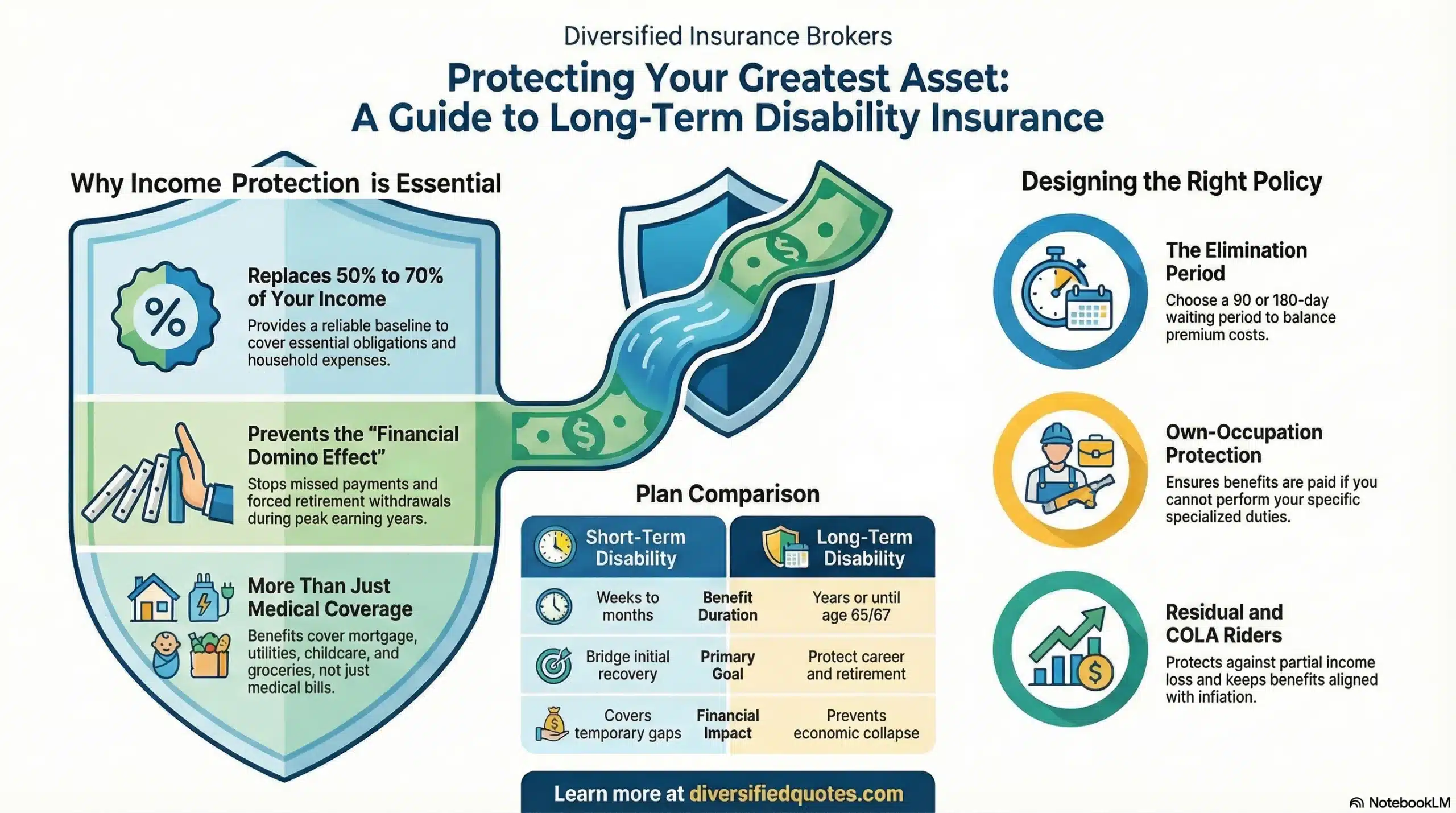
The benefit period should extend to retirement age — long-term disability insurance to age 65 protects a career-long income stream that depends on sustained physical and medical fitness. The elimination period should reflect available savings; chauffeurs without significant reserves should evaluate 30-60 day elimination periods to minimize the period of unprotected income exposure. The residual disability rider captures partial income loss when a medical condition reduces driving hours or client access without fully preventing all work. Short-term disability options bridge the initial period following an acute injury or illness before long-term coverage activates. Income documentation for self-employed and 1099 chauffeurs uses Schedule C and 1099 returns averaged across two to three years; the disability insurance for self-employed and disability insurance for 1099 workers resources cover this documentation approach in detail. The full rider framework is at disability insurance riders explained. Tax treatment is at are disability insurance payments taxable. Benefit sizing for variable chauffeur income is at how much disability insurance do I need. No-exam options at lower benefit levels are at no-exam disability insurance. For an independent evaluation of any existing or proposed coverage, get a 2nd opinion on your disability insurance quote covers the review process. The value of working with an independent broker who can compare carrier programs for professional driving occupations is at why work with an independent disability insurance broker. The disability insurance for independent contractors context covers the employment structure issue for contract-based chauffeur arrangements. For chauffeurs with high-risk occupational classification concerns, the disability insurance for high-risk occupations framework covers how lower occupational classes affect premium and benefit maximum structures.
Talk With an Advisor Today
Choose how you’d like to connect—call or message us, then book a time that works for you.
Schedule here:
calendly.com/jason-dibcompanies/diversified-quotes
Licensed in all 50 states • Fiduciary, family-owned since 1980
FAQs: Disability Insurance for Chauffeurs
What is the biggest disability risk for professional chauffeurs?
Back and neck conditions from sustained sedentary driving are the most commonly documented chronic disability risk in professional driver careers. High-mileage daily driving creates sustained static posture loading on the lumbar and cervical spine that accumulates over years of professional driving into clinically significant disc disease, radiculopathy, and chronic pain conditions. Vision conditions and cardiovascular events that trigger medical disqualification from licensure represent the profession-specific risk that makes own-occupation disability coverage especially important — because losing the ability to maintain a valid driver’s license ends the chauffeur’s income even when the medical condition might not prevent other forms of work.
If I lose my driving license due to a medical condition, does disability insurance pay?
It depends entirely on how disability is defined in the policy. An own-occupation policy that defines disability as inability to perform the material duties of professional chauffeuring — including the requirement to safely operate a vehicle and maintain licensure — would cover a medical condition that results in driving disqualification. An any-occupation policy would likely deny benefits for the same event, because the person can still perform other types of work even though their specific profession requires a valid driving license. This is why own-occupation language specific to the professional driving function is critically important for chauffeurs, rather than a generic disability definition based on ability to perform sedentary or light-duty work.
What occupational class do chauffeurs receive for disability insurance?
Chauffeurs typically receive a middle-to-lower occupational class reflecting the vehicle accident risk component of professional driving combined with the sedentary physical posture of the work. The vehicle accident risk prevents the top-tier class available to pure desk professionals, but the absence of heavy physical labor, construction-site exposure, or extreme heights separates professional chauffeurs from the lowest occupational class categories. Some carriers offer an “owner upgrade” or more favorable classification to independent owner-operators compared to employee chauffeurs working for a livery company, reflecting the entrepreneurial and managerial component of running a driving business.
How do self-employed chauffeurs document income for disability insurance?
Self-employed and 1099 chauffeurs document disability insurance income through Schedule C tax returns or 1099 forms reflecting active earned income from the driving business, averaged across two to three years to establish a consistent baseline. Net Schedule C income after legitimate business expense deductions is the figure carriers use for benefit sizing for sole proprietors. Chauffeurs with variable income from different client accounts and event bookings benefit from multi-year averaging that smooths seasonal or event-driven income fluctuations. Income from tips should be documented through tax returns if the chauffeur properly reports it as income, as unreported income cannot be used in benefit calculation.
Does workers’ compensation cover employed chauffeurs for all disability causes?
No — workers’ comp covers work-related injuries and occupational diseases only, paying approximately two-thirds of wages for qualifying claims. The large majority of disabling conditions affecting chauffeurs are not occupational in origin: back degeneration from cumulative driving exposure that progresses gradually over a career, cardiac disease from chronic stress and sedentary lifestyle, vision conditions, and general illness all represent disability causes that workers’ comp does not address. Individual disability insurance fills this gap for the full range of illness-based and non-occupational disability causes that represent the most statistically likely disability scenarios throughout a chauffeur’s career.
About the Author:
Jason Stolz, CLTC, CRPC, DIA, CAA and Chief Underwriter at Diversified Insurance Brokers (NPN 20471358), is a senior insurance and retirement professional with more than 25 years of real-world experience helping individuals, families, and business owners protect their income, assets, and long-term financial stability. As a long-time partner of the nationally licensed independent agency Diversified Insurance Brokers, Jason provides trusted guidance across multiple specialties—including fixed and indexed annuities, long-term care planning, personal and business disability insurance, life insurance solutions, Group Health, Travel Medical and Evacuation Insurance, and short-term health coverage. Diversified Insurance Brokers maintains active contracts with over 100 highly rated insurance carriers, ensuring clients have access to a broad and competitive marketplace.
His practical, education-first approach has earned recognition in publications such as VoyageATL, and contributions from his agency featured in Kiplinger and GoBankingRates— highlighting his commitment to financial clarity and client-focused planning. Drawing on deep product knowledge and years of hands-on field experience, Jason helps clients evaluate carriers, compare strategies, and build retirement and protection plans that are both secure and cost-efficient. Visitors who want to explore current annuity rates and compare options across multiple insurers can also use this annuity quote and comparison tool.
Explore More Disability Insurance Options: Browse our complete guide to Disability Insurance for Transportation, Maritime & Hazardous Occupations — covering truck drivers, flight attendants, merchant marines, divers, chauffeurs & drivers from 100+ carriers.
Last Reviewed: June 6, 2026 |
Reviewed by: Jason Stolz, CLTC, CRPC, DIA, CAA
Chief Underwriter, Diversified Insurance Brokers, Inc. | NPN: 20471358 | Diversified Insurance Brokers, Inc. — Licensed in all 50 states
Fact Checked by: Tonia Pettitt, CMIP©
Medicare Specialist, Diversified Insurance Brokers, Inc. | NPN: 14374308 | Diversified Insurance Brokers, Inc. — Licensed in all 50 states
Did you find this content helpful? Leave us a Google review — it helps others find trustworthy guidance too.
Editorial Standards: Diversified Insurance Brokers maintains rigorous editorial standards to ensure accuracy, clarity, and independence in all content. Learn more about our editorial standards and commitment to transparency.
