
Disability Insurance for Bus Drivers
As an Independent Disability Insurance Broker, we have access to exclusive discounts and negotiated pricing most captive agents can’t offer — see the full breakdown near the end of this page.
Disability Insurance for Bus Drivers

Jason Stolz CLTC, CRPC, DIA, CAA
Bus drivers carry a disability risk profile that is both broader and more consequential than most people outside the profession recognize. The physical demands of sustained commercial vehicle operation — whole-body vibration transmitted through the seat and floor over thousands of hours behind the wheel, prolonged sitting in fixed postures that load the lumbar spine and cervical structures, repeated shoulder and neck rotation checking mirrors and blind spots, and the constant low-grade musculoskeletal stress of urban stop-and-go driving — accumulate across a career into the spinal and joint conditions that are among the most common causes of occupational disability in transportation workers. Layered on top of those physical pathways is a structural vulnerability that most bus drivers underestimate: when a health event removes the ability to pass a Department of Transportation physical examination and maintain a valid Commercial Driver’s License, the career stops — not just the shift. For bus drivers, disability insurance is the income protection structure that addresses what happens when the health required to hold the CDL is no longer present.
At Diversified Insurance Brokers, Jason Stolz, CLTC, CRPC, DIA, CAA works with bus drivers across all sectors — school bus operators, transit and municipal bus drivers, charter and motorcoach operators, and private shuttle and employee transportation drivers — to build income protection structures that match the realities of how transportation income works, how group coverage through an employer typically falls short, and what individual policy design decisions determine whether a disability insurance policy performs when a disabling event occurs. Bureau of Labor Statistics data places median annual wages for school bus drivers at approximately $47,040 and transit bus drivers at comparable levels, with senior drivers and union-covered transit operators earning significantly more — income that represents a household’s financial foundation and that carries no automatic protection against the career-ending health events the trade faces.
Compare Disability Insurance for Bus Drivers
We review coverage options across 100+ carriers and identify the policy structure that fits your driving income, CDL dependency, and occupational risk profile.
Request Disability Insurance OptionsBus Driver Disability Risk — Occupational Hazards, CDL Vulnerability, and the Income Protection Gap
| Hazard / Risk Category | Primary Source | Resulting Disability Risk | Workers’ Comp Coverage | DI Coverage Gap |
|---|---|---|---|---|
| Whole-body vibration (WBV) | Vibration transmitted from road surface through vehicle chassis and seat during extended daily driving | Chronic lower back syndrome, herniated disc, vertebral microtrauma, spinal degeneration accelerated beyond age-expected rate | Acute work incidents covered; cumulative WBV-related spinal conditions frequently disputed or categorized as degenerative rather than occupational | Significant gap for chronic back conditions; illness-based spinal degeneration fully outside workers’ comp |
| CDL medical disqualification | Any health condition — cardiac, neurological, vision, hearing, metabolic — that fails DOT FMCSA physical examination standards | Loss of Medical Examiner’s Certificate, CDL suspension, inability to legally operate commercial passenger vehicles | Not covered — CDL disqualification from health conditions is not a workplace injury or occupational disease | Complete gap; DI provides income replacement when health eliminates CDL eligibility |
| Prolonged static posture / ergonomic loading | Fixed seated posture for full shifts; repeated cervical rotation for mirror checks; shoulder and arm loading during steering | Cervical disc disease, rotator cuff injury, chronic neck syndrome, thoracic outlet syndrome | Acute incidents covered; chronic cumulative conditions disputed as occupational versus degenerative | Significant gap for gradual-onset cervical and shoulder conditions; illness-based degeneration not covered |
| Assault and passenger violence | Physical attack, thrown objects, verbal threats escalating to physical confrontation — documented across transit systems | Head trauma, facial injury, PTSD, anxiety disorders affecting return to driving; cognitive and psychological disability | Work-related assault covered for employees; mental/nervous benefit caps at 24 months under most group plans | Gap for PTSD and psychological disability beyond 24-month group plan limit; individual DI provides unlimited period options |
| Diesel exhaust and air quality exposure | Daily inhalation exposure at depots, loading areas, and in-cabin environments; EPA-documented diesel exhaust constituents | Occupational asthma, chronic respiratory irritation, long-term pulmonary conditions | Occupational disease provisions apply for documented exposure; illness-based respiratory outcomes limited | Gap when resulting illness is chronic or produces CDL-disqualifying health condition |
| Illness-based disability (non-occupational) | Cardiac events, cancer, neurological conditions, diabetes — any serious health event that independently disqualifies CDL or prevents driving | Extended inability to drive; CDL medical card failure; career-ending health event | Not covered — workers’ compensation applies only to work-related injury and occupational disease | Approximately 90% of long-term disabilities are illness-based; complete gap for all workers |
The table establishes a disability exposure picture for bus drivers that goes well beyond the roadway accidents most people associate with driving careers. The CDL disqualification row captures the most distinctly transportation-specific disability pathway: the event that ends a bus driver’s career is frequently not a crash or workplace injury but a health condition — a cardiac event, an uncontrolled blood pressure reading, a neurological diagnosis, a vision change — that fails the Department of Transportation physical examination and results in loss of the Medical Examiner’s Certificate required to maintain a Commercial Driver’s License. Workers’ compensation plays no role in this scenario because it is not a workplace injury. Disability insurance by occupation captures exactly this kind of career-ending health event — the ones that do not involve workplace incidents at all but are just as financially devastating for the driver and their household.
The Physical Demands of Commercial Bus Operation and Their Long-Term Disability Implications
The disability pathways most likely to affect bus drivers develop over time rather than in a single catastrophic event. Whole-body vibration is the most thoroughly documented of these pathways. Research on commercial vehicle operators — including transit bus drivers, school bus drivers, and long-haul transportation professionals — consistently documents that prolonged exposure to vibration transmitted from road surfaces through the vehicle’s chassis and seat structure increases the risk of spinal injury and accelerates degenerative changes in the lumbar vertebrae beyond age-expected rates. Texas Department of Insurance Workers’ Compensation documentation on whole-body vibration specifically identifies chronic back pain and nerve damage as outcomes of long-term vibration exposure, noting that research on drivers and heavy equipment operators indicates that intense long-term exposure increases risk to the spine — with twisted sitting postures and steering forces compounding the vibration effect on the neck, shoulder, and lower back structures. A bus driver who spends six to eight hours per day in a vibrating seat over the course of a career is accumulating a spinal load that manifests as herniated discs, chronic lumbar syndrome, and the cervical disc conditions that become career-ending disabilities — conditions that long-term disability insurance is specifically structured to address.
The ergonomic loading dimension of bus driving is equally significant and receives less attention. Bus drivers perform repeated cervical rotation — turning the head and neck to check mirrors, scan intersections, monitor passenger activity, and verify road conditions — thousands of times per shift. The combination of a fixed seated posture, vibration, and this sustained repetitive cervical and shoulder loading creates a musculoskeletal stress pattern that occupational health researchers associate with cervical disc disease, rotator cuff conditions, and thoracic outlet syndrome in long-service commercial drivers. A driver who develops a cervical disc condition requiring surgical intervention faces both a recovery period during which driving is impossible and the additional concern of whether post-surgical physical limitations will affect future CDL medical certification. Short-term disability insurance addresses the immediate recovery window following surgery or acute injury, while long-term coverage addresses the extended scenarios where full return to commercial driving is delayed or impossible.
The passenger violence dimension of transit bus driving is documented by Bureau of Labor Statistics occupational injury data, which recorded thousands of transit and intercity bus driver days-away-from-work injuries in recent tracking periods. Physical assaults, thrown objects, and passenger confrontations represent a workplace violence risk that is specific to public-facing transportation roles and that produces not only physical injury but PTSD and anxiety disorders that can be as disabling as the physical harm. The psychiatric and psychological disability pathway is particularly important for bus drivers to understand in the context of group plan coverage: most group long-term disability plans cap mental and nervous condition benefits at 24 months, meaning that a PTSD condition arising from a serious assault that produces lasting psychological disability receives limited group plan protection. Individual disability policies can provide unlimited benefit periods for all qualifying causes of disability, including psychological conditions — a meaningful protection gap that the 24-month group cap leaves open.
The CDL Medical Examination — The Disability Trigger Specific to Bus Drivers
The Department of Transportation physical examination requirement, administered under Federal Motor Carrier Safety Administration standards, creates a disability trigger for bus drivers that has no parallel in most other occupations. To operate a commercial passenger vehicle requiring a CDL, a driver must maintain a valid Medical Examiner’s Certificate — typically renewable every 24 months, or more frequently when a health condition is being monitored. Any health condition that fails FMCSA physical examination standards results in loss of the medical card and the legal inability to operate a commercial bus. The health conditions that can produce CDL disqualification include serious cardiac conditions, uncontrolled hypertension, epilepsy and seizure disorders, inner ear diseases producing vertigo, vision impairments below FMCSA thresholds, uncontrolled diabetes, and certain neurological and psychiatric diagnoses.
From a disability insurance planning standpoint, the CDL medical examination creates a disability trigger that is entirely separate from a driver’s physical ability to operate a vehicle. A bus driver who develops a cardiac condition that is well-managed medically but fails the DOT physical examination standard has experienced a career-ending disability event — regardless of whether they subjectively feel capable of driving. Workers’ compensation provides no benefit in this scenario because no workplace incident occurred. SSDI provides a general average benefit of approximately $1,630 to $1,634 per month — far below what a senior transit bus driver earns and far below what the household requires to sustain its financial obligations. Individual disability insurance, structured with the right policy definition and benefit amount, provides the income floor that replaces the bus driver’s earnings during the disability period that follows CDL disqualification. Disability insurance for high-risk occupations addresses the underwriting and policy design considerations that apply when a career depends on maintaining a professional license or certification that a health event can eliminate.
Workers’ Compensation and the Bus Driver — Coverage Limits That Matter
Workers’ compensation covers employed bus drivers for work-related injuries at approximately two-thirds of wages up to state maximums — a meaningful floor for the acute roadway accident, the depot slip-and-fall, or the passenger assault that constitutes a clear workplace incident. For employed transit and school bus drivers with union representation and employer-provided workers’ comp, the acute injury coverage is functional. But three structural gaps remain even for well-covered employed drivers that workers’ comp cannot address.
The first gap is the illness-based disability category that accounts for approximately 90 percent of long-term disabling conditions. A bus driver who is diagnosed with a cardiac condition, cancer, a neurological disorder, or any serious health event unrelated to a specific workplace incident receives no workers’ comp benefit — and critically, if that diagnosis also results in CDL medical disqualification, the driver has lost both the ability to work and the workers’ comp protection for the loss simultaneously. Understanding why bus drivers buy disability insurance is largely an exercise in understanding this gap: the event most likely to end a bus driving career permanently is a health condition, not a workplace accident.
The second gap is the group plan limitation that affects most employed bus drivers who have group long-term disability coverage through their employer or union. Most group LTD plans cap mental and nervous condition benefits at 24 months, transition from own-occupation to any-occupation definitions after 24 months, and cap monthly benefits at levels that may be adequate for an entry-level driver but leave a gap for a senior driver earning at the top of their pay scale. Whether disability insurance is worth it for a bus driver with existing group coverage is a question answered by comparing what the group plan actually pays against what the household actually needs — a comparison that most drivers have never made because they assumed the group plan’s existence meant the gap was covered.
The third gap applies specifically to bus drivers who are not employees — charter operators who run their own equipment as self-employed owner-operators, private shuttle service owners, and independent contractors who have no employer-provided workers’ comp or group plan baseline at all. For these drivers, individual disability insurance is the entire protection system rather than a supplement to existing coverage.
Own-Occupation Coverage and What the Policy Definition Means for Bus Drivers
The disability definition in a policy determines whether a health event that prevents bus driving but does not render the driver completely unable to work generates a benefit payment. For a bus driver, this is not a hypothetical concern — it is the realistic scenario that CDL medical disqualification creates: a driver who cannot legally operate a commercial vehicle due to a health condition but who might theoretically work a sedentary administrative job. Under a true own-occupation disability insurance definition, the policy pays benefits when the insured cannot perform the material and substantial duties of their specific occupation — bus driving — regardless of whether they could work in some other capacity. The policy recognizes that the driver’s income derives from the specific skill and license that the disability has compromised.
Under an any-occupation definition — common in group plans and in policies that do not specifically provide own-occupation language — benefits are paid only when the insured cannot perform any gainful work for which they are reasonably suited. A bus driver who has lost CDL eligibility due to a cardiac condition but is theoretically capable of retail or desk work could face denial under an any-occupation standard despite having permanently lost their primary income source. The transition that most group plans make from own-occupation to any-occupation after 24 months is particularly concerning for bus drivers facing long-term or permanent CDL disqualification, because the benefit standard becomes dramatically more restrictive at exactly the point where the disability has proven to be long-term. Understanding how short-term and long-term disability coverage interact in the context of a CDL-dependent career is essential for building a protection structure that actually works when a disabling event occurs.
Policy Design Decisions That Determine Real-World Protection for Bus Drivers
Beyond the disability definition, several policy design decisions determine whether a bus driver’s disability insurance provides genuine income protection or merely the appearance of it. The elimination period — the waiting period between disability onset and first benefit payment — should be calibrated to the driver’s actual financial reserves. A 90-day elimination period is a common and often cost-effective choice for employed bus drivers with stable household savings, while a shorter 30 or 60-day period provides faster income floor activation for drivers with limited liquidity. How elimination periods affect both coverage and premium cost is a foundational design decision that should be made in the context of real household finances rather than a default selection.
The benefit period — how long the policy pays during a qualifying disability — should extend to age 65 for most active bus drivers. The back conditions, cardiac events, and CDL-disqualifying health diagnoses that most frequently end bus driving careers are not short-term recoverable events — they are conditions that may permanently eliminate the ability to operate commercial vehicles for the remainder of the driver’s working life. A two-year benefit period covers recoverable scenarios but leaves the career-ending disability completely unaddressed. The riders available on individual disability policies add meaningful flexibility — the future insurability option allows benefit increases as a driver’s income grows without requiring new medical underwriting, protecting the ability to maintain adequate coverage as earnings advance. The cost of living adjustment rider preserves the real purchasing power of a benefit across a multi-year or permanent disability, ensuring the income floor does not erode from inflation while a long-term disability claim is active.
Pre-Existing Conditions, DOT Medical History, and Disability Insurance Access
Bus drivers who approach the disability insurance market with documented health conditions — a prior back surgery, a blood pressure history, a treated cardiac condition, a prior CDL medical certification issue — will find that underwriting outcomes vary significantly across carriers. The same history that one carrier declines may receive a partial exclusion rider at another or standard coverage at a carrier that specializes in transportation occupations with complex health profiles.
Disability insurance with pre-existing conditions is available through independent broker channels that compare the full market rather than applying to a single carrier and accepting the result as definitive. No-exam disability insurance products may provide a practical starting point for bus drivers whose health history makes traditional fully underwritten applications uncertain — providing meaningful coverage through simplified underwriting without full paramedical examination, at higher per-benefit cost and lower maximum benefit ceiling than fully underwritten coverage. Working with an independent disability insurance broker who understands how transportation occupation health histories are evaluated across the carrier market produces materially better outcomes than submitting directly to a general-channel carrier whose underwriting guidelines are not specifically designed around CDL-dependent transportation professionals.
Get Your Bus Driver Disability Insurance Review
We compare occupational class assignments, benefit structures, and CDL-specific coverage considerations across 100+ carriers to identify the protection architecture that fits your driving income and career.
Request Disability Insurance Options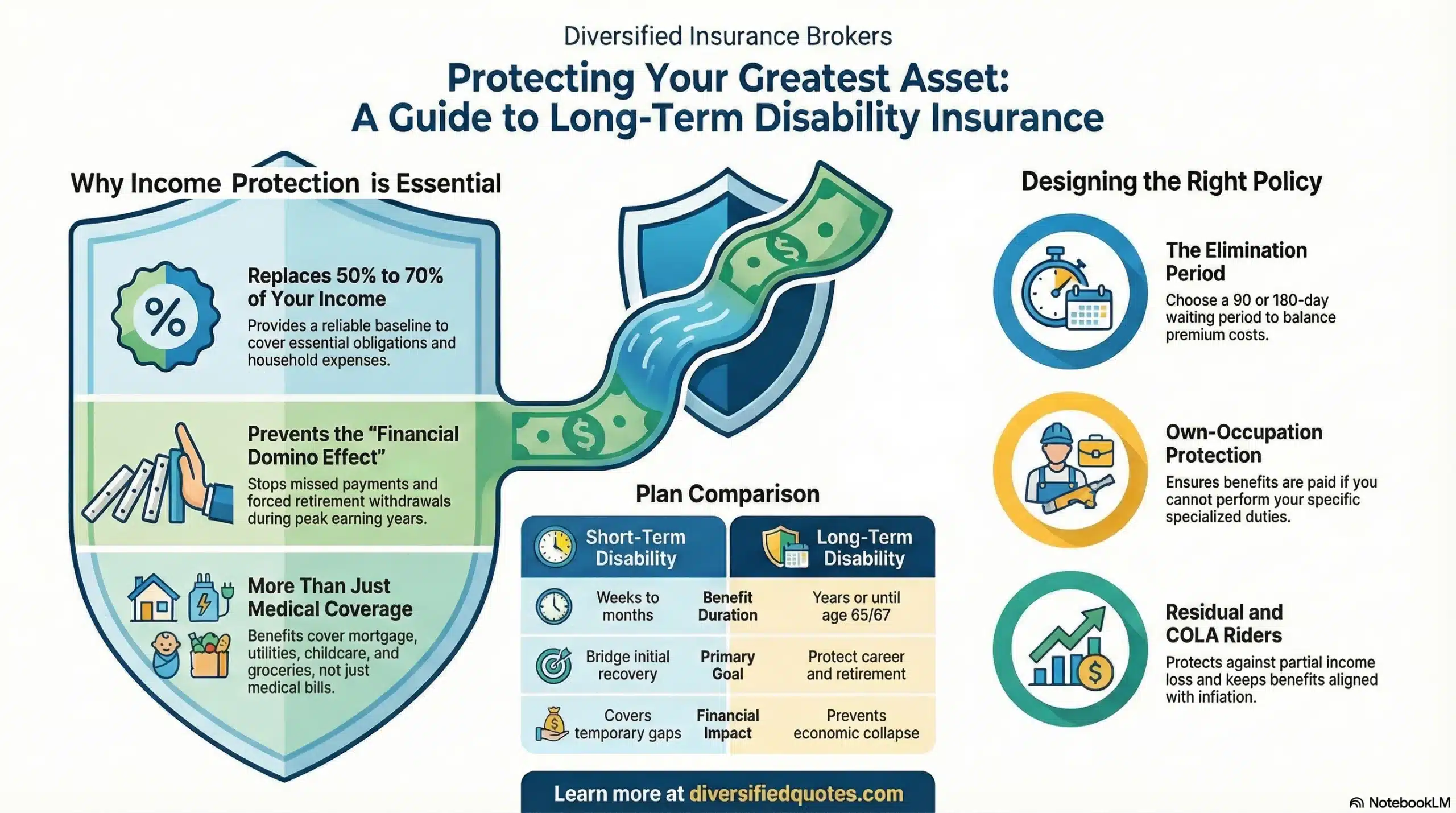
Talk With an Advisor Today
Choose how you’d like to connect—call or message us, then book a time that works for you.
Schedule here:
calendly.com/jason-dibcompanies/diversified-quotes
Licensed in all 50 states • Fiduciary, family-owned since 1980
FAQs: Disability Insurance for Bus Drivers
If I lose my CDL because of a health condition, does disability insurance pay?
Yes — and this is one of the most important income protection scenarios specific to commercial drivers. When a health condition results in failure of the Department of Transportation physical examination and loss of the Medical Examiner’s Certificate required to maintain a CDL, a bus driver has experienced a qualifying disability event under most individual disability insurance policies. The policy does not require that a workplace accident occurred — it requires that the insured is unable to perform the material and substantial duties of their occupation, and a driver who legally cannot operate a commercial passenger vehicle because of a health-driven CDL disqualification meets that definition under an own-occupation policy.
Workers’ compensation provides no benefit in this scenario because CDL medical disqualification from a health condition is not a workplace injury. The CDL loss does not need to be permanent for a disability claim to be active — it needs to persist through the elimination period and continue to prevent the driver from performing their occupational duties. A residual disability benefit may also apply if the driver transitions to reduced-capacity or non-CDL work during recovery, paying a partial benefit proportional to the income loss. Understanding precisely how your specific policy defines disability and what conditions the benefit triggers require is essential before a claim occurs — not after.
Are disability insurance benefits taxable for bus drivers?
The tax treatment of disability insurance benefits for bus drivers depends on how the premiums are paid. For bus drivers who purchase individual disability insurance and pay premiums with after-tax dollars — the standard case for self-employed owner-operators and independent charter drivers — the monthly benefits received during a qualifying disability are generally received income-tax-free. This means the full benefit amount reaches the driver’s household without income tax reduction, making the coverage more financially effective than a gross benefit comparison suggests. Whether disability insurance payments are taxable is a meaningful planning consideration when determining how much monthly benefit is actually needed to replace take-home pay.
For employed bus drivers whose employer or union pays some or all of disability insurance premiums, the tax treatment differs: employer-paid premiums are generally not included in the employee’s taxable income at time of payment, but the resulting disability benefits received during a claim are typically taxable as ordinary income. This effectively reduces the purchasing power of a group plan benefit — a factor that employed drivers should account for when evaluating whether their existing group plan benefit amount is genuinely adequate to cover household expenses during a disability period. In the case where the group plan covers 60 percent of earnings and those benefits are taxable, the effective income replacement is meaningfully lower than 60 percent of pre-disability earnings.
I have a blood pressure condition — can I still get disability insurance as a bus driver?
Yes — hypertension that is medically managed and documented is one of the most common health histories in disability insurance applications from commercial drivers, and it is routinely underwritten with reasonable outcomes when the condition is well-controlled and the medical record demonstrates stable, consistent management. The underwriting evaluation focuses on how well-controlled the blood pressure is, whether there have been any cardiovascular events associated with the hypertension, whether medications are stable and compliant, and how long the condition has been documented and managed. Well-controlled hypertension with no associated events and consistent medication compliance typically does not produce exclusion riders or severe rating at most carriers.
More significant cardiovascular histories — prior cardiac events, left ventricular hypertrophy, or hypertension that is difficult to control — will produce more conservative underwriting outcomes, potentially including table ratings, exclusion riders, or in some cases postponement. The key is that carrier guidelines for hypertension in commercial drivers vary significantly, and the outcome at one carrier is not predictive of the outcome at another. High-risk disability insurance options exist specifically for applicants whose health history places them outside standard underwriting at general-market carriers — an independent broker who understands which carriers are most receptive to specific cardiovascular histories in transportation occupations produces materially better results than applying without that guidance.
I already have group disability coverage through my transit authority — why would I need individual coverage too?
Group disability plans through transit authorities, school districts, and transportation employers typically provide valuable baseline coverage — but they carry structural limitations that leave meaningful gaps for bus drivers in several important scenarios. The most common limitations are: a 24-month cap on mental and nervous condition benefits, which directly affects PTSD and anxiety conditions arising from passenger assaults; a transition from own-occupation to any-occupation disability definition at 24 months, which eliminates CDL-specific protection precisely when a long-term disability has proven itself; monthly benefit caps that may be adequate at entry-level pay but fall short for senior drivers earning at the top of their pay scale; and full portability loss when employment ends, meaning coverage disappears simultaneously with the job loss it is supposed to protect against.
Individual disability insurance supplements group coverage by addressing these gaps — providing own-occupation language that persists beyond 24 months, unlimited mental and nervous benefit periods where selected, portable coverage that follows the driver rather than the employer, and benefit capacity calibrated to the driver’s actual income rather than a plan formula. Bus drivers approaching retirement age who are still active also benefit from individual coverage that extends closer to their actual retirement date, since group plans often have age-based benefit reductions that reduce coverage exactly when spinal and cardiovascular disability risk is highest. The combination of group and individual coverage — with each layer addressed to a different gap — produces the most complete income protection architecture for an employed transit bus driver.
Is disability insurance worth buying for a younger bus driver just starting their career?
Early in a bus driving career is actually the optimal time to purchase disability insurance — not because disability risk is highest for younger drivers, but because the combination of lower premium cost, better health-based underwriting outcomes, and the longest available protection horizon makes early-career purchase the most financially efficient structure. Disability insurance premiums are age-rated, meaning the younger the applicant at issue, the lower the annual premium for any given benefit amount and policy structure. A bus driver who purchases coverage at 28 locks in a far lower premium rate for a policy that can protect their income all the way to age 65 compared to a driver who waits until 45 to address the same coverage need. Why young and healthy workers need disability insurance is a question answered most directly by acknowledging that the ability to purchase coverage in excellent health — without exclusion riders, without rated premiums, without the health complications that accumulate over a long driving career — exists only while the health is actually excellent.
The CDL-specific disability pathway also argues for early purchase: a young bus driver whose back condition develops at age 35 and fails the DOT physical at age 36 who purchased coverage at 27 has full income protection in force. A driver who planned to buy coverage “when they got older” and developed a back condition at 35 is now applying with a pre-existing back condition — facing an exclusion rider for the exact health pathway most likely to end a bus driving career. The future insurability rider available on most individual disability policies allows benefit increases as income grows without new medical underwriting, giving early-career drivers a growth mechanism that preserves the health-based issuance advantages indefinitely.
I received a disability insurance quote — how do I know if it is actually competitive for a bus driver?
A single disability insurance quote from a single carrier establishes one data point, not a market comparison. Bus driver disability insurance premiums and policy terms vary across carriers in ways that make any single quote an unreliable indicator of what the full market offers for the same occupational class, benefit amount, and health profile. Carriers classify bus driving occupational risk differently from each other, which produces different base premium rates for the same applicant at different carriers — and those pricing differences can be meaningful enough to change the coverage decision for a driver on a budget.
Beyond pricing, the policy terms most worth comparing for bus drivers are the disability definition, the mental and nervous condition benefit period, the own-occupation protection duration, the residual benefit provision, and the elimination and benefit period options available. A quote that appears expensive at one carrier may reflect that carrier’s conservative occupational classification of transit bus driving — while another carrier who classifies the same occupation more favorably produces a lower premium for identical benefit terms. A second opinion on your disability insurance quote through an independent broker costs nothing and frequently reveals either a more competitive premium, better policy terms, or both. For bus drivers who found their first quote too expensive to act on, the right response is comparison before declining — the cost of remaining uninsured almost always exceeds the premium difference between carriers.
About the Author:
Jason Stolz, CLTC, CRPC, DIA, CAA and Chief Underwriter at Diversified Insurance Brokers (NPN 20471358), is a senior insurance and retirement professional with more than 25 years of real-world experience helping individuals, families, and business owners protect their income, assets, and long-term financial stability. As a long-time partner of the nationally licensed independent agency Diversified Insurance Brokers, Jason provides trusted guidance across multiple specialties—including fixed and indexed annuities, long-term care planning, personal and business disability insurance, life insurance solutions, Group Health, Travel Medical and Evacuation Insurance, and short-term health coverage. Diversified Insurance Brokers maintains active contracts with over 100 highly rated insurance carriers, ensuring clients have access to a broad and competitive marketplace.
His practical, education-first approach has earned recognition in publications such as VoyageATL, and contributions from his agency featured in Kiplinger and GoBankingRates— highlighting his commitment to financial clarity and client-focused planning. Drawing on deep product knowledge and years of hands-on field experience, Jason helps clients evaluate carriers, compare strategies, and build retirement and protection plans that are both secure and cost-efficient. Visitors who want to explore current annuity rates and compare options across multiple insurers can also use this annuity quote and comparison tool.
Explore More Disability Insurance Options: Browse our complete guide to Disability Insurance for Transportation, Maritime & Hazardous Occupations — covering truck drivers, flight attendants, merchant marines, divers, chauffeurs & drivers from 100+ carriers.
Last Reviewed: June 7, 2026 |
Reviewed by: Jason Stolz, CLTC, CRPC, DIA, CAA
Chief Underwriter, Diversified Insurance Brokers, Inc. | NPN: 20471358 | Diversified Insurance Brokers, Inc. — Licensed in all 50 states
Fact Checked by: Tonia Pettitt, CMIP©
Medicare Specialist, Diversified Insurance Brokers, Inc. | NPN: 14374308 | Diversified Insurance Brokers, Inc. — Licensed in all 50 states
Did you find this content helpful? Leave us a Google review — it helps others find trustworthy guidance too.
Editorial Standards: Diversified Insurance Brokers maintains rigorous editorial standards to ensure accuracy, clarity, and independence in all content. Learn more about our editorial standards and commitment to transparency.
