
Disability Insurance for Welfare and Social Service Workers
As an Independent Disability Insurance Broker, we have access to exclusive discounts and negotiated pricing most captive agents can’t offer — see the full breakdown near the end of this page.
Disability Insurance for Welfare and Social Service Workers

Jason Stolz CLTC, CRPC, DIA, CAA
Disability insurance for welfare and social service workers is a critical component of financial protection for professionals dedicated to helping others navigate complex life challenges. Whether you are a caseworker, social worker, counselor, community outreach specialist, child protective services worker, or mental health case manager, your ability to earn an income depends on your mental focus, emotional resilience, and physical capacity to engage with clients. If an illness, injury, or burnout-related condition prevents you from working, your income can be disrupted immediately — and unlike many professions, the demands of social service work make both physical and mental health conditions a genuine occupational risk that a well-designed disability policy must address. At Diversified Insurance Brokers, we help social service professionals design disability insurance strategies that reflect the hybrid nature of their work — the emotional demands, the administrative responsibilities, the direct client interaction, and the income variability that many welfare professionals experience. For a broad overview of how disability insurance is structured before evaluating occupation-specific considerations, our disability insurance services page provides the foundational framework.
Protect Your Income as a Social Service Professional
Compare disability insurance options designed for healthcare and human services professionals.
Request Disability Insurance OptionsWhy Disability Insurance Is Essential for Welfare and Social Service Workers
Welfare and social service workers operate in emotionally demanding environments where their ability to think clearly, communicate effectively, and manage complex situations is essential to job performance. Whether you are coordinating care plans, assisting vulnerable populations, or navigating crisis situations, your work requires consistent mental clarity and emotional stability. If an illness or condition affects your cognitive or emotional capacity, it can significantly impact your ability to perform your duties — even if you remain physically capable of being present at a worksite.
In addition to mental demands, many social service roles involve physical components: traveling to client locations, standing for extended periods during home visits, managing unpredictable situations in the field, and navigating environments that may expose workers to physical risk. This combination of physical and mental requirements means that a wide range of conditions — from musculoskeletal injuries to anxiety disorders to stress-related cardiovascular conditions — can interfere with your ability to work. Disability insurance provides income replacement during those periods, ensuring that your financial obligations can still be met while you focus on recovery and returning to your role. For social service professionals who want to understand how own-occupation disability definitions protect them specifically — ensuring a benefit when their specific professional duties are impaired, not just when they cannot perform any work whatsoever — our resource on own-occupation disability insurance explains the critical distinction between strong and weak disability definitions.
The Mental and Emotional Demands of the Profession
Social service professionals often work in high-stress environments where they are responsible for supporting individuals facing significant challenges including poverty, abuse, mental health crises, family disintegration, and substance use disorders. This level of responsibility can lead to emotional fatigue, burnout, secondary traumatic stress, and chronic anxiety over time. Unlike physical injuries that occur at a visible moment, these conditions develop gradually across months or years — but can have a profound and lasting impact on a professional’s ability to continue working at the required level of engagement and cognitive performance.
Maintaining emotional resilience is essential in this field. Social service workers are required to manage difficult conversations, make critical decisions under uncertainty, provide ongoing support to clients in acute distress, and document and report in ways that have legal and regulatory consequences. The cumulative effect of these responsibilities — particularly for workers carrying large caseloads with inadequate organizational support — creates one of the highest documented burnout rates of any professional category. Disability insurance recognizes that mental and emotional health is just as important as physical health when it comes to earning capacity. Policies that include meaningful coverage for mental health conditions are not optional for social service workers — they are foundational to any protection strategy that reflects the actual risk profile of the profession. For context on how mental health-related disabilities interact with disability insurance policy definitions, our resource on why working with an independent disability insurance broker matters explains why carrier selection is particularly important when mental health coverage is a priority — as not all policies treat mental and nervous condition claims equally.
Occupational Risk and Secondary Traumatic Stress
Secondary traumatic stress — also called vicarious trauma or compassion fatigue — is a documented occupational health condition specific to professionals who regularly work with individuals experiencing trauma. Social workers, child welfare caseworkers, domestic violence counselors, and mental health case managers are among the most exposed professional categories. The condition develops from sustained exposure to clients’ traumatic experiences and can produce symptoms that mirror post-traumatic stress disorder: intrusive thoughts, emotional numbing, hypervigilance, sleep disturbance, and progressive difficulty engaging empathetically with clients.
When secondary traumatic stress reaches the clinical threshold that prevents a social service worker from performing their professional duties — maintaining therapeutic boundaries, making sound case judgments, managing emotionally charged client situations with appropriate professional distance — it constitutes a genuine occupational disability. A disability policy that covers mental health and nervous condition claims, with an own-occupation definition that recognizes the specific professional requirements of social service work, provides meaningful income protection for this documented and prevalent occupational risk. Applicants who are working with a high caseload and elevated stress should be aware that applying for disability coverage before any health condition has developed and been documented is the most important timing decision in the entire process — a mental health diagnosis that exists at the time of application may result in a policy exclusion for that condition. Applying early, while health is intact, ensures the full benefit of coverage without exclusions.
Common Risks and Disability Scenarios
Welfare and social service workers face a range of risks that can lead to temporary or long-term disability. Stress-related conditions such as anxiety, depression, burnout, and secondary traumatic stress are among the most prevalent — and these are precisely the conditions that most affect a social service worker’s ability to perform the specific professional duties their role requires. Physical risks include musculoskeletal injuries from field work and client site visits, vehicle accidents during travel to client locations, and slip-and-fall injuries in challenging home and community environments. Even relatively minor physical injuries can create meaningful disruption when combined with the sustained cognitive demands of caseload management.
| Risk Scenario | Without Disability Insurance | With Disability Insurance |
|---|---|---|
| Severe Burnout or Mental Health Leave | Loss of income during recovery period | Income replacement while receiving treatment |
| Injury from Travel or Field Work | Unable to visit clients or perform duties | Ongoing benefits support lost income |
| Chronic Stress or Anxiety | Reduced work capacity and income | Residual benefits supplement earnings |
| Extended Disability (1–3 Years) | Financial strain and career disruption | Stable income during recovery |
| Permanent Disability | Loss of long-term earning potential | Long-term income protection |
Income Considerations in Social Service Careers
Income structures for welfare and social service workers vary widely depending on the role, employer, and level of experience. Government agency caseworkers typically earn salaried compensation with defined benefit structures, while nonprofit social workers may face lower base salaries with more limited ancillary benefits. Private practice social workers, therapists, and counselors who work as independent contractors or self-employed professionals face the most acute income protection need — when a self-employed social service professional cannot work, income stops immediately and completely, with no employer sick pay, no group disability plan, and no paid leave as backstop.
Even for those with employer-provided group disability benefits, coverage is often limited to 60 percent of base salary for a defined benefit period — which may not be sufficient to replace total compensation, particularly when overtime, caseload bonuses, and variable income components are excluded from the benefit calculation. Individual disability insurance can supplement group benefits, providing additional coverage that more fully replaces actual income and continues beyond the limitations of employer group plans. For self-employed social workers and therapists, our resource on disability insurance for the self-employed explains the unique underwriting and income documentation considerations that apply when no group coverage backstop exists. For professionals managing variable income including private pay therapy fees alongside caseload-based agency compensation, our resource on residual disability insurance benefits explained covers how partial disability coverage provides income replacement when reduced capacity produces reduced earnings without total inability to work.
Designing a Policy for Social Service Professionals
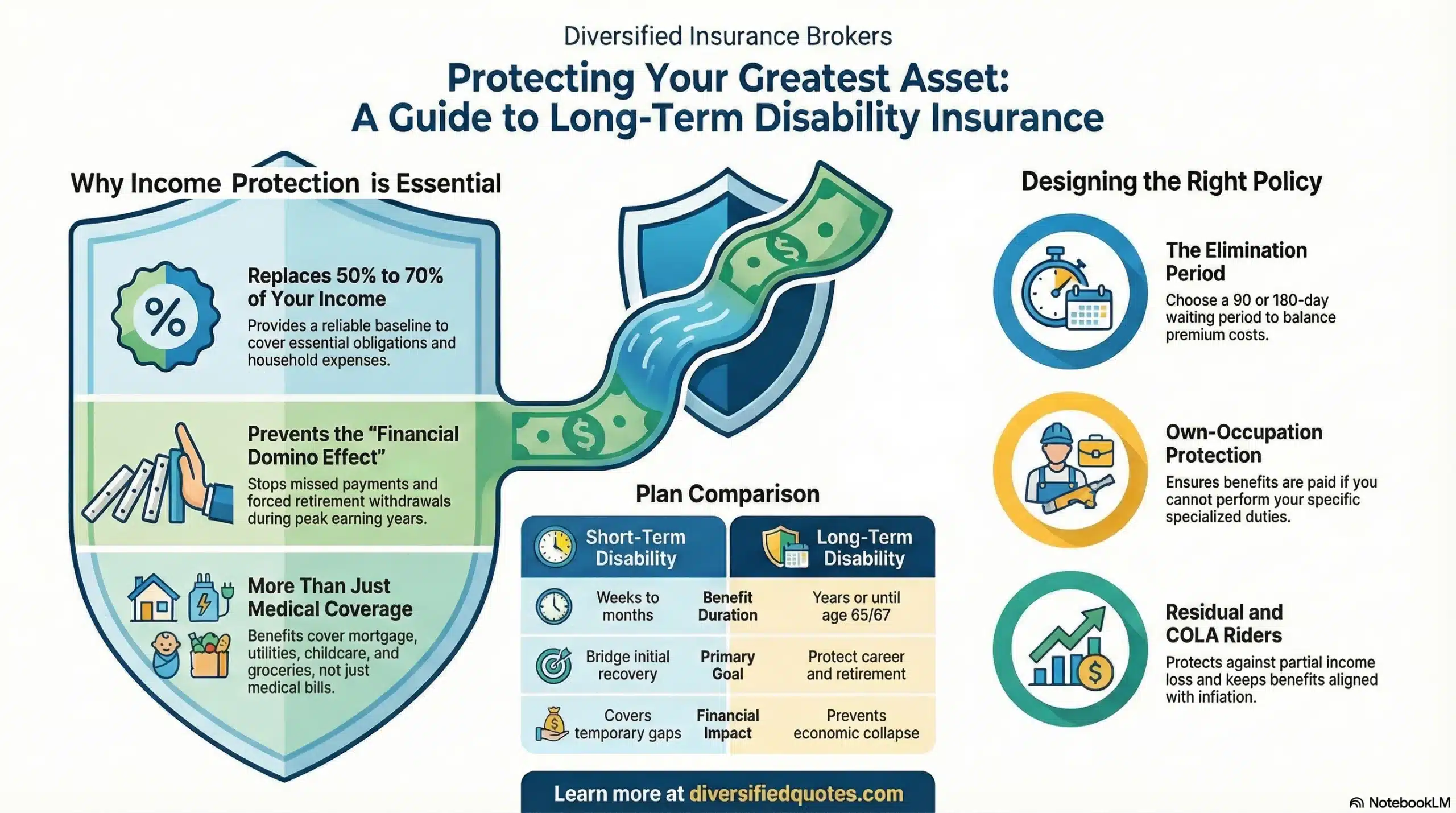
Disability insurance for welfare and social service workers should be designed to reflect both the mental and physical demands of the profession. The elimination period — the waiting time before benefits begin — should be selected based on available financial reserves and how quickly a disability would create financial pressure. Social service workers with limited savings and tight household budgets may need a shorter 30 or 60-day elimination period, while those with stronger reserves may benefit from the premium savings of a 90-day wait. The benefit period should extend to retirement age for comprehensive long-term protection, as mental health conditions and stress-related illness can produce extended or permanent disability that outlasts shorter benefit periods.
Mental health coverage provisions deserve explicit attention when comparing policies for social service workers. Some carriers apply more restrictive language to mental and nervous condition claims — limiting the benefit period for mental health disabilities to 24 months even when physical disability benefits would pay to retirement age. For social service workers whose most likely disabling condition is mental or emotional in nature, selecting a policy without this restriction is a priority that must be confirmed in the policy contract language rather than assumed from marketing materials. Coverage for rehabilitation support and return-to-work accommodation can also be valuable in a profession where a graduated return to client-facing work may be medically recommended. For context on how the disability insurance underwriting and application process works from start to finish — including how mental health history is evaluated by carriers — our resource on how disability insurance works and what it costs provides the foundational framework before comparing specific policy options.
Get Disability Insurance Quotes
A well-structured policy protects your income and provides financial stability through any disabling health event.
Request Disability Insurance OptionsQuestions? Call 800-533-5969
Financial Protection Essentials
Second opinion services, income planning tools, and disability insurance resources for social service and helping professions.
Talk With an Advisor Today
Choose how you’d like to connect—call or message us, then book a time that works for you.
Schedule here:
calendly.com/jason-dibcompanies/diversified-quotes
Licensed in all 50 states • Fiduciary, family-owned since 1980
Disability Insurance for Welfare and Social Service Workers FAQs
Social service workers rely on mental clarity, emotional resilience, and physical capability to perform their duties — and any of these dimensions can be disrupted by illness or injury in ways that immediately impair professional performance. The mental and emotional demands of caseload management, crisis intervention, client advocacy, and mandatory reporting create sustained occupational stress that, over time, can produce disabling mental health conditions including burnout, anxiety, depression, and secondary traumatic stress. Physical risks from field work, client site visits, and travel add acute injury exposure on top of the cumulative cognitive-emotional burden. Unlike office workers whose jobs can sometimes be partially maintained through accommodation, social service work typically requires full professional engagement — the ability to assess complex situations, maintain appropriate professional boundaries, communicate clearly under pressure, and make sound judgments with significant consequences for vulnerable clients. When those capacities are compromised, the professional cannot perform their core duties regardless of whether they could technically be present at a worksite. Disability insurance provides income replacement during those periods, ensuring that a health event does not simultaneously produce a financial crisis that accelerates pressure to return to work before full recovery is achieved. For social service workers who want to understand how disability definitions protect specific occupational function — rather than simply requiring total inability to perform any work — our resource on own-occupation disability insurance explains how the right definition creates meaningful protection for this profession.
Many disability insurance policies include coverage for mental health conditions such as anxiety, depression, burnout, post-traumatic stress disorder, and secondary traumatic stress — but the specifics vary meaningfully between carriers and policy designs in ways that matter enormously for social service workers. Some policies cover mental health disabilities with the same benefit period as physical disabilities — to age 65 or 67 for long-term policies. Other policies apply a separate, more restrictive benefit period for mental and nervous condition claims — often limiting mental health disability benefits to 24 months regardless of how long the physical disability provisions would otherwise pay. For social service workers whose most likely disabling condition is mental or emotional in nature given the demands of the profession, the distinction between these two policy designs is critical. A policy that limits mental health claims to 24 months provides inadequate protection for a population at elevated risk of extended mental health conditions. Selecting a carrier and policy design that does not apply this limitation — or applies it with broader exceptions — is a priority for social service professionals. This is one reason why working with an independent broker who can identify which carriers have the most favorable mental health provisions for this profession produces substantially better outcomes than purchasing the lowest-premium option available without evaluating mental health coverage terms. Apply before any mental health condition has been diagnosed or documented to ensure the full benefit of comprehensive coverage without pre-existing condition exclusions.
Yes — even if you have employer-provided group disability benefits through a government agency or nonprofit employer, individual disability insurance can supplement that coverage and provide more comprehensive protection in several important ways. Group disability plans typically replace 60 percent of base salary up to a monthly maximum, and they often exclude overtime pay, bonuses, and variable income components from the benefit calculation. They are also tied to your employment — if you change employers, leave the profession, or your employer changes plan designs, your group coverage changes with it, and you may face new waiting periods or different terms at the new plan. Individual disability insurance is personally owned and fully portable — it follows you regardless of employment changes, provides income replacement based on total earned income rather than just base salary, and allows you to customize benefit periods and elimination periods to your specific financial situation. For government employees who may have access to some form of sick pay or short-term coverage through the agency but inadequate long-term disability replacement, individual coverage fills the gap that group benefits leave. For nonprofit workers who often have more limited group benefits than government employees, individual coverage may be the primary or only meaningful disability protection available. The combination of group benefits (where available) and individual coverage provides the most comprehensive income replacement across both short-term recovery periods and longer-term disability scenarios.
Most individual disability insurance policies replace approximately 60 to 70 percent of pre-disability gross earned income through a monthly benefit that is typically received income-tax-free when premiums are paid with after-tax dollars. The replacement percentage is intentionally structured below 100 percent — both to prevent moral hazard (the incentive to remain disabled rather than return to work) and to reflect that income taxes and certain work-related expenses are eliminated during a disability period. For social service workers, this means the target benefit should be calibrated to cover essential household expenses — housing, utilities, food, transportation, healthcare, debt service — and not necessarily all discretionary spending. The income documentation process is straightforward for salaried employees: two recent W-2s and pay stubs are typically sufficient. For self-employed social service professionals — therapists, counselors, and case managers who work as independent contractors — the documentation process uses tax returns (Schedule C net profit), which requires planning around how business expenses are deducted. For professionals who want to understand how the benefit calculation process works from the income documentation through the actual claim payment, our resource on how disability insurance works covers the full process in practical terms.
Residual disability coverage — also called partial disability coverage — pays a proportional benefit when a disabling condition reduces a social service worker’s capacity and income without eliminating the ability to work entirely. This is particularly relevant for social service professionals because disability in this field is rarely all-or-nothing. A social worker recovering from severe burnout may be able to manage reduced caseload and attend scheduled appointments, but cannot handle crisis calls, emergency case responses, or the high-intensity client situations that represent the most demanding portion of their professional duties. A counselor recovering from a mental health condition may return to part-time sessions before being cleared for full-time clinical work. During these graduated return periods, professional income is reduced without being fully eliminated. Without a residual disability rider, a total-disability-only policy pays nothing during this partial-output phase because the professional can technically work in some capacity. A residual rider pays proportionately — if income is reduced by 50 percent, the residual benefit typically replaces approximately 50 percent of the base disability benefit, providing continuous financial support throughout the return-to-full-capacity arc. For social service professionals whose recovery is likely to involve a medically guided graduated return rather than a binary off-on transition, residual coverage is not an optional rider — it is the feature that makes the disability policy function as genuine income protection across the full recovery timeline. Our full resource on residual disability insurance benefits explained covers this feature in complete detail.
Benefit periods for individual disability insurance policies vary and should be selected based on the realistic duration of potential disability and the long-term financial consequences of an extended inability to work. Short benefit periods of two to five years cost less in premium but may expire before recovery is complete for more serious disabling conditions — particularly relevant for social service workers facing mental health conditions that may require extended treatment before full professional function is restored. Long-term benefit periods extending to retirement age at 65 or 67 provide the most comprehensive protection, ensuring the policy pays for as long as the disability continues through the working career. The difference in premium between a five-year benefit period and a to-age-65 benefit period is typically meaningful but not dramatic — and for most social service professionals in their primary earning years, the risk of an extended or permanent disability that outlasts a five-year benefit period is real enough to justify the additional cost. For social service professionals specifically, the elevated risk of mental health conditions that may require extended treatment and gradual recovery before full professional function is restored argues strongly for a benefit period extending to retirement age rather than a shorter fixed period. The combination of a meaningful benefit period, residual coverage, and an appropriate elimination period calibrated to available savings creates the most complete disability protection structure for this profession.
Disability insurance premiums for social service workers are generally competitive and affordable relative to the income being protected, primarily because the occupational classification assigned to welfare and social service work is favorable — typically in the 4A to 5A tier, reflecting the predominantly professional, office-and-field nature of the work rather than heavy physical labor or highly hazardous occupational exposure. This favorable classification gives social service workers access to own-occupation disability definitions, non-cancelable and guaranteed renewable policy provisions, benefit periods to retirement age, and the full range of supplemental riders including residual disability, cost-of-living adjustment, and future increase options. Premium cost depends primarily on age at application, gender, health history, tobacco status, the benefit amount chosen, the elimination period selected, and the specific riders included. A disability policy that replaces 60 percent of income with a 90-day elimination period and a to-age-65 benefit period is typically a modest percentage of monthly income — and the financial case for that cost is clear when compared against the financial impact of even a six-month disability without income replacement. Applying for coverage earlier in a social service career — while health is strong and age premiums are lower — produces the most favorable premiums and ensures comprehensive coverage before the occupational health conditions most likely to affect social service workers have developed in the medical record.
About the Author:
Jason Stolz, CLTC, CRPC, DIA, CAA and Chief Underwriter at Diversified Insurance Brokers (NPN 20471358), is a senior insurance and retirement professional with more than 25 years of real-world experience helping individuals, families, and business owners protect their income, assets, and long-term financial stability. As a long-time partner of the nationally licensed independent agency Diversified Insurance Brokers, Jason provides trusted guidance across multiple specialties—including fixed and indexed annuities, long-term care planning, personal and business disability insurance, life insurance solutions, Group Health, Travel Medical and Evacuation Insurance, and short-term health coverage. Diversified Insurance Brokers maintains active contracts with over 100 highly rated insurance carriers, ensuring clients have access to a broad and competitive marketplace.
His practical, education-first approach has earned recognition in publications such as VoyageATL, and contributions from his agency featured in Kiplinger and GoBankingRates— highlighting his commitment to financial clarity and client-focused planning. Drawing on deep product knowledge and years of hands-on field experience, Jason helps clients evaluate carriers, compare strategies, and build retirement and protection plans that are both secure and cost-efficient. Visitors who want to explore current annuity rates and compare options across multiple insurers can also use this annuity quote and comparison tool.
Explore More Disability Insurance Options: Browse our complete guide to Disability Insurance for Technology, Science & Education — covering software developers, engineers, scientists, teachers, architects & researchers from 100+ carriers.
Last Reviewed: June 8, 2026 |
Reviewed by: Jason Stolz, CLTC, CRPC, DIA, CAA
Chief Underwriter, Diversified Insurance Brokers, Inc. | NPN: 20471358 | Diversified Insurance Brokers, Inc. — Licensed in all 50 states
Fact Checked by: Tonia Pettitt, CMIP©
Medicare Specialist, Diversified Insurance Brokers, Inc. | NPN: 14374308 | Diversified Insurance Brokers, Inc. — Licensed in all 50 states
Did you find this content helpful? Leave us a Google review — it helps others find trustworthy guidance too.
Editorial Standards: Diversified Insurance Brokers maintains rigorous editorial standards to ensure accuracy, clarity, and independence in all content. Learn more about our editorial standards and commitment to transparency.
