
Disability Insurance for Ambulance Drivers
As an Independent Disability Insurance Broker, we have access to exclusive discounts and negotiated pricing most captive agents can’t offer — see the full breakdown near the end of this page.
Disability Insurance for Ambulance Drivers

Jason Stolz CLTC, CRPC, DIA, CAA
Disability insurance for ambulance drivers addresses the income risk of a profession that is more accurately described, in most cases, as emergency medical service work: the people who staff and operate ambulances are primarily Emergency Medical Technicians and paramedics who provide patient care from the moment they arrive on scene through transport and hospital handoff. Driving is one component of the role; the physical work of patient assessment, extrication, lifting and loading onto stretchers, and emergency medical intervention is the other. The physical demands of patient care — particularly the back and musculoskeletal strain of lifting, positioning, and transferring patients in confined ambulance environments and in the field — are well-documented as the leading occupational injury category in emergency medical services. When a back injury, shoulder condition, or other physical disability prevents an EMT or paramedic from performing that patient care work, income stops immediately. The disability insurance services available to EMS professionals address this physical income risk directly, and the broader income protection insurance framework covers how individual policies are structured for first responders whose income is tied to physical readiness.
EMS professionals work in one of the most psychologically demanding frontline environments in emergency response: they witness traumatic accidents, pediatric emergencies, violent scenes, and mass casualty events on a regular basis. PTSD and behavioral health conditions are a growing disability category for EMTs and paramedics, with a growing number of states adding workers’ compensation coverage for first-responder PTSD since 2017 — but many states still do not cover mental-only PTSD claims, and the 24-month behavioral health cap in most group and employer disability plans leaves EMS professionals underprotected for the specific health conditions their work creates. At Diversified Insurance Brokers, we help EMTs, paramedics, and EMS professionals structure disability coverage that reflects the physical patient care demands of the work, the psychological exposure dimension, and the income structures of both public and private EMS employment. The disability insurance by occupation and disability insurance for high-risk occupations frameworks cover how carriers evaluate EMS professionals’ specific occupational risk profile.
Compare Disability Insurance for EMTs & Ambulance Professionals
We compare options across 100+ carriers and structure coverage around the physical patient care demands, PTSD exposure, and income structure of EMS professionals.
Request Disability Insurance OptionsDisability Insurance for Ambulance Drivers and EMS Professionals — Risk Profile, Coverage Gaps, and Policy Design
| Coverage Dimension | The EMS Professional Reality | What the Right Design Looks Like |
|---|---|---|
| Physical injury — patient lifting and transfer | Back injuries from patient lifting and transfer are the leading documented occupational injury in EMS; EMTs and paramedics lift, position, and transfer immobile patients — sometimes in tight stairwells, vehicles, or outdoor settings — in postures that create sustained back and shoulder stress; herniated discs, back strain, and shoulder injuries are the most common disability-causing conditions in EMS careers | Coverage for any cause of disability including the physical injury categories most directly tied to patient care work; residual disability rider capturing partial income loss when reduced physical capacity limits patient care capability but doesn’t prevent lighter EMS duties; benefit sized to documented total income including shift differentials and overtime |
| Ambulance vehicle accidents | Emergency driving under lights-and-siren conditions, high-mileage daily travel, and the physical dynamics of vehicle-based patient care create accident risk that is meaningfully different from standard commuter driving; EMTs working in the patient care compartment during transport face unrestrained movement and equipment risks during vehicle accidents | Standard individual disability insurance covers vehicle accident disability regardless of emergency driving circumstances; the accident risk dimension of EMS work is covered fully by any-cause disability coverage |
| PTSD and behavioral health | EMTs and paramedics regularly witness traumatic accidents, pediatric emergencies, violent crime scenes, and mass casualty events; PTSD rates are significantly elevated among EMS professionals compared to the general population; growing states now cover first-responder PTSD through workers’ comp, but coverage is inconsistent by state and most group/employer plans cap behavioral health benefits at 24 months regardless of severity | Individual policy with unlimited mental/nervous benefit period matching physical coverage; PTSD from cumulative traumatic exposure or specific critical incidents is fully covered without the 24-month group cap; the behavioral health coverage gap between group plans and individual policies is the most significant coverage improvement for EMS professionals with high trauma exposure |
| Occupational class and workers’ comp gap | EMS professionals qualify for a middle occupational class reflecting the physical patient-handling component alongside the medical judgment and driving components; workers’ comp covers work-related injuries but pays approximately two-thirds of wages, applies state maximums, and covers only occupational injury and disease — the majority of disabling conditions affecting working adults are not work-related | Individual disability insurance fills the gap between workers’ comp partial replacement and full income needs for work-related conditions; provides complete coverage for the 90%+ of disabling conditions (illness, non-work accidents, cumulative health conditions) that workers’ comp does not address; own-occupation language reflecting the patient care and driving functions of EMS work |
| Public vs. private EMS — coverage structures | Municipal and fire-department-based EMS professionals may have government employer disability provisions similar to firefighters; private ambulance company employees have standard employer benefits that often include group LTD with typical limitations; hospital-based EMS and air ambulance professionals may have stronger employer benefits; rural and volunteer EMS workers often have minimal or no employer coverage | Individual coverage evaluation should start with a clear picture of what employer provisions actually pay, how they define disability, and when they apply any-occupation standards; individual supplemental policy fills specific identified gaps in the existing structure rather than duplicating coverage |
| Exposure to blood-borne pathogens and infectious disease | EMS professionals have occupational exposure to blood-borne pathogens, respiratory infections, and other communicable diseases from patient contact; needlestick incidents, airborne pathogen exposure, and sustained patient contact create disease transmission risk that is a documented occupational hazard in EMS | Individual disability insurance covers disability from infectious disease regardless of route of transmission; occupationally acquired conditions that produce lasting disability are covered the same as any other disabling illness or injury under a comprehensive individual policy |
The Back Injury Problem — Why Physical Readiness Is the Core Income Risk
Emergency medical service work is significantly more physically demanding than the title “ambulance driver” implies. Patient lifting and transfer is the central physical function that creates the profession’s leading injury risk: EMTs and paramedics regularly move non-ambulatory patients — from narrow stairwells, cramped vehicle interiors, outdoor scenes with uneven terrain, and beds in small rooms — onto stretchers and into ambulances, often in time-critical situations that don’t allow for optimal body mechanics. Back injuries, herniated discs, and shoulder conditions from this repetitive lifting and patient-transfer work are the most documented occupational injury category in EMS nationwide. An EMT or paramedic whose back injury prevents patient lifting is removed from the core patient care function that defines the job, regardless of whether they could drive, do administrative work, or perform other less physically demanding tasks. Own-occupation disability insurance that reflects the patient care physical demands as material to the occupation — not just driving ability — provides the protection that an any-occupation standard would deny in this scenario. The parallel first responder physical demand and income-protection need is directly addressed at disability income insurance for firefighters, whose patient care and rescue operations involve the same back and musculoskeletal exposure profile. Disability income insurance for nurses covers the same patient-handling physical injury risk for medical professionals in hospital settings. Disability insurance for dispatchers addresses the EMS coordination professionals whose behavioral health exposure parallels EMS field personnel.
PTSD and the Behavioral Health Coverage Gap
EMTs and paramedics operate on the front line of traumatic events with a frequency and intensity that most occupations do not approach. Pediatric cardiac arrests, mass casualty incidents, violent crime scenes, and fatal accidents are not rare events in a full-time EMS career — they are regular working conditions. The cumulative effect of sustained high-trauma exposure produces elevated PTSD rates that are well-documented in the EMS literature, alongside elevated rates of depression, burnout, and substance use disorder. A growing number of states have added workers’ compensation coverage specifically for first-responder PTSD since 2017 — including Minnesota, Florida, Washington, Colorado, and others. Missouri has enacted specific provisions for EMTs and paramedics. But workers’ comp PTSD coverage remains unavailable or limited in many states, and even where it exists, the group employer plan’s 24-month behavioral health benefit cap creates a funding gap for serious conditions requiring extended treatment. Individual disability insurance with unlimited mental/nervous benefit periods eliminates this cap entirely, providing complete income protection for the behavioral health conditions that EMS work is documented to produce. The same PTSD coverage gap issue affects SWAT team members, law enforcement officers, and other first responders whose work creates identical trauma exposure patterns.
Policy Design for EMS Professionals
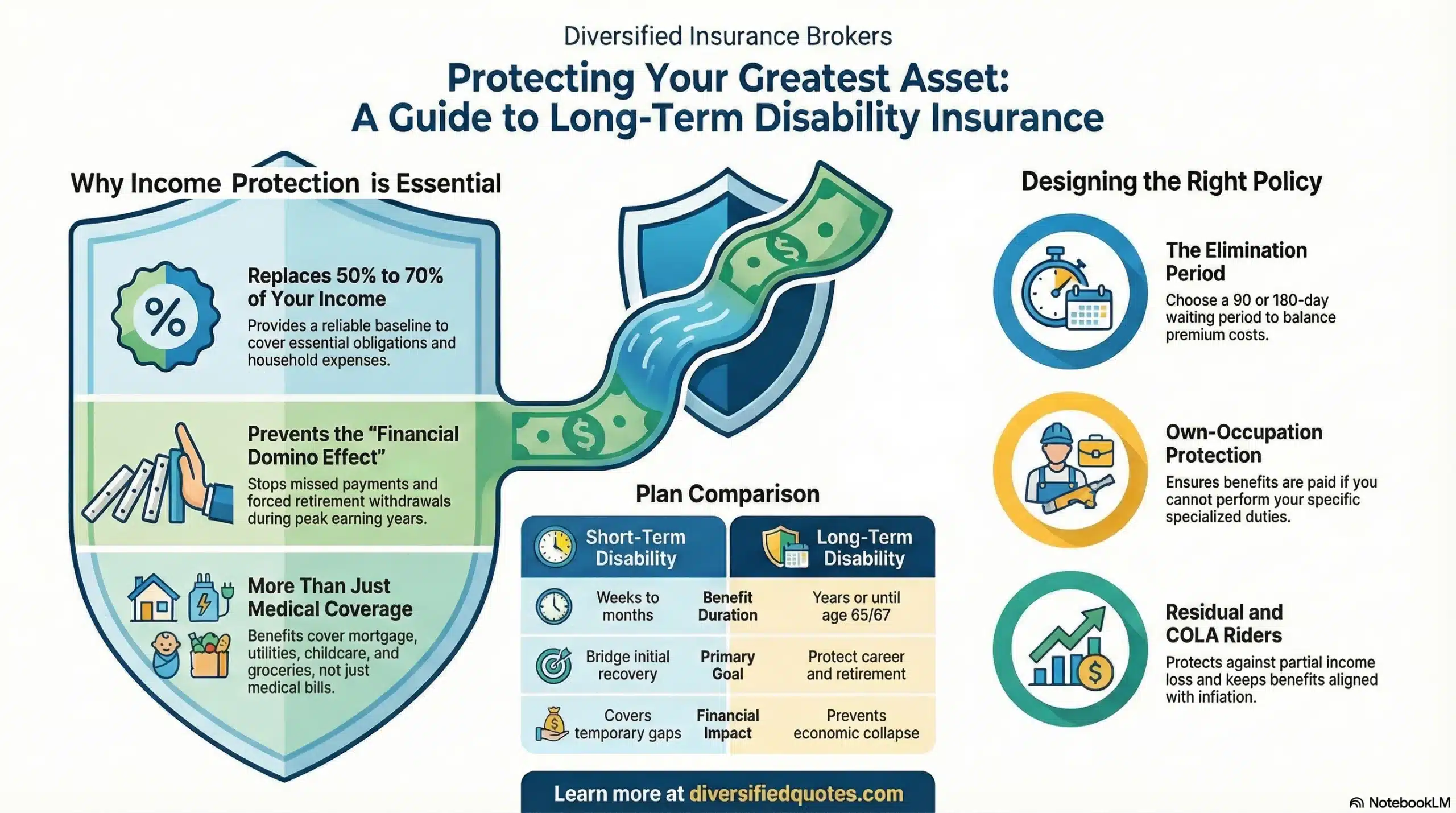
The benefit period should extend to retirement age — long-term disability insurance to age 65 provides career-long protection for the physical conditions that accumulate over decades of patient care work. The elimination period should coordinate with available employer sick leave; many EMS employers provide meaningful sick leave accumulation that can bridge a 30-90 day initial period before individual benefits begin. The residual disability rider captures partial income loss during restricted duty periods when reduced physical capacity limits patient care but doesn’t prevent all work. The full rider framework is at disability insurance riders explained. Tax treatment of individually owned policy benefits is at are disability insurance payments taxable. For EMS professionals who have not had individual coverage before or who want an independent evaluation of existing coverage, get a 2nd opinion on your disability insurance quote covers the review process. No-exam disability options for EMS professionals are at no-exam disability insurance. The value of working with an independent broker for a high-risk occupation where carrier programs vary significantly is at why work with an independent disability insurance broker. The parallel government and private employment security professional planning considerations are at TSA employees, airline security personnel, and prison and jail guards. Sizing benefit amounts for EMS professionals with shift differential and overtime income is at how much disability insurance do I need. For an initial introduction to why EMS professionals prioritize disability coverage, short-term disability covers the initial bridge period and the disability insurance for FBI agents federal employee context covers the government employer benefit structure that applies to federally employed EMS personnel.
Talk With an Advisor Today
Choose how you’d like to connect—call or message us, then book a time that works for you.
Schedule here:
calendly.com/jason-dibcompanies/diversified-quotes
Licensed in all 50 states • Fiduciary, family-owned since 1980
FAQs: Disability Insurance for Ambulance Drivers and EMS Professionals
What is the most common disability risk for EMTs and paramedics?
Back injuries from patient lifting and transfer are the most documented occupational injury category in emergency medical services. EMTs and paramedics regularly lift and reposition immobile patients in confined spaces, stairwells, and field environments under time pressure and in suboptimal body mechanics conditions. Herniated discs, back strain, and shoulder conditions from this repetitive work are the career-ending disabilities most commonly reported in EMS. Vehicle accidents during emergency driving and exposure to blood-borne pathogens represent additional physical risk categories. PTSD from cumulative trauma exposure is an increasingly documented disability category as behavioral health awareness in EMS has grown.
Does workers’ compensation cover EMS professionals adequately?
Workers’ compensation covers work-related injuries and occupational diseases for EMS professionals, paying approximately two-thirds of average wages up to a state maximum for qualifying claims. But workers’ comp has significant limitations: it covers only work-related conditions, leaving illness-based and non-occupational disability completely uncovered; the two-thirds wage replacement is capped at state maximums that may fall below total compensation including shift differentials and overtime; and PTSD coverage through workers’ comp varies dramatically by state and is unavailable in many states for EMS professionals. Individual disability insurance fills these gaps for work-related conditions where workers’ comp falls short and provides complete coverage for the full range of non-work-related disabling conditions.
Are EMTs and paramedics considered high-risk for disability insurance purposes?
EMTs and paramedics typically qualify for a middle occupational class reflecting the hybrid nature of the work — physical patient care and emergency driving alongside medical judgment and clinical assessment components. The physical patient-handling component prevents top-tier classification available to pure desk professionals. The clinical and cognitive aspects of emergency patient care are evaluated more favorably than purely physical labor. The specific class assigned varies across carriers and depends on how the duty mix is described — primary patient care certification level and actual physical lifting duties versus clinical assessment and supervision functions all influence classification.
Does PTSD from EMS work qualify for disability insurance benefits?
Individual disability insurance with comprehensive mental/nervous condition coverage provides benefits for PTSD when the condition genuinely prevents the EMT or paramedic from performing their patient care duties. The critical advantage of individual over group coverage is the benefit period: group employer plans typically cap mental/nervous benefits at 24 months. Individual policies with unlimited mental/nervous benefit periods provide sustained coverage for serious PTSD conditions requiring extended treatment. Workers’ comp PTSD coverage is a separate question and varies by state; a number of states have added first-responder PTSD workers’ comp coverage since 2017, but many still do not include it, making individual coverage the primary available protection in those states.
Does disability insurance for EMTs cover vehicle accidents during emergency driving?
Yes — standard individual disability insurance covers disability from any cause including vehicle accidents, without distinction between emergency driving and standard commuting. An EMT or paramedic injured in an ambulance accident during an emergency response is covered by individual disability insurance for the resulting income loss, the same as any other disabling injury. The emergency driving context does not create coverage exclusions in individual disability policies. Workers’ compensation would separately cover the work-related nature of a vehicle accident during an active emergency response call.
About the Author:
Jason Stolz, CLTC, CRPC, DIA, CAA and Chief Underwriter at Diversified Insurance Brokers (NPN 20471358), is a senior insurance and retirement professional with more than 25 years of real-world experience helping individuals, families, and business owners protect their income, assets, and long-term financial stability. As a long-time partner of the nationally licensed independent agency Diversified Insurance Brokers, Jason provides trusted guidance across multiple specialties—including fixed and indexed annuities, long-term care planning, personal and business disability insurance, life insurance solutions, Group Health, Travel Medical and Evacuation Insurance, and short-term health coverage. Diversified Insurance Brokers maintains active contracts with over 100 highly rated insurance carriers, ensuring clients have access to a broad and competitive marketplace.
His practical, education-first approach has earned recognition in publications such as VoyageATL, and contributions from his agency featured in Kiplinger and GoBankingRates— highlighting his commitment to financial clarity and client-focused planning. Drawing on deep product knowledge and years of hands-on field experience, Jason helps clients evaluate carriers, compare strategies, and build retirement and protection plans that are both secure and cost-efficient. Visitors who want to explore current annuity rates and compare options across multiple insurers can also use this annuity quote and comparison tool.
Explore More Disability Insurance Options: Browse our complete guide to Disability Insurance for Nursing, Therapy & Allied Health — covering nurses, therapists, dental hygienists, pharmacists, lab techs & allied health professionals from 100+ carriers.
Last Reviewed: June 6, 2026 |
Reviewed by: Jason Stolz, CLTC, CRPC, DIA, CAA
Chief Underwriter, Diversified Insurance Brokers, Inc. | NPN: 20471358 | Diversified Insurance Brokers, Inc. — Licensed in all 50 states
Fact Checked by: Tonia Pettitt, CMIP©
Medicare Specialist, Diversified Insurance Brokers, Inc. | NPN: 14374308 | Diversified Insurance Brokers, Inc. — Licensed in all 50 states
Did you find this content helpful? Leave us a Google review — it helps others find trustworthy guidance too.
Editorial Standards: Diversified Insurance Brokers maintains rigorous editorial standards to ensure accuracy, clarity, and independence in all content. Learn more about our editorial standards and commitment to transparency.
