
Disability Insurance for Dispatchers
As an Independent Disability Insurance Broker, we have access to exclusive discounts and negotiated pricing most captive agents can’t offer — see the full breakdown near the end of this page.
Disability Insurance for Dispatchers

Jason Stolz CLTC, CRPC, DIA, CAA
Disability insurance for dispatchers is an essential layer of financial protection for professionals whose careers depend on mental sharpness, sustained focus, and the ability to perform under extraordinary pressure every single shift. Whether you work as a 911 emergency dispatcher, a truck and freight dispatcher, a transportation logistics coordinator, a fire dispatch operator, or a law enforcement communications officer, your income is directly tied to your cognitive performance, communication ability, and consistent availability. When illness or injury interrupts that capacity, the financial consequences arrive immediately.
Dispatchers are among the most underinsured professionals in the workforce — not because disability insurance for dispatchers is unavailable, but because the profession is frequently misunderstood at the underwriting level. The risks dispatchers face are real, well-documented, and often career-ending. They simply look different from the physical risks associated with manual labor. The absence of hard hats and heavy equipment does not mean the absence of serious occupational health exposure.
At Diversified Insurance Brokers, we work with dispatchers across all sectors to structure disability insurance policies that reflect the genuine demands of this profession. We understand how dispatchers earn, how their health is affected over a career, and how to present their risk profile to carriers in a way that produces comprehensive, fairly priced coverage. Disability insurance for dispatchers is one of the most important financial decisions a working dispatcher can make — and we are here to help make it the right one.
Protect Your Income as a Dispatcher
Compare disability insurance options built for emergency dispatchers, freight coordinators, logistics dispatchers, and all dispatch professionals.
The Many Types of Dispatchers and Why Disability Insurance Matters
The word “dispatcher” covers a wide range of professionals, each with distinct working conditions, income structures, and occupational health exposures. Disability insurance for dispatchers is not a one-size-fits-all product — coverage needs to reflect the specific realities of your role.
Emergency dispatchers — including 911 call takers, police communications officers, fire dispatch operators, and emergency medical service coordinators — work in high-stakes, emotionally intense environments where every shift involves life-or-death calls, traumatic audio exposure, and sustained cognitive load. The psychological demands of this role are among the most significant of any occupation in the country.
Truck and freight dispatchers coordinate the movement of commercial cargo, managing driver schedules, routing logistics, regulatory compliance, and time-sensitive deliveries. They work under constant deadline pressure, handle frequent multi-task management, and often maintain irregular schedules to match the round-the-clock nature of freight operations.
Transportation and logistics dispatchers in rail, airline, maritime, and municipal transit settings face similar pressures, often with the added weight of public safety responsibility and regulatory accountability. A dispatcher who cannot perform at full cognitive capacity — due to illness, a mental health condition, or a physical limitation that affects concentration — poses a risk not just to their own income, but to the systems they manage.
In all of these roles, the common thread is this: dispatchers are paid for their mental capacity, not their physical labor. And disability insurance for dispatchers must be structured to protect that cognitive income, not just physical ability. Just as comptrollers protecting their cognitive income require carefully structured coverage, so do dispatchers whose value lies entirely in sustained mental performance.
Dispatcher Disability Risks — The Hidden Occupational Hazards
Disability insurance for dispatchers addresses a set of occupational risks that are frequently underestimated because they are invisible. There is no heavy machinery, no heights, no chemical exposure — but the health consequences of a dispatching career are documented, serious, and capable of ending a career abruptly.
Post-traumatic stress disorder and secondary traumatic stress are among the most significant risks facing emergency dispatchers. These professionals are exposed to traumatic events — violent crimes, medical emergencies, accidents involving children, natural disasters — at rates that can exceed those of field responders. Unlike first responders who arrive at a scene and engage physically, dispatchers absorb the emotional content of these events entirely through audio, with no outlet for action and no closure after the call ends. Over a career of repeated exposure, the cumulative psychological toll can be profound and disabling.
Burnout is recognized as a serious occupational health condition for dispatchers across all sectors. The combination of sustained high-stakes decision-making, mandatory overtime, irregular shift schedules, and the chronic absence of positive feedback creates conditions that lead to emotional exhaustion, reduced cognitive function, and an inability to perform at the level required to dispatch effectively. When burnout progresses to clinical levels, the ability to work can be genuinely compromised. This is an area where disability insurance for dispatchers provides critical income replacement while a dispatcher works to recover and return to function.
Musculoskeletal conditions are an underappreciated risk for dispatchers who spend extended hours seated at workstations, often in environments with poor ergonomics. Chronic back pain, cervical spine issues, repetitive strain injuries from keyboard and headset use, and carpal tunnel syndrome are all documented occupational conditions in sedentary, high-concentration roles. When these conditions become severe enough to limit sustained work capacity, they create genuine disability that affects income.
Shift work carries its own category of health risk for dispatchers who rotate through day, evening, and overnight schedules. Chronic disruption of sleep patterns has been associated with increased rates of cardiovascular disease, obesity, hypertension, metabolic disorders, and immune dysfunction. Over a career of shift-based dispatching, these systemic health risks accumulate in ways that can significantly affect long-term wellbeing and work capacity. These are the same types of career-long health risks that make disability insurance for dispatchers as important as it is for physically demanding professions like blacksmiths and skilled trade workers or brewery professionals in demanding environments.
Cardiovascular events — including hypertension-related incidents, heart attacks, and stroke — are a meaningful risk for long-serving dispatchers, particularly those in emergency services who carry sustained physiological stress responses over years of high-pressure work. A cardiovascular event that temporarily or permanently impairs cognitive function or physical stamina can disable a dispatcher from performing their duties even if they retain the ability to perform lighter work.
Disability Insurance for Dispatchers — Occupation Class and Underwriting
Understanding how disability insurance carriers classify dispatchers is important for setting realistic expectations about coverage cost and structure. Disability insurance underwriting uses occupational class systems — typically ranging from the highest class (4A or 5A, reserved for physicians and highly specialized professionals) down to lower classes for more physically demanding or higher-risk roles.
Emergency dispatchers are generally classified in the 2A to 3A range, reflecting the moderate-to-significant occupational stress exposure of the role combined with its non-manual nature. Truck and freight dispatchers, depending on their specific duties and whether they involve any physical components, may fall similarly or slightly lower. The classification affects both premium cost and the maximum monthly benefit available — making it essential to work with a broker who understands how to present a dispatcher’s duties accurately to optimize the underwriting outcome.
The key principle in dispatcher underwriting is that carriers evaluate duties, not job titles. Two people with the title of “dispatcher” can have meaningfully different risk profiles depending on whether they work in an emergency communications center or a freight brokerage, whether they have management responsibilities, and what percentage of their time is spent in direct high-stress call environments. Presenting this information precisely is a core function of working with an independent disability insurance broker who knows how to advocate for favorable classification on your behalf.
The Case for Own-Occupation Disability Coverage for Dispatchers
Disability insurance for dispatchers is most effective when it includes an own-occupation definition of disability — the policy provision that pays benefits when you are unable to perform the specific duties of dispatching, regardless of whether you could theoretically perform some other type of work.
This distinction matters enormously for dispatchers. A 911 dispatcher who develops severe PTSD may be capable of performing a low-stress data entry job, but they are not capable of returning to a position that requires sustained emotional engagement with traumatic audio content under deadline pressure. An any-occupation disability policy would deny benefits in that scenario. An own-occupation policy would recognize that the dispatcher cannot perform their specific occupational duties and would pay benefits accordingly.
Similarly, a freight dispatcher who develops a cognitive condition — whether from burnout, a neurological event, or a mental health diagnosis — may retain the general ability to perform some tasks but not the rapid multi-task management, time-sensitive decision-making, and communication precision that dispatching requires. Own-occupation disability insurance for dispatchers is the policy structure that actually responds to how dispatcher disabilities manifest in practice.
For dispatchers who want to explore how own-occupation coverage compares across carriers, working with an independent broker who can present multiple options side by side is the most effective approach. The same own-occupation principles that protect teachers and other cognitive-role professionals apply directly to dispatchers whose income depends on mental performance rather than physical output.
PTSD, Mental Health Conditions, and Disability Insurance for Emergency Dispatchers
For emergency dispatchers specifically, the question of mental health coverage in a disability insurance policy is not peripheral — it is central. Post-traumatic stress disorder, secondary traumatic stress, clinical depression, and anxiety disorders are occupational realities for professionals who spend careers as the first voice heard in the worst moments of other people’s lives.
Many individual disability insurance policies do provide coverage for mental health and nervous system conditions, but the terms vary significantly between carriers. Some policies pay full benefits for mental health disabilities through the end of the benefit period. Others limit mental health and nervous disorder claims to a 24-month benefit period, even if the base policy would otherwise pay to age 65. Understanding exactly how your policy handles mental health disability — not assuming it handles it well — is one of the most important questions a dispatcher should ask before purchasing coverage.
At Diversified Insurance Brokers, we specifically evaluate mental health benefit period provisions when structuring disability insurance for emergency dispatchers, because this is the area most likely to determine whether the policy actually protects you when you need it most. The same careful attention to mental health provisions is important for other high-stress cognitive professionals, including zookeepers and animal care professionals and bill collectors managing chronic occupational stress, where mental health conditions are a significant disabling risk.
Case Study: Emergency Dispatcher Earning $58,000 Per Year
Consider a 911 emergency dispatcher earning $58,000 annually, including shift differential pay. After nine years in the profession, this dispatcher is diagnosed with PTSD and clinical depression following repeated exposure to traumatic calls. The attending physician recommends an extended leave from dispatch work, with no guarantee of return to the same role.
| Scenario | Without Disability Insurance | With Disability Insurance |
|---|---|---|
| Monthly Income | $0 after sick leave exhausted | $2,900–$3,500 |
| 12-Month Income | $0 | $34,800–$42,000 |
| Treatment Costs | Paid from depleting savings | Income preserved for living and treatment expenses |
| Long-Term Outcome | Financial crisis compounds recovery difficulty | Financial stability supports sustained recovery |
This scenario is not hypothetical — it reflects a pattern that plays out regularly across the emergency dispatch profession. Disability insurance for dispatchers does not prevent the health crisis from occurring, but it ensures that a health crisis does not become a simultaneous financial catastrophe. Financial stability during recovery is itself a significant factor in how well and how quickly a dispatcher can return to work.
Disability Insurance for Dispatchers — Employer Plans vs. Individual Policies
Many dispatchers, particularly those employed by municipalities, public safety agencies, or large logistics companies, have access to employer-sponsored group disability coverage. This coverage is valuable, but it carries limitations that make supplemental individual disability insurance for dispatchers an important consideration.
Group disability plans provided through employers typically replace 60% or less of base salary. For dispatchers who earn meaningful shift differentials, overtime pay, or performance-based compensation, these variable components of income are frequently excluded from the benefit calculation — meaning the actual replacement ratio can be significantly lower than 60% of total earned income. When those additional income sources are a regular part of your monthly budget, a group plan that ignores them creates a genuine coverage gap.
Group plans are also owned by the employer. When employment ends — whether due to resignation, layoff, agency restructuring, or disability itself — group coverage ends with it. An individual disability insurance policy purchased through an independent broker belongs to you, follows you through career changes, and cannot be canceled or modified by anyone other than you, as long as premiums are paid. This portability is especially important for dispatchers who may move between agencies or transition from emergency services to private sector dispatching roles over the course of a career.
Dispatchers who want to understand how to fill gaps in existing employer coverage should explore how social service workers supplement employer disability plans — a parallel situation where group plans consistently fall short of actual income replacement needs.
Residual Disability Coverage for Dispatchers Returning to Work
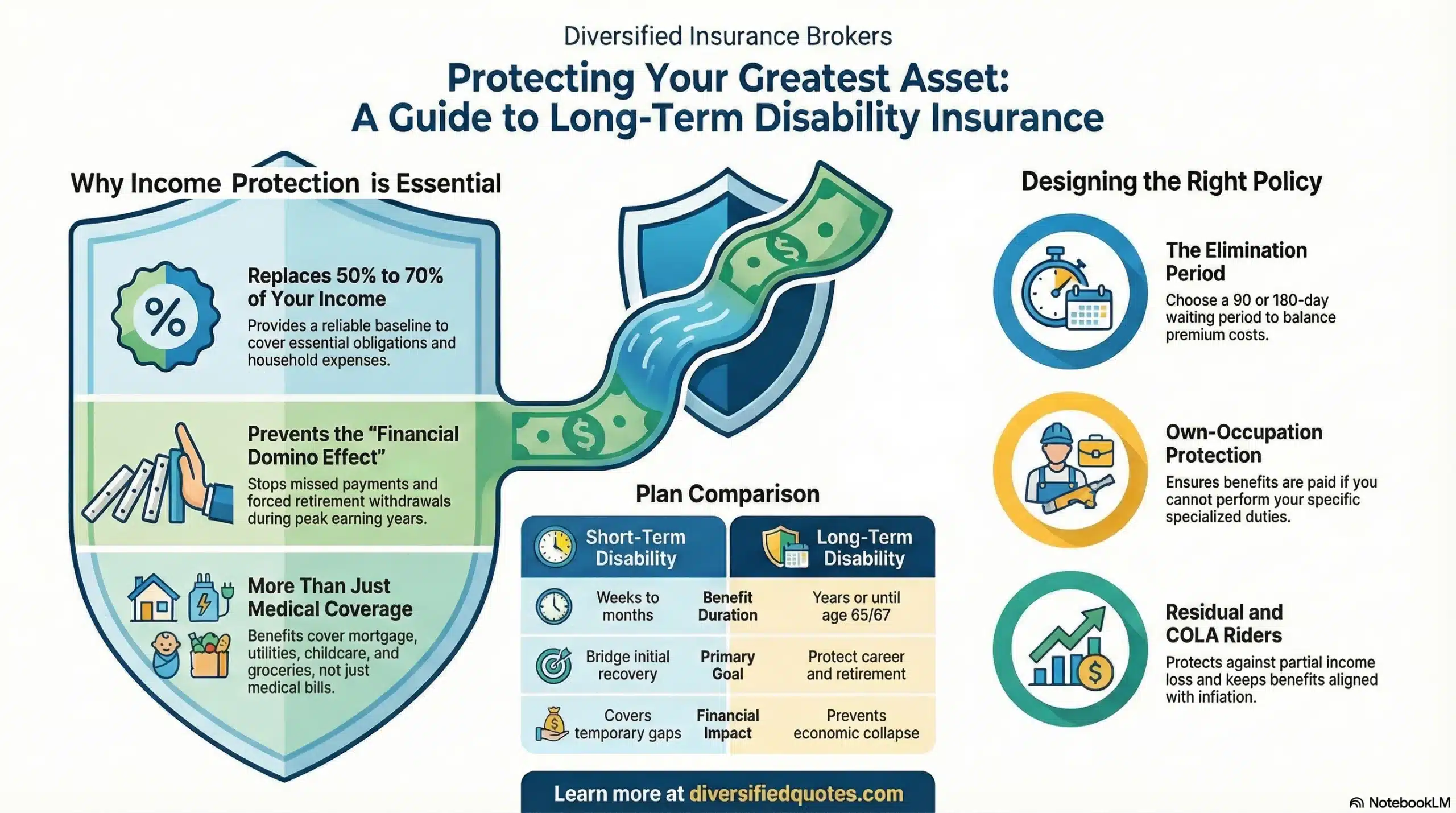
Disability insurance for dispatchers should include residual disability coverage — the provision that pays proportional benefits when a condition reduces your earning capacity without completely eliminating your ability to work. This rider is particularly relevant for dispatchers whose recovery from mental health conditions, burnout, or physical injuries often happens gradually rather than all at once.
A dispatcher returning from a PTSD-related leave may initially return to work on a reduced schedule — perhaps three shifts per week instead of five, or in a limited role with reduced call exposure. During this transition, income is reduced but not eliminated. Without residual disability coverage, a basic total-disability-only policy would pay nothing during this period. With a residual disability rider, the policy supplements reduced earnings proportionally, bridging the income gap during the recovery phase.
The transition from full disability to full return to work is rarely a clean line for dispatchers. A well-structured policy acknowledges this reality and provides financial support throughout the entire recovery arc, not just at the beginning. This approach mirrors how other specialized professionals structure residual benefits to account for gradual return-to-work situations.
Key Policy Features Every Dispatcher Should Prioritize
Disability insurance for dispatchers is most effective when specific policy provisions are built in from the start. The own-occupation definition of disability, as discussed, is foundational. Beyond that, dispatchers should prioritize non-cancelable and guaranteed renewable provisions, which lock in premium rates and prevent the carrier from altering coverage terms as long as payments are made — providing the policy stability that a long dispatching career requires.
The future increase option is particularly valuable for dispatchers early in their careers or those who anticipate income growth through promotion, additional certifications, or transition to supervisory roles. This rider allows coverage to be increased as income rises without requiring new medical underwriting, meaning conditions that develop over time do not prevent you from securing additional protection. A cost-of-living adjustment rider ensures that benefit payments increase annually during a long-term claim, preserving the purchasing power of disability income across extended recovery periods.
The elimination period — the waiting time before benefits begin — should be chosen based on the financial resources available to cover expenses during that window. Most dispatchers with stable employment and some savings choose a 90-day elimination period to keep premiums lower. Those with fewer reserves may prefer a 30 or 60-day period. Working with an independent broker who specializes in disability coverage is the most reliable way to calibrate these provisions to your specific financial situation.
How Disability Insurance for Dispatchers Fits Into a Financial Plan
For dispatchers, disability insurance is the financial foundation that makes every other financial goal achievable. The mortgage, the retirement contributions, the family financial obligations — all of these depend on income continuing. Disability insurance for dispatchers ensures that an unexpected health event does not derail the financial life that income supports.
Once disability insurance is in place, dispatchers can build additional financial resilience through complementary tools. Fixed annuities for stable retirement income provide a guaranteed income stream that is independent of employment status. Life insurance options for public safety professionals address the family protection dimension of a dispatching career. And for dispatchers approaching retirement age, understanding supplemental healthcare coverage options helps ensure continuity of protection as workplace coverage changes.
Long-term income security for dispatchers also involves planning for the transition out of the profession. Many dispatchers move into supervisory, training, or administrative roles as their careers mature. Disability insurance for dispatchers structured with a future increase option and own-occupation provisions can accommodate this career evolution, ensuring coverage remains appropriate across different roles and income levels.
Comparing Dispatchers to Other High-Stress Cognitive Professions
Disability insurance for dispatchers addresses the same fundamental challenge faced by all professionals whose income depends on cognitive performance rather than physical output: the risks are real but less visible, and coverage must be structured to protect mental and neurological function rather than just physical capacity.
Dispatchers share this challenge with other high-pressure, cognitively demanding professions. Bookkeepers and financial professionals rely on accuracy and concentration in the same way a dispatcher relies on precise communication and rapid decision-making. Computer engineers and technical professionals face similar cognitive-income exposure where conditions affecting mental function have direct and immediate income consequences. Stockbrokers managing high-stakes financial decisions experience the pressure-cognition relationship in a way that mirrors what emergency dispatchers face every shift.
In all of these cases, disability insurance for cognitive professionals needs to be structured with own-occupation definitions, strong mental health provisions, and residual disability coverage — precisely the approach we take at Diversified Insurance Brokers for every dispatcher client we serve.
Why Dispatchers Should Work with an Independent Broker
Disability insurance for dispatchers is not a product that should be purchased from the first carrier that offers a quote. Policy definitions, mental health benefit period provisions, residual disability riders, and occupational class assignments vary significantly between carriers — and those differences determine whether a policy actually protects you when a disability occurs.
An independent broker with expertise in disability insurance for dispatchers can compare multiple carriers, identify the most favorable underwriting classifications, and structure policy provisions specifically around the risks that dispatchers actually face. This is categorically different from working with a captive agent who represents a single carrier and presents only that company’s products regardless of whether they are the best fit for your occupation and income profile.
Dispatchers who have been quoted by a single carrier — or who have defaulted to whatever their employer offers — are frequently underinsured in ways they do not discover until claim time. Fitness professionals who rely on employer plans and independent health practitioners learn the same lesson: group coverage is a starting point, not a complete solution. The difference between a policy that pays when you need it and one that does not is almost always in the details — and those details are exactly what an experienced independent broker exists to navigate on your behalf.
Final Thoughts on Disability Insurance for Dispatchers
Dispatchers hold one of the most demanding and underappreciated roles in the workforce. The cognitive load, the emotional exposure, the shift-based schedules, and the relentless pressure of managing high-stakes communications are all real occupational hazards that carry real consequences for health and income over the course of a career.
Disability insurance for dispatchers is the financial tool that ensures those consequences do not become permanent. A well-structured policy — built around own-occupation definitions, strong mental health provisions, residual disability coverage, and appropriate benefit periods — provides the income protection that allows a dispatcher to recover, heal, and return to work from a position of financial stability rather than financial desperation.
If you are a dispatcher and you do not have disability insurance in place, or if you have coverage but have not reviewed it recently, now is the time to act. Professionals in similarly demanding roles consistently report that the most important financial decision they made was securing disability coverage before they needed it. The same is true for dispatchers.
Related Pages
Talk With an Advisor Today
Choose how you’d like to connect—call or message us, then book a time that works for you.
Schedule here:
calendly.com/jason-dibcompanies/diversified-quotes
Licensed in all 50 states • Fiduciary, family-owned since 1980
Disability Insurance for Dispatchers FAQs
Yes, dispatchers qualify for individual disability insurance, and the majority are insurable at competitive rates. Emergency dispatchers, freight dispatchers, logistics coordinators, and transportation dispatchers all fall within occupational classes that most major disability insurance carriers will cover. The key is presenting your specific duties accurately during the underwriting process, since carriers evaluate what you actually do rather than simply your job title. Working with an independent broker who understands how to position a dispatcher’s role favorably is the most effective way to secure the best available classification and premium.
The most significant disability risk for emergency dispatchers is mental health — specifically post-traumatic stress disorder, secondary traumatic stress, clinical depression, and burnout. Emergency dispatchers are exposed to traumatic events at rates that can exceed those of field responders, absorbing the emotional content of violent crimes, pediatric emergencies, and life-threatening situations entirely through audio with no physical outlet and no resolution. Over a career of this exposure, cumulative psychological impact can become genuinely disabling, making strong mental health benefit provisions in a disability policy one of the most important features a dispatcher can have. For guidance on finding the right disability insurance broker, we are here to help.
Many individual disability insurance policies do cover PTSD, clinical depression, anxiety disorders, and other mental health conditions — but the terms vary significantly between carriers. Some policies pay full benefits for mental health disabilities through the end of the benefit period, which can extend to age 65. Others limit mental health and nervous disorder claims to a 24-month benefit period, even if the base policy would otherwise pay longer. For emergency dispatchers, where mental health is the primary disability risk, reviewing the specific mental health provisions of any policy before purchasing is essential. This is one of the most important conversations to have with your broker before committing to coverage.
Employer group disability plans are a valuable starting point, but they are rarely sufficient on their own for dispatchers. Most group plans replace 60% or less of base salary — and frequently exclude shift differentials, overtime, and other variable pay that make up a meaningful portion of a dispatcher’s total income. Group plans are also owned by the employer, meaning coverage ends when employment ends. An individual disability insurance policy owned by you fills these gaps, covers total compensation more accurately, and remains in force regardless of changes in employment. Dispatchers who rely solely on employer group plans are often significantly underinsured. For comparison, social service workers face the same group plan shortfalls.
Own-occupation disability coverage pays benefits when you are unable to perform the specific duties of dispatching — regardless of whether you could technically perform some other type of work. For dispatchers, this is critically important because the most likely disabling conditions — PTSD, severe burnout, cognitive effects of cardiovascular events — may prevent a dispatcher from functioning in their role while still leaving them able to perform lower-stress work elsewhere. An any-occupation policy would deny benefits in that situation. An own-occupation policy recognizes that the inability to dispatch is a genuine occupational disability, even if other employment is theoretically possible. This distinction is what separates comprehensive protection from false security.
Shift work itself does not typically disqualify a dispatcher from obtaining disability insurance, but the health consequences of career-long shift work can affect underwriting. Chronic shift rotation has been associated with increased rates of cardiovascular disease, metabolic disorders, obesity, and immune dysfunction — all of which are factors that underwriters may examine during the medical evaluation portion of the application. Dispatchers with established health conditions related to shift work should work with an independent broker who can identify carriers most likely to provide favorable terms given their specific medical history. Applying before significant health conditions develop is always the most advantageous approach.
Yes, freight dispatchers, transportation logistics coordinators, and other non-emergency dispatching professionals qualify for individual disability insurance and are generally viewed more favorably by underwriters than emergency dispatchers, given the lower psychological trauma exposure. The occupational class assigned will depend on specific duties, income level, and any physical components of the role. Freight dispatchers with office-based, sedentary roles coordinating driver schedules and cargo logistics typically fall into favorable occupational classes that allow access to comprehensive policy features including own-occupation definitions and residual disability riders. Explore how independent contractors structure their disability coverage for a parallel framework.
Residual disability coverage pays proportional benefits when a disabling condition reduces your income without eliminating your ability to work entirely. For dispatchers, this is particularly relevant during recovery from mental health conditions or physical limitations, where return to work often happens gradually — reduced hours, modified duties, or limited call exposure before full return. Without residual coverage, a dispatcher who returns at 50% capacity may receive no benefits at all under a total-disability-only policy. A residual disability rider ensures that reduced earnings during recovery are supplemented by the policy, providing financial support throughout the entire transition back to full capacity.
Most disability insurance policies replace 60% to 70% of verified earned income, up to monthly benefit caps that vary by carrier and occupational class. For a dispatcher earning $55,000 annually, this translates to a monthly benefit of approximately $2,750 to $3,200. The calculation should be based on total compensation — including shift differentials and overtime that are regularly earned — not just base salary. Structuring coverage based only on base pay creates a gap between what the policy pays and what you actually need to maintain your financial obligations during a disability. Your broker should help you document total compensation accurately to maximize your eligible benefit amount. For related guidance, see whether disability insurance is worth the investment.
The elimination period is the waiting time between the start of your disability and when policy benefits begin — similar to a deductible measured in days rather than dollars. Dispatchers with three to six months of emergency savings accessible during a disability can typically manage a 90-day elimination period, which keeps premiums lower. Those with less financial cushion, or whose household budget relies heavily on their dispatcher income, may be better served by a 60-day or 30-day elimination period, accepting a higher premium for faster benefit access. The right choice depends on your specific financial situation and how quickly income interruption would create real hardship.
The best time to apply for disability insurance is early in your dispatching career, before stress-related health conditions, cardiovascular changes, or documented psychological impacts of the role have accumulated in your medical record. Premiums are determined in part by age and health status at the time of application, and clean medical history at the time of underwriting produces the most comprehensive and affordable coverage. Waiting until mid-career — after years of shift work, stress exposure, and potentially a documented mental health treatment — significantly narrows your options. The coverage secured early in your career, when you need it least, is the coverage that protects you when you need it most. Professionals in other demanding roles consistently confirm this as the most important timing insight in disability insurance planning.
An independent broker has access to multiple disability insurance carriers and can compare policy definitions, occupational class assignments, mental health provisions, residual disability riders, and premium costs across the market. For dispatchers, where the difference between a policy that covers PTSD for a full benefit period and one that caps mental health benefits at 24 months can represent years of income protection, this comparison matters enormously. A captive agent representing one carrier can only offer that carrier’s products. An independent broker works exclusively for you, with no incentive to steer you toward any particular carrier. That independence is what produces the right coverage at the right price. Learn more at our page about why working with an independent disability broker matters.
About the Author:
Jason Stolz, CLTC, CRPC, DIA, CAA and Chief Underwriter at Diversified Insurance Brokers (NPN 20471358), is a senior insurance and retirement professional with more than 25 years of real-world experience helping individuals, families, and business owners protect their income, assets, and long-term financial stability. As a long-time partner of the nationally licensed independent agency Diversified Insurance Brokers, Jason provides trusted guidance across multiple specialties—including fixed and indexed annuities, long-term care planning, personal and business disability insurance, life insurance solutions, Group Health, Travel Medical and Evacuation Insurance, and short-term health coverage. Diversified Insurance Brokers maintains active contracts with over 100 highly rated insurance carriers, ensuring clients have access to a broad and competitive marketplace.
His practical, education-first approach has earned recognition in publications such as VoyageATL, and contributions from his agency featured in Kiplinger and GoBankingRates— highlighting his commitment to financial clarity and client-focused planning. Drawing on deep product knowledge and years of hands-on field experience, Jason helps clients evaluate carriers, compare strategies, and build retirement and protection plans that are both secure and cost-efficient. Visitors who want to explore current annuity rates and compare options across multiple insurers can also use this annuity quote and comparison tool.
Explore More Disability Insurance Options: Browse our complete guide to Disability Insurance for Legal, Finance & White Collar Professionals — covering attorneys, accountants, bankers, executives, financial planners & business professionals from 100+ carriers.
Last Reviewed: June 7, 2026 |
Reviewed by: Jason Stolz, CLTC, CRPC, DIA, CAA
Chief Underwriter, Diversified Insurance Brokers, Inc. | NPN: 20471358 | Diversified Insurance Brokers, Inc. — Licensed in all 50 states
Fact Checked by: Tonia Pettitt, CMIP©
Medicare Specialist, Diversified Insurance Brokers, Inc. | NPN: 14374308 | Diversified Insurance Brokers, Inc. — Licensed in all 50 states
Did you find this content helpful? Leave us a Google review — it helps others find trustworthy guidance too.
Editorial Standards: Diversified Insurance Brokers maintains rigorous editorial standards to ensure accuracy, clarity, and independence in all content. Learn more about our editorial standards and commitment to transparency.
