
Disability Insurance for Blacksmiths
As an Independent Disability Insurance Broker, we have access to exclusive discounts and negotiated pricing most captive agents can’t offer — see the full breakdown near the end of this page.
Disability Insurance for Blacksmiths

Jason Stolz CLTC, CRPC, DIA, CAA
Blacksmithing sits at a compelling intersection in the disability insurance market: a skilled artisan craft that is practiced primarily by self-employed professionals operating their own forges and studios, with a physical hazard profile that includes direct burn and heat injury risk, sustained heavy repetitive motion that loads the shoulder, elbow, and wrist structures over thousands of hammer strokes per working day, forge smoke and metal vapor respiratory exposure, and the flying spark and debris risk that OSHA specifically identifies as a documented blacksmith workplace hazard. The income a blacksmith generates — whether through custom ornamental ironwork, toolmaking, farrier services, artistic commissions, or industrial forging contracts — depends entirely on the continued physical capacity to stand at the forge, swing the hammer, and control hot metal through the full range of blacksmithing operations. When that capacity is eliminated by disability, the income stops with it. Disability insurance provides the income floor that remains in place when a burn injury, a repetitive strain condition, a respiratory illness, or any other health event removes the ability to work the forge.
At Diversified Insurance Brokers, Jason Stolz, CLTC, CRPC, DIA, CAA works with blacksmiths, farriers, ornamental ironworkers, and custom metal artisans across the range of forge-based professional structures — from the solo studio owner running a custom gate and railing business to the industrial smith working in fabrication environments to the craft blacksmith selling at markets and through commission work. The income protection structure that serves a blacksmith is necessarily shaped by how their income is actually generated — the self-employed studio owner’s needs differ from the employed forge worker’s needs, and both require policy design that reflects the physical demands and artisan-business economics of the trade rather than a generic template built for office professionals.
Compare Disability Insurance for Blacksmiths
We review coverage options across 100+ carriers and identify the policy structure that fits your forge income, studio structure, and occupational risk profile.
Request Disability Insurance OptionsBlacksmith Disability Risk — Forge Hazards, Income Exposure, and the Protection Gap
| Hazard Category | Primary Source | Resulting Disability Risk | Workers’ Comp Coverage | DI Coverage Gap |
|---|---|---|---|---|
| Burn and heat injury | Direct contact with hot metal at forging temperature; radiant heat from forge and anvil work; flying hot scale; accidental contact with heated workpieces | Hand, forearm, and face burns; severe burn injuries requiring surgical treatment; scarring and permanent grip or dexterity impairment | Covers employees for acute work-related burns; self-employed studio blacksmiths carry zero workers’ comp unless specifically elected | Full gap for self-employed smiths; DI covers income loss during recovery and any permanent functional impairment from burn injuries |
| Repetitive hammer strain — elbow, shoulder, wrist | Blacksmithing requires thousands of hammer strokes per working session; bone and joint strain from anvil rebound, heavy blows, and sustained upper extremity loading | Lateral epicondylitis (tennis elbow), medial epicondylitis (golfer’s elbow), rotator cuff conditions, carpal tunnel syndrome — conditions accumulating across a forge career | Acute incidents covered for employees; cumulative repetitive strain conditions disputed as occupational; self-employed unprotected entirely | Major gap for chronic RSI conditions; individual DI covers disability from any qualifying cause regardless of whether a single incident can be identified |
| Forge smoke and respiratory exposure | Combustion gases including carbon monoxide and sulfur dioxide from coal and propane forges; metal fume from hot iron and alloy work; scale dust and combustion particulates during sustained forge operation | Chronic respiratory irritation, occupational asthma, COPD from sustained forge environment exposure; cardiovascular effects from cumulative carbon monoxide exposure in enclosed forge spaces | Occupational disease for employed smiths in documented exposures; self-employed smiths unprotected; gradual-onset respiratory conditions difficult to document as acute incident | Full gap for self-employed; illness-based respiratory conditions outside workers’ comp for all workers; individual DI covers qualifying respiratory disability |
| Prolonged standing and back strain | Extended forge sessions standing at anvil height; bending and posture loading during detailed hammer work; heavy workpiece handling and moving of materials and finished pieces | Chronic lower back syndrome, herniated disc, knee degeneration from prolonged hard-floor standing and heavy lifting | Acute incidents covered for employees; degenerative and cumulative conditions disputed; self-employed carry no automatic protection | Significant gap for chronic spinal and lower extremity conditions; illness-based musculoskeletal degeneration fully outside workers’ comp |
| Eye injury from sparks and flying debris | Flying hot scale, sparks, and metal debris generated during forging and grinding operations — OSHA specifically identifies eye injury as a documented blacksmith workplace hazard | Eye laceration, corneal damage, vision impairment — conditions that can permanently affect the precision visual capacity that detailed forge work and tool identification require | Acute incidents covered for employees; self-employed smiths unprotected without specific election | Full gap for self-employed; permanent vision impairment from forge work requires individual DI to replace the lost income |
| Illness-based disability (non-occupational) | Cancer, cardiac events, neurological conditions — health events entirely independent of forge work that eliminate the ability to perform the physical demands of blacksmithing | Extended inability to perform forge operations, commission work, or client service | Not covered — workers’ comp applies only to work-related injury and occupational disease | Approximately 90% of long-term disabilities are illness-based; complete gap for all workers regardless of employment structure |
The table captures the full disability exposure picture for blacksmiths — one that spans the acute burn and injury risk of working with hot metal at forging temperatures, the cumulative musculoskeletal loading of thousands of hammer strokes per working session accumulated over a forge career, the respiratory exposure risk of sustained forge smoke and metal vapor inhalation, and the approximately 90 percent of long-term disabling conditions that are illness-based and that arrive independently of any forge-related incident. Disability insurance by occupation recognizes that blacksmithing’s disability risk profile combines elements of the physical trade hazard categories with the artisan small-business ownership structure that is characteristic of the modern forge industry — a combination that makes both personal income protection and business overhead coverage essential planning elements for most practicing blacksmiths.
The Physical Demands of Blacksmithing and Their Long-Term Disability Implications
Blacksmithing is one of the most physically demanding of the craft and artisan trades — a profession that requires sustained heavy physical labor at the forge, precise manual control of hot metal through complex shaping operations, and the endurance to maintain production quality through extended working sessions that accumulate significant physical loading on the upper extremity, back, and lower extremity structures. The hammer and anvil are the central tools of the trade, and the repetitive high-force impact of hammer work — repeated thousands of times in a productive forge session — creates a documented disability pathway through cumulative loading of the wrist, forearm, elbow, and shoulder that occupational health literature specifically identifies as a pattern associated with lateral epicondylitis, rotator cuff conditions, and carpal tunnel syndrome in blacksmithing and related hammer-intensive occupations.
Occupational health documentation on blacksmith health risks specifically identifies bone and joint injuries as among the most common health concerns in the craft — noting that the anvil’s rebound characteristics affect how much additional force the smith’s arm and elbow must absorb with each blow, and that smiths can end up doing double the work when anvil rebound is poor, causing substantial joint strain. Knee conditions from prolonged standing on concrete forge floors, lower back conditions from the sustained standing and bending postures of detailed anvil work, and wrist and forearm conditions from sustained hammer work and grip loading all accumulate across a forge career into the chronic musculoskeletal disability pathway that is the most common long-term occupational health outcome for blacksmiths who remain active in the craft for years. Long-term disability insurance addresses the scenarios where elbow surgery, rotator cuff repair, or chronic back conditions eliminate forge production for months or permanently — producing income loss that no amount of craft skill or business reputation can prevent once the physical capacity to swing the hammer is gone.
The burn and heat injury dimension of blacksmithing creates the most immediate acute disability pathway. Working with metal at forging temperatures — typically 2,000 to 2,300 degrees Fahrenheit for steel — places the smith in continuous proximity to material capable of producing severe thermal injury from contact that lasts fractions of a second. Flying hot scale, a momentary lapse in workpiece control, or a misaligned strike can direct a burn to the hand or forearm that requires medical treatment and produces a recovery period during which forge work is impossible. For a production blacksmith whose weekly income depends on active forge time, even a minor burn requiring a week or two of protected healing eliminates revenue during a period when overhead costs — forge fuel, studio rent, tool maintenance — continue without interruption. Short-term disability insurance is specifically designed for these recoverable but income-eliminating events — filling the gap between injury onset and return to production that most blacksmiths experience without any income floor in place.
The respiratory exposure dimension of forge work is a long-horizon disability risk that receives less immediate attention because it develops gradually rather than presenting as a discrete incident. Coal and coke forges produce combustion gases including carbon monoxide and sulfur dioxide; propane forges produce combustion byproducts under heavy use; and all hot metalwork generates metal fumes and scale particulates during the forging process. Occupational health documentation on blacksmith respiratory risks specifically identifies carbon monoxide from incomplete combustion as a significant hazard in enclosed forge spaces, noting that sustained elevated carbon monoxide levels are associated with increased risk of cardiovascular effects. A blacksmith who develops chronic obstructive pulmonary disease or occupational asthma from sustained forge environment exposure faces a respiratory disability that is entirely illness-based under workers’ compensation — generating no benefit for self-employed smiths and only limited benefit for employed smiths where cumulative exposure documentation is challenged. Individual disability insurance covers disability from any qualifying cause without requiring a discrete acute workplace incident, making it the structure that actually addresses this category of forge-related health risk. Disability insurance for high-risk occupations covers how chemical and thermal exposure pathways are evaluated in disability underwriting for forge-based artisan trades.
Workers’ Compensation and the Blacksmith — The Coverage That Is Rarely There
The modern blacksmithing industry is characterized by a high proportion of self-employment and independent studio operation — sole proprietors running their own forges, artisan blacksmiths selling through commissions and craft markets, and experienced smiths who have built their own businesses around their craft reputation and client base. This employment structure means that workers’ compensation, as the default income protection system for workplace injuries, is largely absent from the protection picture for most practicing blacksmiths in a way that employed workers in most industries do not experience.
A self-employed blacksmith who operates their own studio as a sole proprietor or single-member LLC has no workers’ comp coverage for their own injuries unless they have specifically and deliberately elected it — which most independent artisan smiths do not do because the system does not require or prominently prompt owner coverage. The person whose disability would eliminate the forge’s revenue and leave clients without commissioned work and the studio overhead without income has zero workers’ comp protection by default. A burn injury during a production session, a serious elbow condition requiring surgery, or a diagnosis of COPD from years of forge smoke exposure generates no workers’ comp benefit for the studio-owning smith — only the income interruption and the medical costs. Understanding why blacksmiths buy disability insurance begins with this foundational reality: individual disability insurance is not a supplement to existing protection for most artisan smiths — it is the entire protection system.
The second gap applies to all blacksmiths regardless of employment structure: workers’ compensation covers only work-related injuries and occupational diseases attributable to specific workplace incidents — not illness-based disability from health events that arise independently of forge work. Since approximately 90 percent of long-term disabling conditions are illness-based, workers’ comp is structurally designed to address the minority of disability events. A blacksmith diagnosed with cancer, a cardiac condition, or a neurological disorder receives no workers’ comp benefit regardless of how comprehensive any employer’s policy is — and for the self-employed studio smith, there is no employer policy at all. Whether disability insurance is worth it for a blacksmith is answered most directly by calculating what twelve months of eliminated forge income would cost against the annual premium of the policy that replaces it.
For self-employed blacksmiths who also work as farriers, take contract forge work, or earn income from teaching blacksmithing classes or workshops alongside their primary studio production, the income structure may involve multiple revenue streams — each of which can be interrupted simultaneously by a disability event that prevents the physical work all of them require. Disability insurance for 1099-earning craft professionals addresses how this blended income structure is documented and how the maximum approvable benefit is calculated to reflect the full earning picture.
Own-Occupation Coverage — The Definition That Protects Forge Income
The disability definition in a policy determines whether an elbow condition that prevents hammer work but theoretically permits desk employment generates a benefit payment or a claim denial. For a blacksmith whose entire professional value derives from the combination of physical forge skill, hand and arm function, and the ability to work hot metal through sustained physical operations, the own-occupation policy definition is the contractual language that determines whether the coverage is genuinely protective or merely appears to be.
A true own-occupation disability insurance policy pays benefits when the insured cannot perform the material and substantial duties of their specific occupation — blacksmithing — even if theoretically capable of some other work. A blacksmith who develops bilateral lateral epicondylitis severe enough to prevent the heavy hammer work the craft requires receives benefit payments under an own-occupation policy regardless of whether they could theoretically perform a non-hammer role. The policy recognizes that the blacksmith’s income derives from a specific set of physical craft skills and that the loss of those skills is a genuine economic disability independent of what other theoretical employment might exist.
Understanding how short-term and long-term disability coverage work together in a comprehensive income protection architecture matters particularly for blacksmiths whose disability scenarios span a wide recovery timeline spectrum — from the two-week burn recovery that short-term coverage addresses, to the six-month elbow rehabilitation that bridges both coverage layers, to the permanent respiratory disability that requires long-term coverage extending to retirement age.
Business Overhead Expense Coverage for Blacksmith Studio Owners
Blacksmith studio owners — particularly those who have invested in substantial forge equipment, dedicated studio space, specialized tooling, and the infrastructure of a custom metalworking operation — face the same two-layer disability financial exposure that any skilled artisan business owner faces: personal income loss and business overhead continuation. Studio rent or mortgage, forge fuel costs, equipment maintenance, tool replacement, supply costs, business insurance premiums, and any helper or apprentice wages continue whether the smith is working or convalescing from an injury. A personal disability income policy addresses the personal income layer. Business overhead expense disability insurance addresses the studio overhead layer.
The BOE structure pays a monthly benefit calibrated to the actual fixed operating costs of the blacksmith studio during the owner’s qualifying disability — preserving the studio infrastructure, meeting overhead obligations, and protecting the equipment assets and client relationships that represent years of craft business development. For a blacksmith who has built a reputation for custom ornamental ironwork, architectural metalwork, or specialized tool production, maintaining the studio operation during a disability period means the business can resume when recovery occurs. Without BOE coverage, studio overhead accumulating against zero production income during an extended disability leads to the forced dissolution of a business that took years to build.
Occupational Class, Income Documentation, and Policy Design for Blacksmiths
Blacksmiths receive lower-middle to middle occupational class assignments from most disability insurance carriers — a classification reflecting the documented burn and heat injury risk, repetitive hammer strain, forge environment chemical exposure, and physical labor demands of the trade. This classification produces higher premiums per dollar of benefit than top-tier sedentary occupations but does not prevent blacksmiths from obtaining meaningful, comprehensive individual disability protection. Different carriers classify blacksmithing differently depending on whether the work is primarily artisan and light-production versus heavy industrial forging, which makes carrier comparison through an independent broker particularly important for identifying the best available terms for a specific smith’s work profile.
Income documentation for self-employed blacksmith studio owners uses Schedule C and business financials, with the maximum approvable monthly benefit calculated as a percentage of documented net earned income — typically 60 to 70 percent. The variable income pattern of artisan blacksmithing — commission-based, seasonal craft market revenue, project-based custom work — requires careful documentation to establish the most complete accurate picture of annual earning capacity. How much disability insurance a blacksmith actually needs depends on documented income, household financial obligations, and for studio owners, the overhead obligations that BOE coverage addresses separately.
The elimination period should reflect the studio’s actual financial reserves — the trade-off between premium cost and income floor activation speed is a real financial decision rather than a generic default. The benefit period should extend to age 65 for most active blacksmiths — the elbow condition, serious burn, respiratory disease, and serious illness most likely to end a forge career are not short-term recoverable events when they reach disabling severity. The rider options worth evaluating include the future insurability option that allows benefit increases as forge business income grows without new medical underwriting, and the cost of living adjustment rider that protects the real purchasing power of benefits across a multi-year disability period.
Blacksmiths who approach the disability insurance market with a prior burn history, documented elbow or shoulder treatment, or an existing respiratory condition will find that carrier guidelines for these histories vary significantly. Disability insurance with pre-existing conditions is available through independent broker channels, and no-exam disability insurance may serve smiths whose health history makes traditional underwriting uncertain. Working with an independent disability insurance broker who understands how artisan forge occupation health histories are evaluated across the carrier market produces consistently better outcomes than a direct single-carrier application for any blacksmith with a complex occupational or health background.
Get Your Blacksmith Disability Insurance Review
We compare occupational class assignments, benefit structures, and BOE options across 100+ carriers to identify the coverage architecture that fits your forge income and studio obligations.
Request Disability Insurance Options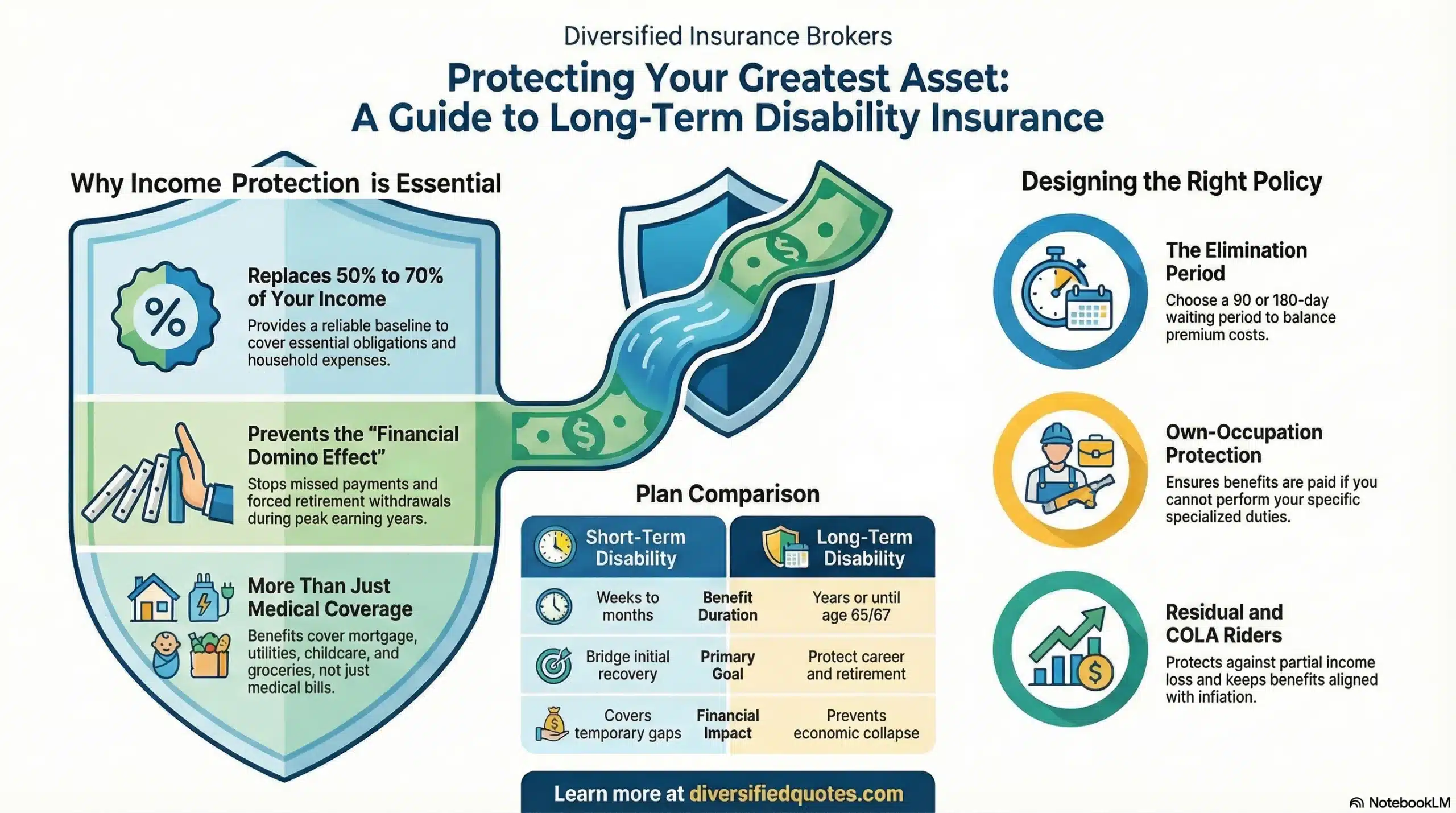
Talk With an Advisor Today
Choose how you’d like to connect—call or message us, then book a time that works for you.
Schedule here:
calendly.com/jason-dibcompanies/diversified-quotes
Licensed in all 50 states • Fiduciary, family-owned since 1980
FAQs: Disability Insurance for Blacksmiths
What occupational class does blacksmithing receive for disability insurance?
Blacksmithing typically receives a lower-middle to middle occupational class assignment from most disability insurance carriers — a classification reflecting the documented burn and heat injury risk, repetitive hammer loading on the elbow and shoulder structures, forge environment chemical and smoke exposure, and sustained physical labor demands of working at the forge and anvil daily. This classification produces higher premiums per dollar of monthly benefit than top-tier sedentary occupations, but does not prevent blacksmiths from obtaining meaningful, comprehensive individual disability protection.
Occupational class assignments for blacksmithing vary between carriers, particularly based on whether the work is characterized primarily as artisan and custom production versus heavy industrial forging. A studio blacksmith doing ornamental ironwork and commissioned custom pieces may receive a different classification at some carriers than a production smith doing heavy-volume industrial forging work. This variation is one of the most important reasons to compare multiple carriers rather than applying to a single one: the classification difference can translate directly into meaningful premium differences for identical coverage terms. A residual disability benefit provision is especially important for blacksmiths, because the realistic disability scenarios in the trade — a burn recovery that limits forge time, an elbow condition that reduces hammer output but doesn’t completely stop work — frequently produce partial rather than total disability. A residual benefit pays a proportional benefit based on actual income loss from partial disability, addressing these common realistic scenarios directly.
Are disability insurance benefits taxable for a self-employed blacksmith?
For self-employed blacksmith studio owners and independent artisan smiths who purchase individual disability insurance and pay premiums with after-tax personal income, the monthly benefits received during a qualifying disability are generally received income-tax-free. This means the full monthly benefit reaches the household without income tax reduction — an important planning input when determining how large a benefit amount is needed to replace actual take-home forge income during a disability period. Whether disability insurance payments are taxable is a meaningful practical distinction between individual coverage paid personally versus employer-funded group coverage: the tax-free individual benefit replaces take-home income directly, while a taxable group benefit must be sized larger to deliver equivalent net household income.
Self-employed blacksmiths who deduct disability insurance premiums as a business expense should confirm the specific tax treatment with a tax professional, as the deduction may affect whether benefits received during a claim are taxable. For blacksmiths who teach forge classes, do contract work, or earn income from multiple sources alongside studio production, the income mix and premium payment structure may have specific tax implications worth confirming. This is one area where the blacksmith’s professional knowledge of accounting for self-employment income is an asset in understanding how the coverage works — ensuring the benefit amount selected actually covers the net household income that matters when the forge is not running.
Can forge smoke and respiratory conditions qualify as a disability insurance claim for a blacksmith?
Yes — individual disability insurance covers disability arising from respiratory conditions, including those that developed from forge environment chemical and combustion gas exposure, as long as the condition meets the policy’s definition of disability and no specific pre-existing respiratory exclusion applies. The critical distinction between individual disability insurance and workers’ compensation for this specific scenario is that individual DI does not require the condition to have arisen from a single discrete, documented workplace incident — it requires the condition to meet the disability definition, which a respiratory illness severe enough to prevent sustained forge work typically does.
Workers’ compensation frequently struggles to compensate blacksmiths’ forge-related respiratory conditions precisely because they develop cumulatively from sustained exposure over years rather than from a single dated incident that a workers’ comp claim requires. A blacksmith who develops COPD from years of coal forge smoke exposure faces a workers’ comp claim process that is difficult to establish causally and that is often denied for self-employed smiths entirely. Individual disability insurance covers the disability that results — without requiring causation documentation from a specific workplace incident. Blacksmiths who already have a documented respiratory history should expect underwriting scrutiny of that history. High-risk disability insurance options address the underwriting pathways available when existing respiratory conditions are part of the application — typically producing a partial exclusion rider for that specific condition while providing full coverage for all other disabling causes.
I teach blacksmithing workshops alongside my studio work — how does this affect my disability insurance?
Teaching blacksmithing workshops, classes, or apprenticeship programs alongside studio production work creates a blended income stream that is common in the artisan blacksmith profession and that has specific disability insurance implications. When disability strikes, it typically affects all physical work activities simultaneously — a smith who cannot swing a hammer due to an elbow condition cannot teach physical forge techniques any more effectively than they can produce commissioned work. Both income streams are interrupted by the same disability event, and the benefit amount should reflect the total earned income from all sources — production, instruction, commissions, contract work — rather than just the primary studio income.
Income documentation for underwriting purposes covers all earned income sources, and the maximum approvable monthly benefit is calculated from the total documented net earned income from all professional activities. For a blacksmith who earns significant income from teaching — particularly those who have built well-established instructional programs with regular workshop enrollment — the teaching income may represent a meaningful portion of the total earning picture that should be included in the benefit calculation rather than treated as secondary or supplemental. High-risk and specialty disability insurance options exist for blacksmiths whose combined income structure or occupational health history makes the standard underwriting process require more specialized navigation — an independent broker familiar with artisan craft occupations is the right resource for structuring the application to present the most accurate and complete income picture.
I’m a younger blacksmith building my studio — is it too early to buy disability insurance?
Early in a forge career is actually the most financially advantageous time to purchase disability insurance — for reasons that compound over the full trajectory of a blacksmithing career. Disability insurance premiums are age-rated, meaning the younger the applicant at issue, the lower the annual premium locked in for the policy’s duration. A blacksmith who secures coverage at 26 or 27 pays a substantially lower premium rate for a policy that protects their income all the way to age 65 compared to one who waits until 40 to address the coverage need — and the difference accumulates significantly over a 40-year policy term. Why young and healthy craft professionals need disability insurance is most directly answered by noting that the elbow conditions, shoulder injuries, and respiratory effects that accumulate over a forge career have not yet had time to develop at the beginning of that career — creating a window to secure comprehensive coverage without the pre-existing condition exclusions that develop alongside the career’s physical toll.
The future insurability rider available on most individual disability policies allows a blacksmith to increase their benefit amount as studio income grows — from early-career modest production to established custom work and potentially apprentice or employee operations — without undergoing new medical underwriting when that income growth occurs. An early-career smith who purchases a benefit sized to current income can increase it to match growing studio revenue without new health screening at that stage. This preserves the favorable health-based underwriting terms of early purchase through the full income trajectory of a forge career that may eventually support a substantial custom metalworking business.
My disability insurance quote seemed expensive — is there a better option for blacksmiths?
A single disability insurance quote from a single carrier is not a market comparison — it is one carrier’s price for one occupational class assignment on one product structure. For an artisan trade occupation like blacksmithing, premium levels and occupational class assignments vary between carriers in ways that make genuine market comparison the only accurate method of identifying the best available terms. A carrier that classifies studio ornamental blacksmithing more favorably than another carrier — recognizing the artistic and precision craft components of the work alongside the physical hazard elements — will produce meaningfully lower premiums for identical coverage terms. That difference is only discoverable through independent comparison, not through a single direct application.
Beyond pricing, the policy terms most worth comparing for blacksmiths are the disability definition, the residual benefit provision, the available benefit period options, and the elimination period flexibility. A policy that appears less expensive but uses an any-occupation definition that requires near-total incapacity to pay benefits delivers very different protection than one that costs more but uses a genuine own-occupation definition and includes a residual benefit for partial disability — the realistic outcome for many forge injuries and conditions. A second opinion on your disability insurance quote through an independent broker who accesses the full carrier market costs nothing and regularly reveals either more competitive premiums, better policy terms, or both. For blacksmiths who found the first quote too expensive to act on, genuine market comparison before declining coverage is always the right response.
About the Author:
Jason Stolz, CLTC, CRPC, DIA, CAA and Chief Underwriter at Diversified Insurance Brokers (NPN 20471358), is a senior insurance and retirement professional with more than 25 years of real-world experience helping individuals, families, and business owners protect their income, assets, and long-term financial stability. As a long-time partner of the nationally licensed independent agency Diversified Insurance Brokers, Jason provides trusted guidance across multiple specialties—including fixed and indexed annuities, long-term care planning, personal and business disability insurance, life insurance solutions, Group Health, Travel Medical and Evacuation Insurance, and short-term health coverage. Diversified Insurance Brokers maintains active contracts with over 100 highly rated insurance carriers, ensuring clients have access to a broad and competitive marketplace.
His practical, education-first approach has earned recognition in publications such as VoyageATL, and contributions from his agency featured in Kiplinger and GoBankingRates— highlighting his commitment to financial clarity and client-focused planning. Drawing on deep product knowledge and years of hands-on field experience, Jason helps clients evaluate carriers, compare strategies, and build retirement and protection plans that are both secure and cost-efficient. Visitors who want to explore current annuity rates and compare options across multiple insurers can also use this annuity quote and comparison tool.
Explore More Disability Insurance Options: Browse our complete guide to Disability Insurance for Trades, Construction & Industrial — covering contractors, electricians, plumbers, welders, roofers, machinists & skilled trades from 100+ carriers.
Last Reviewed: June 7, 2026 |
Reviewed by: Jason Stolz, CLTC, CRPC, DIA, CAA
Chief Underwriter, Diversified Insurance Brokers, Inc. | NPN: 20471358 | Diversified Insurance Brokers, Inc. — Licensed in all 50 states
Fact Checked by: Tonia Pettitt, CMIP©
Medicare Specialist, Diversified Insurance Brokers, Inc. | NPN: 14374308 | Diversified Insurance Brokers, Inc. — Licensed in all 50 states
Did you find this content helpful? Leave us a Google review — it helps others find trustworthy guidance too.
Editorial Standards: Diversified Insurance Brokers maintains rigorous editorial standards to ensure accuracy, clarity, and independence in all content. Learn more about our editorial standards and commitment to transparency.
