
Disability Insurance for Asbestos Removers
As an Independent Disability Insurance Broker, we have access to exclusive discounts and negotiated pricing most captive agents can’t offer — see the full breakdown near the end of this page.
Disability Insurance for Asbestos Removers

Jason Stolz CLTC, CRPC, DIA, CAA
Disability insurance for asbestos removers and abatement professionals addresses one of the most financially vulnerable occupation profiles in the American workforce. Asbestos abatement workers combine physically demanding labor — confined space work, heavy material handling, PPE-intensive environments — with documented long-term occupational health exposure that creates disability risk extending decades beyond the working years. The income-to-physical-capacity dependency is direct: when an abatement worker cannot perform the certified, regulated tasks that define the work, income stops. There is no desk duty version of asbestos removal and no comparable income alternative that preserves earnings without the same physical demands and certifications. The disability insurance services available to high-risk tradespeople address this specific exposure, and the broader income protection insurance framework covers how individual policies are structured for hazardous occupation workers whose income is entirely tied to active physical performance.
There are two important realities about disability insurance for asbestos removers that belong in the opening of any honest discussion. First, this is a high-risk occupation that creates genuine underwriting challenges — many standard disability insurance carriers decline asbestos abatement workers or offer coverage only with respiratory and pulmonary exclusions that remove the most occupation-specific disease risk from coverage. Second, coverage with a respiratory exclusion still provides significant financial protection against the full range of other disabling conditions — musculoskeletal injuries, cardiovascular events, neurological conditions, accidents, and any illness unrelated to respiratory or pulmonary function. Understanding both the limitations and the real value of available coverage is the foundation for making an informed decision. At Diversified Insurance Brokers, we help abatement workers navigate the carrier landscape honestly, structure coverage around what is actually available, and evaluate whether the coverage achievable provides meaningful financial protection for their specific situation. The disability insurance by occupation framework covers how carriers classify high-risk trade occupations and what that means for available coverage.
Compare Disability Insurance for Asbestos Removers
We compare options across 100+ carriers — including those with programs for high-risk trades — and structure coverage around what is genuinely available and valuable for abatement professionals.
Request Disability Insurance OptionsDisability Insurance for Asbestos Removers — Occupational Profile, Risk Factors, and Coverage Realities
| Coverage Dimension | The Asbestos Abatement Reality | What Coverage Looks Like in Practice |
|---|---|---|
| Occupational class and carrier availability | Asbestos removal is a lower occupational class reflecting physical hazard, chemical exposure, and elevated claim risk; many standard individual DI carriers decline this occupation entirely; those that offer coverage often do so at higher premium rates and with condition-specific exclusions | Independent broker access to the full market — including carriers with specific programs for hazardous trade occupations — is essential for this occupation; a single-carrier application to a standard market carrier will typically produce a decline; finding coverage requires systematic market comparison across carriers who will evaluate hazardous trade workers |
| Respiratory exclusions — what they mean and what they don’t | Carriers who will cover asbestos workers often attach respiratory, pulmonary, or asbestos-related condition exclusions; this removes from coverage the specific occupational disease risk most associated with asbestos work — asbestosis, mesothelioma, lung cancer from asbestos exposure — while leaving all other causes of disability covered | Coverage with a respiratory exclusion still protects against musculoskeletal injuries (back, knee, shoulder), cardiovascular conditions, neurological conditions, accidents, cancers unrelated to respiratory function, mental health conditions, and all other non-excluded causes; this represents a meaningful portion of realistic disability causes for active working-age abatement professionals and may be the best achievable option for this occupation |
| Workers’ compensation and its limitations | Workers’ comp covers asbestos-related occupational diseases including asbestosis and mesothelioma — but pays approximately two-thirds of average weekly wages up to a state maximum, which may fall well below actual earnings; mesothelioma’s 20-50 year latency period means diagnosis often occurs after workers’ comp filing deadlines have passed; workers’ comp does not cover illnesses or injuries unrelated to workplace asbestos exposure | Individual disability insurance does not replace workers’ comp but fills the income gap for the full range of disability causes workers’ comp does not cover — the 95%+ of disabling conditions that are not work-related; even for work-related asbestos diseases, individual insurance (if not excluded) may provide benefits workers’ comp leaves inadequate |
| Physical injury risks beyond chemical exposure | Abatement work involves extreme physical demands independent of chemical exposure: back and musculoskeletal injuries from heavy material handling and confined space work; falls in buildings with damaged or structurally compromised areas; heat stress from full PPE including respirators; repetitive strain from abatement equipment operation; these acute physical injury risks create near-term disability exposure alongside the long-term disease risk | These physical injury risks are typically NOT excluded from disability coverage — they represent the most immediately realistic disability scenarios for currently active abatement workers; coverage for musculoskeletal, acute injury, and physical accident disabilities provides genuine near-term financial protection even when respiratory exclusions are attached |
| Income structure — hourly and project-based work | Most asbestos abatement workers earn hourly or project-based wages; some are union members with associated benefit structures, others work for private contractors with limited group benefits; self-employed abatement contractors have no employer disability coverage whatsoever; income stops immediately when work stops | Benefit sized to documented earned income from W-2 wages or Schedule C income; elimination period matched to available savings; for workers with no employer sick leave or short-term disability, shorter elimination periods (30-60 days) reduce financial crisis risk during the initial gap; for union members with strong benefit packages, evaluate what existing union benefits provide before sizing supplemental coverage |
| No-exam and simplified issue options | When full-underwriting individual DI products are unavailable or prohibitively priced for asbestos workers, simplified issue or no-exam products from carriers with specific high-risk trade programs may provide an alternative path to coverage; these products typically have lower maximum benefit amounts and shorter benefit periods than fully underwritten policies | No-exam products represent a partial solution — not ideal, but meaningful income protection for workers who cannot access fully underwritten coverage; some benefit is substantially better than no benefit for a worker facing the physical disability risks of abatement work; an independent broker compares available options across both markets |
The Physical Demands and Near-Term Disability Risks
Asbestos removal is physically intensive in ways that create real near-term disability risk beyond the long-latency disease concerns. Abatement workers remove materials from confined spaces — attics, crawlspaces, mechanical rooms, pipe chases — that require sustained contorted postures that place extreme stress on the back and neck. Heavy material handling for bagging and removal of abatement materials creates acute musculoskeletal injury risk. Working in buildings undergoing demolition or remediation exposes workers to structurally unstable areas where falls from ladders and scaffolding are a genuine risk. Full personal protective equipment including respirators creates extreme heat burden that can produce heat exhaustion and heat stroke in hot environments. Repetitive use of abatement tools — scrapers, drills, encapsulation equipment — over full working days creates repetitive strain risk in the wrists, shoulders, and elbows. All of these physical injury risks are distinct from the chemical exposure dimension and represent the immediate, near-career-span disability exposures that most realistically affect currently active workers. These risks parallel those faced by other hazardous trade workers: hazmat cleanup professionals who work in equally demanding PPE environments, welders with both chemical fume exposure and physical strain, boilermakers whose confined space work mirrors the confined space demands of abatement, and roofers whose elevated work and fall risk parallel the structural instability environments of abatement sites. The disability insurance for high-risk occupations framework covers how carrier markets approach hazardous trades broadly.
Workers’ Compensation — What It Covers and Where the Gaps Are
Workers’ compensation provides an important baseline for asbestos workers with work-related occupational diseases, but its limitations are substantial. Workers’ comp covers medical treatment and partial wage replacement — approximately two-thirds of average weekly wages up to a state maximum — for employees who develop mesothelioma, asbestosis, pleural disease, or other conditions from occupational asbestos exposure. The no-fault structure means employees do not need to prove employer negligence to receive these benefits. However, several critical limitations define what workers’ comp does not provide: the benefit rate is capped at state maximums that may substantially underreplace actual wages; the 20-50 year latency period of mesothelioma means diagnosis typically occurs long after most states’ workers’ comp filing deadlines have passed; workers’ comp covers only occupational disease — not the back injuries, cardiovascular events, accidents, and other non-asbestos disabilities that constitute the majority of disability risk during active working years; and self-employed contractors typically have no workers’ comp coverage at all. Individual disability insurance addresses the gaps that workers’ comp leaves: income protection for the range of non-work-related disabling conditions, supplemental protection when workers’ comp benefit amounts fall below actual income needs, and complete coverage for self-employed abatement contractors with no workers’ comp baseline. The structural parallel for other hazardous construction trades is covered at disability insurance for construction superintendents and workers and disability insurance for commercial painters, who face similar trade-based workers’ comp and individual coverage coordination questions.
Underwriting Realities and the Value of Independent Broker Access
Asbestos abatement is one of the occupations where independent broker access matters most in the individual disability insurance market. Standard personal DI carriers evaluate this occupation as too high-risk to cover under their normal underwriting guidelines — a reflexive decline rather than an individualized assessment. Carriers with specific programs for hazardous trade occupations approach the same occupational profile differently, using classification systems that account for the full occupational context rather than applying a blanket hazardous-occupation decline. Finding these carriers requires knowing which ones have programs for abatement workers and what their specific underwriting guidelines produce in terms of available benefit amounts, exclusions, and benefit periods. The difference between applying to one standard market carrier (which will likely decline) and systematically comparing the carriers with hazardous trade programs is the difference between concluding that disability insurance is unavailable and finding meaningful coverage that addresses the most realistic near-term financial risks. This principle applies across other hazardous occupation trades whose workers face similar market navigation challenges: exterminators with chemical exposure risk, workers in oil and natural gas industries with both physical and chemical hazard exposure, and basement waterproofers working in confined and chemically hazardous environments all benefit from the same independent market comparison approach. For self-employed abatement contractors, disability insurance for self-employed workers and disability insurance for 1099 workers cover the income documentation and policy structure considerations when no employer backup exists. The case for working with an independent disability insurance broker is especially strong for hazardous occupations where carrier selection determines whether coverage is available at all. For workers with an existing quote or policy who want an independent evaluation of whether better options exist, get a 2nd opinion on your disability insurance quote covers the review process.
Policy Design for Asbestos Abatement Workers
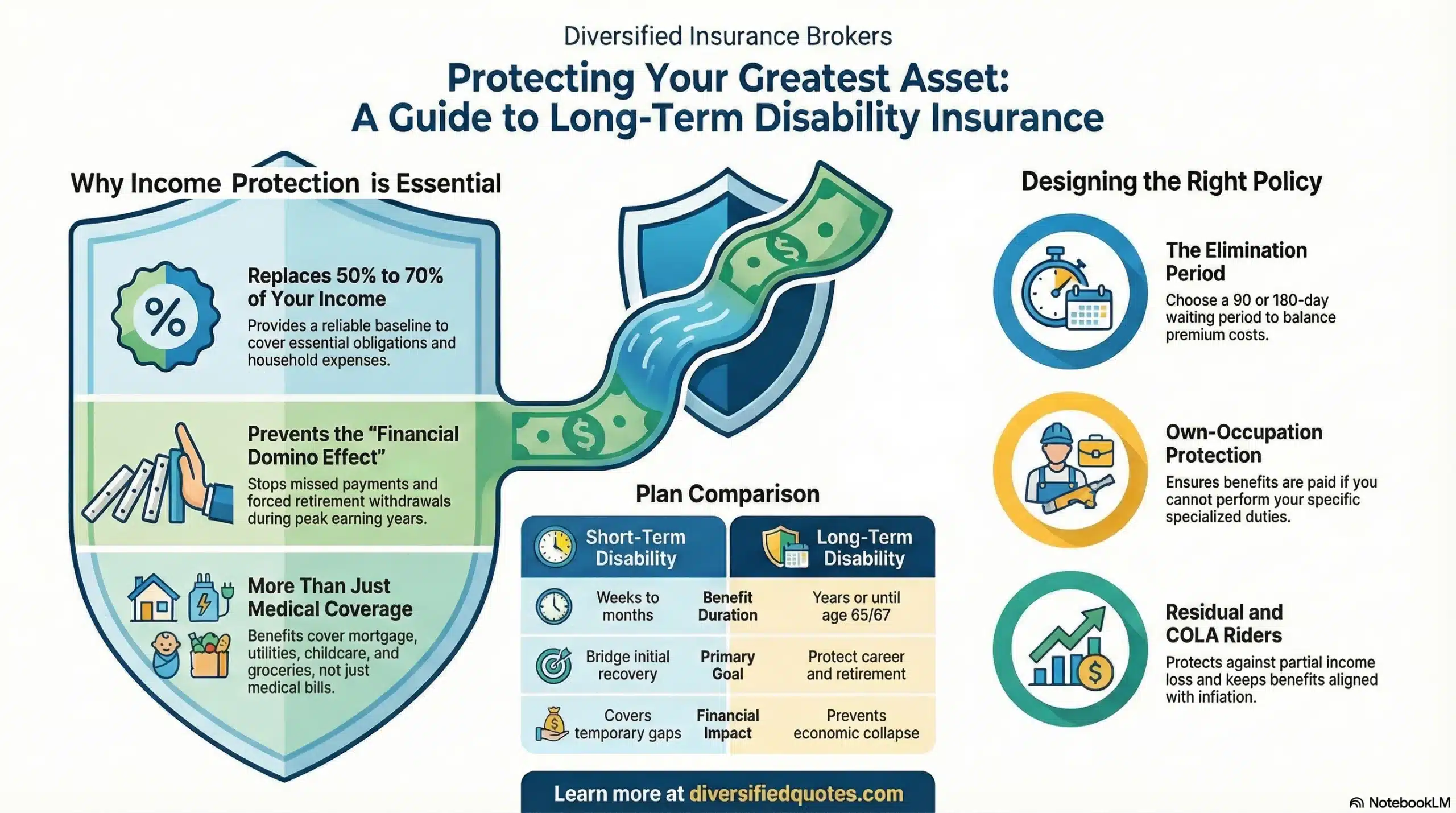
When coverage is available, the elimination period for abatement workers without employer sick leave should be short — 30-60 days — because income stops immediately when work stops and savings without an employer buffer may be limited. The benefit period for long-term disability insurance should extend as far as the carrier permits given the occupational class; some carriers restrict benefit periods for lower-class occupations to 2-5 years rather than to-age-65, and understanding what is achievable before committing to a carrier is part of evaluating options. The residual disability rider captures partial income loss when reduced physical capacity limits work hours or project volume without completely stopping work — often the most realistic early-stage disability pattern for physical trades. Tax treatment of individually owned benefits from after-tax premium payment — generally received income-tax-free — is at are disability insurance payments taxable. Benefit sizing for hourly and project-based workers is at how much disability insurance do I need.
Talk With an Advisor Today
Choose how you’d like to connect—call or message us, then book a time that works for you.
Schedule here:
calendly.com/jason-dibcompanies/diversified-quotes
Licensed in all 50 states • Fiduciary, family-owned since 1980
FAQs: Disability Insurance for Asbestos Removers
Can asbestos removers actually get disability insurance, or is the occupation uninsurable?
Asbestos abatement workers can generally get some form of disability insurance, but the market is more limited than for other occupations. Many standard individual DI carriers will decline this occupation entirely due to the hazardous exposure and elevated claim risk. However, carriers with specific programs for high-risk and hazardous trade occupations evaluate the same applicant differently and may offer coverage — often with respiratory or pulmonary exclusions, at higher premiums, or with shorter benefit periods than are available to lower-risk occupations. An independent broker who regularly works with hazardous trade workers can identify which carriers will consider this occupation and what coverage terms are available. The answer is not “uninsurable” but rather “requires targeted market access that a single-carrier application or standard market broker cannot provide.”
What is a respiratory or pulmonary exclusion and does it make coverage worthless?
A respiratory or pulmonary exclusion means the policy will not pay benefits for disabilities caused by respiratory or pulmonary conditions — which would include asbestosis, mesothelioma, lung disease, and other asbestos-related conditions directly relevant to occupational exposure. This exclusion removes the most occupation-specific long-term disease coverage from the policy. However, it does not make coverage worthless for currently active working-age abatement professionals. Coverage remains in place for the full range of other disabling conditions: back, knee, and shoulder injuries from physical work; cardiovascular conditions; neurological conditions; cancers unrelated to respiratory function; vehicle accidents and other physical accidents; mental health conditions; and any other non-respiratory cause of disability. For workers in their active career years, these non-respiratory disabilities represent a significant portion of realistic near-term disability risk. A policy with a respiratory exclusion is less comprehensive than full coverage, but it still provides meaningful financial protection for the most immediately relevant disability scenarios.
Doesn’t workers’ compensation cover asbestos-related disability?
Workers’ compensation covers work-related asbestos diseases — mesothelioma, asbestosis, pleural disease — for qualifying employees with occupational exposure. But workers’ comp has significant limitations: it pays approximately two-thirds of average weekly wages up to a state maximum that may be well below actual earnings; the 20-50 year latency period of mesothelioma means diagnosis often occurs after workers’ comp filing deadlines have passed; it does not cover the majority of disabling conditions that affect working adults — illnesses and injuries unrelated to workplace asbestos exposure; and self-employed contractors typically have no workers’ comp coverage. Individual disability insurance is not a replacement for workers’ comp but fills the substantial gaps workers’ comp leaves for the full range of non-occupational disability causes.
What are the most realistic short-term disability risks for currently active abatement workers?
The most immediately realistic disability risks for currently active abatement workers are physical injuries distinct from the long-latency chemical exposure diseases. Back injuries from heavy material handling and confined space work postures are extremely common in trades that involve the same physical demands as abatement. Falls at structurally unstable or damaged properties represent acute injury risk. Heat stress from full PPE in hot environments can produce incapacitating health events. Repetitive strain from sustained tool use affects wrists, shoulders, and elbows. Vehicle accidents from daily travel between job sites are a consistent occupational risk across all field-based trades. These physical injury categories are typically not excluded from disability coverage and represent the near-term financial risks that individual disability insurance most directly addresses for working abatement professionals.
Are there disability insurance options for self-employed asbestos abatement contractors?
Yes — the same individual disability market that covers employed abatement workers is available to self-employed contractors. Self-employed abatement contractors document income through tax returns and may face additional underwriting scrutiny because variable project-based income creates income documentation complexity alongside the occupational hazard classification. However, the absence of any employer disability safety net makes individual coverage even more important for self-employed contractors, since workers’ compensation for self-employed contractors is typically unavailable or optional depending on state law. An independent broker compares carriers across both the standard market and carriers with specific high-risk trade programs to find the best available terms for the contractor’s specific occupation, income documentation, and coverage needs.
About the Author:
Jason Stolz, CLTC, CRPC, DIA, CAA and Chief Underwriter at Diversified Insurance Brokers (NPN 20471358), is a senior insurance and retirement professional with more than 25 years of real-world experience helping individuals, families, and business owners protect their income, assets, and long-term financial stability. As a long-time partner of the nationally licensed independent agency Diversified Insurance Brokers, Jason provides trusted guidance across multiple specialties—including fixed and indexed annuities, long-term care planning, personal and business disability insurance, life insurance solutions, Group Health, Travel Medical and Evacuation Insurance, and short-term health coverage. Diversified Insurance Brokers maintains active contracts with over 100 highly rated insurance carriers, ensuring clients have access to a broad and competitive marketplace.
His practical, education-first approach has earned recognition in publications such as VoyageATL, and contributions from his agency featured in Kiplinger and GoBankingRates— highlighting his commitment to financial clarity and client-focused planning. Drawing on deep product knowledge and years of hands-on field experience, Jason helps clients evaluate carriers, compare strategies, and build retirement and protection plans that are both secure and cost-efficient. Visitors who want to explore current annuity rates and compare options across multiple insurers can also use this annuity quote and comparison tool.
Explore More Disability Insurance Options: Browse our complete guide to Disability Insurance for Trades, Construction & Industrial — covering contractors, electricians, plumbers, welders, roofers, machinists & skilled trades from 100+ carriers.
Last Reviewed: June 6, 2026 |
Reviewed by: Jason Stolz, CLTC, CRPC, DIA, CAA
Chief Underwriter, Diversified Insurance Brokers, Inc. | NPN: 20471358 | Diversified Insurance Brokers, Inc. — Licensed in all 50 states
Fact Checked by: Tonia Pettitt, CMIP©
Medicare Specialist, Diversified Insurance Brokers, Inc. | NPN: 14374308 | Diversified Insurance Brokers, Inc. — Licensed in all 50 states
Did you find this content helpful? Leave us a Google review — it helps others find trustworthy guidance too.
Editorial Standards: Diversified Insurance Brokers maintains rigorous editorial standards to ensure accuracy, clarity, and independence in all content. Learn more about our editorial standards and commitment to transparency.
