
Disability Insurance for Airline Security Personnel
As an Independent Disability Insurance Broker, we have access to exclusive discounts and negotiated pricing most captive agents can’t offer — see the full breakdown near the end of this page.
Disability Insurance for Airline Security Personnel

Jason Stolz CLTC, CRPC, DIA, CAA
Airline security personnel — including TSA Transportation Security Officers, airport screening staff, private airport security contractors, and aviation security supervisors — work in one of the most physically demanding and psychologically stressful environments in the transportation sector. A shift involves hours of standing at screening stations, repeatedly lifting carry-on baggage onto conveyor systems, performing physical pat-downs, operating scanning equipment with repetitive arm and wrist motions, and remaining in a sustained state of situational awareness that produces meaningful mental fatigue over time. The combination of repetitive physical demands and constant vigilance creates a disability risk profile that is more acute than most airline security workers realize — and the federal benefits or employer-sponsored coverage available to many of these workers leaves larger income protection gaps than most expect. The disability insurance services available to public safety and security professionals are specifically structured to fill those gaps, and the income protection insurance framework covers how individual policies coordinate with existing employer or government benefits to build a complete income protection plan.
The highest-volume disabling conditions for TSA officers and airport security workers are musculoskeletal — back injuries and disc conditions from lifting heavy baggage onto carousels and maintaining static standing postures across long shifts, shoulder and rotator cuff injuries from repeated overhead searching and pat-down motions, carpal tunnel syndrome from the gripping and repetitive wrist motions involved in bag searches and equipment operation, and knee conditions from sustained standing on hard terminal floors. These are not theoretical risks: TSA workers have historically reported injury rates among the highest in the federal workforce, and FECA workers’ compensation claims from this occupation category reflect high volumes of exactly these injury types. Layered on top of physical injury risk is the mental health exposure that comes with a high-threat, high-passenger-volume environment — PTSD, anxiety disorders, and stress-related conditions are documented consequences of sustained security work that involves potential physical threats, confrontational passenger interactions, and the psychological weight of responsibility for aviation safety.
At Diversified Insurance Brokers, we help airline security professionals understand what their current coverage actually provides — and where the gaps are — so that an individual disability policy can be sized and structured to address the specific income exposure that federal or employer benefits do not cover.
Compare Disability Insurance for Airline Security Personnel
We compare coverage across 100+ carriers and structure policies around the specific income and occupational risk profile of security and aviation safety roles.
Request Disability Insurance OptionsAirline Security Disability Insurance — Occupational Risk, Coverage Gaps, and Policy Design
Understanding the real disability risk profile for airline security personnel — and where existing federal or employer coverage falls short — is the foundation for building meaningful income protection. The table below maps the key dimensions of this coverage decision.
| Coverage Dimension | The Reality for Airline Security Personnel | What Individual DI Coverage Addresses |
|---|---|---|
| Federal (FERS) disability retirement gaps | FERS disability retirement pays 60% of the high-3 average salary in year one, dropping to 40% thereafter; shifts from a job-specific to an any-occupation standard after the first year; is not portable beyond federal employment; and does not cover non-work-related health conditions unless paired with OWCP | Individual disability insurance fills the income gap between FERS payments and actual monthly financial obligations; own-occupation coverage protects against conditions that prevent security work specifically even when other employment would theoretically remain possible; portable coverage travels with the worker regardless of future employment changes |
| FECA/OWCP coverage limitations | The Federal Employees’ Compensation Act provides wage replacement for work-related injuries — 66.67% of salary without dependents, 75% with dependents, tax-free — but only for on-the-job injuries and occupational illness; health conditions, non-work accidents, and illnesses unrelated to workplace exposure receive nothing under OWCP | Individual policies cover disability from any cause — not just work-related events — creating income protection for the full range of conditions that can interrupt a security career, including illnesses, off-duty injuries, and mental health conditions regardless of workplace connection |
| Private/contractor employment gaps | Private airport security contractors — including personnel employed by security firms operating at airports rather than directly as federal employees — often have limited or no employer-sponsored LTD; short-term disability may exist but provide only weeks of coverage, and group plans may carry any-occupation definitions that are difficult to satisfy | Individual own-occupation LTD provides income protection that does not depend on employer offerings, does not terminate when jobs change, and is sized to actual income and expenses rather than plan-mandated caps |
| Musculoskeletal injury exposure | Back injuries, disc conditions, rotator cuff and shoulder damage, carpal tunnel syndrome, and knee conditions from repeated heavy baggage lifting, extended standing, and repetitive pat-down and scanning motions are the highest-volume disabling conditions for TSA and airport security workers | Residual disability coverage pays proportional benefits during the partial recovery phase — when an airline security worker can perform some but not all job functions — which is the most realistic pattern for musculoskeletal recovery; total disability coverage addresses career-ending conditions |
| Mental health and PTSD exposure | Sustained vigilance in a high-threat environment, confrontational passenger interactions, physical altercations, and the psychological weight of aviation security responsibility create meaningful exposure to PTSD, anxiety disorders, burnout, and stress-related conditions that can prevent continued security work | Individual policies with unlimited mental/nervous benefit periods — rather than the 24-month caps common in group plans — provide sustained income replacement for mental health conditions; own-occupation coverage ensures that conditions preventing security-specific work trigger benefits even when the person is capable of other employment |
| Benefit period and portability | FERS and group plans are tied to employment status; a career change from federal employment to private security, or a job change within the private sector, can affect or terminate existing coverage — leaving the worker with a coverage gap that requires new underwriting at an older age or with existing health conditions | Individually owned policies with to-age-65 or to-age-67 benefit periods remain in force regardless of employer changes; coverage secured during healthy working years travels through the career without requiring re-qualification as health or age changes |
Physical Risks That Actually Disable Airline Security Workers
The injury categories that produce the highest volume of disability claims for airport security personnel are well-documented through FECA claims data and workers’ compensation records for this occupation. Back injuries and spinal disc conditions from lifting heavy carry-on luggage onto elevated conveyor carousels — performed thousands of times across career — are among the most common disabling conditions. Shoulder and rotator cuff injuries from repeated overhead arm motions during bag searches and physical pat-downs create cumulative damage that often progresses to a point requiring surgery or sustained limitation. Carpal tunnel syndrome from the repetitive gripping, scanning, and wrist motions central to the daily workflow represents one of the most consistent repetitive strain patterns in this occupation. Knee conditions from sustained standing on hard airport terminal floors through eight-hour shifts add to the joint damage profile over a long career. Each of these injury categories follows a gradual progression pattern — function deteriorates over time until a threshold is crossed where the physical demands of security work can no longer be safely met — rather than an acute single incident, which is exactly why the residual disability rider matters so much for security workers. The risk profile parallels what other physically demanding security and public safety roles face: law enforcement officers and correctional and jail security personnel face similar musculoskeletal and physical confrontation injury patterns, and the coverage design principles that apply to those roles apply directly to airline security work. For the high-risk occupations framework, the occupational class and definition considerations that determine how disability carriers treat security work versus desk-based roles are covered at disability insurance by occupation.
Why Own-Occupation Coverage Matters for Security Professionals
For airline security personnel, the definition of disability determines whether conditions that prevent security work actually produce benefits. The specific physical and mental capabilities required in security roles — sustained standing endurance, physical search and pat-down capability, rapid physical response capacity, sustained vigilance under high-passenger-volume conditions — can be genuinely and meaningfully impaired by common conditions while leaving the person capable of other types of employment. A back condition that prevents the repeated heavy lifting and prolonged standing of security work may still allow desk-based employment. A mental health condition that prevents the sustained high-alertness requirement of security screening may still allow other less stressful roles. Under an any-occupation definition, those remaining capabilities can justify a benefit denial. Under a true own-occupation disability policy, the inability to perform the material duties of the specific security role is sufficient to trigger benefits — the same principle that makes own-occupation coverage critical for SWAT team members, FBI agents, and detectives whose physical and situational capabilities define their professional function. The federal disability coverage structure that TSA employees fall under does not provide own-occupation protection after the first year — making an individual own-occupation policy the only mechanism that preserves this definition through the full working career. The parallel situation for military and federal security professionals who transition from government employment is covered at disability insurance for armed forces and military.
Mental Health, PTSD, and the Limits of Group Coverage
Airline security work creates sustained psychological exposure that produces real disability risk. High-passenger-volume environments, frequent confrontational interactions, physical altercations with non-compliant passengers, the psychological weight of being the last line of screening defense against aviation threats, and the compressed high-stakes decision-making required during security incidents all contribute to stress, burnout, anxiety, and PTSD that can prevent continued effective security performance. Mental health conditions account for a meaningful share of long-term disability claims among security and law enforcement professionals broadly — and the coverage terms that determine whether those claims are compensated are among the most important factors in evaluating any policy for security workers. Most group LTD plans cap mental and nervous condition benefits at 24 months — a duration that is frequently insufficient for serious anxiety disorders, PTSD, or burnout recovery that can span multiple years. Individual policies with unlimited mental/nervous benefit periods provide the sustained income protection that genuinely complex mental health recovery requires. The coverage considerations for conditions that may be pre-existing or arise from cumulative occupational stress are covered at disability insurance with preexisting conditions and high-risk disability insurance options for those with medical challenges.
Short-Term and Long-Term Coverage — How the Pieces Fit Together
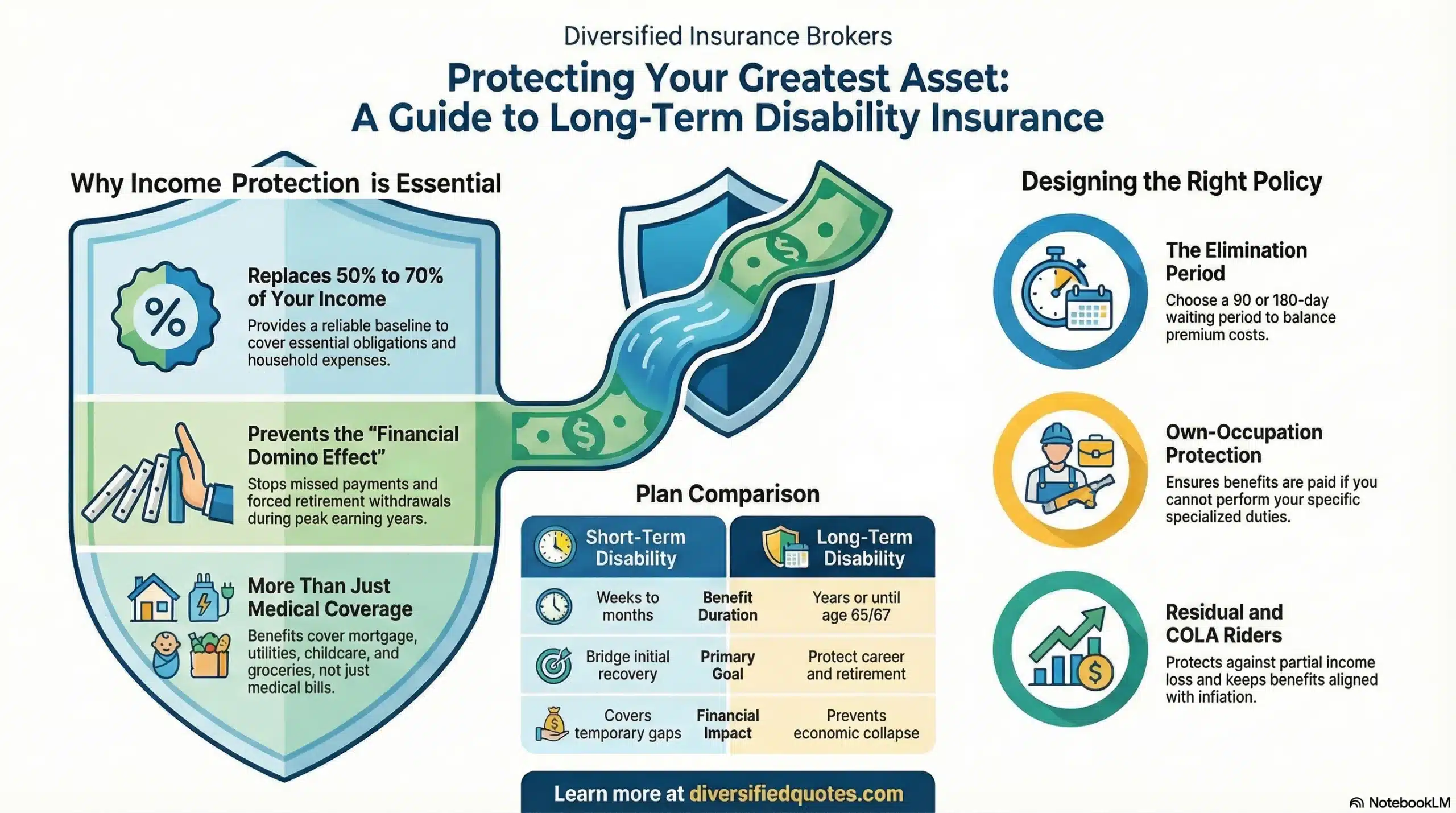
For TSA employees, OWCP/FECA provides temporary wage replacement for work-related injuries while claims are being processed — but this coverage has conditions and limitations that leave many workers financially exposed. For private airport security contractors, employer short-term disability may exist but typically covers only a few weeks. Short-term disability coverage addresses the acute early recovery phase. Long-term disability insurance addresses the extended or permanent income disruption that outlasts any short-term mechanism. The elimination period — the waiting period between onset and first benefit payment — should be selected based on what bridge resources are available: OWCP temporary compensation for work injuries, personal savings, or short-term disability can sometimes bridge a longer elimination period, while workers without those resources need a shorter one to avoid a coverage gap during initial recovery. The full rider landscape that determines long-term policy value, including COLA riders that protect benefit purchasing power during extended claims, is covered at disability insurance riders explained, and the COLA mechanism specifically is at disability income insurance with COLA.
Sizing the Right Benefit for Airline Security Income
TSA Transportation Security Officers typically earn approximately $45,000-$65,000 annually depending on airport location, pay band, and seniority. Private airport security contractors typically earn $35,000-$55,000 depending on employer and location. The right benefit amount for a disability policy is sized to actual monthly essential expenses — mortgage or rent, vehicle, household utilities, debt service, insurance premiums, and family obligations — rather than to a generic percentage of gross income. How much disability insurance do I need covers this calculation in practical terms. For TSA employees specifically, the FERS disability benefit should be factored into the gap analysis: if FERS would pay approximately 40% of the high-3 salary average, the individual policy benefit needs to cover the remaining essential expense exposure that FERS leaves unfunded. Benefits from individually owned policies where premiums were paid with after-tax dollars are generally received income-tax-free — meaning the effective replacement ratio is higher than the gross benefit percentage implies. The full tax framework is at are disability insurance payments taxable. The practical case for disability coverage for security professionals — including why the probability is higher than most workers assume — is covered at is disability insurance worth it.
Working With an Independent Broker
Disability coverage for security and public safety roles involves occupational class considerations, mental/nervous benefit period evaluation, and coordination with federal or employer benefits that vary significantly across carriers. Working with an independent disability insurance broker means comparing how multiple carriers classify airline security occupations, what definition quality each offers, and how policies coordinate with FERS or employer coverage to fill actual income gaps rather than creating redundancy. Neighboring public safety professions — firefighters and dispatchers — face similar carrier evaluation challenges where independent broker access produces meaningfully different outcomes than single-carrier submissions. For airline security workers who have received an existing quote or want an independent evaluation of current coverage, get a 2nd opinion on your disability insurance quote covers what that review involves.
Talk With an Advisor Today
Choose how you’d like to connect—call or message us, then book a time that works for you.
Schedule here:
calendly.com/jason-dibcompanies/diversified-quotes
Licensed in all 50 states • Fiduciary, family-owned since 1980
FAQs: Disability Insurance for Airline Security Personnel
Don’t TSA employees already have disability coverage through the federal government?
Partially — but the gaps are significant. TSA employees covered under FERS can qualify for disability retirement, which pays approximately 60% of the high-3 average salary in year one, dropping to roughly 40% thereafter. FERS disability also shifts to an any-occupation standard after the first year, meaning benefits can be reduced or terminated if the employee can work in any reasonably suited capacity. FECA/OWCP provides wage replacement for work-related injuries only — health conditions, off-duty injuries, and illnesses unrelated to workplace exposure are not covered. Individual disability insurance fills the income gap, covers all causes of disability rather than just work-related events, and provides portable own-occupation protection that follows the worker regardless of employment changes.
What are the most common disabilities for airline security workers?
Musculoskeletal conditions are the most common — back injuries and disc conditions from repeated heavy baggage lifting and extended standing, shoulder and rotator cuff injuries from overhead search and pat-down motions, carpal tunnel syndrome from repetitive wrist and gripping motions, and knee conditions from sustained standing on hard terminal floors. These typically progress gradually over time rather than appearing as single acute incidents. Mental health conditions including PTSD, anxiety disorders, and burnout from high-stress threat-monitoring environments are also a meaningful disability category for security personnel. TSA workers have historically reported injury rates among the highest in the federal workforce, reflecting the physical demands of the role at scale.
Does disability insurance cover PTSD and mental health conditions for security workers?
Individual disability policies typically include mental health and nervous condition coverage. The key difference from group plans is the benefit period: most group LTD policies cap mental/nervous benefits at 24 months, while quality individual policies provide unlimited benefit periods for mental health conditions matching the physical disability benefit period. For airline security workers with genuine PTSD or stress-related conditions that prevent continued security performance, an individual policy with unlimited mental/nervous coverage provides protection that group plans frequently do not. The own-occupation definition also matters — a mental health condition that prevents the high-vigilance demands of security screening should trigger benefits under own-occupation language, whereas any-occupation definitions may deny benefits because the person could theoretically perform a less demanding role.
What if I’m a private airport security contractor, not a TSA federal employee?
Private airport security contractors typically have less built-in protection than TSA federal employees — no FERS, no OWCP, and employer-provided group LTD that may have limited benefit amounts, any-occupation definitions, and 24-month mental health caps. The individual disability insurance planning need is often greater for private contractors than for TSA employees, precisely because fewer government-provided benefit layers exist as a fallback. Individual LTD sized to actual income and household expenses, with own-occupation language and unlimited mental/nervous coverage, provides the income protection that private contractors otherwise lack entirely.
How should an airline security worker size their disability benefit?
The right benefit amount is sized to the gap between actual monthly essential expenses and whatever existing coverage would pay. For TSA employees, that means calculating what FERS disability retirement would pay (approximately 40% of the high-3 salary average after year one) and determining how much individual coverage is needed to cover the remaining mortgage, utilities, debt service, family expenses, and other obligations. For private contractors with no government benefits, the full 60-70% income replacement target applies. Benefits from individually owned policies paid with after-tax premiums are generally received income-tax-free, which improves the effective replacement ratio relative to the gross benefit percentage.
About the Author:
Jason Stolz, CLTC, CRPC, DIA, CAA and Chief Underwriter at Diversified Insurance Brokers (NPN 20471358), is a senior insurance and retirement professional with more than 25 years of real-world experience helping individuals, families, and business owners protect their income, assets, and long-term financial stability. As a long-time partner of the nationally licensed independent agency Diversified Insurance Brokers, Jason provides trusted guidance across multiple specialties—including fixed and indexed annuities, long-term care planning, personal and business disability insurance, life insurance solutions, Group Health, Travel Medical and Evacuation Insurance, and short-term health coverage. Diversified Insurance Brokers maintains active contracts with over 100 highly rated insurance carriers, ensuring clients have access to a broad and competitive marketplace.
His practical, education-first approach has earned recognition in publications such as VoyageATL, and contributions from his agency featured in Kiplinger and GoBankingRates— highlighting his commitment to financial clarity and client-focused planning. Drawing on deep product knowledge and years of hands-on field experience, Jason helps clients evaluate carriers, compare strategies, and build retirement and protection plans that are both secure and cost-efficient. Visitors who want to explore current annuity rates and compare options across multiple insurers can also use this annuity quote and comparison tool.
Explore More Disability Insurance Options: Browse our complete guide to Disability Insurance for Public Safety, Military & Government — covering firefighters, law enforcement, military, pilots, TSA, SWAT & first responders from 100+ carriers.
Last Reviewed: June 6, 2026 |
Reviewed by: Jason Stolz, CLTC, CRPC, DIA, CAA
Chief Underwriter, Diversified Insurance Brokers, Inc. | NPN: 20471358 | Diversified Insurance Brokers, Inc. — Licensed in all 50 states
Fact Checked by: Tonia Pettitt, CMIP©
Medicare Specialist, Diversified Insurance Brokers, Inc. | NPN: 14374308 | Diversified Insurance Brokers, Inc. — Licensed in all 50 states
Did you find this content helpful? Leave us a Google review — it helps others find trustworthy guidance too.
Editorial Standards: Diversified Insurance Brokers maintains rigorous editorial standards to ensure accuracy, clarity, and independence in all content. Learn more about our editorial standards and commitment to transparency.
