
Disability Insurance for Prison and Jail Guards
As an Independent Disability Insurance Broker, we have access to exclusive discounts and negotiated pricing most captive agents can’t offer — see the full breakdown near the end of this page.
Disability Insurance for Prison and Jail Guards

Jason Stolz CLTC, CRPC, DIA, CAA
Disability insurance for prison and jail guards is essential income protection for corrections professionals who work in one of the most physically dangerous and psychologically demanding occupations in American public safety — and whose institutional benefit structures, while providing a meaningful foundation, leave specific and consequential income protection gaps that individual supplemental disability insurance directly addresses. Whether you serve as a correctional officer at a state prison, work as a jail guard at a county detention facility, operate as a federal Bureau of Prisons correctional officer, serve as a juvenile corrections officer, or work in any of the supervision, security, and control roles that keep correctional institutions functioning — your income depends on your physical and psychological capacity to perform hazardous close-quarters work in environments where violence, assault, and psychological trauma exposure are documented occupational constants.
Published research confirms that correctional officers face one of the highest nonfatal injury rates of any occupation in the United States. A NIOSH study published in the Journal of Safety Research specifically documents that the nonfatal injury rate requiring at least one day of missed work for correctional officers was 445.6 per 10,000 full-time workers — roughly four times the all-occupation rate of 117.2 per 10,000 full-time workers. In the years examined, correctional officers incurred the highest number of injuries resulting in days away from work among all state government employees — not just among law enforcement, but among every single state government occupation category. Survey research documents that 29% of corrections officers report being seriously injured at work, and published national research finds that 100% of correctional officers had been exposed to at least one violence, injury, or death incident during their career, with an average of 28 such events reported per officer. These are not marginal risk statistics — they describe the documented daily occupational reality of corrections work.
At Diversified Insurance Brokers, we help correctional officers, jail guards, detention officers, and corrections professionals at the federal, state, and county level structure disability insurance coverage that reflects the genuine occupational hazards of corrections work, the limitations of their institutional benefit structures, and the specific conditions most likely to interrupt or end a corrections career and income.
Protect Your Corrections Officer Income
Compare disability insurance options designed for correctional officers, jail guards, detention officers, and corrections professionals at federal, state, and county facilities.
Request Disability Insurance OptionsThe Documented Hazard Profile of Corrections Work
Disability insurance for prison and jail guards begins with an accurate accounting of what published occupational health research documents about corrections work — because the public perception of correctional officers as supervisors in a controlled institutional environment significantly underestimates the genuine physical danger of the occupation.
Inmate assault is the defining occupational hazard of corrections work and the injury source most unique to this profession. Published research documents inmate battery incidence rates of 65.3 per 100,000 work hours for correctional officers, with injury rates of 16.8 per 100,000 work hours from those incidents. These assault events produce the full spectrum of serious physical injuries — blunt force trauma from punches and kicks, lacerations from improvised weapons and shanks, injuries from thrown objects, injuries sustained while breaking up inmate fights or restraining resistive inmates, and injuries from group assaults where multiple inmates attack simultaneously. An officer who is seriously assaulted during a cell extraction, a dormitory disturbance, or a transport operation can sustain traumatic brain injuries, fractures, spinal injuries, and soft tissue damage whose recovery timelines are measured in months and whose permanent consequences can prevent return to active corrections duty.
The corrections work environment produces assault injury rates at levels that substantially exceed other law enforcement contexts — in part because of the chronic understaffing that published research documents, with the ratio of incarcerated persons to correctional officers reaching 4-to-1 by mid-2022, compared to 3-to-1 in 2020. When officers manage larger inmate populations with less backup, the risk of serious injury from any individual confrontation is amplified because there are fewer officers available to respond quickly. The assault and physical injury disability risk profile of correctional officers is among the highest documented for any uniformed public safety occupation, paralleling the remote and outnumbered hazard dimensions documented for other high-risk law enforcement contexts, including game wardens and other law enforcement professionals managing solo and outnumbered enforcement contact risk.
Musculoskeletal Injuries From Physical Use-of-Force and Restraint
Beyond direct assault injuries, correctional officers sustain significant musculoskeletal disability from the physical demands of use-of-force applications, inmate restraint, and the sustained physical requirements of corrections work. Breaking up inmate fights — which requires officers to physically intervene between combatants who are themselves actively fighting — produces the same acute injury spectrum as assault, with the additional mechanical injury risk of awkward body mechanics under dynamic load. Cell extractions — where officers physically remove non-compliant inmates from cells — require sustained heavy exertion in confined spaces with unpredictable inmate resistance, producing back injuries, shoulder injuries, and knee injuries from the specific body mechanics of close-quarters physical control.
Published research specifically identifies overexertion as a major nonfatal injury source for correctional officers, noting that job duties including restraining inmates or breaking up fights, moving heavy furniture or equipment during contraband searches, and standing for prolonged periods to supervise inmates all create elevated musculoskeletal injury risk. A correctional officer who develops a serious lumbar disc herniation from a cell extraction or fight response, or who accumulates the cumulative spinal and joint loading of sustained use-of-force applications over a corrections career, faces exactly the physical disability scenario that own-occupation disability insurance specifically protects against. The musculoskeletal overexertion and use-of-force injury disability risk for correctional officers parallels that documented for other physically demanding government public safety roles, including public safety professionals managing physical occupation disability risk alongside government benefit coordination.
PTSD and Psychological Disability — The Defining Long-Term Career Risk
The psychological disability dimension of corrections work is one of the most severe and most extensively documented of any profession in published occupational health research. Survey research finds that approximately 50% of all correctional officers report that they rarely feel safe at work — and those officers report higher rates of digestive disease, hypertension, diabetes, and cardiovascular disease than their counterparts who feel safer. The combination of constant threat vigilance, chronic understaffing that amplifies vulnerability, routine exposure to violence and death, and the institutional culture that discourages seeking help creates a psychological occupational health burden that produces disabling outcomes at rates that are among the highest in any public safety profession.
A published national study documents that 100% of correctional officers had been exposed to at least one violence, injury, or death incident during their careers, with an average of 28 such exposures per officer. Published research specifically notes that inmate suicides and self-harm — which correctional officers regularly witness and respond to — constitute a specific traumatic content exposure that is distinct from and arguably more psychologically damaging than most other law enforcement traumatic exposures because officers often know the individuals involved and experience the event at close range in confined institutional spaces. The cumulative psychological burden of sustained violence exposure, death scene response, institutional isolation, and the specific stressors of corrections work produces PTSD, occupational depression, and burnout at rates that constitute genuine disability-producing outcomes for a meaningful share of the corrections officer population.
The specific PTSD finding that 17 correctional officers died from self-inflicted gunshot wounds in the workplace during the 10-year study period — documented in published NIOSH research — reflects the ultimate expression of a psychological disability burden that sits at the severe end of a spectrum that also includes PTSD and depression severe enough to prevent continued corrections service. Individual disability insurance that provides full benefit period mental health coverage — rather than the 24-month limitation that many policies impose even when the base policy pays to retirement age — is a critical policy evaluation priority for correctional officers whose career creates documented and extreme psychological disability risk. The documented PTSD and psychological disability risk from sustained corrections traumatic exposure parallels that facing other isolated and violence-exposed public safety professionals, including forest and park rangers managing PTSD and psychological disability risk from sustained remote traumatic incident response.
Bloodborne Pathogen and Infectious Disease Exposure
Correctional facilities house populations with significantly elevated rates of infectious disease compared to the general population — including tuberculosis, HIV, hepatitis B and C, and other communicable diseases — creating occupational infectious disease exposure risk for corrections officers that is specific to the institutional environment they work in daily. Bloodborne pathogen exposure during physical altercations, during medical emergency response, and from inmate-initiated biological threats — including deliberate exposure events where inmates throw bodily fluids at officers — creates documented occupational illness risk that falls outside the physical injury categories most people associate with corrections hazards.
Long-latency infectious disease consequences from occupational exposure — hepatitis C infection producing progressive liver disease, respiratory illness from tuberculosis exposure, and other chronic disease outcomes from institutional pathogen contact — represent disability-producing outcomes that individual disability insurance covers regardless of when the disabling illness develops after initial exposure. Applying for disability insurance before any occupational illness from institutional pathogen exposure has been documented in the medical record is therefore an important timing consideration for corrections officers, paralleling the long-latency occupational illness exposure considerations facing other professionals with sustained biological hazard exposure. The infectious disease and occupational illness exposure disability risk for correctional officers parallels contexts documented for other physical professionals in high-exposure institutional environments, including agricultural and environmental workers managing long-latency occupational illness disability risk from sustained biological exposure.
State and County Government Benefit Structures — Meaningful but Incomplete
Most correctional officers are employed by state departments of corrections or county sheriff’s offices and correctional agencies — and their disability protection depends on the specific benefit structure of their state or county employer. This creates substantial variation in the quality of institutional disability protection across jurisdictions, from states with relatively comprehensive disability retirement provisions to counties where disability benefits are minimal and individual disability insurance is the primary meaningful protection available.
State and county government group long-term disability plans typically replace 60% to 66.67% of base salary — excluding overtime, shift differential pay, and other supplemental compensation that many corrections officers depend on for meaningful portions of their total annual earnings. For corrections officers working mandatory overtime as a result of the chronic understaffing that affects most correctional systems, the exclusion of overtime earnings from disability benefit calculations creates a specific and significant income gap. Disability retirement provisions through state pension systems typically calculate benefits on years of service and final average salary — meaning that a corrections officer who is disabled early in their career may receive a disability retirement benefit representing a fraction of their active service income.
Federal Bureau of Prisons correctional officers are covered under FERS and face the same FERS disability retirement limitations documented for all federal employees — 60% of High-3 average base salary in year one, 40% thereafter, with availability pay and supplemental compensation excluded, taxable benefits, and a qualification process that requires the agency to consider reassignment to vacant positions before certifying disability retirement. The institutional benefit gap structure facing corrections officers mirrors that documented for other public safety professionals operating under government group disability plans, including investigators and public safety officers managing the income protection gap in government group disability frameworks.
Case Study: State Correctional Officer Earning $72,000 Per Year
Consider a state correctional officer with nine years of service earning $72,000 annually including base salary, shift differential, and regular overtime. During a facility disturbance response, this officer sustains a serious shoulder injury — a complete rotator cuff tear requiring surgical repair — and a concussion from being struck during the disturbance, requiring seven months of recovery during which corrections duty is medically prohibited.
| Scenario | State Group Plan Only | State Group Plan + Individual Supplement |
|---|---|---|
| Monthly Benefit During Recovery | ~$3,000 (60% of base salary only) | ~$3,000 group + $1,400–$1,800 individual supplement |
| Overtime and Shift Differential Protected | $0 — excluded from group benefit calculation | Individual policy calibrated to total compensation |
| 7-Month Total Income | ~$21,000 | ~$30,800–$33,600 |
| Own-Occupation Protection After Year 2 | Often converts to any-occupation — corrections duty disability may not qualify | Individual own-occupation definition maintained for full benefit period |
Inmate assault injuries during facility disturbances — including the rotator cuff tears, traumatic brain injuries, and orthopedic trauma produced by physical altercations in corrections environments — are among the most frequently occurring serious injuries in the corrections officer disability profile. Disability insurance for prison and jail guards ensures that a career-disrupting assault injury does not simultaneously produce a household financial crisis during recovery, particularly when overtime and shift differential income that the household depends on is excluded from the group plan benefit calculation.
Key Policy Features for Correctional Officer Disability Insurance
Disability insurance for prison and jail guards should incorporate specific policy provisions addressing the physical assault hazard profile, the psychological disability risk, the government group benefit coordination requirements, and the overtime income gaps that define the corrections officer disability planning context. The own-occupation definition is foundational — ensuring that a correctional officer who cannot perform the specific physical, alert, and responsive demands of active corrections duty receives disability benefits regardless of theoretical capacity for sedentary or less physically demanding work. Our comprehensive resource on own-occupation disability insurance explained covers how this definition protects corrections officer income from the conditions most likely to end an active corrections career.
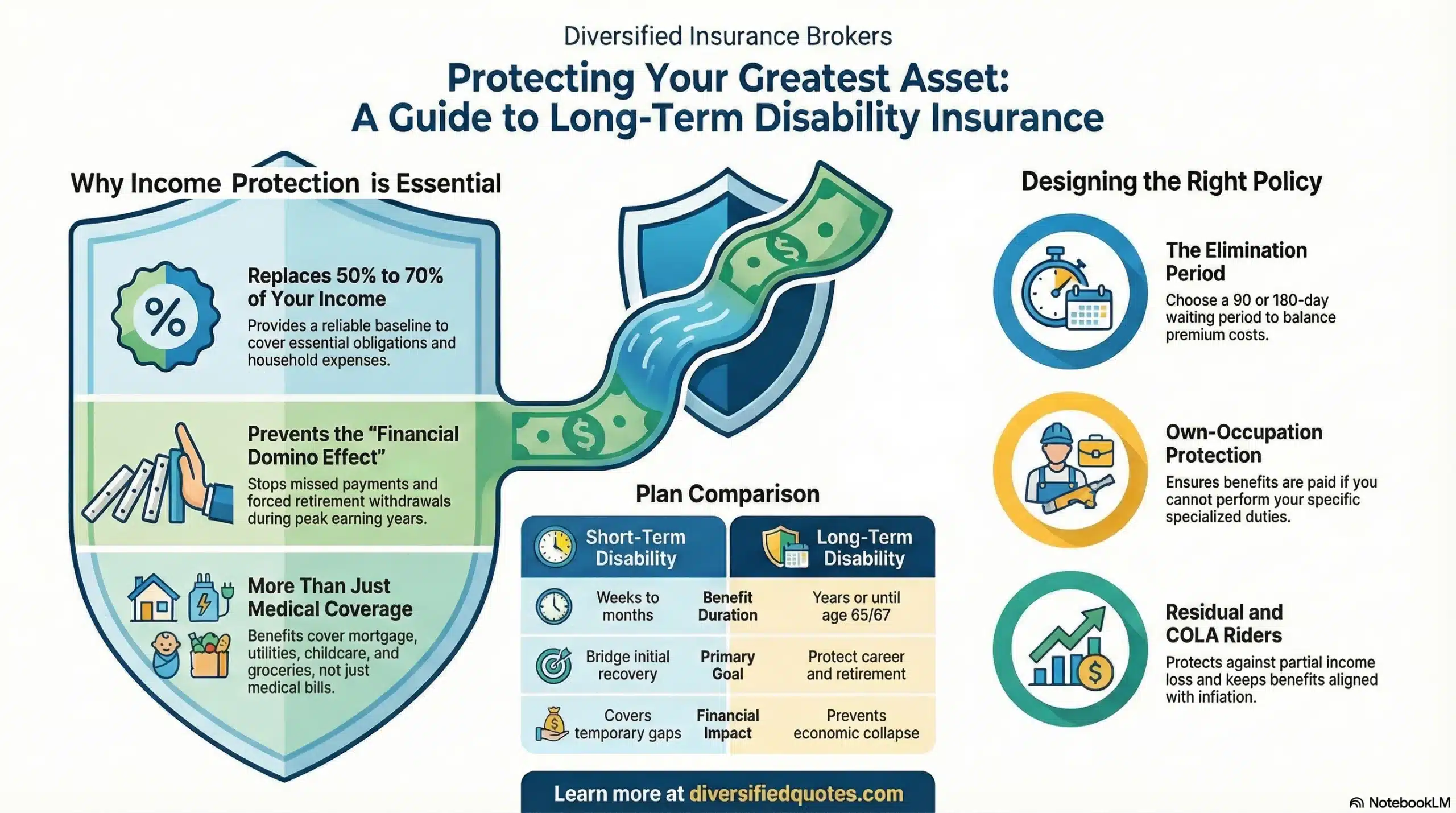
Mental health coverage provisions must be specifically evaluated for the full benefit period rather than a 24-month limitation — the documented 100% traumatic exposure rate and 28-event average per officer career creates genuine and ongoing PTSD and psychological disability risk that requires comprehensive benefit period coverage. A residual disability rider is important for officers whose injuries may reduce corrections duty capacity without eliminating it entirely. Our resource on how residual disability insurance benefits work explains partial disability coverage for graduated return-to-duty periods. The elimination period should account for sick leave accrual and workers’ compensation coverage for work-related assault injuries — our guide on how disability insurance elimination periods work provides the complete framework. A cost-of-living adjustment rider preserves real benefit value across extended disability periods — our resource on disability income insurance with a COLA rider explains this protection. For officers exploring short-term coverage options, our guide on how to buy short-term disability insurance covers the complete income protection picture.
Overtime and Shift Differential Income — The Critical Coverage Gap
The corrections profession operates under chronic understaffing conditions that produce mandatory overtime as a structural feature of corrections employment rather than an occasional supplement. Published research documents that the total number of people working in state and local corrections declined by approximately 12% — a loss of over 64,000 staff — between 2020 and 2023, creating staffing deficits that force surviving officers into mandatory overtime across most state and county correctional systems. For corrections officers whose total annual compensation includes substantial mandatory overtime earnings, the group disability plan calculation on base salary alone can represent a significant underprotection relative to actual household financial obligations.
An officer earning $50,000 in base salary with $20,000 in mandatory overtime — total compensation of $70,000 — receives group disability benefits calculated on the $50,000 base, leaving the $20,000 overtime component entirely unprotected. Individual disability insurance can be structured to cover total W-2 compensation including verified overtime earnings, ensuring the benefit amount reflects genuine earning capacity rather than just the base salary portion. This overtime income gap parallels the availability pay exclusion problem facing federal correctional officers and other federal law enforcement professionals, including those in specialized analytical and investigative roles that carry significant income beyond base pay, including professionals in federal and specialized employment managing supplemental compensation coverage gaps.
Cardiovascular and Stress-Related Disease — The Silent Long-Term Disability Risk
Published research documents that correctional officers who rarely feel safe at work — approximately 50% of the officer population in survey research — report higher rates of high blood pressure, diabetes, digestive disease, and cardiovascular disease than officers who feel safer. The sustained occupational stress of corrections work — constant threat vigilance, chronic understaffing that amplifies every individual risk, mandatory overtime that prevents adequate recovery, repeated trauma exposure, and the institutional isolation of working inside a correctional facility for extended periods — creates the psychophysiological stress burden that produces these elevated cardiovascular and metabolic disease rates.
A corrections officer who suffers a serious cardiac event mid-career — a myocardial infarction or a significant arrhythmia — and whose recovery timeline prevents return to the physical and alertness demands of active corrections duty faces a genuine occupational disability that individual disability insurance covers. The connection between occupational stress, chronic physiological stress loading, and cardiovascular disease in corrections professionals is documented in the occupational health literature — and the elevated disease rates in officers who feel unsafe at work suggest that the stress-disease pathway is specifically activated by the corrections work environment. Individual disability insurance covers cardiovascular disability regardless of cause, providing income replacement when stress-related disease produces career-ending outcomes. The stress-related cardiovascular disability risk for correctional officers parallels that documented in other sustained high-stress government public safety roles, including high-stress government professionals managing cardiovascular and chronic disease disability risk from sustained occupational stress.
Why Prison and Jail Guards Need an Independent Disability Insurance Broker
Disability insurance for prison and jail guards requires occupational classification expertise for a profession whose physical hazard profile places it in one of the most injury-intensive categories in government employment, knowledge of state and county government benefit coordination for the jurisdictional variation in institutional disability protection, understanding of overtime and shift differential income documentation for benefit calculation, and specific expertise in evaluating mental health coverage provisions for the documented PTSD and psychological disability risk of corrections work.
At Diversified Insurance Brokers, we work with correctional officers, jail guards, detention officers, and corrections professionals at all levels of government to structure individual disability insurance that supplements institutional protections, covers total corrections compensation including overtime and shift differential, provides own-occupation protection for the full benefit period, and delivers comprehensive mental health benefit period coverage for the documented psychological disability risk of corrections careers. Our dedicated resource on why independent disability insurance brokers matter explains the full value of this approach. And our resource on whether disability insurance is worth the investment provides the foundational financial case that applies with particular force to corrections professionals in one of the highest injury-rate occupations in all of government employment.
Final Thoughts on Disability Insurance for Prison and Jail Guards
Correctional officers and jail guards perform essential public safety work in conditions that produce the highest documented injury rates of any state government occupation category — working inside facilities where every shift involves the possibility of assault, where psychological trauma exposure is documented as universal, and where the physical and psychological demands of the work accumulate into disability risk that is among the most severe in any public safety profession. The institutional benefit structures that support them are meaningful but specifically limited in ways — overtime exclusions, own-occupation to any-occupation conversion risk, inadequate mental health benefit periods, qualification processes complicated by reassignment requirements — that individual supplemental disability insurance directly and specifically addresses.
Disability insurance for prison and jail guards — built around own-occupation protection for corrections duty specifically, comprehensive mental health benefit period coverage, overtime and shift differential income inclusion, and coordination with state and county group plan structures — provides the complete income protection that every corrections professional deserves for the dangerous and essential public service they perform inside some of America’s most challenging institutions.
Related Pages
Talk With an Advisor Today
Choose how you’d like to connect—call or message us, then book a time that works for you.
Schedule here:
calendly.com/jason-dibcompanies/diversified-quotes
Licensed in all 50 states • Fiduciary, family-owned since 1980
Disability Insurance for Prison and Jail Guards FAQs
Corrections work is documented by published occupational health research as one of the most dangerous occupations in the United States. A NIOSH study published in the Journal of Safety Research documents that the nonfatal injury rate requiring at least one day of missed work for correctional officers was 445.6 per 10,000 full-time workers — roughly four times the all-occupation rate of 117.2. In the years examined, correctional officers incurred the highest number of injuries resulting in days away from work among all state government employees — surpassing every other government occupation category. Survey research documents that 29% of corrections officers report being seriously injured at work, and a published national study found that 100% of correctional officers had been exposed to at least one violence, injury, or death incident during their career, with an average of 28 such events per officer. Approximately 50% of all corrections officers report that they rarely feel safe at work. These statistics describe a genuinely extreme occupational hazard profile that places corrections work among the most injury-intensive occupations in all of government employment. For context on disability insurance planning for other high-injury government public safety occupations, see our page on disability insurance for government and public safety professionals managing documented high-injury occupational risk.
Inmate assault injuries — from direct physical attacks, from breaking up inmate fights, from cell extractions, and from restraining resistive inmates — are the most distinctive and most frequently occurring disabling injury category in corrections work. These assault events produce traumatic brain injuries, fractures, spinal injuries, rotator cuff tears, shoulder injuries, and soft tissue damage whose recovery timelines are measured in months. Overexertion injuries from the physical demands of use-of-force applications, moving heavy equipment during contraband searches, and sustained physical control work produce back injuries, shoulder injuries, and musculoskeletal conditions that accumulate over a corrections career. Bloodborne pathogen exposure from altercations and deliberate biological exposure events creates infectious disease disability risk from hepatitis, tuberculosis, and other institutional pathogens. PTSD, occupational depression, and psychological health conditions from sustained trauma exposure — with 100% of officers reporting career violence exposure at an average of 28 events — produce psychological disability outcomes documented at rates among the highest of any public safety profession. Cardiovascular disease from chronic occupational stress, particularly for officers who report rarely feeling safe at work, represents a long-term physiological disability risk with published research supporting elevated rates of hypertension, cardiac disease, and diabetes in this population.
Yes — state and county corrections officers are covered by their state’s workers’ compensation system for work-related injuries including assault injuries sustained on duty. Federal Bureau of Prisons officers are covered under FECA through the DOL OWCP system. Workers’ compensation and FECA provide medical treatment coverage and partial wage replacement for approved work-related injury claims. However, these systems have the same structural limitations that affect all workers’ compensation: wage replacement of two-thirds to three-quarters of regular wages only, with overtime, shift differentials, and supplemental pay excluded; coverage limited to work-related injury events only, with off-duty injuries, illness, and non-work-related disability receiving no benefit; and benefits that end at maximum medical improvement rather than when the officer has fully regained the physical and cognitive capacity for active corrections duty. Individual disability insurance fills these specific gaps — covering any cause of disability regardless of origin, for the full benefit period, at benefit amounts calibrated to total compensation including overtime and shift differential, and remaining in force independently of workers’ compensation status and claim outcomes. For context on workers’ compensation limitations for public safety professionals, see our page on disability insurance for government professionals managing workers’ compensation coverage gaps with individual supplemental protection.
Many individual disability insurance policies provide coverage for mental health conditions including PTSD, major depression, and burnout-related illness when those conditions prevent performing occupational duties. For correctional officers — whose careers involve documented 100% exposure to violence, injury, or death incidents with an average of 28 such exposures per officer, plus routine response to inmate suicides, self-harm, violent assaults, and medical emergencies in confined institutional spaces — PTSD and psychological health disability are occupational risks of documented extreme severity. The most critical planning consideration for correctional officers evaluating mental health coverage is the benefit period: many policies limit mental health disability benefits to 24 months even when the base policy pays to age 65. For a corrections officer whose career involves decades of cumulative traumatic exposure, a 24-month mental health benefit limitation may provide materially inadequate protection for serious occupational PTSD or depression that requires extended treatment and recovery. At Diversified Insurance Brokers, we specifically evaluate mental health benefit period provisions and identify carriers offering full benefit period mental health coverage when structuring disability insurance for correctional officers and corrections professionals. This is one of the most important differentiating policy features for this specific professional population.
Own-occupation disability insurance pays benefits when a disabling condition prevents a correctional officer from performing the specific duties of their corrections role — maintaining physical alertness and readiness throughout an entire shift, responding to inmate disturbances and assaults, performing use-of-force and restraint applications, managing physical confrontations, and sustaining the physical fitness and reactive capability that corrections safety demands — regardless of whether they could theoretically perform other less physically demanding or less tactically demanding work. Any-occupation coverage only pays if the officer cannot perform virtually any gainful employment. A correctional officer whose traumatic brain injury from an assault permanently affects the reaction time, cognitive processing, and physical responsiveness required for safe corrections duty but who could theoretically perform sedentary data entry work would receive no any-occupation benefits — while an own-occupation policy recognizes the genuine inability to continue active corrections service and pays accordingly. The own-occupation distinction is also particularly consequential for state and county corrections officers because government group disability plans commonly shift from own-occupation to any-occupation definitions after two years — precisely where individual own-occupation supplemental coverage maintains benefits through the full recovery period. For context on own-occupation coverage for public safety and government professionals, see our page on disability insurance for government and analytical professionals managing the own-occupation definition in complex benefit frameworks.
Overtime pay is a structurally significant component of total annual compensation for most corrections officers — not a periodic supplement but a chronic feature of corrections employment produced by the systematic understaffing that affects nearly every state and county correctional system. Published research documents that total corrections staffing declined by approximately 12% — over 64,000 staff — between 2020 and 2023, forcing remaining officers into mandatory overtime as the operational response to these staffing deficits. State and county group disability plans calculate benefits on base salary, explicitly excluding overtime and shift differential pay from the benefit calculation. For a corrections officer earning $50,000 in base salary with $20,000 in mandatory overtime, the group plan benefit is calculated on the $50,000 base alone — leaving the $20,000 overtime component entirely unprotected. Individual disability insurance can be structured to cover total W-2 compensation including documented overtime earnings, ensuring the benefit amount reflects genuine earning capacity. Working with an independent broker who understands how to document corrections overtime earnings for disability insurance underwriting is essential for securing benefit amounts that reflect actual annual compensation rather than just the base pay portion that the group plan covers.
Residual disability coverage pays proportional benefits when a disabling condition reduces a correctional officer’s corrections duty capacity without completely eliminating the ability to work. A corrections officer recovering from a serious assault injury — a shoulder surgical repair, a concussion rehabilitation, a back injury recovery — may be medically cleared for modified duty or administrative assignment months before they can safely return to full corrections floor duty including physical confrontation response and use-of-force applications. During this graduated return-to-duty period, full active corrections pay and any overtime associated with active duty may be reduced or unavailable without the officer being totally disabled. Without a residual disability rider, a total-disability-only policy pays nothing during this partial capacity period. A residual rider supplements reduced corrections income proportionally throughout the graduated return to full duty, providing continuous financial support from disability onset through complete return to unrestricted active corrections service. For correctional officers whose most common disabling conditions — assault injuries, orthopedic surgery recovery, PTSD treatment — typically follow extended graduated return-to-duty timelines rather than binary incapacity, the residual rider is essential for the disability policy to function as genuine income protection across the full recovery arc.
Elimination period selection for correctional officers should account for sick leave accrual, workers’ compensation coverage for work-related assault and injury events, and the nature of the disability — work-related events that activate workers’ compensation provide a different initial income bridge than non-work-related conditions that depend entirely on sick leave and personal savings. For work-related assault injuries where workers’ compensation activates to provide wage replacement from the early weeks of disability, a 90-day elimination period on an individual supplemental policy may be financially manageable for officers with strong sick leave banks. For non-work-related disabilities — off-duty injuries, illness, stress-related cardiovascular conditions, and psychological health conditions where the work-relatedness may be disputed — no workers’ compensation income is available, making the elimination period selection more dependent on available personal savings. Officers with limited sick leave accrual or limited personal financial reserves should evaluate 30 or 60-day elimination periods to ensure faster benefit access for non-work-related disability events that produce immediate income interruption without any institutional bridge. The determination of which elimination period is most appropriate requires honest assessment of whether sick leave reserves can realistically bridge the household through the full waiting period with zero pay coming in from any institutional source.
The best time is as early as possible in a corrections career — ideally within the first year of service, before any occupational health consequences from assault injuries, musculoskeletal loading from use-of-force work, mental health treatment from traumatic exposure, or cardiovascular findings from sustained occupational stress have accumulated in the medical record. Disability insurance premiums are based in part on age and health status at the time of application, and younger corrections officers in excellent health secure the most comprehensive coverage at the most favorable rates. Back and orthopedic conditions from physical corrections work, any mental health treatment history connected to occupational trauma exposure, and cardiovascular findings from corrections occupational stress can all result in exclusion riders or restricted policy terms if documented at application. The non-cancelable and guaranteed renewable provision locks in the early-career health rating for the policy’s entire duration, regardless of what occupational health developments occur during subsequent years of corrections service. A future increase option rider secured early also allows benefit amounts to grow with pay increases — including step increases, negotiated pay raises, and expanding overtime — without requiring new medical underwriting when health may have changed from years of physically and psychologically demanding corrections work.
An independent broker with public safety and government occupational underwriting expertise accesses multiple disability insurance carriers and compares occupational class assignments, own-occupation definition language, mental health benefit period provisions, overtime income documentation approaches, residual disability rider terms, and premium structures across the full marketplace. For correctional officers whose occupational profile combines extreme physical assault hazard, documented PTSD risk, variable state and county government benefit structures, and significant overtime income that group plans exclude, the differences between carriers in how they classify corrections duty, handle mental health benefit periods, and approach government employee income documentation produce meaningfully different real-world coverage outcomes. At Diversified Insurance Brokers, we evaluate the full competitive landscape for every corrections officer we work with — evaluating mental health benefit period provisions specifically for the documented psychological disability risk of corrections careers, ensuring overtime and shift differential income is properly documented and included in benefit calculations, and structuring coverage that accurately coordinates with the state or county group plan and pension provisions already in place. For context on why independent broker expertise matters for public safety and government employment disability planning, see our page on disability insurance for government and institutional employees managing complex benefit coordination with individual supplemental coverage.
About the Author:
Jason Stolz, CLTC, CRPC, DIA, CAA and Chief Underwriter at Diversified Insurance Brokers (NPN 20471358), is a senior insurance and retirement professional with more than 25 years of real-world experience helping individuals, families, and business owners protect their income, assets, and long-term financial stability. As a long-time partner of the nationally licensed independent agency Diversified Insurance Brokers, Jason provides trusted guidance across multiple specialties—including fixed and indexed annuities, long-term care planning, personal and business disability insurance, life insurance solutions, Group Health, Travel Medical and Evacuation Insurance, and short-term health coverage. Diversified Insurance Brokers maintains active contracts with over 100 highly rated insurance carriers, ensuring clients have access to a broad and competitive marketplace.
His practical, education-first approach has earned recognition in publications such as VoyageATL, and contributions from his agency featured in Kiplinger and GoBankingRates— highlighting his commitment to financial clarity and client-focused planning. Drawing on deep product knowledge and years of hands-on field experience, Jason helps clients evaluate carriers, compare strategies, and build retirement and protection plans that are both secure and cost-efficient. Visitors who want to explore current annuity rates and compare options across multiple insurers can also use this annuity quote and comparison tool.
Explore More Disability Insurance Options: Browse our complete guide to Disability Insurance for Public Safety, Military & Government — covering firefighters, law enforcement, military, pilots, TSA, SWAT & first responders from 100+ carriers.
Last Reviewed: June 8, 2026 |
Reviewed by: Jason Stolz, CLTC, CRPC, DIA, CAA
Chief Underwriter, Diversified Insurance Brokers, Inc. | NPN: 20471358 | Diversified Insurance Brokers, Inc. — Licensed in all 50 states
Fact Checked by: Tonia Pettitt, CMIP©
Medicare Specialist, Diversified Insurance Brokers, Inc. | NPN: 14374308 | Diversified Insurance Brokers, Inc. — Licensed in all 50 states
Did you find this content helpful? Leave us a Google review — it helps others find trustworthy guidance too.
Editorial Standards: Diversified Insurance Brokers maintains rigorous editorial standards to ensure accuracy, clarity, and independence in all content. Learn more about our editorial standards and commitment to transparency.
