
Life Insurance Laddering Guide
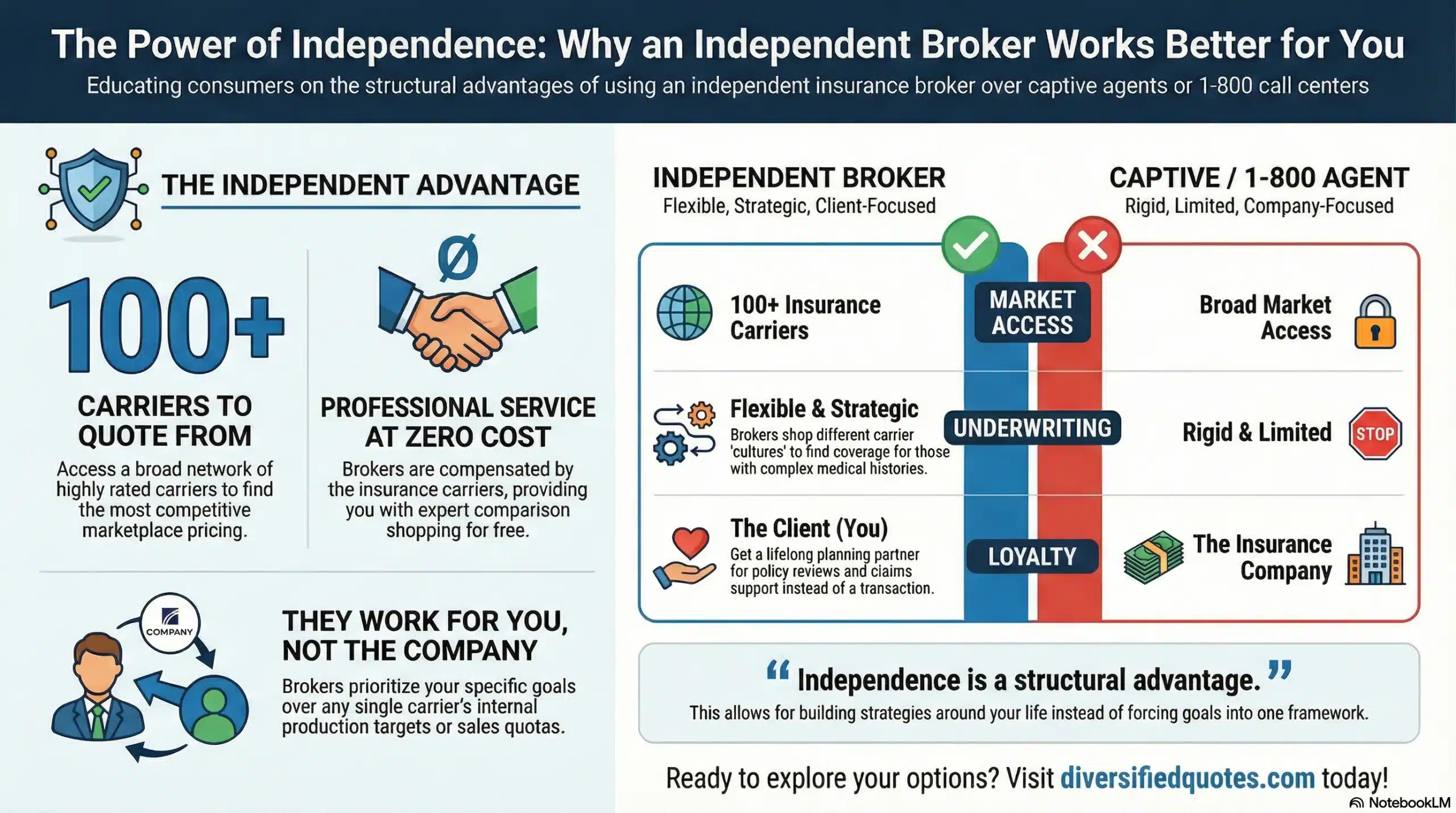
As an Independent Life Insurance Broker, we compare rates across 100+ carriers and prescreen every application before submission.
Life Insurance Laddering Guide

Jason Stolz CLTC, CRPC, DIA, CAA
Life insurance laddering is one of the most cost-efficient protection strategies available to working families — and one of the most underused, primarily because most people encounter life insurance through a single conversation with a single carrier that presents a single policy structure. The concept is straightforward: instead of buying one large term policy and paying a uniform premium for 30 years on coverage you will genuinely need only during parts of that window, you stack two or three term policies with different lengths, each aligned to a specific financial obligation that has a natural expiration date. As obligations resolve — the mortgage pays down, children become independent, retirement savings reach meaningful levels — the coverage layers that were tied to those obligations expire by design. Your premium load naturally decreases over time without any action on your part, and you never paid 30-year pricing on protection you only needed for 10 years.
The laddering framework works because financial obligations are not monolithic — they have different sizes and different durations. A mortgage that will be paid off in 24 years is not the same financial risk as an income replacement need that lasts until your youngest child reaches independence at 22. Paying for both obligations at 30-year pricing — as a single large 30-year term policy would require — is inefficient. Matching each obligation to its own appropriately-sized policy allows the largest coverage amounts to live in the shorter-term policies where pricing is most favorable, and keeps the long-duration policy lean. At Diversified Insurance Brokers, Jason Stolz, CLTC, CRPC, DIA, CAA helps families design ladders that are calibrated to actual obligations and timed to actual life events — not designed around generic assumptions or the most convenient single-carrier product. Our resource on how life insurance works covers the foundational mechanics that make the ladder design decisions clearer, and our resource on group vs. individual life insurance covers the related question of how employer group coverage fits into the overall protection architecture alongside individually owned ladder policies.
See Real-Term Rates Side by Side
Life Insurance Quoter
Build Your Life Insurance Ladder
We price multiple term lengths side-by-side across 100+ carriers, design the ladder around your specific obligations, and structure conversion options where they add the most value.
Request a Ladder Design Review Call 800-533-5969Life Insurance Ladder — Coverage Timeline Illustration
The laddering concept becomes most concrete when illustrated across a specific timeline. The table below maps how a three-layer ladder for a 34-year-old changes over time — showing how total coverage, active layers, and life circumstances evolve as each policy’s intended obligation resolves.
| Policy Year / Milestone | Total Coverage | Layers Active | Premium Trend | Family Context |
|---|---|---|---|---|
| Year 1 — Ladder launch 10-yr $500K + 20-yr $750K + 30-yr $250K issued |
$1,500,000 | All three layers (1 + 2 + 3) | Full premium — all three policies paying simultaneously | Young children at home, mortgage near its largest balance, both spouses income-dependent — peak vulnerability period |
| Years 1–10 — Peak protection window | $1,500,000 | All three layers | Stable — all three level-premium policies locked at issue-age pricing | Children in school, mortgage meaningful, career peak years; full $1.5M protection in place throughout |
| Year 10 → Year 11 — Layer 1 expires 10-year $500K policy ends as designed |
$1,500,000 → $1,000,000 | Layers 2 + 3 | Premium drops — 10-year policy cost removed; remaining two layers continue unchanged | Oldest child approaching college; mortgage significantly paid down; retirement savings growing; $1M still provides strong protection |
| Years 11–20 — Reduced premium window | $1,000,000 | Layers 2 + 3 | Lower than years 1–10 — meaningful reduction when children’s college years arrive | College funding years, late mortgage, peak career savings; $1M covers income replacement and mortgage residual |
| Year 20 → Year 21 — Layer 2 expires 20-year $750K policy ends as designed |
$1,000,000 → $250,000 | Layer 3 only | Second premium drop — only the lean 30-year $250K layer remains; lowest ongoing cost | Children independent, mortgage mostly paid or paid off, retirement savings well-established; $250K covers final expenses, legacy, and flexibility |
| Years 21–30 — Long-tail protection 30-year layer still active; serves late-stage purposes |
$250,000 | Layer 3 only | Lowest premium phase — single lean policy at lowest total cost of the entire 30-year window | Near or in retirement; policy may be converted to permanent coverage using conversion provision if ongoing coverage is desired beyond year 30 |
The table makes the single most important laddering insight concrete: the highest protection exists exactly when it matters most (years 1–10, when children are young and the mortgage is largest), and costs naturally decrease as those obligations resolve — without any action required on the part of the policyholder. The comparison point is what a single large 30-year $1,500,000 term policy would cost: the same $1.5M of coverage maintained uniformly for 30 years at 30-year pricing, with no reduction in premium as the mortgage pays down and children become independent. The ladder’s premium advantage compounds over time precisely because it allocates the largest coverage amounts to the shortest-duration, lowest-cost policies. Our resource on at what age should you stop buying term life insurance covers the complementary question of how long the long-tail layer should extend — providing the strategic framework for deciding whether a 30-year final layer makes sense or whether a shorter final layer would serve the specific household’s goals.
What Is a Life Insurance Ladder?
A life insurance ladder is a small portfolio of term life policies — typically two or three — where each policy has a different term length calibrated to a different financial obligation with a different expiration date. The purpose of the structure is alignment: matching coverage amounts and durations to the actual obligations they are designed to protect, rather than buying one large uniform policy that covers all obligations simultaneously at the same cost regardless of when each obligation actually resolves.
The fundamental insight behind laddering is that most significant financial obligations have natural timelines. A mortgage paid on schedule for 26 years resolves at year 26 — the obligation has an end date built into the amortization schedule. A child’s financial dependency ends when they reach adulthood and independence — a timeline that is estimable based on current age. An income replacement need for a surviving spouse extends until the survivor’s own retirement savings can sustain them — another estimable timeline. None of these timelines is 30 years for every family in every situation. And yet, without deliberate design, most families default to a single long-term policy sized to the largest current obligation and priced accordingly for the full duration.
The ladder replaces that single monolithic structure with a multi-layer design where each layer’s term and face amount reflect the actual obligation it is protecting. The 10-year layer protects the highest-vulnerability decade at the most favorable pricing. The 20-year layer covers the income replacement window through the end of children’s dependency years. The 30-year layer — lean by design — provides long-tail coverage for late-stage planning, spouse security into retirement, or the conversion option that preserves permanent coverage flexibility without new medical underwriting. Our resource on life insurance alternative options covers the adjacent strategies that can complement a ladder design, particularly for applicants who need interim coverage while pursuing the full underwritten ladder design.
Why Laddering Often Costs Less Than One Large Policy
The cost advantage of laddering flows from a simple actuarial reality: term length drives pricing. A 10-year term policy for $500,000 costs less per month than a 20-year term policy for the same $500,000, which costs less than a 30-year term policy. The pricing difference reflects the declining probability of a claim as the term shortens — the carrier is bearing the death risk for a shorter period, so the premium reflects a smaller expected obligation.
When a ladder puts $500,000 into a 10-year policy rather than a 30-year policy, the premium for those $500,000 is calculated at 10-year pricing rather than 30-year pricing. The premium savings on those dollars — paid every month for however long the 10-year policy remains active — represent real money that accumulates into significant savings over the full coverage period. Multiplied across multiple layers where each is properly sized to a shorter term than the maximum available, the cumulative savings over a 30-year period can be substantial.
The savings calculation is not simply “shorter term = less money total” — the shorter-term layer pays less per month but also expires sooner, so the comparison requires looking at total premiums paid over the full life of the ladder versus total premiums paid for a single large 30-year policy. The ladder typically wins this comparison when the largest coverage amounts are in the shortest layers — which is the correct design — because those high-face-amount dollars are priced at 10-year rather than 30-year pricing for the duration of the 10-year policy. Our resource on best term life insurance policy covers the individual term evaluation framework, and our resource on how to protect your mortgage with life insurance covers the mortgage-specific coverage calculation that drives the sizing of the largest typical ladder layer.
How to Design Your Ladder Step by Step
Designing an effective ladder requires identifying the specific obligations that need protection, mapping each to a timeline, selecting appropriate term lengths, and sizing each layer to reflect the actual magnitude of the obligation rather than a uniform face amount across all layers.
The first step is listing time-bound needs with honest specificity. The mortgage balance and payoff date, the children’s ages and the dependency horizon through college, the income replacement need until retirement, specific business debts or partnership obligations, and any other obligations that would create financial hardship for a surviving family member if the earner died prematurely. This list is the architecture of the ladder — every layer should map to one or more obligations on the list. Layers that don’t map to a specific obligation are premium dollars being spent without a clear purpose.
The second step is selecting term lengths that match those specific timelines rather than defaulting to standard round-number options. A family with a 26-year remaining mortgage can use a 25-year or 30-year layer for the mortgage; a family with a youngest child at age 4 who wants income replacement through college can calibrate the income replacement layer to a 20-year or 22-year term. Common ladder combinations include 10/20/30, 10/15/25, 15/30, and 20/30 depending on the specific obligation timelines. The “right” combination is the one that matches actual timelines — not the one that uses the most common options. Our resource on life insurance for parents with young children covers the dependency horizon analysis that anchors the most important layer sizing decision for most young families.
The third step is sizing each layer precisely — which means the biggest dollar amounts should sit in the shortest layers. If the largest risk exists in the next 10–12 years (active mortgage, young children, maximum income dependence), then the 10-year layer should carry the largest face amount. The 20-year layer carries the income replacement need at a moderate face amount. The 30-year layer is purposefully lean — sized to the specific late-stage obligation it serves rather than scaled to match the other layers. This deliberate sizing structure is what produces the cost advantage: large dollars at 10-year pricing, moderate dollars at 20-year pricing, and small dollars at 30-year pricing.
The fourth step is protecting future options through conversion. At least one layer — typically the longest — should have a strong term-to-permanent conversion window so that future health changes don’t eliminate the option to extend coverage permanently if circumstances change. Our resource on convert term to permanent life insurance covers how conversion provisions work, which carriers have the strongest conversion options, and when converting a ladder layer makes strategic sense relative to applying for new permanent coverage.
Single-Policy vs. Ladder: The Decision Framework
The practical question most families face is not “should I ladder” in the abstract — it is “does laddering produce better outcomes for my specific situation than a single policy would?” The answer depends on the structure of the obligations, the health and underwriting situation, and the time horizon. When the answer is a clear yes, the premium savings and structural alignment make laddering compelling. When the answer is uncertain, the single-policy simplicity may have value. When the answer is that permanent coverage serves the need better than any term structure, laddering may not be the right framework at all.
Laddering is most clearly superior to a single large policy when the financial obligations have distinctly different timelines — a 10-year mortgage payoff horizon alongside a 20-year income replacement horizon alongside a lean 30-year long-tail need. It is also valuable when premium budget is a constraint, because the layer-by-layer design allows coverage to be sized to what can be afforded while concentrating the most important protection in the layers that matter most. And it is particularly useful when underwriting flexibility is needed — because multiple policies can be placed with multiple carriers, allowing each layer to be matched to the carrier whose guidelines are most favorable for the applicant’s specific health and occupation profile. Our resource on life insurance with pre-existing conditions covers the multi-carrier flexibility that makes laddering particularly powerful for applicants whose health history requires strategic carrier matching rather than single-carrier submission.
Single-policy approaches are often appropriate when the obligations are simple and uniform, when the underwriting situation makes placing multiple policies at once complex, or when the administrative simplicity of one policy matters to the household. For high-net-worth families with more complex planning needs, the is life insurance a good investment framework covers when permanent coverage serves planning objectives that pure term laddering cannot address — relevant context for families evaluating whether any layer of the ladder should be permanent rather than term.
Laddering With Complex Medical or Underwriting Situations
One of the less-discussed advantages of laddering for applicants with complex health histories is that a ladder can be built incrementally — starting with the most important layer using the best available approval today, and adding additional layers later as health improves, stability periods extend, or better carrier matches become available. An applicant who qualifies today for a 10-year policy but whose health history makes the 20-year or 30-year layer uncertain can secure the most critical near-term protection now and re-evaluate the additional layers in 12–24 months when additional documentation of stability may improve the underwriting outcome.
This staged approach is particularly relevant for applicants with histories that improve over time: mental health stability, resolved substance use history, post-cancer remission, or recovering from a cardiac event. In each case, the applicant who cannot access a full 30-year term policy today may qualify for a 10-year policy — and 2–3 years of additional stability documentation may significantly improve the options for the longer layers. Our resource on high-risk life insurance services covers the complex underwriting landscape, and our resource on life insurance for diabetics with complications illustrates how carrier-specific underwriting positioning applies within the ladder framework for specific health profiles.
Advanced Ladder Strategies — Business, Family, and Estate Planning
The basic ladder framework — two or three term layers aligned to family financial obligations — is the right starting point for most households. Advanced applications extend the framework into business protection, estate planning, and annuity coordination that serve more complex planning situations.
Business owners often have life insurance needs that are both personal (family protection) and business-related (key person coverage, buy-sell funding, business loan protection) that should be separated into distinct policy structures rather than blended into a single policy. The personal ladder handles family obligations; a separate business policy or policies handle the business-related exposures with appropriate ownership and beneficiary structure. Our resource on life insurance to fund buy-sell agreements covers the business-specific application where policy ownership and beneficiary design are as important as face amount and term length. Our resource on key man policy for business covers the parallel key person exposure that exists alongside personal family protection needs for business owners and that should be structured separately from the personal ladder.
For clients with specialized occupational or industry circumstances — including those in emerging industries where carrier selection is critical — the ladder can be designed to use different carriers for different layers, allowing each layer to be placed with the carrier most favorable for that specific coverage amount and term length combination. Our resource on life insurance for the marijuana industry illustrates how specialized industry circumstances interact with carrier selection in ladder design. For applicants with unique family planning needs — including special needs dependents for whom coverage continuity beyond the parent’s working years is critical — the ladder design requires additional consideration of which layer should have the strongest conversion provision for potential permanent coverage extension. Our resource on life insurance for autistic individuals covers how laddering interacts with special needs planning objectives.
The annuity ladder is a conceptually parallel strategy in retirement income planning — staggering fixed annuity maturity dates to create staged liquidity and income events aligned to different retirement cash flow needs. Our resource on fixed annuity ladder strategy covers this retirement income application of the laddering concept, which is relevant for clients who are simultaneously using life insurance laddering for protection and annuity laddering for income planning. And for families considering a final expense layer as part of their ladder design — ensuring that final costs are funded independently from the primary income replacement coverage — our resource on best burial insurance for parents over 70 covers the final expense products that serve this specific late-stage planning objective. Our resource on term life insurance with return of premium covers an alternative term structure that some families use for one layer of the ladder — where the policy returns premiums if the insured outlives the term, addressing the “paying and getting nothing back” concern that some families have about term insurance.
Have Us Design Your Ladder
We price multiple carriers and terms, build the ladder around your specific obligation timeline, and structure conversion options where they create the most long-term value.
Request a Ladder Design ReviewRelated Life Insurance Strategy Pages
Coverage comparison, conversion mechanics, alternative structures, and investment value guides.
Related Underwriting and Specialized Planning Pages
High-risk underwriting, pre-existing condition strategy, health-specific positioning, and business coverage guides.
Financial Protection Essentials
Mortgage protection sizing, family coverage resources, term decision guides, and business coverage tools that support comprehensive ladder design.
Compare Term Life Insurance Lengths
Explore different term periods to find coverage that best matches your timeline and budget.
Talk With an Advisor Today
Choose how you’d like to connect—call or message us, then book a time that works for you.
Schedule here:
calendly.com/jason-dibcompanies/diversified-quotes
Licensed in all 50 states • Fiduciary, family-owned since 1980
FAQs: Life Insurance Laddering
How many policies should be in a ladder?
Most families build effective ladders with two or three policies. Two-layer ladders are simpler to administer and work well when the financial obligations divide cleanly into two timeframes — a higher-need decade followed by a moderate long-tail period. Three-layer ladders are appropriate when there are three meaningfully different obligation timelines — a mortgage payoff horizon, a child dependency horizon, and a long-tail security need — that don’t align well with two layers. More than three policies add administrative complexity without proportional benefit for most families. The right number is the one that matches the actual obligation timeline structure — not the number that produces the most layers or the simplest single-layer approach. One useful test: can you name a specific financial obligation that each layer is designed to protect? If yes, the layer is justified. If a layer exists without a clear underlying obligation, it may be unnecessary. Our coverage illustration table above shows how a three-layer structure evolves over time — making the three-layer logic concrete with a specific example.
Can I ladder with different carriers?
Yes — and in many cases, using different carriers for different layers is advantageous rather than merely acceptable. Different carriers have different pricing strengths across different age, health, and term combinations. A carrier that offers the most competitive pricing for a 10-year $500,000 term at a specific health class may not be the same carrier with the best pricing for a 30-year $250,000 term. When each layer is shopped independently across the full carrier market, total ladder cost often decreases compared to placing all layers with a single carrier. The key design considerations when using multiple carriers are: coordinating beneficiary designations so that all layers work together as a coherent plan; confirming that at least one layer (typically the longest) has a strong conversion provision; ensuring that any underwriting on multiple applications is coordinated to avoid timing issues that might affect the overall approval strategy; and maintaining accurate records of all policies so that beneficiaries can access all layers when needed. These administrative details are straightforward to manage with proper documentation and are well worth the potential premium savings that multi-carrier laddering enables.
Do I need medical exams for every layer?
Not necessarily. Some carriers offer accelerated or exam-free underwriting within certain coverage amount and age parameters — depending on health profile, the application may be approved through an algorithmic review of prescription database information, MIB report, and motor vehicle records without requiring a paramedical examination. Other carriers require a full paramedical exam (blood draw, urine sample, blood pressure, height and weight) for most face amounts. When building a ladder, the underwriting approach for each layer can be optimized: the shorter, smaller layers may qualify for accelerated exam-free underwriting at the right carriers, while the larger or longer layers may benefit from fully underwritten pricing that rewards a healthy health profile. The interaction between exam requirements and health history is particularly relevant for applicants with complex medical situations — where the prescreening strategy determines which carriers and which underwriting pathways produce the best outcomes before any formal application is submitted. Our resource on life insurance with pre-existing conditions covers how underwriting requirements interact with health history in the carrier selection and application process.
What about conversion options when the ladder is designed?
Conversion provisions are one of the most important design considerations in ladder construction — and they are most valuable when built into the longest-duration layer where future flexibility has the most impact. A conversion provision allows the policyholder to convert some or all of the term policy to a permanent policy without providing new evidence of insurability — the original underwriting class earned when the term policy was issued is carried forward to the permanent policy regardless of any health changes that may have occurred in the interim. This conversion option is most valuable for three scenarios: when health deteriorates during the term period and new underwriting would produce worse outcomes than the original class; when planning goals shift (a new dependent, a changed business situation, an evolving legacy objective) and permanent coverage becomes desirable; and when the term layer is approaching its expiration and the policyholder wants to extend coverage without requalifying. When designing a ladder, at least one layer — typically the 30-year or longest layer — should be issued by a carrier with a strong, broad conversion window that includes a wide range of permanent products rather than limited conversion options. Our resource on convert term to permanent life insurance covers conversion mechanics, carrier-specific conversion windows, and how to use conversion to extend ladder coverage without new underwriting.
Can I change my ladder after it’s been approved?
You can reduce coverage by allowing a layer to lapse or by dropping a policy, and this happens naturally by design as layers expire at their scheduled term end. You can also increase beneficiary allocations or adjust beneficiary designations on existing policies at any time. What you generally cannot do is add new coverage to an existing policy after it has been issued — adding more coverage typically requires a new application with new underwriting at that time, which means your current age and health will apply to the new application rather than the underwriting class from the original ladder. This is why proper sizing at ladder inception matters: sizing the layers based on honest assessment of actual obligations, rather than undersizing now with the plan to add more later, avoids the underwriting risk of future applications at an older age or with changed health history. The conversion provision on the longest layer provides an important exception to this general limitation — it allows conversion to permanent coverage without new medical underwriting, subject to the carrier’s conversion rules and time limits, providing a meaningful avenue for coverage extension even when new full underwriting would not be possible.
What if I’ve been declined before — can I still build a ladder?
Yes — and laddering often provides a constructive path forward for applicants with prior declines, because the staged nature of the ladder allows coverage to be built incrementally rather than all at once. A prior decline from one carrier for one policy does not prevent placement with a different carrier whose underwriting guidelines are more favorable for the specific health, occupation, or lifestyle profile. And the ladder structure allows a workable approval today — covering the most critical near-term risk — without requiring the full multi-layer design to be placed simultaneously. An applicant who can qualify today for a 10-year policy but whose profile makes a 20-year or 30-year approval uncertain can secure the most important near-term protection now and re-evaluate additional layers in 12–24 months when additional stability documentation or improved health metrics may open better underwriting options. Our resource on high-risk life insurance services covers the complete impaired-risk underwriting landscape, and the staged ladder approach is one of the primary strategies we use to build meaningful protection for applicants whose full coverage needs cannot be placed in a single underwriting attempt.
When should I NOT ladder and use a single policy instead?
Laddering is specifically designed for time-bound financial obligations. When the coverage need is genuinely lifelong — not reducible to a specific declining obligation timeline — a core permanent policy may serve better than any term ladder, either alone or paired with a smaller supplemental term layer. The clearest examples are special needs planning (where a dependent may require financial support indefinitely), permanent estate liquidity needs (where the death benefit serves a tax or estate purpose that exists regardless of when death occurs), and charitable legacy goals (where coverage is intended to fund a bequest rather than protect a time-bound income stream). In these situations, the ladder’s cost advantage from time-aligned design is less relevant because the need doesn’t have an expiration date that layers can be calibrated to. Single-policy approaches also make sense when simplicity has real value to the household — when administrative complexity of multiple policies and carriers is a genuine burden, and when a single premium, single beneficiary designation, and single policy document better serves the household’s practical management capacity. The decision is ultimately about whether the obligations are time-bound enough that laddering produces meaningfully better alignment than a uniform approach — and when they are, the ladder’s advantages in cost and structure are compelling.
About the Author:
Jason Stolz, CLTC, CRPC, DIA, CAA and Chief Underwriter at Diversified Insurance Brokers (NPN 20471358), is a senior insurance and retirement professional with more than 25 years of real-world experience helping individuals, families, and business owners protect their income, assets, and long-term financial stability. As a long-time partner of the nationally licensed independent agency Diversified Insurance Brokers, Jason provides trusted guidance across multiple specialties—including fixed and indexed annuities, long-term care planning, personal and business disability insurance, life insurance solutions, Group Health, Travel Medical and Evacuation Insurance, and short-term health coverage. Diversified Insurance Brokers maintains active contracts with over 100 highly rated insurance carriers, ensuring clients have access to a broad and competitive marketplace.
His practical, education-first approach has earned recognition in publications such as VoyageATL, and contributions from his agency featured in Kiplinger and GoBankingRates— highlighting his commitment to financial clarity and client-focused planning. Drawing on deep product knowledge and years of hands-on field experience, Jason helps clients evaluate carriers, compare strategies, and build retirement and protection plans that are both secure and cost-efficient. Visitors who want to explore current annuity rates and compare options across multiple insurers can also use this annuity quote and comparison tool.
Explore More Life Insurance Options: Browse our complete guide to How Life Insurance Works — covering term life, whole life, final expense, annuity alternatives & more from 100+ carriers.
Last Reviewed: September 16, 2026 |
Reviewed by: Jason Stolz, CLTC, CRPC, DIA, CAA
Chief Underwriter, Diversified Insurance Brokers, Inc. | NPN: 20471358 | Diversified Insurance Brokers, Inc. — Licensed in all 50 states
Fact Checked by: Tonia Pettitt, CMIP©
Medicare Specialist, Diversified Insurance Brokers, Inc. | NPN: 14374308 | Diversified Insurance Brokers, Inc. — Licensed in all 50 states
Did you find this content helpful? Leave us a Google review — it helps others find trustworthy guidance too.
Editorial Standards: Diversified Insurance Brokers maintains rigorous editorial standards to ensure accuracy, clarity, and independence in all content. Learn more about our editorial standards and commitment to transparency.
