
10-Year Term Life Insurance
10-Year Term Life Insurance

Jason Stolz CLTC, CRPC, DIA, CAA
10 year term life insurance is the most precisely targeted protection structure available in the life insurance market — a fixed death benefit, a level premium, and a ten-year coverage window that aligns directly with a specific financial obligation rather than a general long-term need. When the match is right — when a mortgage has approximately ten years remaining, when a business note runs for a defined decade, when children will be financially independent within ten years, when a debt-payoff plan has a clear endpoint — 10 year term life insurance provides maximum death benefit per premium dollar for exactly the window that matters. When the match is wrong — when the actual financial obligation extends well past ten years and the buyer chose ten-year term because the quote was the cheapest — the result is an expired policy when the coverage need is still active, and a second application at higher rates during a decade when health may have changed. The decision to use 10 year term life insurance begins with being honest about the length of the obligation being insured, not with searching for the lowest monthly number available.
At Diversified Insurance Brokers, Jason Stolz, CLTC, CRPC, DIA, CAA helps applicants compare 10 year term life insurance against alternative term lengths and coverage structures — identifying which carriers offer the most competitive pricing for specific age and health profiles, which underwriting path produces the best outcome, and whether 10 year term is genuinely the right structure or whether a slightly longer term would better serve the actual household protection need. Our resource on how does life insurance work covers the foundational framework for term life insurance before the 10-year-specific analysis, and our resource on how to choose the right life insurance policy covers the decision framework for matching term length to actual coverage goals.
See Real-Term Rates Side by Side
Life Insurance Quoter
Compare 10 Year Term Life Insurance Options
We identify the carriers most competitive for your age and health profile, confirm the underwriting path that produces the cleanest outcome, and compare 10 year term against alternative lengths to ensure the term matches your actual obligation.
Request My 10 Year Term QuoteHow 10 Year Term Life Insurance Works
10 year term life insurance provides a fixed death benefit — the amount paid to designated beneficiaries if the insured person dies while the policy is active — for a period of exactly ten years, with level premiums that do not change during the coverage period. If the insured dies during the ten-year term, the carrier pays the full death benefit to the named beneficiary or beneficiaries, typically income-tax-free under current federal tax law. If the insured outlives the ten-year term, the policy expires with no return of premiums and no residual cash value — unlike permanent life insurance structures that build a cash reserve over time.
The level premium structure is the practical backbone of 10 year term life insurance: the monthly or annual payment is fixed at policy issue and does not increase during the ten-year period regardless of changes in the insured’s health. This guarantee means that a 40-year-old who purchases 10 year term life insurance today pays the same premium in year ten as in year one, regardless of any health changes that occur during that decade. The premium is determined by the underwriting class assigned at application — based on the insured’s age, health history, build, tobacco status, family history, and other factors — and remains fixed for the life of the policy.
Most 10 year term life insurance policies are structured as pure protection — no cash value accumulation, no investment component, no savings element. The entire premium pays for the death benefit protection and carrier administrative costs. This pure-protection structure is what makes 10 year term life insurance the most cost-efficient way to put a large death benefit in place for a defined period: there is no cash value buildup diluting the premium toward the protection component, so the premium for the same death benefit is substantially lower than for permanent life insurance covering the same individual.
2025 Sample 10 Year Term Life Insurance Rates by Age and Health Class
| Age / Health Class | $250,000 — Male (approx./mo.) | $250,000 — Female (approx./mo.) | $500,000 — Male (approx./mo.) | $500,000 — Female (approx./mo.) |
|---|---|---|---|---|
| Age 30, Preferred Non-Smoker | ~$13 | ~$11 | ~$20 | ~$17 |
| Age 35, Preferred Non-Smoker | ~$15 | ~$13 | ~$25 | ~$21 |
| Age 40, Preferred Non-Smoker | ~$18 | ~$16 | ~$31 | ~$26 |
| Age 45, Preferred Non-Smoker | ~$25 | ~$21 | ~$42 | ~$35 |
| Age 50, Preferred Non-Smoker | ~$35 | ~$28 | ~$62 | ~$50 |
| Age 55, Preferred Non-Smoker | ~$55 | ~$42 | ~$100 | ~$78 |
| Age 40, Standard Non-Smoker (vs. Preferred above) | ~$26 | ~$22 | ~$44 | ~$37 |
| Age 40, Tobacco User | ~$55 | ~$45 | ~$100 | ~$80 |
Rates shown are approximate sample benchmarks for illustrative comparison only. Actual premiums depend on the specific carrier, underwriting class, state of residence, exact age, and health details at application. Use the quote tool above or contact us directly for carrier-specific rates for your profile. I’m guessing here on some of these specific dollar amounts — always verify with carrier quotes before making a purchasing decision.
The rate table illustrates the three most important pricing dynamics in 10 year term life insurance: age increases premiums predictably at each bracket, health class produces a meaningful premium difference even at the same age (compare preferred vs. standard vs. tobacco at age 40), and gender affects pricing with women consistently paying lower premiums than men at equivalent ages and health classes because of lower statistical mortality risk at younger ages. The tobacco user premium approximately doubling the preferred non-smoker premium at age 40 reflects the actuarial significance of tobacco use in underwriting — a factor that applies across all term lengths but is visible in the 10-year context as well. Our resource on life insurance for smokers covers the tobacco underwriting framework and the timeline for reclassification after cessation.
Who Is 10 Year Term Life Insurance Best For?
10 year term life insurance fits best when the financial obligation being insured has a clearly defined ten-year or shorter timeline — and when the applicant is confident that financial obligations will be materially smaller or fully resolved at the policy’s expiration. The strongest candidates for 10 year term life insurance fall into several distinct categories.
Applicants with a specific debt payoff plan are among the clearest fits for 10 year term. Someone who carries a business loan, car loan, or personal debt with approximately a decade remaining, and who wants to ensure a surviving spouse or business partner is not left with that obligation, can purchase a 10 year term policy sized to the debt balance and let the policy expire when the debt is paid — clean, efficient, and precisely matched to the obligation. Our resource on mortgage protection vs term life insurance covers how this logic applies specifically to mortgage-related protection, where the declining loan balance over time can make a 10-year period relevant for those approaching payoff.
Adults in their mid-to-late 50s or early 60s with a defined coverage window that does not extend to life expectancy are excellent candidates for 10 year term. A 58-year-old who wants coverage through age 68 — long enough to ensure financial security through early retirement transition — but does not need lifelong coverage for final expense or estate planning purposes, can secure meaningful protection at 10-year rates that are substantially lower than permanent life alternatives covering the same period. The ten-year window aligned to a working-years-remaining horizon makes 10 year term particularly practical for this demographic, and our resource on at what age should you stop buying term life insurance covers how the coverage-need horizon should drive these timing decisions.
Business owners with a buy-sell agreement tied to a partnership arrangement, a key person insurance need protecting against the loss of a critical employee during a defined business transition window, or a business note tied to a specific decade-long financial relationship represent another strong fit for 10 year term. When the business timeline is defined — a ten-year partnership, a defined succession window, a note maturing in a fixed period — 10 year term life insurance can protect the business interest cleanly without committing to longer-term premium payments that outlast the business obligation.
Young parents who want affordable coverage for a high-expense decade — covering the years when children are young and household income protection is most critical — sometimes find 10 year term attractive when budget is the primary constraint. However, this is also one of the scenarios where the case for a longer term (15 or 20 years) is strongest, because the dependency window typically extends well past ten years when children are very young. The parent who purchases 10 year term when children are three and five will face a coverage gap when children are 13 and 15 — still in school, still financially dependent, but no longer protected by the original policy. Our resource on 20 year term life insurance covers the longer protection window that typically better matches the full child-dependency horizon for young families.
10 Year Term vs. Longer Term Life Insurance — Choosing the Right Length
The most consequential decision in purchasing any term life insurance policy is not which carrier to use or whether to take the exam — it is whether the selected term length covers the actual duration of the financial obligation being insured. Choosing 10 year term life insurance for a fifteen- or twenty-year obligation to save on monthly premium creates a coverage gap that can be more expensive to fill later than the original savings justified.
The premium difference between 10 year term and 20 year term is real but often smaller than applicants expect. A 35-year-old male purchasing $500,000 of coverage might pay approximately $25 per month for a 10-year term and approximately $35 per month for a 20-year term — a difference of $10 per month, or $120 per year. Over ten years, that $10 monthly difference accumulates to $1,200 in premium savings. But if the 20-year obligation still exists at year 10 and a new policy is needed at age 45, the premium for a new 10-year policy at age 45 is substantially higher than the original premium — potentially $42 or more per month compared to $25. The total cost over 20 years of the “buy a new 10-year term at 45” strategy often substantially exceeds the cost of having purchased 20-year term at 35 to begin with. Our resources on 15 year term, 20 year term, 25 year term, and 30 year term cover the longer coverage windows and help compare across term lengths for specific household timelines. Our resource on life insurance rates and best life insurance rates provide current benchmark comparisons across term lengths.
The inverse argument also applies: purchasing a 20-year term policy for a genuine ten-year obligation means paying premium for ten years of coverage that was never needed. For applicants with a truly defined ten-year window — confirmed by concrete financial planning, not vague optimism — 10 year term life insurance is the right tool. The practical guideline: choose 10 year term only when you can specifically name what financial obligation the coverage is protecting and confirm that obligation will be fully resolved or substantially smaller in ten years. When that confidence is high, 10 year term is efficient. When that confidence is uncertain, erring toward a longer term produces better long-term outcomes than discovering the coverage gap at year ten.
What Determines Your 10 Year Term Life Insurance Rate?
10 year term life insurance rates are determined through a life insurance underwriting process that evaluates the applicant’s mortality risk — the statistical likelihood of a claim during the coverage period — and assigns a health class that determines the premium. The factors that most directly affect where an applicant lands in the underwriting hierarchy are age, tobacco status, overall health and medical history, build and weight, family history of major illness, driving record, and the amount of coverage requested. Understanding how these factors interact helps applicants prepare for the underwriting process and set realistic premium expectations before receiving formal quotes.
Age is the most predictable and unavoidable underwriting variable: each year of additional age increases 10 year term life insurance premiums because the statistical mortality probability during any ten-year window increases with age. This is why the standard guidance to “buy term life insurance as young as possible while the coverage need exists” is financially sound — locking in younger-age rates for a ten-year window produces lower cumulative premiums than purchasing the same coverage at an older age, even accounting for the extra years of premium payments if the need would have been met anyway.
Tobacco status is the underwriting factor that produces the largest premium jump relative to base rates. Most carriers classify current smokers and some recent former smokers in a tobacco-user underwriting class that effectively doubles or triples the non-smoker premium for equivalent coverage. Some carriers define “current tobacco user” broadly to include cigarettes, cigars, chewing tobacco, and nicotine delivery devices; others draw distinctions between product types. Former smokers who have been tobacco-free for 12 to 24 months (the specific threshold varies by carrier) may qualify for non-smoker rates — a potentially enormous premium reduction that provides strong financial motivation for cessation before applying. Our resource on life insurance for smokers covers the tobacco underwriting framework and cessation timelines in full.
Health class assignment — Preferred Plus, Preferred, Standard Plus, Standard, or various table ratings for higher-risk applicants — is the underwriting output that determines the final premium for any given age and coverage amount. Preferred Plus applicants with no significant health conditions, ideal build, clean family history, and excellent lab results receive the lowest available premiums. Standard applicants — the baseline health class — pay meaningfully more for the same coverage. Table-rated applicants with managed health conditions pay a percentage surcharge above standard rates depending on the table rating assigned. Our resource on life insurance with pre-existing conditions covers how chronic conditions affect underwriting class assignment and which factors most influence where rated applicants land.
Underwriting Paths — Exam vs. No-Exam for 10 Year Term
10 year term life insurance applications can be processed through two primary underwriting paths: traditional fully underwritten (which may include a paramedical examination — blood draw, urinalysis, blood pressure measurement, and basic health questions) or accelerated underwriting (which uses data sources including prescription history databases, MIB records, and driving records to make an underwriting decision without a physical exam). The path available to any specific applicant depends on the carrier’s guidelines, the coverage amount requested, the applicant’s age, and the health profile presented.
Many carriers now offer accelerated underwriting for 10 year term policies in the $1 million and below range for applicants under a defined age (often 50 or 60) who meet health profile criteria. This pathway produces coverage decisions within days rather than weeks and eliminates the exam scheduling friction that was historically associated with all fully underwritten applications. When accelerated underwriting is available and the health profile qualifies, it is generally the more convenient path without meaningful premium disadvantage.
Traditional fully underwritten applications with a paramed exam may still produce the best outcome in specific circumstances: when the coverage amount is very large (typically over $1 million to $3 million depending on carrier), when the applicant’s health profile is complex and would benefit from the full medical picture being presented rather than inferred from data records, or when a carrier known for favorable underwriting of a specific condition requires full underwriting as part of their review process. For applicants with any significant health history, working with an independent broker to identify which underwriting path — and which carrier — is most likely to produce the best outcome before submitting any application prevents wasted time and avoidable MIB decline records. Our resource on what is a life insurance exam covers what the paramedical examination involves and how to prepare for the best results.
Conversion — The Option to Extend Coverage Without New Medical Underwriting
One of the most valuable features available on many 10 year term life insurance policies is the conversion privilege — the contractual right to convert the term policy to a permanent life insurance policy offered by the same carrier, without submitting new evidence of insurability. Conversion allows an insured whose health changes during the ten-year term to secure permanent coverage at a premium based on age at conversion rather than on current health — because the health evidence from the original application governs the convertibility, not the health at the time of conversion.
Conversion rights matter most in two scenarios. First, when an insured develops a health condition during the ten-year period that would make a new application for term coverage very expensive or impossible, converting the existing term policy to permanent coverage locks in protection without re-underwriting. Second, when financial planning evolves during the decade and permanent coverage becomes desirable for estate planning, legacy, or business planning purposes, conversion provides a clean path from term to permanent without the uncertainty of a fresh application.
Conversion provisions vary significantly by carrier: some allow conversion at any point during the level term, while others have earlier conversion deadlines (often 5 or 7 years into the term rather than the full 10). Some carriers offer broad permanent product menus for conversion; others restrict conversion to specific products with limited flexibility. Evaluating conversion provisions at the point of initial policy selection — not as an afterthought — is important for applicants who anticipate that their life insurance needs may evolve during the ten-year window. Our resource on convert term to permanent life insurance covers the mechanics and timing considerations of term-to-permanent conversion in detail.
How Much 10 Year Term Life Insurance Do You Need?
Coverage amount decisions for 10 year term life insurance are most useful when they start with a specific obligation analysis rather than a general rule of thumb. The general guidance that life insurance should equal ten to twelve times income addresses a long-term income replacement need — but 10 year term is typically purchased to address a more specific, time-bounded obligation rather than replacing all future income indefinitely. The right coverage amount for 10 year term is determined by answering: what is the worst financial outcome that would occur if the insured died during this ten-year period, and how much money would prevent that outcome?
For debt-focused use cases — protecting against a specific loan, mortgage balance, or business note — the coverage amount should be at or above the current loan balance (or slightly above to account for the years during which the balance is being paid down). For income replacement during a defined transition period — protecting a spouse during a career change, a business wind-down, or an early retirement transition — the coverage amount should equal the income that needs to be replaced multiplied by the number of years it needs to be replaced, adjusted for what other assets or income sources would be available. For business key-person protection, the coverage amount is typically based on the economic value the insured person provides to the business — often estimated as several years of revenue or the cost of replacement and business disruption.
Our resource on best term life insurance policy covers the broader coverage selection framework, and our resource on term life insurance calculator provides a tool for estimating coverage needs based on specific financial inputs.
What Happens When 10 Year Term Life Insurance Expires?
When a 10 year term life insurance policy reaches the end of its level premium period, the coverage does not simply end with no further options — but the options available differ dramatically in cost, convenience, and applicability depending on what action is taken and when. The three paths available at the end of a 10 year term life insurance policy are: let the policy expire if the coverage need has been met, convert to permanent coverage if a conversion privilege exists and permanent coverage is desired, or apply for a new term policy if continued term coverage is needed and health allows a competitive new application.
Most 10 year term life insurance policies include an annual renewal provision after the level premium period ends — the policy does not automatically terminate but instead becomes an annually renewable term policy with premiums that adjust upward each year based on attained age. These renewal premiums are typically calculated from the carrier’s annual renewable term rate table rather than the original underwriting class, and they increase substantially with each passing year because the mortality probability at older ages is materially higher. A policy that cost $31 per month during the level ten-year period might renew at $150 to $250 or more in the first annual renewable year for a 50-year-old — rates that quickly become financially impractical and that make continued coverage through annual renewal the most expensive of the available paths.
The practical best practice is to schedule a policy review at year eight or year nine — not in the final month before expiration. An early review provides time to compare new term options (if health has remained stable), evaluate permanent conversion (if the conversion deadline has not passed), or plan the transition to a different coverage structure without deadline pressure. Our resource on is life insurance a good investment covers how to think about the long-term economics of different coverage structures in the context of broader financial planning.
Get Your Best 10 Year Term Life Insurance Options
We identify the carriers most competitive for your age, health class, and coverage amount — confirm whether the 10-year term matches your actual obligation timeline — and compare pricing across term lengths so you choose the right structure for your household.
Request My 10 Year Term QuoteFinancial Protection Essentials
Connect 10 year term life insurance to related coverage decisions, underwriting resources, and income protection planning.
Compare Term Life Insurance Lengths
Explore different term periods to find coverage that best matches your timeline and budget.
Talk With an Advisor Today
Choose how you’d like to connect—call or message us, then book a time that works for you.
Schedule here:
calendly.com/jason-dibcompanies/diversified-quotes
Licensed in all 50 states • Fiduciary, family-owned since 1980
Frequently Asked Questions: 10 Year Term Life Insurance
How does 10 year term life insurance work?
10 year term life insurance provides a fixed death benefit for a ten-year coverage period with level premiums that do not change during the term. If the insured dies during the ten-year period, the carrier pays the death benefit to the named beneficiaries, typically income-tax-free. If the insured outlives the ten-year term, the policy expires with no cash value and no death benefit paid. Most 10 year term policies include an annual renewal provision after the level period expires, but renewal premiums typically increase dramatically with each year of age — making annual renewal the most expensive continuation path for most applicants. The policy may also include a conversion privilege allowing exchange to permanent coverage without new health underwriting within a defined conversion deadline.
Who should consider 10 year term life insurance?
10 year term life insurance is best suited for people with a clearly defined financial obligation that will be resolved or substantially reduced within ten years: a specific debt payoff plan, a business note or buy-sell agreement with a ten-year horizon, protection through a career transition window, or coverage for adults in their late 50s or early 60s who need protection through early retirement but not for life. It is less appropriate when the actual financial obligation extends significantly beyond ten years — such as young parents with children who will remain financially dependent for fifteen or twenty more years — because the coverage will expire before the need is resolved, requiring a potentially more expensive second application.
How much does 10 year term life insurance cost?
10 year term life insurance rates depend on age, health class, gender, tobacco status, and coverage amount. As general 2025 benchmark guidance: a 30-year-old preferred non-smoker male can expect approximately $13 to $20 per month for $250,000 to $500,000 in coverage; a 40-year-old preferred non-smoker pays approximately $18 to $31 per month for the same range; a 50-year-old preferred non-smoker pays approximately $35 to $62. Tobacco users pay approximately three to four times the non-smoker rate at equivalent ages. Standard health class applicants (good but not optimal health) pay approximately 40 to 50 percent more than preferred applicants for the same coverage. These are approximate benchmarks — actual carrier quotes will vary based on specific underwriting details.
Is 10 year term better than 20 year term?
The better choice depends entirely on the duration of the financial obligation being insured. 10 year term has lower initial premiums and is the right structure when the coverage need genuinely ends within ten years. 20 year term costs moderately more per month but covers twice the window — and the total 20-year cost of a 20-year policy purchased now is often lower than buying a 10-year policy today and a second 10-year policy at year 10 (at older-age, higher-health-risk rates). The mistake to avoid is choosing 10 year term based solely on the lower monthly number without confirming the obligation is truly resolved in ten years. When the need is genuinely ten years, 10 year term is efficient. When there is meaningful uncertainty, erring toward the longer term typically produces better long-term outcomes.
Can I convert a 10 year term life insurance policy to permanent coverage?
Many 10 year term life insurance policies include a conversion privilege that allows exchange to a permanent policy from the same carrier without submitting new evidence of insurability. This conversion right is most valuable when the insured’s health changes during the ten-year period — because conversion is available at the original underwriting class regardless of current health. Conversion rules vary significantly: some carriers allow conversion throughout the full ten-year level period, while others have earlier conversion deadlines (often 5 or 7 years into the term). Available permanent products for conversion also vary by carrier. Evaluating conversion provisions at the time of initial policy selection — not as an afterthought — is important for applicants who expect their coverage needs to evolve during the decade.
What happens when my 10 year term life insurance expires?
At the end of the ten-year level premium period, three paths are typically available: let the policy expire if the coverage need has been met, convert to permanent coverage if a conversion privilege remains available, or apply for a new term policy if continued coverage is needed and health allows competitive new underwriting. Most policies also allow annual renewal after expiration, but renewal premiums increase sharply each year based on attained age — quickly becoming financially impractical for most applicants. The practical recommendation is to schedule a coverage review at year eight or nine to evaluate options from a position of control rather than deadline pressure. Planning ahead at year nine gives time to compare new term quotes, complete a conversion if desired, or arrange an alternative coverage structure before the original policy expires.
About the Author:
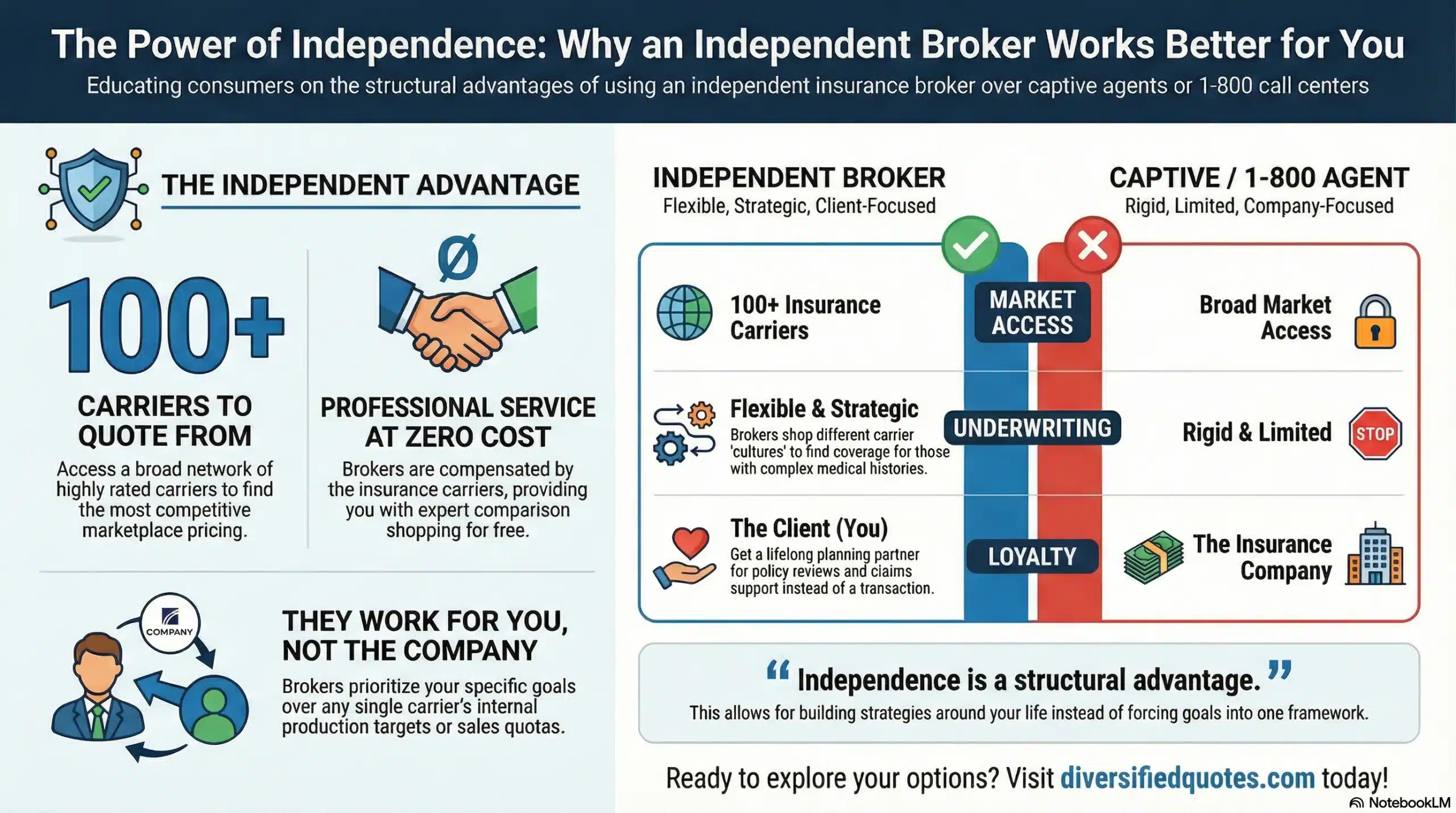
Jason Stolz, CLTC, CRPC, DIA, CAA and Chief Underwriter at Diversified Insurance Brokers (NPN 20471358), is a senior insurance and retirement professional with more than 25 years of real-world experience helping individuals, families, and business owners protect their income, assets, and long-term financial stability. As a long-time partner of the nationally licensed independent agency Diversified Insurance Brokers, Jason provides trusted guidance across multiple specialties—including fixed and indexed annuities, long-term care planning, personal and business disability insurance, life insurance solutions, Group Health, Travel Medical and Evacuation Insurance, and short-term health coverage. Diversified Insurance Brokers maintains active contracts with over 100 highly rated insurance carriers, ensuring clients have access to a broad and competitive marketplace.
His practical, education-first approach has earned recognition in publications such as VoyageATL, and contributions from his agency featured in Kiplinger and GoBankingRates— highlighting his commitment to financial clarity and client-focused planning. Drawing on deep product knowledge and years of hands-on field experience, Jason helps clients evaluate carriers, compare strategies, and build retirement and protection plans that are both secure and cost-efficient. Visitors who want to explore current annuity rates and compare options across multiple insurers can also use this annuity quote and comparison tool.
Explore More Life Insurance Options: Browse our complete guide to How Life Insurance Works — covering term life, whole life, final expense, annuity alternatives & more from 100+ carriers.
Last Reviewed: May 25, 2026 |
Reviewed by: Jason Stolz, CLTC, CRPC, DIA, CAA
Chief Underwriter, Diversified Insurance Brokers, Inc. | NPN: 20471358 | Diversified Insurance Brokers, Inc. — Licensed in all 50 states
Fact Checked by: Tonia Pettitt, CMIP©
Medicare Specialist, Diversified Insurance Brokers, Inc. | NPN: 14374308 | Diversified Insurance Brokers, Inc. — Licensed in all 50 states
Did you find this content helpful? Leave us a Google review — it helps others find trustworthy guidance too.
Editorial Standards: Diversified Insurance Brokers maintains rigorous editorial standards to ensure accuracy, clarity, and independence in all content. Learn more about our editorial standards and commitment to transparency.
