
Whole Life Burial Insurance vs. Term
Whole Life Burial Insurance vs. Term

Jason Stolz CLTC, CRCP, DIA, CAA
Whole life burial insurance vs term is one of the most practical comparisons families make when deciding how to protect loved ones without overpaying — and the confusion is understandable because both products share the same category label despite solving fundamentally different problems. Some people want nothing more than enough coverage to handle funeral costs and small outstanding debts so their children are not left managing those expenses during grief. Others want to protect income, eliminate a mortgage balance, fund college costs, or replace a breadwinner’s earnings if something unexpected happens during working years. Both needs are real and valid. What separates them is the duration of the financial obligation being protected — and that duration is what determines which product type fits the situation.
The confusion starts because both policies are called life insurance, and both pay a death benefit. The structural differences that actually matter — how long the coverage lasts, how much it costs per dollar of protection, what underwriting is required to obtain it, whether it accumulates any cash value, and which financial problem it is designed to solve — are not visible from the name alone. If your goal is affordable protection for final expenses on a fixed income, burial whole life may fit naturally because it stays in force for life, never increases in premium, and does not require re-qualification as you age. If your goal is maximizing coverage during peak earning years when financial obligations are largest, term insurance often delivers dramatically more protection per dollar because the insurer is covering a finite window of risk rather than a lifetime of it. Understanding the structural difference is what allows a family to build coverage intentionally around their actual planning objective rather than making an emotional decision based on which description sounds most reassuring.
Compare Burial Whole Life vs Term Life Quotes
Run side-by-side pricing and see which option fits your budget and protection goals.
How Burial Whole Life Insurance Works — The Permanent Final-Expense Foundation
Burial insurance — also called final-expense insurance or funeral insurance — is a type of permanent whole life coverage typically issued in smaller face amounts, most commonly between $5,000 and $40,000. It is designed to remain in force for the insured’s entire life as long as premiums are paid, with level premiums that do not increase as the insured ages and coverage amounts that do not decrease. The core planning purpose is simple: ensure that funeral costs and related final expenses are covered regardless of when death occurs, without requiring the surviving family to come out of pocket during an already difficult time.
The financial problem burial insurance solves is real and consistent. According to the National Funeral Directors Association, the median cost of a funeral with viewing and burial was nearly $7,848 as of 2023, and the average total cost in 2025 is estimated at $7,000 to $12,000 before accounting for additional expenses like cemetery plots, headstones, obituary notices, flowers, and transportation. When post-death medical bills, credit card balances, outstanding loans, and other small debts are added to that baseline, the total final-expense picture for many families reaches $15,000 to $25,000 or more. A burial whole life policy in the $10,000 to $25,000 range addresses that exposure directly and permanently, without requiring the insured to maintain the policy only through a defined term window and hope that death occurs before the coverage expires.
The permanent nature of burial whole life is its primary structural advantage. Because the insurer is guaranteeing coverage for the insured’s entire lifetime regardless of how long that is, the premium must reflect that lifetime commitment — which is why burial whole life costs more per dollar of coverage than term insurance. The insurer will pay the claim eventually; the only uncertainty is timing. That certainty of payment is exactly what makes burial whole life the right tool for covering permanent, irreducible expenses like funeral costs. No matter what happens to the insured’s health after the policy is issued, no matter how long they live, and no matter when the claim is filed, the death benefit will be paid. That guarantee has real value that cannot be replicated by a term policy that expires before death occurs.
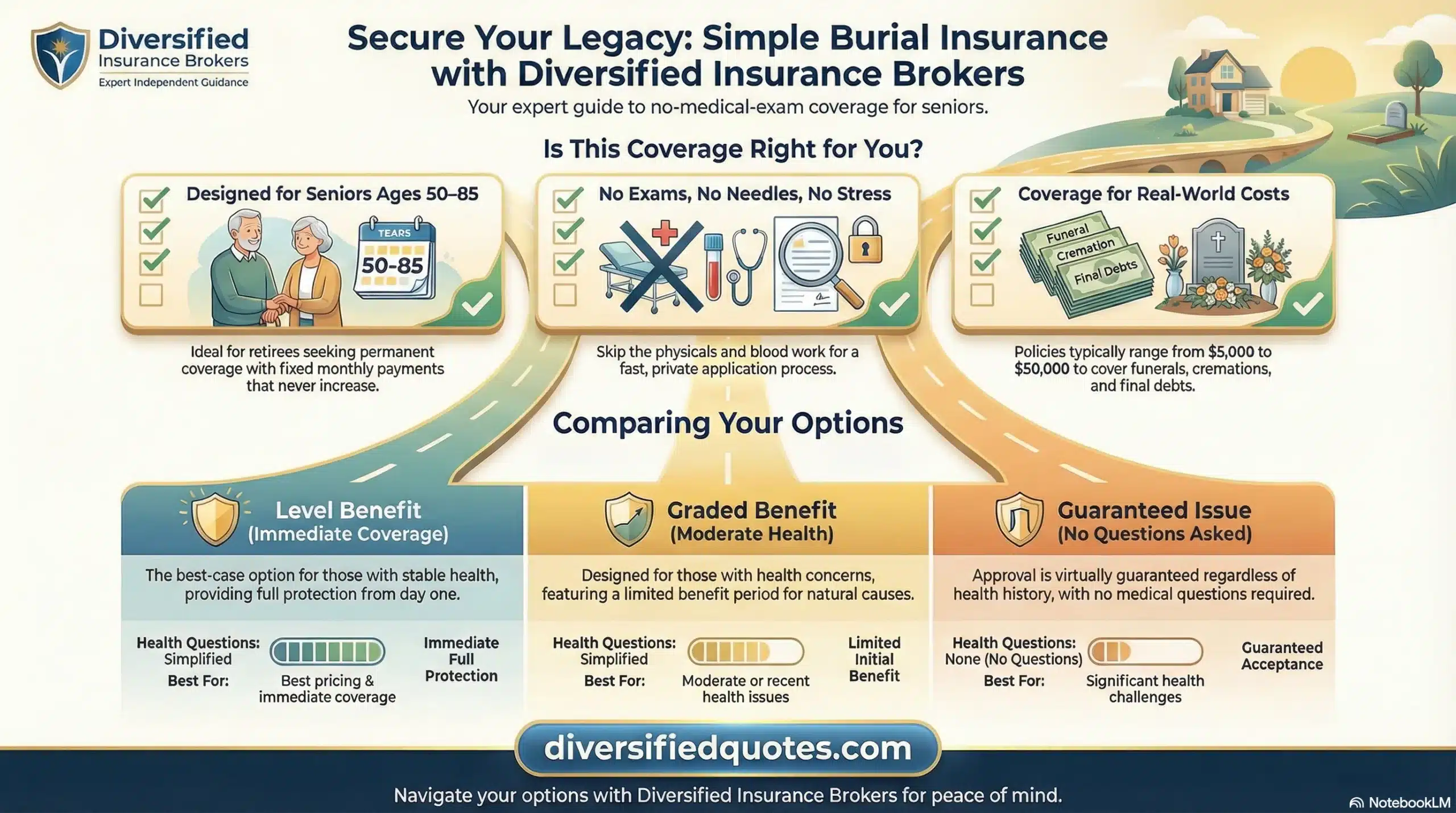
Because coverage amounts are smaller and underwriting is often simplified, burial insurance appeals to retirees, individuals with modest health concerns, and anyone who wants certainty without the complexity of a full medical underwriting process. Many carriers offer simplified-issue designs requiring only a short health questionnaire with no medical exam. Some carriers offer guaranteed-issue burial insurance — meaning approval without any health questions — for applicants whose health history makes simplified-issue qualification difficult. Guaranteed-issue policies typically include graded benefits: the full death benefit may not be payable during the first two years for death from natural causes, though accidental death is usually covered in full from day one. After the graded benefit period ends, the full policy amount is payable for any cause of death. This structure makes burial coverage accessible even for individuals with serious health histories, including those in construction and physically demanding professions with occupational risk factors that sometimes complicate traditional underwriting.
See Real-Term Rates Side by Side
Life Insurance Quoter
How Term Life Insurance Works — Maximum Coverage During Peak Financial Years
Term life insurance provides life insurance coverage for a defined period — typically 10, 20, or 30 years — at the lowest possible cost per dollar of protection. It is built to cover temporary but financially intense obligations: income replacement for a surviving spouse, mortgage payoff, children’s education funding, debt elimination, and business continuity. The defining characteristic of term life is leverage: for the same monthly premium that might purchase $15,000 to $25,000 of burial whole life coverage, a healthy 35- to 45-year-old can typically obtain $500,000 to $1,000,000 or more of 20-year term coverage. That gap in coverage-per-dollar is why term insurance is the standard recommendation for working adults with dependents who need maximum financial protection during the years when those dependents rely most heavily on the insured’s income.
Term insurance is priced lower per dollar of coverage than burial whole life for a straightforward actuarial reason: the insurer is only covering the risk of death during a defined window of time, and statistically the majority of term policyholders will outlive their term. Research suggests that approximately 99% of term life policies do not result in a death claim during the policy period — meaning the insurer collects premiums throughout the term and pays claims only in the relatively small fraction of cases where the insured dies before the term expires. That statistical structure allows insurers to price term coverage significantly below permanent coverage for the same face amount, because the lifetime claim obligation that makes burial whole life expensive simply does not exist in a term policy.
The duration-matching principle is the conceptual foundation of when term insurance is the right choice. A 40-year-old parent who needs to protect their income until retirement in 25 years needs a 25- or 30-year term policy, not burial whole life — because burial whole life at $20,000 cannot replace $80,000 per year of household income if the parent dies at age 45. A 30-year-old couple who just purchased a home with a 30-year mortgage needs enough life insurance to pay off that mortgage if either spouse dies — burial insurance at $15,000 cannot eliminate a $350,000 mortgage balance. The temporary, high-value financial obligations that characterize working years call for temporary, high-value insurance coverage, and term life insurance is the tool designed specifically for that match. When the mortgage is paid off, the children are independent, and retirement savings are sufficient, the need for the large term death benefit has largely expired — which is why the term policy ending at that point is not a failure of the coverage but a successful completion of its intended purpose.
The conversion option available in most term policies deserves specific attention because it bridges the gap between temporary and permanent coverage without requiring new medical underwriting. Most quality term policies include a conversion privilege that allows the policyholder to convert part or all of the term coverage to a permanent life insurance policy — typically any permanent product in the carrier’s portfolio — before a defined conversion deadline and without evidence of insurability. This means a person who purchases a 20-year term policy at age 40 in excellent health and then develops a serious health condition at 55 can still convert the term coverage to permanent coverage despite the health change, at rates based on the original issue age or a conversion scale rather than current age and health. For families who want the leverage of term coverage now but want to preserve the option for permanent coverage later, the quality of the conversion provision is an important selection criterion that goes beyond the premium comparison.
Side-by-Side Comparison — Burial Whole Life vs Term Life
The table below maps the structural differences between burial whole life insurance and term life insurance across the dimensions that most directly affect a family’s decision — so the comparison is based on what each product actually does rather than which marketing description sounds most appealing.
| Factor | Burial Whole Life Insurance | Term Life Insurance | What This Means in Practice |
|---|---|---|---|
| Policy Duration | Lifetime — coverage never expires as long as premiums are paid, regardless of how long the insured lives | Defined term — 10, 20, or 30 years; coverage ends at term expiration unless renewed or converted | Permanent needs — funeral costs, final expenses — require permanent coverage; temporary needs — income replacement, mortgage, child-rearing years — fit term’s limited window |
| Typical Face Amount | $5,000 to $40,000 — sized to cover funeral costs ($7,000–$12,000 median in 2025), small debts, and related final expenses | $100,000 to $2,000,000+ — sized to replace income, eliminate mortgage debt, fund education, or protect business cash flow | The coverage amount determines which financial problem the policy can actually solve; burial whole life cannot replace income, and term cannot substitute for permanent final-expense certainty |
| Cost Per $1,000 of Coverage | Higher — because the insurer guarantees payment regardless of when death occurs; the lifetime claim obligation increases actuarial cost | Lower — because coverage is limited to a defined window and approximately 99% of term policies do not result in a death claim during the term period | For the same monthly premium, term delivers dramatically more coverage; burial whole life delivers permanent coverage certainty — the pricing difference reflects what each policy structurally guarantees |
| Underwriting | Simplified-issue (no exam, short health questionnaire) or guaranteed-issue (no health questions, graded benefit period); accessible for applicants with moderate health concerns | Typically more detailed for larger face amounts; accelerated underwriting available for healthy applicants; full medical exam may be required for very large policies | Burial insurance is more accessible for applicants with health history; term’s lower cost is partially offset by stricter qualification for the best rates, though accelerated underwriting has expanded access |
| Premium Structure | Level for life — premiums are fixed at issue and never increase as the insured ages; budgeting certainty on a fixed income | Level for the term period; renewal premiums after term expiration are dramatically higher because they reflect the insured’s age at that time | Burial whole life’s level-for-life structure is particularly important for retirees on fixed incomes who cannot absorb premium increases in later years |
| Cash Value | Modest cash value accumulates over time; policyholders may access small policy loans or surrender value, though the primary purpose is the death benefit | No cash value — pure insurance; premiums purchase coverage only and do not accumulate any savings component | Cash value in burial whole life is a secondary benefit rather than the planning objective; most purchasers value the death benefit certainty more than the modest accumulation |
| Conversion Privilege | Not applicable — burial whole life is already permanent and does not require conversion | Most quality term policies include conversion options allowing conversion to permanent coverage without new medical underwriting before a defined deadline | Term conversion quality is an important selection criterion; it preserves the option for permanent coverage regardless of future health changes during the term period |
| Best For | Retirees and older adults who want final-expense certainty for life; individuals on fixed incomes; applicants with moderate health history who need guaranteed permanent coverage | Working adults with dependents, mortgages, income replacement needs, or large temporary financial obligations during peak earning years | The planning objective — not the age alone — determines the right fit; a 55-year-old with young children may need term; a 45-year-old retiree may need only burial whole life |
Burial (Final-Expense) Insurance Calculator
The Cost Structure Explained — Why Burial Whole Life Costs More Per Dollar
The premium difference between burial whole life and term insurance is the single most common point of confusion for families comparing coverage options, and it is worth explaining in concrete terms rather than assuming the difference is self-evident. Burial whole life costs more per dollar of coverage than term insurance for one straightforward reason: the insurer is making a lifetime guarantee. The claim will be paid — the only question is when. Because the insurer must set aside reserves sufficient to pay the claim at any point in the insured’s remaining life, and because administrative costs, agent compensation, and profit margin must be built into a premium that is level for life, the cost per $1,000 of coverage is higher than for a term policy where the insurer is only reserving for the defined term period and will collect premiums without paying a claim in the large majority of cases.
Term insurance is priced for the statistical reality that most policyholders outlive their term. This means the insurer can offer dramatically lower premiums per dollar of coverage because the expected claim incidence during the defined period is low relative to the premium collected. That pricing efficiency is what makes term insurance the right tool for large temporary coverage needs — a healthy 40-year-old can secure $1,000,000 of 20-year term coverage for a monthly premium that would buy only a fraction of that coverage in permanent burial whole life. But that pricing efficiency comes with a trade-off: the coverage ends, and when it ends, obtaining comparable permanent coverage later will be substantially more expensive because the insured is older and may have developed health conditions that make new coverage difficult or impossible to obtain at preferred rates.
The “right” answer on cost is not which policy has a lower premium in isolation — it is which policy’s cost structure matches the financial problem being solved. Burial whole life’s higher cost per dollar produces permanent, guaranteed protection for a modest but real and irreducible obligation — funeral costs that every family will eventually face. Term life’s lower cost per dollar produces maximum coverage for temporary but large obligations during the years those obligations exist. Comparing them on premium alone without accounting for what each product does is like comparing the monthly cost of renting a compact car versus a full-size moving truck — the “better deal” depends entirely on what you need to carry.
The Blended Strategy — When Both Products Work Together
Many households ultimately discover that the most efficient coverage design is not an either/or choice between burial whole life and term life but a blended strategy that assigns each product to the specific financial obligation it is best suited to address. The foundational insight behind a blended strategy is separating permanent needs from temporary needs and covering each with the product type designed for it.
A practical illustration: a 45-year-old parent with a $300,000 mortgage, two children in middle school, and a household income of $90,000 per year has both permanent and temporary coverage needs. The funeral cost need is permanent — it exists regardless of whether the parent dies at 55 or 85, and it should be covered by a burial whole life policy that stays in force regardless of when death occurs. The income replacement need, the mortgage payoff need, and the children’s education funding need are temporary — they exist now and for approximately 15 to 20 years, but will diminish as the mortgage amortizes, the children graduate, and retirement savings accumulate. A 20-year term policy with a $600,000 to $750,000 face amount addresses those temporary needs efficiently. By the time the term expires at age 65, the mortgage is substantially reduced or paid off, the children are independent adults, and retirement savings are sufficient — and the burial whole life policy remains in force to handle the one obligation that never goes away.
The blended strategy is also appropriate for retirees who already have term coverage expiring soon and want to ensure that final-expense protection remains in place. A 65-year-old whose 20-year term policy issued at age 45 is approaching its end date may not need large income replacement coverage anymore — the income replacement period is over. But the funeral cost exposure is still real and still permanent. A modestly sized burial whole life policy — perhaps $15,000 to $25,000 — addresses that remaining permanent need at a premium that is manageable on a fixed retirement income, without requiring the retiree to renew term coverage at dramatically higher rates that reflect their current age and health.
Underwriting Differences — What the Application Process Looks Like
The underwriting process differs meaningfully between burial whole life and term life insurance, and those differences have practical consequences for how easily each product can be obtained and how health history affects the outcome. Understanding these differences helps applicants approach the coverage selection and application process realistically rather than being surprised by what underwriting reveals.
Burial insurance typically uses simplified underwriting — a short health questionnaire without a medical exam, asking about a defined list of conditions and recent medical history. If the answers do not trigger any exclusionary conditions, coverage is typically approved quickly, often within days. For applicants with more significant health histories — recent hospitalizations, complex diagnoses, or conditions that simplified-issue guidelines decline — guaranteed-issue burial insurance is available from multiple carriers without any health questions. Guaranteed-issue coverage includes a graded benefit period, typically two years, during which the death benefit from natural causes is limited (usually to a return of premiums plus interest), with full coverage applying from day one for accidental death. After the graded period ends, the full death benefit is payable for any cause. The guaranteed-issue path makes burial insurance genuinely accessible across a wider range of health profiles than traditional life insurance can accommodate.
Term life insurance underwriting for standard to large face amounts is typically more thorough — potentially including a medical exam, blood and urine lab work, medical records review, prescription history check, and Motor Vehicle Report review. The depth of underwriting generally increases with face amount; many carriers now offer accelerated underwriting programs for healthy applicants seeking face amounts below defined thresholds, eliminating the medical exam and providing approvals within hours or days rather than weeks. Health conditions that produce adverse underwriting outcomes in term applications — certain cardiovascular diagnoses, diabetes with complications, cancer history within defined recency windows, significant build issues — may not eliminate the possibility of coverage but will affect the rate class offered, which in turn affects the premium. If you anticipate health changes or already have conditions that may complicate term underwriting, exploring term options sooner rather than later and understanding whether a policy’s conversion privilege is available without new medical underwriting is an important part of the planning process.
Flexibility and Long-Term Planning Considerations
Beyond cost and duration, the long-term planning flexibility each product offers is an important dimension of the comparison — particularly for applicants who anticipate that their needs, health, or financial situation may evolve over the life of the policy. Burial whole life’s primary flexibility advantage is its permanent structure: once issued, it remains in force indefinitely regardless of health changes, and the premium never increases. The policyholder’s ability to keep coverage in force is a function only of premium payment, not health re-qualification. Some burial whole life policies also include modest provisions for policy loans against the accumulated cash value, which can provide liquidity in financial emergencies — though the cash value in a burial policy is typically small relative to the death benefit and should not be the primary planning rationale for the purchase.
Term life insurance’s primary flexibility advantage is its conversion privilege. As described earlier, most quality term policies allow the policyholder to convert coverage to a permanent product without new medical underwriting before a defined conversion deadline — typically the earlier of a set age or a set number of years into the term. The conversion privilege is particularly valuable for families whose planning needs may shift from temporary to permanent over time, or for policyholders who develop health conditions during the term period that would make obtaining new permanent coverage difficult or expensive. The conversion window is not unlimited — it has a deadline — so policyholders who want to preserve this option must monitor the conversion timeline and make a conversion decision before the window closes rather than assuming it is available indefinitely.
Families with estate planning or significant legacy goals that go beyond burial expense coverage should also recognize that burial whole life’s face amounts typically cap in the $40,000 range, which is insufficient for more complex estate liquidity or wealth transfer objectives. If permanent coverage is needed for estate planning purposes at a meaningful face amount, additional permanent life insurance planning beyond burial coverage is necessary — either at point of purchase or through later conversion of term coverage. Burial whole life is designed for a specific, well-defined objective — final-expense certainty — and should be evaluated in that context rather than stretched beyond it.
Making the Decision — Matching Coverage Type to Financial Objective
The most important principle in deciding between burial whole life and term life insurance is matching the product type to the financial objective it is best suited to serve — not choosing based on which description sounds more reassuring or which premium number is smaller in absolute terms. The premium number means nothing in isolation without understanding what the premium is purchasing and for how long.
If the primary objective is ensuring that funeral costs, final medical bills, and small outstanding debts are handled without burdening surviving family members — and if that objective exists regardless of whether death occurs next year or in 40 years — burial whole life insurance is the structurally correct product. The permanent guarantee, the simplified underwriting access, the level premium for life, and the appropriately sized death benefit all align with what that objective requires. The higher cost per dollar of coverage is not a disadvantage in this context; it is the price of the lifetime guarantee that makes the product work for the purpose.
If the primary objective is maximum financial protection during peak earning and obligation years — income replacement, mortgage elimination, dependent support, debt coverage — term life insurance is the structurally correct product because it delivers coverage per premium dollar that burial whole life cannot match, during exactly the years when that coverage magnitude matters most. The fact that the coverage ends is not a flaw; it is what allows the pricing efficiency that makes large-scale income and debt protection affordable during working years.
And if both objectives exist simultaneously — final-expense certainty for life and maximum income-replacement coverage during working years — a blended strategy that combines a modest burial whole life policy with a larger term policy addresses each need with the product designed for it, at a combined premium that is typically more efficient than trying to solve both problems with a single product type. The calculators above provide real pricing for both product types so that the comparison can be based on actual numbers rather than general descriptions. Run the burial insurance calculator to see final-expense premium options at specific coverage amounts, and run the life insurance quoter to see term pricing across carriers — then build the strategy around what the numbers actually show for your age, health, and coverage objectives.
Build a Blended Strategy That Fits Your Budget
See how a small permanent burial policy and a larger term policy can work together.
Explore Your OptionsRelated Life Insurance Planning Guides
Talk With an Advisor Today
Choose how you’d like to connect—call or message us, then book a time that works for you.
Schedule here:
calendly.com/jason-dibcompanies/diversified-quotes
Licensed in all 50 states • Fiduciary, family-owned since 1980
FAQs: Whole Life Burial Insurance vs Term
Is burial whole life insurance better than term life insurance?
Neither product is universally better — each is better than the other for a specific planning purpose. Burial whole life insurance is better for covering permanent, irreducible final expenses — funeral costs, small outstanding debts, and final medical bills — because it guarantees coverage for life regardless of how long the insured lives or what happens to their health after the policy is issued. Term life insurance is better for covering temporary but large financial obligations — income replacement, mortgage payoff, dependent support, and debt coverage — during peak earning and obligation years, because it delivers dramatically more coverage per premium dollar during the defined window of highest financial risk. The practical decision rule is straightforward: if the financial objective is permanent — it exists whether death occurs next year or in 40 years — the correct product is permanent whole life. If the financial objective is temporary — it diminishes or ends as obligations are paid down — the correct product is term. When both objectives exist simultaneously, a blended strategy using a modest burial whole life policy for final-expense certainty alongside a larger term policy for income replacement typically produces the most efficient combined outcome.
How much does burial insurance typically cost?
Burial insurance premiums depend primarily on the insured’s age at application, gender, tobacco use status, and the face amount selected. For a non-tobacco female in her 60s, a $10,000 burial whole life policy might range from approximately $30 to $60 per month depending on carrier and health classification. For a non-tobacco male of the same age, premiums are typically about 30% higher because men have shorter average life expectancy, which increases the actuarial cost. Premiums increase meaningfully with each additional decade of age — a 70-year-old will pay substantially more than a 60-year-old for the same coverage amount, and a 75-year-old more still. The key advantage of burial whole life’s premium structure is that once the premium is set at issue, it never increases regardless of how long the insured lives — the $45 monthly premium locked in at age 62 remains $45 at age 82. For retirees and others on fixed incomes, that premium stability is often as important as the premium level itself. The burial insurance calculator above provides actual pricing based on your specific age, gender, tobacco use, and desired face amount — which is more accurate than any range estimate for your specific situation.
What happens to term life insurance when it expires?
When a term life policy expires, coverage ends — there is no death benefit payable if the insured dies after the term has ended and the policy has not been renewed or converted. Most term policies offer a renewal option at the end of the term, but the renewal premium reflects the insured’s age at that time rather than the original issue age, which means renewal premiums can be dramatically higher than the premiums paid during the original term period. For most policyholders, the cost of renewing term coverage in later years is prohibitive. The better planning approach for managing term expiration is to use the conversion privilege before the conversion deadline — converting some or all of the term coverage to a permanent policy without new medical underwriting, at a premium that reflects the conversion terms rather than full current-age rates. For policyholders whose term is expiring and who want ongoing life insurance coverage, the options are: convert existing term coverage if the conversion window is still open, apply for new coverage if health permits at competitive rates, or purchase a burial whole life policy to address the permanent final-expense need that remains regardless of age. The term life insurance quoter above allows you to compare term pricing including conversion privilege quality across carriers, which is a relevant selection criterion for applicants who want to preserve their flexibility for later.
Can I get burial insurance if I have health problems?
Yes — burial insurance is specifically designed to be accessible for applicants with a range of health histories, including many conditions that would complicate or preclude affordable term life insurance applications. Simplified-issue burial insurance requires only a short health questionnaire with no medical exam, and the list of conditions that would trigger a decline is narrower than typical term underwriting. For applicants whose health history does not clear even simplified-issue guidelines — certain serious diagnoses, recent hospitalizations, or conditions that most simplified-issue carriers decline — guaranteed-issue burial insurance is available from multiple carriers with no health questions whatsoever. Guaranteed-issue coverage includes a graded benefit period — typically two years — during which the death benefit from natural causes is limited to a return of premiums paid plus interest (usually 10%), with full coverage for accidental death from day one. After the graded period ends, the full death benefit is payable for death from any cause. The graded benefit structure is not a reduction in the ultimate coverage — it is a waiting period that the insurer requires to limit adverse selection risk — and after it ends, the policy functions identically to a standard burial whole life policy. For individuals with serious health histories, guaranteed-issue burial insurance is often the most practical available path to meaningful final-expense coverage.
About the Author:
Jason Stolz, CLTC, CRPC, DIA, CAA and Chief Underwriter at Diversified Insurance Brokers (NPN 20471358), is a senior insurance and retirement professional with more than 25 years of real-world experience helping individuals, families, and business owners protect their income, assets, and long-term financial stability. As a long-time partner of the nationally licensed independent agency Diversified Insurance Brokers, Jason provides trusted guidance across multiple specialties—including fixed and indexed annuities, long-term care planning, personal and business disability insurance, life insurance solutions, Group Health, Travel Medical and Evacuation Insurance, and short-term health coverage. Diversified Insurance Brokers maintains active contracts with over 100 highly rated insurance carriers, ensuring clients have access to a broad and competitive marketplace.
His practical, education-first approach has earned recognition in publications such as VoyageATL, and contributions from his agency featured in Kiplinger and GoBankingRates— highlighting his commitment to financial clarity and client-focused planning. Drawing on deep product knowledge and years of hands-on field experience, Jason helps clients evaluate carriers, compare strategies, and build retirement and protection plans that are both secure and cost-efficient. Visitors who want to explore current annuity rates and compare options across multiple insurers can also use this annuity quote and comparison tool.
Explore More Burial Insurance Options: Browse our complete guide to Best Burial Insurance — covering top burial insurance options, rates, calculators & how to find the best coverage from top carriers.
Last Reviewed: June 20, 2026 |
Reviewed by: Jason Stolz, CLTC, CRPC, DIA, CAA
Chief Underwriter, Diversified Insurance Brokers, Inc. | NPN: 20471358 | Diversified Insurance Brokers, Inc. — Licensed in all 50 states
Fact Checked by: Tonia Pettitt, CMIP©
Medicare Specialist, Diversified Insurance Brokers, Inc. | NPN: 14374308 | Diversified Insurance Brokers, Inc. — Licensed in all 50 states
Did you find this content helpful? Leave us a Google review — it helps others find trustworthy guidance too.
Editorial Standards: Diversified Insurance Brokers maintains rigorous editorial standards to ensure accuracy, clarity, and independence in all content. Learn more about our editorial standards and commitment to transparency.
