
Whole Life Insurance for People on Fixed Income
Whole Life Insurance for People on Fixed Income

Jason Stolz CLTC, CRPC
Fixed budgets should not mean giving up essential protection. Whole life insurance for people on fixed income is built around what matters most when your income is predictable and limited: lifetime coverage that cannot be cancelled due to age or health, guaranteed premiums that will never increase, and a guaranteed death benefit that provides a clear financial purpose for everyone in the family. These three guarantees are not marketing language — they are contractual commitments that distinguish whole life insurance from every other form of coverage and make it uniquely suited to the financial structure of retirement income.
Whether you are living on Social Security, pension income, disability benefits, retirement distributions, or some combination of smaller income streams, the challenge is consistently the same: you want coverage that is stable, simple, and dependable without creating the financial stress of unpredictable costs. When funeral expenses alone average $8,000 to $9,000 in 2025 — with funeral service costs rising approximately 4.7% annually between 2021 and 2024 — the question of who pays those costs when the time comes is not abstract. Without a policy designed to handle final expenses, the answer is most commonly the surviving spouse or adult children, coming out of pocket during one of the most emotionally difficult periods a family experiences. A well-designed whole life policy eliminates that burden deliberately and permanently, at a monthly cost that can be structured to fit within a fixed-income budget when selected at the right face amount and the right time.
At Diversified Insurance Brokers, we help families compare permanent life insurance options from many carriers so you can find the best fit for your budget, your age, and your health profile. The goal is not to overbuy coverage. The goal is to find a policy you can realistically keep for the long haul — because the best life insurance policy is the one that stays in force when you need it.
Compare Affordable Whole Life Options
We’ll show lifetime coverage choices—final expense, traditional whole life, and guaranteed issue—across 100+ carriers.
Why Whole Life Insurance Fits a Fixed Income
When income is steady but limited, insurance must behave the same way — remaining stable, predictable, and affordable across years and decades rather than becoming a financial moving target. That alignment between the fixed-income lifestyle and the whole life insurance structure is the core reason whole life is consistently the preferred coverage type for retirees, Social Security recipients, pensioners, and others whose monthly budget has defined and dependable parameters.
Many people on a fixed budget are not looking for large policies designed for income replacement or wealth transfer at scale. They are looking for a policy that provides reliable protection for final expenses and allows them to keep their savings intact for living costs rather than earmarking retirement funds for funeral expenses. The concern is not complicated: funeral costs, final medical bills, credit card balances, and small outstanding loans create immediate financial pressure on surviving family members when they arrive unplanned. Whole life insurance addresses that pressure by creating a funded, contracted solution — one that is in place regardless of when it is needed and that pays a defined benefit quickly so the family can focus on the emotional demands of loss rather than the logistics of how to cover costs.
Guaranteed premiums for life are the foundational advantage of whole life insurance for people on fixed incomes. A policy that is affordable today but subject to premium increases as the insured ages creates a compounding affordability risk — the coverage is most valuable at advanced ages when health declines, but if premiums have risen beyond what the fixed income can sustain, the policy lapses precisely when it would have been most useful. Whole life insurance eliminates that risk contractually. The premium set at issue — whether the policy is purchased at age 58 or age 72 — remains at that level for the life of the policy as long as premiums are paid. A monthly premium of $45 locked in at age 65 is still $45 at age 85, regardless of what happens to the insured’s health, regardless of inflation, and regardless of any other factor. That predictability is not a minor feature — for a household managing a retirement income that does not expand with age, it is the difference between coverage that can be maintained indefinitely and coverage that eventually becomes unaffordable.
Guaranteed death benefit is equally foundational. Unlike investment accounts whose value fluctuates with markets, and unlike annuities whose income depends on contract terms and longevity projections, the death benefit in a whole life policy is a fixed, contractually guaranteed amount that does not decrease with age, does not require favorable investment conditions, and does not depend on how long the insured lives. Most insurance carriers pay claims within 24 to 72 hours of receiving a completed claim form and death certificate — which means the funds are available to the beneficiary immediately when they are most needed, rather than requiring weeks of estate administration to access.
Guaranteed cash value provides a secondary benefit that many policyholders do not fully appreciate until it is available to them. Whole life policies build cash value over time through a portion of each premium that the carrier credits to a guaranteed accumulation account within the policy. In the early years, cash value accumulates slowly. Over decades, it becomes a meaningful reserve — accessible through policy loans or surrender if the policyholder chooses — that provides a financial backstop during emergencies without requiring the policyholder to liquidate savings accounts or investment assets. For fixed-income households where emergency savings may be modest, the cash value component of a whole life policy represents an additional layer of financial security that term insurance simply does not provide.
Simplified underwriting makes whole life accessible across a wider range of health profiles than many fixed-income individuals realize. Many senior-focused whole life policies use a short health questionnaire and prescription history review rather than requiring a full medical exam, blood draws, or extensive medical records. That simplified process makes coverage accessible to applicants with managed chronic conditions — controlled hypertension, well-managed diabetes, prior cancer with stable follow-up — who might assume their health history automatically disqualifies them. In many cases, the right carrier with the right simplified-issue program can provide day-one full coverage at a competitive premium despite a health history that would complicate a traditional fully-underwritten application.
The Real Cost of Funeral Expenses — Why Coverage Is Not Optional
The financial case for whole life insurance on a fixed income becomes most concrete when the actual cost of dying without coverage is examined clearly. The National Funeral Directors Association reported a median funeral cost of $7,848 for a funeral with viewing and burial in 2023, and industry data suggests that average costs in 2025 are approaching $8,000 to $9,000 before additional expenses. That baseline figure does not include the cemetery plot, headstone, obituary placement, flowers, reception expenses, or transportation costs that commonly bring the total well above $12,000 to $15,000 in many markets. Cremation offers a less expensive alternative but still typically ranges from $5,000 to $10,000 depending on services selected and geographic location.
When post-death medical bills — the final hospital admission, the emergency room visit that preceded the death, the hospice care in the final weeks — are added to the funeral baseline, the total immediate financial obligation facing a family can easily reach $15,000 to $25,000. When credit card balances and small outstanding loans are included, the number is larger still. These costs arrive within days or weeks of the death, when family members are simultaneously managing grief, legal paperwork, and the logistics of settling an estate. The last thing a surviving spouse on a fixed Social Security income needs is a $15,000 bill with no clear source of funds to pay it.
The inflation dynamic compounds the urgency. Funeral service costs rose approximately 4.7% annually between 2021 and 2024 — a rate that meaningfully exceeds the modest cost-of-living adjustments that Social Security provides. A fixed-income household’s purchasing power is being eroded relative to funeral costs each year that coverage is not purchased, which means the gap between what savings can cover and what coverage is needed grows over time rather than remaining constant. For seniors who are delaying the purchase decision, that delay has a quantifiable cost: premiums increase with each year of age, and the funeral cost that the coverage needs to address increases each year as well. Earlier planning consistently produces better outcomes — lower premiums for the same coverage, more carrier options, and a longer period during which the policy is in force and accumulating cash value.
Budget-Smart Whole Life Policy Designs for Fixed-Income Households
There is not a single “whole life insurance” product — there are several types of permanent coverage that fall under the whole life category, and choosing the right design is the difference between a policy that fits comfortably within a fixed-income budget and one that creates strain. Understanding the distinct structure and purpose of each design helps fixed-income households select the coverage type that matches their specific objective rather than defaulting to the most familiar or most heavily advertised option.
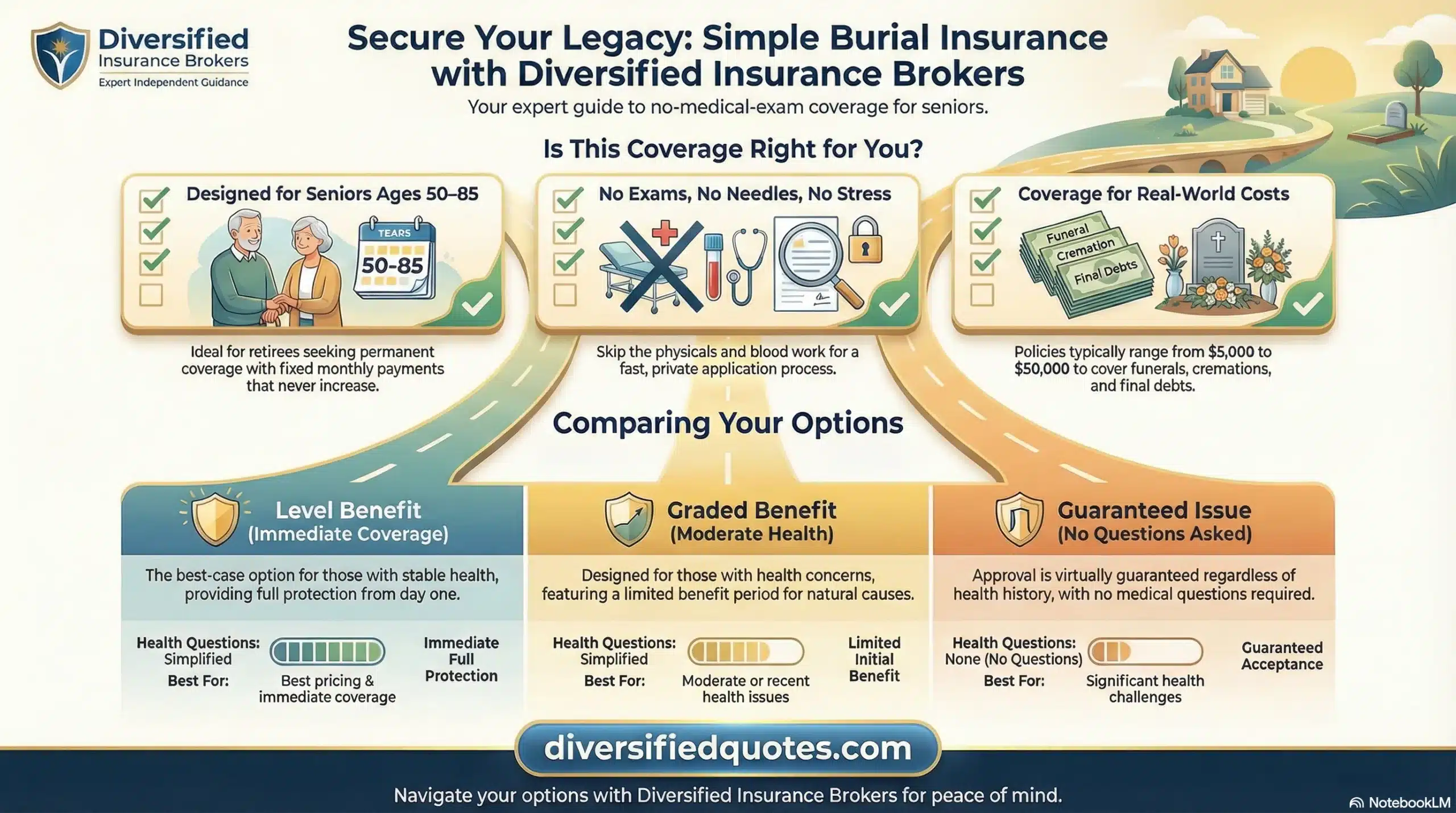
Final expense whole life insurance — also called burial insurance or funeral insurance — is the most common and most appropriate solution for fixed-income households whose primary objective is covering funeral costs and final medical expenses. Coverage amounts typically range from $5,000 to $25,000, sized specifically for the final-expense obligation rather than income replacement. Premiums are structured to be modest relative to the face amount, and underwriting is simplified: most final expense policies require only a short health questionnaire with no medical exam, and the questions focus on a defined list of conditions that the carrier considers high-risk rather than requiring a comprehensive health review. Many seniors who worry that their health history will prevent them from qualifying are surprised to find that managed chronic conditions — controlled hypertension, stable diabetes, remote cancer history — are acceptable to simplified-issue final expense carriers at day-one full benefit coverage. You can explore the full range of final expense options here: burial insurance.
Guaranteed issue whole life insurance is designed for applicants who either prefer no health questions at all or whose specific health history exceeds what simplified-issue programs will accept. Guaranteed issue policies — available from multiple carriers for applicants typically between ages 50 and 85 — approve coverage without any health questionnaire, medical review, or prescription history check. The trade-off for that unconditional approval is a graded benefit period during the first two years: if the insured dies from natural causes during that window, the policy typically pays a return of premiums plus interest rather than the full face amount. Accidental death is covered in full from day one. After the graded period ends, the full face amount is payable for death from any cause, and the policy functions identically to a standard final expense policy from that point forward. The graded benefit is not a reduction in the ultimate protection — it is a waiting period that allows the carrier to offer coverage without health screening by limiting its near-term exposure during the highest-risk period immediately after policy issue. For applicants with significant health challenges, guaranteed issue is often the most realistic available path to meaningful final-expense coverage. A well-known guaranteed issue example in the market is the Gerber Guaranteed Issue Whole Life policy, which provides context for how these products are structured.
Traditional whole life insurance provides level premiums, level death benefits, and stronger long-term cash value mechanics than final expense products — and is often appropriate when a fixed-income household’s goal goes beyond funeral-only protection. A traditional whole life policy in a modest face amount — perhaps $25,000 to $50,000 — can provide final-expense coverage plus a modest legacy component, with cash value that accumulates more substantially over time than in a final expense design. Some traditional whole life policies are eligible to receive dividends, which — while not guaranteed — can be used to reduce premiums, increase the death benefit, or accumulate in a paid-up additions account. For fixed-income households who are still in their late 50s or early 60s and have reasonable health, traditional whole life may offer better long-term value than final expense products despite slightly more involved underwriting.
Living benefits riders are available on many whole life policies and allow the policyholder to access a portion of the death benefit if diagnosed with a qualifying terminal, chronic, or critical illness. For fixed-income households where the concern is not only death costs but also the financial impact of a serious illness during the final years of life, living benefits can provide meaningful flexibility — accelerating a portion of the death benefit to help with care costs, home modifications, or other needs that arise during extended illness. These riders should be added selectively: they typically increase the premium, and if budget is tight, a basic whole life policy without riders may be the right starting point. This guide on life insurance with living benefits for seniors provides more detail on how these features work and when they add genuine value for the specific planning situation.
Burial Insurance Calculator
If your goal is predictable whole life protection for final expenses, this calculator helps you estimate pricing by age, state, and coverage amount — so you can right-size coverage for a fixed monthly budget.
Tip: Start with $10,000–$25,000 to match typical final expense goals, then adjust up or down to fit your monthly comfort zone.
How Whole Life Pricing Works on a Fixed Income
People on fixed incomes often assume that whole life insurance is automatically prohibitive. The reality is more nuanced — and for households whose goal is modest final-expense coverage rather than large-scale income replacement, whole life premiums can be structured to fit within a defined monthly budget when the right face amount and policy type are selected. Understanding what drives pricing helps fixed-income households make realistic decisions rather than assuming coverage is unattainable or accepting unnecessarily high premiums by defaulting to a product design that does not match the planning objective.
Face amount is the single most controllable pricing variable for a fixed-income buyer. The relationship between face amount and premium is direct — a $10,000 final expense policy costs roughly half what a $20,000 policy from the same carrier at the same age costs. Starting with a realistic assessment of what the coverage is actually supposed to accomplish — funeral costs plus immediate final medical bills, rather than an aspirational round number — often reveals that a $10,000 to $20,000 policy provides adequate coverage at a premium that fits the monthly budget without strain. Typical final expense premiums for healthy non-tobacco applicants range from approximately $30 to $70 per month in the mid-60s age range, and scale upward with age — at age 80, a $10,000 policy averages approximately $158 per month for women and $197 per month for men, reflecting the actuarial reality that the insurer’s expected holding period before paying the claim is shorter.
Age at application is the most significant pricing factor after face amount, and it is the one factor that fixed-income households cannot control except by making a decision sooner rather than later. Carriers set premiums based on the insured’s age at issue, and those premiums are locked in at that level for the life of the policy. A 65-year-old who purchases a $15,000 final expense policy will pay a meaningfully lower premium than a 75-year-old purchasing the same policy from the same carrier — and the premium difference accumulates into a substantial long-term savings for the person who acted earlier. Waiting is not neutral: every year of delay increases both the annual premium the policy will carry and the probability that a health change will push the application into a more expensive product category or trigger a decline.
Health is evaluated differently across policy types. Traditional whole life and larger face amount policies involve more detailed health review. Final expense simplified-issue policies ask a shorter list of health questions focused on the most significant risk factors. Guaranteed issue policies ask no health questions at all. For fixed-income applicants whose health history includes managed chronic conditions, the practical guidance is to explore simplified-issue options first — because simplified-issue policies typically offer better pricing and day-one full benefits compared to guaranteed issue, and many applicants who assume they need guaranteed issue actually qualify for simplified-issue at more favorable terms. Working with an independent broker who can pre-screen a health profile against multiple carriers’ simplified-issue guidelines before submitting a formal application significantly improves the probability of qualifying at the best available rate class.
Gender affects pricing in a consistent and predictable way: women pay approximately 30% less than men for the same coverage amount at the same age because women have longer average life expectancy, which means the insurer holds the premium and earns investment returns for a longer average period before the claim is paid. Tobacco use increases premiums significantly across all carriers — typically 30% to 50% above non-tobacco rates — because tobacco use is one of the strongest predictors of shortened life expectancy in the actuarial data. Applicants who have not used tobacco for a defined period — typically 12 months or more, though the qualifying period varies by carrier — may qualify for non-tobacco rates even if they were tobacco users previously.
Payment mode can affect total cost at the margins. Monthly automatic bank draft (EFT/ACH) is the most common payment structure for fixed-income households and is offered by virtually all carriers without additional fees. Some carriers offer a modest discount for annual premium payment, but for households whose planning is built around monthly cash flow rather than annual lump sums, the convenience and budget consistency of monthly draft typically outweighs the potential premium discount. The most important payment-mode consideration for fixed-income households is timing: scheduling the premium draft immediately after Social Security or pension income arrives — rather than mid-month or at other times — reduces the risk of insufficient funds situations that could trigger a lapse notice.
Whole Life vs. Other Fixed-Income Coverage Options — Side by Side
Not every fixed-income household needs the same type of coverage. The best solution depends on the planning timeline, budget stability, health profile, and whether the primary goal is final-expense certainty or broader family protection. The table below maps the key coverage types against the factors that most affect a fixed-income household’s decision.
| Coverage Type | Premium Structure | Covers for Life? | Health Screening Required | Cash Value | Best For |
|---|---|---|---|---|---|
| Final Expense Whole Life | Level for life — never increases; typical range $30–$70/month for healthy mid-60s applicants at $10,000–$15,000 coverage | Yes — permanent; no expiration date as long as premiums are paid | Simplified issue — short health questionnaire, no medical exam; most managed chronic conditions acceptable | Modest accumulation; provides policy loan access and surrender value | Fixed-income households needing permanent funeral and final-expense coverage at the lowest appropriate premium |
| Guaranteed Issue Whole Life | Higher per dollar of coverage than simplified-issue; no health screening trade-off reflected in premium | Yes — permanent after graded benefit period; full coverage for accidental death from day one, full coverage for all causes after 2 years | No health questions — guaranteed approval for applicants within age range (typically 50–85) | Modest accumulation; same cash value mechanics as simplified-issue policies | Applicants with significant health challenges who do not qualify for simplified-issue programs; highest-risk health profiles |
| Traditional Whole Life | Level for life; higher than final expense for same face amount due to stronger cash value mechanics; dividend eligibility at some carriers | Yes — permanent; stronger long-term value at larger face amounts | More detailed underwriting; may require medical records review for larger face amounts; exam sometimes required | Stronger accumulation; dividend participation possible; larger loan access over time | Fixed-income households in their late 50s or early 60s with good health who want coverage beyond funeral-only protection or want stronger long-term cash value |
| Term Life (10–30 Years) | Lowest initially; rises sharply at renewal after term ends; often unaffordable to renew at older ages | No — expires at term end; no death benefit if insured outlives the policy without renewal or conversion | Health questions required; accelerated underwriting available for healthy applicants; exam sometimes required for large face amounts | None — pure insurance with no savings component | Working adults with temporary high-value obligations (income replacement, mortgage, dependent support); not appropriate as the primary coverage for fixed-income retirees whose goal is final-expense certainty |
See Real-Term Rates Side by Side
Life Insurance Quoter
Who Benefits Most From Whole Life Insurance for People on Fixed Income
Whole life insurance on a fixed income is most valuable for households where the financial objective is clear, the time horizon is long, and the budget constraint is real. The profile is consistent across a wide range of individual circumstances: the person wants to ensure that their passing does not create a financial crisis for their surviving spouse or adult children, they are living on income that is predictable and limited, and they want a solution that does not require ongoing monitoring, active management, or future decisions about renewal or re-qualification.
Retirees are the primary beneficiary population for final expense and whole life coverage because their financial obligations have typically shifted from the high-value temporary needs of working years — income replacement, mortgage coverage, child-rearing — to the permanent but modest needs of later life. A retired couple on Social Security whose children are independent, whose mortgage is paid, and whose retirement savings are modest enough that a $12,000 funeral bill would create meaningful disruption does not need $500,000 of term life insurance. They need a $15,000 to $25,000 permanent policy that guarantees those costs are covered regardless of when death occurs, at a premium that fits within their fixed monthly budget.
Seniors with health conditions are often the most surprised to discover that whole life coverage is accessible to them. Many individuals who have been declined for or have never applied for traditional fully-underwritten life insurance assume that any life insurance requiring health disclosure is beyond their reach. The simplified-issue final expense market is specifically designed to extend coverage to this population. Carriers that specialize in final expense underwriting have developed guidelines that accept a wide range of managed chronic conditions — hypertension, diabetes, COPD when managed, remote cancer history, cardiovascular disease without recent acute events — at day-one full benefit coverage and competitive premiums. If you are evaluating options with a specific health history, our resource on affordable life insurance for seniors with health issues provides more detail on which conditions most commonly affect underwriting outcomes and how carrier selection influences the result.
Caregivers and individuals anticipating significant health changes in the years ahead sometimes add living benefits riders to their whole life policies, creating flexibility to access a portion of the death benefit if diagnosed with a qualifying serious illness before death. For fixed-income households where the concern is not only funeral costs but also the financial impact of a terminal or chronic illness during the final years of life, living benefits riders can provide a meaningful additional layer of protection. The key planning consideration is whether the rider’s additional premium fits within the budget after the base policy premium is accounted for — because a policy that provides living benefits but cannot be sustained financially due to premium strain is less valuable than a simpler policy without riders that stays in force indefinitely.
Fixed-income households with modest or no savings reserves are particularly well-served by whole life insurance because the alternative — self-insuring against final expenses by accumulating dedicated savings — requires exactly the kind of long-term discipline and surplus cash flow that a fixed income rarely provides. For a 68-year-old on Social Security with $15,000 in savings, designating those savings for future funeral expenses is both financially impractical (the savings serve double duty as an emergency fund) and emotionally difficult (setting aside money specifically earmarked for one’s own death is uncomfortable). A whole life policy creates that funded final-expense plan externally — through a dedicated, contracted instrument whose purpose is clear and whose funds cannot be inadvertently spent on other needs — without requiring the policyholder to hold a mental reservation against their liquid savings.
How Cash Value Works on a Fixed Income — And How to Use It Safely
Cash value is the feature that most distinguishes whole life insurance from term insurance, and it is also the feature most commonly misunderstood by fixed-income policyholders. Understanding what cash value actually is, how it accumulates, and how it should and should not be used is important for making informed decisions about whole life coverage on a fixed budget.
Cash value is a guaranteed accumulation that builds within the policy over time, funded by a portion of each premium that the carrier credits at a guaranteed minimum interest rate. In the early years of a final expense or whole life policy, cash value grows slowly relative to premiums paid — because a meaningful portion of early premiums covers the cost of insurance and the carrier’s operating expenses. As the policy matures over years and decades, the relationship shifts: more of each premium credits to cash value, and the accumulated balance grows to become a meaningful portion of the face amount. After 20 or 30 years, the cash value in many whole life policies approaches or reaches the face amount — the point at which the policy “endows” and the cash value equals the death benefit.
For fixed-income policyholders, the most important thing to understand about cash value is what it is not. It is not a savings account from which money can be freely withdrawn without consequences. Accessing cash value through a withdrawal reduces the death benefit by the amount withdrawn. Accessing it through a policy loan is interest-bearing — the outstanding loan balance accrues interest at the carrier’s stated loan rate, and if the loan balance grows to equal the cash surrender value, the policy lapses. For a fixed-income household whose primary purpose for the policy is the death benefit, triggering a lapse by mismanaging a policy loan would defeat the entire planning objective.
The safest framework for thinking about cash value on a fixed income is as an emergency backstop of last resort — available in genuine financial emergencies when no other reasonable option exists, but not accessed routinely or treated as supplemental income. If a fixed-income policyholder faces a genuine financial emergency where the choice is between taking a policy loan and a worse alternative, the policy loan may be appropriate — but it should be repaid as soon as the financial situation allows, and the outstanding loan balance should be monitored carefully. The death benefit, not the cash value, is the reason the policy was purchased, and preserving that death benefit for the intended purpose is the priority.
How to Keep Premiums Affordable Without Losing the Protection You Need
Right-sizing the coverage amount is the single most impactful decision a fixed-income buyer can make. The temptation to purchase a larger face amount — enough to leave something for the grandchildren, or enough to cover every possible expense in the most generous scenario — is understandable but often works against long-term policy sustainability. A $30,000 burial policy that strains the monthly budget creates constant pressure and the risk of lapse; a $15,000 policy at half the premium that fits comfortably within the fixed income creates a funded final-expense plan that will actually be in force when needed. The right coverage amount is the one that covers the actual financial obligation — funeral costs plus immediate medical bills and small debts — at a premium that fits within the budget without requiring ongoing financial stress to maintain.
Choosing automatic EFT or ACH monthly bank draft is strongly advisable for fixed-income policyholders. Automatic premium drafting eliminates the risk of forgetting a due date, eliminates the delay of mailing a check, and creates the kind of routine, invisible payment structure that keeps the policy in force through the same automatic process that handles utility bills and other recurring fixed expenses. Most carriers accept monthly EFT at no additional cost and may offer a small premium discount for this payment method. For households whose income arrives on a predictable schedule — the third of the month for most Social Security recipients, or a specific Wednesday based on birth date — scheduling the premium draft to occur immediately after income arrives minimizes the risk of an insufficient-funds situation that could trigger a lapse notice.
Avoiding unnecessary riders keeps premiums focused on the core coverage objective. Riders add flexibility but they also add cost, and on a tight budget every additional premium dollar spent on a feature that may not be needed is a dollar that creates premium pressure rather than protection. The right starting point for most fixed-income buyers is the simplest available policy design — level premiums, guaranteed death benefit, no additional riders — and adding riders only if a specific, likely-to-be-needed feature is clearly identified. If living benefits are a priority, the next step is verifying that the additional rider premium fits comfortably within the budget after the base policy premium is established. If they don’t fit, the base policy without riders is the better choice.
Shopping independently across multiple carriers is one of the most impactful steps a fixed-income buyer can take, and it is one that many buyers skip. The same applicant profile — same age, same gender, same health history, same desired face amount — can produce meaningfully different premiums at different carriers because carriers evaluate health conditions, prescription histories, and risk profiles using their own proprietary underwriting guidelines. A carrier that is conservative about one specific condition may be lenient about another, and vice versa. The only way to identify which carrier offers the best available terms for a specific applicant is to compare across the full relevant market rather than accepting the first quote as the definitive answer. If health history is part of the affordability puzzle, our resource on affordable life insurance for seniors with health issues addresses the carrier selection dimension of that challenge in more detail.
Common Mistakes to Avoid When Buying Whole Life on a Fixed Income
Buying too much coverage too fast is the most common and most consequential mistake in the fixed-income life insurance market. It is natural to want coverage that handles every scenario and leaves something meaningful for the next generation — but whole life premiums increase directly with face amount, and a policy sized for aspirational legacy goals rather than realistic final-expense needs can create premium pressure that makes the policy difficult to sustain on a fixed income. The policy that gets purchased enthusiastically at an oversized face amount but lapses two years later because the premium strains the budget provides zero benefit. The policy sized realistically for the actual financial need, at a premium the policyholder can maintain indefinitely, provides permanent protection that delivers its value when it matters most.
Assuming that only guaranteed issue is available is a mistake that causes many applicants to pay higher premiums than their health history requires. Guaranteed issue policies carry the highest cost per dollar of coverage in the final expense market because the carrier is accepting all applicants without health screening, which means they are also accepting applicants with imminent or very high claim probability. The premium reflects that elevated risk. Many applicants who default to guaranteed issue because they believe their health history disqualifies them from simplified-issue programs are actually eligible for simplified issue at better pricing and day-one full benefits — and would never have known it because they assumed the worst rather than exploring options. Working with an independent broker who can evaluate the specific health history against multiple carriers’ simplified-issue guidelines before any formal application is submitted is the most reliable way to identify the best available product category before committing to a premium.
Waiting too long creates compounding costs. Age is the most significant pricing driver after face amount, and every year of delay produces a higher permanent premium for the same coverage. A fixed-income buyer who delays a $15,000 final expense policy purchase from age 68 to age 73 will pay a materially higher monthly premium for the identical coverage — and will have also created a five-year window during which a health event could have shifted them from a simplified-issue qualification to a guaranteed-issue-only situation. The right time to purchase final expense whole life is when the planning need is clear, the budget is defined, and health still supports the most favorable available underwriting category.
Not comparing multiple carriers costs money silently and invisibly. The pricing difference between the most and least competitive carriers for a specific applicant profile can be $15 to $30 per month or more — which, over a 20-year holding period, represents $3,600 to $7,200 in additional premium paid for identical coverage. That difference is never visible to a buyer who accepts the first quote they receive as the market rate, and it is entirely avoidable by comparing across multiple carriers with the guidance of an independent broker who understands which carriers are most competitive for specific age, health, and coverage combinations.
Practical Example — Balancing Budget and Protection
Evelyn is 69, retired, and receives a fixed Social Security income. She wants to ensure that her daughter is never forced to pay funeral costs or final medical bills out of pocket when she passes away. She is not looking for income replacement or a large legacy — she simply wants the final-expense problem solved permanently and clearly, at a monthly cost that fits within her budget without stress.
After comparing options, Evelyn selects a $15,000 final expense whole life policy with level premiums and a simplified approval process that does not require a medical exam. The coverage addresses the specific financial problem she is solving — funeral costs plus any immediate medical bills — without oversizing the face amount in ways that would increase the premium beyond what her fixed income can sustain. Because the premium is manageable and drafts automatically the day after her Social Security income arrives each month, the policy stays in force without requiring any active attention or budgeting decisions month to month. When Evelyn passes — whether at 75 or 92 — the $15,000 death benefit pays to her daughter within 24 to 72 hours of the claim being submitted, covering the funeral and any remaining immediate expenses without her daughter bearing any out-of-pocket cost during an already difficult time.
The reason this approach works is not complicated. The coverage amount is realistic. The premium fits the budget. The policy is designed for one specific, well-defined purpose. And because it is permanent whole life insurance with guaranteed premiums, it will never become unaffordable, will never expire, and will never require re-qualification due to health changes. Those three guarantees — not the face amount — are what make it the right solution for a fixed-income household whose goal is final-expense certainty.
Helpful Resources
If you’re comparing policy types, underwriting paths, and affordability strategies, these pages can help.
Related Whole Life & Senior Coverage Pages
Explore permanent coverage types and senior-friendly underwriting paths that can work on a fixed budget.
Related Budget-Friendly Final Expense Guides
Compare affordability-focused burial insurance pages that can help you choose a realistic benefit amount.
Talk With an Advisor Today
Choose how you’d like to connect—call or message us, then book a time that works for you.
Schedule here:
calendly.com/jason-dibcompanies/diversified-quotes
Licensed in all 50 states • Fiduciary, family-owned since 1980
FAQs: Whole Life Insurance for People on Fixed Income
Can I afford whole life insurance on Social Security income?
Yes — many whole life policies designed for final-expense coverage are specifically structured to fit within Social Security income budgets. The key is right-sizing the face amount to match the actual financial need rather than purchasing more coverage than the planning objective requires. A $10,000 to $15,000 final expense whole life policy — which covers the median funeral cost plus immediate medical bills for most families — typically carries a monthly premium of $30 to $70 for healthy non-tobacco applicants in their mid-60s. Even at age 80, a $10,000 policy averages approximately $158 per month for women and $197 for men — still manageable within many fixed-income budgets when sized for the specific need rather than maximized for coverage amount. The guaranteed-premium structure of whole life insurance is particularly compatible with fixed income because the premium that fits the budget today will still fit the budget in 10 or 20 years — it does not increase with age after the policy is issued. Comparing across multiple carriers with the guidance of an independent broker who understands which insurers are most competitive for your specific age, health, and desired face amount is the most reliable way to identify the best available pricing for a fixed-income budget.
What is the difference between simplified issue and guaranteed issue whole life for seniors?
Simplified issue whole life requires the applicant to answer a short health questionnaire — typically 8 to 15 questions focused on serious health conditions the carrier considers high-risk. No medical exam is required. If the answers to the questionnaire are acceptable under the carrier’s underwriting guidelines, the policy is issued with day-one full benefit coverage at a premium that reflects the health information provided. Simplified issue typically offers lower premiums per dollar of coverage than guaranteed issue, because the carrier has screened out the highest-risk applicants through the health questions. Guaranteed issue whole life requires no health questions at all — approval is available to anyone within the eligible age range (typically 50 to 85) without health disclosure. The trade-off is that guaranteed issue policies include a graded benefit period — typically two years — during which the death benefit from natural causes is limited to a return of premiums plus interest, with full coverage for accidental death from day one. After the graded period, the full face amount is payable for death from any cause. Guaranteed issue premiums are higher per dollar of coverage than simplified issue because the carrier is accepting applicants without any health screening, including those with imminent or very high claim probability. Many seniors who believe they need guaranteed issue actually qualify for simplified issue — exploring simplified issue options before defaulting to guaranteed issue is an important step in finding the most favorable available terms.
How much whole life insurance does a fixed-income senior actually need?
For most fixed-income seniors whose primary goal is final-expense coverage, $10,000 to $25,000 of whole life insurance is the appropriate range. The correct amount depends on three factors: the expected funeral cost in your geographic market (which ranges from approximately $7,500 to $15,000 or more depending on location and service choices), any anticipated final medical bills that won’t be fully covered by Medicare, and any small outstanding debts — credit card balances, personal loans — that you want the policy to address. Many seniors choose $15,000 to $20,000 as a balanced amount that covers the funeral cost at current pricing with modest additional buffer for other final expenses, without pushing the premium to a level that strains the fixed-income budget. The national average funeral cost is approximately $8,000 to $9,000 in 2025, but funeral costs have risen approximately 4.7% annually in recent years — so a senior purchasing coverage today for a final expense that may occur 10 to 20 years in the future should account for the inflation that will affect actual costs over that period. Starting with the burial insurance calculator above to see actual premium options at different face amounts allows you to align the coverage amount with what the monthly budget will realistically sustain long-term rather than choosing a number that feels right conceptually but creates premium pressure in practice.
What happens to the cash value in a whole life policy if I need it?
The cash value in a whole life policy can be accessed in two primary ways: through a policy loan or through a partial or full surrender. A policy loan allows you to borrow against the cash value without a required repayment schedule — the outstanding loan balance simply accrues interest at the carrier’s stated loan rate. The death benefit paid at claim is reduced by any outstanding loan balance plus accumulated interest, so an unpaid policy loan directly reduces the benefit your beneficiary receives. A partial surrender withdraws a portion of the cash value permanently, reducing the death benefit by the amount withdrawn. A full surrender terminates the policy and pays the full cash surrender value, ending all coverage. For fixed-income policyholders whose primary purpose for the policy is the death benefit, the safest approach to cash value is treating it as an emergency resource of last resort rather than supplemental income. Accessing cash value through loans or withdrawals that are not repaid reduces or eliminates the very benefit the policy was purchased to provide. If cash value is needed in a genuine financial emergency, a policy loan is generally preferable to surrender because it preserves the coverage while providing liquidity — but any loan balance should be repaid as quickly as the financial situation allows, and the outstanding balance should be monitored to ensure it does not approach the cash surrender value in ways that could trigger a policy lapse.
About the Author:
Jason Stolz, CLTC, CRPC, DIA, CAA and Chief Underwriter at Diversified Insurance Brokers (NPN 20471358), is a senior insurance and retirement professional with more than 25 years of real-world experience helping individuals, families, and business owners protect their income, assets, and long-term financial stability. As a long-time partner of the nationally licensed independent agency Diversified Insurance Brokers, Jason provides trusted guidance across multiple specialties—including fixed and indexed annuities, long-term care planning, personal and business disability insurance, life insurance solutions, Group Health, Travel Medical and Evacuation Insurance, and short-term health coverage. Diversified Insurance Brokers maintains active contracts with over 100 highly rated insurance carriers, ensuring clients have access to a broad and competitive marketplace.
His practical, education-first approach has earned recognition in publications such as VoyageATL, and contributions from his agency featured in Kiplinger and GoBankingRates— highlighting his commitment to financial clarity and client-focused planning. Drawing on deep product knowledge and years of hands-on field experience, Jason helps clients evaluate carriers, compare strategies, and build retirement and protection plans that are both secure and cost-efficient. Visitors who want to explore current annuity rates and compare options across multiple insurers can also use this annuity quote and comparison tool.
Explore More Life Insurance Options: Browse our complete guide to How Life Insurance Works — covering term life, whole life, final expense, annuity alternatives & more from 100+ carriers.
Last Reviewed: June 20, 2026 |
Reviewed by: Jason Stolz, CLTC, CRPC, DIA, CAA
Chief Underwriter, Diversified Insurance Brokers, Inc. | NPN: 20471358 | Diversified Insurance Brokers, Inc. — Licensed in all 50 states
Fact Checked by: Tonia Pettitt, CMIP©
Medicare Specialist, Diversified Insurance Brokers, Inc. | NPN: 14374308 | Diversified Insurance Brokers, Inc. — Licensed in all 50 states
Did you find this content helpful? Leave us a Google review — it helps others find trustworthy guidance too.
Editorial Standards: Diversified Insurance Brokers maintains rigorous editorial standards to ensure accuracy, clarity, and independence in all content. Learn more about our editorial standards and commitment to transparency.
