
Affordable Burial Insurance for Low-Income Seniors
Affordable Burial Insurance for Low-Income Seniors

Jason Stolz CLTC, CRPC, DIA, CAA
Affordable burial insurance for low-income seniors is not a contradiction in terms — it is a realistic planning outcome for the majority of seniors who approach this coverage correctly. The two most common barriers that prevent fixed-income seniors from securing burial insurance are the assumption that premiums will be unmanageable on a Social Security or pension budget, and the assumption that health problems will make coverage impossible or prohibitively expensive to obtain. Both assumptions are frequently wrong. Burial insurance, also known as final expense life insurance, is specifically designed for the senior market — premiums are smaller than traditional life insurance, underwriting is simplified, and coverage is structured for permanent protection rather than large investment-grade face amounts. The question for most low-income seniors is not whether affordable burial insurance is available, but which of the three available underwriting types — level benefit, graded benefit, or guaranteed issue — they qualify for and which one produces the most coverage per dollar of monthly premium given their specific health situation.
The financial stakes of going without burial insurance are real and immediate for families without savings. The average funeral and burial service in the United States costs several thousand dollars before related expenses — transportation, death certificates, obituary publication, reception costs, headstone — are factored in. For families living on fixed incomes themselves, covering these expenses out of pocket when an unexpected death occurs can mean depleting emergency savings, going into debt, or making painful financial decisions under time pressure and grief. Affordable burial insurance for low-income seniors eliminates this scenario with a modest, level monthly premium that fits a fixed income budget and a tax-free death benefit that reaches the family within days of a claim. At Diversified Insurance Brokers, Jason Stolz, CLTC, CRPC, DIA, CAA helps seniors on fixed incomes identify which burial insurance path is most cost-effective for their specific health profile, compare premiums across our carrier network, and secure coverage at the lowest realistic premium for the amount of protection their family needs. Our resource on burial insurance services covers the full product landscape, and our resource on burial insurance for seniors covers age-specific planning considerations across the senior demographic.
Get Personalized Low-Cost Burial Insurance Quotes
We size coverage to your budget, compare premiums across multiple final expense carriers, and identify the underwriting path that produces the most protection per dollar for your specific health and age profile.
The Three Types of Affordable Burial Insurance — How They Differ and Which Costs Less
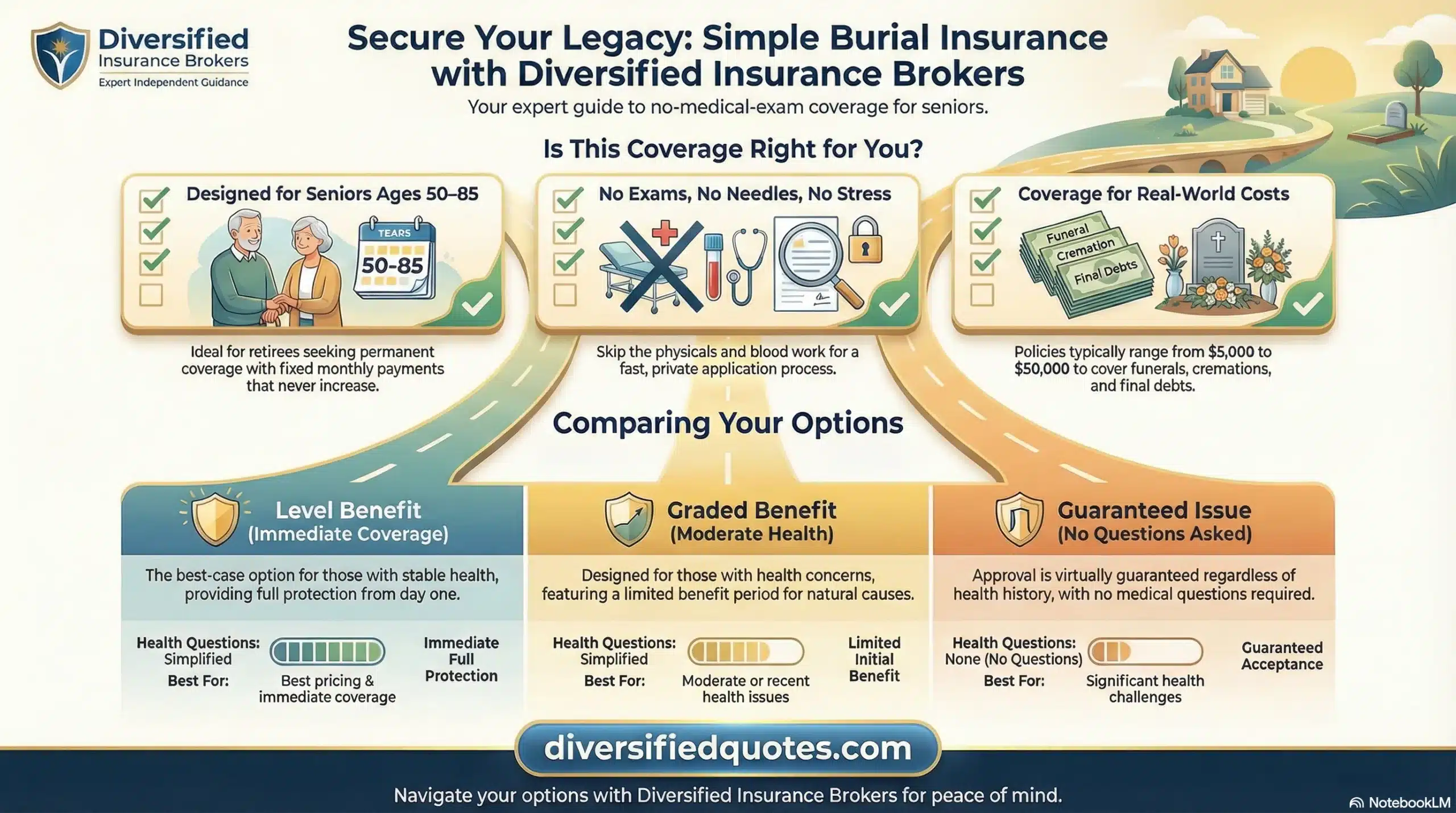
The most important decision in finding affordable burial insurance for low-income seniors is choosing the right underwriting type — because the underwriting type determines the monthly premium more than almost any other factor, including the specific carrier chosen. Three distinct policy structures exist in the final expense market, and each serves a different health profile at a different price point. Understanding the differences before applying is the most direct path to the most coverage per dollar of monthly premium.
| Policy Type | Health Questions Required? | Benefit in Year 1–2 | Relative Monthly Premium | Best Suited For |
|---|---|---|---|---|
| Level Benefit (Preferred) | Yes — brief health questionnaire | Full death benefit from day one | Lowest — most coverage per dollar | Seniors with manageable health — no major recent diagnoses or hospitalizations |
| Graded Benefit (Standard/Modified) | Yes — simplified health questions | Partial benefit in years 1–2; full benefit from year 3 | Moderate — higher than level, lower than guaranteed issue | Seniors with some health history who cannot qualify for level benefit |
| Guaranteed Issue | No — automatic approval within age range | Return of premiums + interest for natural death; accident benefit typically immediate | Highest — least coverage per dollar | Seniors who cannot qualify for any simplified issue policy due to serious health conditions |
The table reveals the core affordability principle of burial insurance for low-income seniors: the level benefit simplified issue path is consistently the most affordable per dollar of coverage when health qualifies, because the carrier can price the risk based on the applicant’s actual health profile rather than assuming worst-case risk across all applicants. Guaranteed issue is priced to account for the carrier’s inability to screen health risk — meaning it is always more expensive per $1,000 of coverage than a level benefit policy from the same carrier or a comparable competitor. For a senior on a fixed income who can qualify for simplified issue coverage, choosing guaranteed issue because it sounds simpler or more certain is one of the most common and costly mistakes in final expense planning. Our resource on guaranteed issue burial insurance covers when guaranteed issue is genuinely the appropriate choice rather than the assumed default. Our resource on burial insurance with no waiting period covers the level benefit options that provide immediate full coverage for qualifying applicants.
What Makes Burial Insurance Affordable — The Levers Seniors Can Actually Control
Affordability in burial insurance for low-income seniors is not simply a function of which company’s advertisement shows the lowest dollar amount. It is a function of several specific variables, each of which the senior or their family can influence before and during the application process. Understanding which levers actually move the monthly premium is the most practical path to the lowest sustainable cost for a given amount of coverage.
The face amount — the death benefit — is the most direct affordability lever. A senior who selects $10,000 of coverage will pay meaningfully less per month than a senior who selects $20,000 of coverage from the same carrier on the same policy type. Right-sizing the face amount to the actual funeral cost and final expense need rather than rounding up to a larger number is one of the simplest ways to reduce monthly premium on a fixed income. Funeral and cremation costs vary significantly by location, service choices, and family preferences — a direct cremation with a simple memorial service can be accomplished for substantially less than a traditional full-burial funeral, and the coverage amount selected should reflect realistic family goals rather than a default round number.
The underwriting class — level benefit versus graded versus guaranteed issue — is the second major affordability lever, and it is determined by health history. A senior who would qualify for level benefit but applies for guaranteed issue based on incorrect assumptions about their health eligibility is paying more than necessary for less immediate protection. Working with an independent broker who evaluates health history against actual carrier underwriting guidelines — rather than defaulting to the easiest application — routinely produces better pricing outcomes for seniors who have manageable health conditions. Our resource on affordable burial insurance with no medical exam covers the simplified issue process for seniors concerned about underwriting.
Tobacco use is the third major pricing variable — and it is one that the senior can directly address if they are willing and able to change their status before applying. Non-tobacco rates for burial insurance are substantially lower than tobacco rates at every age. A senior who has not used tobacco products (including cigarettes, cigars, chewing tobacco, vaping, and nicotine patches or gum, depending on carrier definitions) for the required period — typically 12 months, though some carriers require 24 months — qualifies for non-tobacco pricing. The premium difference at ages 65-80 can be significant enough to change the affordability calculation substantially for a fixed-income senior. Gender is the fourth variable: female applicants typically pay lower premiums than male applicants at the same age due to actuarially longer life expectancy.
Right-Sizing Burial Coverage for a Fixed-Income Budget
The most sustainable approach to affordable burial insurance for low-income seniors is determining the specific dollar amount needed to accomplish a defined goal — and selecting coverage to match that goal, not exceeding it. This requires an honest assessment of what the insurance is meant to do, which is different for every family.
A senior whose primary concern is covering the cost of a direct cremation and a simple memorial service has a different coverage need than a senior whose family expects a traditional burial with a viewing, a graveside service, and a reception. Direct cremation in many U.S. markets is available for several thousand dollars; a full traditional burial can cost significantly more before cemetery fees, headstone, obituary, and reception expenses. The face amount selected should cover the realistic anticipated expense at current prices, with some margin for price increases, rather than defaulting to an arbitrary number like $10,000 or $25,000 simply because those are commonly marketed amounts.
For seniors on very tight budgets — those with Social Security income of $800-$1,200 per month — even $5,000 of level benefit coverage from a qualified simplified issue carrier can represent meaningful protection at a premium that fits within a small monthly budget. The goal is not maximum coverage; it is coverage that stays in force for the rest of the senior’s life without creating premium payment stress that leads to policy lapse. A lapsed policy provides no protection to the family and represents all the premiums paid with nothing to show for them. Our resource on how much burial insurance do I need at 65 covers the coverage needs analysis process in practical detail. Our resource on what does burial insurance cover clarifies the specific expense categories that burial insurance benefits are most commonly used to address.
The Lock-In Argument — Why Applying Now Costs Less Than Waiting
Affordable burial insurance for low-income seniors becomes more expensive — not more affordable — the longer a senior waits to apply. This is the opposite of most purchase decisions and is one of the most important planning realities to convey to seniors who are considering delaying. Final expense premiums are age-banded: the monthly premium for the same face amount on the same policy type from the same carrier is higher at age 72 than at age 70, higher at age 75 than at age 72, and substantially higher at age 80 than at any earlier age. The rate locked in on the day the policy is issued is the rate that remains level for the life of the policy — but only if the policy is actually issued at that age.
Every year a senior delays applying for burial insurance is a year during which the premium for their next available policy increases. Additionally, health changes that occur during the delay period may push a future application from level benefit into graded benefit or from simplified issue into guaranteed issue — each of which is more expensive per dollar of coverage. A senior who qualifies today for level benefit at a given premium may not qualify for level benefit in two years if a qualifying health event occurs during the delay. The “I’ll get to it later” approach to burial insurance planning routinely results in higher premiums, reduced coverage options, and in some cases, the loss of any meaningful cost-effective coverage path at all.
Our resource on burial insurance for seniors over 60 covers the pricing and qualification landscape for this specific age band. Our resource on burial insurance for seniors over 70 covers the more limited but still practical options available for this age group, and our resource on burial insurance for seniors over 80 covers the narrower but still viable options for the oldest senior applicants where affordability requires the most careful carrier and product selection.
Simplified Issue Burial Insurance — The Best Value When Health Allows
Simplified issue burial insurance is the first and most important option to evaluate for every low-income senior who is considering affordable burial insurance. It requires no medical exam — a major advantage for seniors who want to avoid the time, inconvenience, and potential health discovery risk of a physical examination — while asking a defined set of health questions that allow the carrier to assign the applicant to an appropriate underwriting class. Most simplified issue applications consist of 10-20 yes/no health questions covering conditions, diagnoses, hospitalizations, medications, and treatment history within defined lookback periods.
The range of health conditions that qualify for simplified issue coverage is broader than many seniors expect. Controlled high blood pressure, controlled type 2 diabetes, high cholesterol, COPD, arthritis, depression, anxiety, and many other common senior health conditions may qualify — depending on the carrier’s specific underwriting guidelines and how the condition is currently managed. The key is that carriers evaluate the management status and stability of conditions, not simply the diagnosis. A senior with well-controlled diabetes on oral medication is in a meaningfully different underwriting position than a senior with poorly controlled diabetes requiring insulin and recent hospitalizations.
This is why working with an independent broker who knows the underwriting guidelines across multiple carriers produces dramatically better results for seniors with health complexity than applying directly to a single company. A condition that disqualifies an applicant at one carrier may be fully accepted at a different carrier — and the premium difference between those outcomes can be 30-50% or more on the same face amount. Our resource on best burial insurance covers the carrier landscape and what to look for when comparing simplified issue policies across providers.
Guaranteed Issue Burial Insurance — When It’s the Right Choice and When It Isn’t
Guaranteed issue burial insurance has genuine value for a specific population of seniors: those who have serious health conditions that disqualify them from all simplified issue options and who want to create some level of final expense protection despite their health profile. For these seniors — those who have had recent cancer diagnoses, recent cardiac events, dialysis dependency, organ transplant, or other conditions that most simplified issue carriers decline — guaranteed issue is not a compromise. It is the only available path to coverage.
However, guaranteed issue is often marketed to seniors who actually qualify for simplified issue options, and this mismatch between the appropriate product and the marketed product is one of the most common sources of overpayment in the final expense market. Guaranteed issue premiums are significantly higher per $1,000 of coverage than simplified issue premiums because the carrier is accepting all applicants within the eligible age range without any health screening. The graded benefit period — typically two years, during which the full death benefit is not paid for natural causes of death — further reduces the immediate value of guaranteed issue relative to its cost.
The appropriate sequence for any senior seeking affordable burial insurance is to evaluate simplified issue options first, with a qualified broker who can assess realistic eligibility across multiple carriers, and to move to guaranteed issue only if simplified issue is genuinely not available. Our resource on guaranteed issue burial insurance covers the full mechanics, appropriate use cases, and carrier landscape for this product type.
Adult Children Helping Parents Secure Affordable Burial Insurance
A significant portion of affordable burial insurance for low-income seniors is arranged not by the senior directly but by adult children who are concerned about their parents’ final expense situation and want to prevent the family from facing unexpected funeral costs at an already difficult time. This planning arrangement is completely legitimate — an adult child can own, pay for, and manage a burial insurance policy on a parent’s life with the parent’s consent and signature on the application. The parent is the insured; the adult child is typically the policy owner and sometimes the beneficiary, or the parent designates another family member as beneficiary.
For adult children whose parents have difficulty navigating financial decisions independently, or who are concerned their parents may allow a policy to lapse by missing payments, the adult-child-owned structure provides the additional assurance that premium payment continuity is maintained by someone with both the financial means and the awareness to keep the policy active. Premium amounts that may feel burdensome for a senior on $1,100/month Social Security income may be easily manageable as a small monthly expense shared among two or three adult siblings. Our resource on burial insurance for parents over 80 covers the specific underwriting landscape and practical planning approach for adult children securing coverage for older parents. Our resource on burial insurance for seniors over 50 covers the full age range at which parents may be approaching the conversation about final expense planning.
What Affordable Burial Insurance Does Not Require
Part of the appeal of burial insurance for low-income seniors is what the application process does not require. There is no medical exam — no blood draw, no urine sample, no paramedical nurse visit, no physician involvement. There is no waiting for laboratory results or medical record review that takes weeks. Simplified issue applications are completed through a health questionnaire that can be done over the phone or online, with decisions made electronically in most cases. Guaranteed issue applications involve no health questions at all — just age verification and identity confirmation within the eligible age band.
There are no credit checks and no income verification requirements for burial insurance qualification. A senior’s financial profile — their Social Security income level, their assets or lack thereof, their housing situation — has no bearing on whether they qualify medically for burial insurance or what premium they pay. Coverage decisions are based on age, gender, tobacco status, and health answers — not financial circumstances. This makes burial insurance genuinely accessible to low-income seniors in a way that many other financial products are not. Our resource on whole life burial insurance covers the permanent life insurance structure that all final expense policies share, and our resource on burial insurance quotes covers the quoting and comparison process for selecting among available options.
Secure Affordable Burial Coverage Today
We compare final expense plans across our carrier network, identify the underwriting path that produces the most protection per dollar for your health profile, and help you enroll in coverage that fits a fixed-income budget and stays in force for life.
Related Pages
Compare low-cost burial plans, understand no-exam options, and see what’s realistic based on age and health profile.
Financial Protection Essentials
High-risk life insurance planning, disability income protection with COLA, and financial institution reviews.
Talk With an Advisor Today
Choose how you’d like to connect—call or message us, then book a time that works for you.
Schedule here:
calendly.com/jason-dibcompanies/diversified-quotes
Licensed in all 50 states • Fiduciary, family-owned since 1980
Frequently Asked Questions: Affordable Burial Insurance for Low-Income Seniors
What is burial insurance and how does it work for seniors?
Burial insurance is a small whole life insurance policy designed to cover funeral costs, final medical bills, and other end-of-life expenses. Premiums are level — they never increase — coverage lasts for the rest of the insured’s life, and the death benefit is paid tax-free directly to the named beneficiary, typically within days of receiving a death certificate. Most burial insurance policies have face amounts between $5,000 and $25,000, making them specifically designed for the final expense use case rather than income replacement or estate planning. Our resource on whole life burial insurance covers the permanent insurance structure that all final expense policies share and how it differs from term life insurance.
How much burial insurance do most low-income seniors actually need?
Most low-income seniors select between $5,000 and $15,000 of coverage — enough to cover realistic final expense costs without creating premium obligations that strain a fixed monthly income. The right amount depends on the specific funeral and final expense plan the family intends to use: a direct cremation with a simple memorial can be accomplished for several thousand dollars in many markets; a traditional burial service with viewing and graveside ceremony costs more. The goal is to select a face amount that covers the realistic anticipated cost, maintains a premium the family can sustain, and does not pad coverage beyond the actual need. Our resource on how much burial insurance do I need at 65 covers the coverage needs analysis process with age-specific context.
Is there a medical exam required for burial insurance?
No. Most burial insurance uses either simplified issue underwriting — a brief health questionnaire answered by the applicant, with no physical examination — or guaranteed issue approval, where no health questions are asked at all and all applicants within the eligible age range are accepted. The absence of a medical exam makes burial insurance accessible to seniors who want to avoid the time, inconvenience, and potential health discovery risk of a paramedical examination. The health questionnaire in simplified issue policies can usually be completed over the phone or online in 10-20 minutes. Our resource on affordable burial insurance with no medical exam covers the full simplified issue process and what health conditions typically qualify or disqualify.
What is a graded waiting period and how does it affect affordability?
A graded waiting period is a provision in some burial insurance policies — most commonly guaranteed issue policies — that limits the death benefit for natural causes of death during the first two to three years of the policy. Instead of paying the full face amount if the insured passes away from natural causes in year one or two, the policy typically returns the premiums paid plus interest. Accidental death coverage is usually immediate with no waiting period. After the graded period expires — typically at the end of year two — the full death benefit becomes payable for all causes of death. The graded period exists because guaranteed issue carriers accept applicants without health screening and price for the elevated risk of policyholders who may be in declining health at the time of application. Simplified issue level benefit policies generally have no graded period — full coverage is immediate. Our resource on burial insurance with no waiting period covers the level benefit alternatives that provide immediate full coverage for qualifying applicants.
Do burial insurance premiums ever increase?
No. Burial insurance premiums are level — they are fixed at the rate established when the policy is issued and never increase due to age, changes in health, or any other factor after the policy is in force. This premium stability is one of the most valuable features for seniors on fixed incomes, because it makes the monthly obligation predictable and budget-plannable for the life of the policy. The rate locked in when the senior applies at age 68, for example, remains the same rate throughout the policy — whether the senior lives to 80, 90, or beyond. This is also why applying sooner rather than later produces a more favorable rate, since the locked-in rate at age 68 is lower than the locked-in rate that would be available at age 72 for the same policy. Our resource on affordable burial insurance with no medical exam covers the no-exam simplified issue policies where this premium stability feature is most accessible to cost-conscious seniors.
Can a family member pay for burial insurance on a parent’s behalf?
Yes. An adult child or other family member can own and pay for a burial insurance policy on a parent’s life with the parent’s knowledge and consent. The parent is the insured; the adult child is typically the policy owner who pays premiums and manages the policy. This arrangement is common when the senior has fixed-income constraints that make premium payment difficult, or when family members want to ensure the policy stays active regardless of the senior’s financial situation. Multiple adult siblings can share the cost of premiums by contributing together. The parent must consent to the coverage and sign the application, and insurability is based on the parent’s age and health profile. Our resource on burial insurance for parents over 80 covers the specific planning approach for adult children securing coverage for elderly parents at advanced ages where options are more limited.
How quickly are burial insurance claims paid after a death?
Burial insurance claims are designed for fast processing — typically within days to a week of submitting a death certificate and completed claim form to the carrier. This speed is intentional: funeral expenses and related costs are often due within days of a death, and a death benefit that takes weeks to process defeats the purpose of the coverage. Most carriers have simplified claim processes specifically for final expense policies because the face amounts are modest and the documentation requirements are straightforward. The beneficiary submits the death certificate, the carrier verifies the claim, and the benefit is paid directly to the named beneficiary — typically by check or electronic transfer. Our resource on burial insurance quotes covers carrier comparisons that include evaluating claim processing reputation alongside premium costs.
About the Author:
Jason Stolz, CLTC, CRPC, DIA, CAA and Chief Underwriter at Diversified Insurance Brokers (NPN 20471358), is a senior insurance and retirement professional with more than 25 years of real-world experience helping individuals, families, and business owners protect their income, assets, and long-term financial stability. As a long-time partner of the nationally licensed independent agency Diversified Insurance Brokers, Jason provides trusted guidance across multiple specialties—including fixed and indexed annuities, long-term care planning, personal and business disability insurance, life insurance solutions, Group Health, Travel Medical and Evacuation Insurance, and short-term health coverage. Diversified Insurance Brokers maintains active contracts with over 100 highly rated insurance carriers, ensuring clients have access to a broad and competitive marketplace.
His practical, education-first approach has earned recognition in publications such as VoyageATL, and contributions from his agency featured in Kiplinger and GoBankingRates— highlighting his commitment to financial clarity and client-focused planning. Drawing on deep product knowledge and years of hands-on field experience, Jason helps clients evaluate carriers, compare strategies, and build retirement and protection plans that are both secure and cost-efficient. Visitors who want to explore current annuity rates and compare options across multiple insurers can also use this annuity quote and comparison tool.
Explore More Burial Insurance Options: Browse our complete guide to Burial Insurance for Seniors — covering burial insurance for seniors over 50, 60, 70, 80 & parents from top carriers from top carriers.
Last Reviewed: September 25, 2026 |
Reviewed by: Jason Stolz, CLTC, CRPC, DIA, CAA
Chief Underwriter, Diversified Insurance Brokers, Inc. | NPN: 20471358 | Diversified Insurance Brokers, Inc. — Licensed in all 50 states
Fact Checked by: Tonia Pettitt, CMIP©
Medicare Specialist, Diversified Insurance Brokers, Inc. | NPN: 14374308 | Diversified Insurance Brokers, Inc. — Licensed in all 50 states
Did you find this content helpful? Leave us a Google review — it helps others find trustworthy guidance too.
Editorial Standards: Diversified Insurance Brokers maintains rigorous editorial standards to ensure accuracy, clarity, and independence in all content. Learn more about our editorial standards and commitment to transparency.
