
Burial Insurance with no Waiting Period
Burial Insurance with no Waiting Period

Jason Stolz CLTC, CRPC, DIA, CAA
Burial insurance with no waiting period means the policy pays the full death benefit from the first day it is in force — for both natural and accidental causes of death — with no phase-in period, no partial benefit during the first two years, and no return-of-premium limitation if the insured passes away shortly after the policy starts. The correct technical term for this structure is a level benefit plan, and qualifying for it requires answering health questions and being approved through simplified underwriting. This is the most important clarification anyone shopping for burial insurance needs to understand before applying anywhere: any burial insurance policy that requires no health questions at all — what carriers call guaranteed issue or guaranteed acceptance — always comes with a two-year waiting period for natural causes of death. The “no medical exam” language that appears in television commercials and direct mail advertisements almost universally describes guaranteed issue products, not level benefit products. If the ad says “no health questions asked,” the policy has a waiting period. If the ad says “no medical exam required” but does not specify whether health questions are involved, the default assumption should be that a waiting period exists. Our resource on burial insurance with no medical exam covers the no-exam category in full, and our resource on guaranteed issue burial insurance covers the guaranteed issue structure — when it is the right choice and when it is not.
The confusion between “no waiting period” and “no medical exam” costs families money every year. A family that believes their loved one purchased day-one coverage because the television commercial said “guaranteed acceptance” may discover at the time of a claim that only the premiums paid are returned — not the face amount — because the insured passed away during the two-year graded period of a guaranteed issue policy. This is not fine print. It is the fundamental structure of the product, disclosed in the policy document, and it is the direct consequence of purchasing coverage that requires no health qualification at all. The guaranteed issue product is not a bad product — it is the appropriate last resort for people who genuinely cannot qualify for any health-question-based coverage. But it is not a no-waiting-period policy, and treating it as one creates a gap between what families expect and what they receive. Our resource on best burial insurance with immediate coverage covers the level benefit product landscape and which carriers offer the strongest day-one coverage options, and our resource on what is burial insurance and who needs it covers the foundational product education that every buyer should review before selecting a plan.
A meaningful number of people assume they cannot qualify for a level benefit policy because they have health conditions — and this assumption costs many of them more coverage for the same premium dollar. The majority of people who apply for simplified issue burial insurance with health questions are approved for level benefit coverage, including many applicants with controlled chronic conditions like Type 2 diabetes, managed hypertension, COPD that is mild and stable, and histories of treated cancer in remission. The key is not having perfect health — it is having health conditions that are stable, managed, and within the underwriting parameters of at least one of the dozens of carriers offering this product. What makes this feasible is the independent broker advantage: instead of applying to one carrier and accepting a declined or graded offer, an independent approach identifies which carrier’s underwriting guidelines most favorably match the applicant’s specific health profile. Our resource on best rated burial insurance companies covers the carrier landscape for independent comparison, and our resource on burial insurance services covers the full suite of burial insurance options Diversified Insurance Brokers offers across multiple carriers.
Get a No-Waiting-Period Burial Insurance Quote
We identify which carriers will approve you for level benefit coverage based on your health profile — and compare pricing across dozens of options before recommending any specific plan.
Request a Burial Insurance QuoteLevel Benefit vs. Graded Benefit vs. Guaranteed Issue — The Three Burial Insurance Tiers
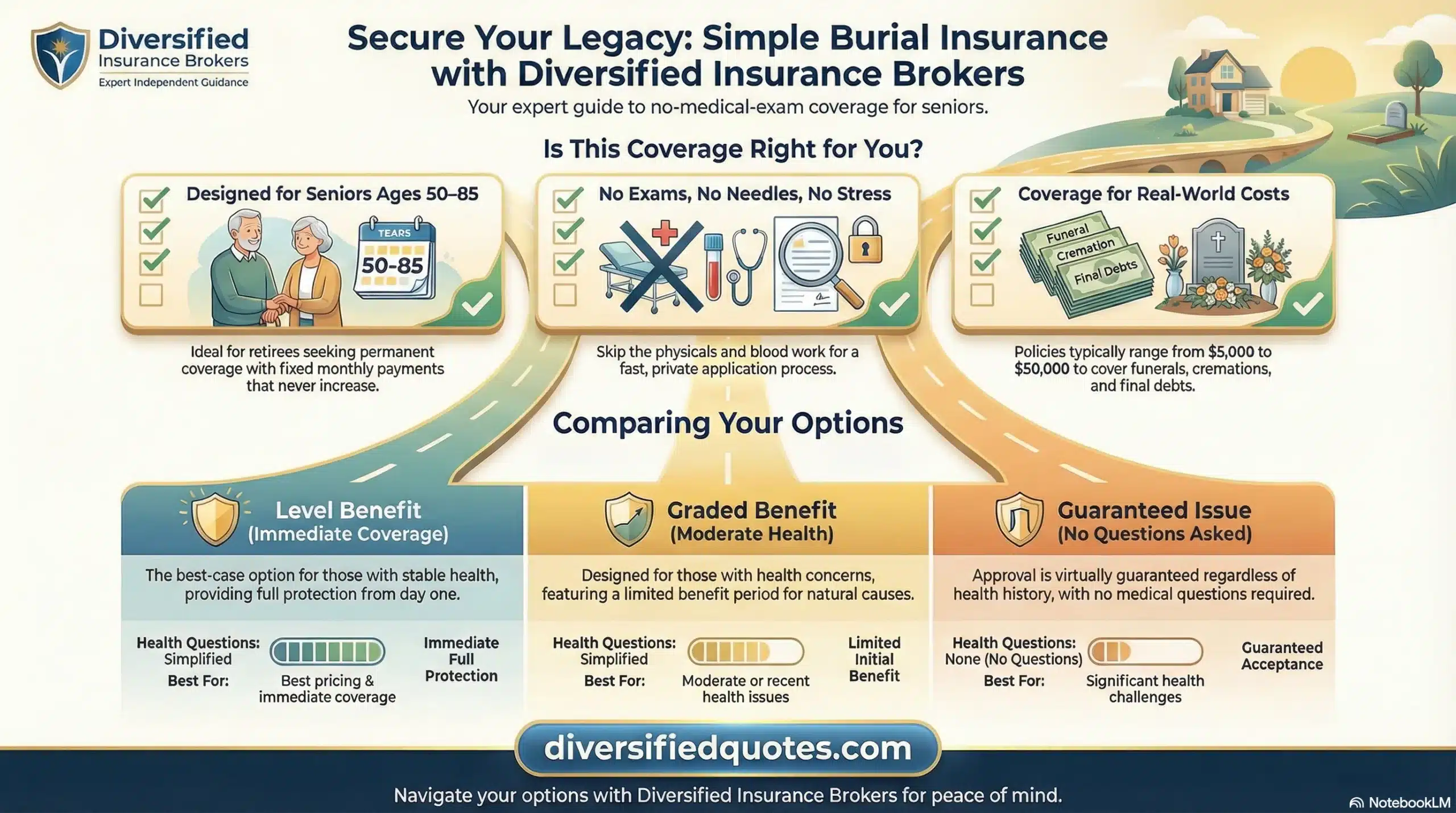
Understanding which of these three structures applies to any given policy is more important than comparing premium rates. A lower-priced policy with a two-year waiting period provides less actual protection in year one and year two than a higher-priced policy with immediate coverage. The table below maps each structure across the dimensions that determine real-world family protection.
| Feature | Level Benefit (True No Waiting Period) | Graded Benefit | Guaranteed Issue (GI / GIWL) |
|---|---|---|---|
| Health questions required? | Yes — simplified underwriting with health questions; no physical exam required | Yes — health questions required; applicant approved at modified/graded level based on health profile | No — no health questions at all; acceptance is guaranteed regardless of health |
| Year 1 benefit (natural death) | Full face amount — 100% of the policy death benefit paid from day one | Typically premiums returned only — if death occurs in year one from natural causes, beneficiaries receive only the premiums paid plus interest | Return of premiums plus interest only — no face amount paid for natural death in year one; accidental death often covered at full face amount |
| Year 2 benefit (natural death) | Full face amount — 100% of the policy death benefit paid, same as year one | Typically 50% of face amount — partial benefit in year two, increasing to full in year three and beyond | Return of premiums plus interest only — most GI policies apply the 2-year waiting period to natural causes; some pay full benefit in year 2 for accidental death |
| Year 3+ benefit (natural death) | Full face amount — no change; coverage has been at 100% since day one | Full face amount — complete coverage phase-in reached in year three | Full face amount — after the 2-year waiting period is satisfied, full benefit is available |
| Cost relative to other tiers | Lowest cost per dollar of coverage — because the carrier qualifies the applicant and reduces mortality risk through underwriting | Moderate — priced between level and GI; reflects the higher risk the carrier accepts by approving applicants with more significant health history | Highest cost per dollar of coverage — same premium budget buys 2-5x more coverage in a level benefit plan than in a GI plan; GI pricing reflects maximum mortality risk with no underwriting filter |
| Who typically qualifies | Applicants with stable, managed chronic conditions (controlled diabetes, hypertension, COPD without recent hospitalization) and no recent serious acute events (heart attack, stroke, cancer treatment) within the carrier’s look-back window | Applicants with more significant health history — recent (but not too recent) cardiac events, more advanced COPD, or conditions that fall outside level benefit underwriting but do not trigger a full decline | Applicants who cannot qualify for any health-question-based product — including those on dialysis, in active cancer treatment, in hospice, or with extremely advanced conditions; also appropriate for people who want absolute certainty of approval without any risk of decline |
| Best choice when | Any applicant who can answer health questions honestly and be approved — this delivers the most coverage per premium dollar with the strongest family protection | When level benefit is declined but a 2-3 year phase-in window is acceptable given the applicant’s realistic life expectancy and financial planning horizon | When health conditions are severe enough to preclude approval for any simplified issue product; last resort, not first choice |
Benefit structures above reflect general market patterns. Specific graded benefit percentages, waiting period terms, and accidental death treatment vary by carrier and product. Always review the benefit schedule in the actual policy document before purchase. Some carriers offer modified structures that differ from the standard 3-tier framework described above. Independent comparison across multiple carriers is the most reliable way to identify which tier is available for a specific applicant profile.
The Television Ad Problem — Why Most “No Medical Exam” Ads Are Guaranteed Issue
The burial insurance market runs more television advertising per dollar of premium than almost any other insurance segment, and the phrases used in those ads create consistent consumer confusion that results in families buying the wrong product type. “No medical exam” is accurate for both level benefit and guaranteed issue plans — neither requires a physical exam, blood work, or doctor’s visit. But “no health questions asked” and “guaranteed acceptance” are specific to guaranteed issue, and guaranteed issue always carries a waiting period. When a television commercial says “acceptance guaranteed, no matter your age or health” — the operative phrase is “no matter your health,” which means no health questions, which means guaranteed issue, which means a two-year waiting period for natural causes. The reason this matters so much is that buyers often purchase these policies specifically because they are concerned about their health and want to “lock in coverage before something happens.” If something happens in the first two years, the family receives only the premiums paid back — not the face amount that was advertised. Our resource on burial insurance with no medical exam covers how to distinguish between no-exam simplified issue (level benefit) and no-exam guaranteed issue (waiting period) when evaluating any policy, and our resource on what does burial insurance cover covers what the policy actually pays for in each benefit tier.
Health Conditions That Often Qualify for Level Benefit Coverage
The most common reason applicants assume they cannot get level benefit burial insurance is that they have health conditions — and in many cases that assumption is incorrect. Simplified issue underwriting is designed to accommodate a wide range of stable, managed chronic conditions. Controlled Type 2 diabetes — meaning the condition is being treated and managed without recent hospitalization or serious complications — is one of the most common qualifying conditions among level benefit burial insurance applicants. The key standard most carriers apply is stability: has the condition been managed without a recent acute event, hospitalization, or significant change in treatment? Controlled hypertension (high blood pressure) is similarly common and routinely approved for level benefit coverage when the condition is medically managed. Mild to moderate COPD that does not require hospitalization, home oxygen, or emergency intervention qualifies at many carriers. A history of cancer that is in full remission — typically two to five years cancer-free, depending on the cancer type and the carrier — can qualify for level benefit coverage at multiple carriers. Treated and stable heart conditions can also qualify when the most recent event is outside the carrier’s look-back window and subsequent follow-up has been positive. Our resources on burial insurance for people with diabetes, burial insurance for people with heart conditions, burial insurance for people with high blood pressure, and burial insurance for cancer survivors cover the specific underwriting profiles for each of these common conditions.
Health Conditions That Typically Result in Graded Benefit or Guaranteed Issue
Not every health profile qualifies for level benefit coverage, and knowing which conditions typically push applicants into graded or guaranteed issue tiers helps set realistic expectations before applying. A recent heart attack — within the past one to two years depending on the carrier — is one of the most common reasons for a graded offer or decline from level benefit underwriting. Carriers are concerned about recurrence risk and want to see evidence of stability over time before offering full immediate coverage. Our resource on burial insurance after a heart attack covers the carrier-specific time windows and what the market looks like post-cardiac event. Similarly, a recent stroke — particularly within the past one to two years — typically results in a graded or GI offer from most carriers, though the exact window varies. Our resource on burial insurance for stroke survivors covers the post-stroke burial insurance landscape. Active cancer treatment — meaning chemotherapy, radiation, or surgery occurring currently or within the recent past — is a near-universal basis for guaranteed issue rather than level benefit; however, cancer that is in full remission for the required time period can qualify for simplified issue at many carriers. Other conditions that typically result in guaranteed issue rather than level benefit include dialysis for kidney disease, hospice care enrollment, current oxygen use at home, and congestive heart failure with recent hospitalization. Our resources on burial insurance for smokers and burial insurance for seniors over 80 cover additional profile-specific qualification patterns.
Coverage Amounts, Age Ranges, and What Immediate Coverage Costs
Burial insurance coverage amounts typically range from $5,000 to $50,000, with some carriers offering higher face amounts for applicants who qualify. Most carriers offer burial insurance to applicants between the ages of 45 and 85, though the specific age range varies by carrier and some offer coverage to age 89 or beyond. The coverage amount to target depends on the actual anticipated funeral and final expense costs in the buyer’s geographic area — a full traditional burial in a major metropolitan area may run $10,000-$15,000 or more, while direct cremation can cost $2,000-$4,000 in many markets. Our resources on how much a funeral costs and how much burial insurance you need cover the coverage sizing question in detail. Premiums for level benefit burial insurance are based on age, gender, health classification (standard, preferred, or tobacco), and the face amount selected. All else equal, a level benefit policy costs less per dollar of coverage than a guaranteed issue policy because the underwriting process reduces mortality risk for the carrier. The difference in premium can be significant — the same monthly budget may purchase $15,000 of level benefit coverage versus $6,000-$8,000 of guaranteed issue coverage for the same applicant profile. Our resource on burial insurance for seniors over 70 and our resource on burial insurance for seniors cover the age-specific premium and qualification patterns for the most common buyer demographic.
Comparing Carriers — Why the Same Health Profile Gets Different Outcomes
Burial insurance underwriting guidelines vary significantly across carriers, and this variation is the primary reason independent carrier comparison matters more than brand recognition for this product. A health condition that results in a decline from one carrier may qualify for level benefit at another. A recent cardiac event that triggers a graded offer from most carriers may fall just outside the look-back window for specific carriers with more favorable guidelines for that condition type. This is not a matter of carriers being lenient or strict in an absolute sense — it is a matter of each carrier’s portfolio mix, reinsurance arrangements, and actuarial assumptions about specific health profiles. An independent broker with access to multiple carriers can identify which ones are most favorable for a specific applicant profile and present those options before any application is submitted. Our resource on best burial insurance covers the carrier comparison framework, our resource on how to get the best burial insurance rates covers the rate shopping process, and our resource on burial insurance — simple, affordable protection for final expenses covers the comprehensive guide to the burial insurance product category. Our resource on burial insurance calculator provides instant rate comparisons by age and coverage amount as a starting point for the evaluation process.
Talk With an Advisor Today
Choose how you’d like to connect—call or message us, then book a time that works for you.
Licensed in all 50 states • Fiduciary, family-owned since 1980
FAQs: Burial Insurance With No Waiting Period
What does “no waiting period” mean for burial insurance?
A no-waiting-period burial insurance policy — also called a level benefit plan — pays the full death benefit from the day the policy is in force and the first premium is paid, for both natural and accidental causes of death. There is no phase-in period, no partial benefit in the first two years, and no return-of-premiums limitation if the insured passes away shortly after coverage starts. This is different from a graded benefit policy (partial benefit in years 1-2) and a guaranteed issue policy (return of premiums only for natural death in the first two years). True no-waiting-period coverage requires answering health questions and being approved — any policy that requires no health questions at all always comes with a waiting period.
Does guaranteed issue burial insurance have a waiting period?
Yes — always. This is one of the most important facts in burial insurance. Any policy that requires no health questions whatsoever — marketed as “guaranteed acceptance,” “guaranteed approval,” or “no health questions asked” — always imposes a two-year waiting period for natural causes of death. If the insured dies from a natural cause in the first two years, most guaranteed issue policies return only the premiums paid plus a small amount of interest, not the face amount. Accidental death is often covered at the full face amount from day one under guaranteed issue policies, but natural causes — which represent the vast majority of deaths — are subject to the waiting period. True no-waiting-period coverage for natural causes requires health questions and underwriting approval.
Can I qualify for level benefit burial insurance if I have health problems?
Yes — many people with health conditions qualify for level benefit burial insurance. The key factors are stability and management of the condition, not perfection. Controlled Type 2 diabetes, managed hypertension, stable mild-to-moderate COPD, treated cancer in remission for the required period, and other managed chronic conditions frequently qualify for level benefit coverage at one or more carriers. The conditions that most commonly result in graded or guaranteed issue are recent acute events — a heart attack or stroke within the past one to two years, active cancer treatment, current home oxygen use, dialysis, or hospice enrollment. Because underwriting guidelines vary across carriers, a condition that results in a decline or graded offer from one carrier may qualify for level benefit at another.
Why is guaranteed issue more expensive than level benefit burial insurance?
Guaranteed issue pricing reflects the highest possible mortality risk because the carrier accepts all applicants regardless of health — including those with terminal conditions, very advanced age, or multiple serious conditions. Without any underwriting filter, the carrier must price for the worst-case health distribution among all applicants. A level benefit policy uses health questions to qualify the applicant, which reduces the carrier’s mortality risk and allows it to offer more coverage per premium dollar. The practical result: the same monthly premium budget typically purchases 2-5 times more coverage in a level benefit plan than in a guaranteed issue plan. For any applicant who can qualify for level benefit coverage, guaranteed issue represents a significantly less efficient use of their premium budget.
Is the two-year contestability period the same as a two-year waiting period?
No — these are different provisions with very different practical implications. The two-year contestability period is a standard feature of virtually all life insurance policies, including level benefit burial insurance, and allows the insurance company to investigate a claim and potentially deny it during the first two years if there is evidence of material misrepresentation or fraud on the application. If your application was accurate and complete, the contestability period does not affect your family’s claim. A waiting period, by contrast, automatically limits benefits for natural causes during a defined period regardless of whether the application was accurate — it is a scheduled benefit reduction, not an investigation provision. A level benefit policy with a two-year contestability clause does not have a waiting period; it pays the full face amount from day one as long as the application was completed honestly.
How quickly can burial insurance be approved and in force?
Most simplified issue burial insurance applications receive a decision within minutes to a few days, because underwriting uses electronic databases (prescription history, MIB, DMV records) rather than a physical exam or lab work. Once approved, coverage is in force when the first premium is paid and the policy is issued — there is no waiting after that point for a level benefit plan. The policy document typically specifies the effective date of coverage. Some carriers offer conditional coverage (coverage pending full policy issuance) from the application date in some designs. For applicants in urgent situations, the turnaround from application to active coverage can be very fast, particularly when applying through a broker who knows which carriers have the fastest processing for specific health profiles.
About the Author:
Jason Stolz, CLTC, CRPC, DIA, CAA and Chief Underwriter at Diversified Insurance Brokers (NPN 20471358), is a senior insurance and retirement professional with more than 25 years of real-world experience helping individuals, families, and business owners protect their income, assets, and long-term financial stability. As a long-time partner of the nationally licensed independent agency Diversified Insurance Brokers, Jason provides trusted guidance across multiple specialties—including fixed and indexed annuities, long-term care planning, personal and business disability insurance, life insurance solutions, Group Health, Travel Medical and Evacuation Insurance, and short-term health coverage. Diversified Insurance Brokers maintains active contracts with over 100 highly rated insurance carriers, ensuring clients have access to a broad and competitive marketplace.
His practical, education-first approach has earned recognition in publications such as VoyageATL, and contributions from his agency featured in Kiplinger and GoBankingRates— highlighting his commitment to financial clarity and client-focused planning. Drawing on deep product knowledge and years of hands-on field experience, Jason helps clients evaluate carriers, compare strategies, and build retirement and protection plans that are both secure and cost-efficient. Visitors who want to explore current annuity rates and compare options across multiple insurers can also use this annuity quote and comparison tool.
Explore More Burial Insurance Options: Browse our complete guide to Guaranteed Issue Burial Insurance — covering no medical exam, no waiting period & immediate coverage burial insurance options from top carriers.
Last Reviewed: June 4, 2026 |
Reviewed by: Jason Stolz, CLTC, CRPC, DIA, CAA
Chief Underwriter, Diversified Insurance Brokers, Inc. | NPN: 20471358 | Diversified Insurance Brokers, Inc. — Licensed in all 50 states
Fact Checked by: Tonia Pettitt, CMIP©
Medicare Specialist, Diversified Insurance Brokers, Inc. | NPN: 14374308 | Diversified Insurance Brokers, Inc. — Licensed in all 50 states
Did you find this content helpful? Leave us a Google review — it helps others find trustworthy guidance too.
Editorial Standards: Diversified Insurance Brokers maintains rigorous editorial standards to ensure accuracy, clarity, and independence in all content. Learn more about our editorial standards and commitment to transparency.
