
How to get the Best Burial Insurance Rates
How to get the Best Burial Insurance Rates

Jason Stolz CLTC, CRPC, DIA, CAA
Getting the best burial insurance rates is a more precise process than most people expect — and the difference between doing it correctly and doing it haphazardly can mean paying thirty to fifty percent more every month for life on a policy that provides the same death benefit. Burial insurance, also called final expense insurance, is a small whole life insurance policy designed to cover funeral costs, medical bills, and other end-of-life expenses when a family needs immediate cash and does not want to pull funds from savings or use credit. The rate optimization process requires understanding how carriers price these policies, which underwriting tier you genuinely qualify for, and why matching your specific health profile to the right carrier produces meaningfully better rates than simply accepting the first quote that appears in a search result. At Diversified Insurance Brokers, Jason Stolz, CLTC, CRPC, DIA, CAA, works with families across all fifty states to identify the burial insurance carriers whose underwriting guidelines are most favorable for a given applicant’s age, health history, and coverage goal — producing the best available rate at the right benefit tier rather than the easiest sale.
The financial case for burial insurance starts with the cost of the problem it solves. According to the National Funeral Directors Association’s 2025 data, the national median cost of a funeral with viewing and burial is $8,300, and the median cost of a funeral with cremation services is $6,280. These figures do not include cemetery property, vaults, monument costs, or cash advance items, which can add several thousand dollars more to the total. For families without a dedicated fund for final expenses, these costs arrive without warning and typically require immediate payment — putting pressure on surviving family members to withdraw savings, liquidate investments, or go into debt at the worst possible time. A well-designed burial insurance policy eliminates that pressure entirely for a fixed monthly premium that never increases.
The Three Underwriting Tiers That Determine Your Rate
Every burial insurance purchase begins with a classification decision that most applicants do not realize is happening: which underwriting tier does your health profile place you in? This classification — not the carrier’s marketing, not the advertised “starting from” rate, not the coverage amount you request — is the single most important factor in determining what you will actually pay. Understanding the three tiers before shopping is essential to interpreting any quote accurately and to identifying whether you are being placed in the right category for your health situation.
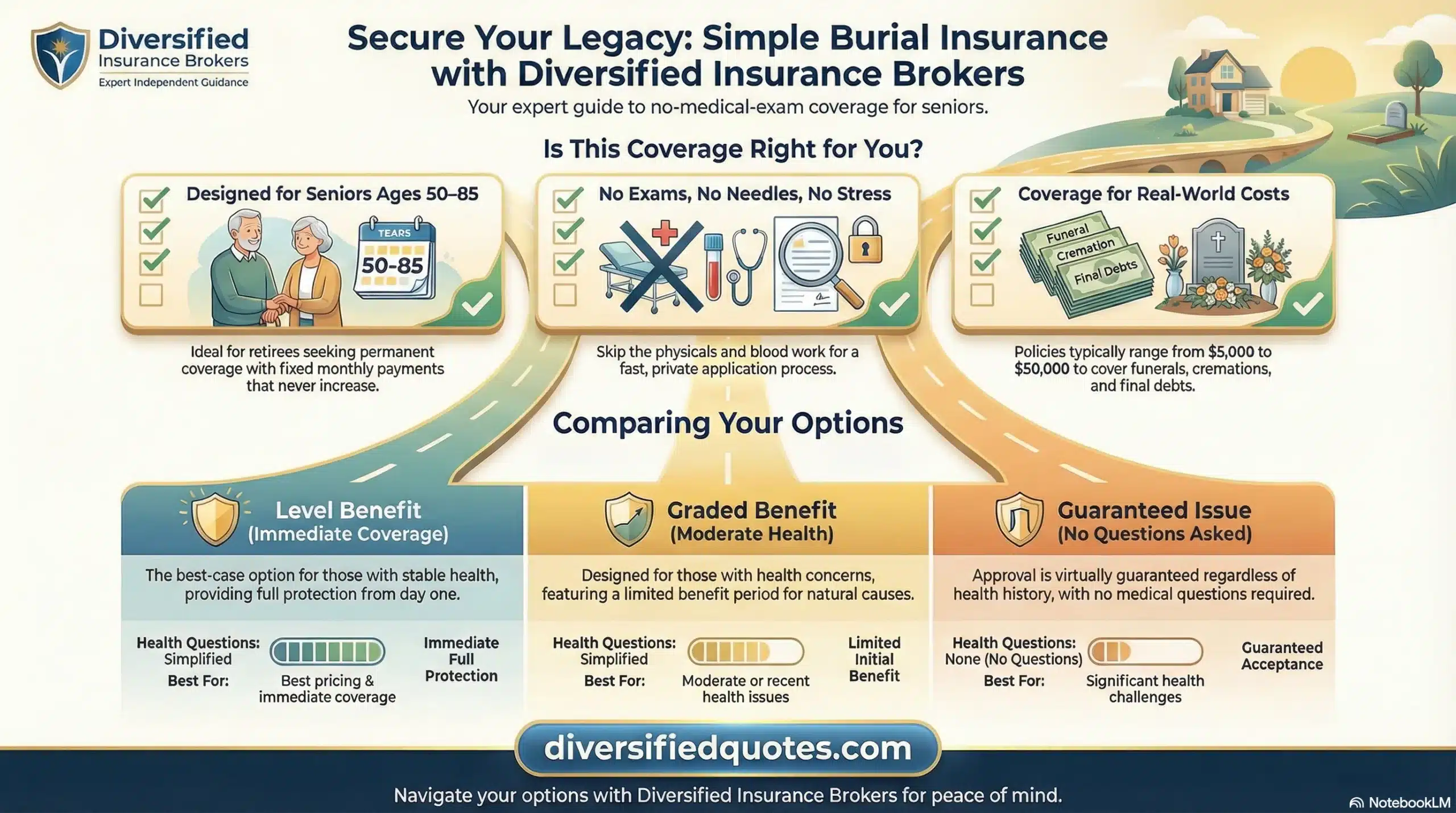
The level benefit tier, sometimes called “preferred” or “immediate benefit,” is the best available classification. A level-benefit policy pays the full death benefit from the first day of coverage, carries no waiting period, and is priced at the lowest rates a given carrier offers. Qualifying for level benefit requires answering health questions on a simplified issue application and meeting the carrier’s underwriting standards — which vary significantly across carriers. The good news is that many people who assume they cannot qualify for level benefit due to health conditions are wrong — they would qualify with the right carrier whose underwriting guidelines are more favorable for their specific condition history. Our resource on burial insurance with no waiting period covers the level-benefit qualification criteria, and our resource on best burial insurance with immediate coverage identifies the carriers with the most accessible level-benefit underwriting standards.
The graded benefit tier is a middle classification where the policy does not pay the full death benefit immediately for natural-cause death — instead, it pays a reduced benefit (typically the return of premiums paid plus ten percent interest) if the insured dies from natural causes within the first two years. After the two-year waiting period, the full face amount pays for any cause of death. Graded benefit policies carry higher premiums than level-benefit policies for the same coverage amount and are appropriate for applicants with moderate health conditions that disqualify them from level benefit but do not push them to guaranteed issue. The critical error to avoid is accepting a graded benefit policy when a level-benefit policy was actually available — a carrier-matching error that results in both a higher premium and a waiting period that was unnecessary.
The guaranteed issue tier is available to any applicant regardless of health history — no health questions, no medical exam, automatic approval. Guaranteed issue policies always include a two-year waiting period for natural-cause death (accidental death typically pays from day one), and their premiums are the highest available. For seniors over seventy, guaranteed issue policies typically cost fifteen to thirty percent more than standard simplified issue coverage due to the no-health-questions structure. The correct use of guaranteed issue is for applicants who genuinely cannot qualify for any level-benefit or graded-benefit policy due to serious health conditions — dialysis, recent cancer diagnosis, or similar significant impairments. Applying for guaranteed issue as a default when level benefit was available is a consistent and costly over-purchase that an independent specialist who matches health profiles to carrier guidelines can prevent. Our resource on burial insurance with no medical exam clarifies how simplified issue and guaranteed issue both avoid medical exams while delivering very different rate and benefit structures.
Burial Insurance Rate Factors: What Drives Your Premium
| Factor | How It Affects Rate | Optimization Strategy | Rate Impact Range |
|---|---|---|---|
| Age at application | Premiums increase with every year of delay; locked in at issue and never increase | Apply as early as the need is identified — delay is permanent cost increase | 50s vs. 70s: premium may double or triple for identical coverage |
| Health classification tier | Level benefit is cheapest; graded is middle; guaranteed issue is highest | Match health profile to the most favorable carrier to access level benefit when eligible | GI costs 30–50% more than comparable level-benefit simplified issue |
| Gender | Women typically pay less than men for the same age and coverage amount due to longer average life expectancy | No optimization available; a fixed pricing input | Women pay 10–20% less than men of the same age at most carriers |
| Tobacco use | Tobacco users pay higher rates at most carriers; non-tobacco rates require meeting carrier-specific non-use periods | Confirm each carrier’s tobacco-use definition and lookback period before applying | Tobacco rates typically 25–40% higher than non-tobacco at the same age |
| Carrier selection | Rate differences of 15–25% between carriers for identical coverage at the same health tier are common | Multi-carrier comparison is the single most reliable rate reduction strategy | 15–25% rate difference between highest and lowest carrier quotes for same profile |
| Coverage amount | Premium scales with face amount; right-sizing coverage to actual need prevents over-purchase | Calculate target need (funeral + final bills) and match coverage to that number | $10K vs. $25K face amount approximately doubles the premium all else equal |
How Carrier Selection Produces the Largest Rate Difference
The most actionable rate optimization lever for most burial insurance applicants is carrier selection — and carrier selection requires comparing multiple carriers simultaneously rather than accepting the first quote offered. Premium differences of fifteen to twenty-five percent between carriers for identical coverage are common. A seventy-two-year-old woman might receive quotes ranging from seventy-eight to one hundred five dollars monthly for the same ten thousand dollars of coverage depending on the carrier. Over a ten-year period at the midpoint of that range, the premium difference compounds to over three thousand dollars paid on identical coverage — a meaningful amount on a fixed income where every dollar of monthly expense matters.
The reason carrier selection produces this variation is that final expense carriers each develop their own underwriting guidelines independently, and those guidelines produce meaningfully different rate tiers for the same health conditions. One carrier may classify managed Type 2 diabetes as a level-benefit condition; another may push it to graded. One carrier may accept a history of atrial fibrillation on stable medication as level benefit; another may require two years post-diagnosis before qualifying. A carrier whose guidelines are favorable for a specific applicant’s health profile will offer both a better tier and a better rate. An applicant who applies to a single carrier without evaluating alternatives has no way of knowing whether a more favorable carrier exists for their specific situation. Our resources on burial insurance for people with heart conditions, burial insurance for people with diabetes, and burial insurance for people with high blood pressure each address the carrier-matching process for those specific conditions, identifying which carriers’ underwriting approaches are most favorable for each health profile. The burial insurance for stroke survivors and burial insurance after a heart attack resources address the timing windows and carrier-specific lookback periods that determine tier placement for recent cardiac events.
The Age Factor: Why Applying Earlier Produces Lower Lifetime Costs
Burial insurance premiums are fixed at the age of application and guaranteed never to increase for the life of the policy — one of the core structural advantages of whole life insurance for final expense planning. The premium you pay at fifty-five is the premium you will pay at eighty-five, regardless of any health changes or general cost of living increases. This means the decision to apply earlier or later is not a one-year cost comparison — it is a lifetime cost decision. Applying at sixty rather than seventy locks in a meaningfully lower monthly premium that will be paid for potentially twenty or thirty years. Waiting five years to apply at sixty-five instead of sixty can result in paying hundreds of additional dollars per year for the rest of the policyholder’s life on the same coverage amount. Our resource on burial insurance for seniors over fifty covers the specific premium ranges and carrier options available at earlier ages where the premium advantage is most significant. The resources on burial insurance for seniors over seventy and burial insurance for seniors over eighty address the rates and product availability for applicants at later ages where guaranteed issue may become more relevant.
Common Rate Mistakes That Inflate Burial Insurance Costs
Several specific mistakes consistently produce higher burial insurance rates than necessary. The most expensive is accepting a guaranteed issue policy when a simplified issue level-benefit policy was actually available. This mistake happens when an applicant assumes that any health condition makes them ineligible for level benefit, or when an agent offers guaranteed issue as the path of least resistance without matching the applicant’s health profile to carrier-specific underwriting guidelines. A level-benefit policy from the right carrier is almost always cheaper than a guaranteed issue policy and provides full immediate coverage without a two-year waiting period — the guaranteed issue option should be a genuine last resort, not a default recommendation. Our resource on burial insurance with no health exam explains how both simplified issue and guaranteed issue avoid medical exams while delivering very different rate structures.
The second common mistake is choosing coverage based on advertised “starting from” rates rather than actual rates for the specific age, health profile, and state of the applicant. Burial insurance advertisements frequently promote rates of nine or ten dollars per month that apply only to very young applicants (typically ages fifty to fifty-five) purchasing minimal coverage amounts through specific carriers under the most favorable conditions. An applicant who is seventy and evaluating a $15,000 policy will find their actual rate bears no resemblance to advertised minimums. The burial insurance calculator on this site provides realistic rate benchmarks by age, coverage amount, and state based on live carrier data — and represents an honest starting point for rate evaluation rather than a marketing minimum. Our resource on burial insurance quotes covers how to interpret and compare quotes across carriers accurately.
The third mistake is over-insuring beyond actual final expense need. Most families’ core burial insurance need — funeral service, cremation or burial, final medical bills, and any small outstanding debts — falls in the $10,000 to $20,000 range based on current NFDA cost data. Purchasing $25,000 or $30,000 out of general anxiety rather than a calculated assessment of actual need increases the monthly premium without providing corresponding family benefit for most situations. The right coverage amount is the one that addresses the specific financial exposure your family faces — not the largest amount a carrier will issue. Our resource on burial insurance as simple, affordable final expense protection covers the coverage sizing process and our best-rated burial insurance companies resource identifies the carriers whose combination of financial strength, underwriting favorability, and competitive pricing produces the best value across common health profiles.
Working With an Independent Specialist: The Carrier-Matching Advantage
The rate optimization strategies described on this page — accessing level benefit when eligible, comparing across carriers, right-sizing coverage, and applying earlier rather than later — all require one capability that no single-carrier agent or direct-to-consumer online quoting tool can fully provide: simultaneous access to the underwriting guidelines of multiple carriers evaluated against the specific applicant’s health profile. An agent who represents only one final expense carrier can only tell you what that carrier will offer. An online quoting tool that shows rates across carriers shows premium numbers but cannot tell you which carriers will actually approve a given health profile at which tier — that determination requires knowledge of each carrier’s underwriting guidelines, health condition lookback periods, and prescription history evaluation standards.
An independent burial insurance specialist who works with dozens of final expense carriers and maintains working knowledge of each carrier’s underwriting approach can match a specific health profile — including conditions like managed diabetes, cardiac history, obesity, COPD, or prior cancer — to the carrier most likely to approve that profile at the most favorable tier. This is the carrier-matching step that follows a quote comparison and produces the difference between paying level-benefit rates with immediate coverage versus graded-benefit rates with a two-year waiting period for the exact same monthly premium or less. Our resources on burial insurance for cancer survivors, burial insurance for smokers, burial insurance for overweight people, and burial insurance for disabled adults cover the carrier-matching considerations for specific applicant profiles. The affordable burial insurance with no medical exam and affordable burial insurance for low-income seniors resources address budget-constrained applications where premium minimization is the primary goal.
Talk With an Advisor Today
Choose how you’d like to connect—call or message us, then book a time that works for you.
Schedule here:
calendly.com/jason-dibcompanies/diversified-quotes
Licensed in all 50 states • Fiduciary, family-owned since 1980
Frequently Asked Questions: How to Get the Best Burial Insurance Rates
What is the most effective way to get a lower burial insurance rate?
The most effective single step for getting the best burial insurance rate is working with an independent specialist who can simultaneously compare your health profile against the underwriting guidelines of multiple final expense carriers to identify the one that will offer the most favorable tier at the lowest premium. Premium differences of fifteen to twenty-five percent between carriers for identical coverage at the same age are common in the final expense market — a seventy-year-old applicant might receive quotes ranging from roughly seventy-eight to one hundred five dollars monthly for the same ten thousand dollars of coverage depending on the carrier. Beyond carrier selection, applying as early as the need is identified produces the lowest lifetime cost because premiums are fixed at the application age and never increase. Every year of delay permanently increases the rate. The third most impactful lever is ensuring you are placed in the correct underwriting tier — level benefit when eligible rather than graded or guaranteed issue. An applicant who qualifies for level benefit but is placed in a graded-benefit policy pays more and waits two years for the full death benefit unnecessarily. Our burial insurance calculator provides live carrier rate comparisons as a starting point, and the carrier-matching conversation with a specialist refines those results to your specific health profile.
What is the difference between level benefit, graded benefit, and guaranteed issue burial insurance?
These are the three underwriting tiers that determine both your rate and your waiting period. Level benefit policies — also called preferred or immediate benefit — pay the full death benefit from the first day of coverage, have no waiting period, and carry the lowest premiums. They require answering health questions on a simplified issue application and meeting carrier-specific underwriting standards. Graded benefit policies pay a reduced death benefit for natural-cause death in the first two years — typically the return of premiums paid plus ten percent interest — then the full face amount after that two-year waiting period. Premiums are higher than level benefit for the same coverage amount. Guaranteed issue policies accept all applicants with no health questions and no medical exam, always include a two-year waiting period for natural-cause death, and carry the highest premiums — typically thirty to fifty percent more than comparable simplified issue level benefit coverage. The hierarchy is clear: if you qualify for level benefit, you should have it. If you do not, graded is preferable to guaranteed issue when available. Guaranteed issue is the right choice only when health conditions genuinely prevent qualification for the first two tiers. Our resource on burial insurance with no medical exam explains how simplified issue and guaranteed issue both avoid medical exams while delivering very different outcomes on rate and waiting period.
Can I get level-benefit burial insurance if I have a health condition?
Yes, in many cases — and more often than applicants assume. Final expense carriers each define their own underwriting guidelines independently, which means a condition that disqualifies you for level benefit at one carrier may be acceptable at another. Common conditions that are frequently eligible for level benefit at the right carrier include well-managed Type 2 diabetes without serious complications, controlled high blood pressure, treated high cholesterol, prior cancer with a clear lookback period (commonly two to five years depending on cancer type), cardiac history with stable management beyond the carrier’s lookback window, obesity, COPD at certain stages, and many others. The key is knowing which carriers accept which conditions at which tiers — a comparison that requires familiarity with each carrier’s guidelines. Applying to a carrier whose guidelines are unfavorable for your condition and being declined or placed at a graded tier does not mean level benefit is unavailable — it means that carrier was not the right match for your profile. Our condition-specific resources address this carrier-matching question directly: burial insurance with high blood pressure, burial insurance with diabetes, and burial insurance with heart conditions.
How much burial insurance do most people need?
Most families’ core burial insurance need falls between ten thousand and twenty thousand dollars based on current funeral industry cost data. According to the National Funeral Directors Association, the national median cost of a funeral with viewing and burial is $8,300, and the median for a funeral with cremation services is $6,280 — neither figure including cemetery property, vaults, or monuments which can add several thousand dollars more. A ten-thousand-dollar policy covers a cremation-focused service with modest buffer for final medical bills or small debts. A fifteen-thousand to twenty-thousand-dollar policy covers a traditional burial service in most markets with adequate buffer. Larger coverage amounts — $25,000 or above — are appropriate when the applicant has significant outstanding debts or anticipates premium funeral service expenses above regional averages. The most common sizing mistake is purchasing more coverage than the actual need requires, which increases the monthly premium without providing meaningful additional family benefit. Our resource on burial insurance as simple final expense protection covers the coverage sizing process, and the whole life burial insurance versus term resource addresses why permanent whole life is the appropriate structure for final expense planning rather than term insurance that expires before death.
Does burial insurance have a waiting period?
It depends on the underwriting tier. Level-benefit simplified issue policies have no waiting period — the full death benefit is payable from the first day of coverage for both natural and accidental causes of death. Graded-benefit policies impose a two-year waiting period for natural-cause death, paying only a reduced benefit during that period, with the full face amount paying after the two-year mark. Guaranteed issue policies always include a two-year waiting period for natural-cause death — accidental death typically pays the full benefit from day one across all policy types. The presence or absence of a waiting period is one of the most important policy terms to confirm when evaluating any burial insurance quote. An applicant who qualifies for a level-benefit policy and is offered a graded-benefit policy instead is paying more while also forfeiting immediate full coverage. The correct approach is to verify the policy type — not just the premium — before applying. Our resource on burial insurance with no waiting period explains which health profiles qualify and which carriers offer the most accessible level-benefit underwriting standards.
Is burial insurance worth it compared to a pre-paid funeral plan?
Burial insurance and a pre-paid funeral plan are fundamentally different in structure, and for most families burial insurance provides meaningfully more flexibility and financial protection. A pre-paid funeral plan is a contract with a specific funeral home that pre-pays for specific services at current or locked prices — the funds are typically held in trust or invested on the consumer’s behalf until needed. The limitations are significant: the contract is tied to a specific funeral home, which may change ownership, go out of business, or not be the facility the family would choose when the time comes. Funds in some pre-paid plans are not portable across states if the family relocates. And if the actual cost of services exceeds the pre-paid amount, the family pays the difference. Burial insurance, by contrast, pays a cash death benefit directly to the named beneficiary — who is free to use it at any funeral home, for any service type, to pay any outstanding bills, or to cover any other final expense need. The beneficiary’s flexibility is complete. For families concerned about locking in today’s prices against future funeral cost increases, a well-sized burial insurance policy that more than covers expected costs provides the same inflation protection with far greater flexibility in how the funds are used. Our resource on burial insurance versus pre-paid funeral covers this comparison in full detail.
What happens to burial insurance premiums over time?
Burial insurance is structured as whole life insurance, which means the premium is fixed for the life of the policy — it never increases regardless of age, health changes, or general cost of living. The rate you lock in at the time of application is the rate you pay at eighty, ninety, or any age as long as premiums are paid. The policy cannot be cancelled by the carrier as long as premiums are paid, and the death benefit cannot be reduced by the carrier for any reason. This guaranteed-level-premium structure is a fundamental advantage over any coverage arrangement where costs can increase over time. It also means the application age decision is a lifetime commitment — a lower premium locked in at sixty will be paid for potentially thirty years, producing total savings that substantially exceed the short-term difference between applying now versus waiting. The total lifetime value of applying five years earlier at a lower premium, even with a modest monthly difference, is significant on a fixed retirement income. Our resource on final expense whole life insurance covers the structural guarantees of these policies and why whole life is the correct product type for final expense planning over term insurance alternatives.
Can I buy burial insurance for a parent or family member?
Yes — adult children commonly purchase burial insurance policies for parents, which is one of the most practical family planning applications for final expense coverage. The policy owner (the adult child) pays the premium, names themselves or other family members as beneficiaries, and ensures that when a parent passes away, funds are available immediately to handle the funeral and final expenses without the family needing to scramble for cash. The insured must consent to the policy and provide information for the application. The age, health, and state of the parent determine the available product tier and premium. For parents who are in moderate health and in their seventies, simplified issue level-benefit coverage is frequently available, providing immediate full coverage at reasonable premiums. For parents with more significant health conditions or in their eighties, the coverage options and available tiers narrow, making it important to evaluate options promptly rather than waiting. Our resources on best burial insurance for parents over 70, best burial insurance for parents over 80, and burial insurance for mom and dad address the specific options and carrier considerations for these family planning scenarios. The annual beneficiary review checklist covers the ongoing policy management steps that protect coverage over time.
About the Author:
Jason Stolz, CLTC, CRPC, DIA, CAA and Chief Underwriter at Diversified Insurance Brokers (NPN 20471358), is a senior insurance and retirement professional with more than 25 years of real-world experience helping individuals, families, and business owners protect their income, assets, and long-term financial stability. As a long-time partner of the nationally licensed independent agency Diversified Insurance Brokers, Jason provides trusted guidance across multiple specialties—including fixed and indexed annuities, long-term care planning, personal and business disability insurance, life insurance solutions, Group Health, Travel Medical and Evacuation Insurance, and short-term health coverage. Diversified Insurance Brokers maintains active contracts with over 100 highly rated insurance carriers, ensuring clients have access to a broad and competitive marketplace.
His practical, education-first approach has earned recognition in publications such as VoyageATL, and contributions from his agency featured in Kiplinger and GoBankingRates— highlighting his commitment to financial clarity and client-focused planning. Drawing on deep product knowledge and years of hands-on field experience, Jason helps clients evaluate carriers, compare strategies, and build retirement and protection plans that are both secure and cost-efficient. Visitors who want to explore current annuity rates and compare options across multiple insurers can also use this annuity quote and comparison tool.
Explore More Burial Insurance Options: Browse our complete guide to Best Burial Insurance — covering top burial insurance options, rates, calculators & how to find the best coverage from top carriers.
Last Reviewed: June 11, 2026 |
Reviewed by: Jason Stolz, CLTC, CRPC, DIA, CAA
Chief Underwriter, Diversified Insurance Brokers, Inc. | NPN: 20471358 | Diversified Insurance Brokers, Inc. — Licensed in all 50 states
Fact Checked by: Tonia Pettitt, CMIP©
Medicare Specialist, Diversified Insurance Brokers, Inc. | NPN: 14374308 | Diversified Insurance Brokers, Inc. — Licensed in all 50 states
Did you find this content helpful? Leave us a Google review — it helps others find trustworthy guidance too.
Editorial Standards: Diversified Insurance Brokers maintains rigorous editorial standards to ensure accuracy, clarity, and independence in all content. Learn more about our editorial standards and commitment to transparency.
