
Is One America a Good Insurance Company?
View the table near the end of the page to see why working with an independent insurance broker provides you the best possible rates.
Is One America a Good Insurance Company?

Jason Stolz CLTC, CRPC, DIA, CAA
OneAmerica Financial is the kind of company that comes up when financial advisors who specialize in retirement planning stop recommending what is most convenient and start recommending what is actually best for clients who need long-term care coverage. Founded in 1877 in Indianapolis, Indiana, and rebranded as OneAmerica Financial in January 2024, this mutual holding company has held AM Best A+ (Superior) — the second-highest possible rating — for 74 consecutive years. No other carrier in the hybrid long-term care market can match that record. The S&P AA- rating, held simultaneously, places OneAmerica in the top 8% of U.S. life insurers by combined rating strength. Products are issued by two subsidiaries: American United Life Insurance Company (AUL), which issues whole life insurance, and The State Life Insurance Company, which issues the Care Solutions product suite — the most complete hybrid LTC product line in the independent insurance market. The flagship product in that suite is Asset Care (and Annuity Care), and it holds one distinction that every buyer evaluating hybrid long-term care insurance should know: Asset Care is the only hybrid LTC product that provides truly unlimited long-term care benefits while simultaneously guaranteeing a death benefit to heirs. Most hybrid LTC products limit the benefit pool to a multiple of the premium paid. Asset Care does not. If you need care and you exhaust the expected benefit, coverage continues. If you never need care, the full death benefit passes to your beneficiaries. Premiums on Asset Care are guaranteed never to increase. The annuity-based Care Solutions products — Annuity Care, Annuity Care II, and Indexed Annuity Care — bring the same no-use-it-or-lose-it structure to buyers who prefer an annuity base or who already have adequate life insurance. At Diversified Insurance Brokers, Jason Stolz, CLTC, CRPC, DIA, CAA, evaluates OneAmerica’s Care Solutions suite for clients who need the most financially secure and structurally protective hybrid LTC solution available in the market.
See Real-Term Rates Side by Side
Life Insurance Quoter
Ensure you are receiving the absolute top rates
Current Fixed Annuity Rates
Compare today’s best fixed annuity rates from top carriers.
Current Bonus Annuity Rates
See which annuities offer the highest upfront bonus today.
Request an Annuity Quote
Submit our annuity request form to get personalized rate options.
Lifetime Income Calculator
Use our calculator to see how much guaranteed income your annuity can provide.
OneAmerica Financial — Product Suite and Financial Strength at a Glance
| Product / Attribute | What It Is | Why It Matters |
|---|---|---|
| AM Best A+ — 74 Consecutive Years | The second-highest AM Best rating, held without interruption since 1951 — longer than any competitor in the hybrid LTC market; also S&P AA- and BBB A+ | A long-term care policy may need to pay benefits 20 or 30 years from purchase; the carrier’s financial strength decades from now matters as much as its strength today — 74 years of A+ is the strongest possible track record |
| Asset Care — Life-Based Hybrid LTC | Whole life insurance with an LTC rider; single or recurring premium; unlimited LTC benefits; guaranteed death benefit if care is never needed; premiums guaranteed never to increase; updated 2024 with expanded caregiver benefits and enhanced inflation protection | The only hybrid LTC product combining unlimited care benefits with a guaranteed death benefit — buyers get full protection whether or not they ever need care, and the benefit pool never runs out regardless of how much care is required |
| Annuity Care Suite — Annuity-Based Hybrid LTC | Fixed or indexed annuity base with LTC benefits layered on top; lifetime benefit option ensures care coverage never runs out; unused LTC benefits revert to annuity value for heirs; guaranteed premiums; more relaxed underwriting than Asset Care | For buyers who prefer an annuity base or who already have adequate life insurance — the annuity grows tax-deferred, LTC benefits pay tax-free when care is needed, and the remaining annuity value passes to heirs if benefits are unused |
| Joint / Couple Coverage | Asset Care and Annuity Care both offer joint policy options for couples — one premium funds LTC protection for both spouses | Couples face the highest LTC risk exposure — if one spouse needs extended care, it depletes the assets the other spouse needs to live on; a joint policy addresses that risk from a single premium at better economics than two individual policies |
| 1035 Exchange Eligible | Existing life insurance, annuity, or long-term care policies can be exchanged into OneAmerica products through a 1035 tax-free exchange — moving funds without triggering a taxable event | Buyers who hold an existing life insurance or annuity policy with accumulated cash value can repurpose those funds into OneAmerica LTC coverage without paying taxes on the transfer — a particularly efficient strategy for buyers with older, lower-yield policies |
| Mutual Structure — No Shareholders | American United Mutual Insurance Holding Company owns the OneAmerica family; there are no outside shareholders; $36.4 million in dividends paid to policyholders in 2025, up 13% from 2024 | No shareholder dividend pressure competing with policyholder obligations; financial gains stay within the organization; 149-year track record of paying dividends reflects operational discipline that only a policyholder-first structure can sustain |
Asset Care — Why It Stands Apart in the Hybrid LTC Market
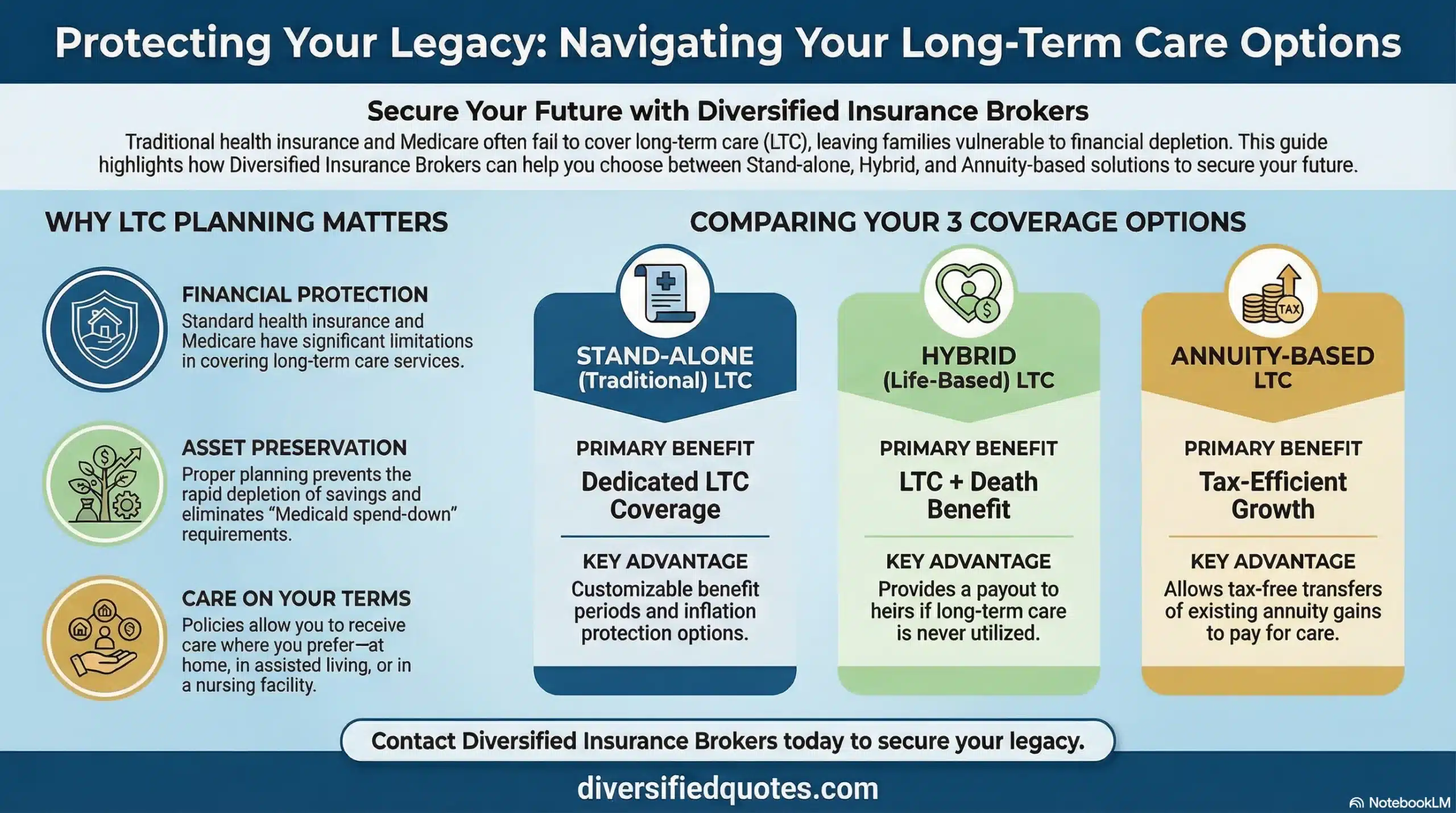
The fundamental problem with traditional standalone long-term care insurance is what the industry calls use-it-or-lose-it: you pay premiums for years or decades, and if you never need care — or need far less care than you planned for — the premiums are gone with nothing returned. That structural problem drove many buyers out of the standalone LTC market entirely. Hybrid long-term care insurance was designed to solve it, and OneAmerica’s Asset Care is the most complete solution available. When you purchase Asset Care, your single premium — or series of premiums — funds a whole life policy with an LTC acceleration rider. If you qualify for long-term care benefits, the death benefit pays out tax-free to cover your care costs. Here is the feature that no other hybrid LTC product matches: those benefits are unlimited. Most competing hybrid products cap the LTC benefit pool at two or three times the original premium. When that pool is exhausted, coverage ends. Asset Care’s benefits do not end. If you need care beyond what the initial benefit pool would provide, coverage continues — you will not be left without benefits in year seven of a nursing home stay. If you never need care, the full death benefit passes to your heirs. If you need some care but not all available benefits, the remaining death benefit passes to your heirs. Premiums are guaranteed never to increase — no multi-year rate action plans, no benefit reduction elections, no surprise notices like the ones Genworth’s legacy LTC policyholders have experienced. Asset Care was updated in 2024 with expanded caregiver benefits and enhanced inflation protection options, keeping it current without requiring existing policyholders to requalify. For couples, a joint Asset Care policy funds coverage for both spouses from a single premium — a critical consideration given that spousal LTC needs often cascade: when one partner enters care, the out-of-pocket expense threatens the financial security of the partner who remains at home. Our resource on long-term care insurance for couples covers the planning mechanics that make joint coverage the right structure for most married buyers.
Annuity Care — The Annuity-Based Path to LTC Coverage
Not every buyer needs or wants a life insurance base under their LTC coverage. Buyers who already carry substantial life insurance — through employer coverage, existing whole life policies, or term insurance during the accumulation years — often find the life insurance death benefit in Asset Care redundant. For them, the Annuity Care series provides the same no-use-it-or-lose-it structure with an annuity foundation instead. A lump sum — which can come from cash, an existing annuity via 1035 exchange, or IRA funds in some structures — funds an annuity that grows at a guaranteed rate tax-deferred. A long-term care benefit is layered on top, multiplying the LTC coverage available beyond the annuity’s base value. If you need care, the LTC benefit pays tax-free. If you do not need care, the accumulated annuity value passes to your heirs. A lifetime benefit option ensures that even if you exhaust the extended LTC benefit pool, coverage does not stop — similar to Asset Care’s unlimited provision. Annuity Care’s underwriting is also generally more relaxed than Asset Care’s, which matters for buyers who may not qualify for a life insurance-based hybrid because of health history. Buyers with existing annuity contracts that have aged past their competitive rate period should evaluate whether a 1035 exchange into Annuity Care makes sense — transferring the accumulated value tax-free into a structure that provides both ongoing growth and LTC coverage simultaneously. Our resource on annuity with long-term care benefits covers the full category of annuity-based LTC solutions, and our resource on fixed annuity with long-term care benefits covers the specific mechanics of the fixed-rate version that Annuity Care is built on.
Who OneAmerica Is Right For and What to Know Before Buying
OneAmerica Financial occupies a specific position in the retirement planning landscape: it is not the carrier for buyers who are purely rate-shopping a MYGA or looking for the highest FIA participation rate. It is the carrier for buyers who are building a comprehensive retirement income and protection plan that accounts for long-term care as a first-order risk rather than an afterthought. The 74 consecutive years of AM Best A+ answers the financial strength question more definitively than any other carrier in the hybrid LTC space can. The unlimited benefit structure of Asset Care answers the “what if I need care for a very long time” question that most hybrid products leave unanswered. The mutual structure answers the “whose interests does this company serve” question. For buyers who are not sure whether they need traditional standalone LTC, a hybrid life-based product like Asset Care, or an annuity-based solution like Annuity Care, our resource on how to buy long-term care insurance covers the decision framework that matches product structure to individual financial situation and health status. For buyers who believe they can self-fund long-term care from retirement assets alone, our resource on self-insured long-term care covers what that strategy actually requires in liquid assets and what can go wrong when care needs extend beyond projections. For buyers evaluating OneAmerica’s Annuity Care against GILICO’s AnnuiCare hybrid — the two most frequently compared annuity-based LTC solutions — our resource on Is GILICO a Good Insurance Company covers the AnnuiCare product and its 3× LTC leverage structure in detail; the right choice between the two depends on the buyer’s health, premium budget, desire for life insurance coverage, and whether unlimited versus leveraged benefits is the higher priority. For buyers wondering what Medicare actually covers when long-term care is needed — the single most common misconception in retirement planning — our resource on does Medicare cover long-term care addresses that gap directly.
Talk With an Advisor Today
Choose how you’d like to connect—call or message us, then book a time that works for you.
Schedule here:
calendly.com/jason-dibcompanies/diversified-quotes
Licensed in all 50 states • Fiduciary, family-owned since 1980
Frequently Asked Questions: Is OneAmerica a Good Insurance Company?
What is OneAmerica’s AM Best rating and why does 74 consecutive years matter?
OneAmerica’s primary issuing entities — American United Life Insurance Company and The State Life Insurance Company — hold AM Best A+ (Superior), affirmed August 2024, and have held that rating continuously since 1951. The S&P AA- rating provides independent corroboration. Holding A+ for 74 consecutive years is not just a marketing fact; it is meaningful evidence of institutional discipline. Insurance ratings can shift with economic cycles, investment losses, claims shocks, or management changes. A carrier that has maintained A+ through the 2001 recession, the 2008 financial crisis, the 2020 pandemic shock, and the 2022 interest rate surge has demonstrated something that a carrier with a current A+ but a shorter history cannot: durability under stress. For a long-term care policy that may need to pay benefits 25 or 30 years from purchase, that durability record is the most relevant financial strength credential available. For context on how A+ sits within the full rating framework, our resource on what an AM Best rating means covers the complete scale.
What makes Asset Care different from other hybrid LTC products?
Asset Care is the only hybrid long-term care product that combines two features no other carrier offers simultaneously: unlimited long-term care benefits and a guaranteed death benefit. Most hybrid LTC products — including Nationwide Care Matters, Lincoln MoneyGuard, and GILICO’s AnnuiCare — cap the LTC benefit pool at a defined multiple of the original premium. When that pool is exhausted, coverage ends. Asset Care does not work that way. The whole life base provides a guaranteed death benefit that can be fully accelerated for LTC costs — and if you exhaust the death benefit through LTC claims, additional benefits can continue. If you never need care, the full death benefit passes to heirs intact. If you need some care but not all of the available benefit, the remaining death benefit still passes to heirs. Premiums are guaranteed never to increase — a provision that directly addresses the premium volatility that has damaged trust in traditional standalone LTC insurance. The 2024 update added expanded caregiver benefit provisions and enhanced inflation protection options, keeping the product competitive without requiring existing policyholders to re-qualify.
Who should choose Annuity Care instead of Asset Care?
Annuity Care is the right structure for buyers who fall into one of three profiles. First, buyers who already carry adequate life insurance — through existing whole life, a large employer-sponsored group policy, or other coverage — and do not need or want an additional death benefit layered into their LTC solution. Second, buyers who prefer working with an annuity foundation: their mental model of the product is “my money grows, and if I need care it pays for that; if I don’t, my heirs get the accumulated value.” Third, buyers whose health history makes qualifying for a life insurance-based product difficult — Annuity Care’s underwriting is generally more relaxed than Asset Care’s. The non-qualified long-term care annuity structure that underlies Annuity Care also makes it well-suited for buyers who want to use after-tax savings — including matured CDs, existing annuities, or non-IRA savings — to fund LTC coverage through a 1035 exchange without triggering taxes on the transfer. The lifetime benefit option on Annuity Care addresses the same unlimited benefit concern that Asset Care addresses on its life insurance side — buyers can elect to ensure their LTC coverage never runs out regardless of how long care is needed.
Can I use a 1035 exchange to fund OneAmerica Care Solutions products?
Yes — and for many buyers this is one of the most tax-efficient ways to fund OneAmerica LTC coverage. A 1035 exchange allows you to transfer the cash value or accumulated value of an existing life insurance policy or annuity into a new policy without triggering a taxable event on the gain. For buyers who hold older whole life policies with significant cash value, or annuities that have grown past their competitive rate period and whose gains have never been taxed, a 1035 exchange into Asset Care or Annuity Care repurposes those funds into a structure that provides both ongoing guaranteed value and LTC protection. The mechanics require working with a licensed advisor to ensure the exchange qualifies under IRS §1035 and that the new policy’s benefits align with what you are surrendering. Not every exchange is optimal — if an existing policy has surrender charges remaining, the math changes. An independent review of the existing policy before executing any exchange is essential.
How does OneAmerica Asset Care compare to self-funding long-term care from retirement assets?
The self-funding argument for long-term care goes like this: keep the money invested, earn a return, and draw on it if care is needed instead of paying premiums to a carrier. Our resource on self-insured long-term care covers what that strategy actually requires — and the number is larger than most people expect. The average nursing home private room costs well over $90,000 per year, and a multi-year stay can easily run $300,000 to $500,000 or more. The self-funded approach works if you have enough liquid assets that a $400,000 long-term care draw does not materially affect the surviving spouse’s financial security. For most retirement savers, it does — which is why the hybrid LTC approach that Asset Care provides is strategically sound: a single premium of $100,000 to $150,000 can fund substantially more than that in LTC coverage, the premium is guaranteed to not increase, and if care is never needed the death benefit preserves the full value for heirs. The comparison is not just about the LTC benefit itself but about what the premium could have earned in the market — a calculation that is highly sensitive to market assumptions and care timing. An independent analysis comparing the guaranteed LTC coverage value of Asset Care against the projected self-funded alternative is the right way to make that decision.
About the Author:
Jason Stolz, CLTC, CRPC, DIA, CAA and Chief Underwriter at Diversified Insurance Brokers (NPN 20471358), is a senior insurance and retirement professional with more than 25 years of real-world experience helping individuals, families, and business owners protect their income, assets, and long-term financial stability. As a long-time partner of the nationally licensed independent agency Diversified Insurance Brokers, Jason provides trusted guidance across multiple specialties—including fixed and indexed annuities, long-term care planning, personal and business disability insurance, life insurance solutions, Group Health, Travel Medical and Evacuation Insurance, and short-term health coverage. Diversified Insurance Brokers maintains active contracts with over 100 highly rated insurance carriers, ensuring clients have access to a broad and competitive marketplace.
His practical, education-first approach has earned recognition in publications such as VoyageATL, and contributions from his agency featured in Kiplinger and GoBankingRates— highlighting his commitment to financial clarity and client-focused planning. Drawing on deep product knowledge and years of hands-on field experience, Jason helps clients evaluate carriers, compare strategies, and build retirement and protection plans that are both secure and cost-efficient. Visitors who want to explore current annuity rates and compare options across multiple insurers can also use this annuity quote and comparison tool.
Review More Carrier Reviews: Browse our complete Long-Term Care Insurance Company Reviews — covering John Hancock, Genworth, Bankers Life, Mutual of Omaha, and more LTC carriers.
Last Reviewed: September 29, 2026 |
Reviewed by: Jason Stolz, CLTC, CRPC, DIA, CAA
Chief Underwriter, Diversified Insurance Brokers, Inc. | NPN: 20471358 | Diversified Insurance Brokers, Inc. — Licensed in all 50 states
Fact Checked by: Tonia Pettitt, CMIP©
Medicare Specialist, Diversified Insurance Brokers, Inc. | NPN: 14374308 | Diversified Insurance Brokers, Inc. — Licensed in all 50 states
Did you find this content helpful? Leave us a Google review — it helps others find trustworthy guidance too.
Editorial Standards: Diversified Insurance Brokers maintains rigorous editorial standards to ensure accuracy, clarity, and independence in all content. Learn more about our editorial standards and commitment to transparency.
