
Long Term Care vs Assisted Living Insurance
As an Independent Long Term Care Insurance Broker, we compare traditional, hybrid, and partnership-qualified policies across dozens of carriers to find the structure that actually fits your situation.
Long Term Care vs Assisted Living Insurance

Jason Stolz CLTC, CRPC, DIA, CAA
Planning for future care starts with understanding your options. Many families hear terms like long term care insurance and assisted living insurance and assume they’re interchangeable. In reality, they work very differently. Long term care insurance is designed to follow you across multiple care settings — often including home care, assisted living, memory care, and nursing facilities — while assisted living–only coverage is typically focused on one specific type of facility. The difference in scope can determine whether your coverage actually pays when your care situation unfolds, which is why understanding how these products compare is foundational to making a sound planning decision. At Diversified Insurance Brokers, Jason Stolz, CLTC, CRPC, DIA, CAA, helps clients compare both approaches side by side so they can protect retirement savings and maintain control over where and how they receive care. We also show how coverage choices fit into a broader retirement plan that may include annuities for retirement income, Medicare decisions, and other risk-management tools that reduce unknown expenses later in life.
The financial stakes of this comparison are significant. Current cost of care data shows a private nursing home room now averages $127,750 annually, assisted living costs approximately $70,800 per year, and a home health aide averages $77,792 annually. An estimated 70% of Americans will need long-term care at some point in their lives, and nearly one in five adults turning 65 will face more than $200,000 in long-term care expenses over their lifetime. A coverage choice made today without understanding which scenarios the policy will and will not pay for can leave a family exposed to exactly the outcomes they purchased coverage to prevent. The gap between “we have a policy” and “the policy pays for what we actually need” is where most long-term care planning failures occur.
Compare Long Term Care & Assisted Living Coverage
See what each option covers (and what it doesn’t), then match coverage to your lifestyle, budget, and retirement plan.
Request a Long Term Care Quote Explore Long Term Care InsuranceWhat Long Term Care Insurance Typically Covers
Long term care insurance is built to support you across the full continuum of care as needs change over time. Most modern LTC policies are triggered when you need help with at least two Activities of Daily Living — bathing, dressing, eating, toileting, transferring, or continence — or when a licensed healthcare practitioner documents severe cognitive impairment that requires substantial supervision. These triggers are functional and clinical, meaning they are tied to what you can and cannot do rather than to which specific building you are in at the time. That distinction is what gives LTC insurance its core design advantage over setting-specific coverage: the trigger travels with you, so the policy can pay regardless of where your care eventually takes place.
Once you qualify, benefits can follow you through multiple care settings in sequence or simultaneously depending on how care is structured. A well-designed policy can support an age-in-place plan with in-home care and caregiver support as the first line of care, and then still function if your care path shifts to adult day care, assisted living, memory care, or a skilled nursing facility as needs progress. Because the contract is organized around functional impairment rather than one building type, the policy can still pay even if your care journey looks different than originally anticipated. This flexibility is the single most important design advantage of comprehensive LTC insurance over assisted living–only coverage, and it is the primary reason LTC insurance remains a cornerstone of comprehensive care planning for families who want control over their options as care needs evolve.
When evaluating coverage, the levers that most directly affect real-world outcomes are the monthly benefit amount — because a policy that pays $6,000 per month behaves very differently than one paying $3,000 per month in a high-cost metropolitan area — the benefit period or pooled benefit structure, the elimination period, and inflation protection provisions. The financial strain from long-term care usually comes from longer-duration claims rather than short rehabilitation stays. A care situation lasting three or more years at current costs can consume $200,000 to $400,000 or more, which is why the benefit period and inflation protection decisions matter as much as the monthly benefit size. For couples, benefit design that coordinates between spouses can reduce the risk of one partner exhausting coverage while the other has substantial unused benefit remaining. Long-term care insurance with shared spousal benefits covers how household benefit pooling works and why it often produces better outcomes for couples than separate individual policies sized without coordination. If your biggest hesitation is paying premiums for coverage you may never use, whether long-term care insurance is worth it addresses the full range of trade-offs including return-of-premium and hybrid structures that address the “use it or lose it” concern directly.
What Assisted Living–Only Insurance Covers
Assisted living insurance — or coverage limited to assisted living reimbursement — focuses specifically on expenses inside an assisted living facility. Some versions are true assisted living–only products; others are riders or limited-benefit designs that reimburse expenses tied to assisted living facility contracts. Either way, the defining characteristic is narrow scope: benefits are designed for one specific care setting rather than following you across multiple settings as needs change. The policy pays when you are in a qualifying assisted living facility and stops paying in any other setting — home care, adult day care, memory care in a standalone facility, or skilled nursing — regardless of how significant your care need has become.
Because the coverage is narrower, premiums can sometimes be lower than a robust comprehensive LTC policy. That sounds attractive on the surface, but the trade-off is rigidity. If your preference is to stay at home longer with professional caregivers — which is the preference of the large majority of people when asked directly — or if your health progresses in a direction that requires skilled nursing rather than assisted living, benefits from an assisted living–only policy simply do not apply. A narrow plan can be perfectly positioned for one specific scenario and completely unhelpful in another, and the care situations that turn out to be the most financially damaging are often the ones that deviate from what was expected when the policy was purchased.
Families often gravitate toward assisted living–only coverage because they are thinking about a specific nearby community they like, or because they are trying to control premium cost by limiting the insured risk to the care setting they consider most likely. The problem with that reasoning is that care paths rarely unfold exactly as anticipated. Our process for evaluating this trade-off involves stress-testing the decision with realistic “what if” scenarios: what if care starts at home first before the assisted living community becomes appropriate, what if memory care is needed sooner than expected in a standalone memory care facility the assisted living policy does not cover, what if the preferred community changes its pricing or care model, or what if the required level of care eventually moves beyond what assisted living is designed to provide? Answering those questions with honest projections rather than optimistic assumptions almost always changes the coverage comparison in favor of broader protection.
Long Term Care vs Assisted Living Insurance: Side-by-Side
If you strip away the marketing language, the difference comes down to scope and flexibility. Long term care insurance is designed to pay when you meet a functional or cognitive trigger and then provide benefits across multiple covered care settings, following you as care needs evolve. Assisted living insurance is designed to reimburse one specific setting. That difference changes how the plan actually behaves when real life deviates from original assumptions — which it reliably does for most families navigating a multi-year care situation.
| Feature | Long Term Care Insurance | Assisted Living Insurance |
|---|---|---|
| Coverage Scope | Broad — typically includes home care, adult day care, assisted living, memory care, and skilled nursing | Narrow — typically assisted living benefits only; other settings not covered |
| Flexibility | High — benefits follow you as needs change across multiple settings over time | Low — no benefit if care starts at home, or if care progresses beyond assisted living capacity |
| Benefit Trigger | Functional impairment (2+ ADLs) or cognitive impairment — setting-independent | Residency in a qualifying assisted living facility — setting-dependent |
| Premium Design | Often higher because more care scenarios and settings are covered | Can be lower, but gaps and coverage restrictions are more common in real claims |
| Inflation Risk | Addressable with compound inflation or step-up provisions built into policy design | Varies by product; inflation protection options may be limited or unavailable |
| Best for | Households seeking broad protection and control across multiple care paths and settings | Households primarily planning for assisted living and willing to accept significant coverage limits |
Cost, Premium Design, and Inflation Protection
For most families, the real question is not which policy costs less today — it is which type of coverage does a better job of protecting savings over time against the care costs that are actually most financially damaging. The most expensive long-term care outcomes are the longer-duration ones, especially those involving progressive cognitive decline that requires sustained supervision and care over three, five, or more years. At current costs of $70,800 annually for assisted living and $127,750 for a private nursing home room, a five-year care situation represents a $350,000 to $640,000 financial exposure before any insurance benefit is applied. Design decisions about what the policy covers, how much it pays monthly, and how that payment keeps pace with rising costs matter enormously over those timeframes.
Inflation protection is one of the largest planning levers in comprehensive LTC coverage design. Many traditional LTC policies offer compound inflation options — commonly 3% or 5% compound annually — so the monthly benefit grows over time at a rate that approximates care cost inflation. That can be critical if you are purchasing coverage in your mid-50s or early 60s and care may not begin for 15 or more years, during which care costs will have increased substantially. A benefit that looks adequate for today’s assisted living cost can become a partial benefit by the time it is actually needed without inflation protection built into the policy design. The long-term care insurance calculator provides a practical starting point for modeling how different benefit amounts and inflation assumptions translate into projected coverage at the time care is actually needed.
Funding strategy also matters and is often overlooked in the initial coverage comparison. Some clients use non-qualified assets to fund premiums on a tax-efficient basis. Others reposition a portion of low-yield savings or CD-ladder assets into structures that create a defined care funding pool with specific guarantees. Fixed annuities with long-term care benefits and annuities with long-term care benefits address how asset repositioning into insurance-linked structures can create care funding without the “use it or lose it” concern that makes traditional LTC premiums psychologically difficult for some families. Understanding how to get favorable pricing on the coverage itself is also foundational — how to get the best long-term care insurance rates covers the underwriting and product selection variables that most directly affect total cost across the full coverage period.
See What Your Policy Would Actually Pay For
We’ll compare benefits by care setting (home, assisted living, memory care, skilled nursing) so you can see where gaps exist.
Request My LTC Quote Explore Long Term Care InsuranceHybrid Policies and Partnership Plans
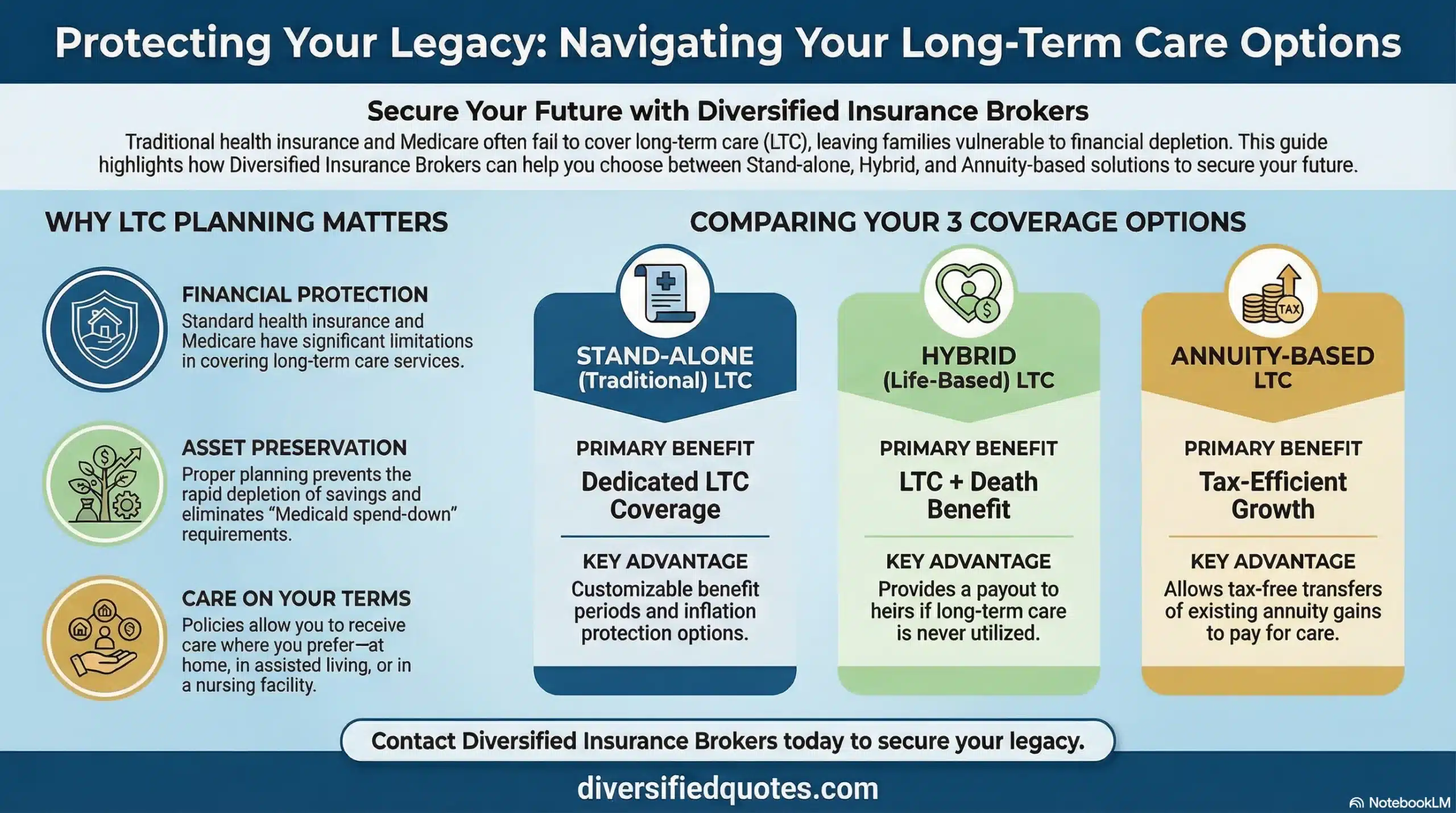
Traditional LTC insurance and assisted living–only coverage are not the only options in the market. Many households also compare hybrid designs and state partnership-qualified policies, especially if they want to address the “use it or lose it” concern that makes traditional LTC premium commitments emotionally difficult for some families or if they want to coordinate care funding with asset preservation strategies.
Hybrid life and LTC policies combine long-term care benefits with a life insurance component, meaning that if care is never needed, beneficiaries still receive a death benefit from the policy. If care is needed, the contract provides LTC benefits under qualifying functional or cognitive triggers. Many clients find the “either way the policy does something” structure reduces the psychological friction of long-term care planning, because the premium is no longer perceived as a cost with a zero-sum outcome. Hybrid life insurance with long-term care benefits covers how the LTC component of these products works in practice. Hybrid life versus traditional long-term care insurance provides the side-by-side framework for which structure suits which household situation. Hybrid long-term care covers the broader category overview for families who want to understand all of the available hybrid structures before narrowing to specific carriers.
Partnership-qualified LTC policies can provide additional asset protection in certain Medicaid planning scenarios when the policy meets partnership requirements established by the state. This is not the right focus for every household, but for families where Medicaid eligibility coordination is part of the long-term risk planning conversation, the partnership qualification adds a meaningful layer of protection that standard non-qualified policies do not provide. Partnership-qualified long-term care insurance covers how these policies work and which families benefit most from the Medicaid asset protection dimension. Assisted living–only coverage can still play a role in narrow planning scenarios, but hybrid and partnership structures generally provide better long-term planning alignment because they address multiple possible care outcomes rather than betting on one specific scenario.
How to Decide Which Coverage Fits Your Situation
Choosing between long term care insurance and assisted living–only coverage becomes much clearer when you start with your actual preferences and then stress-test the plan against realistic scenarios rather than best-case assumptions. Most families who honestly answer the question of where they would prefer to receive care say they want to remain at home as long as safely possible before transitioning to a facility setting. That preference alone points strongly toward comprehensive LTC coverage, because a policy that only pays for assisted living provides no benefit during the home care years that most families will experience first.
Assisted living–only coverage can be considered when the household’s planning goal is genuinely narrow, the budget is significantly constrained, and the family is fully aware of and comfortable accepting the coverage gaps. Even then, the decision should be made with complete information: if care begins at home first — which research and claims data both confirm is the most common first step in a care situation — the policy does not pay. If skilled nursing eventually becomes necessary — which occurs for a significant percentage of people with dementia and other progressive conditions — the policy does not pay. Our comparison process is designed to make those trade-offs visible and quantified before a commitment is made, not after a claim reveals the gap. For applicants who want to understand the full underwriting and application process before selecting between coverage types, how to find, evaluate, and apply for long-term care insurance walks through needs analysis, underwriting, plan design, and carrier comparison in practical terms. For those who want to confirm their health profile qualifies before comparing products, how to qualify for long-term care insurance covers the underwriting standards that determine eligibility and how health history affects the products available.
Coordinating Care Coverage With the Rest of Your Retirement Plan
Care planning does not live in isolation. The right mix of LTC coverage or assisted living coverage should fit alongside your guaranteed income sources, investment strategy, Medicare planning, and overall household financial structure. Some clients prefer to create a stable baseline retirement income and then use long-term care benefits as the dedicated funding mechanism for care expenses when they arise — keeping the care cost exposure separate from the income and asset picture so neither is disrupted by the other. Others view LTC coverage as the asset-protection layer that prevents a prolonged care event from consuming the portfolio that was intended to support the surviving spouse or pass to the next generation. Both approaches are valid, but they lead to different coverage design priorities, which is why starting with the planning goal rather than the product is consistently more effective.
Medicare is one of the most commonly misunderstood dimensions of this planning picture. Many people assume Medicare covers long-term care the way it covers acute medical care. In reality, Medicare is not designed to cover extended custodial long-term care needs. Medicare covers short-term skilled nursing care after a qualifying hospital stay under strict time and medical necessity conditions — providing full coverage for days 1 through 20 and requiring a daily coinsurance of $204 per day for days 21 through 100 as of 2025, after which Medicare coverage ends entirely. This is meaningfully different from the months or years of custodial care that a chronic condition or cognitive impairment typically requires. Whether Medicare and long-term care insurance are the same clarifies this distinction in plain terms. Whether Medicare covers nursing home care addresses the specific nursing home coverage question that generates the most confusion. When the retirement plan is coordinated correctly — retirement income tools handling lifestyle and fixed expenses, long-term care coverage handling care expenses, and Medicare handling acute medical coverage — each piece has a defined job and the household avoids the forced decisions that arise when the plan has gaps.
Find the Right Care Coverage for Your Family
We’ll compare comprehensive LTC coverage vs. assisted living-focused options, then map the trade-offs to your retirement plan.
Request Your Long Term Care Quote Explore Long Term Care InsuranceRelated Pages
Helpful next reads if you’re comparing care settings, costs, and coverage designs.
Talk With an Advisor Today
Choose how you’d like to connect—call or message us, then book a time that works for you.
Schedule here:
calendly.com/jason-dibcompanies/diversified-quotes
Licensed in all 50 states • Fiduciary, family-owned since 1980
Frequently Asked Questions: Long Term Care vs Assisted Living Insurance
What is the main difference between long term care insurance and assisted living insurance?
Long term care insurance is designed to follow you across multiple care settings — home care, adult day care, assisted living, memory care, and skilled nursing — triggered by functional impairment involving at least two Activities of Daily Living or a qualifying cognitive impairment. Benefits apply regardless of which specific setting provides the care. Assisted living insurance is designed to reimburse expenses specifically inside an assisted living facility. If care begins at home first, or if the level of care required progresses beyond what assisted living can provide, an assisted living–only policy typically does not pay. The scope difference — broad versus narrow — is the fundamental distinction that determines how each type of policy behaves when real care situations unfold differently than anticipated.
Does Medicare pay for assisted living or long-term care?
Medicare does not cover long-term custodial care — meaning the ongoing assistance with Activities of Daily Living that constitutes most of what people think of as long-term care. Medicare covers short-term skilled nursing facility care after a qualifying hospital stay under strict conditions: full coverage for days 1 through 20, a daily coinsurance of $204 per day for days 21 through 100 (as of 2025), and no coverage after day 100. Medicare does not cover assisted living at all in most circumstances. Families who assume Medicare will handle extended care costs are among the most financially unprepared for a significant care situation, because Medicare’s coverage design is oriented toward acute medical recovery, not long-term custodial support.
Why is inflation protection important in long-term care insurance?
Inflation protection ensures your monthly benefit grows over time at a rate that approximates rising care costs. Care costs have consistently increased over time — a private nursing home room now averages $127,750 annually, and assisted living costs approximately $70,800 per year. If you purchase LTC coverage in your 50s or early 60s and care does not begin for 15 or more years, a benefit that looks adequate for today’s costs can become insufficient by the time it is actually needed without built-in growth provisions. Most comprehensive LTC policies offer compound inflation options, commonly 3% or 5% compounding annually, that allow the benefit amount to grow in parallel with care cost increases. Choosing a policy without inflation protection because the premium is lower today is a common planning mistake that creates a coverage gap at the exact time when coverage matters most.
What is a hybrid long-term care policy and how does it compare to traditional LTC insurance?
A hybrid long-term care policy combines life insurance or annuity benefits with long-term care benefits in a single product. If care is never needed, beneficiaries receive a death benefit — addressing the “use it or lose it” concern that makes traditional LTC premium commitments difficult for some families. If care is needed, the policy provides LTC benefits under qualifying functional or cognitive triggers, similar to a traditional LTC policy. The main trade-offs are that hybrid policies typically require a larger upfront or scheduled premium commitment than traditional LTC policies, and the LTC benefit pool per dollar of premium may be smaller than a comparable traditional LTC design. The right choice between hybrid and traditional depends on whether the guaranteed residual value of the policy is more important than maximizing the LTC benefit per premium dollar — a trade-off that varies significantly by household situation and planning priority.
When should I choose comprehensive LTC insurance over assisted living–only coverage?
Comprehensive LTC insurance is almost always the stronger choice when you want flexibility to receive care at home first, when cognitive impairment is a concern (which often requires memory care settings beyond standard assisted living), when your care situation is likely to evolve across multiple settings over time, or when protecting retirement savings against a multi-year care event is the primary objective. Assisted living–only coverage may be considered when the planning goal is genuinely narrow, the budget is significantly constrained, and the family understands and accepts the coverage gaps for home care, memory care outside assisted living, and skilled nursing. The stress test question is: what if your care situation does not follow the specific scenario the assisted living policy was designed for? If the honest answer is “we would not be covered,” comprehensive LTC coverage is the appropriate foundation.
About the Author:
Jason Stolz, CLTC, CRPC, DIA, CAA and Chief Underwriter at Diversified Insurance Brokers (NPN 20471358), is a senior insurance and retirement professional with more than 25 years of real-world experience helping individuals, families, and business owners protect their income, assets, and long-term financial stability. As a long-time partner of the nationally licensed independent agency Diversified Insurance Brokers, Jason provides trusted guidance across multiple specialties—including fixed and indexed annuities, long-term care planning, personal and business disability insurance, life insurance solutions, Group Health, Travel Medical and Evacuation Insurance, and short-term health coverage. Diversified Insurance Brokers maintains active contracts with over 100 highly rated insurance carriers, ensuring clients have access to a broad and competitive marketplace.
His practical, education-first approach has earned recognition in publications such as VoyageATL, and contributions from his agency featured in Kiplinger and GoBankingRates— highlighting his commitment to financial clarity and client-focused planning. Drawing on deep product knowledge and years of hands-on field experience, Jason helps clients evaluate carriers, compare strategies, and build retirement and protection plans that are both secure and cost-efficient. Visitors who want to explore current annuity rates and compare options across multiple insurers can also use this annuity quote and comparison tool.
Explore More Long Term Care Insurance Options: Browse our complete guide to LTC Insurance Costs, Rates & Planning — covering how much it costs, best rates, calculators, planning strategies & is it worth it from top carriers.
Last Reviewed: September 18, 2026 |
Reviewed by: Jason Stolz, CLTC, CRPC, DIA, CAA
Chief Underwriter, Diversified Insurance Brokers, Inc. | NPN: 20471358 | Diversified Insurance Brokers, Inc. — Licensed in all 50 states
Fact Checked by: Tonia Pettitt, CMIP©
Medicare Specialist, Diversified Insurance Brokers, Inc. | NPN: 14374308 | Diversified Insurance Brokers, Inc. — Licensed in all 50 states
Did you find this content helpful? Leave us a Google review — it helps others find trustworthy guidance too.
Editorial Standards: Diversified Insurance Brokers maintains rigorous editorial standards to ensure accuracy, clarity, and independence in all content. Learn more about our editorial standards and commitment to transparency.
