
How to Find, Evaluate, and Apply for Long Term Care Insurance
How to Find, Evaluate, and Apply for Long Term Care Insurance

Jason Stolz CLTC, CRPC, DIA, CAA
Finding, evaluating, and applying for long-term care insurance is a three-stage process that most people approach backward — they start by asking about cost before they have defined what they actually need coverage to do. The sequence matters because long-term care insurance is not a commodity product where the lowest premium wins. It is a contractually complex instrument where benefit design, carrier selection, underwriting positioning, and policy mechanics interact in ways that produce meaningfully different real-world outcomes. A policy that appears less expensive because it lacks inflation protection may fund a fraction of actual care costs twenty years from now. A carrier whose underwriting guidelines are favorable for a specific health profile may produce a level benefit approval where another carrier would decline or surcharge. Getting the process right requires starting with the goal, working through design, and then applying with deliberate carrier positioning. At Diversified Insurance Brokers, Jason Stolz, CLTC, CRPC, DIA, CAA, works with individuals and couples across all fifty states through exactly this sequence — identifying care preferences, designing coverage that integrates with retirement income, and positioning applications for the strongest available underwriting outcome.
The scale of the financial risk that long-term care insurance addresses is substantial and frequently underestimated. According to CareScout’s 2025 Cost of Care Survey, the national median monthly cost for assisted living communities is $6,200 per month ($74,400 annually), and the national median daily rate for a semi-private nursing home room is $315 per day ($114,975 annually). A private nursing home room runs even higher. These are median figures — costs in higher-cost markets like the Northeast, Pacific Northwest, and major metropolitan areas run significantly above these benchmarks. And these costs do not stand still: long-term care cost inflation has historically run at three to five percent annually, well above general inflation, which means a cost structure that appears manageable today will be materially larger when care is actually needed. Milliman’s 2025 Long-Term Care Index projects the average lifetime cost of formal paid long-term care services for a 65-year-old at approximately $135,000, with women facing roughly $171,000 and men approximately $98,000 due to longer life expectancy, and with individual cost ranges running from under $30,000 for short needs to over $660,000 for extended care.
Design a Plan Around Your Retirement Goals
We compare multiple carriers and show you how benefit pools, inflation protection, and elimination periods affect long-term outcomes — with no obligation.
Request an LTC QuoteStage One: Finding the Right Coverage Structure
The first stage is defining what you need coverage to accomplish — and this requires honest clarity about care preferences, retirement income structure, and estate objectives before any carrier or policy is evaluated. Three fundamental care preference questions shape everything that follows: Do you want the option to receive care at home, or are you primarily planning for facility-based care? Are you planning around cognitive risk specifically — Alzheimer’s disease and related dementias account for a substantial share of long-term care claims, and policies vary significantly in how they handle cognitive triggers? And what is the care duration assumption — are you planning for a relatively short claim or building protection against an extended care scenario that could span five, seven, or more years?
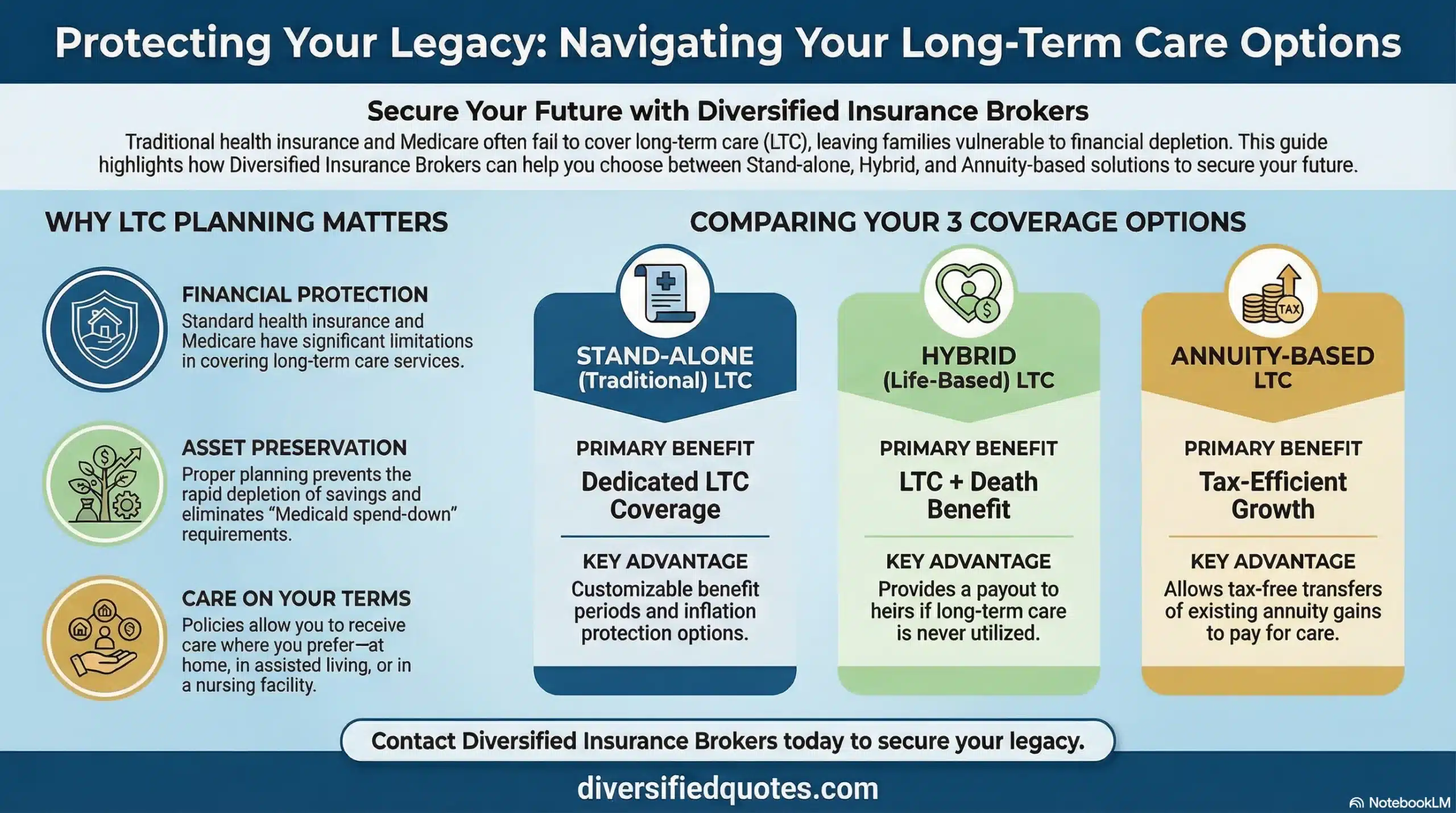
The structural choice comes next: standalone traditional LTC insurance, hybrid life/LTC insurance, or annuity-based LTC planning. Each structure has distinct financial mechanics, premium behavior, and benefit characteristics that make it more or less appropriate depending on the household’s financial situation and planning priorities. Standalone traditional LTC policies are pure care leverage vehicles — they provide the greatest care benefit per premium dollar among the three structures, often by a significant margin, and may qualify for state Partnership programs that protect assets if Medicaid is eventually needed. The trade-off is that premiums can be increased by the carrier in the future (though significant increases require state regulatory approval) and unused premiums do not return any value. Hybrid life/LTC policies combine a permanent death benefit with long-term care benefit acceleration — the premium produces guaranteed value whether care is used or not, which resolves the “use-it-or-lose-it” objection to standalone policies. Hybrid annuity/LTC products reposition existing assets into contracts that multiply the deposited amount for qualified care expenses while also maintaining access to principal if care is not needed. Our resources on hybrid life versus traditional long-term care insurance, hybrid long-term care, and understanding hybrid long-term care insurance cover these structural distinctions in depth. Our resource on the primary reason people buy long-term care insurance addresses the motivational framework that shapes which structure fits best.
Stage Two: Evaluating the Four Core Benefit Variables
Once the structural decision is made, the benefit design stage involves four variables that interact with each other and must be calibrated together rather than optimized individually. Understanding how each variable affects both premium and real-world benefit adequacy is what separates a well-designed policy from one that looks good on a summary page but underperforms when care is actually needed.
The monthly benefit is the most visible lever — it represents the maximum the policy will pay per month for qualifying care. Monthly benefit structures (as opposed to daily caps) provide more flexibility, allowing a month of high-cost care to fully utilize the benefit maximum regardless of how costs are distributed across days. The range for most applicants runs from $3,000 to $8,000 per month depending on local care costs, existing income sources that can cover a portion of care costs, and budget. Our resource on how much long-term care insurance you need and our interactive cost of long-term care by state calculator provide the regional cost benchmarks needed to calibrate monthly benefit to actual care costs in the applicant’s likely care geography.
The benefit period determines the total benefit pool available over the life of the claim. A three-year benefit period with a $6,000 monthly maximum creates a total pool of $216,000 — sufficient for an average claim but potentially inadequate for an extended cognitive care scenario. A five-year benefit period with the same monthly benefit creates a $360,000 pool. Shared care riders allow couples to combine their benefit pools and draw from a common resource if one spouse’s individual pool is exhausted — a structure that provides meaningful additional protection for couples where one partner has a longer-than-expected claim. Our resources on LTC insurance with shared benefits, shared spousal benefits, and shared care riders explained cover the mechanics and appropriate use of these structures. The companion resource on what a benefit period is covers the foundational concept for applicants new to this language.
LTC Insurance Benefit Design Variables: How Each Choice Affects Premium and Protection
| Variable | What It Controls | Premium Impact | Optimization Guidance |
|---|---|---|---|
| Monthly benefit | Maximum the policy pays per month of qualifying care | Directly proportional — higher benefit = higher premium | Calibrate to regional care costs minus guaranteed income that would offset care costs |
| Benefit period / pool | Total dollars available over the life of the claim | Longer period = higher premium; couple pool sharing reduces per-person cost | 3–5 years covers the statistical average claim; shared care provides additional runway for couples |
| Elimination period | Days of qualifying care you pay out of pocket before benefits begin | Longer elimination = lower premium; 90-day is the most common balance point | Confirm whether carrier counts calendar days or service days — service day counting is less favorable |
| Inflation protection | How the benefit amount grows over time to keep pace with care cost inflation | 3% compound adds significantly to premium; 5% compound substantially more | 3% compound strongly recommended for applicants under 65; skipping inflation creates a growing coverage shortfall over time |
Inflation protection deserves specific emphasis because it is the most common benefit design error. A policy with a $6,000 monthly benefit today and no inflation protection will still provide $6,000 per month in twenty years — when care costs that today run $6,200 per month for assisted living may run $11,000 or more at a three percent annual increase, or $16,000 at five percent. A policy with three percent compound inflation protection on that same $6,000 starting benefit would provide approximately $10,800 per month at twenty years — covering the inflated cost rather than paying a fraction of it. According to AALTCI’s 2025 price index, a 55-year-old male purchasing a policy with a $165,000 benefit and three percent compound inflation protection pays approximately $2,200 per year, while a 55-year-old female pays approximately $3,750 per year. With no inflation protection, those premiums drop to approximately $950 and $1,500 respectively. The premium savings from skipping inflation protection are real, but they produce a benefit that covers progressively less of actual care costs over the policy’s most likely active claim period. Our resource on LTC elimination periods explained covers the elimination period mechanics in detail, and our resource on LTC insurance with return of premium covers that optional rider for applicants concerned about the use-it-or-lose-it dimension of standalone policies.
Stage Three: Applying Strategically — The Underwriting Positioning Process
The application and underwriting stage is where most applicants make their most consequential mistakes — not in fraud or misrepresentation, but in applying to the wrong carrier for their health profile, applying at the wrong time relative to their health history, or failing to prepare for the cognitive and functional screening components of the evaluation. Long-term care insurance underwriting is among the most detailed in the insurance industry. Carriers evaluate six primary categories: age, medical history, prescription history, functional status and mobility, cognitive performance, and financial suitability. A stable chronic diagnosis may be entirely acceptable to one carrier and disqualifying at another — which is why carrier selection should precede formal application submission, not follow it.
The pre-underwriting review is the step that most self-directed applicants skip and most independent specialists make standard practice. A pre-underwriting review involves presenting a summary of the applicant’s health history — diagnoses, medications, recent medical events, functional status — informally to multiple carriers before any formal application is submitted. Carriers provide informal guidance on how they would likely classify the applicant: preferred rate class, standard rate class, rated (higher premium due to specific health factors), or decline. This informal guidance is not binding, but it allows the advisor to direct the formal application to the carrier most likely to produce the best available outcome for that specific health profile. Applying formally to a carrier that is likely to decline based on pre-underwriting signals wastes time, creates a record of a declined application that other carriers can see, and may consume the applicant’s energy at a critical decision point. Our resource on how to qualify for long-term care insurance covers the six underwriting categories and what carriers evaluate in each. Our resource on whether LTC insurance requires a medical exam addresses the examination and assessment requirements by carrier and product type.
The Age Window: Why Timing Affects More Than Premium
The premium savings from applying earlier are significant and well-documented, but the more important advantage of earlier application is insurability. AALTCI’s 2025 price index shows that a single man buying a standard policy at age 55 pays about $2,200 per year. Waiting until 65 raises that to $3,280 per year — a difference of $1,080 per year that compounds over decades. For women, the jump is larger: $3,750 per year at 55 versus $5,290 per year at 65. But the premium difference only matters if the applicant is still insurable at the later age. New diagnoses, mobility changes, cognitive assessment results, or medication changes between age 55 and age 65 can disqualify an applicant entirely — not merely raise the premium. The best health classification and the best premium are both available when health is at its strongest, and that window is typically in the fifties and early sixties. Our resource on whether you can still get LTC insurance after sixty covers the available options for applicants who have already passed the optimal window. Our resource on LTC insurance after age 80 covers the specialized product options for applicants at advanced ages where traditional underwriting is largely unavailable. The resource on guaranteed issue long-term care insurance addresses the options available when standard underwriting is not accessible.
The Partnership Program: A Rarely Discussed Rate Protection Strategy
Long-term care Partnership programs — available in most states — represent one of the most financially compelling and least-understood features of traditional LTC insurance. A Partnership-qualified policy provides dollar-for-dollar asset protection against Medicaid spend-down requirements: for every dollar the policy pays in benefits, the policyholder can shelter an additional dollar of assets from Medicaid’s asset limits if extended care eventually exhausts the policy benefit and Medicaid eligibility becomes relevant. A policy that pays $300,000 in benefits allows the insured to protect an additional $300,000 of assets beyond the standard Medicaid asset limit — an asset protection mechanism that is simply not available through non-Partnership policies. Our resources on Partnership-qualified long-term care insurance and LTC Partnership reciprocity across states cover how these programs work, which states participate, and how reciprocity applies for applicants who may relocate after purchasing a policy in a different state.
Tax Advantages That Reduce the Net Cost of Coverage
Tax-qualified long-term care insurance premiums are deductible as a medical expense subject to age-based limits established by the IRS — limits that increase with age and are adjusted annually. Self-employed individuals, C-corporations, and S-corporation shareholders above two percent have the most favorable deduction access. For employer-sponsored LTC programs, premium contributions can be tax-deductible as a business expense and received by employees tax-free. Benefits paid by a tax-qualified policy are received income-tax-free regardless of the premium deduction taken, making the after-tax cost of LTC insurance significantly more favorable than the gross premium suggests. For applicants considering hybrid annuity/LTC products, a 1035 exchange from an existing annuity or life insurance policy into a qualified LTC annuity contract can be accomplished tax-free, repositioning assets that might otherwise carry an embedded gain into a structure that multiplies those assets for care expenses without a taxable transaction. Our resources on tax advantages of long-term care insurance, tax benefits of LTC insurance, and tax-free long-term care insurance cover the deduction rules and benefit taxation treatment. Our resource on using qualified funds for long-term care insurance addresses the specific planning considerations for funding LTC premiums from retirement accounts.
Getting a Second Opinion on an Existing Quote or Policy
Many people researching long-term care insurance have already received a quote — from a single carrier’s agent, a bank, a financial advisor, or a workplace benefit presentation — and want to know whether the quote represents the best available option for their health profile and coverage goals. A second-opinion review compares that quote against the full competitive market: multiple carriers evaluated simultaneously at consistent benefit specifications, with carrier financial strength, rate increase history, and underwriting favorability for the specific applicant’s health profile all factored into the evaluation. Our resource on getting a second opinion on your LTC insurance quote initiates this comparison, and our resource on why working with an independent LTC broker matters explains the structural advantage of multi-carrier access over single-carrier recommendation. Our resource on self-insured long-term care covers the alternative approach and the financial scenarios under which self-funding is and is not a rational strategy.
Talk With an Advisor Today
Choose how you’d like to connect—call or message us, then book a time that works for you.
Schedule here:
calendly.com/jason-dibcompanies/diversified-quotes
Licensed in all 50 states • Fiduciary, family-owned since 1980
Frequently Asked Questions: How to Find, Evaluate, and Apply for Long-Term Care Insurance
What is the right age to apply for long-term care insurance?
The optimal age range for long-term care insurance application is the mid-fifties to early sixties, for two reinforcing reasons: health and premium. Premiums rise significantly with each year of delay — AALTCI’s 2025 data shows that a 55-year-old male pays approximately $2,200 per year for a policy with three percent compound inflation protection, while waiting to 65 raises that to approximately $3,280. For women the difference is larger, and for couples the combined increase for waiting ten years can exceed $2,000 per year. But the premium difference is secondary to the insurability consideration: conditions that develop between age 55 and age 65 — diabetes complications, cardiac events, mobility issues, cognitive assessment concerns, or new neurological diagnoses — can disqualify an applicant entirely. The premium savings from earlier application are available only to applicants who are actually eligible for the policy. For applicants who have already passed the optimal window, our resource on whether LTC insurance is still available after sixty and the resource on guaranteed issue long-term care insurance cover the options that remain accessible at later ages.
What does the long-term care insurance underwriting process actually involve?
Long-term care insurance underwriting is more detailed than most other types of insurance underwriting because carriers are assessing not just mortality risk but functional and cognitive risk that determines whether and how extensively care will be needed. The process typically involves five steps: first, a health questionnaire submitted with the application covering diagnoses, medications, hospitalizations, and functional status; second, review of prescription history through a national pharmacy database; third, review of medical records from treating physicians — a process that typically takes four to eight weeks depending on how quickly physicians’ offices respond; fourth, a telephone interview conducted by the carrier covering additional health questions, functional capacity, and in many cases a brief cognitive assessment; and fifth, a final underwriting decision that results in approval at the standard rate class, approval at a preferred rate class, approval at a rated (surcharge) class, or decline. The cognitive assessment component surprises many applicants — it involves simple recall and reasoning tasks that are straightforward for most people but can produce adverse results for applicants with early-stage cognitive concerns that may not have reached a clinical diagnosis. Being well-rested, unhurried, and free of distractions at the time of the telephone interview helps applicants perform their best on this component. Our resource on whether LTC insurance requires a medical exam covers the examination requirements by carrier and product type.
What is the difference between traditional standalone LTC and hybrid life/LTC insurance?
Traditional standalone LTC insurance is a pure long-term care contract — every premium dollar purchases care coverage, with no death benefit component. These policies typically provide the most care benefit per premium dollar and often qualify for state Partnership programs. The trade-off is that premiums can be increased by the carrier (subject to state regulatory approval) and if care is never needed, premiums paid produce no financial return. Hybrid life/LTC insurance combines a permanent life insurance policy with a long-term care acceleration rider — premiums are typically fixed for life and guaranteed not to increase, and the policy produces value whether care is used or not. If care is needed, the death benefit accelerates to pay for qualifying care. If care is not needed, the full death benefit passes to beneficiaries. Hybrid annuity/LTC products work differently — the applicant deposits a lump sum that is multiplied (typically two to three times) to create a larger care benefit pool, while also maintaining access to principal if care is not needed. For applicants who want guaranteed premiums and guaranteed value regardless of whether care is used, hybrid structures are typically preferred. For applicants who want maximum care leverage per dollar and are comfortable with the use-it-or-lose-it structure, traditional standalone policies typically win on care benefit per premium. Our resource on hybrid life versus traditional LTC insurance provides a direct comparison of these structures.
Should I choose three percent or five percent compound inflation protection?
For most applicants under sixty-five with a care horizon of twenty or more years, three percent compound inflation protection is the minimum strongly recommended — and five percent compound is worth evaluating for applicants in their fifties who are building protection against a care event that may be twenty-five to thirty years away. The math is straightforward: a starting benefit of $6,000 per month with three percent compound inflation grows to approximately $10,800 at twenty years and approximately $14,600 at thirty years. With five percent compound, that same $6,000 grows to approximately $15,900 at twenty years and approximately $25,950 at thirty years. Without inflation protection, the benefit remains $6,000 in nominal dollars while actual care costs — which have historically increased three to five percent annually — grow to ten to twenty thousand dollars per month. Skipping inflation protection to reduce premium creates a benefit that covers an ever-shrinking share of actual care costs over time, making it the most common design error in hindsight. For applicants over sixty-five whose care horizon is shorter, simple inflation, future purchase options, or even no inflation protection can be appropriate — the right choice is age and benefit-horizon specific. Our resource on how to get the best LTC insurance rates covers how inflation protection selection interacts with premium optimization.
What is a shared care rider and when does it make sense for couples?
A shared care rider allows two spouses or domestic partners who each purchase a qualifying LTC policy to access a combined benefit pool rather than being limited to their individual policy’s pool. Without a shared care rider, if one spouse exhausts their individual benefit period before care is complete, they must fund ongoing care out of pocket or seek Medicaid. With a shared care rider, the exhausted spouse can access unused benefits from the other spouse’s policy — providing additional runway for the higher-need claimant and reducing the risk of a prolonged care event depleting the family’s financial resources. Shared care riders are particularly valuable in couples where one partner is substantially older, in worse health, or statistically more likely to need extended care — conditions that make the asymmetric use of a combined pool more probable. The premium for a shared care rider is meaningful but generally modest relative to the protection it provides. For couples who both need protection but want to manage total premium, some carriers allow one spouse to purchase a shorter benefit period with shared care access rather than each purchasing a longer individual period — reducing combined premium while preserving extended coverage access if needed. Our resource on LTC insurance for couples provides the full framework for couples navigating this decision together.
Can I get long-term care insurance if I have a pre-existing health condition?
Many applicants with pre-existing conditions can obtain long-term care insurance — the question is which carrier, which product type, and at which rate class. Long-term care underwriting is carrier-specific: a condition that one carrier classifies as disqualifying may be acceptable at another at a standard rate, or acceptable at a rated (surcharge) class. The most critical factors are stability of the condition — a well-managed, stable condition is assessed very differently from a recently diagnosed or poorly controlled one — and functional and cognitive status. Controlled hypertension, managed cholesterol, and stable Type 2 diabetes without complications are frequently acceptable across multiple carriers. Recent cancer history typically involves waiting periods before coverage is available. Progressive neurological conditions, recent strokes, insulin-dependent diabetes with complications, and any current cognitive impairment are among the most restrictive underwriting considerations. For applicants with health conditions, pre-underwriting review — presenting the health summary informally to multiple carriers before formal application — is the most important process step. Matching the application to the carrier most likely to produce the best outcome for that specific health profile is what the independent broker’s carrier-matching expertise provides. Our resources on LTC insurance with pre-existing conditions and LTC insurance for diabetics address specific health profile considerations.
What is a Partnership-qualified LTC policy and why does it matter?
A long-term care Partnership program is a state-federal agreement that allows policyholders with Partnership-qualified LTC insurance to protect assets from Medicaid spend-down requirements equal to the amount of benefits their policy paid. Under standard Medicaid eligibility rules, an individual must spend down most of their assets to a very low threshold before qualifying for long-term care Medicaid. A Partnership-qualified policy provides dollar-for-dollar asset protection above that threshold: for every dollar the policy pays in benefits, the policyholder protects an additional dollar of assets from the Medicaid spend-down requirement. A policy that pays $300,000 in benefits allows the insured to shelter $300,000 in assets beyond the standard Medicaid limit — a potentially significant protection for moderate-net-worth households who want to protect savings for a surviving spouse or heirs without purchasing a policy large enough to cover all conceivable care costs. Partnership programs are available in most states but not all, and they require the policy to meet specific benefit and inflation requirements. Reciprocity between states varies — a policy purchased in one state may or may not transfer its Partnership status if the insured relocates. Our resources on Partnership-qualified LTC insurance and LTC Partnership reciprocity cover the program details and state availability.
How do I know if self-funding long-term care is a viable alternative to insurance?
Self-funding long-term care is a rational strategy for a narrow segment of households: those with substantial liquid assets well above the likely lifetime care cost, guaranteed income streams that would cover a significant share of care costs, and no strong preference for asset preservation for a surviving spouse or heirs. For most households, even those with meaningful retirement savings, a prolonged care event represents a meaningful financial threat. The Milliman 2025 projection of $171,000 in average lifetime care costs for women and $98,000 for men are averages — individual outcomes range from zero to over $660,000, with no way to predict where any individual will fall in that range. A household self-funding at the higher end of the range faces a complete depletion of moderate retirement savings and a forced transition to Medicaid for any remaining care. For households where one spouse needs extended care, the depletion risk is compounded by the simultaneous need to preserve assets for the healthy spouse’s remaining years. The economic case for LTC insurance typically strengthens as the gap between insurance cost and the financial consequence of a large claim widens — which describes most moderate-net-worth retirement households. Our resource on self-insured long-term care covers the specific financial scenarios under which self-funding is and is not rational, and whether LTC insurance is worth it provides the broader cost-benefit framework.
About the Author:
Jason Stolz, CLTC, CRPC, DIA, CAA and Chief Underwriter at Diversified Insurance Brokers (NPN 20471358), is a senior insurance and retirement professional with more than 25 years of real-world experience helping individuals, families, and business owners protect their income, assets, and long-term financial stability. As a long-time partner of the nationally licensed independent agency Diversified Insurance Brokers, Jason provides trusted guidance across multiple specialties—including fixed and indexed annuities, long-term care planning, personal and business disability insurance, life insurance solutions, Group Health, Travel Medical and Evacuation Insurance, and short-term health coverage. Diversified Insurance Brokers maintains active contracts with over 100 highly rated insurance carriers, ensuring clients have access to a broad and competitive marketplace.
His practical, education-first approach has earned recognition in publications such as VoyageATL, and contributions from his agency featured in Kiplinger and GoBankingRates— highlighting his commitment to financial clarity and client-focused planning. Drawing on deep product knowledge and years of hands-on field experience, Jason helps clients evaluate carriers, compare strategies, and build retirement and protection plans that are both secure and cost-efficient. Visitors who want to explore current annuity rates and compare options across multiple insurers can also use this annuity quote and comparison tool.
Explore More Long Term Care Insurance Options: Browse our complete guide to How to Buy, Qualify & Coverage Details — covering how to buy, who qualifies, policy types, shared benefits, partnership plans & more from top carriers.
Last Reviewed: June 11, 2026 |
Reviewed by: Jason Stolz, CLTC, CRPC, DIA, CAA
Chief Underwriter, Diversified Insurance Brokers, Inc. | NPN: 20471358 | Diversified Insurance Brokers, Inc. — Licensed in all 50 states
Fact Checked by: Tonia Pettitt, CMIP©
Medicare Specialist, Diversified Insurance Brokers, Inc. | NPN: 14374308 | Diversified Insurance Brokers, Inc. — Licensed in all 50 states
Did you find this content helpful? Leave us a Google review — it helps others find trustworthy guidance too.
Editorial Standards: Diversified Insurance Brokers maintains rigorous editorial standards to ensure accuracy, clarity, and independence in all content. Learn more about our editorial standards and commitment to transparency.
