
Long Term Care Insurance After Age 80
Long Term Care Insurance After Age 80

Jason Stolz CLTC, CRPC, DIA, CAA
Long term care insurance after age 80 is more available than most families realize — but the product structure that works at 80 and beyond looks fundamentally different from the traditional standalone LTC policies that dominate most financial planning discussions. Families who call us after being told by another advisor that long term care insurance after age 80 is “impossible” or “not worth pursuing” frequently discover that asset-based strategies — specifically, annuities structured under the Pension Protection Act to provide long term care benefits — remain available into the mid-to-late 80s for individuals who are still functionally independent. The window for long term care insurance after age 80 has not closed. The product structure that makes sense within it has simply shifted from annual-premium traditional policies to repositioned-asset strategies that leverage existing conservative holdings to create leveraged, tax-advantaged care pools.
The distinction matters enormously because the population most urgently searching for long term care insurance after age 80 is often also the population holding the largest concentration of non-qualified deferred annuities, idle conservative savings, and CDs that have accumulated decades of deferred tax liability. These assets — sitting in accounts earning modest returns, waiting for an emergency that may never come — are precisely the raw material for the most powerful long term care insurance after age 80 strategy available: a properly structured 1035 exchange into a Pension Protection Act compliant annuity that multiplies care benefits while simultaneously converting a potential income-tax liability into tax-free long term care distributions. Rather than surrendering a non-qualified annuity and paying ordinary income tax on decades of deferred gain in a single year, the retiree repositions those dollars into a structure where the same funds — plus the carrier’s benefit multiplier — become available for qualifying long term care expenses without triggering federal income tax on the gain component. At Diversified Insurance Brokers, we specialize in identifying which individuals over 80 still qualify for these structures, which carriers have the most favorable underwriting guidelines at specific age bands, and how to model the before-and-after tax picture to confirm whether repositioning makes financial sense for a specific household.
Our broader resource on whether to buy long term care insurance establishes the planning framework within which this age-specific discussion sits, and our overview of long term care insurance services covers the full spectrum of solutions we help retirees evaluate. This resource focuses specifically on the options, mechanics, tax strategies, underwriting realities, and planning considerations that are unique to individuals seeking long term care insurance after age 80.
Find Out If You Qualify for LTC Coverage After Age 80
We evaluate your health status, existing assets, and age band to identify which long term care insurance after age 80 strategies are still available for your specific situation.
Request LTC Options After Age 80Why Traditional Long Term Care Insurance After Age 80 Is Rarely Available
Understanding why traditional standalone long term care insurance after age 80 is typically not accessible helps clarify what the actual planning conversation should focus on. Most traditional LTC insurance carriers stop issuing new policies at ages between 75 and 79. A handful will issue to age 80 under specific circumstances, but the combination of age, higher health underwriting standards for traditional LTC, and actuarially elevated care probability at advanced ages makes traditional standalone long term care insurance after age 80 either inaccessible or prohibitively expensive for most applicants. This is not a product design failure — it reflects accurate actuarial pricing of a population group that statistically has a high probability of needing care within a relatively short claim horizon.
The carriers that do offer traditional standalone long term care insurance after age 80 in limited circumstances typically impose strict health underwriting, significant premium loads for the age band, and elimination periods and benefit structures that may not serve the individual’s actual care timeline well. A 83-year-old purchasing traditional long term care insurance with a 90-day elimination period and a 3-year benefit period is purchasing a product that may not activate before care is already needed, and whose benefit period may not cover the duration of care actually required. The economics of traditional standalone long term care insurance after age 80 rarely work in the applicant’s favor — which is why the planning conversation correctly shifts to asset-based and annuity-based structures designed specifically for this age group.
Long Term Care Insurance After Age 80: Options by Structure and Eligibility
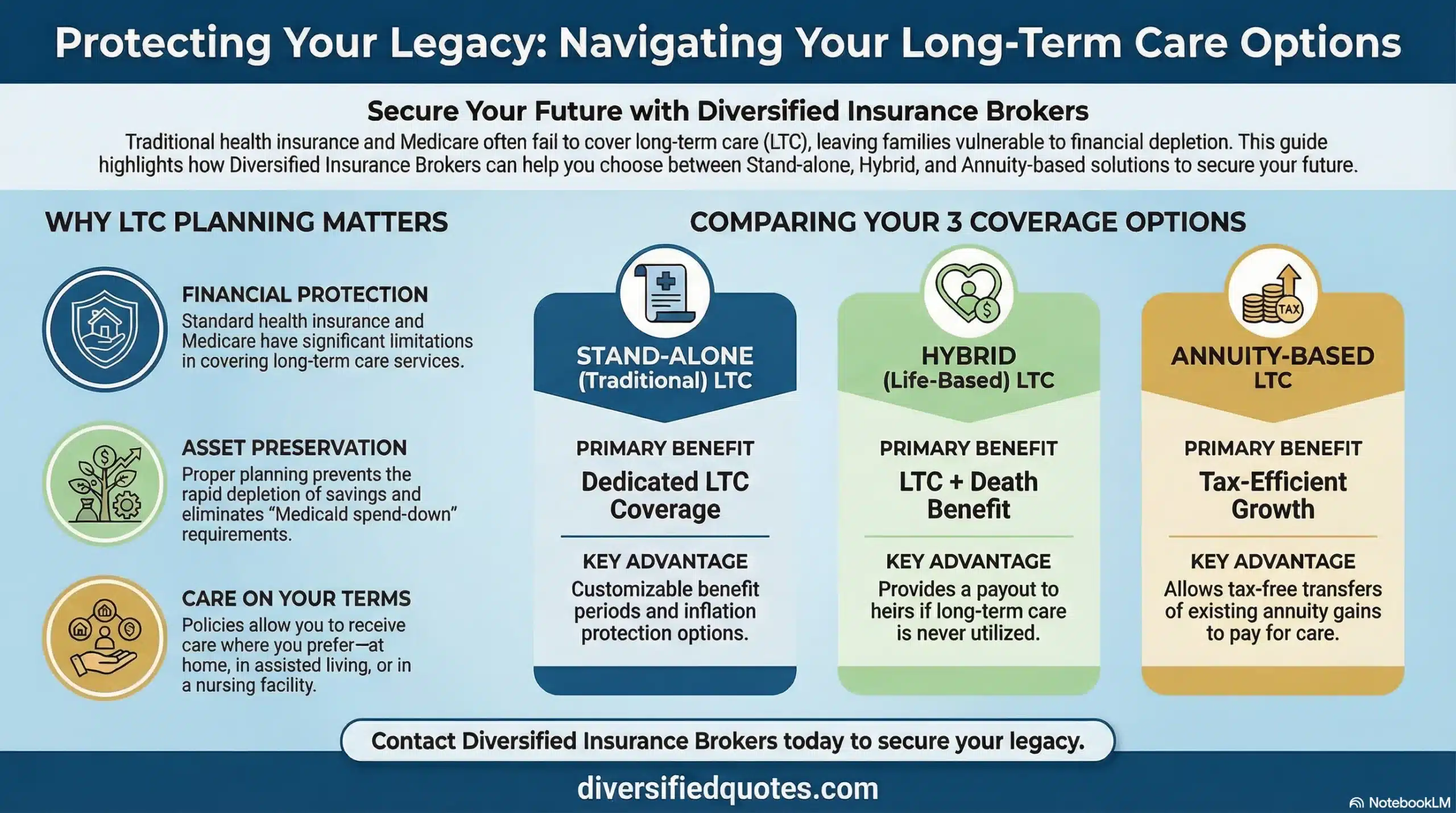
The landscape of long term care insurance after age 80 is narrower than it is for younger applicants, but it is not empty. The table below maps the primary available structures against eligibility ranges, underwriting requirements, and planning contexts to provide a reference framework for the most common situations we encounter at this age.
| Structure | Typical Max Issue Age | Underwriting Type | Asset Required | Care Benefit Structure | Best For |
|---|---|---|---|---|---|
| Traditional Standalone LTC Policy | 75–79 at most carriers; rare exceptions to 80 | Full medical underwriting | None (ongoing annual premiums) | Reimbursement pool; inflation option available | Ages 50–74; typically not available after 80 |
| PPA-Compliant Annuity With LTC Benefits (Non-Qualified) | Up to age 85–87 at select carriers | Simplified; ADL-focused | Existing non-qualified annuity or lump-sum cash (1035 exchange eligible) | 2x–3x benefit multiplier on deposit; care distributions tax-free on gain | Retirees holding non-qualified annuities with deferred gain; ages 80–87 |
| Hybrid Life/LTC Policy | Typically 75–80; some carriers to 80 | Simplified or full underwriting by carrier | Single premium or limited pay | LTC benefit pool + death benefit; leveraged from single premium | Ages 65–80 primarily; fewer options at 80+ but some carriers accommodate |
| Annuity With LTC or Nursing Home Rider | Varies by carrier; some to age 85 | Simplified | Single premium lump sum | Enhanced income if care needed; waiver of surrender charges in care facility | Retirees who want income annuity with care access features added |
| Self-Funded Care Reserve (No Insurance) | Available at any age | N/A | Dedicated liquid assets | Full asset liquidation at care cost; no leverage; taxable if from IRAs or deferred annuities | Very high net worth households ($3M+ liquid); anyone for whom asset repositioning is unavailable |
The table illustrates a critical planning insight for long term care insurance after age 80: the PPA-compliant annuity structure is the most consistently available and most financially compelling option for the large majority of retirees in this age range who hold non-qualified annuities or conservative savings. Our resources on annuities with long term care benefits and annuities with nursing home care riders cover the specific product mechanics in detail.
The Pension Protection Act Strategy: The Primary Vehicle for Long Term Care Insurance After Age 80
The Pension Protection Act of 2006 (PPA) created a specific federal tax framework that transformed the economics of long term care insurance after age 80 for retirees holding non-qualified annuities. Before the PPA, using a non-qualified annuity to pay for long term care was tax-inefficient: any gain in the contract was subject to ordinary income tax when distributed, regardless of whether the distribution was used for care. The PPA changed this for contracts that meet specific design requirements, creating a mechanism by which gain in a qualifying annuity can be distributed income-tax-free when used for qualified long term care insurance premiums or qualified long term care services.
The practical mechanics for long term care insurance after age 80 through a PPA-compliant annuity work as follows. A retiree holds a non-qualified deferred annuity with, for example, a $100,000 cost basis and $200,000 accumulated value — meaning $100,000 of deferred, untaxed gain. Rather than surrendering the annuity outright (which would trigger ordinary income tax on the $100,000 gain in a single year, potentially pushing income into higher marginal brackets and triggering additional Social Security taxation and Medicare IRMAA surcharges), the retiree executes a 1035 exchange — a tax-free transfer — into a PPA-compliant annuity designed with a long term care benefit component. Inside the new structure, the $200,000 deposit generates a benefit pool that may be two to three times the deposit amount for qualifying care events. When care is needed and distributions are made to pay for qualifying long term care services, the gain component that would have been taxable in a straight surrender is instead distributed income-tax-free because it is being used for qualified long term care purposes.
This single mechanism addresses the three most common concerns we hear from retirees exploring long term care insurance after age 80: the tax concern (“I don’t want to pay taxes on all that gain at once”), the cost concern (“I can’t afford large new annual premiums at this age”), and the access concern (“I thought it was too late to do anything”). The PPA strategy resolves all three simultaneously — it avoids the tax event, requires no new ongoing premium, and remains available for many applicants into their mid-to-late 80s. Understanding how tax-free long term care insurance distributions work under this structure, and how they compare to the taxable cost of self-funding through conventional annuity distributions, is the foundation of the long term care insurance after age 80 analysis. Our resource on the tax benefits of long term care insurance covers the PPA treatment and related tax advantages in detail.
How the Tax Picture Changes With Long Term Care Insurance After Age 80
The tax dimension of long term care insurance after age 80 through asset repositioning is often the most persuasive element of the planning conversation, because it quantifies a benefit that is concrete and immediate rather than speculative. Consider a specific illustration of how the tax comparison works for a typical applicant.
A retiree at age 82 holds a non-qualified deferred annuity with $300,000 of accumulated value and $120,000 of cost basis — meaning $180,000 of deferred gain. If this annuity is surrendered outright to fund care or meet expenses, the $180,000 gain is fully taxable as ordinary income in the year of surrender. Added to existing Social Security income and required minimum distributions from qualified accounts, this one-year income spike could push the retiree into a significantly higher marginal bracket, trigger the IRMAA surcharge that increases Medicare Part B and D premiums, and increase the percentage of Social Security benefits subject to federal income tax. Our resource on reducing taxes on Social Security covers how combined income affects Social Security taxation, and our resource on Medicare’s annual notice of change covers how income-based premium adjustments affect Medicare costs.
By contrast, a 1035 exchange of the same $300,000 annuity into a PPA-compliant long term care insurance after age 80 structure creates: no immediate taxable event (the exchange itself is tax-free), a benefit pool that may be $600,000 to $900,000 for qualifying care events (representing the carrier’s 2x to 3x multiplier), and future care distributions that are income-tax-free on the gain component as long as used for qualified long term care expenses. The retiree has converted a $180,000 pending tax liability into a leveraged care pool without triggering a single dollar of current-year income tax. Even for retirees who never need care, the residual contract value (typically the deposit plus any credited growth minus care distributions) passes to beneficiaries at death — with the gain component subject to ordinary income tax, but distributed over the beneficiary’s tax situation rather than compressed into a single year of the retiree’s income.
This before-and-after tax comparison is the core analysis that drives most long term care insurance after age 80 decisions. For retirees simultaneously evaluating what to do with existing retirement accounts, our resources on what to do with an IRA after retirement and what to do with a deferred compensation plan after retirement provide context for the broader asset distribution decision framework within which the long term care annuity repositioning sits.
Activities of Daily Living: What Underwriting Actually Evaluates for Long Term Care Insurance After Age 80
The underwriting evaluation for long term care insurance after age 80 through asset-based annuity structures is meaningfully different from traditional standalone LTC underwriting. Rather than reviewing extensive medical history, running prescription database checks, and applying complex health classification systems, PPA-compliant annuity underwriting for long term care insurance after age 80 focuses primarily on current functional independence — specifically, whether the applicant can currently perform the activities of daily living without assistance.
Activities of daily living (ADLs) are the six functions that define long term care benefit eligibility under most LTC insurance contracts: bathing, dressing, transferring (moving from bed to chair), toileting, continence, and eating. The standard qualifying trigger for most long term care insurance contracts — including PPA-compliant annuities — is inability to perform two or more ADLs without substantial assistance, or a severe cognitive impairment such as dementia. For underwriting purposes, the key question is whether the applicant is currently independent in these functions, because an applicant already unable to perform two or more ADLs without assistance is already in a qualifying care state and therefore not eligible for new coverage at any age. Our resource on what activities of daily living are covers the six ADLs and how they are evaluated in detail.
This functional independence focus means that for long term care insurance after age 80, the underwriting is not primarily about chronic diagnoses. A retiree at 83 who manages controlled hypertension, stable type 2 diabetes, and moderate arthritis but is fully functionally independent — drives their own vehicle, lives at home without assistance, manages their own medications, and performs all ADLs independently — is a meaningfully different underwriting picture than a retiree at 78 with fewer diagnoses who needs assistance with bathing and dressing. Functional status, not diagnosis count, drives eligibility for long term care insurance after age 80 through these structures.
Cognitive status is the second primary underwriting gate. Applicants showing signs of dementia, Alzheimer’s disease, or significant cognitive impairment are typically not eligible for new long term care insurance after age 80 coverage because the cognitive impairment itself constitutes a qualifying care trigger. The underwriting process may include cognitive screening questions or a brief cognitive assessment as part of the application evaluation. Applicants who are cognitively sharp but have chronic physical conditions are generally not disqualified by those physical conditions alone, as long as functional independence is maintained. Our resource on how to qualify for long term care insurance covers the qualification criteria in detail for both traditional and asset-based products.
Age Band Differences: How Long Term Care Insurance After Age 80 Changes at 80–82, 83–85, and 86–87
The availability and structure of long term care insurance after age 80 is not uniform across the decade. Carriers adjust product availability, benefit multipliers, maximum deposit amounts, and qualification requirements at specific age bands, and understanding these distinctions helps set accurate expectations and identify the most advantageous timing for repositioning.
Between ages 80 and 82, long term care insurance after age 80 through PPA-compliant annuity structures is most broadly available. The largest number of carriers offer products in this age range, benefit multipliers are often at their most favorable (2x to 3x the deposited amount in many structures), maximum eligible deposit amounts are highest, and the qualification process is most streamlined. Retirees in this age band who are functionally independent have the broadest set of options and the most leverage available from the repositioning strategy. If there is a decision to make about whether to pursue long term care insurance after age 80 and the applicant is currently in the 80 to 82 range, the strategic argument for acting sooner rather than later is clear — each year of waiting narrows the product set and reduces available benefit leverage.
Between ages 83 and 85, long term care insurance after age 80 options narrow somewhat but remain meaningful. Some carriers exit the market in this age band, benefit multipliers may be reduced (often to 1.5x to 2x in some structures), and maximum eligible deposit limits may decrease. However, for retirees with significant non-qualified annuity assets who are still functionally independent, the strategy remains viable and the tax advantages of the 1035 exchange remain as compelling as they are at younger ages within this bracket. Carrier selection at this age band requires more specific market knowledge — the pool of carriers with competitive products narrows, making independent broker access across multiple carriers more important than it is at any other point in the long term care insurance after age 80 spectrum.
Between ages 86 and 87, long term care insurance after age 80 options are most limited but not entirely absent. A small number of specialty carriers have products designed for this age band, though benefit leverage is typically reduced compared to earlier ages and maximum eligible deposit amounts are constrained. For retirees at 86 or 87 who are in excellent functional health and hold significant non-qualified annuity assets with large deferred gains, the strategy can still produce meaningful planning benefits — but the conversation requires working with an advisor who specifically knows which carriers are still active at this age band with competitive product designs.
Using Qualified IRA Assets for Long Term Care Insurance After Age 80
While the PPA strategy is most cleanly executed with non-qualified annuity assets, many retirees at 80 and beyond hold their primary savings in traditional IRAs or 401(k) accounts rather than in non-qualified annuities. The tax treatment of qualified assets used for long term care insurance after age 80 is different, and the planning conversation changes accordingly.
Qualified assets (IRA, 401(k), traditional annuities inside an IRA) do not benefit from the PPA tax-free distribution treatment in the same way as non-qualified annuities, because qualified distributions are fully taxable as ordinary income regardless of how they are used. There is no 1035 exchange mechanism for qualified assets equivalent to the one that exists for non-qualified annuities. A distribution from a traditional IRA used to purchase long term care insurance or to fund care is taxable regardless of the purpose.
However, there are still planning strategies worth considering for retirees whose primary assets are in qualified accounts. One approach is using qualified funds to purchase a qualified longevity annuity contract (QLAC) or other income structure that manages required minimum distributions while addressing income needs, then directing non-qualified assets toward the PPA-compliant care structure if any exist. For retirees with both qualified and non-qualified assets, the sequencing question — which assets to reposition first — is one of the most important planning decisions. Our resources on how to transfer an IRA to an annuity and what to do with an IRA after retirement cover the qualified asset landscape in detail. Our resource on annuity versus 401(k) strategies in retirement provides context for comparing retirement account structures. For retirees holding annuities with complex beneficiary arrangements, the annuity exclusion ratio resource explains how cost basis and gain are treated in distributions.
Self-Insuring Versus Asset Repositioning for Long Term Care Insurance After Age 80
The most common alternative to pursuing long term care insurance after age 80 is self-funding — simply maintaining liquid retirement assets and paying care costs from those assets as they arise. For a subset of the 80-and-older population, self-funding is a legitimate strategy. For many, it is a default born of inertia and the mistaken assumption that no options remain, rather than a deliberate choice made after comparing the self-funding and repositioning alternatives explicitly.
The case for self-funding long term care after age 80 is strongest for retirees with very high liquid net worth — typically $3 million or more in liquid assets — who have sufficient reserves to absorb multi-year extended care costs without materially impairing the surviving spouse’s financial security or legacy goals. For these households, the simplicity of self-funding may outweigh the benefits of repositioning. For everyone else, the self-funding calculus typically underestimates the financial exposure because it fails to account for three specific realities.
The first reality is care cost escalation. Care costs for assisted living, memory care, and skilled nursing have increased at rates exceeding general inflation for years. A plan that assumes today’s care costs remain flat for a 5-to-7-year care event will systematically underestimate the actual financial exposure of a care scenario. The second reality is tax efficiency. Self-funding care from non-qualified annuities or traditional IRAs triggers taxable income at the same time the household is managing large care expenses — a double financial burden that the PPA repositioning strategy eliminates for non-qualified annuity assets. The third reality is leverage. Self-funding provides exactly $1 of care benefit per $1 of assets spent. A PPA-compliant annuity structure for long term care insurance after age 80 provides $2 to $3 of care benefit per dollar repositioned through the carrier’s benefit multiplier — which means the same assets, repositioned correctly, create meaningfully more care protection.
The protect your nest egg resource covers the broader retirement asset protection framework within which this comparison sits, and our resource on the retirement income gap addresses how gaps between guaranteed income and care costs can be managed strategically.
Couples Planning Long Term Care Insurance After Age 80
When both spouses are at or near age 80, long term care insurance after age 80 planning becomes a coupled risk management exercise. The financial consequences of a long term care event affecting one spouse fall on the household — the care costs deplete assets that also need to fund the healthy spouse’s ongoing living expenses. This coupled risk is one of the most compelling reasons to evaluate long term care insurance after age 80 proactively rather than after one spouse has already entered a care state.
Some PPA-compliant annuity structures designed for long term care insurance after age 80 allow a spouse to be added to the contract or to share benefits from the same pool. This shared benefit feature — familiar from traditional LTC insurance contexts but now available in the annuity chassis at advanced ages — means that the same repositioned asset base can provide care protection for both spouses rather than creating two separate funding needs. For couples evaluating how to address both spouses’ care risk through a single coordinated strategy, our resource on shared benefit long term care insurance for couples covers how pooled benefit structures work and when they produce the most planning efficiency.
The sequence of care between spouses also matters for planning. If one spouse is significantly older, has greater health complexity, or is perceived as more likely to need care first, the initial planning priority may be to secure care protection for that spouse while the other remains healthy. The spousal care event is often the catalyst that prompts the surviving spouse to take action on long term care insurance after age 80 — unfortunately, this timing may be after the healthier spouse has also passed the age at which options are most available. Earlier action, when both spouses are still healthy and functionally independent, consistently produces more options, better leverage, and more favorable structures than action taken after a care event has already affected the household.
Medicare’s Role and Why Long Term Care Insurance After Age 80 Still Matters
Many retirees assume that Medicare will address their long term care needs after age 80 — an assumption that our resource on whether Medicare covers long term care addresses directly and thoroughly. Medicare covers short-term skilled nursing rehabilitation following a qualifying hospital stay, but it does not cover custodial care — the ongoing assistance with activities of daily living that constitutes the majority of what long term care events actually require. After Medicare’s 100-day skilled nursing benefit is exhausted, there is no government coverage of extended custodial care until and unless Medicaid qualification criteria are met through asset depletion.
For retirees at 80 and beyond who are weighing long term care insurance after age 80 against the assumption that Medicare will handle their care needs, the critical correction is understanding that Medicare’s care coverage is medically-focused and time-limited, while the long term care scenario most likely to occur is functionally-focused and potentially years in duration. The gap between what Medicare provides and what an extended care event actually costs is the gap that long term care insurance after age 80 through the strategies described here is designed to fill. Our resource on Medicare planning services covers the full Medicare coverage landscape, including how Medigap and Medicare Advantage interact with skilled nursing facility benefits.
Asset Diversification and Laddering in Long Term Care Insurance After Age 80 Planning
Many retirees approaching long term care insurance after age 80 planning are simultaneously managing multiple annuity contracts, various savings accounts, and income streams from Social Security and other sources. The integration of long term care insurance after age 80 into the existing asset landscape involves decisions about which assets to reposition, which to maintain for income, and how to structure the overall portfolio for both income stability and care coverage.
A strategy many retirees find useful is segmenting assets by purpose rather than managing them as a single undifferentiated pool. One segment serves ongoing income needs — perhaps a deferred annuity that continues to accumulate or an immediate annuity providing guaranteed monthly income. A second segment serves liquidity needs — accessible savings that do not require surrender or distribution decisions for normal expenses. A third segment, designated specifically for long term care insurance after age 80, holds the non-qualified annuity or cash that will be repositioned into the PPA-compliant care structure.
This segmentation clarity prevents the most common self-funding planning failure: the belief that “all assets are available for care” without recognizing that care expenditures from taxable sources during high-cost care events create tax compounding that erodes purchasing power. Our resource on laddering annuities covers how segmented annuity structures can serve multiple planning purposes simultaneously, and our coverage of best fixed annuities for conservative investors addresses the accumulation side of the equation for retirees evaluating what to do with conservative savings that have not yet been committed to a specific purpose.
International Considerations for Long Term Care Insurance After Age 80
An increasing number of retirees at 80 and beyond are considering international retirement or have family members in other countries who may provide informal care. Long term care insurance after age 80 planning for these individuals involves an additional dimension: whether care received outside the United States qualifies for benefits under the LTC insurance structure. Traditional standalone LTC policies almost universally limit benefits to care received within the United States or have specific international exclusions. PPA-compliant annuity structures may have different geographic benefit parameters depending on the specific carrier and contract design. Our resource on whether long term care insurance benefits can be used overseas addresses this dimension specifically and should be reviewed by any applicant planning for international care scenarios.
How to Evaluate Long Term Care Insurance After Age 80: The Planning Process
The planning process for long term care insurance after age 80 is more specific than the general LTC planning process for younger applicants, because the product set is narrower, the tax analysis is more central, and the window for taking action is shorter. A useful evaluation framework involves five sequential questions.
First, what assets are available for repositioning? The PPA strategy works most cleanly with non-qualified annuities holding meaningful deferred gain. Identifying the size of the potential tax liability that the 1035 exchange could avoid is the starting point for quantifying the financial benefit of the strategy. Second, what is the current functional status? Both spouses should honestly assess ADL independence and cognitive status, because the underwriting gate for long term care insurance after age 80 is functional rather than medical. Third, which age band applies, and what benefit leverage is available at current age? This question requires current carrier-by-carrier comparison, because product designs and multipliers change regularly. Fourth, how does the after-repositioning care pool compare to realistic care costs in the likely geographic market? Local care costs, projected forward with inflation, determine whether the repositioned pool adequately addresses the planning need. Fifth, how does this strategy integrate with the overall retirement income and estate plan?
For retirees who have already received a quote for long term care insurance after age 80 and want an independent verification that it represents the most competitive available option, our second opinion on long term care insurance quotes service provides exactly that assessment. Our resource on affordable long term care insurance for retirees covers the broader pricing landscape, and our overview of best long term care insurance rates covers how to compare options across carriers.
Find Your Long Term Care Insurance After Age 80 Options
We evaluate your health status, existing assets, deferred gain picture, and age band to identify the most compelling long term care insurance after age 80 strategy available for your situation.
Request a Long Term Care ReviewRelated Long Term Care and Retirement Planning Pages
Explore the strategies and resources most relevant to long term care insurance after age 80 planning.
Financial Protection Essentials
Coordinate long term care insurance after age 80 with Social Security, Medicare, annuity income, and retirement asset management.
Talk With an Advisor Today
Choose how you’d like to connect—call or message us, then book a time that works for you.
Schedule here:
calendly.com/jason-dibcompanies/diversified-quotes
Licensed in all 50 states • Fiduciary, family-owned since 1980
Frequently Asked Questions: Long Term Care Insurance After Age 80
Is long term care insurance after age 80 really still available?
Yes — but through a different structure than traditional standalone LTC policies, which most carriers stop issuing between ages 75 and 79. The primary vehicle for long term care insurance after age 80 is a Pension Protection Act compliant annuity that repositions existing non-qualified annuity assets or conservative savings into a structure that multiplies available care benefits and distributes qualifying care expenses income-tax-free on the gain component. These structures are available at select carriers into the mid-to-late 80s for individuals who are still functionally independent — able to perform all activities of daily living without assistance and without significant cognitive impairment.
The most important planning insight is that the window for long term care insurance after age 80 narrows with each passing year, and benefit leverage and available options are most favorable between ages 80 and 82. Retirees who are currently in their early 80s and still healthy have the most options available — waiting until the mid-to-late 80s reduces available product choices and benefit multipliers significantly.
How does the Pension Protection Act (PPA) strategy work for long term care insurance after age 80?
The Pension Protection Act created a federal tax mechanism allowing gain in a non-qualified annuity to be transferred via 1035 exchange into a qualifying long term care annuity and subsequently distributed income-tax-free when used for qualifying long term care expenses. The practical benefit for long term care insurance after age 80 applicants who hold non-qualified deferred annuities with significant accumulated gain is substantial: rather than surrendering the annuity and paying ordinary income tax on decades of deferred gain in a single year, the retiree executes a tax-free 1035 exchange into the care-focused structure and creates a benefit pool that is 2 to 3 times the deposited amount for qualifying care events, with the gain component available tax-free for care distributions.
This strategy simultaneously eliminates a potential large single-year tax event, creates leveraged care benefits through the carrier’s multiplier, and avoids triggering Social Security income taxation increases and Medicare IRMAA premium surcharges that an outright surrender would cause. Our resource on tax-free long term care insurance covers the PPA distribution treatment in detail.
What does underwriting look at for long term care insurance after age 80?
Underwriting for long term care insurance after age 80 through asset-based annuity structures focuses primarily on current functional independence rather than extensive medical history. The key evaluation is whether the applicant can currently perform all six activities of daily living — bathing, dressing, transferring, toileting, continence, and eating — without substantial assistance, and whether there is significant cognitive impairment such as dementia. An applicant who already cannot perform two or more ADLs without assistance is already in a qualifying care state and not eligible for new coverage.
This functional independence focus means that many chronic conditions — controlled hypertension, managed diabetes, stable heart conditions — do not automatically disqualify applicants for long term care insurance after age 80, as long as the applicant remains fully functionally independent and cognitively intact. The underwriting is simpler and more streamlined than traditional LTC underwriting, which is appropriate for the asset-based structure where the applicant is repositioning existing assets rather than committing to ongoing annual premiums.
Can I use an existing annuity to fund long term care insurance after age 80?
Yes. This is the most common and most efficient path to long term care insurance after age 80 for retirees who hold non-qualified deferred annuities. The 1035 exchange transfers the existing annuity value into the new PPA-compliant structure without triggering immediate taxation. The gain component that would have been taxable in a straight surrender is preserved inside the new structure, available for income-tax-free distribution when used for qualified long term care expenses. The new structure also provides the carrier’s benefit multiplier, which creates a care pool larger than the deposited amount.
For retirees holding multiple annuities, the asset with the largest deferred gain typically represents the most compelling repositioning candidate, because the tax benefit from avoiding gain recognition is largest for the highest-gain contract. Our resource on best fixed annuities for conservative investors covers the accumulation context from which many repositioning decisions originate.
What happens to the money if I never need long term care after age 80?
Most PPA-compliant annuity structures designed for long term care insurance after age 80 include a residual value feature: if care is never needed, the remaining contract value (typically the original deposit plus credited growth, less any care distributions) passes to named beneficiaries at death. The gain component is subject to ordinary income tax at the beneficiary’s rate when distributed — but the tax is spread over the beneficiary’s situation rather than being compressed into a single year of the original owner’s income. The combination of leveraged care protection and residual death benefit is one of the features that makes these structures attractive compared to traditional standalone LTC insurance, where unused premiums are not returned if care is never needed.
How does this strategy affect Social Security taxation and Medicare premiums?
This is one of the most compelling dimensions of the long term care insurance after age 80 repositioning strategy. An outright surrender of a non-qualified annuity with significant deferred gain creates a large ordinary income event in a single year — which can push combined income above thresholds that increase the taxable percentage of Social Security benefits and trigger IRMAA surcharges that increase Medicare Part B and Part D premiums for the following two years. A 1035 exchange into the PPA-compliant structure creates no current-year taxable income, preserving the retiree’s income-based thresholds and avoiding these cascading effects entirely. Our resources on reducing taxes on Social Security and Medicare premium brackets provide the specific threshold calculations relevant to this planning dimension.
Can qualified IRA money be used for long term care insurance after age 80?
Qualified assets such as traditional IRA or 401(k) funds can be used to purchase annuities or fund care, but the tax treatment is different from non-qualified annuities. Qualified distributions are fully taxable as ordinary income regardless of purpose — there is no equivalent to the PPA tax-free distribution treatment for care expenses paid from qualified funds. The most efficient repositioning strategy for long term care insurance after age 80 prioritizes non-qualified annuity assets over qualified assets when both are available. For retirees whose primary assets are in qualified accounts, the strategy conversation involves which accounts to draw from in what sequence, with qualified assets typically managed separately from the care-focused repositioning analysis. Our resource on how to transfer an IRA to an annuity clarifies the distinct rules governing qualified fund repositioning.
How does long term care insurance after age 80 fit with Medicare coverage?
Medicare provides limited short-term skilled nursing rehabilitation following a qualifying hospital stay — up to 100 days, with significant daily coinsurance from days 21 to 100 — but it does not cover extended custodial care. The ongoing assistance with activities of daily living that constitutes the majority of a long term care event is not covered by Medicare at any duration beyond the initial skilled nursing benefit. After Medicare’s short-term benefit is exhausted, costs must be paid from private resources until and unless Medicaid asset qualification is reached. Long term care insurance after age 80 through the annuity-based strategies described here is specifically designed to fill this gap — providing a defined care pool that covers the custodial care costs that Medicare does not. Our resource on whether Medicare covers long term care covers the specific coverage limits in precise detail.
About the Author:
Jason Stolz, CLTC, CRPC, DIA, CAA and Chief Underwriter at Diversified Insurance Brokers (NPN 20471358), is a senior insurance and retirement professional with more than 25 years of real-world experience helping individuals, families, and business owners protect their income, assets, and long-term financial stability. As a long-time partner of the nationally licensed independent agency Diversified Insurance Brokers, Jason provides trusted guidance across multiple specialties—including fixed and indexed annuities, long-term care planning, personal and business disability insurance, life insurance solutions, Group Health, Travel Medical and Evacuation Insurance, and short-term health coverage. Diversified Insurance Brokers maintains active contracts with over 100 highly rated insurance carriers, ensuring clients have access to a broad and competitive marketplace.
His practical, education-first approach has earned recognition in publications such as VoyageATL, and contributions from his agency featured in Kiplinger and GoBankingRates— highlighting his commitment to financial clarity and client-focused planning. Drawing on deep product knowledge and years of hands-on field experience, Jason helps clients evaluate carriers, compare strategies, and build retirement and protection plans that are both secure and cost-efficient. Visitors who want to explore current annuity rates and compare options across multiple insurers can also use this annuity quote and comparison tool.
Explore More Long Term Care Insurance Options: Browse our complete guide to Tax, Medicare & Special Situations — covering tax advantages, Medicare vs LTC, seniors, couples, diabetics & age-specific coverage from top carriers.
Last Reviewed: May 23, 2026 |
Reviewed by: Jason Stolz, CLTC, CRPC, DIA, CAA
Chief Underwriter, Diversified Insurance Brokers, Inc. | NPN: 20471358 | Diversified Insurance Brokers, Inc. — Licensed in all 50 states
Fact Checked by: Tonia Pettitt, CMIP©
Medicare Specialist, Diversified Insurance Brokers, Inc. | NPN: 14374308 | Diversified Insurance Brokers, Inc. — Licensed in all 50 states
Did you find this content helpful? Leave us a Google review — it helps others find trustworthy guidance too.
Editorial Standards: Diversified Insurance Brokers maintains rigorous editorial standards to ensure accuracy, clarity, and independence in all content. Learn more about our editorial standards and commitment to transparency.
