
Should You Buy Long Term Care Insurance
As an Independent Long Term Care Insurance Broker, we compare traditional, hybrid, and partnership-qualified policies across dozens of carriers to find the structure that actually fits your situation.
Should You Buy Long Term Care Insurance

Jason Stolz CLTC, CRPC, DIA, CAA
Whether you should buy long term care insurance is one of the most consequential planning decisions in retirement, and one of the most frequently deferred until it is too late to make it optimally. The decision to buy long term care insurance involves more variables than most retirement financial decisions — cost of care in your region, your health history and family longevity, your asset base and income sources, your available support network, and the specific product structures available to you at your current age and health classification. Answering “should you buy long term care insurance?” correctly requires evaluating all of these dimensions together, not in isolation, and not with a predetermined answer driven by premium reluctance or product enthusiasm.
At Diversified Insurance Brokers, we help individuals and couples work through the long term care insurance decision honestly — which means acknowledging when coverage makes clear financial sense, when self-funding is a legitimate strategy, and when a hybrid or asset-based approach provides the best of both. We work with more than 75 carriers offering traditional long term care insurance, hybrid life/LTC policies, and annuity-based LTC structures, and our role is to provide the information and comparison tools needed to make the decision with clarity rather than anxiety. Our resource on LTC insurance costs, rates, and planning covers the pricing landscape in detail, and our overview of long term care insurance services provides the broader framework within which this decision sits.
The practical planning questions for whether you should buy long term care insurance reduce to four core issues. First, what is the realistic financial exposure from a long term care event given current care costs in your area, your likely care setting preferences, and your family’s health history? Second, how does that exposure compare to your available financial resources — your retirement income, liquid assets, and the portion of those assets you are prepared to commit to care without disrupting other household goals? Third, what product structure — traditional LTC, hybrid life/LTC, or annuity-based LTC — best matches your financial profile, health history, and planning preferences? Fourth, when is the right time to act, given that underwriting outcomes and pricing are directly tied to age and health at application? The sections below address each of these questions with the depth needed for a genuine planning decision. Our resource on the tax benefits of long term care insurance and our coverage of shared benefit LTC plans for couples provide additional depth on specific dimensions of the decision.
Compare Long Term Care Insurance Strategies
We compare traditional LTC, hybrid life/LTC, and asset-based solutions side by side — using your age, health profile, and retirement goals.
Request LTC Planning OptionsWhy the Long Term Care Insurance Decision Is Different From Other Insurance Decisions
Most insurance decisions involve protecting against a low-probability, high-severity event — the family home burning down, a serious auto accident, or premature death. Long term care insurance is different in a critical way: the probability of needing some form of extended care during retirement is not low. Estimates from the U.S. Department of Health and Human Services have consistently indicated that a substantial majority of people who reach age 65 will need some level of long term care during their lifetime. The question is not whether care will eventually be needed for most people, but what form it will take, how long it will last, and how expensive it will be in your specific geographic market and preferred care setting.
This statistical reality changes the nature of the decision. With most insurance, you are paying to transfer the financial consequences of an unlikely event. With long term care insurance, you are often paying to transfer the financial consequences of a likely event — one where the timing and duration are uncertain, but the probability over a long retirement horizon is meaningful. That probability-adjusted framing changes the cost-benefit analysis significantly. The question shifts from “should I pay to protect against something that probably won’t happen” to “should I fund this likely expense through insurance, self-funding, or some combination, and which approach preserves retirement security most effectively?”
The financial impact also differs from most other insurable risks. Market volatility in retirement accounts can often recover over time. Inflation erodes purchasing power gradually and predictably. Long term care costs, by contrast, create immediate and ongoing cash flow demands that can last for multiple years — and those demands tend to grow as care needs escalate. A retiree who needed $3,000 per month for in-home care in year one of a care event may need $7,000 per month for memory care in year three and $10,000 per month for skilled nursing by year five. The compounding cost trajectory of a serious care event is one of the most underestimated financial risks in retirement planning.
Long Term Care Funding Options: A Scenario-by-Scenario Reference
Before deciding whether to buy long term care insurance, understanding how different funding strategies perform across different care scenarios — in terms of cost, control, family impact, and asset preservation — provides the clearest analytical framework. The table below maps the most common funding strategies against the key dimensions that matter for retirement planning decisions.
| Funding Strategy | How It Works | Asset Protection | Care Choice Control | Family Burden | Best Fit Profile |
|---|---|---|---|---|---|
| Traditional LTC Insurance | Ongoing premiums fund a benefit pool paid when qualifying care is needed | Strong — transfers care cost risk to carrier | High — benefits usable at home, assisted living, or skilled nursing | Low — defined plan reduces emergency decision-making | Ages 50–65 with ongoing premium budget and insurable health |
| Hybrid Life/LTC Policy | Single or limited-pay premium funds both a life insurance death benefit and an LTC benefit pool | Strong — either LTC benefits or death benefit are paid; no “lost premium” scenario | High — similar to traditional LTC for benefit usage | Low to moderate | Retirees with lump sum assets who want guaranteed value regardless of care use |
| Annuity With LTC Rider | Annuity contract enhanced with LTC benefit multiplier if care is needed; base income continues regardless | Moderate to strong — annuity value preserved; LTC rider multiplies benefit | Moderate — benefit tied to annuity structure | Low to moderate | Retirees wanting both income and care protection in a single product |
| Self-Funding | Pay care costs from retirement savings, investments, and income as they arise | Weak for extended care — assets can be depleted rapidly | High — no carrier approval required for care choices | High — family manages finances and care decisions simultaneously | Very high-net-worth households with $3M+ in liquid assets |
| Medicaid (Spend-Down) | Government assistance after assets are depleted to qualification levels; covers skilled nursing only | None — requires asset depletion to qualify | Very low — limited to Medicaid-accepting facilities only | High — family oversees Medicaid planning and facility placement | Very low-asset households with no alternative funding sources |
| Family Caregiving | Spouse or adult children provide care without formal professional services | Variable — reduces direct care costs but creates caregiver economic losses | High informally — but limited by caregiver capacity | Very high — creates economic, physical, and emotional burden on family | Not a plan — an unplanned fallback |
The table above makes clear that the most meaningful distinction across funding strategies is not simply premium cost — it is the combination of asset protection, care choice control, and family burden. Long term care insurance consistently outperforms self-funding and family caregiving on the dimensions that most directly affect retirement security and family quality of life during a care event. Our deeper resources on affordable hybrid long term care policies and annuities with long term care benefits provide detailed product comparisons within the insurance and hybrid categories.
Why Medicare Does Not Answer the Long Term Care Insurance Question
The most consequential misconception in long term care planning is the belief that Medicare will cover extended care needs. This misunderstanding is widespread and understandable — Medicare is a robust health insurance program that most retirees rely on for medical expenses, and it does cover some short-term skilled nursing and rehabilitation. But Medicare was designed to cover medical treatment, not custodial care, and this distinction is the heart of the long term care funding gap that makes the question of whether to buy long term care insurance so important.
Medicare will cover a limited stay in a skilled nursing facility following a qualifying hospital stay of at least three days — but only for care that is medically necessary and actively rehabilitative. Coverage for the first 20 days is fully paid; days 21 through 100 require a significant daily coinsurance payment. Beyond 100 days, Medicare coverage ends entirely. Once a patient’s condition stabilizes and transitions from active rehabilitation to maintenance — what is called custodial care — Medicare coverage stops, regardless of whether the patient still needs assistance with daily activities. The definition of custodial care is broad: needing help with bathing, dressing, eating, toileting, transferring, or managing continence qualifies. These are exactly the needs that define a long term care event, and they are exactly what Medicare does not cover on an extended basis.
Traditional health insurance under Medicare Advantage or Medigap supplement plans follows the same fundamental limitation — these products are designed to supplement Medicare’s medical coverage, not to replace the custodial care coverage that Medicare never provided. Many retirees who explore whether Medicare covers long term care in detail are surprised by the clarity of the limitation once it is explained specifically. And the Medicaid alternative — which does cover long term care on an extended basis — requires asset depletion to qualify in most states, which represents an outcome most middle-income households consider unacceptable as a planning strategy. Should you buy long term care insurance? For the large majority of households with retirement assets worth protecting, the answer begins with understanding that Medicare does not provide the protection they assume it does.
Who Should Buy Long Term Care Insurance: The Profiles Where Coverage Makes Clear Sense
Should you buy long term care insurance is not a question with one universal answer — but there are household profiles where the case for purchasing coverage is consistently strong, and profiles where alternative strategies may be more appropriate. Understanding which profile applies to your household is the most efficient starting point for the decision.
Middle-Asset Households With Assets Worth Protecting
The clearest case for why you should buy long term care insurance is a household with retirement assets in the range of $250,000 to $2,000,000. These households have enough saved to fund a comfortable retirement when care costs are not a factor — but not enough to absorb years of extended professional care without significantly depleting the retirement portfolio. For a household with $600,000 in retirement savings and $4,000 per month in income from Social Security and pension, a care event costing $8,000 per month for 36 months represents a $144,000 direct drain on savings — before accounting for investment returns forgone on funds withdrawn during a volatile market period. Long term care insurance transfers that financial exposure to the carrier for a fraction of the potential cost.
This middle-asset household profile is where long term care insurance provides the most leverage — where the benefit pool is meaningful relative to the household’s ability to absorb the cost independently, and where asset preservation serves real retirement security goals rather than abstract wealth protection. Our resource on affordable long term care insurance for retirees covers how coverage is structured and priced for households in this profile.
Couples Who Want to Protect Both Partners
Married couples face a compounded long term care risk that single individuals do not. If one spouse requires extended professional care, the cost of that care must be paid from household assets that also need to fund the healthy spouse’s ongoing living expenses. The depleting effect of a care event on one spouse’s health can directly undermine the other spouse’s financial security. Long term care insurance — particularly shared-benefit policies for couples that allow benefit pools to be shared between spouses — directly addresses this compounded risk. Couples who should buy long term care insurance frequently cite the desire to protect the healthy spouse’s financial security as the primary motivation for coverage.
Individuals With Strong Family History of Longevity or Cognitive Decline
Family health history is one of the most predictive indicators of long term care need. Individuals with parents or siblings who required extended memory care, experienced prolonged mobility limitations, or lived into their 90s have a statistically elevated probability of facing similar care needs. For these individuals, the question of whether to buy long term care insurance is informed by concrete family precedent rather than abstract actuarial statistics. The cost of the premiums, evaluated against a concrete family care history, often produces a clear answer in favor of coverage.
Individuals in Their 50s Who Are Currently Insurable
The window in which long term care insurance can be purchased with favorable underwriting outcomes and manageable premiums is not unlimited. Premiums for long term care insurance increase with age, health underwriting tightens as chronic conditions develop, and some applicants who wait until their mid-60s find their options significantly narrowed or their premiums substantially higher than they would have been a decade earlier. Individuals currently in their 50s who are in reasonably good health are in the most favorable position to purchase long term care insurance, and the decision to defer often costs more than the immediate premium commitment would suggest. Our resource on how to qualify for long term care insurance covers what underwriters evaluate so applicants can assess their qualification prospects before applying.
Who May Not Need to Buy Long Term Care Insurance
An honest answer to whether you should buy long term care insurance must also acknowledge the household profiles where coverage may be less necessary or where alternative strategies are more appropriate. The decision framework is not complete without this side of the analysis.
Very high-net-worth households — those with liquid assets exceeding $3 million to $4 million — often have the financial capacity to self-fund extended care without materially disrupting the retirement plan of the surviving spouse or depleting legacy assets. For these households, the premium cost of long term care insurance may represent an inefficient use of capital relative to simply maintaining the assets to pay care costs if and when they arise. The self-funding strategy works for these households because the asset base is deep enough that even multi-year care events do not create financial crisis. Protecting the nest egg through strategies like those outlined in our protect your nest egg resource remains important even for high-net-worth households, but the specific instrument used for care risk management may differ.
Very low-asset households — those with limited retirement savings who would qualify for Medicaid relatively quickly even without long term care insurance — may find that the premium cost of traditional LTC insurance is not justified given that their likely care funding pathway is Medicaid regardless. For these households, other protective strategies may be more appropriate. This is a profile where the decision genuinely depends on the specific numbers, and working through the analysis with a knowledgeable advisor produces more useful guidance than a general rule.
Individuals with serious current health conditions may find that traditional long term care insurance is unavailable to them or only available at rates that are economically unfavorable. In these cases, hybrid structures — particularly annuity-based LTC products that have simpler underwriting requirements — may provide an accessible path to some level of care coverage. Our resource on annuities with nursing home care riders covers products specifically designed for individuals who face traditional LTC underwriting challenges.
When Should You Buy Long Term Care Insurance: The Timing Question
If the analysis supports purchasing long term care insurance, the timing question is the next critical decision. The optimal window for most applicants is between ages 50 and 65 — a range that balances the premium efficiency of purchasing at younger ages, the underwriting favorability of applying before common health changes develop, and the relevance of coverage given the likely timeframe before care needs emerge.
The premium advantage of purchasing earlier within this window is real and compounding. A 55-year-old purchasing a traditional long term care insurance policy will pay a lower annual premium than a 60-year-old purchasing identical coverage, and the premium differential between those ages is often more meaningful than people expect. Over a 20-year holding period before care need, the cumulative premium savings from earlier purchase can be substantial. However, purchasing at 50 creates a long premium-paying period before care needs are likely to arise, and the premium dollars represent committed capital throughout that period. Most advisors find the mid-50s to early-60s range to be the sweet spot for most applicants — early enough for favorable underwriting and pricing, late enough that the coverage is relevant within a realistic planning timeframe.
The most common reason the timing question becomes urgent is a health event that changes underwriting prospects. Many applicants who call us about long term care insurance are doing so because a parent or sibling recently experienced a care event that made the issue concrete — or because they recently received a health diagnosis that prompted urgency about securing coverage before their insurability diminishes. Should you buy long term care insurance while you can still qualify is a different question than should you buy it in principle, and the answer is often yes even for households where the abstract cost-benefit analysis is close to the margin.
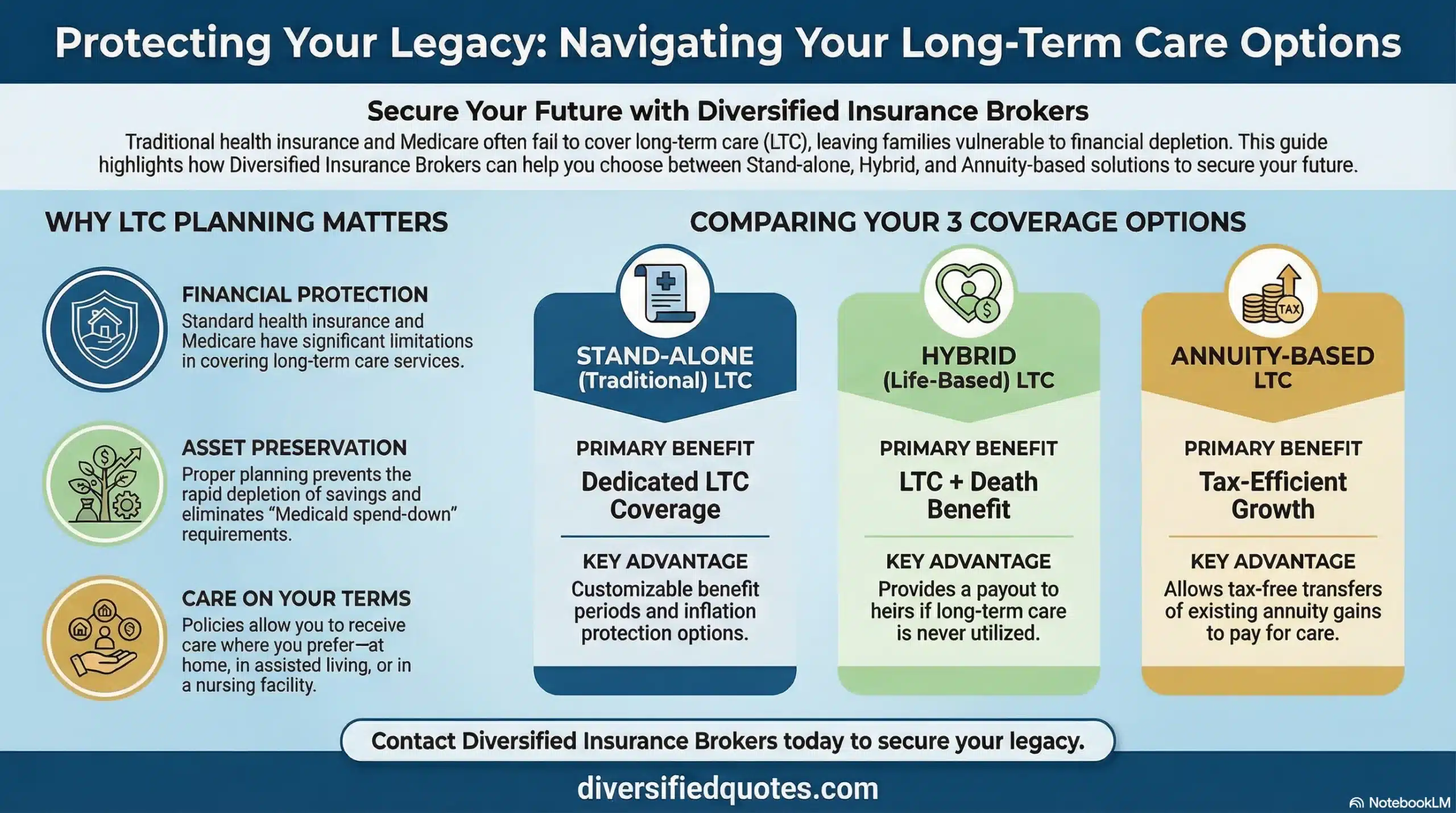
Traditional Versus Hybrid Long Term Care Insurance: How to Choose
Once the decision to buy long term care insurance is made, the second major question is which product structure fits the household’s financial profile and planning priorities. The landscape has expanded significantly over the past decade, and the right choice depends on premium budget structure, asset availability, concern about the “lost premium” scenario, and how care coverage integrates with life insurance and retirement income goals.
Traditional Long Term Care Insurance
Traditional long term care insurance provides dedicated care benefits funded through ongoing premium payments. The policyholder selects a daily or monthly benefit amount, an elimination period (the waiting period before benefits begin, typically 30, 60, or 90 days), a benefit period (the maximum duration benefits will be paid — commonly two years, three years, or lifetime), and an inflation protection option. If the policyholder never needs care, premiums are not returned — this is the “use it or lose it” feature that some households find psychologically difficult despite the genuine financial protection the coverage provides.
Traditional long term care insurance typically provides the most benefit per premium dollar for households that use the coverage, because the entire premium goes toward funding the care benefit rather than also funding a life insurance death benefit. For households that want maximum care benefit per dollar of premium and who are comfortable with the traditional insurance model — paying for protection that may never be used in exchange for protection if it is — traditional LTC is often the most cost-efficient structure. Our resource on the tax benefits of long term care insurance covers how traditional LTC premiums may be tax-deductible and how benefits are typically received tax-free, which improves the effective value of the coverage.
Hybrid Life/LTC Policies
Hybrid long term care insurance policies combine a life insurance death benefit with a long term care benefit pool in a single product, typically funded through a single premium or a limited-pay structure (7, 10, or 20 annual payments). The hybrid structure eliminates the “lost premium” concern: if the policyholder uses the long term care benefits, the care expenses are funded by the policy; if the policyholder never needs care, the full death benefit or a portion of it passes to beneficiaries. In either scenario, the premium commitment produces value — there is no scenario where premiums are paid for decades with no financial return.
This guaranteed-value structure is the primary reason hybrid policies have grown significantly in market share relative to traditional LTC insurance. Many households that are reluctant to commit to traditional LTC premiums — because of the possibility that they will never use the benefits — are comfortable committing to a hybrid premium because the money is not “lost” if care is never needed. The trade-off is that the care benefit per dollar of premium is typically lower with a hybrid than with a comparable traditional policy. The affordable hybrid long term care policies resource covers current product options and explains how the hybrid benefit structure works in practice.
Annuity-Based Long Term Care Solutions
Annuity products with long term care riders represent a third category that combines retirement income security with care cost protection in a single structure. Some annuities with LTC riders double or triple the available monthly benefit if the annuity owner qualifies for long term care benefits — providing enhanced income precisely when care costs are highest, while continuing to pay the base annuity income regardless of care status. Our resources on annuities with long term care benefits and annuities with nursing home care riders cover how these products work and for whom they are most appropriate. For retirees who want to understand the tax treatment of LTC benefits distributed from annuity products, our resource on tax-free long term care insurance covers the relevant rules in detail.
How Much Long Term Care Insurance Coverage Is Enough
Determining how much long term care insurance coverage to purchase requires understanding care costs in your likely geographic market, your preferences for care setting, and how much of your care expenses you want the policy to cover versus self-funding. Coverage needs vary substantially by household — and the right answer is not always maximum coverage.
Care costs vary significantly by geography. Skilled nursing facility costs in metropolitan Northeast markets frequently exceed $12,000 per month, while comparable care in rural Midwest markets may cost $6,000 to $7,000 per month. Assisted living rates follow similar geographic patterns. Home care costs vary with the hours of assistance needed, the nature of the tasks required, and local labor market conditions. Any coverage analysis should start with current care costs in your specific market, projected forward with realistic inflation assumptions, rather than relying on national averages that may not reflect your planning reality.
Many households choose to buy long term care insurance designed to cover the cost differential between what their retirement income can support and the full cost of professional care — rather than purchasing coverage designed to pay the entire cost of care. A retiree with $4,000 per month in guaranteed income from Social Security and pension might purchase a $5,000-per-month LTC benefit rather than an $8,000-per-month benefit, planning to supplement insurance income with retirement account withdrawals for the additional $3,000 per month. This partial-coverage approach reduces the premium commitment while still protecting the core retirement portfolio from catastrophic depletion. Understanding how retirement income tools like deferred annuities and fixed indexed annuities provide reliable income floors helps retirees size their LTC benefit appropriately relative to their guaranteed income base. Our resource on lifetime income planning covers how these income structures coordinate with long term care planning.
Inflation Protection and Why It Matters for Long Term Care Insurance
Inflation protection is one of the most important and most frequently undervalued features in long term care insurance. Care costs have historically increased faster than general consumer price inflation — at an average rate that meaningfully exceeds CPI over multi-decade periods. A policy purchased at age 55 that provides $6,000 per month in benefits at current care costs may cover only a fraction of those same care expenses at age 80 if the benefit is not adjusted upward over the intervening 25 years.
The most common inflation protection options in traditional long term care insurance are simple inflation (a fixed percentage increase in benefits each year) and compound inflation (a percentage increase applied to the growing benefit balance, which accelerates value accumulation over time). Compound inflation protection produces substantially more benefit growth over long periods and is generally considered the superior option for applicants in their 50s who may be 25 to 35 years from likely care need. The premium difference between simple and compound inflation protection is real, but for younger applicants with long horizons, the compound growth often justifies the additional cost.
For applicants in their early to mid-60s with shorter expected horizons to care need, the premium differential may make simple inflation or even a fixed-benefit policy a more appropriate trade-off. The inflation analysis is specific to each applicant’s age, the term of coverage before expected use, and the projected care cost trajectory in the applicant’s geographic market. Working through this specific analysis — rather than accepting a generic recommendation — is one of the most important planning conversations we have with clients who are deciding whether to buy long term care insurance and at what benefit level.
Tax Advantages of Long Term Care Insurance in Retirement Planning
Long term care insurance offers several tax advantages that improve its value relative to self-funding through taxable retirement account distributions. Understanding these tax benefits is particularly important for retirees who are already managing the tax efficiency of retirement income across Social Security, required minimum distributions, and investment income.
Benefits paid from a tax-qualified long term care insurance policy are generally received income-tax-free. This means that when the policy pays $8,000 per month for care expenses, the entire $8,000 is available for care without any federal income tax obligation — unlike retirement account distributions, which are fully taxable when withdrawn. For a retiree in a combined 25% marginal rate, self-funding $8,000 per month from an IRA requires withdrawing approximately $10,667 per month to net the same $8,000 after tax. Long term care insurance benefits avoid this gross-up entirely, which represents a meaningful efficiency advantage over self-funding from qualified accounts.
Traditional LTC insurance premiums may also be partially tax-deductible, depending on the applicant’s age and itemized deduction structure. Age-based deductible limits set by the IRS increase with age, and qualified LTC premiums that exceed the limits for medical expense deductions may be partially deductible. Hybrid life/LTC policies funded with after-tax annuity or life insurance policy funds may also allow tax-free LTC benefit distributions under specific IRC rules. Our resource on the tax benefits of long term care insurance covers the full treatment across product types and filing structures.
Coordinating Long Term Care Insurance With Retirement Income and Social Security
The decision to buy long term care insurance does not exist in planning isolation. It interacts with Social Security claiming strategy, retirement account distribution timing, annuity income structures, and estate planning objectives in ways that can meaningfully affect the overall efficiency of the retirement plan. The most effective long term care insurance decisions are made in the context of the full retirement income plan, not as a standalone product evaluation.
Social Security claiming strategy is one important interaction point. Retirees who delay Social Security to age 70 to maximize benefits have a higher guaranteed income floor, which changes how much long term care coverage they need to protect retirement assets — because the higher Social Security income can absorb a portion of care costs that would otherwise require portfolio withdrawals. Our resource on Social Security planning covers claiming optimization strategies that interact with LTC planning. Similarly, understanding how IRA distributions are taxed helps retirees anticipate how self-funded care costs from qualified accounts compare in efficiency to insurance-funded care costs.
Long term care insurance also interacts with Medicare planning in ways that are worth understanding before making coverage decisions. Medicare’s limitations on extended care — which our resource on whether Medicare covers long term care explains in detail — define exactly where the long term care insurance coverage gap begins. Understanding the handoff point between Medicare and long term care insurance helps households structure their coverage to fill the right gaps without duplicating coverage that Medicare already provides for short-term rehabilitation. For comprehensive Medicare planning that coordinates with LTC coverage, our Medicare planning services resource covers the full enrollment and coverage optimization framework.
Why Working With an Independent Long Term Care Insurance Advisor Matters
Should you buy long term care insurance is a question that different advisors will answer differently depending on their product access, their carrier relationships, and whether they are working in your interest or their own. A captive agent who represents a single carrier will show you that carrier’s products regardless of whether they are the most competitive option for your age, health, and financial profile. A broker who works primarily with traditional LTC products may not adequately represent hybrid or annuity-based alternatives that could serve your goals better.
An independent advisor with access to the full range of products — traditional LTC policies from multiple carriers, hybrid life/LTC designs, and annuity-based LTC solutions — can compare actual options side by side and provide an honest recommendation based on which structure fits your specific situation. The premium differences between the most and least competitive carriers for the same traditional LTC benefit can be meaningful at the same health class. The structural differences between a hybrid and a traditional policy can be even more significant when the household’s financial profile and planning priorities are considered. Our resource on the best independent long term care insurance broker explains what to look for in an LTC advisor relationship, and our second opinion on your long term care insurance quote service is available for households who have already received a recommendation and want an independent verification that it represents the best available option.
Since 1980, Diversified Insurance Brokers has helped retirees across all 50 states navigate the long term care insurance decision with clarity and confidence. We bring together traditional LTC, hybrid, and annuity-based options in a single comprehensive comparison so the answer to “should you buy long term care insurance” is grounded in real product options, real pricing, and a realistic assessment of your household’s care risk profile.
Build Your Long Term Care Insurance Plan
We compare traditional LTC, hybrid life/LTC, and annuity-based solutions across 75+ carriers — using your age, health history, and retirement income goals.
Request LTC Planning OptionsRelated Long Term Care Planning Pages
Explore deeper strategies for protecting retirement assets, understanding care coverage options, and coordinating LTC with income planning.
Financial Protection Essentials
Coordinate long term care coverage with retirement income, Social Security, Medicare, and annuity planning.
Talk With an Advisor Today
Choose how you’d like to connect—call or message us, then book a time that works for you.
Schedule here:
calendly.com/jason-dibcompanies/diversified-quotes
Licensed in all 50 states • Fiduciary, family-owned since 1980
Frequently Asked Questions: Should You Buy Long Term Care Insurance?
Should you buy long term care insurance, or is self-funding a better strategy?
The answer depends on your asset level, retirement income structure, family support network, and health history. For middle-asset households — those with $250,000 to $2,000,000 in retirement savings — long term care insurance typically provides the most financial leverage because the benefit pool is meaningful relative to the household’s ability to absorb care costs independently. For very high-net-worth households with $3 million or more in liquid assets, self-funding may be a legitimate strategy. For most households in the middle range, the risk of a 2-to-5 year care event depleting retirement assets is real enough that transferring that risk through insurance produces better long-term household financial security than self-funding.
The most common planning mistake is assuming self-funding is appropriate because retirement assets look adequate today — without modeling what those assets look like after a multi-year care event requiring $8,000 to $12,000 per month. Working through a specific scenario model with a professional advisor typically makes the decision much clearer than a general principle can. Our resource on LTC insurance costs and rates provides the cost framework for that comparison.
What is the best age to buy long term care insurance?
Most applicants find the mid-50s to early-60s to be the optimal window for purchasing long term care insurance. During this period, premiums are lower than they will be at later ages, underwriting is generally more favorable before chronic conditions commonly develop, and the coverage horizon is long enough to be meaningful for the planning goals involved. Purchasing in the early 50s is possible and provides the lowest premiums, but creates a long premium-paying period before care needs are likely. Purchasing after 65 is still possible but typically involves higher premiums, more limited options, and greater underwriting uncertainty.
The most important caveat to any age recommendation is that individual health history matters more than age alone. An applicant at 62 in excellent health may have better underwriting outcomes and more product options than an applicant at 58 with several chronic conditions. Reviewing how to qualify for long term care insurance before applying helps applicants understand whether they are likely to qualify and at what health classification, which directly affects the timing decision.
Does Medicare cover long term care, and if not, what does it actually cover?
Medicare does not cover extended long term care in the way most retirees assume. Medicare covers medical treatment, hospital stays, and limited skilled nursing facility care following a qualifying three-day hospital stay — but only for care that is actively rehabilitative and medically necessary. Coverage for days 21 through 100 in a skilled nursing facility requires significant daily coinsurance. After 100 days, Medicare coverage ends entirely.
Once a patient’s condition stabilizes and transitions to custodial care — ongoing assistance with daily living activities like bathing, dressing, eating, or managing mobility — Medicare coverage stops. This custodial care gap is exactly the kind of care that long term care insurance is designed to fund. Our dedicated resource on whether Medicare covers long term care explains these limitations in precise detail so retirees understand exactly where Medicare’s coverage ends and where long term care insurance coverage begins.
What is the difference between traditional and hybrid long term care insurance?
Traditional long term care insurance provides dedicated care benefits funded through ongoing premiums. If you need care, benefits are paid; if you never need care, the premiums are not returned — it functions like other insurance products where the benefit of “not using it” is the protection itself. Traditional LTC typically provides the highest care benefit per premium dollar and offers more benefit customization options, including broader inflation protection choices.
Hybrid long term care insurance combines a life insurance death benefit with a long term care benefit pool in a single product, typically funded through a single premium or limited-pay structure. The hybrid structure eliminates the “lost premium” concern: either LTC benefits are paid during life or the death benefit passes to heirs. In either scenario, the premium commitment produces value. The trade-off is typically a lower care benefit per dollar of premium compared to traditional LTC. Our resource on affordable hybrid long term care policies explains the current product landscape and how to compare structures.
What happens to long term care insurance premiums if I never need care?
With traditional long term care insurance, premiums are not returned if care is never needed — the benefit of “not using it” is having had the protection in place. This is the same model as homeowner’s insurance or auto insurance: you do not receive a refund if your house doesn’t burn down. Some traditional LTC policies offer return-of-premium riders as optional additions, though these typically add meaningful cost to the annual premium.
With hybrid life/LTC policies, the “lost premium” concern is eliminated by design. If you never use the LTC benefits, the life insurance death benefit is paid to your beneficiaries. With annuity-based LTC solutions, the annuity contract value remains available for income or beneficiary purposes if care is never triggered. These hybrid and annuity-based structures are specifically designed for households who want guaranteed value regardless of care use.
Can an annuity help pay for long term care?
Yes. Several annuity structures are specifically designed to address long term care costs alongside retirement income needs. Annuities with long term care riders typically provide a multiplier on the monthly benefit if the annuity owner qualifies for long term care services — for example, doubling or tripling the available monthly income for qualifying care expenses while continuing to pay base income regardless of care status. This structure provides retirement income security when no care is needed and enhanced income when care is required.
Some annuity structures also allow tax-free LTC benefit withdrawals under IRS rules governing qualified LTC insurance distributions, which can improve the tax efficiency of care funding compared to taxable retirement account withdrawals. Our resources on annuities with long term care benefits and annuities with nursing home care riders cover specific product structures currently available.
How does long term care insurance interact with retirement income and Social Security planning?
Long term care insurance fits most effectively into a retirement plan when the guaranteed income floor — Social Security, pension, and annuity income — is sized to cover essential living expenses, and long term care insurance is layered on top to address care cost exposure without requiring portfolio liquidation. Retirees who delay Social Security to maximize benefits have a higher guaranteed income floor, which changes how much LTC coverage is needed because more of the care cost can be absorbed by guaranteed income before portfolio withdrawals are required.
The tax interaction is also important. Benefits from qualified long term care insurance policies are typically received tax-free, while self-funded care from traditional IRA distributions generates taxable income that must be grossed up to produce the same net care funding. For retirees managing combined income — Social Security, RMDs, and care costs — the tax-free treatment of LTC benefits can meaningfully improve overall tax efficiency. Our resource on Social Security planning and our overview of lifetime income strategies cover how these elements integrate.
What should couples consider when buying long term care insurance together?
Couples face a compounded long term care risk that single individuals do not: a care event affecting one spouse depletes household assets that must also fund the healthy spouse’s ongoing retirement income needs. This double exposure — care costs for one spouse plus continued living expenses for the other — is one of the strongest arguments for why couples should buy long term care insurance rather than self-fund. A care event that would be financially manageable for a high-net-worth individual can significantly impair household financial security for a couple at the same asset level.
Shared-benefit policies designed for couples allow the total benefit pool to be shared between spouses, so if one spouse uses more benefit than anticipated and exhausts their individual pool, the remaining joint benefit is available. This shared structure typically provides more total benefit security per premium dollar for couples than two separate individual policies. Our resource on shared benefit long term care insurance for couples covers the mechanics and benefit structures available.
About the Author:
Jason Stolz, CLTC, CRPC, DIA, CAA and Chief Underwriter at Diversified Insurance Brokers (NPN 20471358), is a senior insurance and retirement professional with more than 25 years of real-world experience helping individuals, families, and business owners protect their income, assets, and long-term financial stability. As a long-time partner of the nationally licensed independent agency Diversified Insurance Brokers, Jason provides trusted guidance across multiple specialties—including fixed and indexed annuities, long-term care planning, personal and business disability insurance, life insurance solutions, Group Health, Travel Medical and Evacuation Insurance, and short-term health coverage. Diversified Insurance Brokers maintains active contracts with over 100 highly rated insurance carriers, ensuring clients have access to a broad and competitive marketplace.
His practical, education-first approach has earned recognition in publications such as VoyageATL, and contributions from his agency featured in Kiplinger and GoBankingRates— highlighting his commitment to financial clarity and client-focused planning. Drawing on deep product knowledge and years of hands-on field experience, Jason helps clients evaluate carriers, compare strategies, and build retirement and protection plans that are both secure and cost-efficient. Visitors who want to explore current annuity rates and compare options across multiple insurers can also use this annuity quote and comparison tool.
Explore More Long Term Care Insurance Options: Browse our complete guide to LTC Insurance Costs, Rates & Planning — covering how much it costs, best rates, calculators, planning strategies & is it worth it from top carriers.
Last Reviewed: June 16, 2026 |
Reviewed by: Jason Stolz, CLTC, CRPC, DIA, CAA
Chief Underwriter, Diversified Insurance Brokers, Inc. | NPN: 20471358 | Diversified Insurance Brokers, Inc. — Licensed in all 50 states
Fact Checked by: Tonia Pettitt, CMIP©
Medicare Specialist, Diversified Insurance Brokers, Inc. | NPN: 14374308 | Diversified Insurance Brokers, Inc. — Licensed in all 50 states
Did you find this content helpful? Leave us a Google review — it helps others find trustworthy guidance too.
Editorial Standards: Diversified Insurance Brokers maintains rigorous editorial standards to ensure accuracy, clarity, and independence in all content. Learn more about our editorial standards and commitment to transparency.
