
Affordable Long Term Care Insurance for Retirees
As an Independent Long Term Care Insurance Broker, we compare traditional, hybrid, and partnership-qualified policies across dozens of carriers to find the structure that actually fits your situation.
Affordable Long Term Care Insurance for Retirees

Jason Stolz CLTC, CRPC, DIA, CAA
Affordable long term care insurance for retirees is one of the most searched and least understood topics in retirement planning — because “affordable” in the LTC context means something more specific than simply finding the lowest monthly premium. A policy that appears affordable at application but becomes unsustainably expensive when fixed income tightens five years into retirement is not affordable in any meaningful planning sense. A policy sized so large that it provides more benefit than the household will realistically use creates premium waste rather than protection. And a policy that was not designed with the retirement income picture in mind — the Social Security amounts, the pension or investment distributions, the spouse’s income stream — cannot deliver on the promise of meaningful care cost protection when it is actually needed. Affordable long term care insurance for retirees is a design problem as much as a pricing problem, and the difference between a retiree who successfully maintains coverage for 20 years and one who lapses their policy when premiums rise is almost always found in the benefit design choices made at application.
The long term care insurance market has changed significantly over the past decade in ways that directly affect retirees searching for affordable options. Many large carriers that once dominated the traditional LTC market have exited or reduced their offerings, and the carriers that remain have repriced substantially upward. At the same time, the hybrid life/LTC and asset-based LTC markets have grown dramatically — offering retirees who have savings or retirement assets an alternative path to care cost protection that addresses the “use it or lose it” concern that makes traditional LTC feel like an unattractive gamble. Understanding where traditional LTC still delivers the most value, where hybrid and asset-based solutions are more cost-effective for specific situations, and how to design benefits at any budget level to transfer the most meaningful portion of care risk — that is what affordable long term care planning for retirees actually requires. At Diversified Insurance Brokers, Jason Stolz, CLTC, CRPC, DIA, CAA helps retirees navigate this landscape across more than 75 A-rated carriers, building benefit designs that fit real retirement income budgets and stay in place through the years when they are most likely to be needed. Our resource on long term care insurance services covers the full product landscape, and our resource on long term care playbook covers the planning framework that structures a complete LTC strategy.
Get Affordable Long Term Care Insurance Quotes for Retirees
We build benefit designs that fit your retirement income budget, compare traditional LTC, hybrid, and asset-based options across our carrier network, and help you identify the structure that transfers the most meaningful care risk at the most sustainable premium for your specific situation.
Request a QuoteThe Three Structures for Affordable LTC Insurance for Retirees
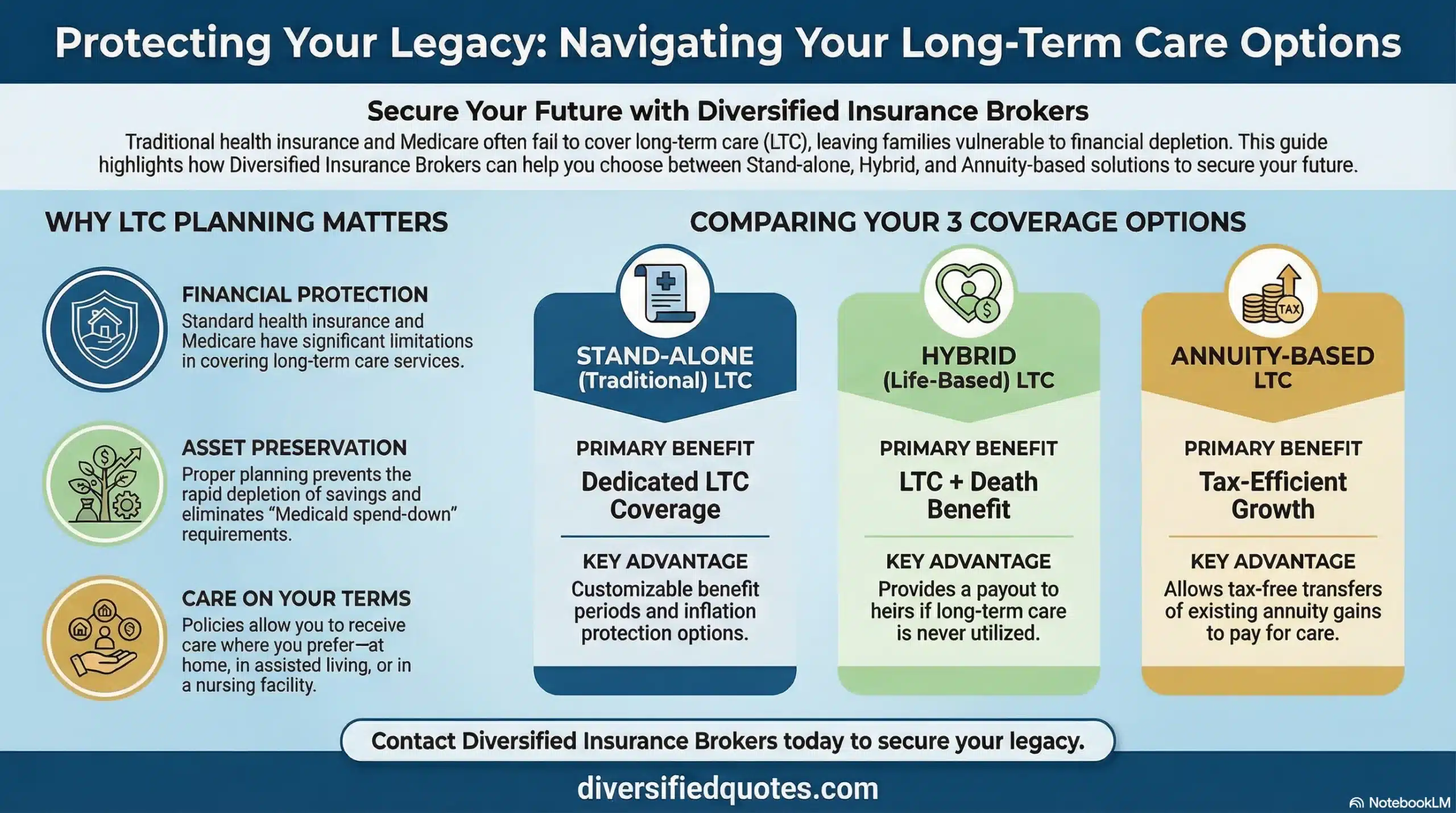
Retirees evaluating affordable long term care insurance have access to three distinct structural approaches, each of which addresses the LTC risk differently, prices differently, and fits different retirement situations. Understanding these three structures before comparing specific products is the most important analytical step in the planning process — because retirees who compare within a structure without understanding the alternatives often miss the most cost-effective solution for their specific financial situation.
| Feature | Traditional LTC Insurance | Hybrid Life/LTC Policy | Asset-Based / Annuity LTC |
|---|---|---|---|
| How premiums work | Ongoing monthly premiums — not guaranteed, can be increased by carrier with regulatory approval | Single premium or limited-pay structure — level and guaranteed once set | Single premium repositioned from existing savings — no additional ongoing premiums |
| If LTC is never needed | Premiums are paid but no benefit returned — “use it or lose it” | Death benefit paid to heirs — premium dollars not lost | Annuity value preserved — heirs receive remaining asset value |
| Premium risk if not using | Higher — future increases possible; can force policy redesign or lapse | Lower — premiums are guaranteed and fixed at issue | None — uses existing assets rather than new cash flow |
| Health underwriting required? | Yes — moderate to comprehensive underwriting | Yes — typically simplified compared to traditional LTC | Yes — but often less stringent than standalone LTC |
| LTC benefit leverage | Highest — maximum benefit pool per premium dollar | Moderate — LTC benefit limited by life insurance face amount and design | Moderate — LTC benefit multiplies deposited asset amount |
| Best suited for retirees who | Have predictable retirement income cash flow, want maximum coverage per premium dollar, and can absorb potential future premium increases | Want guaranteed premiums, no “use it or lose it” concern, and a death benefit for heirs if care is never needed | Have existing savings or CDs earmarked for safety that can be repositioned for enhanced LTC leverage |
The table makes clear that the most “affordable” structure for affordable long term care insurance for retirees is not a universal answer — it is situation-specific. A retiree with predictable pension and Social Security income who can sustain monthly premiums and wants maximum LTC benefit leverage per dollar may find traditional LTC most cost-effective despite the premium instability risk. A retiree with a lump sum of savings in a CD or low-yield fixed account who is concerned about “use it or lose it” may find that repositioning those assets into an asset-based LTC annuity provides LTC leverage without creating a new monthly obligation. Understanding which structure fits which retirement profile is the first decision, before any carrier or specific product is compared. Our resource on fixed annuity with long term care benefits covers the asset-based structure in detail, and our resource on John Hancock Life Care hybrid life and LTC covers a leading hybrid design.
What Affordable Long Term Care Insurance for Retirees Actually Pays For
Long term care insurance is designed to pay for custodial and supportive care — the assistance with daily living activities that people need when they can no longer manage independently due to a chronic condition, cognitive decline, or physical decline associated with aging. This is categorically different from the skilled medical care that Medicare covers, which is why LTC insurance and Medicare serve different and largely non-overlapping functions in retirement planning.
Modern long term care contracts cover a range of care settings including in-home personal care from licensed aides, adult day programs, assisted living facilities, memory care facilities, and skilled nursing facilities. The care setting coverage is important for affordability planning because the cost of care varies enormously by setting — home care is typically less expensive per day than facility care, and many retirees prefer to receive care at home for as long as possible before transitioning to a facility. Policies designed to emphasize home care coverage can sometimes be structured at lower benefit amounts while still addressing the care setting most retirees actually prefer. Our resource on what are activities of daily living covers the specific ADL framework that governs benefit eligibility, and our resource on what is a skilled nursing facility covers the most expensive care setting that most LTC policies are designed to address.
Beyond the primary care benefit, many modern LTC contracts include practical supplemental benefits that meaningfully improve real-world care outcomes. Care coordination services — where a professional care manager helps identify qualified providers, build a care plan, and coordinate logistics — can reduce family burden during a care transition. Respite care benefits compensate family caregivers who provide unpaid care, allowing them time away without financial penalty. Some contracts include caregiver training, home modification benefits, and support services. Our resource on travel, lodging, and pet care benefits explained covers some of the more specific supplemental benefits that appear in modern LTC contract designs.
The Six Benefit Design Levers That Determine Affordability
Affordable long term care insurance for retirees is primarily created through intentional benefit design rather than carrier shopping alone. The six core design variables — daily or monthly benefit amount, benefit duration, elimination period, inflation protection, benefit pool structure, and home care coverage ratio — each affect the monthly premium independently and together produce the final cost. Understanding how to move each lever toward affordability while preserving meaningful protection is the core skill in LTC benefit design for cost-conscious retirees.
The daily or monthly benefit amount is the most direct premium driver. A $150/day benefit produces a meaningfully lower premium than a $200/day benefit from the same carrier on the same policy design. The right amount is not the highest affordable figure — it is the amount that, combined with the retiree’s other income sources, covers the realistic expected care cost in their area and preferred care setting. Retirees who expect to receive home care can sometimes use a lower daily benefit effectively because home care tends to be less expensive than facility care per day. Those who anticipate facility care need should ensure the benefit amount is adequate for facility costs in their region.
Benefit duration — the total period for which the policy will pay — is the second major lever. A 2-year benefit period produces substantially lower premiums than a 5-year or unlimited benefit period. The actuarial reality is that many care events last 2-3 years, meaning a 3-year benefit period covers the majority of care episodes while the most extended long-term care scenarios (those lasting 5+ years) are less common. Retirees who want protection against the most extreme care duration but cannot afford a long benefit period can sometimes combine a moderate benefit duration with a shared care rider for couples — allowing one spouse to access the other’s unused benefit if a very long care episode occurs. Our resource on shared care riders in LTC covers this design feature that can extend couple protection significantly at a modest additional cost.
The elimination period — the waiting period between the onset of qualifying care need and the first benefit payment — is one of the most powerful affordability tools available in LTC design. An elimination period of 90-180 days meaningfully reduces premium relative to a 30-day or 0-day elimination period, because the retiree is agreeing to self-fund the initial care period. Retirees who have a defined “self-pay window” in their retirement plan — a cash reserve or liquid asset earmarked for initial care costs — can pair a longer elimination period with their savings strategy and secure lower LTC premiums without removing protection against the longer, more expensive phases of a care episode.
Inflation protection is the benefit design choice that generates the most confusion and the most unnecessary premium spending among retirees who do not evaluate it carefully. A 5% compound inflation rider applied to an already-generous benefit amount can produce a premium that feels unsustainable within 5-10 years of retirement. A more moderate inflation approach — 3% simple or a lower compound option — can provide meaningful benefit growth at a substantially lower premium. The right inflation choice depends on age at application, retirement timeline, and how much of the premium budget can be directed toward benefit growth versus benefit magnitude. Our resource on how much does long term care insurance cost covers the premium impact of different inflation protection choices.
How Traditional LTC Insurance Works for Retirees
Traditional standalone long term care insurance provides the highest LTC benefit leverage per premium dollar among the three structural options — meaning that for retirees who can qualify medically and maintain predictable monthly premiums, traditional LTC delivers the most potential care benefit coverage relative to what is paid in premium. The policy accumulates no cash value and has no death benefit — it is pure insurance coverage against the cost of care. If care is never needed, premiums are paid with no return of value. If care is needed, the policy pays benefits that can significantly exceed total premiums paid over the life of the contract.
The principal risk of traditional LTC for retirees is premium instability. Unlike many other insurance products, traditional LTC premiums are not guaranteed to remain level — carriers can apply to state regulators for rate increases, and many carriers have received approval for significant increases on in-force policies over the past two decades. This premium increase risk is what has driven many retirees toward hybrid and asset-based alternatives, which offer guaranteed premium structures. For retirees who choose traditional LTC, building in benefit design flexibility — selecting an inflation option that can be reduced, or a benefit duration that could be shortened — provides a mechanism for responding to a future premium increase without having to lapse the policy entirely. Our resource on how to find, evaluate, and apply for long term care insurance covers the traditional LTC application and carrier selection process in full.
How Hybrid Life/LTC Policies Deliver Affordable LTC for Retirees
Hybrid life/LTC policies address the “use it or lose it” objection to traditional LTC by combining a permanent life insurance policy with a long term care benefit rider. The LTC benefit is funded from the life insurance policy’s face amount, meaning that if LTC is needed, the policy pays out LTC benefits. If the insured passes away without ever needing care, the remaining death benefit goes to named heirs. The “at worst” outcome is a death benefit for the family; the “best protection” outcome is meaningful LTC funding when care is needed.
Hybrid policies typically offer guaranteed level premiums — either a single lump-sum premium or a limited payment period of 10 years or fewer — which eliminates the premium increase risk that concerns retirees evaluating traditional LTC. The trade-off is that hybrid policies generally require a meaningful upfront capital commitment (single premium designs often start at $50,000-$100,000 or more) and the LTC leverage — the ratio of LTC benefit to premium paid — is lower than traditional LTC because some of the premium is funding the life insurance component rather than pure LTC coverage. For retirees with capital available who want the certainty of guaranteed premiums and a death benefit backstop, hybrids frequently deliver the best combination of LTC protection and premium predictability. Our resource on long term care insurance with lifetime benefits covers the most comprehensive benefit structures available in hybrid designs.
Asset-Based LTC — Repositioning Savings for Care Cost Protection
Asset-based LTC using an annuity with long term care benefits is particularly well-suited for retirees who have savings in CDs, money market accounts, or conservative investment accounts that are earning modest returns and are earmarked for the “safety” portion of their retirement asset allocation. Instead of leaving those assets in a low-yield account, the retiree repositions them into an annuity that provides principal protection, accumulation, and — through an attached LTC rider — a significantly enhanced benefit pool if qualifying care is needed.
The structure works by allowing the LTC benefit to be a multiple of the deposited premium — often 2x, 3x, or more — so that a $100,000 deposit might create a $200,000-$300,000 pool of LTC benefit available if care is needed. If care is never needed, the annuity value is preserved and can be passed to heirs or used for other retirement purposes. The LTC rider triggers under the same ADL and cognitive impairment framework as traditional LTC policies, and benefits are paid to cover qualifying care costs up to the monthly maximum. This structure eliminates the monthly premium obligation of traditional or hybrid policies and the “use it or lose it” concern, but it does require the capital commitment of repositioning an existing asset rather than creating new protection from ongoing cash flow. Our resource on fixed annuity with long term care benefits covers this structure in full detail.
Retiree Underwriting — What Carriers Evaluate for LTC Applications
LTC underwriting for retirees is more involved than burial insurance or simplified issue life insurance underwriting — it typically includes a health history questionnaire, prescription database review, and often a cognitive screening assessment. Understanding what carriers evaluate before applying is the most effective way to identify which carrier and which product type is most appropriate for a retiree’s specific health profile.
Carriers evaluate current health conditions, medication history, build (height and weight relative to accepted ranges), functional status (ability to perform ADLs independently), recent hospitalizations, and cognitive function. Stable, well-managed conditions — controlled blood pressure, controlled diabetes, high cholesterol, stable cardiac history — are typically acceptable in LTC underwriting, though they may affect the specific carrier and pricing tier. Conditions that tend to create more significant LTC underwriting challenges include degenerative neurological conditions, recent stroke or transient ischemic attack, recent cancer treatment, severe obesity, and any condition affecting current functional independence. Our resource on long term care insurance with preexisting conditions covers the underwriting landscape for common health conditions. Our resource on how to prescreen a life insurance application covers the pre-screening process that helps identify the most appropriate carrier before any formal application is submitted.
Why Medicare Doesn’t Solve the LTC Problem for Retirees
One of the most common misconceptions in retirement planning is that Medicare provides meaningful long term care coverage. It does not. Medicare covers skilled medical care — treatment by licensed medical professionals following a hospitalization or for a defined medical condition — for defined short durations under specific eligibility conditions. Medicare does not cover custodial care: the assistance with bathing, dressing, eating, mobility, and daily living management that constitutes the vast majority of long term care need. A retiree who requires a home health aide five days per week to assist with bathing and dressing is receiving custodial care — which Medicare does not fund.
Medicaid does fund long term care for low-income individuals — but only after the retiree has spent down assets to near-poverty levels under state-specific rules. For retirees who have accumulated meaningful retirement savings, Medicaid spend-down requirements would effectively require exhausting those assets before Medicaid assistance begins. Most retirees with any meaningful asset base want to avoid this scenario. In states with LTC Partnership programs, a Partnership-qualified LTC policy creates a dollar-for-dollar asset protection benefit — meaning the retiree can protect an amount of assets equal to the benefits the policy paid before Medicaid eligibility rules apply. Our resource on LTC partnership reciprocity covers how Partnership policies work across different states and what the asset protection implications are for retirees who do use LTC benefits.
Couple Planning — Shared Care and Spousal Discounts
Affordable long term care insurance for retirees frequently looks very different for couples than for single individuals — because couple planning introduces shared care design options, spousal discounts, and protection against the “second spouse” financial disruption that is one of the most damaging LTC scenarios in retirement. When one spouse needs care, the healthy spouse often faces simultaneously reduced household income, increased household expenses for the care recipient, and the loss of their own retirement plan stability — all while managing the emotional and logistical demands of coordinating care.
Spousal or partner discounts are standard features at most traditional LTC carriers when both spouses apply simultaneously — reducing the premium for each applicant by a meaningful percentage that makes the combined cost more efficient than two separate individual applications. Shared care riders allow unused benefits from one spouse’s policy to be accessed by the other if one spouse exhausts their individual benefit pool — a particularly valuable feature for couples where one partner faces a significantly longer care need. Our resource on shared care riders in LTC covers this design feature in full. Our resource on long term care insurance for seniors covers age-specific planning considerations for retirees at different stages of retirement.
Sample Premium Ranges by Design
| Applicant | Policy Design | Approx. Sample Premium | Key Affordability Feature |
|---|---|---|---|
| 60-Year-Old Male | $150/day benefit, 3-year duration, 90-day elimination, no inflation | ~$90–$120/month | No inflation rider keeps premium lowest; self-funded inflation tolerance |
| 60-Year-Old Female | $150/day benefit, 3-year duration, 90-day elimination, 3% compound inflation | ~$140–$180/month | 3% compound inflation preserves benefit value; premium reflects longer female longevity |
| Married Couple, Age 55 | Shared pool of $300,000, 3% compound inflation, 90-day elimination | ~$200–$250/month (combined) | Spousal discount and shared pool design maximize protection per premium dollar for couple |
| 70-Year-Old, Single | $200/day, 2-year duration, 180-day elimination, 3% simple inflation | ~$180–$240/month | Longer elimination reduces premium; shorter benefit duration targets highest-cost initial phase |
Sample ranges only. Actual premiums vary by carrier, state, health classification, and policy design. These are illustrative estimates based on market analysis — not a quote for any specific individual. Request a personalized illustration for accurate pricing.
Protect Your Retirement With Affordable LTC
We build benefit designs that fit your retirement income picture, compare across 75+ A-rated carriers, and help you identify the structure — traditional, hybrid, or asset-based — that transfers the most meaningful care risk at the most sustainable premium for your specific situation and goals.
Request Your QuoteRelated Long-Term Care Insurance Pages
More LTC planning guides, underwriting help, benefit design options, and carrier resources.
Related Retirement Protection Pages
Other ways retirees plan for long-term stability, income, and asset protection alongside LTC coverage.
Financial Protection Essentials
High-risk life insurance planning, disability income protection with COLA, and financial institution reviews.
Talk With an Advisor Today
Choose how you’d like to connect—call or message us, then book a time that works for you.
Schedule here:
calendly.com/jason-dibcompanies/diversified-quotes
Licensed in all 50 states • Fiduciary, family-owned since 1980
Frequently Asked Questions: Affordable Long Term Care Insurance for Retirees
When is the best time to buy LTC insurance?
Many retirees achieve the best combination of premium, eligibility, and benefit design by applying in their late 50s to early 60s — early enough to benefit from lower age-based premiums and broader health qualification, but close enough to retirement that the coverage design reflects actual retirement income realities. Applying earlier can lock in lower premiums for life (in traditional LTC) or require smaller capital commitments (in hybrid and asset-based designs). Waiting until health changes occur can eliminate options or significantly increase costs. That said, affordable long term care insurance for retirees in their 70s is still available through the full product range — particularly for those considering hybrid or asset-based structures where the capital commitment is fixed. Our resource on long term care playbook covers timing considerations across the full planning spectrum.
What if LTC premiums rise in the future?
Traditional LTC insurance premiums are not guaranteed and can be increased by carriers with state regulatory approval — this is one of the most significant risks in traditional LTC planning. The primary defense is benefit design flexibility: choosing an inflation protection option that can be reduced, selecting a benefit duration that can be shortened, or structuring the initial benefit at a level where a future reduction still provides meaningful protection. Hybrid policies and asset-based LTC solutions typically offer guaranteed premium structures that eliminate this risk entirely, at the cost of higher initial capital requirements. For retirees on fixed incomes where premium stability is critical, the hybrid or asset-based structures may provide the most sustainable long-term solution. Our resource on how much does long term care insurance cost covers the cost environment and the factors that drive premium changes in the traditional LTC market.
Does LTC insurance cover care at home?
Yes. Most modern long term care contracts provide comprehensive home care coverage alongside assisted living and skilled nursing facility coverage. Home care benefits typically cover personal care aides, homemaker services, adult day programs, and care coordination — the services that allow retirees to remain in their own homes while receiving needed assistance. Home care is often the most preferred care setting and can be less expensive per day than facility care, making it an efficient coverage target for retirees who want to maximize benefit value. The policy’s benefit triggers — the inability to perform two of six Activities of Daily Living, or qualifying cognitive impairment — apply the same way regardless of care setting. Our resource on what is a skilled nursing facility covers the most intensive care setting that LTC policies are designed to fund, providing context for understanding the full care setting spectrum that modern LTC policies address.
Can couples share LTC benefits?
Yes — shared care riders allow spouses or domestic partners to access each other’s unused benefit pools if one partner exhausts their individual coverage. This feature provides protection against the scenario where one spouse has a much longer care episode than the other, by making both partners’ benefit pools available to either partner. Shared care is typically available as an optional rider on traditional LTC policies and is one of the most valuable affordability features for couple planning because it extends the effective coverage duration without requiring both partners to purchase maximum individual benefit periods. Spousal and partner discounts — offered when both partners apply simultaneously — further improve the cost efficiency of couple LTC planning. Our resource on shared care riders in LTC covers this design feature in full detail, and our resource on LTC partnership reciprocity covers how state Partnership programs provide additional asset protection benefits for qualifying LTC policies.
About the Author:
Jason Stolz, CLTC, CRPC, DIA, CAA and Chief Underwriter at Diversified Insurance Brokers (NPN 20471358), is a senior insurance and retirement professional with more than 25 years of real-world experience helping individuals, families, and business owners protect their income, assets, and long-term financial stability. As a long-time partner of the nationally licensed independent agency Diversified Insurance Brokers, Jason provides trusted guidance across multiple specialties—including fixed and indexed annuities, long-term care planning, personal and business disability insurance, life insurance solutions, Group Health, Travel Medical and Evacuation Insurance, and short-term health coverage. Diversified Insurance Brokers maintains active contracts with over 100 highly rated insurance carriers, ensuring clients have access to a broad and competitive marketplace.
His practical, education-first approach has earned recognition in publications such as VoyageATL, and contributions from his agency featured in Kiplinger and GoBankingRates— highlighting his commitment to financial clarity and client-focused planning. Drawing on deep product knowledge and years of hands-on field experience, Jason helps clients evaluate carriers, compare strategies, and build retirement and protection plans that are both secure and cost-efficient. Visitors who want to explore current annuity rates and compare options across multiple insurers can also use this annuity quote and comparison tool.
Explore More Long Term Care Insurance Options: Browse our complete guide to Tax, Medicare & Special Situations — covering tax advantages, Medicare vs LTC, seniors, couples, diabetics & age-specific coverage from top carriers.
Last Reviewed: September 17, 2026 |
Reviewed by: Jason Stolz, CLTC, CRPC, DIA, CAA
Chief Underwriter, Diversified Insurance Brokers, Inc. | NPN: 20471358 | Diversified Insurance Brokers, Inc. — Licensed in all 50 states
Fact Checked by: Tonia Pettitt, CMIP©
Medicare Specialist, Diversified Insurance Brokers, Inc. | NPN: 14374308 | Diversified Insurance Brokers, Inc. — Licensed in all 50 states
Did you find this content helpful? Leave us a Google review — it helps others find trustworthy guidance too.
Editorial Standards: Diversified Insurance Brokers maintains rigorous editorial standards to ensure accuracy, clarity, and independence in all content. Learn more about our editorial standards and commitment to transparency.
