
Long Term Care Insurance for Seniors
Long Term Care Insurance for Seniors

Jason Stolz CLTC, CRPC, DIA, CAA
For many seniors, the biggest financial surprise in retirement is not the stock market — it is the cost of extended care. Long-term care can arrive slowly through increasing help at home, or it can appear suddenly after a fall, stroke, or hospitalization. Either way, home health care, assisted living, memory care, and nursing facility costs can create ongoing monthly expenses that were never part of the original retirement plan.
Long term care insurance for seniors is designed to pay benefits when you can no longer safely complete daily self-care or when a cognitive impairment requires ongoing supervision. This coverage can protect retirement income, reduce the burden on adult children, and preserve options — because you can afford the type of care you want, not just the type of care that fits the budget. At Diversified Insurance Brokers, we help seniors and their families understand their options, compare policy designs, and choose a structure that matches health history, assets, and risk tolerance. We also help families compare traditional LTC, simplified-issue options, and hybrid approaches so you can find the balance between affordability and long-term protection.
Compare Long Term Care Insurance for Seniors
Review traditional and hybrid LTC options to find the right balance of premium, benefits, and flexibility for your stage of life.
Questions? Call 800-533-5969
Why Seniors Need Long Term Care Insurance
Medicare is excellent for acute care — doctor visits, hospital stays, and short-term skilled services after a hospitalization. But most seniors are surprised to learn that Medicare generally does not pay for ongoing custodial care, meaning help with the activities of daily living that most people need when they can no longer safely live independently. That gap is where long-term care insurance is designed to step in.
Without a plan, long-term care costs usually get paid from savings and income. That can force difficult decisions: selling investments in a down market, drawing more from retirement accounts than planned, or relying heavily on family caregivers who were never meant to be the primary source of support. LTC insurance helps replace those out-of-pocket withdrawals with a predictable benefit that can keep a retirement plan intact. For couples especially, one spouse’s care event can materially affect the other spouse’s financial security for years — and a well-structured policy is often the most practical way to protect both simultaneously. Seniors looking at the broader retirement picture sometimes also explore how pension alternatives and lifetime income strategies work alongside LTC coverage to stabilize cash flow if a care event occurs.
For many seniors, the real value of long-term care insurance is not just paying bills — it is preserving options. The ability to stay at home longer, get help sooner, and make care transitions based on preference rather than what is left in the account. A policy that covers home health aides, assisted living, adult day care, memory care, and skilled nursing gives a family room to move across settings without financial crisis at each transition.
What Long Term Care Insurance Covers
Long-term care insurance is typically designed to pay benefits when you meet the policy’s benefit triggers. Most policies use a standard measurement: the inability to perform a certain number of Activities of Daily Living — bathing, dressing, eating, toileting, transferring, or continence — or the need for ongoing supervision due to cognitive impairment. The policy’s definition section matters considerably, because different contracts set these thresholds differently, and tighter language can mean slower or narrower benefit activation at claim time. For a detailed breakdown of how ADL triggers work in practice, our companion page on Activities of Daily Living covers the mechanics in full.
Depending on plan design, benefits may support home health aides and caregivers, adult day care and community-based services, assisted living and supportive housing, memory care for cognitive impairment supervision, skilled nursing care, respite care that gives family caregivers relief, and hospice and end-of-life support when included. Some policies pay benefits by reimbursing documented expenses up to a daily or monthly limit. Others pay a cash or indemnity benefit once you qualify, which can be used more flexibly — including for informal caregivers and home modifications. The right structure depends on whether you prioritize maximum benefit leverage, maximum flexibility, or a blend of both, and that answer differs by household.
Traditional LTC vs Hybrid LTC: What Seniors Should Know
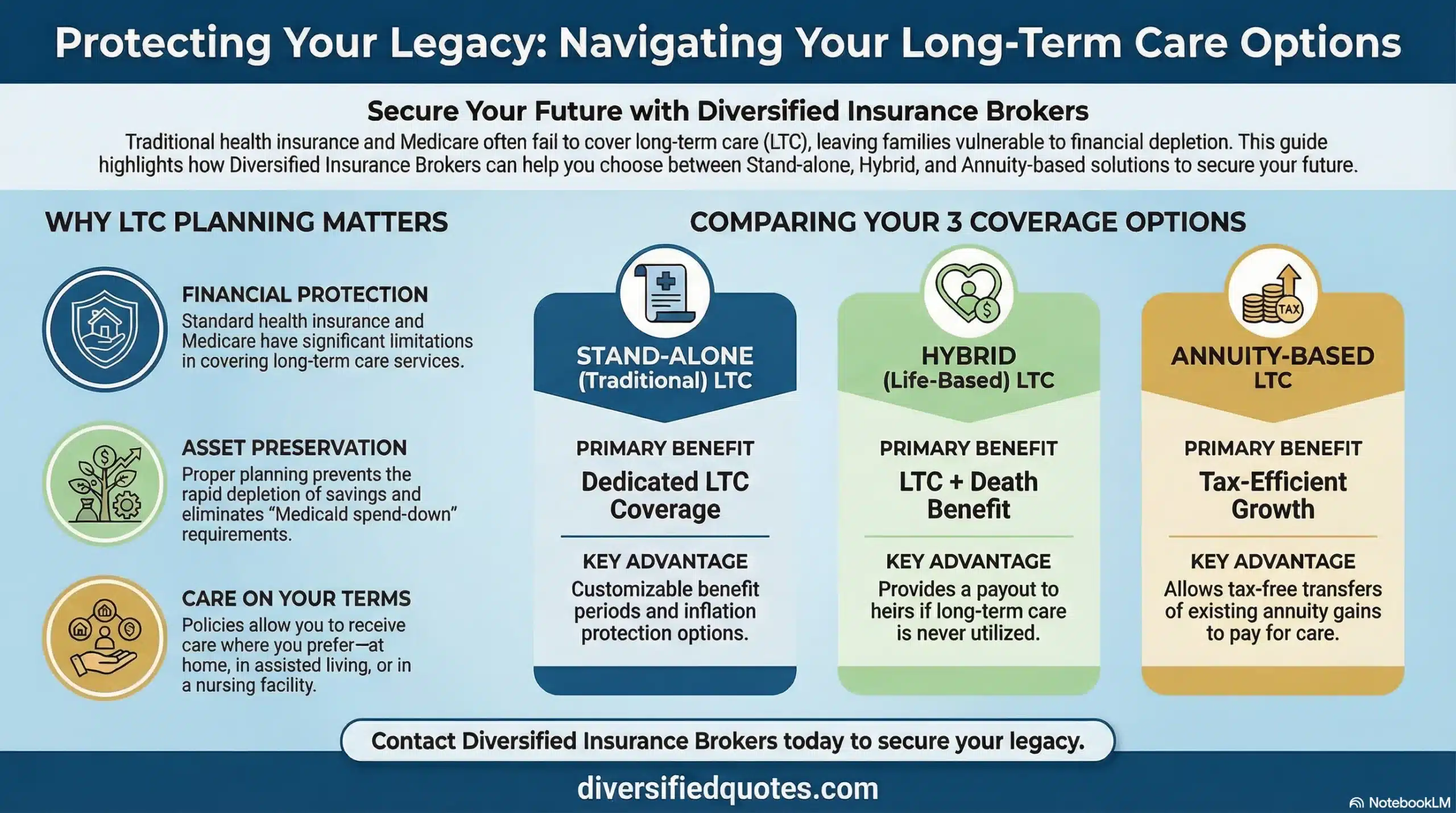
Seniors typically compare two broad directions: traditional long-term care insurance and hybrid long-term care insurance — usually life insurance or annuity-based designs that include LTC benefits as an accelerated or extension-of-benefits rider. Traditional LTC can be cost-efficient for healthy applicants, especially when the goal is maximizing the benefit pool relative to premium paid. Hybrid designs are often attractive for seniors who dislike the use-it-or-lose-it feeling that comes with traditional premium structures — and who want value to remain in the policy if care is never needed.
Many hybrid plans preserve a death benefit or retained cash value if LTC benefits go unused. This dual-purpose design resonates with seniors who are weighing whether to spend down assets or keep them intact for a surviving spouse or heirs. Our companion guide on understanding hybrid long-term care insurance walks through the structure in detail. Seniors also frequently ask whether LTC benefits are taxable. Most long-term care benefits are received tax-free when used for qualifying care, subject to IRS rules and policy structure — and the tax treatment of hybrid policies differs from traditional LTC in ways worth understanding before purchasing. For the full analysis, see: Tax Advantages of Long-Term Care Insurance and Hybrid Policies.
See Which LTC Structure Fits Your Situation
We’ll help you compare traditional LTC, hybrid LTC, and simplified-issue options based on age, health, assets, and goals.
Key Policy Features Seniors Should Compare
The fastest way to get confused when shopping for long-term care coverage is to compare policies by monthly premium alone. Two plans can cost the same and behave very differently in a real claim. The benefit amount and total benefit pool set the ceiling on what the policy can pay — whether measured as a daily or monthly maximum or as a total fund that can be drawn down over time. The right target depends on local care costs and whether your goal is full coverage, partial coverage, or a shock absorber that reduces the worst-case withdrawal from retirement accounts.
The elimination period — typically 30, 60, or 90 days — functions like a time-based deductible. A longer elimination period lowers premium but increases what you pay out of pocket before benefits begin. Families with solid liquid reserves often find a 90-day elimination period very manageable; those with less liquidity sometimes prefer 30 or 60 days even at a higher premium. For a detailed breakdown of how this choice plays out across different scenarios, see: LTC Elimination Periods Explained.
Inflation protection increases benefit values over time to help keep pace with rising care costs. For seniors purchasing in their 60s who may not need benefits for 15 to 20 years, inflation protection can have a substantial impact on whether the benefit is still meaningful when it is actually used. Reimbursement versus cash or indemnity benefit design is another distinction worth examining carefully. Finally, some policies include care coordination features that actively help families plan and manage transitions across settings — a feature that can be as valuable as the benefit dollars themselves during an actual claim. Our resource on LTC care coordination benefits covers this in detail.
Who Should Consider Long Term Care Insurance as a Senior?
Long-term care insurance can make sense for a wide range of seniors, but it is not one-size-fits-all. Coverage is most often considered when seniors want to protect retirement income, preserve assets for a surviving spouse, and reduce the probability that adult children will become default caregivers by necessity rather than by choice. Seniors who have built meaningful retirement savings often find that LTC coverage is the logical next protection layer — because a care event is the spending category most likely to disrupt a retirement plan that is otherwise well-funded.
Many seniors also consider LTC coverage when they have a family history of dementia, Parkinson’s, stroke, or other conditions that carry a longer-than-average care duration. Couples face an additional dimension: one spouse’s extended care can drain joint assets that the other depends on for the remainder of their life. A shared care rider in LTC is one mechanism couples use to create a pooled benefit that can flow to whichever spouse needs it most. For a planning guide built specifically around couple scenarios, see: Long-Term Care Insurance for Couples.
Timing matters significantly. Seniors who apply while still in good health have the widest carrier options, the most competitive premiums, and access to features like inflation protection that some carriers restrict for older or less healthy applicants. Waiting until a health event has already appeared can narrow options considerably or result in a decline. The window of opportunity for most seniors is the late 50s through mid-60s — and for those approaching the decision now, a preliminary health and coverage review is a more useful first step than waiting.
How Much Coverage Do Seniors Typically Need?
The right coverage amount depends on what you are trying to protect. Some seniors want a policy that can pay most of the expected monthly cost of assisted living or home care in their area. Others want coverage that reduces the worst-case damage to retirement income — so a care event does not force a major lifestyle change for the healthy spouse or accelerate depletion of jointly held assets. Both approaches are valid; the difference is in how you define the problem the policy needs to solve.
We typically start by identifying the care setting a senior would prefer first — home care, assisted living, or skilled nursing — and build the benefit amount around a realistic monthly cost for that setting in the local market. From there, the elimination period is calibrated to the household’s liquid reserves, and the inflation decision is guided by age and how far out benefits are likely to be needed. For seniors with a family history suggesting longer-duration care risk, the comparison between limited-term benefits versus lifetime benefits is often the most consequential design decision of the entire planning process. Budget is always part of the conversation — the goal is not the biggest benefit for the lowest price, but a policy you can keep, that will behave predictably in a claim, and that protects the retirement outcome you care most about.
Why Work With Diversified Insurance Brokers?
Diversified Insurance Brokers is a family-owned, fiduciary agency licensed nationwide. For seniors, choosing long-term care coverage is rarely about finding a “perfect” policy. It is about choosing a plan you can keep, that behaves predictably in a claim, and that protects the retirement outcome you care about — whether that is income stability, asset preservation, independence, or reducing family burden. Because we work with more than 100 highly rated carriers, we are not limited to a single product line — our job is finding the structure that fits your situation, not the one that is easiest to place.
We help seniors compare traditional LTC, hybrid designs, and simplified-issue paths when underwriting is complicated. We also help families right-size benefits, select elimination periods that match liquid reserves, and balance inflation options against long-term affordability. Our long-term care insurance service page is the best starting point for seniors who want a comprehensive overview before requesting a quote.
Plan Ahead with Long Term Care Insurance
Protect your future, your independence, and your family’s financial well-being with the right coverage design.
Questions? Call 800-533-5969
Get Senior-Focused LTC Recommendations
Answer a few questions and we’ll share plan designs that match your age, goals, and coverage priorities.
Financial Protection Essentials
Long-term care is one piece of a complete retirement protection plan. Explore these related coverage areas to fill any remaining gaps.
Related Pages to Explore
Explore these related long-term care comparisons and planning guides.
Talk With an Advisor Today
Choose how you’d like to connect—call or message us, then book a time that works for you.
Schedule here:
calendly.com/jason-dibcompanies/diversified-quotes
Licensed in all 50 states • Fiduciary, family-owned since 1980
FAQs: Long Term Care Insurance for Seniors
Long-term care insurance is designed to pay benefits when you can no longer safely perform a certain number of Activities of Daily Living—commonly bathing, dressing, eating, toileting, transferring, and continence—or when cognitive impairment requires ongoing supervision. The specific trigger threshold varies by policy, and the definitions inside the contract matter considerably. A policy that requires inability with two ADLs will activate benefits at a different point than one requiring three, so comparing policy language carefully is important. For a full breakdown of how ADL triggers work, see our companion page on Activities of Daily Living.
Most well-designed policies cover a broad range of care settings: home health aides and private caregivers, adult day care programs, assisted living communities, memory care units, and skilled nursing facilities. Some also include respite care for family caregivers and hospice support. Whether the policy pays by reimbursing documented expenses or by providing a flexible cash or indemnity benefit after you qualify depends on the plan design. Seniors who want maximum flexibility for home-based or informal care often find indemnity-style policies more practical, while those seeking the highest benefit-per-premium often prefer reimbursement structures.
For most seniors, the optimal window is in the late 50s through mid-60s. During this period, health is typically still strong enough to qualify for preferred underwriting rates, the premium per unit of benefit is lower, and there is enough lead time before likely benefit use for inflation protection to add meaningful value. Seniors in their early 70s can still find coverage—particularly through simplified-issue products or hybrid LTC designs with less aggressive underwriting—but the options are narrower and the cost-per-dollar-of-benefit is typically higher.
The most important thing to avoid is waiting until a health event has already occurred. Once a significant chronic condition, hospitalization, or cognitive change is on record, some carriers will decline the application outright, while others may apply exclusion riders or rate-up the premium significantly. Timing matters more in long-term care insurance than in almost any other insurance line, because the underwriting review is thorough and health history from years prior can affect the outcome. If you’re close to the edge of the planning window, a conversation now—even a preliminary one—is better than waiting another year.
Yes, health is the single most important underwriting factor in long-term care insurance. Carriers review current health status, chronic conditions, cognitive function, functional ability, prescription history, and in many cases medical records and attending physician statements. Common conditions that can result in a decline include dementia or cognitive impairment, Parkinson’s disease, multiple sclerosis, insulin-dependent diabetes with complications, recent strokes, and certain heart conditions—though carrier standards vary significantly, so a decline from one carrier does not always mean a decline from all.
Seniors with moderate health complications may still find options through simplified-issue policies, which use shorter health questionnaires and less intensive underwriting in exchange for smaller benefit pools or higher premiums. Hybrid LTC designs built on life insurance or annuity platforms sometimes have more lenient underwriting than traditional standalone LTC carriers. Working with an independent broker who represents multiple carriers—rather than a captive agent with a single product—is critical when health history is a factor, because the difference in outcomes across carriers can be substantial.
Premiums generally increase with age at the time of application. The same benefit amount, elimination period, and inflation option will cost meaningfully more for a 70-year-old applicant than for a 62-year-old, because the insurer’s expected claim timeline is shorter and the statistical likelihood of near-term use is higher. This is why the timing of the purchase decision matters: every year of delay typically increases the premium for equivalent coverage, and at some point the increase becomes significant enough to affect whether the policy remains affordable for the long term.
Some policies are guaranteed level premium, meaning the rate cannot increase after issue. Others are guaranteed renewable but not level, which means the carrier can seek regulatory approval for rate increases across an entire policy class—though not for individual policyholders specifically. Understanding the premium stability structure of any policy you’re considering is important, because a policy that starts affordable but becomes unaffordable in ten years creates its own set of problems. Seniors on fixed retirement income often prioritize carriers with stronger rate-stability histories, even if the initial premium is slightly higher.
An elimination period is the number of days you must receive qualifying care and pay out of pocket before your policy begins paying benefits. Common options include 30, 60, and 90 days. Think of it as a time-based deductible: a longer elimination period means lower premium but higher initial out-of-pocket exposure, while a shorter period means higher premium with faster benefit activation. For a detailed breakdown of how different elimination periods work across policy types, see: LTC Elimination Periods Explained.
For most seniors, the choice should be driven by liquid reserves. If the household has savings or income that could comfortably cover 90 days of care costs—roughly $15,000 to $30,000 in most markets—then a 90-day elimination period is usually the most efficient choice from a premium standpoint. Families with less liquidity or who strongly prefer the policy to activate quickly often choose 30 or 60 days instead. There is no universally “right” answer; it’s a tradeoff between premium cost and the amount of risk you’re willing to self-insure during the elimination window.
In most cases, yes—if the policy includes cognitive impairment as a benefit trigger, which the majority of modern tax-qualified LTC policies do. Cognitive impairment is typically defined as a deterioration or loss of intellectual capacity that requires substantial supervision to protect the insured from health or safety hazards. Alzheimer’s disease and related dementias generally qualify under this trigger once the impairment reaches a level requiring supervision, even if the person can still perform some ADLs independently. The key is that the policy’s cognitive trigger must be satisfied, which is evaluated through licensed healthcare practitioner assessment.
The type of memory care services covered—and for how long—depends on the policy’s benefit amount, benefit pool, and whether the care setting (memory care unit within an assisted living facility, dedicated memory care community, or home-based care with supervision) falls within the policy’s covered care categories. Some policies define covered settings broadly; others list specific facility types that must be licensed in a particular way. If memory care is a specific concern for your family—whether due to personal history or family history—it’s worth carefully reviewing the cognitive trigger language and covered settings before selecting a policy.
Inflation protection increases your benefit amount over time—either automatically each year at a fixed percentage (such as 3% or 5% compound), or optionally at specific intervals. The purpose is to help your benefit keep pace with rising care costs, which have historically grown faster than general inflation. Without inflation protection, a daily benefit that covers today’s assisted living costs in your area may cover only a fraction of those costs in fifteen or twenty years—which is often when the benefit will actually be needed.
Whether a specific senior needs inflation protection depends on age, budget, and expected benefit timing. A 58-year-old purchasing coverage today who may not need benefits for 20 or 25 years has a long runway for care costs to outpace a static benefit—making strong inflation protection more important. A 74-year-old purchasing coverage who may need benefits within 5 to 10 years has a shorter runway, making a higher starting benefit with moderate or no inflation sometimes more cost-effective. There’s no universal answer, but this is one of the design decisions where the difference between options can have a six-figure impact over the life of a claim. We walk through this tradeoff carefully with every senior we work with.
Yes. Many long-term care insurance carriers offer a partner or spousal discount when both individuals apply together, typically ranging from 5% to 30% off the premium depending on the carrier and whether both are approved. Some carriers extend this discount to domestic partners or unmarried couples who share a household and apply simultaneously. The discount is generally applied to each person’s premium individually, making the combined household cost lower than two separate standalone applications.
Beyond discounts, some carriers offer a shared care rider in LTC, which allows spouses to draw from each other’s benefit pool if one person exhausts their individual benefits before the other. This is a powerful feature for couples where one spouse may have a significantly longer care event than the other—or where the health risk is asymmetric between the two. Shared care riders typically add cost, but many couples find the added flexibility worth the premium increase, particularly if one spouse has a family history suggesting a higher likelihood of an extended care event.
A hybrid long-term care policy combines LTC coverage with either a life insurance policy or an annuity. Instead of paying a standalone premium that provides only LTC benefits, you fund or premium-pay a life insurance or annuity contract that includes an LTC rider or acceleration feature. If you need long-term care, the policy pays benefits—either by accelerating the death benefit, extending it beyond the base contract, or using a linked-benefit structure. If you never need long-term care, there is typically a death benefit remaining for heirs or a return of premium option that preserves some or all of what you paid in. For a detailed comparison of hybrid structures, see: Understanding Hybrid Long-Term Care Insurance.
Hybrid policies are especially popular among seniors who dislike the “use it or lose it” aspect of traditional LTC premiums—the feeling that years of premium payments produce nothing if care is never needed. The dual-purpose design addresses that concern directly. The tradeoff is that hybrid policies often cost more upfront, may require a single lump-sum premium or larger ongoing payments than traditional LTC, and may offer a smaller benefit pool per dollar of premium in some designs. The right choice between traditional and hybrid depends heavily on the individual’s financial situation, goals, existing assets, and estate planning priorities.
The most important comparison points are the policy’s benefit trigger definitions, the maximum benefit amount and total benefit pool, the elimination period structure, the inflation protection options, and whether the policy is guaranteed renewable with a stable premium history. The trigger definitions matter most at claim time—a policy with vague or narrow ADL definitions may pay benefits later or less consistently than a policy with clear, favorable language. Reviewing a sample policy contract rather than just a brochure is the best way to evaluate this before purchasing.
Beyond the contract language itself, seniors should evaluate the financial strength and rate stability history of the issuing carrier. Some carriers have sought multiple rounds of premium increases over the past decade on older LTC blocks, while others have maintained stable rates. Carrier history doesn’t guarantee future behavior, but it provides useful context. Finally, consider whether the policy’s benefit amount is calibrated to realistic local care costs—a $150/day benefit may look adequate today but represent only partial coverage in a high-cost market. We help seniors run this analysis against current local cost-of-care data as part of the quoting process, so the coverage is sized appropriately from day one.
About the Author:
Jason Stolz, CLTC, CRPC, DIA, CAA and Chief Underwriter at Diversified Insurance Brokers (NPN 20471358), is a senior insurance and retirement professional with more than 25 years of real-world experience helping individuals, families, and business owners protect their income, assets, and long-term financial stability. As a long-time partner of the nationally licensed independent agency Diversified Insurance Brokers, Jason provides trusted guidance across multiple specialties—including fixed and indexed annuities, long-term care planning, personal and business disability insurance, life insurance solutions, Group Health, Travel Medical and Evacuation Insurance, and short-term health coverage. Diversified Insurance Brokers maintains active contracts with over 100 highly rated insurance carriers, ensuring clients have access to a broad and competitive marketplace.
His practical, education-first approach has earned recognition in publications such as VoyageATL, and contributions from his agency featured in Kiplinger and GoBankingRates— highlighting his commitment to financial clarity and client-focused planning. Drawing on deep product knowledge and years of hands-on field experience, Jason helps clients evaluate carriers, compare strategies, and build retirement and protection plans that are both secure and cost-efficient. Visitors who want to explore current annuity rates and compare options across multiple insurers can also use this annuity quote and comparison tool.
Explore More Long Term Care Insurance Options: Browse our complete guide to Tax, Medicare & Special Situations — covering tax advantages, Medicare vs LTC, seniors, couples, diabetics & age-specific coverage from top carriers.
Last Reviewed: June 15, 2026 |
Reviewed by: Jason Stolz, CLTC, CRPC, DIA, CAA
Chief Underwriter, Diversified Insurance Brokers, Inc. | NPN: 20471358 | Diversified Insurance Brokers, Inc. — Licensed in all 50 states
Fact Checked by: Tonia Pettitt, CMIP©
Medicare Specialist, Diversified Insurance Brokers, Inc. | NPN: 14374308 | Diversified Insurance Brokers, Inc. — Licensed in all 50 states
Did you find this content helpful? Leave us a Google review — it helps others find trustworthy guidance too.
Editorial Standards: Diversified Insurance Brokers maintains rigorous editorial standards to ensure accuracy, clarity, and independence in all content. Learn more about our editorial standards and commitment to transparency.
