
Understanding Hybrid Long-Term Care Insurance
Understanding Hybrid Long-Term Care Insurance
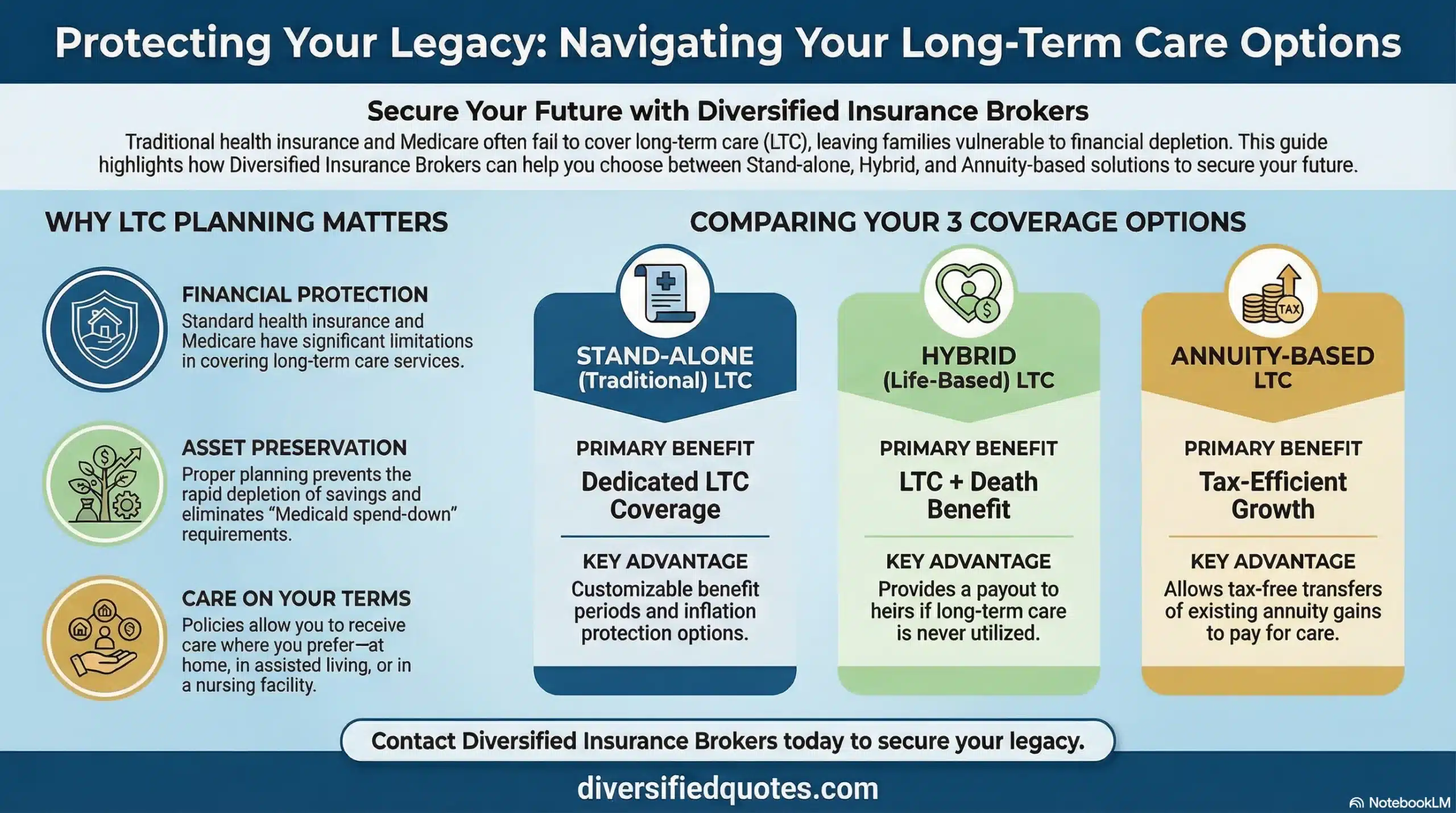
Traditional long-term care insurance can feel like a gamble — if you do not use it, you lose it. Hybrid long-term care insurance was designed to eliminate that fear by combining long-term care coverage with either a life insurance policy or an annuity. Instead of paying premiums for decades and hoping you never need the benefit, hybrid coverage ensures that your dollars will create value one way or another. If you require care, the policy pays for it. If you never need care, your family receives a death benefit or the policy retains meaningful value. That outcome certainty is why hybrid long-term care planning has become one of the fastest-growing segments in retirement protection today.

Compare Hybrid vs. Traditional Long-Term Care Options
See side-by-side illustrations of life-based and annuity-based hybrid LTC plans tailored to your age, health, and assets.
Start Your LTC ReviewHybrid LTC vs. Traditional LTC vs. Self-Insurance — The Core Comparison
| Feature | Hybrid LTC Insurance | Traditional LTC Insurance | Self-Insurance (No Policy) |
|---|---|---|---|
| If Care Is Needed | Policy pays monthly long-term care benefits — typically a multiple of the original premium. Benefits can be used for home care, assisted living, memory care, or skilled nursing. Death benefit reduces as LTC benefits are paid. | Policy pays daily or monthly benefits for qualifying care services. For identical benefit amounts, traditional coverage often provides the highest leverage per premium dollar — particularly in early years before hybrid break-even. | Portfolio assets are liquidated to fund care costs. At $7,000–$12,000+ per month for facility care, even substantial portfolios can be materially depleted over a 2–5 year care event. No leverage — every dollar of care is a dollar out of the estate. |
| If Care Is Never Needed | Life-based hybrid: death benefit passes to named beneficiaries — often income-tax-free. Annuity-based hybrid: accumulated annuity value remains accessible or passes to beneficiaries per contract terms. No premiums “lost.” | “Use it or lose it” — no residual benefit for heirs if care is never required. Premiums paid over many years produce no legacy value when care events do not occur. This is the most cited objection to traditional LTC coverage. | All assets retained — no premium cost and full portfolio value available for heirs if care is never needed. The self-insurer benefits maximally in this scenario but bears all risk in the care-needed scenario. |
| Premium Structure | Single premium or limited-pay (5-pay, 10-pay) — defined, finite commitment. No ongoing annual premium obligation after the payment period. Psychological clarity: you know when you are “done paying.” | Ongoing annual or monthly premiums — may extend for many years. While modern policies are more stable than older generations, carrier history of rate adjustments weighs on consumer confidence in indefinite premium obligations. | No premium — zero annual cost. The self-insurance “cost” is invisible until care occurs, at which point the out-of-pocket cost can be catastrophically high relative to what any insurance product would have cost. |
| Tax Treatment | LTC benefits generally received income-tax-free when structured properly. Life insurance death benefit passes income-tax-free to beneficiaries. Annuity-based hybrids preserve tax-deferred growth with potentially enhanced distribution treatment for qualified LTC expenses. | LTC benefits generally received income-tax-free when structured under qualified HIPAA guidelines. Premium may be partially deductible above certain age-based thresholds if itemizing and meeting the adjusted gross income threshold. | No premium tax considerations. Portfolio liquidations to fund care may trigger capital gains, required minimum distribution complications, and accelerated tax recognition — particularly from qualified accounts where all distributions are taxable as ordinary income. |
| Premium Stability | Fixed and guaranteed at issue for the payment period — no rate increase risk once the policy is issued. Single-pay and limited-pay structures eliminate future premium adjustment exposure entirely. | Premiums may be subject to future rate adjustments with state regulatory approval. Modern policies are structured more conservatively than older generations, but rate adjustment risk is a real and documented feature of the traditional LTC market. | No premium — no rate increase risk. The “rate” is simply the cost of care when it occurs, which historically increases significantly over time as healthcare costs rise faster than general inflation. |
| Best Suited For | Asset-conscious retirees who want care protection without premium waste; estate-focused households wanting dual-purpose coverage; those repositioning idle conservative assets; buyers with premium certainty as a priority. | Buyers focused on maximum care benefit leverage per annual premium dollar; those who are comfortable with the use-it-or-lose-it structure; applicants in good health seeking the highest monthly benefit for the lowest current outlay. | Individuals with very substantial liquid net worth who can genuinely absorb multi-year facility care costs without disrupting retirement income or legacy goals. Appropriate for a much smaller segment than typically assumes they can self-insure. |
Why Hybrid Coverage Addresses the Core Objection to Traditional LTC Insurance
For many families, the hesitation around traditional long-term care coverage is not about denying the risk — it is about efficiency. People understand that extended care, whether at home, in assisted living, or in a nursing facility, can cost hundreds of thousands of dollars over time. They also understand that Medicare does not cover ongoing custodial care. Yet they hesitate because they do not want to commit large premium dollars to something that might never be used. Hybrid long-term care insurance addresses that exact concern by repositioning assets in a way that creates leverage for care while preserving wealth if care is never needed. Instead of “use it or lose it,” the structure becomes “use it or leave it.”
The Three Possible Outcomes — and How Hybrid Coverage Addresses Each
In practice, hybrid long-term care insurance integrates long-term care benefits into either a life insurance chassis or an annuity contract. Many policies are funded with a single premium or a limited payment schedule rather than open-ended lifetime premiums. The result is predictability: you know what you are committing, you know what the minimum benefits will be, and you know that the policy cannot simply evaporate without value. The real power of hybrid coverage becomes clear when you examine the three possible outcomes every policy is designed to address. First, if you need long-term care, the policy activates and pays benefits based on the structure selected at issue — usable for home health care, adult day care, assisted living, memory care, or skilled nursing depending on policy terms. Second, if you never require long-term care, the life insurance-based hybrid pays a death benefit to beneficiaries, often income-tax-free. Third, many policies provide access to cash value or return-of-premium features if circumstances change and liquidity is needed. No matter which path life takes, the policy is structured to deliver something tangible.
Life-Based Hybrids vs. Annuity-Based Hybrids — Choosing the Right Structure
Life insurance-based hybrid long-term care policies are particularly attractive for individuals who prioritize legacy and estate continuity. In these structures, the base of the policy is a permanent life insurance contract. Long-term care benefits are attached as riders that allow acceleration of the death benefit for qualified care expenses. If care is needed, the death benefit is reduced as benefits are paid. If care is never required, the full remaining death benefit passes to heirs. Some policies also offer extension riders that multiply the available long-term care pool beyond the original face amount, providing additional leverage for extended care scenarios.
Annuity-based hybrid long-term care policies serve a slightly different purpose. These designs are often used when individuals already hold conservative assets — such as CDs, savings, or existing non-qualified annuities — that are earning modest returns. By repositioning those assets into an annuity with a long-term care rider, policyholders can create a multiple of their original deposit for care needs while maintaining tax-deferred growth on unused funds. For retirees with idle conservative assets, the non-qualified long-term care annuity structure explains exactly how this repositioning works and what the tax treatment of LTC benefits from annuity contracts involves. If long-term care is never required, the annuity value remains available or passes to beneficiaries according to contract terms.
Tax Advantages, Funding Structures, and Couple Planning
Tax considerations also play a role in hybrid planning. Long-term care benefits are generally received income-tax-free when structured properly. Life insurance death benefits typically pass income-tax-free to named beneficiaries. Annuity-based hybrids preserve tax deferral on growth while potentially enhancing distributions used for qualified long-term care expenses. Understanding the tax advantages of long-term care insurance and hybrid policies — including the interaction between current tax law and asset structure — can meaningfully influence overall retirement efficiency, which is why hybrid LTC is often integrated into broader estate and income planning strategies rather than purchased in isolation.
Couples frequently find hybrid long-term care insurance especially compelling. Statistically, there is a strong likelihood that at least one spouse will require some form of extended care during retirement. Hybrid designs may offer shared benefit options, survivorship protections, or coordinated coverage that allows benefits to be accessed flexibly — adapting to whichever spouse needs care first, or potentially both. The comparison between hybrid LTC designs for couples vs. individual policies is covered in depth in our resource on long-term care insurance for couples.
Underwriting, Carrier Selection, and When to Act
Underwriting remains a critical factor in any long-term care planning decision. Approval is not based solely on age but on functional independence, cognitive clarity, and overall health profile. Insurers evaluate medical history, prescription use, mobility, recent falls, and assistance with activities of daily living. Because underwriting standards vary by carrier, working with an independent brokerage that represents multiple companies can significantly improve approval outcomes. Hybrid policies sometimes offer more flexible underwriting pathways than traditional standalone long-term care contracts, particularly in asset-based designs, though eligibility still depends on individual health circumstances. Our long-term care insurance services cover how we approach carrier selection and pre-screening for complex health profiles to maximize approval probability before any formal application is submitted.
Hybrid long-term care insurance is particularly well-suited for individuals who have accumulated meaningful savings and want to protect those assets from erosion due to extended care expenses. It is also appropriate for those who are concerned about the “use it or lose it” structure of traditional coverage, those with idle conservative assets earning modest returns, and estate-focused households who want dual-purpose coverage serving both care protection and wealth transfer. At Diversified Insurance Brokers, our approach is consultative rather than transactional. We evaluate age, health, asset structure, liquidity needs, income sources, and estate intentions before recommending a specific design. Because we represent numerous top-rated carriers, we are able to compare policy structures side by side. Working with an independent long-term care insurance broker rather than a captive agent provides access to the full marketplace and ensures the comparison reflects the competitive range of available structures.
Ready to see actual numbers on hybrid LTC options for your specific situation?
Request Your Personalized LTC Plan Review
Financial Protection Essentials
Explore annuity interest examples across different investment sizes along with professional disability insurance options and long-term care planning resources.
Talk With an Advisor Today
Choose how you’d like to connect—call or message us, then book a time that works for you.
Schedule here:
calendly.com/jason-dibcompanies/diversified-quotes
Licensed in all 50 states • Fiduciary, family-owned since 1980
How does a hybrid LTC policy differ from just buying a life insurance policy with a chronic illness rider?
This is one of the most important structural distinctions in the hybrid LTC marketplace, and the terminology is often used interchangeably in ways that obscure a meaningful difference. A chronic illness rider on a life insurance policy allows acceleration of the death benefit when the insured meets a chronic illness definition — typically inability to perform two or more activities of daily living or cognitive impairment — but the acceleration is often subject to actuarial discounting. Depending on the carrier and policy, the accelerated amount may be a discounted present value of the death benefit rather than the full face amount, meaning you may receive less than the face amount in total over the life of the claim. A true hybrid long-term care policy — structured as an extension of benefits rider or a separate LTC rider — typically provides an independent long-term care benefit pool that is separate from the death benefit rather than an acceleration of it. This distinction matters: in a true hybrid, using LTC benefits reduces the death benefit by the amount paid, but the LTC pool can be extended beyond the original face amount through multipliers or extension riders, while the chronic illness rider on a standard life policy typically cannot exceed the face amount. When comparing policies, confirm whether the LTC benefit is an acceleration of the death benefit (which limits the total available benefit to the face amount) or an independent LTC pool with potential for extension beyond the face amount. Our guide on working with an independent LTC broker explains why carrier selection and policy structure language require specialist knowledge to evaluate correctly.
Can I use a 1035 exchange from an existing life insurance or annuity to fund a hybrid LTC policy?
Yes — this is one of the most commonly used funding strategies for hybrid LTC policies, and one of the most tax-efficient. Section 1035 of the Internal Revenue Code permits tax-free exchanges between certain insurance and annuity contracts, and this provision extends to exchanges into qualified long-term care insurance contracts. An existing life insurance policy with accumulated cash value can be exchanged into a hybrid life/LTC policy without triggering income tax on the gain that has accumulated inside the life policy. Similarly, an existing non-qualified annuity with significant deferred gain can often be exchanged into an annuity-based hybrid LTC contract or into a non-qualified LTC annuity structure under Section 1035 without recognizing the accumulated gain as current income. The practical impact: a retiree with $200,000 in an existing annuity that has $80,000 in accumulated gain can reposition that $200,000 into a hybrid LTC structure — maintaining the full $200,000 as the new policy’s funded value and creating a multiple of that in LTC coverage — without paying the income tax on the $80,000 gain that would have been due if the annuity were simply surrendered. Additionally, under the Pension Protection Act, distributions from non-qualified annuities used to pay for qualified long-term care insurance premiums or qualifying hybrid LTC policies may receive favorable tax treatment on the gain portion. Coordinating the 1035 exchange structure and the Pension Protection Act provisions with a tax advisor and an independent LTC broker ensures the maximum tax efficiency of the repositioning.
Is hybrid LTC insurance available if I have health conditions that previously caused issues with traditional LTC underwriting?
In many cases, yes — hybrid LTC policies often have more flexible underwriting pathways than traditional standalone LTC insurance, particularly the asset-based annuity-funded designs. Traditional LTC insurance uses detailed health history review, prescription database checks, and in some cases in-person assessments. Asset-based hybrid LTC structures — particularly those funded through annuity contracts — may underwrite based on simplified health criteria that accept a broader range of health profiles. This is particularly relevant for applicants who may have been declined or rated by traditional LTC carriers due to conditions that are common in the 60s and early 70s. That said, hybrid policies are not universally simplified issue — life insurance-based hybrid products still involve full underwriting on the life insurance component, which means health conditions that affected life insurance eligibility will also affect hybrid life/LTC eligibility. The key variable is which product type is the right fit for the applicant’s specific health profile: an annuity-funded hybrid may be available to applicants who cannot qualify for a life-based hybrid. Our resource on long-term care insurance services covers how we pre-screen health history against multiple carrier guidelines before any formal application is submitted — identifying which carriers and which product types are most likely to produce approval for the specific health profile rather than submitting blind applications that create decline records.
How should couples structure hybrid LTC coverage — together or separately?
The couple coverage question has no universal answer because the optimal structure depends on the health profiles of both spouses, the relative probability of each needing care, the budget available, and the legacy goals of the household. Two distinct approaches are most common. The first is separate individual policies for each spouse — each policy is underwritten independently, provides its own benefit pool, and serves each spouse’s specific care needs. The advantage is independent coverage that is not affected by the other spouse’s care usage. The disadvantage is potentially higher combined cost than joint designs. The second approach is joint or shared benefit designs, where a combined benefit pool can be drawn by either spouse, or where one spouse’s unused benefits can flow to the other. This is particularly valuable when health histories differ significantly — if one spouse has higher LTC risk, the shared pool ensures the lower-risk spouse’s potential unused benefit is available for the higher-risk spouse rather than sitting idle. Our resource on long-term care insurance for couples covers the specific design options, including shared benefit pools and how hybrid structures integrate for two-person households. For couples where one spouse cannot qualify medically for traditional or life-based hybrid coverage, combining an annuity-based hybrid for the higher-risk spouse with a life-based hybrid for the lower-risk spouse may provide comprehensive coverage across the household while working within each spouse’s underwriting eligibility.
What happens to a hybrid LTC policy if I need to access the cash value for another purpose?
Most hybrid LTC policies are designed with some form of residual value access, though the specific mechanics vary by product type and carrier. Life insurance-based hybrids typically include a return-of-premium provision — allowing the policyholder to surrender the policy for a defined percentage of premiums paid, often 50% to 100% depending on the policy year, if the coverage is no longer wanted or needed. This provision is what distinguishes hybrid coverage from traditional LTC insurance on the “no waste” dimension: even if care is never needed and the policy is surrendered, a portion of the invested premium is recovered. Return of premium provisions vary significantly in how they are structured — some policies guarantee full return of premium at any point; others have declining schedules or are only available after a minimum holding period. Annuity-based hybrids retain the underlying annuity cash value throughout the contract — if LTC benefits are never used, the full annuity value (plus credited growth) remains accessible subject to standard annuity surrender provisions. If a cash emergency arises during the surrender period, the standard annuity free withdrawal provisions — typically 10% annually — allow partial access without surrender charges. Reviewing the specific return of premium terms and liquidity provisions before purchase ensures the hybrid policy selected matches the policyholder’s liquidity needs alongside its care protection and legacy objectives.
About the Author:
Jason Stolz, CLTC, CRPC, DIA, CAA and Chief Underwriter at Diversified Insurance Brokers (NPN 20471358), is a senior insurance and retirement professional with more than 25 years of real-world experience helping individuals, families, and business owners protect their income, assets, and long-term financial stability. As a long-time partner of the nationally licensed independent agency Diversified Insurance Brokers, Jason provides trusted guidance across multiple specialties—including fixed and indexed annuities, long-term care planning, personal and business disability insurance, life insurance solutions, Group Health, Travel Medical and Evacuation Insurance, and short-term health coverage. Diversified Insurance Brokers maintains active contracts with over 100 highly rated insurance carriers, ensuring clients have access to a broad and competitive marketplace.
His practical, education-first approach has earned recognition in publications such as VoyageATL, and contributions from his agency featured in Kiplinger and GoBankingRates— highlighting his commitment to financial clarity and client-focused planning. Drawing on deep product knowledge and years of hands-on field experience, Jason helps clients evaluate carriers, compare strategies, and build retirement and protection plans that are both secure and cost-efficient. Visitors who want to explore current annuity rates and compare options across multiple insurers can also use this annuity quote and comparison tool.
Explore More Long Term Care Insurance Options: Browse our complete guide to Hybrid & Annuity LTC Policies — covering hybrid life insurance, annuities with LTC benefits & linked benefit policies from top carriers.
Last Reviewed: June 25, 2026 |
Reviewed by: Jason Stolz, CLTC, CRPC, DIA, CAA
Chief Underwriter, Diversified Insurance Brokers, Inc. | NPN: 20471358 | Diversified Insurance Brokers, Inc. — Licensed in all 50 states
Fact Checked by: Tonia Pettitt, CMIP©
Medicare Specialist, Diversified Insurance Brokers, Inc. | NPN: 14374308 | Diversified Insurance Brokers, Inc. — Licensed in all 50 states
Did you find this content helpful? Leave us a Google review — it helps others find trustworthy guidance too.
Editorial Standards: Diversified Insurance Brokers maintains rigorous editorial standards to ensure accuracy, clarity, and independence in all content. Learn more about our editorial standards and commitment to transparency.
