
Why Work with an Independent Long Term Care Insurance Broker
As an Independent Long Term Care Insurance Broker, we compare traditional, hybrid, and partnership-qualified policies across dozens of carriers to find the structure that actually fits your situation.
Why Work with an Independent Long Term Care Insurance Broker

Jason Stolz CLTC, CRPC, DIA, CAA
Long-term care planning is one of the most consequential financial decisions individuals and families make as they approach retirement. The cost of extended care — whether provided at home, in an assisted living community, or in a nursing facility — can place significant financial pressure on retirement savings that took decades to accumulate. A 2025 study by the Center for Retirement Research at Boston College found that 80% of adults 65 and older will need long-term care at some point, yet most households enter retirement without a funded plan to address it. Long-term care insurance is designed to help protect assets and provide financial resources if care becomes necessary — and because these policies are complex and vary significantly between carriers, working with an independent long-term care insurance broker is one of the most effective ways to navigate the evaluation and selection process.
An independent broker works with multiple insurance companies rather than representing a single carrier. This matters enormously in long-term care planning because no single carrier dominates every planning situation — different insurers offer different strengths in policy design, underwriting flexibility, benefit structure, and financial stability, and the right fit depends on the individual’s health profile, budget, benefit priorities, and timeline. An independent broker can compare options across the full market rather than being limited to whatever one company offers. For retirees who are already evaluating other aspects of financial planning — including questions about whether specific institutions like well-known investment companies are a good fit for their portfolios — long-term care insurance plays a distinct and complementary role: protecting retirement assets from being consumed by healthcare expenses rather than growing them.
Key Advantages of an Independent Long-Term Care Insurance Broker
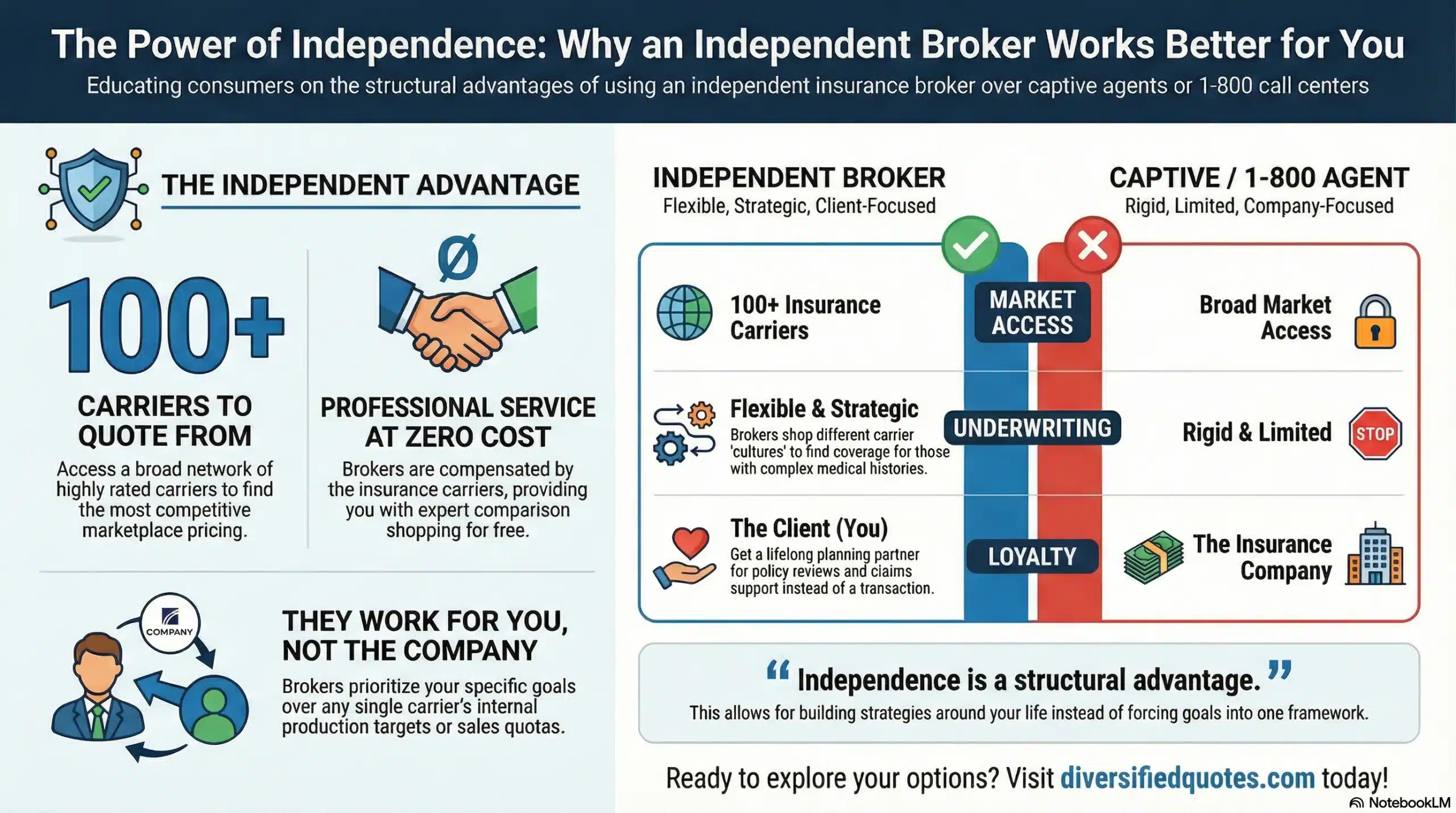
Before examining each advantage in depth, the table below maps the primary ways an independent broker differs from a captive or single-carrier agent — so the value of independence in this specific product category is clear before diving into the details.
| Broker Type | Carrier Access | Underwriting Flexibility | Comparison Objectivity |
|---|---|---|---|
| Independent Long-Term Care Broker | Multiple carriers — traditional LTC, hybrid life/LTC, and annuity-based LTC products | Can shop health profile across carriers to find the best underwriting fit for the applicant’s specific medical history | No loyalty to any single carrier — recommendation driven entirely by what fits the client’s goals and budget |
| Captive or Single-Carrier Agent | Limited to one company’s product lineup — if the carrier’s products don’t fit the client, no alternative is offered | No ability to place business with a more favorable underwriter if the one carrier declines or rates up | Inherent conflict: agent is compensated only by placing the single carrier’s products regardless of fit |
| Bank or Financial Institution Representative | Often limited to a preferred carrier relationship or a small panel of carriers selected by the institution | Limited ability to shop underwriting across the broader market | Institution may receive override compensation or preferred status from certain carriers, affecting objectivity |
| Online Quote Platform (No Advisor) | May display rates from multiple carriers but typically cannot provide underwriting guidance or help applicants navigate health-based decisions | No professional guidance on which carrier is most likely to approve a specific health profile at the best rate class | Rate comparisons without context — does not account for how policy design differences affect real-world claim experience |
Access to Multiple Long-Term Care Insurance Carriers
One of the biggest advantages of working with an independent long-term care insurance broker is the ability to compare coverage from multiple insurance companies. Long-term care policies are issued by a variety of insurers, and each carrier structures its products differently — in terms of benefit triggers, benefit period options, inflation protection designs, elimination periods, and premium stability history. Some insurers focus on traditional long-term care policies that reimburse expenses for qualified care services. Others offer hybrid policies that combine life insurance or annuities with long-term care benefits, providing a return on premium or death benefit even if care is never needed. By working with multiple carriers, an independent broker can compare both traditional and hybrid designs rather than defaulting to whatever a single company offers.
Insurance companies also vary significantly in underwriting guidelines — which matters practically for applicants who have any medical history. Over 60% of long-term care carriers now use six or more data inputs in their underwriting processes, including pharmacy checks, cognitive assessments, and predictive analytics, according to a 2026 EY industry study. That sophistication means that a health condition that one carrier rates up significantly may be acceptable at standard rates at a different carrier. An independent broker understands these differences across carriers and can help match an applicant’s specific health profile to the insurer most likely to offer the best terms. Evaluating insurer stability is also important — just as individuals research insurance company financial strength and reputation before purchasing any major policy, an independent broker helps identify carriers with strong financial ratings and a demonstrated record of handling long-term care claims fairly.
Objective Policy Comparisons
Because independent brokers are not limited to a single insurance company, they can provide objective comparisons between multiple policy designs — which is especially important for long-term care insurance because small differences in policy structure can significantly affect how benefits function during an actual claim. Daily benefit amounts, benefit periods, inflation protection options, elimination periods, and benefit triggers for care eligibility can all vary meaningfully between carriers offering nominally similar policies. A policy with a 90-day elimination period and 3% compound inflation protection behaves very differently over a 25-year retirement than one with a 30-day elimination period and simple inflation, even if the quoted premium looks similar at purchase. An experienced independent broker helps clients see those differences in concrete terms rather than abstract policy language.
Understanding how insurance contracts interact with retirement assets is also an important part of the broader planning picture. Some retirees coordinate long-term care strategies alongside income products when building their overall financial plan — learning how annuity beneficiaries work, how fixed indexed annuities with income riders create guaranteed cash flow, and how long-term care coverage fits alongside those income streams to protect the plan if extended care becomes necessary. An independent broker who works across both insurance and retirement planning disciplines is positioned to help clients see how all of these pieces fit together rather than evaluating long-term care in isolation.
Understanding Long-Term Care Policy Features
Long-term care insurance policies include several important features that determine how coverage works — and an independent broker’s job is to help clients understand those features in practical terms rather than policy jargon. The benefit period determines how long the policy will pay for care services: some policies provide coverage for a fixed number of years (commonly two, three, or five years), while others offer unlimited lifetime benefits. The elimination period is the waiting period before benefits begin — typically 30, 60, or 90 days of paid care expenses — functioning similarly to a deductible in how it affects the out-of-pocket cost before coverage kicks in. Shared care riders on joint policies allow a married couple to share a combined pool of benefits, which can significantly extend coverage if one spouse requires more care than the other.
Inflation protection is among the most critical features to evaluate when purchasing long-term care insurance. Because healthcare costs consistently rise over time, a policy purchased today may cover considerably less of actual care costs in 20 or 25 years if the daily benefit amount doesn’t keep pace with inflation. Compound inflation riders — which increase the daily benefit by a percentage compounded annually — typically provide the most meaningful protection for younger buyers who purchase coverage decades before they may need it. Some retirees also evaluate how the government pension offset and other retirement income factors affect their ability to self-fund care costs, which helps clarify how much private insurance coverage is actually needed to protect the plan.
Helping Protect Retirement Assets
One of the primary reasons people purchase long-term care insurance is to protect retirement savings from the potentially high cost of extended care. Nursing home stays, assisted living facilities, and in-home care services can be expensive — especially if care is required for several years. According to Genworth’s cost of care data, median annual nursing home costs for a private room now exceed $100,000 in most U.S. markets, and many retirees require care for two to five years or more. Without insurance coverage, individuals may be forced to draw down retirement savings or sell assets to pay for care. Long-term care insurance offsets these costs and allows retirees to preserve their savings for other financial goals — or preserve assets for beneficiaries.
Some individuals also integrate inheritance planning with long-term care coverage evaluation. Understanding how assets such as inherited non-qualified annuities and inherited qualified annuities are structured helps families coordinate wealth transfer strategies alongside healthcare expense protection — so that long-term care costs don’t eliminate what was intended to pass to the next generation.
Guidance Through the Underwriting Process
Long-term care insurance typically requires medical underwriting. Insurance companies evaluate health history, medications, and other risk factors before approving coverage — and the underwriting process has become increasingly sophisticated. An experienced independent broker helps clients prepare for this process by explaining underwriting requirements in advance, helping gather the documentation insurers typically request, and setting realistic expectations about timing and outcomes. Because underwriting guidelines differ significantly between carriers, a broker who works across the full market can also help identify which insurer is most likely to be favorable for a specific health profile before any application is submitted — avoiding the risk of a decline from one carrier making it harder to obtain coverage from another.
Some individuals explore supplemental health coverage options alongside long-term care planning when thinking about healthcare costs in retirement more broadly. Programs such as Medicare supplement plans may complement long-term care strategies by helping manage other medical expenses — since Medicare does not cover extended custodial care and Medicare supplement plans fill gaps in Medicare’s acute-care coverage rather than providing long-term care benefits. Understanding where Medicare ends and long-term care insurance begins is one of the most common clarifications an independent broker provides.
Coordinating Long-Term Care Insurance With Retirement Planning
Long-term care insurance should not be evaluated in isolation — it is most effective when integrated into a broader retirement planning strategy that accounts for retirement income, Social Security benefits, estate planning goals, and the household’s overall approach to risk. The question is not simply “should I buy long-term care insurance?” but “how does this coverage interact with everything else in the retirement plan, and what happens to the plan if care costs are not covered?” That planning lens — evaluating the interaction rather than the product in isolation — is where an experienced independent broker adds the most value compared to a product-first sales approach.
Life insurance products that include long-term care components through riders or return-of-premium hybrid designs often overlap with other estate planning tools. For example, individuals who own modified endowment contracts or split-dollar insurance arrangements may need to coordinate those structures with long-term care planning to ensure the full financial plan works coherently. Independent brokers help clients understand how long-term care coverage interacts with these broader financial structures so that decisions in one area don’t inadvertently create problems in another.
Ongoing Support After the Policy Is Issued
The value of working with an independent long-term care insurance broker does not end once a policy is purchased. Brokers continue assisting clients throughout the life of the policy by explaining annual premium notices, reviewing coverage options if a client’s needs change, and helping coordinate claims when long-term care services are actually needed. Having a knowledgeable advisor who understands the specific policy structure can make a significant difference during the claims process — which is often stressful for both the policyholder and family members, particularly when cognitive decline or physical limitation makes self-advocacy difficult. Independent brokers often act as advocates for their clients during claims, helping them understand how benefits apply, ensuring claims are submitted with the correct documentation, and working with the carrier when questions or disputes arise. That ongoing relationship — not just the initial sale — is what distinguishes a professional advisory relationship from a transactional policy purchase. Some clients also discover supplemental coverage gaps after purchase that can be addressed through riders or separate policies, and an independent broker is positioned to identify and address those gaps across multiple carriers rather than being limited to one company’s solutions. For clients evaluating outpatient surgery and rehabilitation riders as part of their broader health coverage picture, that multi-carrier perspective is especially relevant.
Related Pages
Talk With an Advisor Today
Choose how you’d like to connect—call or message us, then book a time that works for you.
Schedule here:
calendly.com/jason-dibcompanies/diversified-quotes
Licensed in all 50 states • Fiduciary, family-owned since 1980
FAQs: Why Work With an Independent Long-Term Care Insurance Broker?
What is the difference between an independent long-term care broker and a captive agent?
An independent long-term care insurance broker works with multiple insurance companies and is not contractually limited to placing business with a single carrier. A captive or single-carrier agent represents one company and can only offer that company’s products, regardless of whether they represent the best fit for the client’s health profile, budget, or coverage goals. In long-term care insurance specifically, this distinction matters more than in many other product categories because no single carrier dominates every planning situation. Underwriting guidelines, benefit designs, premium stability histories, and financial strength ratings vary significantly across the carriers that offer long-term care coverage. An independent broker can shop an applicant’s health profile across multiple carriers to find the most favorable underwriting outcome, compare traditional and hybrid policy designs objectively, and recommend coverage based entirely on what fits the client — not what generates the most commission from a single company relationship. The ability to represent carriers that offer traditional reimbursement policies, hybrid life/LTC designs, and annuity-based LTC products gives an independent broker the flexibility to match the solution to the planning need rather than fitting the client’s need to a single product.
What long-term care policy features matter most?
The features that have the most meaningful impact on how a long-term care policy performs during an actual claim are the benefit period, the daily or monthly benefit amount, the inflation protection design, and the elimination period. The benefit period determines how long the policy pays for care — whether two years, five years, or an unlimited lifetime benefit. The daily benefit amount determines how much the policy pays per day of covered care, and whether that amount is adequate in your geographic market. Inflation protection is arguably the most critical feature for buyers who are decades from needing care, because the cost of long-term care services rises consistently over time — a policy with compound inflation protection maintains its purchasing power in a way that a simple or no-inflation design does not. The elimination period is the waiting period before benefits begin, functioning like a deductible: a longer elimination period typically reduces the premium but increases the out-of-pocket cost before coverage activates. Shared care riders on joint policies are also highly valuable for married couples because they allow a combined benefit pool that one spouse can use more than the other if care needs are unequal. Understanding how these features interact with each other — and with the rest of the retirement income plan — is one of the primary reasons working with an experienced independent broker produces better outcomes than purchasing a policy without professional guidance.
When is the best time to purchase long-term care insurance?
The best time to purchase long-term care insurance is when you are still healthy enough to qualify for coverage at favorable underwriting rates — typically in your mid-50s to early 60s, before age-related health conditions make approval more difficult or premiums significantly higher. Waiting too long reduces options in two compounding ways: premiums increase with age, and health conditions that accumulate over time can result in rate-ups, modified offers, or outright declines. A 2025 study by the Center for Retirement Research at Boston College found that 80% of adults 65 and older will need long-term care at some point — which means the probability of needing the coverage is high, but the ability to obtain it at favorable terms diminishes with each year of delay. Hybrid long-term care policies that combine life insurance or annuity benefits with long-term care coverage have somewhat more flexible underwriting than traditional standalone LTC policies in some cases, but still require medical underwriting — applicants with dementia, Parkinson’s disease, or who already require assistance with activities of daily living are typically ineligible. The practical message is consistent across all product types: apply while healthy. An independent broker can also help identify the right carrier for a specific health situation when there is a condition present, since underwriting flexibility varies meaningfully across carriers in how they evaluate specific medical histories.
Does Medicare pay for long-term care?
Medicare does not cover extended custodial care — the type of ongoing assistance with activities of daily living that constitutes the majority of long-term care needs. Medicare covers skilled nursing facility care only under specific and limited conditions: following a qualifying hospital stay of at least three days, for a maximum of 100 days per benefit period, and only while the patient requires and receives skilled nursing or rehabilitation services. Once the skilled care need ends, Medicare coverage stops — even if the patient still requires custodial care assistance. Medicare supplement plans, sometimes called Medigap policies, fill gaps in Medicare’s acute-care coverage — such as hospital coinsurance and Part B deductibles — but they do not add long-term care coverage. This is one of the most significant misunderstandings in retirement healthcare planning: many retirees assume Medicare or their Medicare supplement will cover nursing home or assisted living costs, only to discover at the time of need that neither does. Medicare supplement plans are valuable tools for managing medical expenses in retirement, but they complement long-term care insurance rather than replacing it. Understanding this distinction is foundational to building a complete retirement healthcare protection strategy.
About the Author:
Jason Stolz, CLTC, CRPC, DIA, CAA and Chief Underwriter at Diversified Insurance Brokers (NPN 20471358), is a senior insurance and retirement professional with more than 25 years of real-world experience helping individuals, families, and business owners protect their income, assets, and long-term financial stability. As a long-time partner of the nationally licensed independent agency Diversified Insurance Brokers, Jason provides trusted guidance across multiple specialties—including fixed and indexed annuities, long-term care planning, personal and business disability insurance, life insurance solutions, Group Health, Travel Medical and Evacuation Insurance, and short-term health coverage. Diversified Insurance Brokers maintains active contracts with over 100 highly rated insurance carriers, ensuring clients have access to a broad and competitive marketplace.
His practical, education-first approach has earned recognition in publications such as VoyageATL, and contributions from his agency featured in Kiplinger and GoBankingRates— highlighting his commitment to financial clarity and client-focused planning. Drawing on deep product knowledge and years of hands-on field experience, Jason helps clients evaluate carriers, compare strategies, and build retirement and protection plans that are both secure and cost-efficient. Visitors who want to explore current annuity rates and compare options across multiple insurers can also use this annuity quote and comparison tool.
Explore More Long Term Care Insurance Options: Browse our complete guide to How to Buy, Qualify & Coverage Details — covering how to buy, who qualifies, policy types, shared benefits, partnership plans & more from top carriers.
Last Reviewed: June 20, 2026 |
Reviewed by: Jason Stolz, CLTC, CRPC, DIA, CAA
Chief Underwriter, Diversified Insurance Brokers, Inc. | NPN: 20471358 | Diversified Insurance Brokers, Inc. — Licensed in all 50 states
Fact Checked by: Tonia Pettitt, CMIP©
Medicare Specialist, Diversified Insurance Brokers, Inc. | NPN: 14374308 | Diversified Insurance Brokers, Inc. — Licensed in all 50 states
Did you find this content helpful? Leave us a Google review — it helps others find trustworthy guidance too.
Editorial Standards: Diversified Insurance Brokers maintains rigorous editorial standards to ensure accuracy, clarity, and independence in all content. Learn more about our editorial standards and commitment to transparency.
