
EquiTrust MarketForce Bonus – 8% Bonus, Index Growth & Retirement Security
EquiTrust MarketForce Bonus – 8% Bonus, Index Growth & Retirement Security
At Diversified Insurance Brokers, we specialize in helping individuals secure customized annuity strategies that combine market participation with principal protection and long-term financial clarity. The EquiTrust MarketForce Bonus Index Annuity, issued by EquiTrust Life Insurance Company (AM Best: B++ Good, stable; S&P A- Strong; Fitch A- Strong; $23+ billion in assets; NAIC Complaint Index 0.21 — well below the 1.00 national average), is designed for retirement savers who want growth potential tied to market indices without direct exposure to market losses. For many pre-retirees and retirees, the challenge is balancing upside opportunity with downside protection. Traditional equities can deliver strong gains but come with volatility risk. Bonds may provide stability but often lack sufficient yield. Fixed indexed annuities like MarketForce attempt to bridge that gap by crediting interest based on index performance while guaranteeing that market downturns do not reduce principal due to negative returns. If you are evaluating how indexed annuities differ from fixed-rate options, reviewing what a fixed indexed annuity with an income rider is can help clarify how crediting strategies and income rider structures work together.

Carrier Note: EquiTrust Life Insurance Company currently holds an AM Best financial strength rating of B++ (Good) — the fifth highest of 13 AM Best rating categories — with a stable outlook. EquiTrust also holds A- (Strong) ratings from both S&P Global (as of July 2024) and Fitch (as of March 2024). While B++ reflects AM Best’s assessment of a good ability to meet policyholder obligations, it is one tier below the A- (Excellent) threshold that many conservative financial planners recommend as a minimum for long-term annuity commitments. Buyers who apply an A- or better standard to carrier selection should weigh this accordingly before committing. All guarantees in the MarketForce contract — including the 0% floor, the 8% premium bonus, and the death benefit — are backed solely by EquiTrust’s financial strength.
Ensure you are receiving the absolute top rates
Current Fixed Annuity Rates
Compare today’s best fixed annuity rates from top carriers.
Current Bonus Annuity Rates
See which annuities offer the highest upfront bonus today.
Request an Annuity Quote
Submit our annuity request form to get personalized rate options.
Lifetime Income Calculator
Use our calculator to see how much guaranteed income your annuity can provide.
EquiTrust MarketForce vs. Competing Bonus and Non-Bonus FIA Structures
| Dimension | EquiTrust MarketForce FIA | Non-Bonus FIA (A-Rated Carrier) | MYGA (Fixed Rate Annuity) |
|---|---|---|---|
| Premium Bonus | 8% applied to first-year contributions — immediately enhances contract value and amplifies both long-term accumulation and potential future income calculations. Bonus is subject to the vesting schedule of the surrender period; surrendering before vesting is complete may result in recapture of some or all of the bonus amount. | No upfront bonus — contract value begins at the premium amount on day one. No vesting recapture risk; the full accumulation reflects only actual indexed crediting plus principal. The absence of a bonus typically allows for higher ongoing cap rates or participation rates than bonus products from the same carrier tier. | No bonus structure — principal earns at the declared rate from day one. Maximum simplicity; contract value known at purchase for the full guarantee period. No bonus recapture risk regardless of when the contract is surrendered relative to the guarantee period maturity. |
| Principal Protection | Full — 0% floor on indexed accounts. Account value cannot decline due to negative index performance. The 8% bonus enhances the starting accumulation base, so the principal-plus-bonus total is the floor that the 0% protection applies to rather than just the original premium. | Full — 0% floor equivalent protection. Same structural mechanism; no market loss to principal. From A- rated or higher carriers, the contractual guarantee carries the additional financial strength backing that buyers who apply an A- minimum standard require. | Full — principal and declared interest guaranteed contractually for the full term. No index exposure of any kind. Rate known from day one; maximum certainty with no crediting formula complexity. |
| Index Strategy Menu | Multiple — S&P 500 and other diversified indices with cap rates, participation rates, and spread structures. Optional rate buy-up features may allow enhanced caps or participation rates in exchange for a declared charge. Annual reset locks in gains; negative years credit zero. | Multiple — similar cap-based and participation-rate strategies across major indexes from A-rated FIA competitors. Cap rates at A-rated carriers may be higher than bonus-product competitors because the carrier is not funding an upfront bonus from the options budget. | None — single declared rate. No strategy selection, no crediting formula, no renewal rate uncertainty during the guarantee period. Maximum simplicity at the cost of any indexed upside participation. |
| Carrier Strength | EquiTrust: AM Best B++ (Good), stable; S&P A- (Strong); Fitch A- (Strong); NAIC Complaint Index 0.21. B++ is one tier below the A- threshold many planners apply. S&P and Fitch both at A- provide a multi-agency partially offsetting view. See yellow disclosure above for full context. | A- or higher AM Best rated carrier — carriers like North American (A+), Midland National (A+), F&G (A), or Athene (A+) offer equivalent FIA accumulation structures at a higher AM Best tier, typically with comparable or superior cap and participation rate terms. | Varies — MYGA marketplace spans B++ through A++ rated carriers. Buyers who prioritize the highest available carrier strength alongside declared-rate certainty can access MYGA products from A+ rated carriers at the same or better declared rates. |
| Best Suited For | Buyers who place significant value on the immediate 8% bonus boost to the starting accumulation base, have evaluated the bonus vesting schedule and recapture provisions, and are comfortable with EquiTrust’s B++ AM Best rating and A- S&P/Fitch ratings as their carrier strength baseline. | Buyers who prioritize AM Best A- or higher carrier strength alongside indexed accumulation potential, and who prefer higher ongoing caps or participation rates over an upfront bonus — understanding that over a full 10-year surrender period, competitive cap rates may produce similar or better accumulation than a bonus product with lower caps. | Buyers who value maximum rate certainty and are not comfortable with indexed crediting formula uncertainty — specifically those who want to know the exact maturity value on day one regardless of how markets perform during the accumulation period. |
The 8% Premium Bonus — What It Is, What It Isn’t, and How to Evaluate It
The standout feature of the MarketForce Bonus Index Annuity is its 8% premium bonus applied to first-year contributions, which immediately enhances the contract value and can amplify both long-term accumulation and potential future income calculations. Bonuses are not free money in the sense that they are purely additive to the buyer’s economics with no offsetting cost. The bonus is funded by the carrier from the options budget — the same budget that determines cap rates and participation rates. This means that a bonus product from the same carrier will typically carry lower cap rates or participation rates than a comparable non-bonus product, because some of the options budget that would otherwise support higher crediting terms is used to fund the upfront bonus instead. The honest evaluation question is not “does the bonus make this product better?” but rather “over the full surrender period, does the total accumulation produced by the bonus product (lower ongoing credits + 8% head start) exceed the accumulation produced by a non-bonus competitor (higher ongoing credits + zero head start)?” Our resource on how bonus annuities compare covers this analytical framework in detail, including how to read a bonus annuity illustration and what to look for in the fine print around vesting schedules and recapture provisions. Additionally, the bonus may be vested over the surrender period — meaning if the contract is surrendered before the full vesting schedule completes, the unvested portion of the bonus may be recaptured by the carrier as part of the surrender adjustment. Confirming the full vesting schedule and recapture terms in the current MarketForce product documentation is a required due diligence step before any premium commitment.
Index Strategies, Rate Buy-Up Features, Liquidity, and Death Benefit
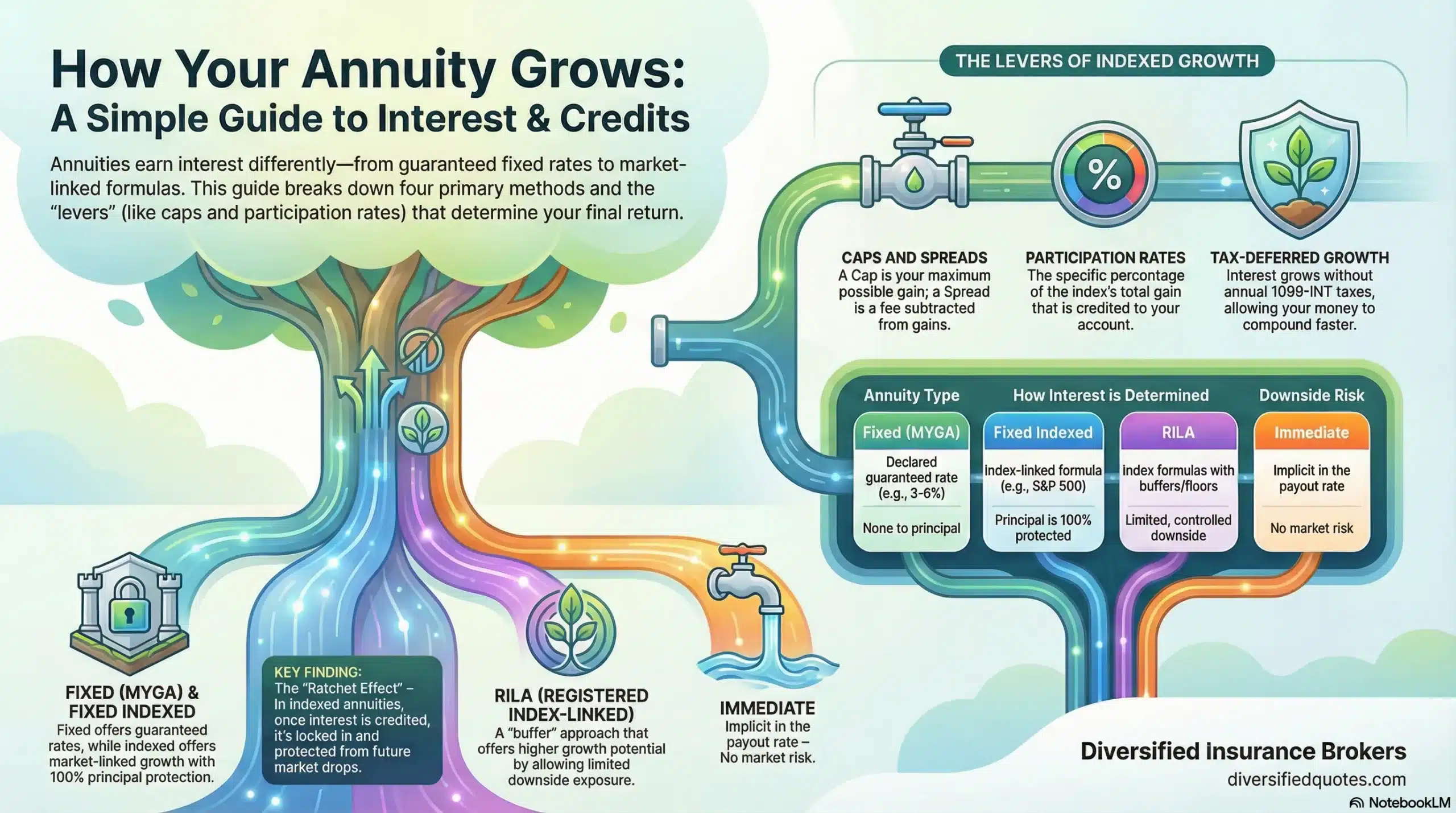
Beyond the bonus, MarketForce offers multiple index crediting strategies, including allocations tied to the S&P 500 and other diversified indices. Policyholders may choose from various cap rates, participation rates, and spread structures depending on the selected crediting method. Some strategies include optional rate buy-up features, which allow for enhanced caps or participation rates in exchange for a declared annual charge — potentially increasing upside opportunity for buyers who believe a sustained positive market environment makes the buy-up cost economical. Understanding how FIA crediting methods work — specifically the mechanics of cap-based versus participation-rate versus spread-based crediting, and how the rate buy-up feature adjusts the effective crediting terms — is foundational to evaluating whether the MarketForce’s specific index menu produces competitive credited interest in different market environments. Regardless of index performance, negative market years do not reduce principal due to index losses — the annual reset structure locks in prior gains and the 0% floor prevents any single year’s negative index performance from reducing the accumulated base. Understanding how the FIA crediting mechanism works at a product level ensures the 0% floor is correctly understood as a guarantee against index-caused losses, not against all possible reductions from fees or other contract charges.
Liquidity provisions are equally important. After the first contract year, policyholders may withdraw up to 10% of the contract value annually without surrender charges, providing measured access to funds while maintaining long-term growth potential. Understanding how annuity free withdrawal rules work alongside the bonus vesting schedule — specifically whether free withdrawals affect the unvested bonus amount or only the non-bonus accumulation portion — is a required product-level clarification before any large MarketForce commitment. Nursing home and terminal illness waivers may allow broader access in qualifying circumstances. A guaranteed death benefit ensures that beneficiaries receive the full accumulation value, avoiding probate in many cases and preserving the intended legacy transfer. Reviewing how annuity beneficiary death benefits work — including whether the full bonus-enhanced accumulation value is included in the death benefit, how the named beneficiary structure avoids probate, and what the 10-year payout rule means for non-spouse beneficiaries under SECURE 2.0 — provides the complete legacy planning context for the MarketForce structure.
Rollover Suitability, Tax Considerations, and Honest Carrier Evaluation
MarketForce is often considered by pre-retirees rolling over IRA or 401(k) assets who want downside protection combined with higher growth potential than traditional fixed annuities may provide. Understanding how to transfer a 401(k) to an annuity — including the direct rollover mechanics that avoid mandatory withholding and the tax treatment of the transfer — is the procedural foundation before any qualified rollover into the MarketForce. Understanding how annuity gains are taxed at distribution — the LIFO rule for non-qualified partial withdrawals, the ordinary income character of all gains, and the 10% early distribution penalty before age 59½ — ensures the tax planning around the MarketForce is accurate. For those evaluating fixed versus indexed options, comparing current fixed annuity rates alongside bonus-based indexed contracts clarifies the trade-offs between guaranteed declared rates and capped market participation. Some investors prefer the simplicity of fixed guarantees, while others are comfortable with indexed variability in exchange for potentially higher crediting. The right decision depends on liquidity needs, income timing, tax considerations, risk tolerance, and — critically — carrier financial strength standards. No annuity should be selected based solely on bonus percentage or marketing language.
Want to see how the 8% bonus and index strategies could impact your retirement timeline?
Request Your Personalized Annuity Quote
Related Pages
Explore additional retirement and annuity planning resources.
Financial Protection Essentials
Evaluate insurance costs, specialized coverage options, and financial protection strategies for unique professions and business structures.
Talk to an Advisor or Request Your Annuity Quote
Ready to explore this annuity in more detail—or compare it with other carriers to see if even higher rates are available? With guaranteed income, principal protection, and long-term growth potential on the line, making the right choice is essential. The experienced advisors at Diversified Insurance Brokers will guide you through the options and design a strategy tailored to your retirement goals.
Schedule here:
calendly.com/jason-dibcompanies/diversified-quotes
Licensed in all 50 states • Fiduciary, family-owned since 1980
How does the 8% MarketForce bonus actually affect total accumulation — and when does a non-bonus FIA outperform it?
The 8% premium bonus creates an immediate 8% head start on the accumulation base — a $500,000 premium starts as a $540,000 contract value, meaning indexed credits are calculated on $540,000 rather than $500,000 from year one. Over a 10-year surrender period, the compounding effect of earning indexed credits on the bonus-enhanced base rather than just the original premium is meaningful. The offset: the MarketForce’s cap rates and participation rates are typically set lower than comparable non-bonus FIAs from higher-rated carriers, because the carrier is using a portion of its options budget to fund the 8% bonus rather than investing that budget entirely in indexed crediting potential. The break-even comparison works as follows. If the non-bonus FIA averages 1.5% higher effective annual credited interest than the MarketForce (reflecting the cap rate advantage the non-bonus product retains), the 8% bonus head start is erased at approximately year 5 or 6 of the accumulation period. After that break-even point, the non-bonus FIA produces higher accumulated value. If the cap rate differential is smaller — say 0.75% per year — the bonus head start may persist further into the surrender period. The specific break-even depends on actual credited rates, which change annually at renewal. Our resource on how bonus annuities compare walks through this illustration framework with concrete numeric examples — which is the only way to evaluate whether the bonus produces a genuine total accumulation advantage over the specific surrender period the buyer is committing to, at the specific cap rates in effect at the time of purchase. The vesting recapture adds another dimension: if the MarketForce is surrendered before the bonus is fully vested, the unvested portion is clawed back — which changes the net economics of early exit materially compared to a non-bonus product that only applies the declining surrender charge schedule without a bonus recapture adjustment.
How should I evaluate EquiTrust’s B++ AM Best rating alongside its A- S&P and Fitch ratings?
EquiTrust Life Insurance Company presents an unusual multi-agency rating split that is important to understand rather than average. AM Best rates EquiTrust at B++ (Good) — one tier below the A- threshold that most conservative financial planners apply as a minimum for long-term annuity commitments. S&P Global and Fitch both rate EquiTrust at A- (Strong). The gap between the AM Best B++ and the S&P/Fitch A- reflects a methodological difference in how the agencies weigh EquiTrust’s specific financial characteristics. AM Best’s analysis — from a recent ICR downgrade — cited a weak BCAR score, high asset concentrations, high dividend payout ratios, and lack of transparency into the holding company structure as the drivers of the B++ position. S&P and Fitch, which weigh different financial metrics and have different capital models, arrive at A- for the same company. For buyers evaluating this split, three interpretive approaches apply. First, prioritize AM Best: AM Best is the most specialized insurance rating agency, exclusively focused on insurer risk rather than broader corporate credit. Many insurance-specific solvency standards reference AM Best specifically, and financial planners who require A- or better for annuity placements typically mean A- from AM Best. By this standard, EquiTrust does not meet the threshold. Second, consider the multi-agency view: if the buyer accepts that S&P and Fitch provide independent validation, the majority (2 of 3 agencies) rate EquiTrust at A-, and the AM Best B++ reflects specific concerns (asset concentration, holding company structure) rather than imminent solvency risk. Third, use the COMDEX score: EquiTrust’s blended COMDEX score of 51 (as of November 2025) places it near the median of all rated U.S. insurers — not in the top tier, but also not in the bottom half. The full EquiTrust carrier profile provides the complete rating history, AM Best rationale, and financial trajectory for buyers conducting thorough due diligence before a MarketForce commitment.
What does the MarketForce rate buy-up feature do — and when is it worth electing?
The rate buy-up feature in the MarketForce allows policyholders to elect enhanced caps or participation rates in exchange for a declared annual charge assessed against the contract value. The mechanics: without the buy-up, the standard cap rate might be set at a certain level each year at renewal; with the buy-up elected, the cap rate is enhanced by a defined amount above the standard rate, in exchange for the declared annual fee (for example, a 0.50% or 1.00% annual charge applied to the account value). The buy-up creates a straightforward break-even question: does the additional indexed credit from the enhanced cap or participation rate, in most or all crediting years, exceed the declared annual charge? In a strong bull market year where the index posts large gains and the cap is the binding constraint, a higher cap from the buy-up translates directly into meaningfully higher credited interest — which can easily exceed the cost of the buy-up in that year. In a flat or negative market year where the index credits zero regardless of the cap rate, the buy-up provides zero additional credit but the annual charge is still assessed — creating a net negative for that year. Over a 10-year surrender period with a mix of positive, flat, and negative index years, the average annual value of the buy-up depends on the average effective credit differential in positive years versus the annual cost across all years including zero-credit years. Understanding how FIA crediting formulas work at the product level — and how to model the buy-up break-even across a range of market scenarios — is the analytical framework for deciding whether to elect the rate buy-up on the MarketForce at the time of purchase. The buy-up election is typically made at contract issuance and may be subject to annual renewal choices at each contract anniversary, depending on the specific MarketForce product version and state availability.
Can the MarketForce 8% bonus be used to fund a guaranteed income rider — and how does the bonus affect income calculations?
If the MarketForce includes an optional income rider (availability depends on the specific product version and state), the 8% premium bonus typically enhances the income base calculation from which the guaranteed withdrawal benefit is derived. The most common income rider structure: the income base begins at the bonus-enhanced contract value (the original premium plus 8% bonus) and then grows at a guaranteed roll-up rate during the deferral period. Because the income base starts 8% higher than a non-bonus starting point at the same premium, the guaranteed income payout at any given deferral length and payout percentage is proportionally higher than a comparable income rider on a non-bonus FIA funded with the same original premium. For buyers who prioritize the income rider over the accumulation component — meaning the bonus’s primary value is in amplifying the income base rather than the accumulation value — the MarketForce’s bonus structure can provide a meaningful head start on lifetime income potential. This is one context where the bonus’s economics may be more straightforwardly positive than in a pure accumulation comparison: the income rider calculation uses the bonus-enhanced base, and the accumulation cap rate differential that makes non-bonus products competitive for pure accumulation buyers is less relevant when the primary objective is income base amplification. Reviewing how a fixed indexed annuity with an income rider works — specifically how the income base and account value function as separate parallel calculations, and how the guaranteed withdrawal percentage applied to the income base determines the annual income amount — provides the full analytical framework for evaluating whether the MarketForce’s bonus-enhanced income base produces better lifetime income economics than competing non-bonus income FIAs at equivalent premium levels.
How does the MarketForce surrender schedule interact with the bonus vesting — and what are the real exit costs during the surrender period?
The MarketForce exit cost calculation during the surrender period involves two distinct adjustment mechanisms that work together: the standard declining surrender charge and the bonus vesting recapture. Understanding how surrender charges work provides the baseline — the surrender charge schedule typically starts at a defined percentage in year one and declines by approximately one percentage point per year until reaching zero at the end of the surrender period. For a bonus product like the MarketForce, the vesting recapture adds a second adjustment: in early surrender years, the unvested portion of the 8% bonus is recaptured by the carrier if the contract is surrendered. If the vesting schedule provides, for example, 20% bonus vesting per year for 5 years, surrendering in year two means 60% of the bonus (the years three through five vesting amounts) is recaptured in addition to the standard surrender charge applied to the non-bonus accumulation. The combined effect of the surrender charge plus the bonus recapture can make early exit from a bonus FIA significantly more expensive than early exit from a comparable non-bonus FIA with an identical surrender charge schedule — because the bonus FIA applies two stacked exit costs while the non-bonus FIA applies only the surrender charge. The 10% annual free withdrawal provision reduces but does not eliminate this risk: amounts within the 10% free provision avoid the surrender charge, but their interaction with the vesting recapture depends on the specific MarketForce product terms. Confirming both the complete surrender charge schedule and the complete bonus vesting/recapture schedule from the current product documentation before any MarketForce commitment is the most important product-level due diligence step, because the total exit cost profile during the surrender period is materially different from non-bonus products in ways that marketing summaries and rate sheets typically do not highlight prominently.
About the Author:
Jason Stolz, CLTC, CRPC, DIA, CAA and Chief Underwriter at Diversified Insurance Brokers (NPN 20471358), is a senior insurance and retirement professional with more than 25 years of real-world experience helping individuals, families, and business owners protect their income, assets, and long-term financial stability. As a long-time partner of the nationally licensed independent agency Diversified Insurance Brokers, Jason provides trusted guidance across multiple specialties—including fixed and indexed annuities, long-term care planning, personal and business disability insurance, life insurance solutions, Group Health, Travel Medical and Evacuation Insurance, and short-term health coverage. Diversified Insurance Brokers maintains active contracts with over 100 highly rated insurance carriers, ensuring clients have access to a broad and competitive marketplace.
His practical, education-first approach has earned recognition in publications such as VoyageATL, and contributions from his agency featured in Kiplinger and GoBankingRates— highlighting his commitment to financial clarity and client-focused planning. Drawing on deep product knowledge and years of hands-on field experience, Jason helps clients evaluate carriers, compare strategies, and build retirement and protection plans that are both secure and cost-efficient. Visitors who want to explore current annuity rates and compare options across multiple insurers can also use this annuity quote and comparison tool.
Explore More: Browse our complete Lifetime Income Planning guide — covering retirement income strategies, account transfers & annuity income solutions from 100+ carriers.
Last Reviewed: June 26, 2026 |
Reviewed by: Jason Stolz, CLTC, CRPC, DIA, CAA
Chief Underwriter, Diversified Insurance Brokers, Inc. | NPN: 20471358 | Diversified Insurance Brokers, Inc. — Licensed in all 50 states
Fact Checked by: Tonia Pettitt, CMIP©
Medicare Specialist, Diversified Insurance Brokers, Inc. | NPN: 14374308 | Diversified Insurance Brokers, Inc. — Licensed in all 50 states
Did you find this content helpful? Leave us a Google review — it helps others find trustworthy guidance too.
Editorial Standards: Diversified Insurance Brokers maintains rigorous editorial standards to ensure accuracy, clarity, and independence in all content. Learn more about our editorial standards and commitment to transparency.
