
Group Health Insurance for Consulting Firms
Group Health Insurance for Consulting Firms

Jason Stolz CLTC, CRPC, DIA, CAA
Group health insurance for consulting firms is both a recruiting essential and a financial planning challenge that most general benefits guides do not address accurately. The consulting workforce is not a standard employer group — it is a collection of highly skilled professionals who actively compare compensation packages across multiple firms, who frequently work remotely or across multiple states, whose headcount may fluctuate with client engagement cycles, and whose principals or partners often have complex ownership and compensation structures that interact with group health eligibility in ways that require deliberate design rather than default settings. A plan that works for a 50-person manufacturing company or a retail staffing operation may produce participation problems, network complaints, and renewal surprises when applied to a consulting team. At Diversified Insurance Brokers, Jason Stolz, CLTC, CRPC, DIA, CAA helps consulting firms build group health strategies that account for how consulting businesses actually operate — not how generic benefits templates assume they do.
The foundation of an effective consulting firm health plan is selecting the right funding structure for the firm’s current size and stage — fully insured for simplicity at smaller headcounts, level-funded for cost transparency and potential savings at mid-size stable teams, or self-funded for larger firms that want maximum control and governance. But funding structure alone does not determine whether the plan succeeds. Network adequacy for a geographically distributed workforce, contribution strategy that supports high earner expectations, and eligibility design that cleanly handles partner and owner participation are equally important variables that separate plans that work from plans that merely check the compliance box. Our resource on group medical insurance covers the foundational framework for evaluating all three funding structures, and our resource on why group level funding covers the specific case for level-funded arrangements that many consulting firms in the 15–75 employee range find most compelling once they understand how the structure aligns their claims experience with their renewal economics.
Get a Side-by-Side Group Health Proposal for Your Consulting Firm
We compare fully insured, level-funded, and self-funded options across 100+ carriers — built around your team’s geography, headcount, and ownership structure.
Contact Us for a Group Health Proposal Call 800-533-5969Consulting Firm Profile — Group Health Strategy by Business Model
The right group health approach for a consulting firm depends heavily on the firm’s operating model — how it staffs, where employees are located, how ownership is structured, and how headcount moves across project cycles. The table below maps the most common consulting firm profiles to the benefits strategy considerations that matter most for each.
| Consulting Firm Profile | Typical Size | Best Plan Structure | Primary Benefits Challenge | Network Priority | Key Renewal Risk |
|---|---|---|---|---|---|
| Solo practice / micro-firm Owner-operator or 1-2 consultants |
1–4 eligible | Fully insured small group or marketplace QSEHRA/HRA alternative if below minimum | Meeting carrier minimum participation and owner eligibility requirements; very small groups may not qualify for traditional group plans | Single-metro coverage usually sufficient; national network if owner travels frequently | Single large claim can spike renewal dramatically in small group pools; limited negotiating leverage |
| Small boutique — stable headcount Consistent team, single or few locations |
5–20 eligible | Fully insured with strong contribution strategy; evaluate level-funded at 10+ enrolled | Competing against larger firms for talent; plan must feel competitive without exceeding cost budget | Regional depth critical — employees will notice gaps in local specialty care | Fully insured renewals opaque; switching carriers repeatedly creates disruption without solving root cause |
| Project-based firm — fluctuating headcount Staff ramps up/down with engagements |
5–40 (variable) | Fully insured with clean eligibility controls; level-funded viable only if core headcount is stable | Enrollment/termination administration during staffing swings; participation requirements at minimum threshold during low-headcount periods | National or broad regional coverage for consultants deployed to client sites across geographies | Headcount drops below participation minimum mid-year; renewal disruption if enrollment pools become unpredictable |
| Remote-first / multi-state team Employees across multiple states or regions |
Any size | National PPO or national network structure essential; level-funded or self-funded for larger remote teams | Network adequacy across all employee zip codes is the dominant issue — a plan that fails in 3 of 8 employee states is a failing plan regardless of its price | Highest priority of any consulting profile — must verify coverage in each employee’s residential zip code before enrollment | Out-of-network claims from underserved employee geographies driving unexpected cost and HR noise at renewal |
| Mid-size generalist firm — stable Established consulting practice, consistent team |
20–75 eligible | Level-funded is typically the optimal structure — predictable monthly cost, claims transparency, potential savings in favorable years | Balancing plan richness expectations of senior consultants and principals against sustainable employer cost at all levels | National or broad regional depending on office locations and employee distribution | With level-funded structure and stable demographics, renewal risk is most manageable of any consulting profile |
| Technology / management consulting High earner demographics, sophisticated employees |
Any size | Any structure appropriate to size; plan quality and design sophistication matter as much as structure | High earner employees will actively evaluate and compare benefits; a plan that feels “generic” or “cheap” creates real retention friction in this demographic | Best-in-class network depth in primary markets; employees will test this and report gaps immediately | Specialty pharmacy spend from highly insured, healthcare-engaged population; early claims data review prevents renewal surprises |
The table’s most actionable insight is in the remote-first row — because network adequacy for geographically distributed employees is the consulting firm equivalent of the accounting firm’s busy-season plan stability concern. A consulting firm that selects a plan with excellent pricing but inadequate coverage in three of its eight employee states will spend its first plan year managing complaints and out-of-network claims that cost more than the premium savings produced by the cheaper plan. The network selection decision must be validated against actual employee residential zip codes before enrollment — not verified after the first ID card call to the HR manager. Our resource on best independent group health broker covers why independent multi-carrier comparison is the structural mechanism that ensures this validation happens across all carrier options before any commitment is made.
Why Consulting Firm Benefits Are Different
Consulting businesses depend almost entirely on human capital — the knowledge, relationships, and delivery capacity of their consultants. Benefits are not merely a compliance requirement or a cost line item; they are a direct component of the compensation infrastructure that determines whether the firm can attract and keep the people it needs to deliver client work. A manufacturing firm that loses a machine operator faces an operational disruption. A consulting firm that loses a senior consultant may lose a client relationship, a domain expertise anchor, or a business development pipeline simultaneously. The stakes of talent retention in consulting make benefits decisions materially higher-impact than they are in most other employer categories.
The consulting workforce also has specific characteristics that shape benefits design requirements. Consultants are generally high-information employees who actively research and compare their options — not just when accepting an offer, but continuously as their careers develop. Mental health, work-life balance, and benefits flexibility are evaluated with real attention in this demographic. A plan that is technically compliant but practically inconvenient — narrow network, slow prior authorizations, confusing pharmacy rules — will generate ongoing friction that surfaces in exit interviews and lateral recruiting conversations with peer firms. Our parallel resource on group health insurance for law firms covers how the same high-information professional demographic drives similar benefits evaluation intensity in legal practices, and our resource on group health insurance for accounting firms covers the comparable dynamics in accounting professional services — both are useful reference points for consulting firm decision-makers who want to understand how peer professional service firms approach these decisions.
Plan Funding Structures — Matching to the Consulting Firm’s Stage
Fully insured plans are the appropriate starting point for consulting firms below approximately 15 enrolled employees, where the group is too small to generate statistically meaningful claims data and where the simplicity of fixed monthly premiums and carrier-managed administration has practical value. The tradeoff is zero claims visibility — the firm pays the premium, the carrier pays claims, and the firm receives no usable information about what is actually driving costs until the renewal arrives. For smaller consulting firms that are focused on client delivery rather than benefits governance, this tradeoff is acceptable. Our resource on small business group health insurance covers the evaluation framework for firms at this stage, and our resource on minimum employees for group health insurance covers the specific carrier eligibility thresholds that determine which structures are accessible at different enrolled headcounts.
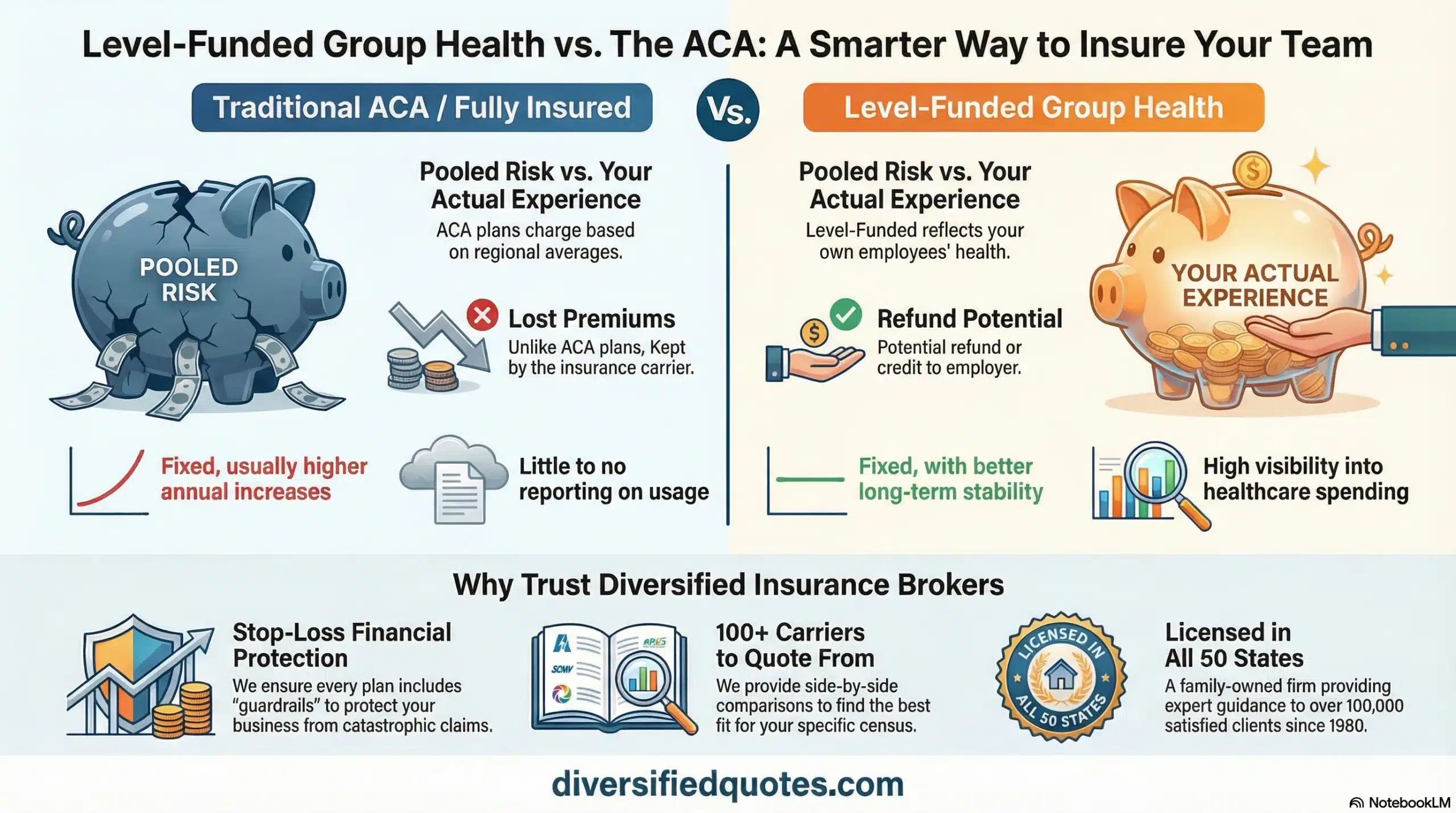
Level-funded plans are the structure most consulting firms in the 15–75 employee range should evaluate seriously. The stable monthly payment addresses the cash flow predictability that consulting firm finance management requires. The claims reporting transparency allows the firm to understand what is actually driving benefit costs — a capability that fully insured plans withhold entirely. And the potential for surplus return when claims run favorably aligns the firm’s interests with efficient utilization in a way that fully insured plans do not. Our resource on what is self-funded group health insurance covers the self-funded mechanics that underlie level-funded structures, and our resource on pros and cons of self-funded group health provides the complete tradeoff analysis for firms evaluating whether the level of control and transparency justifies the shift from fully insured. Our resource on why group level funding makes the specific positive case for this structure across professional service firm contexts.
Self-funded plans serve larger consulting firms — typically 75 or more enrolled employees — where the combination of claims data, plan design flexibility, and direct financial alignment between utilization efficiency and renewal economics produces outcomes that no insured alternative matches. The prerequisite is genuine administrative capacity and governance discipline that many smaller consulting firms have not yet built. For firms considering the self-funded pathway, the readiness assessment includes evaluating TPA relationships, stop-loss vendor strategy, and the internal capacity to act on claims data rather than simply receive it. Our comparable resource on group health insurance for physician practices covers how a similarly credentialed, high-earner professional practice navigates the self-funded evaluation — applicable context for consulting firm decision-makers at this stage.
Remote and Multi-State Teams — The Network Problem
The single most common source of post-enrollment dissatisfaction in consulting firm health plans is network inadequacy for remote employees. The problem follows a predictable pattern: the firm evaluates plans based on price and carrier brand recognition, enrolls the team, and then discovers in the first 60–90 days that employees in secondary markets cannot find in-network primary care physicians, that the nearest in-network specialist is 45 minutes away for two remote employees in a mid-sized city, or that the urgent care facility near one employee’s home is out of network. These complaints arrive during the onboarding period when new employees are forming their impressions of the firm — the worst possible timing for a negative benefits experience.
The correct process is employee-geography-based network validation before carrier selection: collect residential zip codes for all employees (not just office locations), run network adequacy checks in each zip code for the carriers being evaluated, and make carrier selection based on the results rather than on premium or brand. For consulting firms with employees in 5–12 different states, this process consistently reveals that the cheapest carrier option has meaningful coverage gaps in two or three employee locations. The slightly more expensive carrier with the broader national network produces zero out-of-network complaints and often a better renewal outcome because out-of-network claims did not inflate the plan experience.
For owner-operators and small consulting practices that fall below group minimum thresholds, the network and coverage question still applies in a different context. Our resource on how to get group health insurance for the self-employed covers the alternatives and structures that are available when the consulting practice is small enough that traditional group plan eligibility is uncertain — relevant for solo consultants, single-owner practices, and partners who need to coordinate individual and group coverage options. Our resource on how much health insurance does my business need covers the adequacy framework that determines whether the plan design matches what the firm’s workforce actually requires beyond the minimum carrier thresholds.
Headcount Fluctuation — Managing Eligibility During Growth and Engagement Cycles
Project-based consulting firms face a specific administrative challenge that stable professional service employers do not: headcount that ramps up for new engagements and contracts after projects close. When headcount ramps, new employees need to be enrolled efficiently and accurately. When headcount contracts, terminations need to be processed promptly to avoid paying premiums for departed employees. When headcount dips below the carrier’s minimum participation threshold — even temporarily — the plan’s eligibility status can become complicated.
The most common participation minimum problem occurs when a consulting firm’s headcount temporarily drops to a level where too many of the remaining eligible employees are covered under a spouse’s plan and waiving the firm’s coverage. If the waiver rate among remaining employees pushes participation below the carrier’s threshold (typically 70–75% of eligible non-waiving employees), the carrier may flag the plan at renewal or in some cases trigger a special enrollment period evaluation. Building a contribution strategy that keeps healthy employees enrolled — by making the firm’s coverage genuinely affordable and competitive with the waiving alternative — is the primary tool for managing this risk.
For firms that are growing rapidly and approaching benefit structure transition points — moving from small group to mid-market, or from fully insured to level-funded — our resource on small employer group health insurance covers the benchmarking context for firms at the transition boundary, including what typical contribution strategies and plan designs look like in the small-to-mid market segment where most growing consulting firms operate. Our resource on creditable coverage and employer size covers the ACA employer mandate framework that applies as consulting firms cross the 50 full-time equivalent employee threshold — a regulatory boundary that affects which employees must be offered coverage and what “affordable” means for ACA compliance purposes.
Contribution Strategy and the High Earner Expectation Gap
Consulting firms often have the financial capacity to fund competitive benefits, but they sometimes make the strategic error of applying a uniform contribution percentage that is appropriate for an average-wage employer rather than calibrated to the expectations and financial literacy of a professional services workforce. A 70% employer contribution to employee premium is a meaningful benefit at a $45,000 salary; at a $150,000 salary, it barely registers as a compensation differentiator. Senior consultants and principals who are actively evaluating multiple opportunities compare benefits packages with the same attention they bring to base salary and bonus structure.
The effective contribution strategy for most consulting firms is a near-100% employer contribution to employee-only premium combined with a meaningful but not fully subsidized contribution to dependent coverage. This structure ensures healthy employees enroll (protecting the risk pool and the renewal economics), signals that the firm takes benefits seriously as a compensation component, and preserves the firm’s ability to adjust contribution splits modestly at renewal without appearing to cut benefits. The two-option structure — a core plan at the full employer contribution alongside a richer buy-up plan that employees can elect at an additional employee premium — adds the choice dimension that professional employees value without requiring the firm to fund the richest plan option for every member of the workforce.
Complementary Benefits That Round Out the Consulting Firm Package
Medical coverage is the foundation of the consulting firm benefits package, but the most competitive firms layer additional benefits that address specific employee priorities. Dental and vision coverage are consistently among the most valued supplemental benefits across all professional demographics, and their inclusion is one of the most frequently noted positive attributes in recruiter conversations. Our resource on best dental insurance rates covers the group dental comparison framework for employers building a complete benefits package. Disability insurance is particularly relevant for consulting professionals whose income depends entirely on their ability to work — a period of disability that interrupts billing capacity creates the same financial emergency for a consultant that a key person death creates for a business. Our resource on disability insurance services covers the individual and group disability options that complement medical coverage in a comprehensive consulting firm benefits strategy. Our parallel resource on group health insurance for construction firms illustrates how a very different workforce type — where occupational risk and physical exposure dominate the benefits design — approaches the same foundational question of which plan structure and complementary benefits create the most durable protection for the workforce.
Review Your Consulting Firm’s Group Health Plan
We identify opportunities to improve coverage, control costs, fix network gaps, and build a renewal strategy that stops being a yearly scramble.
Contact Us for a Group Health ProposalRelated Pages
Small group resources, peer professional service firm guides, and plan structure analysis for growing consulting practices.
Financial Protection Essentials
Group health sizing resources, dental plan comparisons, disability protection, ACA employer mandate guidance, and small employer benchmarking.
Talk With an Advisor Today
Choose how you’d like to connect—call or message us, then book a time that works for you.
Schedule here:
calendly.com/jason-dibcompanies/diversified-quotes
Licensed in all 50 states • Fiduciary, family-owned since 1980
FAQs: Group Health Insurance for Consulting Firms
Can small consulting firms qualify for group health insurance?
Yes — most carriers offer group health plans to consulting firms with as few as two eligible full-time employees, though the specific minimum varies by state and carrier. The more common challenge for small consulting firms is not the employee minimum but the participation minimum: most carriers require that 70–75% of eligible employees who are not covered under another plan (spouse’s employer plan, for example) must enroll in the firm’s plan. When a small consulting team has two or three members who are already on a spouse’s plan and legitimately waiving, the remaining enrollees may not constitute a sufficient participation rate. Understanding how participation is calculated for your specific group — who is eligible, who is waiving and why, and how the carrier counts dependents — is the essential first step before evaluating plan options. Our resource on minimum employees for group health insurance covers the specific carrier eligibility thresholds, and our resource on how to get group health insurance for the self-employed covers the alternatives available when a consulting practice is structured in a way that falls below group plan eligibility requirements.
What type of group health plan works best for consulting firms?
The right plan type depends on the firm’s size, geographic footprint, headcount stability, and tolerance for administrative involvement. Fully insured plans are the most appropriate starting point for consulting firms below approximately 15 enrolled employees — the group is too small to benefit meaningfully from claims-based pricing mechanics, and the simplicity of fixed monthly premiums and carrier-managed administration has real value when the firm’s HR capacity is limited. Level-funded plans are often the optimal structure for consulting firms in the 15–75 employee range — combining the monthly payment predictability that consulting firm finance management requires with the claims data transparency that allows the firm to understand what is actually driving costs. Self-funded plans serve larger consulting firms with 75 or more enrolled employees where the combination of plan design flexibility, vendor control, and direct financial alignment between utilization efficiency and renewal economics produces outcomes that insured alternatives cannot match. The geographic dimension complicates every choice: remote-heavy consulting firms need to verify national network adequacy regardless of which funding structure they choose, because a structurally sound plan with inadequate network coverage produces the same employee dissatisfaction as a structurally wrong plan.
Are level-funded plans a good fit for consulting firms?
Often yes — particularly for mid-size consulting firms with stable headcounts and relatively healthy demographics. Level-funded plans provide stable monthly payments that consulting firm financial management requires, detailed claims reporting that gives the firm visibility into what is actually driving benefit costs, and the potential for surplus return when claims run favorably. The stop-loss protection inherent in level-funded arrangements prevents catastrophic claims exposure. For consulting firms that have been in fully insured plans with recurring renewal increases without clear explanation of why costs are rising, moving to a level-funded structure is often the single most impactful change — not because level-funded plans automatically produce lower costs, but because the claims visibility they provide creates the management lever that fully insured plans withhold entirely. With that data, the firm can understand what is driving costs and take proactive action before the next renewal arrives. Our resource on why group level funding covers the specific case for this structure in professional service firm contexts.
How does self-funded group health insurance work for consulting firms?
In a self-funded arrangement, the consulting firm pays medical claims as they occur through a third-party administrator (TPA), and purchases two forms of stop-loss insurance to limit exposure to catastrophic claims. Specific stop-loss protects against any single member’s claims exceeding a defined attachment point — often $50,000 to $150,000 per person per year — by having the stop-loss carrier pay claims above that threshold. Aggregate stop-loss protects against total plan-year claims exceeding a defined percentage of expected claims — typically 125% — by covering the excess above that aggregate threshold. Together, these guardrails mean the consulting firm can predict its maximum claims exposure before the plan year begins. In return, the firm gains complete claims data transparency, maximum plan design flexibility, and direct financial alignment with the firm’s actual utilization patterns. The requirement is genuine governance: the firm must actively manage vendor relationships, review claims reports, and make plan adjustments based on what the data shows rather than simply accepting a carrier’s renewal proposal. Our resources on what is self-funded group health insurance and pros and cons of self-funded group health cover the mechanics and tradeoffs in detail.
Can consulting firms cover remote or multi-state employees?
Yes — and this is the most critical design challenge for consulting firms with geographically distributed teams. Most major carriers offer national or broad regional networks that provide in-network coverage across multiple states, but network adequacy varies significantly by carrier, plan type, and geography. A carrier with excellent network depth in major metro areas may have inadequate coverage in secondary markets where several remote consultants live. The correct approach is to validate network adequacy in every employee’s residential zip code before selecting a carrier — not just the firm’s office locations — because employees care about finding in-network care near where they live, not near where the office is. For consulting firms with employees in 5 or more states, this validation process consistently reveals meaningful differences between carriers that are not visible in the premium comparison alone. The cheapest carrier option often has the most network gaps in secondary markets, while a carrier with marginally higher premium produces zero out-of-network complaints because the network actually covers where employees live.
Do partners or firm owners qualify for group health coverage?
Typically yes, but the eligibility mechanics and tax treatment depend on the firm’s legal entity structure and how partner compensation is classified. Partners in an LLC, general partnership, or LLP who receive K-1 distributions rather than W-2 wages are typically classified as self-employed for federal income tax purposes — which affects how premium contributions are handled and how ACA employer mandate provisions apply to their coverage. Partners in a professional corporation or S-corporation with less than 2% ownership are generally treated as W-2 employees for premium purposes, while partners with more than 2% S-corporation ownership have specific IRS rules governing premium deductibility. The practical implication is that confirming partner eligibility and premium treatment with a qualified tax advisor alongside the benefits broker should be standard practice before establishing or redesigning the plan — not an afterthought that surfaces at renewal. Firms that apply uniform W-2 treatment to all partners regardless of their actual tax classification may be creating unintended tax exposure that becomes visible only during an audit or a partner departure.
How can consulting firms manage rising health insurance costs?
Sustainable cost management in consulting firm health insurance comes from structural decisions made at plan design — not from reactive carrier-switching at renewal. The most impactful structural change most consulting firms can make is moving from a fully insured plan (where cost drivers are invisible) to a level-funded or self-funded arrangement (where claims data gives the firm genuine management visibility). Once the firm can see what is driving costs — specialty pharmacy spend, specific utilization patterns, network leakage to out-of-network providers — it can take proactive steps before the renewal arrives rather than accepting a carrier’s proposed increase without context. Beyond funding structure, maintaining strong employee participation across all firm levels is the most important ongoing cost management tool: a risk pool where healthy employees are enrolled alongside those with health events is fundamentally more favorable than one where only employees with upcoming health needs are enrolled. Contribution strategy is the primary lever for keeping healthy employees enrolled — the employer’s contribution to employee-only premium should be high enough that the cost of enrollment is meaningfully lower than the cost of going uninsured or purchasing individual coverage, even for employees who are relatively healthy and low-utilizing.
What information is needed to quote a consulting firm group health plan?
Most group health insurance quotes require a census — a list of eligible employees with birthdate, residential zip code, and coverage tier election (employee only, employee plus spouse, employee plus children, or family). For level-funded and self-funded proposals, the carrier or TPA may also request a claims history from the current carrier — typically 12–24 months — which allows the alternative plan to be priced based on the firm’s actual experience rather than demographic assumptions alone. Beyond the census and claims data, useful contextual information includes the firm’s current plan structure and contribution strategy, the primary goals driving the review (cost reduction, network improvement, transparency improvement, or growth management), and any specific employee demographics or geographic concentrations that should influence the evaluation. For consulting firms with remote employees across multiple states, providing residential zip codes for all employees — not just office-based employees — is particularly important for generating proposals with accurate network adequacy assessments. Our resource on how much health insurance does my business need covers the benefit adequacy framework that helps anchor these conversations.
Is group health insurance tax-deductible for consulting firms?
Employer contributions to group health insurance premiums are generally deductible as a business expense for the consulting firm entity, and the portion of premiums paid by the employer is typically excluded from employees’ taxable income — making it one of the most tax-efficient forms of compensation available. Employee premium contributions made through a Section 125 cafeteria plan (pre-tax payroll deduction) are excluded from the employee’s taxable wages, reducing both the employee’s income tax and payroll tax obligations. The precise tax treatment for partner and owner participants depends on the firm’s legal structure in ways that interact with IRS rules for self-employed health insurance deductions, partnership deduction rules, and S-corporation shareholder premium treatment. Consulting firms with partnership or multi-owner structures should coordinate health plan design and premium contribution decisions with qualified tax counsel to ensure the treatment is correct and consistently applied — particularly for partners whose compensation classification affects deductibility differently than it does for W-2 employees.
How often should consulting firms review their group health plan?
The annual renewal is the minimum frequency — and for most consulting firms, the renewal review should begin 90–120 days before the effective date rather than in the final 30 days when decisions become reactive. Starting early creates the time needed to gather claims data (in level-funded plans), evaluate alternatives across multiple carriers and structures, communicate plan changes to employees with adequate notice, and make thoughtful adjustments rather than rushed ones. Beyond the annual renewal, many consulting firms benefit from a mid-year check-in — a brief structured review of what employees are reporting, whether any network or pharmacy issues have emerged, and whether the headcount and geographic footprint have changed in ways that should influence the next renewal strategy. The mid-year check-in does not need to be comprehensive — 30–60 minutes reviewing the plan administrator’s report and a brief employee pulse survey covers the essential ground. Firms that build this cadence consistently report fewer renewal surprises and more confidence in their benefits strategy because they are managing the plan as a system rather than treating it as an annual transaction.
About the Author:
Jason Stolz, CLTC, CRPC, DIA, CAA and Chief Underwriter at Diversified Insurance Brokers (NPN 20471358), is a senior insurance and retirement professional with more than 25 years of real-world experience helping individuals, families, and business owners protect their income, assets, and long-term financial stability. As a long-time partner of the nationally licensed independent agency Diversified Insurance Brokers, Jason provides trusted guidance across multiple specialties—including fixed and indexed annuities, long-term care planning, personal and business disability insurance, life insurance solutions, Group Health, Travel Medical and Evacuation Insurance, and short-term health coverage. Diversified Insurance Brokers maintains active contracts with over 100 highly rated insurance carriers, ensuring clients have access to a broad and competitive marketplace.
His practical, education-first approach has earned recognition in publications such as VoyageATL, and contributions from his agency featured in Kiplinger and GoBankingRates— highlighting his commitment to financial clarity and client-focused planning. Drawing on deep product knowledge and years of hands-on field experience, Jason helps clients evaluate carriers, compare strategies, and build retirement and protection plans that are both secure and cost-efficient. Visitors who want to explore current annuity rates and compare options across multiple insurers can also use this annuity quote and comparison tool.
Explore More Group Health Insurance Options: Browse our complete guide to Group Health Insurance by Industry — covering law firms, consulting, construction, medical practices, schools & more from 100+ carriers.
Last Reviewed: May 27, 2026 |
Reviewed by: Jason Stolz, CLTC, CRPC, DIA, CAA
Chief Underwriter, Diversified Insurance Brokers, Inc. | NPN: 20471358 | Diversified Insurance Brokers, Inc. — Licensed in all 50 states
Fact Checked by: Tonia Pettitt, CMIP©
Medicare Specialist, Diversified Insurance Brokers, Inc. | NPN: 14374308 | Diversified Insurance Brokers, Inc. — Licensed in all 50 states
Did you find this content helpful? Leave us a Google review — it helps others find trustworthy guidance too.
Editorial Standards: Diversified Insurance Brokers maintains rigorous editorial standards to ensure accuracy, clarity, and independence in all content. Learn more about our editorial standards and commitment to transparency.
