
What Is Pre-Settlement Funding – Fast Cash for Pending Lawsuits
What Is Pre-Settlement Funding – Fast Cash for Pending Lawsuits

Jason Stolz CLTC, CRPC, DIA, CAA
When you are in the middle of a lawsuit, months — or even years — can pass before you see a settlement check. Meanwhile, rent, groceries, medical bills, and everyday expenses keep coming. That is why it helps to understand what pre-settlement funding is and how it works in real life. Pre-settlement funding provides a cash advance against a portion of your expected settlement so you can stay financially stable while your attorney continues building the case and negotiating for a fair result. Understanding how lawsuit loans and pre-settlement advances work is the starting point for evaluating whether this option makes sense for your situation.
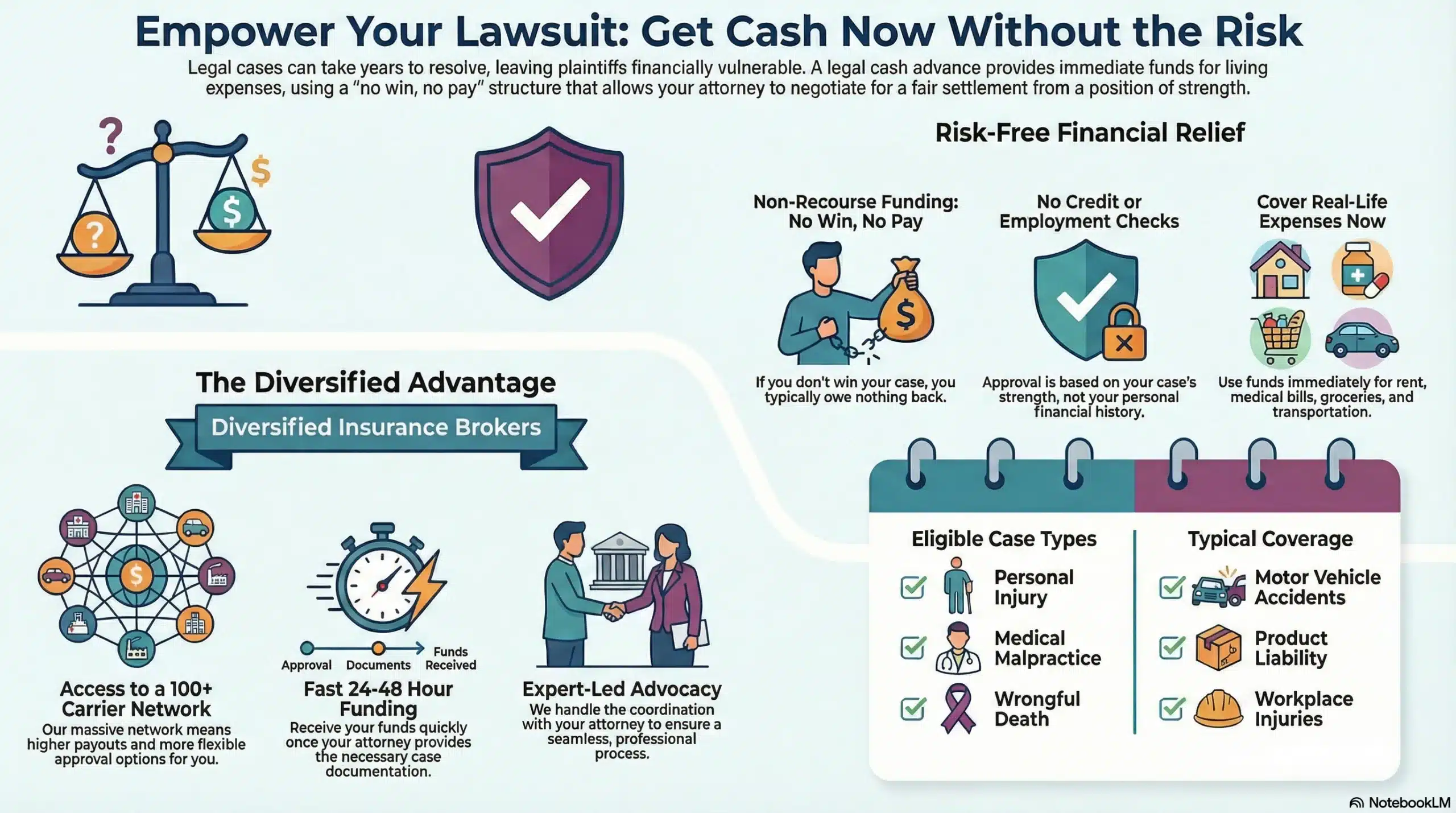
Unlike a traditional personal loan, pre-settlement funding is structured around your case — not your credit score, employment status, or monthly cash flow. Most providers evaluate the strength and likely value of the claim and coordinate directly with your attorney. If the case succeeds, the funding is repaid from the settlement proceeds. If it does not, many arrangements are “non-recourse,” meaning you generally do not repay out of pocket — though terms vary by provider and state, and your attorney should review any agreement before you sign.
Get Your Pre-Settlement Cash Advance
Fast review, high payout amounts, and no repayment unless your case resolves successfully (per provider terms).
Defining Pre-Settlement Funding
Pre-settlement funding — sometimes called lawsuit funding, lawsuit cash advances, or settlement advances — is a financial advance offered to plaintiffs who have an active lawsuit and are represented by an attorney. Instead of underwriting you as a borrower the way a bank would, the funding provider primarily underwrites the case itself. That typically means reviewing the claim type, liability posture, insurance coverage, damages, and the expected timeline to resolution. In many common scenarios, pre-settlement funding is designed as non-recourse — meaning repayment is tied to the case outcome and comes from the settlement proceeds rather than your personal income. If you ultimately lose the case or recover nothing, the provider may not collect repayment. That said, the exact definition of non-recourse, fees, and repayment mechanics differ across providers, states, and individual agreements. The smart move is to have your attorney review the paperwork, confirm the payoff schedule, and ensure the lien or assignment language is clear before you sign anything.
Who Typically Uses Pre-Settlement Funding
Pre-settlement funding is most often used by plaintiffs who are financially squeezed during a long claims process. Even when a case has strong merit, it can take considerable time for medical treatment to complete, records to be gathered, experts to weigh in, and negotiations to progress. During that waiting period, people commonly use funding to avoid falling behind on necessities, to keep stable housing, and to reduce the financial pressure that could push them into accepting a low settlement too early. We commonly see funding requests tied to personal injury claims, slip-and-fall cases, auto accident injuries, trucking or commercial accidents, workplace disputes, and wrongful death claims. Our resource on wrongful death settlement loans covers how funding specifically applies to those more complex and emotionally difficult case types.
If you are in a situation where injuries affect your ability to work, the cash flow gap can be especially intense. Some individuals in this situation explore funding alongside risk-management options like disability coverage for self-employed individuals or temporary medical coverage solutions, depending on eligibility and the nature of the underlying situation. For others who have pending settlement funds but also want immediate access to cash-equivalent amounts, our resources on pre-settlement cash advances and what to do if you need money before your settlement cover the full range of practical options in these situations.
Why People Choose Pre-Settlement Funding Instead of Waiting
The primary reason is straightforward: time is expensive when you are under financial strain. When bills pile up, plaintiffs can feel forced to accept a “quick” offer that does not fully reflect their damages simply to stop the bleeding. Having financial breathing room can reduce the pressure to settle prematurely and allows your attorney to push for the best outcome without the client urgently demanding resolution for cash flow reasons. Pre-settlement funding can also be used strategically when a case is strong but delayed for reasons outside your control — court schedules, insurance carrier delays, medical lien negotiations, or the need to finish a course of treatment before damages can be accurately documented and quantified. In these scenarios, funding is not “extra money.” It is often a bridge that keeps the case on track and allows the litigation strategy to unfold at the pace the attorney recommends rather than the pace financial desperation dictates.
How We Help You Access Funding
We work with a large network of legal funding resources and case-evaluation partners. The advantage of a broad network is that different funders have different appetites, pricing structures, and case-type preferences. One funder may be more favorable for motor vehicle injuries. Another may be more comfortable with premises liability. Another may be more aggressive with wrongful death timelines. Our process focuses on matching your case with the resources most likely to provide a competitive advance and a smoother attorney coordination experience. When you apply, we do not ask you to prove income or creditworthiness the way a bank would. The process is centered on your case status and representation. Funding providers typically communicate with your attorney’s office to verify core case facts and confirm representation, because the attorney is usually involved in the lien or assignment and the settlement disbursement flow.
When Pre-Settlement Funding Helps Most
Funding is typically most helpful when the case has a credible path to resolution but the timeline is uncertain. In practice, that often means the plaintiff has medical bills, lost wages, or ongoing treatment needs and cannot comfortably wait for the settlement process to run its course. Common uses include stabilizing housing, avoiding late fees and collections activity, paying for prescriptions and continuing medical treatment, handling utilities, keeping childcare or tuition current, and covering transportation to specialist appointments. When injury-related work disruption creates a temporary financial gap and the household does not have adequate income protection in place, funding can serve as the bridge that prevents a cascading financial crisis during an already difficult time. If you want to strengthen your overall safety net while a case is pending, it can also be worth learning about products designed to pay cash benefits in medical or injury scenarios — such as short-term health insurance bridge options — depending on your situation and eligibility.
How the Pre-Settlement Funding Process Works
The process is typically straightforward, but it works best when your attorney’s office is responsive and your case documentation is organized. Most funders are looking for clarity: what happened, who is liable, what the damages appear to be, and how long the case may take. The first step is submitting your application with basic details — your name, the case type, your attorney’s contact information, and general facts about the lawsuit. You are not expected to have every document in hand at this stage. The second step involves attorney verification and file request, where the funding provider contacts your attorney to confirm representation, requests relevant case details, and obtains permission to review a limited set of records. This may include the complaint, incident reports, insurance information, medical records summaries, or negotiation posture when available. The third step is case evaluation and offer — the provider evaluates risk and determines whether to offer funding, how much, and on what terms. The fourth step is funding and disbursement, where if you accept the offer, funds are released — often by ACH transfer — and the agreement typically includes a lien or assignment that is repaid from settlement proceeds at the time of case resolution.
How Much Can You Get From a Pre-Settlement Advance?
Advance amounts vary widely and are based primarily on the expected settlement value, case strength, liability clarity, insurance coverage available, and the projected timeline to resolution. In most cases, plaintiffs receive a portion of the estimated settlement rather than the full expected amount. Funding providers balance providing meaningful help with ensuring there is enough remaining settlement value to pay attorney fees, case costs, medical liens, and other obligations. If you are looking for the highest possible advance, the best lever is not asking harder — it is documentation and case clarity. When liability, damages, and coverage are clear, the provider is typically more comfortable extending a higher amount. That is also why coordination with your attorney matters so much — good communication and prompt document sharing consistently produce faster and more favorable outcomes.
Costs, Fees, and What Non-Recourse Really Means
This is the section most people skip — and it is the section that matters most. Pre-settlement funding can be expensive, and terms can vary dramatically across providers. Some use flat fees. Others use compounding structures, and payoff amounts can increase significantly over time. Your attorney should review the agreement to confirm the cost schedule, the payoff timeline, any renewal or administrative fees, and whether there are caps or protections that limit costs from escalating beyond a defined level. “Non-recourse” typically means repayment comes only from the settlement proceeds, not from your personal funds. But you still need to understand what happens if the case settles for less than expected, if the case changes attorneys, or if the defendant declares bankruptcy. Clear answers to these questions matter before signing. The right mindset is to treat funding like a bridge, not a long-term plan. The longer time passes, the more important it is to understand the payoff schedule and ensure the funding amount is genuinely appropriate for your actual needs rather than a maximum available amount.
How Pre-Settlement Funding Can Strengthen Your Negotiating Position
When plaintiffs are under financial pressure, insurance companies are often aware of it. A low offer can look acceptable when bills are overdue and the settlement timeline is uncertain. Funding can reduce that urgency and allow your attorney to negotiate from a position of greater strength. This is especially important in cases that require ongoing treatment or where future damages need time to fully develop and be documented accurately. That does not mean funding guarantees a larger settlement — it means it can reduce the chance that financial desperation forces a premature decision. In that sense, it functions as a strategic tool that supports the legal strategy, provided the cost and size of the advance are reasonable for the specific case.
Risk Management While Your Case Is Pending
While funding can help cover immediate expenses, many people also want to reduce the chance that a new injury, illness, or disability creates additional financial stress during the lawsuit timeline. Depending on your situation, it may be worth exploring coverage that can pay cash benefits during certain events. For example, if your ability to work is uncertain, understanding how disability insurance works for self-employed individuals and contractors is a worthwhile step. If you are in a coverage gap, exploring short-term medical coverage strategies can help reduce financial exposure from new health events. These are not replacements for a settlement — they are simply ways to reduce financial fragility while your case timeline plays out.
Apply for Pre-Settlement Funding Today
Get reviewed fast, receive competitive advance options, and pay nothing unless your case resolves successfully (per provider terms).
Related Pre-Settlement & Legal Funding Pages
Talk With an Advisor Today
Choose how you’d like to connect—call or message us, then book a time that works for you.
Schedule here:
calendly.com/jason-dibcompanies/diversified-quotes
Licensed in all 50 states • Fiduciary, family-owned since 1980
FAQs: Pre-Settlement Funding
Pre-settlement funding is often described as a “lawsuit loan,” but the two terms are not technically the same thing in most structures. Most pre-settlement funding is designed as a non-recourse cash advance tied to your case outcome rather than a traditional credit-based loan. A conventional loan requires repayment regardless of what happens. Pre-settlement funding, when structured as non-recourse, typically means the provider is repaid only if your case resolves successfully and settlement proceeds are available. The repayment comes from the settlement itself rather than from your personal income, savings, or assets.
The key distinction matters because it changes the risk profile for the plaintiff. With a traditional loan, a lost case still creates a repayment obligation. With non-recourse pre-settlement funding, the loss of the case may mean the provider does not collect repayment depending on the agreement terms. However, every pre-settlement funding agreement is different — some have narrower definitions of what constitutes a qualifying “non-recourse” outcome, and some may include terms around minimum settlement thresholds or partial repayment scenarios. Always have your attorney review the agreement in full rather than relying on the marketing description alone.
Typically, no — and this is one of the most important distinctions between pre-settlement funding and traditional credit products. Most pre-settlement funding providers focus on the strength of the claim rather than the applicant’s financial history. That means they evaluate the type of case, the clarity of liability, the expected damages, the defendant’s ability to pay (typically through insurance coverage), and the projected timeline to resolution. Your attorney’s cooperation and the quality of case documentation usually matter far more than your credit score, employment status, or income level.
This structure makes pre-settlement funding accessible to plaintiffs who are in financial difficulty specifically because of the injury or event underlying the lawsuit — which is often the reason they need funding in the first place. Someone who is out of work due to an injury, has depleted their savings, and has a damaged credit history from the financial stress of the situation can still qualify for pre-settlement funding if the underlying case is strong and well-documented. The application focuses almost entirely on case merit rather than personal financial standing.
Many pre-settlement funding cases can be reviewed and approved quickly — sometimes within 24 to 48 hours — once the provider receives the necessary information from your attorney. The actual timeline depends primarily on how quickly your attorney’s office responds to information requests, how complex the case is, and whether the documentation needed to evaluate liability and damages is readily available. Simple cases with clear liability, strong insurance coverage, and organized documentation tend to move through the review process fastest. More complex cases with disputed liability, incomplete medical records, or unusual case structures may take longer to evaluate.
The most common delay in pre-settlement funding approvals is not on the provider’s side — it is in attorney response time. Attorneys are often busy with active litigation, and responding to a funding provider’s information request may not be the highest priority in their office at any given moment. If you want to speed up the pre-settlement funding process, the most effective step is communicating clearly with your attorney’s office about the funding request and ensuring they understand the urgency and what specific information the provider needs. A responsive attorney can often reduce approval time from days to hours in straightforward cases.
Pre-settlement funding advance amounts vary based on case type, expected settlement value, liability clarity, coverage limits, and timeline. Providers typically advance a portion of the expected recovery rather than the full anticipated settlement amount, because the advance needs to leave room for attorney fees, case costs, medical liens, other financial obligations, and the funding provider’s own fees — all of which must be satisfied from the settlement proceeds. In practice, pre-settlement funding amounts can range from a few thousand dollars to significantly larger amounts depending on the case value.
If you want to maximize the pre-settlement funding amount available, the most effective approach is clear documentation rather than negotiation. Cases with well-documented liability, strong medical records that support the claimed damages, confirmed insurance coverage in adequate amounts, and a realistic timeline tend to receive more favorable advance offers than cases with documentation gaps or unclear liability. Your attorney’s ability to communicate the case’s strengths clearly and promptly is often the biggest factor in determining what pre-settlement funding amount the provider will offer.
In most non-recourse pre-settlement funding arrangements, repayment is owed only if the case resolves successfully and there are settlement proceeds available from which repayment can be made. If the case is lost or results in no recovery, the provider may not collect repayment under the terms of the agreement. This is the primary risk-transfer feature of non-recourse pre-settlement funding: the provider bears the risk that the case may not succeed rather than passing that risk to the plaintiff.
However, the definition of “non-recourse” can vary by agreement and by state, and the specific language of any pre-settlement funding contract governs the outcome. Some agreements have nuances around minimum settlement amounts, partial recovery scenarios, or specific case outcomes that could affect whether repayment is required in full, in part, or not at all. Your attorney should review the agreement specifically to understand what happens in adverse scenarios — including a case loss, a settlement significantly below projections, or a case that takes much longer than expected to resolve. Never rely solely on the provider’s verbal description of what “non-recourse” means in their specific contract.
Usually not. Pre-settlement funding repayment typically happens at settlement from the proceeds, coordinated through your attorney’s office — which is one of the features that makes it different from a traditional loan. Because repayment comes from the settlement rather than from ongoing personal income, there are generally no monthly payment obligations during the pendency of the case. The entire repayment amount, including all fees and charges that have accrued over the life of the advance, is typically paid as a lump sum at the time of settlement disbursement.
This structure can be advantageous for plaintiffs who are already financially strained — you receive cash now without adding a monthly payment burden that could make your financial situation worse during the case timeline. The tradeoff is that the total payoff amount at settlement may be substantially higher than the original advance depending on how long the case takes to resolve and how the fee structure compounds over time. This is exactly why understanding the payoff schedule before you accept pre-settlement funding is so important. Your attorney should confirm not just what you receive now, but what the total repayment will be at various projected settlement timelines.
Attorney involvement is a standard and necessary part of the pre-settlement funding process for several important reasons. First, the provider needs to verify that the plaintiff is represented by counsel, because attorney-supervised cases provide the structural framework through which the funding is secured and repaid. Pre-settlement funding is not typically available to unrepresented plaintiffs. Second, the provider reviews case details through the attorney’s office because the attorney has access to the legal file, documentation, and strategic assessment of the case that are necessary to evaluate the advance amount and terms. The attorney acts as the primary source of information about the case’s strength and likely value.
Third, and most importantly, the lien or assignment used to secure the pre-settlement funding repayment is typically documented and managed through the attorney’s office. When the case settles, the attorney is responsible for ensuring that all liens — including the pre-settlement funding lien — are satisfied before distributing net proceeds to the plaintiff. This means the attorney must be aware of and agree to the funding arrangement as part of the settlement disbursement process. If an attorney does not cooperate with the pre-settlement funding provider or does not agree to manage the lien at settlement, the funding may not be possible regardless of case strength.
Pre-settlement funding can be priced in different ways depending on the provider and the agreement structure. Some providers use flat fees for defined periods; others use periodic fees that compound over time; and others use a combination structure. Regardless of the fee model used, the key practical impact is the same: the longer your case takes to resolve, the more the total payoff at settlement will typically exceed the original advance amount. In some structures, the total payoff can grow substantially if the case takes two, three, or more years to resolve.
Your attorney should review the complete fee schedule, any compounding mechanics, the presence or absence of caps on total fees, and the projected payoff at different settlement timeline scenarios before you sign the agreement. This review is not optional — it is one of the most important things an attorney can do for a client who is considering pre-settlement funding. A small difference in fee structure or compounding rate can translate into a significant difference in how much of the final settlement actually reaches the plaintiff after all obligations are paid. Transparency about cost is what allows you to make an informed decision about whether the pre-settlement funding advance is worth its total cost in your specific situation.
Sometimes, yes. Some pre-settlement funding providers allow additional advances as the case progresses, depending on updated case valuation, how much of the original advance has been used, and how much settlement equity remains after accounting for all existing liens and obligations. Additional advances may be appropriate if the case has materially strengthened since the original funding, if the expected settlement value has increased, or if significant time has passed and financial needs continue. However, multiple advances can substantially increase the total payoff at settlement because each advance adds its own fee structure to the cumulative repayment obligation.
Before requesting additional pre-settlement funding, it is important to evaluate the total projected payoff of all existing funding agreements plus the new advance against the expected settlement range. If the cumulative payoff approaches or exceeds the likely net settlement after attorney fees, case costs, and medical liens, additional pre-settlement funding may leave you with little or no net recovery — or even create a situation where the settlement is insufficient to cover all obligations. Your attorney should run this calculation and provide a clear picture of what the net expected recovery looks like under the most likely and least favorable settlement scenarios before any additional funding is accepted.
About the Author:
Jason Stolz, CLTC, CRPC, DIA, CAA and Chief Underwriter at Diversified Insurance Brokers (NPN 20471358), is a senior insurance and retirement professional with more than 25 years of real-world experience helping individuals, families, and business owners protect their income, assets, and long-term financial stability. As a long-time partner of the nationally licensed independent agency Diversified Insurance Brokers, Jason provides trusted guidance across multiple specialties—including fixed and indexed annuities, long-term care planning, personal and business disability insurance, life insurance solutions, Group Health, Travel Medical and Evacuation Insurance, and short-term health coverage. Diversified Insurance Brokers maintains active contracts with over 100 highly rated insurance carriers, ensuring clients have access to a broad and competitive marketplace.
His practical, education-first approach has earned recognition in publications such as VoyageATL, and contributions from his agency featured in Kiplinger and GoBankingRates— highlighting his commitment to financial clarity and client-focused planning. Drawing on deep product knowledge and years of hands-on field experience, Jason helps clients evaluate carriers, compare strategies, and build retirement and protection plans that are both secure and cost-efficient. Visitors who want to explore current annuity rates and compare options across multiple insurers can also use this annuity quote and comparison tool.
Explore All Lawsuit Loan & Legal Funding Options: Browse our complete guide to Lawsuit Loans & Legal Funding — covering pre-settlement funding, lawsuit cash advances, injury claims & more.
Last Reviewed: June 19, 2026 |
Reviewed by: Jason Stolz, CLTC, CRPC, DIA, CAA
Chief Underwriter, Diversified Insurance Brokers, Inc. | NPN: 20471358 | Diversified Insurance Brokers, Inc. — Licensed in all 50 states
Fact Checked by: Tonia Pettitt, CMIP©
Medicare Specialist, Diversified Insurance Brokers, Inc. | NPN: 14374308 | Diversified Insurance Brokers, Inc. — Licensed in all 50 states
Did you find this content helpful? Leave us a Google review — it helps others find trustworthy guidance too.
Editorial Standards: Diversified Insurance Brokers maintains rigorous editorial standards to ensure accuracy, clarity, and independence in all content. Learn more about our editorial standards and commitment to transparency.
