
Need Money Before Settlement – Get Fast Legal Funding Now
Need Money Before Settlement – Get Fast Legal Funding Now

Jason Stolz CLTC, CRPC, DIA, CAA
When you need money before a settlement, what you’re really looking for is a way to stabilize your finances while your case works its way through a process that moves on the legal system’s timeline — not yours. Lawsuits take time. Negotiations take time. Insurance companies have every incentive to delay. And the entire period between when an injury happens and when a settlement check arrives can span months or years — during which rent, utilities, car payments, medical bills, and daily living expenses continue on their own schedule. Pre-settlement funding is a financial tool specifically designed for this gap: it advances cash against the expected value of your pending legal claim so you can cover essential expenses now, without waiting for the case to resolve and without taking on a traditional debt obligation with monthly payments and credit requirements.
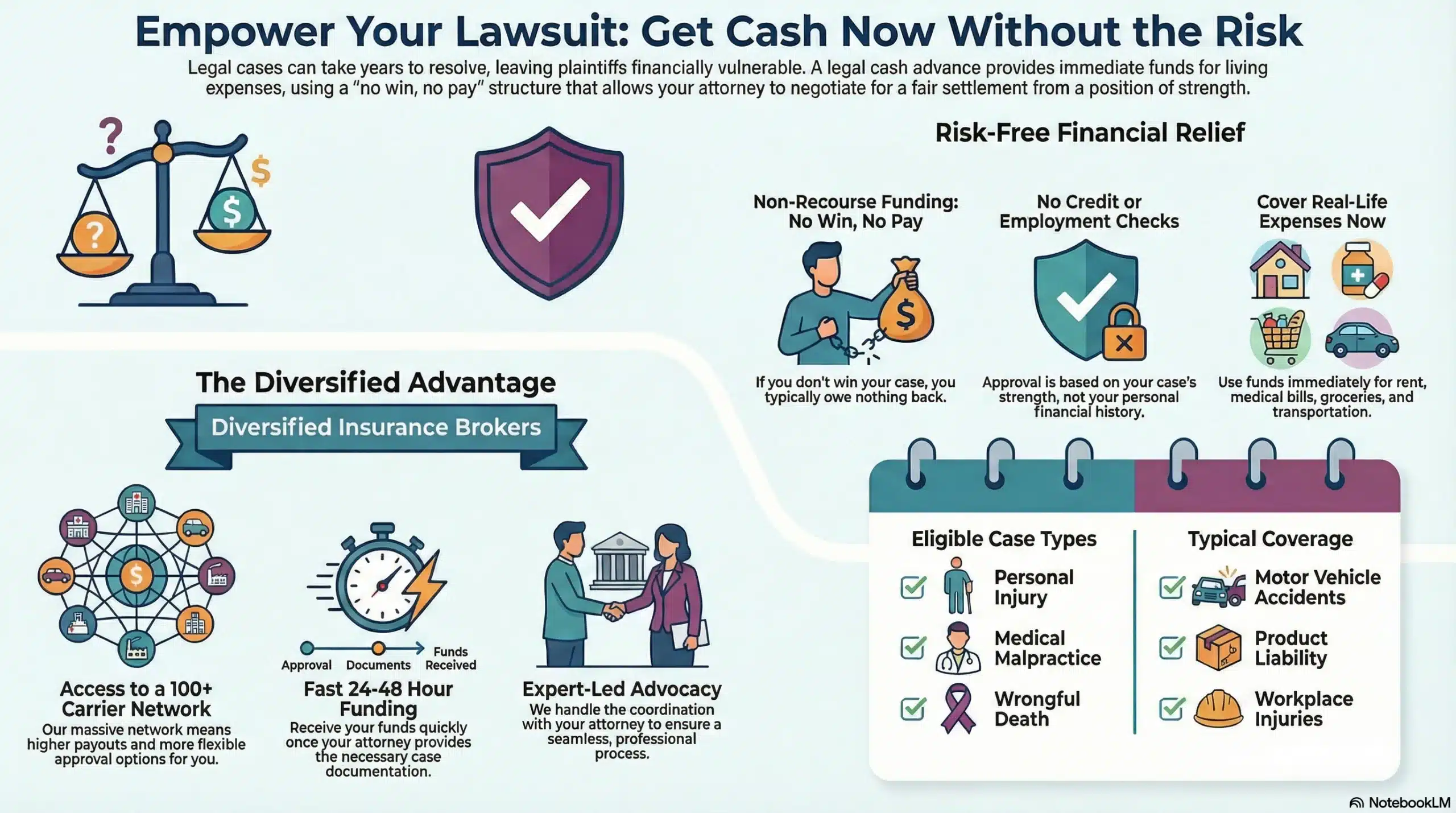
Understanding what pre-settlement funding actually is — and equally important, what it is not — is the foundation for evaluating whether it makes sense for your situation. It is not a loan in the traditional sense. A traditional loan requires a credit check, employment verification, monthly repayment regardless of outcomes, and personal liability for the debt whether or not you ever receive money from any other source. Pre-settlement funding is structured as a non-recourse advance against your future settlement proceeds. “Non-recourse” is the critical legal distinction: repayment is tied to the outcome of your case, not your personal financial obligation. If your case resolves successfully, the advance is repaid from the settlement proceeds. If your case does not result in a recovery, you typically owe nothing on the advance. The funding company assumes the risk of case outcome — not you. This risk structure is what differentiates legal funding from conventional borrowing and makes it accessible to plaintiffs who may have no meaningful credit options available while a case is pending. For a broader overview of how advances are structured and what separates different products in this category, our guide on pre-settlement funding provides the full framework, and our resource on lawsuit loans covers how the market is structured and what to look for when evaluating providers.
The most important thing to understand before pursuing pre-settlement funding is that the advance interacts directly with your final settlement — repayment comes from the proceeds, reducing the net amount you receive. Taking more than you need, at unfavorable terms, from a provider who isn’t transparent about total repayment, is the most common way plaintiffs find themselves unhappy with a funding decision in retrospect. Used strategically — to cover genuine essential expenses and maintain the financial stability needed to pursue the best possible outcome in your case — pre-settlement funding is a legitimate and often valuable tool. Used impulsively or with inadequate scrutiny of terms, it can reduce your net settlement more than necessary. This page covers both dimensions so you can make an informed decision. For context on how a cash advance works in the specific framework of a pending legal claim, our resource on advance on lawsuit settlement covers that structure directly, and our resource on legal cash advances covers the full category of products in this space.
Apply for Funding Before Your Settlement
Find out how much you can access now — based on your case, not your credit. Fast review, risk-free structure, no obligation to accept.
What Pre-Settlement Funding Is — And What It Isn’t
Pre-settlement funding goes by several names in the marketplace — lawsuit advance, legal funding, litigation funding, settlement loan — and the terminology is used inconsistently enough that understanding the actual structure behind any given product matters more than what it’s called. The defining characteristics of legitimate pre-settlement funding are: it is non-recourse (repayment contingent on case recovery, not personal liability), it does not require monthly payments during the pending period, it does not require a credit check or employment verification, and the advance amount is determined based on the expected value of the pending legal claim rather than personal creditworthiness. These characteristics distinguish pre-settlement funding from personal loans, credit card advances, and other forms of conventional debt that create personal repayment obligations regardless of the underlying case outcome.
What pre-settlement funding is not is a guarantee of easy money with no consequences. The advance is repaid with fees from settlement proceeds when the case is successful. Those fees can be meaningful, particularly in cases that take longer to resolve — and the total repayment amount can be significantly more than the original advance if the case extends over many months. Legitimate providers disclose this clearly before the agreement is signed. Providers who minimize or obscure the total repayment structure are a red flag. Any reputable funding company will give you a clear, written illustration of exactly what you would owe if your case resolves in different timeframes, so you can evaluate whether the advance makes economic sense given your specific situation and expected timeline.
The Lawsuit Timeline Problem — Why People Need Funding at All
The fundamental problem that pre-settlement funding solves is the mismatch between the legal timeline and the financial timeline. A personal injury lawsuit — even one with relatively clear liability — typically takes many months to resolve, and complex cases involving serious injuries, disputed liability, or multiple parties can take several years. The legal process has its own rhythm: medical treatment must stabilize before damages can be fully evaluated; records must be gathered and organized; expert witnesses may be needed; insurance companies typically engage in protracted negotiations; and if the case goes to trial, court schedules add additional delay. None of these timelines yield to the plaintiff’s monthly financial obligations.
Meanwhile, the financial timeline of a plaintiff who has been injured doesn’t pause for the legal process. Lost wages from being unable to work due to injury or recovery reduce income immediately. Medical bills accumulate, often before any insurance resolution. Ongoing treatment and therapy create recurring out-of-pocket costs. Existing debt obligations — mortgage, car loan, utilities — continue. And the injury-related disruption may have also affected a spouse’s or family member’s ability to work. The gap between what is owed today and what hasn’t been resolved yet is where pre-settlement funding operates.
The Financial Pressure Problem — How Urgency Affects Settlement Outcomes
The most consequential effect of unmanaged financial pressure during a lawsuit is not the immediate hardship — it is the impact on decision-making. A plaintiff who is three months behind on rent, facing an eviction notice, and fielding calls from medical debt collectors is not in the same negotiating position as a plaintiff who can pay their bills while the case progresses. Insurance companies and defense counsel are sophisticated negotiators who understand that financial pressure moves plaintiffs toward lower settlement offers. The urgency to “just resolve this and move on” — driven not by the merits of the case but by immediate financial desperation — is one of the primary factors that leads to settlements below what the case is actually worth.
Pre-settlement funding doesn’t change the facts of a case. It doesn’t change the legal strategy. What it changes is the plaintiff’s ability to wait. When immediate financial pressure is addressed, the plaintiff and their attorney can allow the case to develop properly — gathering documentation, allowing medical treatment to stabilize and damages to be fully established, and negotiating from a timeline that serves the case rather than the plaintiff’s rent due date. Our resource on how to get cash before a case settles covers this dynamic and how pre-settlement funding affects the negotiating landscape.
Case Types That Commonly Qualify for Pre-Settlement Funding
Not all legal claims qualify for pre-settlement funding. Funding companies evaluate the expected recovery potential of a claim — which means cases where liability is uncertain, damages are speculative, or recovery is unlikely do not produce fundable profiles. The most commonly funded case types share a set of characteristics: clear liability or at least strong liability evidence, documented damages (typically through medical records and treatment), a defendant with the financial capacity to pay (usually through insurance), and an attorney representing the plaintiff on contingency.
Personal injury cases are the most common category. Motor vehicle accidents — car accidents, truck accidents, motorcycle accidents, rideshare accidents — are frequently funded because liability documentation (police reports, insurance information, witness statements) is typically available and medical records establish damages. Slip and fall and premises liability cases qualify when negligence can be documented. Medical malpractice cases can qualify but require more complex evaluation due to the higher litigation costs and greater outcome uncertainty. Wrongful death cases present a specialized situation — the plaintiff is typically a surviving family member or estate representative rather than the injured party directly. Our resource on wrongful death settlement loan covers how funding works in those specific circumstances.
Cases that typically do not qualify include criminal cases (which don’t produce financial settlements), family law matters (divorce, custody), and cases where the plaintiff is the defendant in a counterclaim. Cases with very weak liability documentation, very small expected settlements relative to existing liens, or cases where no attorney representation exists are also unlikely to qualify, since most legitimate funding providers require attorney cooperation as a condition of funding.
Pre-Settlement Funding vs. Your Other Options — A Direct Comparison
Before deciding whether pre-settlement funding is the right approach, understanding how it compares to the other options available during a pending lawsuit helps contextualize both the advantages and the tradeoffs. The table below captures the most relevant distinctions.
| Option | Repayment Obligation | Monthly Payments | Credit Impact | Availability During Lawsuit |
|---|---|---|---|---|
| Pre-Settlement Funding | Only if case results in recovery | None during case | No credit check; does not affect credit | Yes — based on case strength, not employment |
| Personal Loan (Bank) | Regardless of case outcome | Yes — fixed monthly payments begin immediately | Hard credit check; affects credit utilization | Depends on credit; may be unavailable if injured/unemployed |
| Credit Card Advance | Regardless of case outcome | Yes — minimum payments required | Increases utilization; affects credit score | Only if existing credit line is available |
| Borrowing from Family | Typically regardless of outcome (relationship-dependent) | Informal; varies by arrangement | None to credit — but relationship risk | Only if family has available funds and willingness |
| Waiting (No Funding) | No obligation — but financial consequences accumulate | N/A | Missed payments may damage credit | Always available but creates pressure to settle early |
The cost of pre-settlement funding — fees paid from settlement proceeds — is higher than the interest rate on conventional loans for equivalent access periods, because the funding company assumes the risk of case outcome. This tradeoff (higher cost in exchange for no personal repayment obligation if the case fails) is the core economic distinction. It is particularly valuable for plaintiffs who cannot qualify for conventional credit or for whom monthly loan payments would be unmanageable during the lawsuit period.
How Funding Amounts Are Determined
Funding companies evaluate each case individually and base the advance amount on the realistic net proceeds expected from a successful outcome. The calculation is not simply “a percentage of the full injury damages” — it accounts for the full distribution of settlement proceeds, not just the gross amount. A settlement that looks large on paper may produce a smaller net amount once attorney fees (typically one-third on contingency), medical liens, outstanding bills, and any insurance subrogation claims are resolved. The funding company models the expected net proceeds to the plaintiff after all those obligations are satisfied, then offers an advance against a portion of that net amount.
This is why funding amounts are typically described as a portion of the expected settlement — often in the range of ten to twenty percent of the anticipated recovery — rather than the full settlement value. Providers also factor in the stage and timeline of the case. Cases earlier in litigation with more uncertainty typically produce smaller offers relative to expected value than cases further along with stronger documentation, clearer liability, and more complete damages records. Cases where the expected timeline is longer also represent more risk for the funding company (because the advance is outstanding longer before repayment), which can affect both the amount offered and the fee structure applied.
Understanding the Costs — What to Know Before Signing
Cost transparency is the most important factor in evaluating any pre-settlement funding offer, and it is where the market varies most significantly between providers. Unlike a conventional loan with a stated annual percentage rate, pre-settlement funding costs can be structured in several different ways — flat fees, compound rates, simple interest rates — and the total amount owed at repayment depends heavily on how long the case takes to resolve. A fee structure that appears modest in a case that resolves in six months can become significantly larger if the same case takes eighteen months or two years.
Before signing any pre-settlement funding agreement, you should request and review a clear written illustration showing exactly how much you would owe if the case resolves in different timeframes — at six months, twelve months, eighteen months, and twenty-four months. This allows you to evaluate the total cost scenario across realistic case timelines rather than the best-case scenario. The gap between these numbers tells you a great deal about how the provider’s fee structure compounds over time. Providers who refuse to provide this illustration or who present costs only in the most favorable scenario should be approached with caution. Additionally, your attorney should review any funding agreement before you sign it — both because attorney involvement is typically required and because the attorney can identify whether the terms are reasonable relative to what they’ve seen in other agreements.
The Approval Process Step by Step
The approval process for pre-settlement funding is faster and less burdensome than conventional loan applications because the underwriting focuses on the case rather than personal financial history. The general process follows these stages, though specific requirements and timelines vary by provider and case complexity.
The plaintiff submits an application with basic information about the case — what happened, when it occurred, the approximate nature of injuries and damages, and their attorney’s contact information. Most legitimate funding companies require attorney representation as a condition of funding, and the attorney’s willingness to cooperate with the documentation request is essential to moving the process forward. The funding company then contacts the attorney to request case documentation — typically including a case summary or demand letter if one exists, medical records or a treatment summary, insurance information, police reports or incident documentation for accident cases, and information about any known liens or outstanding obligations that would affect net settlement. The underwriting team reviews the file, evaluates liability, estimated damages, recovery probability, and timeline, and determines whether and how much to advance. If approved, the plaintiff receives an offer with specific terms — the advance amount and the complete repayment structure — which they can accept or decline. Funds are typically transferred within 24 to 48 hours of agreement execution once all documents are in place.
What Your Attorney Needs to Provide
Attorney cooperation is not optional in legitimate pre-settlement funding — it is a requirement that protects both the plaintiff and the funding company. The attorney confirms that the case is real, that representation is active, and that the documentation provided accurately reflects the case’s status and prospects. Without attorney verification, no reputable funding company will advance funds. The documentation typically requested from the attorney includes a signed authorization from the plaintiff permitting the case review, basic case information and liability summary, insurance carrier and coverage information (when the recovery depends on insurance proceeds), medical records or a treatment summary establishing damages, and information about any liens or outstanding medical obligations that would affect the net settlement calculation. Attorneys who cooperate promptly and provide organized documentation significantly accelerate the approval process. The most common source of delay in pre-settlement funding approvals is attorney response time — not the underwriting review itself.
Some attorneys are more familiar with pre-settlement funding than others, and some prefer to be more actively involved in reviewing funding terms on behalf of their clients. If your attorney is unfamiliar with the funding process or has concerns about specific terms in a proposed agreement, those are legitimate issues to discuss before signing. A reputable funding company will not require you to sign without giving your attorney adequate time to review the agreement.
How to Evaluate Funding Providers
Not all pre-settlement funding providers operate with equal transparency, and the stakes of selecting a poor-quality provider are paid from your settlement proceeds. The following framework covers the most important evaluation criteria when comparing providers.
Transparency about total cost is the first criterion. Any provider worth considering will show you, in writing, exactly how much you would owe at repayment under different timeline scenarios. The fee structure should be explained clearly — whether it is a simple interest rate, a compound rate, a flat fee, or a combination — and the agreement should contain no hidden fees that appear at repayment. The second criterion is responsiveness and attorney-friendliness. Providers who require extensive delays, make the attorney documentation process unnecessarily burdensome, or communicate poorly during the application process are likely to be similarly difficult at repayment. The third criterion is the non-recourse structure itself — the agreement must clearly and explicitly state that repayment is required only if the case results in a successful recovery, and that no personal liability exists if the case does not result in a recovery. This should be in plain language in the contract, not buried in footnotes. Reading the agreement before signing and having your attorney confirm the non-recourse language is one of the most important steps in the process.
Protecting Your Finances While Your Case Is Pending
Pre-settlement funding addresses the immediate cash need during a lawsuit, but it does not address every financial vulnerability a plaintiff faces during an extended legal process. While your case is pending, it is worth considering whether additional financial protection makes sense — particularly if the injury has affected your ability to work or if you are experiencing ongoing medical costs that may continue regardless of case outcome. Short-term health insurance can bridge coverage gaps when an injury has disrupted employer-sponsored coverage. Our resource on how short-term health insurance can bridge the coverage gap covers the options for maintaining health coverage during transitions. Disability coverage, if obtainable, provides income protection for ongoing work limitations. Our resource on why disability insurance matters covers the income protection case broadly. And for individuals evaluating life insurance in the context of the injury and its financial consequences on their family, our guide on how to get life insurance covers the overall landscape. For high-risk situations where standard underwriting may be challenging, our high-risk life insurance services cover specialty options.
Explore Related Legal Funding Resources
Advance on Lawsuit Settlement
Lawsuit Loans Explained
Get Cash Before Case Settles
Legal Cash Advances
Wrongful Death Settlement Loan
Get Money Before Your Settlement Arrives
Apply now to see how much you can access — fast, risk-free, and based on your case strength rather than your credit. No obligation to accept the offer.
Talk With an Advisor Today
Choose how you’d like to connect—call or message us, then book a time that works for you.
Schedule here:
calendly.com/jason-dibcompanies/diversified-quotes
Licensed in all 50 states • Fiduciary, family-owned since 1980
FAQs: Need Money Before Settlement
What does “need money before settlement” mean, and what are my options?
It means you have a pending legal claim — typically a personal injury lawsuit — and you need to cover essential expenses while the case is still open. Pre-settlement funding is a cash advance against the expected value of your pending claim that provides immediate cash without monthly payment obligations or credit requirements. Repayment typically comes from settlement proceeds if the case is successful. Other options include personal loans, credit card advances, and family borrowing — each of which creates personal repayment obligations regardless of case outcome, unlike pre-settlement funding’s non-recourse structure.
What is pre-settlement funding and how is it different from a loan?
Pre-settlement funding is a non-recourse advance — repayment is tied to the outcome of your case, not your personal financial obligation. If your case does not result in a recovery, you typically owe nothing on the advance. A traditional loan requires repayment with monthly payments regardless of case outcome, requires a credit check and employment verification, and creates personal liability for the full debt. Pre-settlement funding has no monthly payments during the case, no credit check, and no personal liability if the case is unsuccessful. The tradeoff is that the cost structure on pre-settlement funding is typically higher than conventional borrowing when the case is successful, because the funding company assumes the risk of case failure.
How quickly can I get money before my settlement?
Many approved cases are funded within 24 to 48 hours of agreement execution — once the attorney has provided required case documentation and the funding agreement is signed. The primary variable is how quickly your attorney responds to the documentation request. Cases where attorneys provide complete, organized documentation promptly move fastest. The review process itself — once documents are received — is typically completed within one to two business days for straightforward cases. More complex cases involving disputed liability, large damages amounts, or multiple parties may take longer to evaluate.
What types of cases qualify for pre-settlement funding?
The most commonly funded cases are personal injury claims — car accidents, truck accidents, motorcycle accidents, slip and fall incidents, medical malpractice, wrongful death, and certain workplace injury claims. Common qualification requirements: clear or reasonably strong liability evidence, documented damages through medical records or treatment history, a defendant with the financial capacity to pay (typically through insurance), and attorney representation on contingency. Cases with very weak liability documentation, minimal expected recovery, or no attorney representation are unlikely to qualify. Criminal cases and most family law matters do not qualify.
Will funding affect my settlement negotiations or legal strategy?
Funding is designed to be attorney-coordinated and separate from case strategy. Your attorney remains in control of settlement decisions, negotiation posture, and litigation timing. What funding changes is your ability to wait — removing the financial pressure that can force plaintiffs to accept lower offers simply to get immediate relief. When you can afford to let the case develop properly, your attorney has more flexibility to gather stronger documentation, allow damages to be fully established, and negotiate toward the case’s actual value rather than whatever the other side is willing to offer this month.
What do I owe if I don’t win my case?
With true non-recourse funding, you owe nothing if your case does not result in a recovery. Repayment is contingent on a successful outcome — if the case is lost or dismissed without recovery, the advance is not repaid. This is why the funding agreement must explicitly state the non-recourse structure in clear language. Always confirm this provision is in the contract before signing. Providers who obscure or soften the non-recourse language in the agreement, or who require personal guarantees of any kind, are not offering true non-recourse funding.
How much can I get before my settlement?
Funding amounts depend on the expected net settlement value — the amount you would receive after attorney fees, medical liens, and other obligations are satisfied — and the funding company’s advance percentage, typically in the range of ten to twenty percent of anticipated net recovery. The amount is based on what the case is realistically expected to produce for you, not the gross injury damages. Providing complete and organized documentation — medical records, liability evidence, insurance information — gives the underwriter the clearest possible picture and helps maximize the offer within what the case can support.
What should I look for when comparing pre-settlement funding providers?
Three things matter most: transparency about total repayment across different case timeline scenarios (ask for a written illustration showing what you’d owe at 6, 12, and 18 months), clarity of the non-recourse structure in the written agreement (it must explicitly state no personal liability if the case is unsuccessful), and attorney-friendliness of the documentation and review process. Avoid providers who cannot or will not show you total cost scenarios in writing, who require personal guarantees, or who pressure you to sign before reviewing the agreement with your attorney. Cost structures vary significantly across providers — comparing more than one offer is worthwhile when possible.
About the Author:
Jason Stolz, CLTC, CRPC, DIA, CAA and Chief Underwriter at Diversified Insurance Brokers (NPN 20471358), is a senior insurance and retirement professional with more than 25 years of real-world experience helping individuals, families, and business owners protect their income, assets, and long-term financial stability. As a long-time partner of the nationally licensed independent agency Diversified Insurance Brokers, Jason provides trusted guidance across multiple specialties—including fixed and indexed annuities, long-term care planning, personal and business disability insurance, life insurance solutions, Group Health, Travel Medical and Evacuation Insurance, and short-term health coverage. Diversified Insurance Brokers maintains active contracts with over 100 highly rated insurance carriers, ensuring clients have access to a broad and competitive marketplace.
His practical, education-first approach has earned recognition in publications such as VoyageATL, and contributions from his agency featured in Kiplinger and GoBankingRates— highlighting his commitment to financial clarity and client-focused planning. Drawing on deep product knowledge and years of hands-on field experience, Jason helps clients evaluate carriers, compare strategies, and build retirement and protection plans that are both secure and cost-efficient. Visitors who want to explore current annuity rates and compare options across multiple insurers can also use this annuity quote and comparison tool.
Explore All Lawsuit Loan & Legal Funding Options: Browse our complete guide to Lawsuit Loans & Legal Funding — covering pre-settlement funding, lawsuit cash advances, injury claims & more.
Last Reviewed: June 2, 2026 |
Reviewed by: Jason Stolz, CLTC, CRPC, DIA, CAA
Chief Underwriter, Diversified Insurance Brokers, Inc. | NPN: 20471358 | Diversified Insurance Brokers, Inc. — Licensed in all 50 states
Fact Checked by: Tonia Pettitt, CMIP©
Medicare Specialist, Diversified Insurance Brokers, Inc. | NPN: 14374308 | Diversified Insurance Brokers, Inc. — Licensed in all 50 states
Did you find this content helpful? Leave us a Google review — it helps others find trustworthy guidance too.
Editorial Standards: Diversified Insurance Brokers maintains rigorous editorial standards to ensure accuracy, clarity, and independence in all content. Learn more about our editorial standards and commitment to transparency.
