
Get Cash Before Case Settles – Fast Legal Funding Now
Get Cash Before Case Settles – Fast Legal Funding Now

Jason Stolz CLTC, CRPC, DIA, CAA
Waiting months — or longer — for a lawsuit to resolve can put enormous pressure on your finances. Rent, utilities, groceries, medical bills, and transportation costs don’t pause just because your case is still pending. If you need to get cash before your case settles, pre-settlement funding can provide immediate financial relief without forcing you to accept a low settlement offer. Our role is simple: help you stay financially stable while your attorney focuses on maximizing the value of your case. At Diversified Insurance Brokers, we help plaintiffs across the country evaluate their pre-settlement funding options, understand the costs, and access advances that are sized responsibly relative to the expected case value.
Pre-settlement funding is designed for plaintiffs who have a legitimate legal claim but need access to money now — not months or years from now. Instead of relying on credit cards, payday loans, or family support, this option allows you to access a portion of your potential settlement in advance. Because funding is tied to the case itself — not your credit or employment status — it remains accessible even during periods of medical recovery or job interruption. For a broad overview of how the funding structure works from application through repayment, our resource on how pre-settlement funding works covers the full process in plain language, including how case evaluation works, what documents are needed, and how repayment flows through the attorney’s trust account at settlement.
Get Your Advance Now
See how much funding you may qualify for before your case is resolved — no credit check, no monthly payments, no repayment if you don’t win.
Apply for Funding Call 800-533-5969What It Means to Get Cash Before Your Lawsuit Settles
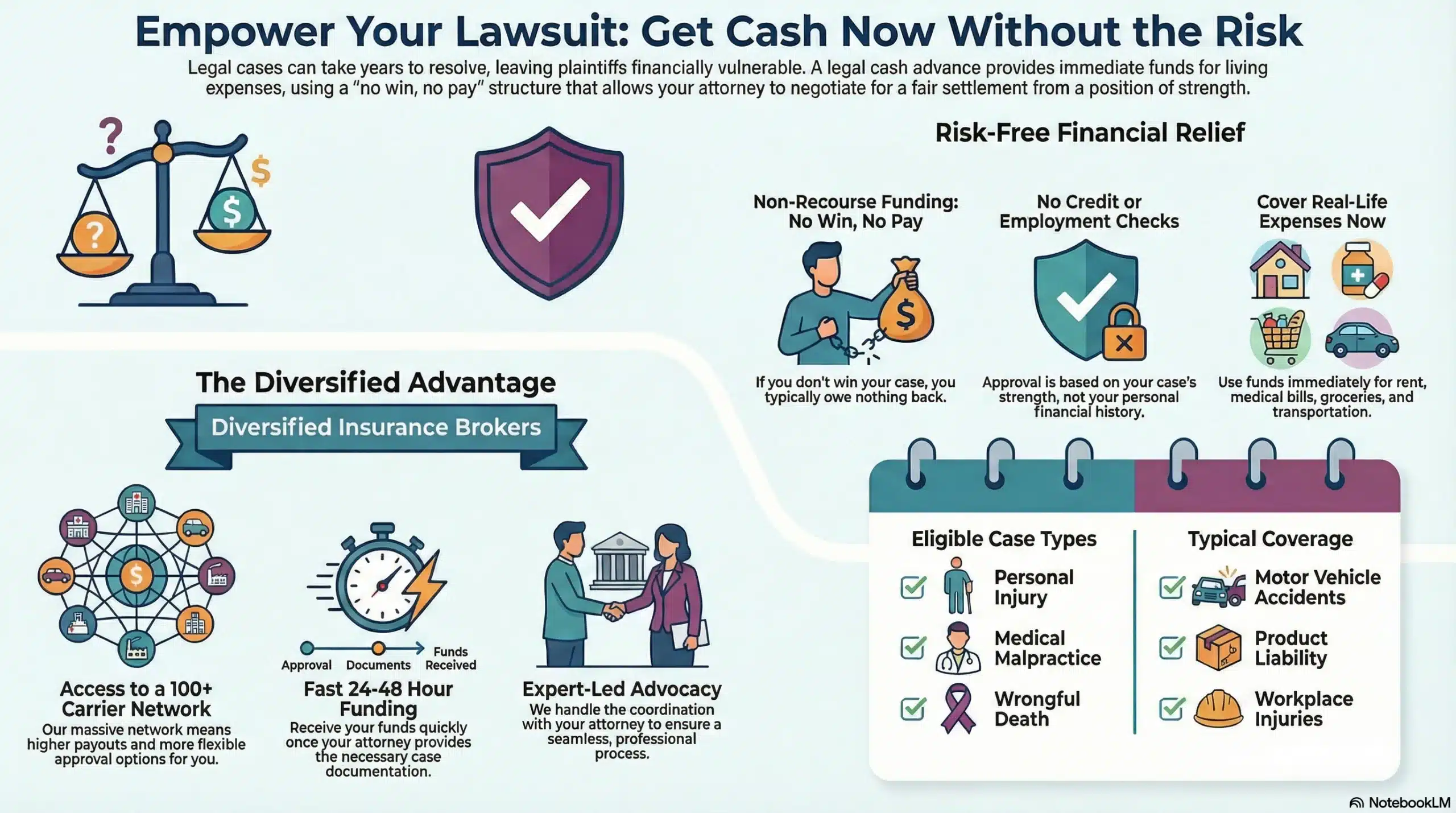
Pre-settlement funding is not a traditional loan. It is a non-recourse cash advance secured by your potential settlement or judgment. That distinction is important. With non-recourse funding, repayment occurs only if your case successfully resolves with a recovery. If there is no settlement or verdict, you typically owe nothing under the terms of the agreement. This structure removes much of the risk plaintiffs associate with borrowing. There are no monthly payments while your case is active, no credit checks, and no employment verification requirements. Approval is based almost entirely on the strength of the legal claim, available insurance coverage, and the likelihood of recovery — not your personal financial profile. Because funding is tied directly to the case, your attorney plays a central role. We coordinate directly with your lawyer to verify case status, review documentation, and confirm estimated recovery timelines. Our resource on pre-settlement funding vs. lawsuit loans: what’s the difference covers this distinction in detail — including how the non-recourse structure differs from a conventional personal loan and why that difference matters for your financial exposure during a case that takes longer than expected to resolve.
Pre-Settlement Funding vs. Traditional Borrowing — Key Comparison
Plaintiffs evaluating pre-settlement funding often compare it against the other options available when income is interrupted during a case. The table below maps the key differences across five common alternatives so you can see where pre-settlement funding fits relative to the other choices plaintiffs typically consider. The most important column for most plaintiffs is “Repayment if case fails” — because that determines the financial risk if the case does not result in a recovery.
| Feature | Pre-Settlement Funding | Bank / Personal Loan | Credit Card | Payday Loan | Family / Friends |
|---|---|---|---|---|---|
| Repayment if case fails | None in most non-recourse agreements — if no recovery, you typically owe nothing | Full repayment required regardless of case outcome | Full balance owed regardless of case outcome; interest continues accruing | Full repayment required; high penalty fees for default | Depends on agreement; relationship risk if repayment cannot be made |
| Credit check required | No — approval based on case merits, not credit score | Yes — credit score and history required; denial common for injured or recovering plaintiffs | Yes — available credit limit depends on prior credit; high rates for lower scores | Minimal check but predatory rates; designed for very short-term gaps only | No formal check — but availability depends on relationship |
| Monthly payments during case | None — repayment deferred entirely until case resolves | Yes — required monthly regardless of income or case status | Yes — minimum payments required monthly; balance grows with interest | Yes — due in very short period (typically 2 weeks); creates cycle of reborrowing | Often informal — may not require monthly payments depending on arrangement |
| Employment/income verification | Not required — approval based on case, not employment status | Required — income and employment documentation needed; difficult if unable to work | Typically reviewed during application; existing credit available without reapplication | Basic income or bank account required — very limited amounts available | Not applicable |
| Approval basis | Strength of legal claim, liability, insurance coverage, and estimated recovery value | Personal creditworthiness, income, and debt-to-income ratio | Prior credit profile and available credit limit | Basic income verification; very limited amounts | Personal relationship and trust |
| Typical speed to funding | 24–48 hours on straightforward cases after attorney cooperation | Days to weeks — application review, underwriting, and funding processing time | Immediate if existing credit available; new card application takes 1–2 weeks | Same day or next day — but very limited amounts and very high effective cost | Depends on availability and willingness of the lender |
| Cost transparency | Costs disclosed before signing; no application fees; payoff schedules available at different time horizons | APR disclosed; fixed repayment schedule clear upfront | APR disclosed but total cost hard to predict if balance carried long-term | High effective APR often obscured; fee-based structures can be very expensive | Informal — terms often not documented, creating risk of misunderstanding |
The table makes the non-recourse structure’s value clearest in the “Repayment if case fails” row. Every conventional borrowing alternative requires repayment regardless of whether your case succeeds — which means the financial risk of borrowing during a case is borne entirely by the plaintiff. Pre-settlement funding transfers that risk to the funding company: if the case produces no recovery, the plaintiff generally owes nothing. That is the structural distinction that makes pre-settlement funding a fundamentally different financial tool for plaintiffs who need immediate relief but cannot afford to take on debt with unconditional repayment obligations. For a full evaluation of the benefits alongside the trade-offs — including the cost implications of extended timelines — our resource on pros and cons of pre-settlement funding covers both sides objectively so plaintiffs and their attorneys can make a well-informed decision.
Why Plaintiffs Use Pre-Settlement Funding
Insurance companies understand financial pressure. In many cases, delays are strategic — designed to push plaintiffs toward accepting settlements that are lower than the true value of the claim. When everyday expenses pile up, that pressure can become overwhelming. By accessing cash before your case settles, you gain time and leverage. Instead of negotiating from a position of urgency, your attorney can continue building the case, completing treatment documentation, and negotiating for full value. For many plaintiffs, this breathing room makes a meaningful difference in the final outcome. Clients commonly use funding to stay current on housing expenses, keep utilities on, pay for transportation to medical appointments, and manage basic household costs. Others use it to avoid high-interest credit products that can create long-term financial damage long after the lawsuit ends. For a detailed look at the full range of funding options available to plaintiffs during different stages of a case, our resource on pre-settlement cash advance options covers the range of advance structures and how they are sized for different case types and timelines.
Who Qualifies for Pre-Settlement Funding?
Most personal injury–related claims may be eligible for funding, provided there is legal representation and a viable path to recovery. Common qualifying cases include auto accidents, truck and rideshare collisions, slip-and-fall injuries, premises liability claims, medical malpractice, and certain workplace injury cases involving third-party liability. Eligibility is influenced by several factors, including liability clarity, documented damages, available insurance coverage, jurisdiction, and anticipated timeline. Cases with clear fault, ongoing medical treatment, and sufficient policy limits are typically stronger candidates. That said, many plaintiffs are surprised to learn they qualify even when a case is still early in development. Our resource on options for plaintiffs who need money before settlement covers the eligibility framework in detail — including what makes a case stronger for funding purposes and what documentation attorneys typically need to provide.
Auto and Car Accident Cases — The Most Common Qualifying Scenario
Auto accident cases represent the largest single category of pre-settlement funding applications. The combination of clear liability documentation, medical treatment records, police reports, and insurance policy coverage creates a relatively well-defined evidence base that allows funding companies to evaluate case strength efficiently. For car accident plaintiffs, the most common financial pressures are lost wages from inability to work during recovery, ongoing medical bills for treatment not covered by health insurance or PIP, vehicle repair or replacement costs, and the mounting household expenses that do not stop during recovery. The typical funding structure for auto accident cases is an advance sized against the estimated net recovery after attorney fees and medical liens — providing immediate relief while the case works toward a more complete and fair settlement value than the insurance company’s initial offer. Our resource on settlement funding for maximum case value covers how the funding relationship is structured to align the plaintiff’s short-term financial stability with the attorney’s ability to hold out for full case value rather than accepting a premature settlement offer.
Workers’ Compensation and Workplace Injury Cases
Workers’ compensation cases present a more specific funding situation because standard workers’ comp claims are handled through the state workers’ comp system, which has its own payment structure. Pre-settlement funding in the workers’ comp context typically applies when there is a third-party liability claim alongside the workers’ comp claim — for example, an injury caused by a defective product, an unsafe premises owned by a party other than the employer, or a vehicle accident that occurred while working. These third-party claims can be funded because they are personal injury claims with potential tort recovery, even when the primary workers’ comp claim is being handled separately. Our resource on workers’ comp settlement funding for injured workers covers the specific eligibility criteria for workplace injury funding, including when third-party claims make a case eligible and how the funding interacts with any workers’ comp liens at settlement.
Medical Malpractice Cases
Medical malpractice cases are among the more complex pre-settlement funding scenarios because they typically involve longer timelines, higher case values, and more involved liability investigations. The extended duration of medical malpractice litigation — often two to four years or more — makes financial stability during the case particularly critical for plaintiffs who were injured by negligent medical care and may be dealing with ongoing medical consequences from the malpractice itself. Funding amounts for medical malpractice cases can be larger than standard auto accident cases because the case value is typically higher, but the extended timeline also means costs can accrue significantly if not managed carefully. Our resource on medical malpractice lawsuit funding covers the specific considerations for this case type — including how liability is evaluated when expert testimony is required, how funding is sized relative to a case that may not resolve for years, and what plaintiffs and attorneys should review before committing to a funding amount.
Wrongful Death Cases
Wrongful death cases present a unique funding context because the plaintiff is typically a surviving family member — a spouse, parent, or child — pursuing compensation for the loss of a loved one’s income, companionship, and support. The financial pressure on wrongful death plaintiffs is often immediate and severe, particularly when the deceased was a primary income earner. Pre-settlement funding for wrongful death cases operates similarly to other personal injury funding but requires careful attention to the estate’s legal standing, the specific wrongful death claims being pursued, available liability coverage, and the jurisdiction’s wrongful death statute. Our resource on wrongful death settlement funding covers the specific eligibility and process considerations for surviving family members who need financial stability while a wrongful death case progresses through what can be a lengthy litigation process.
How Much Cash Can You Receive Before Settlement?
Funding amounts are based on a percentage of the estimated net case value — after accounting for attorney fees, costs, and potential medical liens. While every case is different, advances are commonly structured to provide meaningful short-term relief without overly reducing the eventual net recovery. Our goal is to secure the highest responsible advance. Borrowing more than necessary can significantly reduce what you take home at settlement, so we work closely with your attorney to size funding appropriately. You will see terms clearly before signing, including estimated payoffs at different time horizons. For a detailed breakdown of how advance amounts are calculated across different case types, policy limits, and timeline scenarios, our resource on pre-settlement funding companies and how advances are sized covers the key variables that determine the maximum available advance for your specific case profile.
Understanding Costs and the Repayment Mechanics
Pre-settlement funding costs accrue over time rather than as fixed monthly payments. The cost structure is typically either a fixed “use fee” applied per period or a compounding factor that increases the repayment amount over the life of the advance. This time-based cost structure means the longer a case takes to resolve, the larger the total repayment amount at settlement. Understanding how costs escalate over time is one of the most important things a plaintiff should review before accepting funding. Specifically, reviewing the payoff estimate at 12 months, 24 months, and 36 months helps illustrate the range of possible repayment scenarios based on how the case timeline develops. You will always see costs before you sign. There are no application fees, no upfront payments, and no monthly bills while your case is pending. If your case resolves successfully, repayment occurs directly from the settlement proceeds through your attorney’s trust account. If there is no recovery, you typically owe nothing. Because costs can accrue over time, it is important to borrow only what you need and to understand how timelines affect repayment amounts. We encourage clients to review payoff schedules carefully and discuss the impact with their attorney before proceeding. Our resource on lawsuit settlement loan structures and costs covers how different funding companies structure their cost frameworks and what plaintiffs should compare when evaluating competing funding offers.
Simple, Attorney-Friendly Process
The process is designed to minimize stress and paperwork on your end. After submitting a short application, we verify details directly with your attorney. There is no need to gather extensive documents yourself. Once the case is reviewed and approved, funds are typically delivered within 24–48 hours on straightforward cases. Your attorney remains fully in control of the legal strategy at all times. We never interfere with negotiations or settlement decisions. Funding exists solely to support you financially while your case progresses. For plaintiffs who want to understand what multiple funding applications involve — including the implications of obtaining advances from more than one source — our resource on getting cash before a lawsuit settles covers the multi-advance scenario and how attorneys manage the repayment coordination when multiple funding amounts are outstanding at the time of settlement.
What to Watch For — Responsible Use of Pre-Settlement Funding
Pre-settlement funding is a powerful tool when used correctly and a costly mistake when over-used or misunderstood. The most important principle is to borrow only what you genuinely need for essential living expenses — not a maximum amount just because the case value supports it. Over-funding is one of the primary ways plaintiffs reduce their net recovery at settlement to an amount lower than what careful funding management would have produced. The second most important principle is to understand the timeline implications of the case before committing to a funding amount. Cases that seem close to resolution often extend further than expected when liability disputes, treatment documentation timelines, or negotiation delays push the settlement date back. Every additional month the advance is outstanding adds to the total repayment. Discussing an honest timeline estimate with your attorney before finalizing a funding amount produces a more realistic picture of the total cost range. Third, always confirm that your attorney has reviewed the funding agreement and understands the repayment obligation at settlement. The attorney has a professional responsibility to manage trust account funds appropriately, and an attorney-reviewed funding agreement helps ensure the repayment structure is properly documented and understood before the funding proceeds.
How Clients Use the Funds
Most plaintiffs use pre-settlement advances for essential living expenses: rent or mortgage payments, utilities, groceries, child care, transportation, and uncovered medical costs. Reducing financial stress allows you to focus on recovery while giving your attorney the time needed to pursue fair compensation. Some clients also use this period to strengthen their broader financial safety net. Temporary solutions such as short-term health insurance to bridge coverage gaps or securing life insurance for family protection can provide additional peace of mind while a case remains open. Our resource on settlement funding for maximum case access covers the strategic framing — how funding supports the plaintiff’s ability to hold out for full case value by removing the immediate financial urgency that insurance companies and defense attorneys often rely on to pressure early low settlements.
Privacy, Compliance, and State Rules
Litigation funding is regulated differently across states. Availability, structures, and disclosures vary by jurisdiction. We work with your legal team to ensure documents comply with local requirements, protect attorney-client privilege, and respect your privacy throughout the process. Importantly, funding does not obligate you to settle or accept any offer. All legal decisions remain entirely between you and your attorney. The funding relationship is transparent and documented — you see all costs, terms, and payoff schedules before any commitment is made.
Bottom Line
Getting cash before your case settles can be a powerful tool when used responsibly. It can relieve immediate financial pressure, prevent forced settlements, and give your attorney the time needed to pursue full value. The key is clarity — understanding how funding works, what it costs, and how it fits into your overall legal and financial picture. For plaintiffs who want to understand how the broader landscape of legal funding companies and options compares, our resource on pre-settlement funding vs. lawsuit loans: what’s the difference provides a clear framework for understanding which products are non-recourse, which are conventional debt, and why the distinction matters for your financial protection during what can be a long and unpredictable case timeline.
Get Cash Before Your Case Settles
Apply today to see how much funding you may qualify for — no risk if you don’t win, no monthly payments, no credit check required.
Request Your Advance Call 800-533-5969Related Legal Funding Pages
Additional resources on legal funding options and financial protection during active litigation.
Financial Protection Essentials
Carrier evaluations, travel medical protection, and pre-settlement funding education resources.
Talk With an Advisor Today
Choose how you’d like to connect—call or message us, then book a time that works for you.
Schedule here:
calendly.com/jason-dibcompanies/diversified-quotes
Licensed in all 50 states • Fiduciary, family-owned since 1980
Frequently Asked Questions: Getting Cash Before Your Case Settles
What does it mean to get cash before a lawsuit settles?
It refers to pre-settlement funding — a non-recourse cash advance based on the potential value of your lawsuit. Instead of waiting months or years for a case to resolve, you access a portion of your anticipated settlement proceeds in advance. The advance is repaid only if your case results in a settlement or judgment; if there is no recovery, you typically owe nothing under a standard non-recourse agreement. This structure makes pre-settlement funding fundamentally different from a conventional loan, where repayment is required regardless of outcome. The funding is designed to relieve immediate financial pressure — covering housing, utilities, medical costs, and daily expenses — while giving your attorney the time to pursue full case value rather than accepting a premature low offer driven by your financial urgency.
Is pre-settlement funding a loan?
No — pre-settlement funding is not a traditional loan in the legal or financial sense. It is a non-recourse cash advance structured as a purchase of a portion of your future settlement proceeds. Traditional loans require repayment regardless of what happens to the borrower’s situation. Pre-settlement funding requires repayment only if the case is successfully resolved with a recovery. There are no monthly payments, no credit checks, no employment verification, and no fixed repayment schedule during the case. The cost of the advance accrues over time and is settled from the case proceeds at resolution. Because the funding company assumes the risk of non-recovery, the cost structure is different from conventional lending — and because of that risk transfer, the total repayment amount can be significantly higher than a bank loan would cost for the same dollar amount over the same time period if the case extends significantly.
Do I have to repay the advance if I lose my case?
In most non-recourse funding agreements, if your case does not result in a settlement or judgment in your favor, you typically owe nothing to the funding company. This is the defining feature of non-recourse pre-settlement funding: the funding company absorbs the loss if the case fails. However, “non-recourse” does not mean unconditional in every circumstance — some agreements have specific provisions about what constitutes a “no-recovery” scenario, how the agreement applies if you voluntarily dismiss your case, and how the agreement interacts with partial settlements. Always review your specific agreement carefully and have your attorney explain the exact terms before signing. The non-recourse structure is a major reason many plaintiffs prefer this option over conventional borrowing during an active case — the financial risk of an unfavorable outcome does not extend beyond the case proceeds.
How much cash can I receive before my case settles?
Advance amounts vary based on case strength, estimated settlement value, available insurance coverage, attorney fees, and medical liens that will need to be paid at settlement. Funding is typically sized as a percentage of the estimated net recovery — the amount you would actually receive after attorney fees and liens are paid — rather than the gross settlement value. Advances that represent too large a percentage of the expected net recovery leave very little for the plaintiff after repayment and are generally not in anyone’s interest. Most responsible funding providers work with your attorney to size the advance at a level that provides meaningful immediate relief without creating a situation where a significant portion of the final recovery goes to repayment alone. The specific amount for your case depends on the individual facts — a short conversation with your attorney and our team can clarify the range of what would be responsible for your specific case.
How fast can I receive the money?
Once your attorney provides the required case information and cooperates with our verification process, many approvals occur within 24–48 hours on straightforward cases, with funds delivered shortly after approval via wire transfer or check. The primary variable in timing is attorney cooperation and document availability — cases where the attorney promptly provides the necessary documentation typically move fastest. More complex cases, cases early in litigation where limited documentation is available, or cases in jurisdictions with specific regulatory requirements may take longer. If your need is urgent, communicating that timeline clearly at the time of application allows us to prioritize your case and work directly with your attorney’s office to expedite the verification and approval process.
What types of cases qualify for pre-settlement funding?
Common qualifying case types include motor vehicle accidents (car, truck, motorcycle, rideshare, pedestrian), slip-and-fall injuries, premises liability claims, medical malpractice, product liability, workplace injuries involving third-party claims, wrongful death, and certain other personal injury claims. Eligibility in any specific case depends on liability clarity, documented damages, available insurance or defendant coverage, jurisdiction, and whether there is attorney representation with a viable path to recovery. Cases with clear fault, sufficient insurance coverage, and ongoing treatment documentation tend to be stronger candidates. Cases very early in development, cases with disputed liability, or cases in jurisdictions with regulatory restrictions on litigation funding may face additional evaluation. Many plaintiffs are surprised to qualify even when their case seems complex — a short application is the fastest way to find out.
Will getting an advance affect my lawsuit strategy?
The funding itself does not affect liability, damages, or the legal merits of your case in any way. The funding company has no role in legal strategy, negotiation decisions, or settlement approval — all of those decisions remain entirely between you and your attorney. The primary practical consideration is that repayment comes from your settlement proceeds, which means accepting funding reduces the net amount you receive at settlement. It is important to discuss with your attorney how the anticipated repayment amount interacts with the expected settlement value and how it affects the net recovery you would receive under different resolution scenarios. A well-structured advance — one sized responsibly and used for essential expenses — typically has a neutral or positive effect on case outcomes because it removes the financial urgency that often causes plaintiffs to accept low offers prematurely.
Do I need good credit or a job to qualify?
No. Approval is based on the merits of your case and attorney cooperation — not your credit score, employment status, income, or financial history. This is one of the distinguishing characteristics of pre-settlement funding compared to conventional credit products. Plaintiffs who are unable to work due to injury, who are between jobs, or who have credit challenges due to the financial impact of the injury and litigation are often in exactly the situation pre-settlement funding is designed to address. The funding company evaluates your case, not you as a borrower. As long as there is legal representation, clear liability, insurance coverage, and a viable path to recovery, many cases qualify regardless of the plaintiff’s personal financial situation.
Can I get more than one advance during my case?
In some cases, additional funding may be available if your case value supports it and your case has progressed significantly since the initial advance. Each additional advance increases the total repayment amount at settlement, and the combined repayment of multiple advances can represent a meaningful percentage of the net recovery if the total funding is large relative to the case value. Before applying for additional funding, it is important to review your current advance balance and estimated repayment against the updated case value to confirm there is sufficient room in the expected net recovery to accommodate additional borrowing responsibly. Most experienced attorneys will have a view on whether additional funding makes sense given the case status and estimated timeline to resolution — their guidance is essential before applying for a second advance.
Are pre-settlement cash advances legal in every state?
No — laws and regulations governing litigation funding and pre-settlement advances vary by state. Availability, allowable structures, required disclosures, and specific terms are governed by state law, and some states have more developed regulatory frameworks than others. In states where litigation funding is specifically regulated, there may be required disclosures, rate caps, or specific documentation requirements that affect how agreements are structured. In all cases, we work with your attorney to ensure compliance with local requirements and to structure the agreement in a way that protects attorney-client privilege and meets applicable disclosure standards. The funding’s legal availability and permissible structure should always be confirmed for the state where your case is filed before any agreement is executed.
How does pre-settlement funding affect my attorney’s role?
Your attorney plays a central but limited role in the pre-settlement funding process. We coordinate directly with your lawyer to verify case status, review relevant documentation, and confirm that the funding structure complies with applicable ethics rules and jurisdiction-specific requirements. The attorney must cooperate with the funding process and agree to honor the funding company’s interest in the settlement proceeds at the time of resolution — typically documented through a letter of protection or acknowledgment that repayment will be made through the trust account at settlement. Beyond that limited coordination role, the attorney’s responsibility is solely to their client and to the legal strategy of the case. The attorney does not recommend or endorse the funding decision — that decision belongs entirely to the client. Most attorneys are experienced with pre-settlement funding requests and understand the financial pressure their clients face during extended litigation.
What happens to the advance if my case is still unresolved after several years?
If your case extends significantly beyond the original anticipated timeline, the total repayment amount will continue to grow as the cost accrues. This is why reviewing the payoff estimate at multiple time horizons — 12, 24, and 36 months — before accepting funding helps set realistic expectations for the range of possible repayment amounts. For cases that extend to several years, the total repayment can grow substantially, which is why responsible sizing is so important at the outset. If you have an existing advance and your case is extending well beyond the original timeline, speaking with your attorney about the current balance and whether any renegotiation or partial repayment is available can help manage the total repayment trajectory. In some cases, restructuring discussions with the funding company may be possible depending on the circumstances of the delay and the updated case status.
About the Author:
Jason Stolz, CLTC, CRPC, DIA, CAA and Chief Underwriter at Diversified Insurance Brokers (NPN 20471358), is a senior insurance and retirement professional with more than 25 years of real-world experience helping individuals, families, and business owners protect their income, assets, and long-term financial stability. As a long-time partner of the nationally licensed independent agency Diversified Insurance Brokers, Jason provides trusted guidance across multiple specialties—including fixed and indexed annuities, long-term care planning, personal and business disability insurance, life insurance solutions, Group Health, Travel Medical and Evacuation Insurance, and short-term health coverage. Diversified Insurance Brokers maintains active contracts with over 100 highly rated insurance carriers, ensuring clients have access to a broad and competitive marketplace.
His practical, education-first approach has earned recognition in publications such as VoyageATL, and contributions from his agency featured in Kiplinger and GoBankingRates— highlighting his commitment to financial clarity and client-focused planning. Drawing on deep product knowledge and years of hands-on field experience, Jason helps clients evaluate carriers, compare strategies, and build retirement and protection plans that are both secure and cost-efficient. Visitors who want to explore current annuity rates and compare options across multiple insurers can also use this annuity quote and comparison tool.
Last Reviewed: May 29, 2026 |
Reviewed by: Jason Stolz, CLTC, CRPC, DIA, CAA
Chief Underwriter, Diversified Insurance Brokers, Inc. | NPN: 20471358 | Diversified Insurance Brokers, Inc. — Licensed in all 50 states
Fact Checked by: Tonia Pettitt, CMIP©
Medicare Specialist, Diversified Insurance Brokers, Inc. | NPN: 14374308 | Diversified Insurance Brokers, Inc. — Licensed in all 50 states
Did you find this content helpful? Leave us a Google review — it helps others find trustworthy guidance too.
Editorial Standards: Diversified Insurance Brokers maintains rigorous editorial standards to ensure accuracy, clarity, and independence in all content. Learn more about our editorial standards and commitment to transparency.
