
Pre-Settlement Funding vs Lawsuit Loans: What’s the Difference?
Pre-Settlement Funding vs Lawsuit Loans: What’s the Difference?

Jason Stolz CLTC, CRPC, DIA, CAA
The terms pre-settlement funding and lawsuit loans are often used interchangeably online, but they are not the same thing — and understanding that difference can protect you financially while your case is pending. If you are involved in a personal injury lawsuit, employment dispute, wrongful termination claim, medical malpractice case, or another civil matter, you may be facing months or even years of waiting before a settlement is reached. During that time, bills do not stop. Rent, mortgage payments, utilities, car notes, medical expenses, and daily living costs continue regardless of how strong your case may be. When financial pressure builds, many plaintiffs search for “lawsuit loans,” not realizing that what they are actually looking for is typically pre-settlement funding — a non-recourse cash advance based on the strength of their legal claim rather than their personal creditworthiness. The distinction matters enormously because traditional loans create personal repayment liability regardless of case outcome, while properly structured pre-settlement funding generally does not. What is pre-settlement funding covers the foundational mechanics and terminology for plaintiffs who are encountering this distinction for the first time.
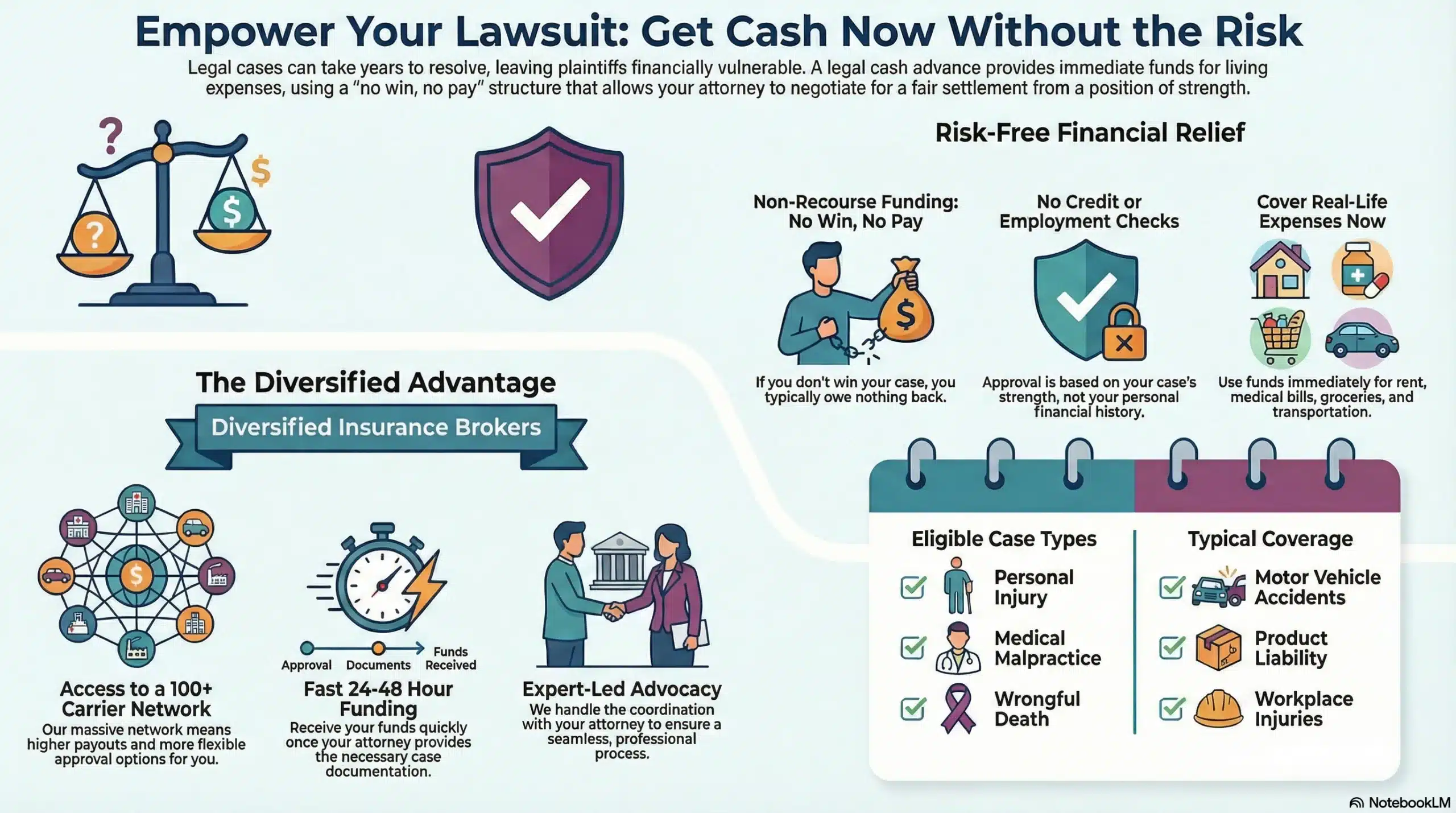
At its core, pre-settlement funding is not a loan in the traditional sense. It is a cash advance against a potential future settlement, structured so that the funding company’s right to repayment is contingent on the case producing a recovery. Approval is based primarily on the merits of the legal claim — not the plaintiff’s credit score, employment history, income, or debt-to-income ratio. If the case is successful, the funding company is repaid from the settlement proceeds. If the plaintiff loses, repayment is typically not required. That non-recourse structure is what separates legitimate pre-settlement funding from consumer loans, and it is the structural feature that makes funding viable for injured plaintiffs who cannot qualify for traditional credit or who do not want to carry personal repayment risk on top of the financial stress they are already managing. How pre-settlement funding works covers the evaluation, approval, and repayment mechanics in detail. How lawsuit loans work covers the terminology and structural distinctions in detail for plaintiffs comparing different legal funding options and trying to understand what they are actually agreeing to when they review a funding offer.
Get a Free Case Evaluation for Pre-Settlement Funding
Find out how much you may qualify for with non-recourse lawsuit funding. No upfront costs. No obligation.
Apply for Pre-Settlement FundingPre-Settlement Funding vs. Lawsuit Loans: Core Structural Differences
| Feature | Non-Recourse Pre-Settlement Funding | Traditional Lawsuit Loan / Consumer Loan |
|---|---|---|
| Repayment obligation | Non-recourse — repayment generally required only if the case results in a recovery; no personal repayment if case is lost | Full recourse — repayment required regardless of case outcome; plaintiff bears all repayment risk |
| Approval based on | Case strength — liability clarity, damages documentation, available insurance coverage, probability of recovery | Borrower’s credit score, income, employment history, and existing debt obligations |
| Monthly payments | None during pending case — all repayment comes from settlement proceeds at resolution | Monthly payments begin immediately and continue regardless of case status or plaintiff’s financial situation |
| Credit check | Generally not required — approval is case-based, not borrower-based | Required — credit history is a primary approval and pricing factor |
| Who assumes case risk | Funding company — if the case produces no recovery, the funding company loses its advance | Plaintiff — if the case produces no recovery, the plaintiff still owes full repayment |
| Attorney involvement | Required — documentation coordinated through attorney; repayment structured through settlement disbursement | None — entirely independent of legal representation; repayment is a separate personal obligation |
| Cost structure | Time-based fee models — flat fees or periodic compounding; higher cost reflects case risk assumed by funding company | Traditional interest rates — lower cost reflects lower lender risk since personal repayment is guaranteed |
| Risk transfer | Risk transferred to funding company — plaintiff receives financial stability without personal repayment liability | Risk retained by plaintiff — financial stability comes with full personal liability regardless of outcome |
The Non-Recourse Distinction: Why It Matters
By contrast with traditional loans, a lawsuit loan structured as a consumer credit product may involve personal repayment responsibility regardless of case outcome. Some financial products marketed as “lawsuit loans” function more like conventional consumer credit — with fixed repayment schedules, personal guarantees, and obligations that survive an adverse case outcome. That means even if the case does not settle favorably, the plaintiff could still owe the full principal plus accumulated interest, creating a compounding financial problem on top of the disappointment of an unsuccessful claim. Non-recourse funding shifts case risk to the funding company. Loans shift case risk back to the plaintiff. That structural difference is the most important thing to understand when comparing these products, and it should be confirmed explicitly in any contract before signing — not assumed based on marketing language that may describe both products as “lawsuit funding” without distinguishing their repayment structures.
The practical implication of this distinction is significant. A plaintiff who accepts a properly structured non-recourse pre-settlement advance and then loses the case walks away owing nothing to the funding company. A plaintiff who accepts what is marketed as a “lawsuit loan” but is actually a recourse consumer credit product and then loses the case still owes the full repayment amount, now with no settlement proceeds to pay it from and no improved financial situation to support the obligation. For plaintiffs whose cases carry meaningful uncertainty — as most civil litigation does — the non-recourse protection is not a minor contractual detail. It is the defining structural feature that determines whether the financial product serves the plaintiff’s interests or creates additional risk during an already challenging period. Is lawsuit funding safe covers the evaluation framework plaintiffs should use to assess providers and contract terms before committing to any arrangement. Pre-settlement funding overview covers the full structural picture of how non-recourse advances are designed and administered.
How Underwriting Differs Between Funding and Loans
Another major difference between pre-settlement funding and lawsuit loans involves the underwriting process — how the provider decides whether to approve the advance and for how much. Banks and conventional lenders evaluate creditworthiness: credit score, income history, employment stability, debt-to-income ratio, and collateral. Their risk model is built around the borrower’s personal ability to repay regardless of what happens in any lawsuit. A plaintiff who has excellent credit and stable income can borrow at favorable rates through conventional channels. A plaintiff who is unemployed because of an injury, who has exhausted savings managing the financial fallout of the incident, and who has damaged credit from unpaid bills during the case period will find conventional lending either unavailable or prohibitively expensive.
Pre-settlement funding providers evaluate case strength rather than borrower creditworthiness. When reviewing a funding request, the provider typically consults with the attorney to assess liability clarity, documented damages, available insurance coverage limits, defendant collectability, and the expected settlement range given the specific facts of the case. This case-based underwriting model allows plaintiffs who cannot qualify for conventional credit to access capital based on what their case is worth rather than what their personal financial history looks like. The two evaluation frameworks are structurally incompatible — a credit underwriter cannot evaluate case strength, and a case-based underwriter does not need to evaluate personal credit — which is why these are genuinely different products rather than the same product with different marketing labels. How much you can get from pre-settlement funding covers the specific evaluation factors that determine funding amounts and explains why the same case can produce different funding offers depending on which factors the underwriting team weights most heavily. Cash for lawsuit plaintiffs covers the qualification process from the plaintiff’s perspective across different case types.
Cost Structure: Understanding How Fees Work
Cost structure is another area where pre-settlement funding and traditional loans differ significantly — and where confusion between the products can lead to unpleasant surprises at settlement. Traditional loans use interest rates that accumulate on the outstanding principal balance over time, expressed as an annual percentage rate that most borrowers are familiar with from mortgage, auto loan, and credit card contexts. Pre-settlement funding often uses time-based fee models rather than traditional interest rates — some agreements use flat fees that do not compound, while others use periodic compounding structures where the repayment obligation grows as a function of how long the case remains unresolved.
Because pre-settlement funding fees are not always expressed as traditional annual percentage rates, comparing funding costs to conventional loan costs requires translating them into equivalent terms. A funding arrangement that uses a monthly compounding structure will produce a very different total repayment obligation over twelve months compared to eighteen months — and because case timelines are uncertain, understanding how the cost grows at different resolution points is essential before signing. The most important step any plaintiff can take before accepting a funding offer is to request a written payoff schedule showing the total repayment obligation if the case resolves in three months, six months, twelve months, and eighteen months. That schedule makes the cost trajectory visible and allows an informed comparison across different offers and different product structures. Lawsuit loan rates and costs covers how different fee structures impact settlement outcomes and what questions to ask when evaluating offers. Pros and cons of pre-settlement funding provides balanced analysis of both the cost dimension and the strategic leverage benefits across different case and timeline scenarios.
Settlement Leverage: Why Financial Stability Affects Case Outcomes
Financial pressure during litigation has a documented and direct effect on settlement outcomes — and this is one of the most compelling reasons to understand the structural difference between non-recourse funding and traditional loans when evaluating which option serves the plaintiff’s interests. Insurance carriers and defense attorneys are sophisticated parties who understand that financially distressed plaintiffs have a compressed time horizon. When a plaintiff is behind on rent, facing collections, or at imminent risk of eviction or vehicle repossession, the pressure to accept any reasonable offer — even one that significantly undervalues the actual case — can become overwhelming and functionally irresistible.
Non-recourse pre-settlement funding is specifically designed to address this leverage imbalance. When essential household expenses are covered, the plaintiff is no longer forced to make settlement decisions based on this week’s bills. The attorney can negotiate based on case strength and patience rather than client urgency, allowing time for liability to be fully established, medical records to be complete, damages to be fully quantified, and the insurance carrier’s initial low offers to be countered with the documented evidence of actual case value. In many situations, the improvement in gross settlement value that results from not being forced into an early, undervalued settlement is larger than the cost of the funding itself — making the net outcome better for the plaintiff even after the funding repayment is satisfied. A traditional loan with monthly payment obligations can actually worsen this problem rather than solving it, adding new monthly financial pressure on top of existing stress rather than removing the underlying pressure that the loan was intended to address. Get cash before your case settles covers how funding specifically supports this leverage strategy. Money during a lawsuit covers the full financial picture of options available to plaintiffs during active litigation and how different approaches affect both immediate stability and long-term case outcomes.
When Pre-Settlement Funding Makes More Sense Than a Loan
Understanding the structural differences between pre-settlement funding and lawsuit loans makes it clearer when each option is more appropriate. Non-recourse pre-settlement funding makes more sense than a traditional loan in several common plaintiff situations. For a plaintiff who cannot qualify for conventional credit because of injury-related unemployment, damaged credit, or insufficient income documentation, pre-settlement funding may be the only accessible capital option regardless of cost. For a plaintiff whose case carries meaningful uncertainty about outcome — where a loss is a genuine possibility rather than an abstract risk — the non-recourse protection eliminates the risk of owing money on a failed claim. For a plaintiff who cannot manage monthly loan payments because their income has been disrupted by the injury, pre-settlement funding’s no-monthly-payment structure removes a pressure source that a conventional loan would add rather than relieve. And for a plaintiff whose attorney anticipates a significantly stronger settlement with additional negotiating time, the cost of funding may be more than offset by the improvement in gross settlement value — making non-recourse funding the financially superior choice even in cases where conventional credit is technically available.
Traditional loan products may make more sense in situations where the plaintiff has strong credit, stable income, can manage monthly payments without additional stress, wants a lower-cost option and can qualify for conventional rates, and is confident enough in the case outcome that the non-recourse protection is not meaningfully valuable. In those situations — which describe a minority of plaintiffs seeking legal funding during active injury litigation — comparing costs across conventional credit products may produce a better total outcome than accepting the higher cost of non-recourse pre-settlement funding. The honest answer for most injured plaintiffs, however, is that the conventional credit comparison is academic because they cannot realistically qualify for or manage the products that would offer better rates. Advance on lawsuit settlement covers how advances are structured against expected proceeds and what the repayment calculation looks like at different case timelines. Legal funding companies covers how to evaluate providers across transparency, documentation requirements, and disclosed cost structures to identify the most appropriate funding source for a specific situation.
Additional Considerations: Tax Treatment and Multiple Advances
Some plaintiffs have questions about the tax treatment of pre-settlement funding proceeds. While lawsuit funding itself is generally not treated as taxable income — because it is an advance against expected settlement proceeds rather than earned income or a taxable distribution — settlement taxation can vary depending on case type, jurisdiction, and the specific nature of the claims. Physical injury settlements are generally excluded from federal taxable income under established tax law, while settlements for non-physical claims such as employment discrimination or punitive damages may have different tax treatment. Because the funding is an advance rather than the settlement itself, it does not independently create a taxable event — but the underlying settlement proceeds, when received, are subject to whatever tax treatment applies to that settlement type. Consulting a tax professional about the specific case type and expected settlement structure is advisable for any plaintiff receiving a substantial settlement.
Another consideration that distinguishes pre-settlement funding from conventional loans is the question of additional advances. Conventional lenders generally allow borrowers to take additional loans as separate credit facilities independent of any previous borrowing. In pre-settlement funding, additional advances against the same case require updated case evaluation and are subject to the existing advance balance — because the total outstanding funding plus accumulated costs must remain supportable by the expected net recovery. This means that unlike conventional borrowing, where the availability of additional credit is primarily a function of the borrower’s creditworthiness and payment history, additional pre-settlement funding is gated by the available headroom in the expected case proceeds. Taking a large initial advance reduces or eliminates the capacity for follow-up funding if the case extends beyond expectations, which is another reason conservative initial borrowing produces better long-term flexibility than maximizing the initial advance amount. Injury lawsuit cash advance covers how funding specifically helps personal injury plaintiffs at different case stages. Medical malpractice lawsuit funding covers the specific documentation and underwriting requirements for complex, high-value cases where the relationship between funding amount, case value, and cost structure requires particularly careful analysis.
How to Evaluate Any Legal Funding Agreement
The safest approach when evaluating any legal funding agreement — whether it is marketed as pre-settlement funding, a lawsuit loan, or a legal cash advance — is to apply a consistent set of transparency standards before signing anything. The first and most important verification is confirming that the agreement explicitly states non-recourse terms — that repayment is conditioned on case success and that the plaintiff has no personal repayment obligation if the case produces no recovery. This should be stated clearly in the contract language, not implied by marketing materials or verbal assurances. The second is requesting a written payoff schedule showing the total repayment at multiple resolution timelines. The third is reviewing the contract with the attorney, who can evaluate the repayment obligation in the context of the expected case value and recommend whether the funding amount and cost structure are appropriate given what the attorney believes the case will ultimately produce. The fourth is confirming that the funding company coordinates through the attorney for documentation and disbursement rather than bypassing the attorney — because attorney involvement is both a quality signal and a structural protection for the plaintiff. Legal funding fast pre-settlement cash advances covers the documentation and coordination process in detail. Lawsuit settlement loans covers the structural landscape of legal funding options and how they compare across repayment mechanics and cost structures.
Avoid Confusion Between Loans and Funding
Understand your options before signing any agreement. Compare structures, costs, and repayment obligations clearly.
Request Funding InformationRelated Pages to Explore
Talk With an Advisor Today
Choose how you’d like to connect—call or message us, then book a time that works for you.
Schedule here:
calendly.com/jason-dibcompanies/diversified-quotes
Licensed in all 50 states • Fiduciary, family-owned since 1980
Frequently Asked Questions: Pre-Settlement Funding vs. Lawsuit Loans
What is the key difference between pre-settlement funding and a lawsuit loan?
The key difference is the repayment structure and who assumes the case risk. Pre-settlement funding is typically structured as non-recourse — repayment is generally required only if the case results in a recovery, and if the plaintiff loses, no repayment is owed. The funding company assumes the case risk. A traditional lawsuit loan structured as consumer credit requires full repayment regardless of case outcome — the plaintiff assumes all case risk and owes the money whether they win or lose. This structural distinction determines whether the product provides financial stability without personal liability exposure or simply creates a new repayment obligation on top of existing financial stress. Confirming non-recourse terms explicitly in any contract before signing is essential — the marketing label is not a reliable indicator of the repayment structure.
Why is pre-settlement funding approved based on case strength rather than credit?
Because the funding company’s right to repayment depends on the case outcome rather than the plaintiff’s personal financial obligations, the underwriting logic must focus on what determines whether repayment will occur — which is the case itself. A plaintiff with excellent credit who loses a weak case cannot repay a non-recourse advance from non-existent settlement proceeds. A plaintiff with poor credit who wins a strong case will repay the advance from substantial settlement proceeds. The relevant risk variable is case strength — liability clarity, damages documentation, insurance coverage, and probability of recovery — not personal creditworthiness. This is also why pre-settlement funding is accessible to injured plaintiffs who are unemployed, have damaged credit, or have no income to document, when those same circumstances would make them ineligible for any conventional lending product.
If pre-settlement funding is more expensive than a loan, why would I choose it?
Pre-settlement funding is typically more expensive than conventional loans because the funding company assumes the case risk that a conventional lender does not. The higher cost reflects that risk premium. The reason to choose it despite the higher cost comes down to three factors: first, many plaintiffs cannot qualify for conventional loans at favorable rates because of injury-related unemployment and credit damage; second, the non-recourse protection eliminates personal repayment liability if the case fails — conventional loans do not; and third, the no-monthly-payment structure removes ongoing payment pressure that conventional loans would add rather than relieve. For plaintiffs who can genuinely access affordable conventional credit, that comparison is worth making — but for most injured plaintiffs seeking legal funding, the comparison is somewhat academic because the conventional options are not realistically available.
How do I confirm that a funding agreement is truly non-recourse?
Confirm it in the contract language itself — not in marketing materials, verbal representations, or the company’s website. The agreement should explicitly state that repayment is conditioned on a successful case recovery and that the plaintiff has no personal repayment obligation if the case produces no recovery. Look for language that states the advance is non-recourse and that the funding company’s only recourse for repayment is the settlement proceeds — not the plaintiff’s personal assets, income, or other resources. If the contract language is ambiguous about repayment obligations or includes any provision that could create personal liability regardless of case outcome, review those specific provisions carefully with the attorney before signing. The attorney’s review of the contract is one of the most valuable steps in this process because the attorney can identify provisions that could create unintended obligations and advise whether the terms are appropriate given the case’s expected trajectory.
Does working with a funding network rather than a single provider make a difference?
Yes — working through a network of legal funding sources rather than a single provider typically produces better outcomes for plaintiffs in several ways. Different funding companies have different underwriting criteria and risk appetites for different case types — a case that one provider declines or offers conservatively may receive a better offer from a different provider whose criteria better fit the specific case profile. Network access also creates competitive pressure that can improve offer quality when multiple sources might fund the same case. For plaintiffs, the practical benefits include better approval odds across a wider range of case types and stages, more competitive offers when multiple funding sources can be compared simultaneously, and access to specialized providers for case types like medical malpractice or complex personal injury where standard underwriting criteria may not fully capture the case’s value.
About the Author:
Jason Stolz, CLTC, CRPC, DIA, CAA and Chief Underwriter at Diversified Insurance Brokers (NPN 20471358), is a senior insurance and retirement professional with more than 25 years of real-world experience helping individuals, families, and business owners protect their income, assets, and long-term financial stability. As a long-time partner of the nationally licensed independent agency Diversified Insurance Brokers, Jason provides trusted guidance across multiple specialties—including fixed and indexed annuities, long-term care planning, personal and business disability insurance, life insurance solutions, Group Health, Travel Medical and Evacuation Insurance, and short-term health coverage. Diversified Insurance Brokers maintains active contracts with over 100 highly rated insurance carriers, ensuring clients have access to a broad and competitive marketplace.
His practical, education-first approach has earned recognition in publications such as VoyageATL, and contributions from his agency featured in Kiplinger and GoBankingRates— highlighting his commitment to financial clarity and client-focused planning. Drawing on deep product knowledge and years of hands-on field experience, Jason helps clients evaluate carriers, compare strategies, and build retirement and protection plans that are both secure and cost-efficient. Visitors who want to explore current annuity rates and compare options across multiple insurers can also use this annuity quote and comparison tool.
Explore All Lawsuit Loan & Legal Funding Options: Browse our complete guide to Lawsuit Loans & Legal Funding — covering pre-settlement funding, lawsuit cash advances, injury claims & more.
Last Reviewed: June 16, 2026 |
Reviewed by: Jason Stolz, CLTC, CRPC, DIA, CAA
Chief Underwriter, Diversified Insurance Brokers, Inc. | NPN: 20471358 | Diversified Insurance Brokers, Inc. — Licensed in all 50 states
Fact Checked by: Tonia Pettitt, CMIP©
Medicare Specialist, Diversified Insurance Brokers, Inc. | NPN: 14374308 | Diversified Insurance Brokers, Inc. — Licensed in all 50 states
Did you find this content helpful? Leave us a Google review — it helps others find trustworthy guidance too.
Editorial Standards: Diversified Insurance Brokers maintains rigorous editorial standards to ensure accuracy, clarity, and independence in all content. Learn more about our editorial standards and commitment to transparency.
