
How Pre-Settlement Funding Works
How Pre-Settlement Funding Works

Jason Stolz CLTC, CRPC, DIA, CAA
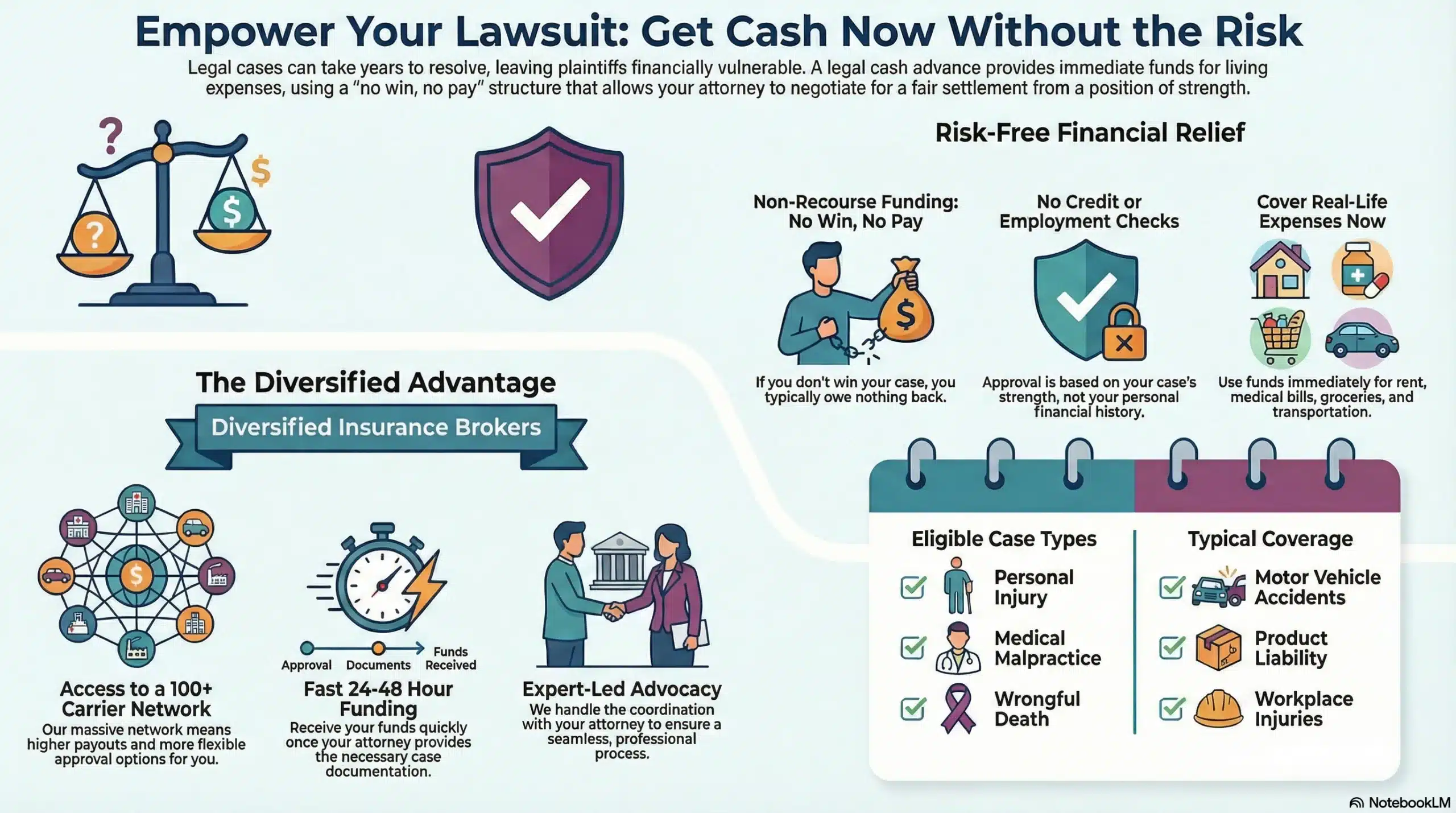
Pre-settlement funding is one of the most misunderstood financial products available to lawsuit plaintiffs — and understanding it correctly before signing an agreement is one of the most important financial decisions an injured person can make while their case is pending. The mechanics are simple in concept: a funding company advances money to a plaintiff against the expected proceeds of a pending lawsuit, and the advance is repaid only if and when the case resolves favorably. If the case is lost or produces no recovery, the plaintiff owes nothing. That non-recourse structure is what fundamentally distinguishes pre-settlement funding from every other form of borrowing — and it is also what makes the cost structure of lawsuit funding significantly different from traditional loan pricing. At Diversified Insurance Brokers, we work with injured plaintiffs and their attorneys to evaluate funding needs, compare options transparently, and access advances based on case strength rather than credit history or employment status.
The financial pressure that drives plaintiffs to seek pre-settlement funding is real and documented. According to Bureau of Justice Statistics analysis, the average tort lawsuit takes approximately twenty-three months to resolve in state courts — and medical malpractice cases average thirty-one months. For a plaintiff who has been injured, is unable to work, and is facing mortgage payments, medical bills, and basic living expenses without income, that timeline represents a genuine financial crisis. Insurance carriers defending these cases understand this dynamic and sometimes leverage it — offering early settlement amounts that are below fair value precisely because they know the plaintiff is under financial pressure. Access to pre-settlement funding can eliminate that pressure and allow the plaintiff’s attorney the time needed to pursue fair compensation rather than accepting a forced early settlement.
Need Cash While Your Case Is Pending?
Fast, non-recourse advances based on case strength — not credit score, income, or employment history. No repayment if you lose your case.
Request Pre-Settlement FundingWhat Pre-Settlement Funding Actually Is — and Is Not
Despite being commonly called a “lawsuit loan,” pre-settlement funding is technically not a loan in the traditional sense. A loan requires repayment regardless of what happens — if you borrow money from a bank and your circumstances change, you still owe the bank. Pre-settlement funding is a non-recourse advance, meaning repayment is contingent on a favorable outcome in your case. If the case produces a settlement or judgment, the funding company is repaid from those proceeds. If the case is lost, dismissed, or produces no recovery, the advance is written off as a loss by the funding company. You owe nothing personally. Your credit, your home, and your other assets are not at risk.
This non-recourse structure has several practical implications. Approval is based on the merits and projected value of the case — not on the plaintiff’s credit score, employment history, income level, or financial reserves. The funding company is effectively investing in the outcome of the lawsuit, which is why they conduct a case-specific underwriting review rather than a personal financial review. It also means the funding company shares the plaintiff’s interest in a strong recovery — they are repaid from the same pool of proceeds the plaintiff receives. Our resource on what pre-settlement funding is covers the foundational concept in plain language, and the resource on pre-settlement funding versus lawsuit loans addresses the terminology distinction that confuses many plaintiffs.
The Application and Approval Process
The pre-settlement funding application process is designed to be fast and requires no financial documentation from the plaintiff. The core application collects basic personal information, the type of case and the jurisdiction where it is filed, and — critically — the contact information for the plaintiff’s attorney. Attorney involvement is not optional in a well-structured pre-settlement funding arrangement. The funding company communicates directly with the attorney to obtain the case documentation needed for underwriting review: the complaint and any counter-pleadings, police reports or incident reports, medical records documenting injuries and treatment, evidence of liability, documentation of insurance coverage limits, and the attorney’s assessment of case strength and likely settlement range.
The underwriting review evaluates several factors simultaneously. Liability strength — how clear and well-documented is the defendant’s fault — is the most critical factor, because a case with disputed liability carries far higher risk of no recovery than one with unambiguous fault. Damages documentation — the medical records, wage loss evidence, and evidence of pain and suffering — establishes the baseline for settlement value estimation. Insurance coverage limits frame the realistic recovery ceiling, since most personal injury settlements are bounded by the defendant’s available insurance. Jurisdiction matters because different courts and different states have different average outcomes and timelines that affect the funding company’s risk assessment. The attorney’s experience, reputation, and case management approach also factor into the evaluation.
Once the underwriting review is complete, the funding company communicates an approval decision to the plaintiff and attorney, including the approved advance amount and the fee or interest rate structure that will govern repayment. For cases that qualify, funding can be disbursed within twenty-four to forty-eight hours of approval and attorney confirmation. Our resource on getting an advance on a pending lawsuit provides additional detail on approval timelines, and our resource on getting cash before your lawsuit settles addresses the documentation preparation that accelerates the review process.
Pre-Settlement Funding: Step-by-Step Process
| Step | Stage | What Happens | Typical Timeline |
|---|---|---|---|
| 1 | Application | Plaintiff submits case details and attorney contact information — no financial documents required | Under 15 minutes |
| 2 | Attorney documentation | Funding company contacts attorney; attorney provides case documents, medical records, liability evidence | Same day to 1–2 days |
| 3 | Underwriting review | Liability strength, damages, insurance limits, jurisdiction, and settlement timeline are evaluated | 24–48 hours of document receipt |
| 4 | Offer and agreement | Approved amount, fee structure, and repayment terms presented to plaintiff and attorney for review | Same day as approval |
| 5 | Funding disbursement | Advance wired directly to plaintiff after attorney confirmation and signed agreement | 24–48 hours after agreement |
| 6 | Repayment at settlement | Attorney repays funding company from settlement proceeds; plaintiff receives net recovery after fees, liens, and advance repayment | At case resolution |
Understanding Pre-Settlement Funding Costs: What You Must Know Before Signing
Pre-settlement funding costs are structured differently from traditional loan interest, and the total cost accumulates in a way that many plaintiffs underestimate when evaluating an initial offer. Most funding companies charge a monthly fee — typically ranging from two to four percent of the funded amount — that accrues from the date the advance is issued until the case resolves. The critical variable is whether this fee is calculated on a simple interest or compound interest basis. Simple interest means the monthly fee applies only to the original advance amount throughout the life of the funding. Compound interest means each month’s fee is added to the outstanding balance, and the following month’s fee is calculated on that growing balance — producing dramatically higher total repayment for cases that take longer to resolve.
The practical illustration of this difference is significant. A $10,000 advance at three percent monthly simple interest outstanding for twelve months would produce approximately $13,600 in total repayment. The same $10,000 advance at three percent monthly compound interest would produce approximately $14,258 at twelve months — and over $20,000 if the case takes two years to resolve. For cases that take three years, the compounding effect produces repayment amounts that can consume a disproportionate share of the plaintiff’s net settlement. Industry research has found that the effective annual cost of many lawsuit advances, when compounding fees are included, exceeds fifty percent per year. This is not inherently predatory — it reflects the genuine risk the funding company assumes by writing off losses on cases that do not recover — but it means that plaintiffs must understand the fee structure completely before accepting any advance. Our resource on lawsuit loan rates and how to compare costs provides the specific comparison framework, and the resource on how much you can get from pre-settlement funding covers the calculation of maximum advance amounts relative to projected settlement value. Most responsible funding companies limit advances to approximately ten to fifteen percent of projected case value to ensure adequate remaining proceeds for the plaintiff after repayment.
What Cases Qualify for Pre-Settlement Funding
Pre-settlement funding is most commonly available for civil personal injury cases where liability is clear and damages are documented. The most frequently funded case types include motor vehicle accidents — including car accidents, truck accidents, motorcycle accidents, and rideshare accidents — premises liability cases including slip and fall and other property hazard claims, medical malpractice, workers’ compensation claims, product liability, and wrongful death matters. Our case-type specific resources on personal injury lawsuit funding, car accident lawsuit loans, medical malpractice lawsuit funding, slip and fall lawsuit funding, workers’ comp settlement loans, and wrongful death settlement funding address the specific considerations for each claim type.
Case types that generally do not qualify for pre-settlement funding include criminal cases, family law matters including divorce and custody disputes, bankruptcy proceedings, and cases without attorney representation. Class action cases may qualify in certain circumstances but face additional evaluation complexity because individual recovery amounts are typically uncertain until late in the litigation. The presence of active attorney representation is effectively a prerequisite for pre-settlement funding — the repayment mechanism runs through the attorney’s trust account, and funding companies require attorney cooperation as part of the underwriting and disbursement process. Our resource on lawsuit funding and legal cash advances provides a broader overview of the eligibility criteria across case types, and the resource on whether lawsuit funding is safe addresses the regulatory and consumer protection considerations plaintiffs should evaluate before applying.
How Repayment Works and What Your Net Recovery Looks Like
Repayment of a pre-settlement advance does not come out of the plaintiff’s pocket directly — it is handled through the attorney’s trust account as part of the settlement distribution process. When the case resolves and settlement proceeds are received, the attorney distributes those proceeds according to the obligations attached to the case: attorney fees (typically thirty-three to forty percent of the gross recovery for contingency fee cases), any medical liens from hospitals or treatment providers, the pre-settlement funding repayment (principal plus accrued fees), and the remaining balance to the plaintiff. Understanding this distribution order and the amounts attached to each obligation before the settlement is reached allows the plaintiff to know what their net recovery will look like before accepting any offer.
This is why responsible pre-settlement funding companies limit their advance to a fraction of projected settlement value — typically ten to fifteen percent. If a case is expected to settle for $100,000 and a $15,000 advance has been outstanding for eighteen months at three percent monthly compound interest, the total repayment might be approximately $23,000 to $25,000. After attorney fees of $33,000 and medical liens, the net proceeds to the plaintiff from a $100,000 settlement would be substantially reduced. A responsible advance amount ensures the plaintiff still receives meaningful net recovery. An advance that is too large, or one where fees have compounded excessively on a long case, can consume a disproportionate share of the net recovery — which is why reviewing the full repayment scenario with your attorney before accepting any funding is essential. Our resource on the pros and cons of pre-settlement funding provides a balanced evaluation of when the financial case for funding is strong and when it is not.
The Strategic Value: Avoiding Forced Low Settlements
One of the most significant and least discussed benefits of pre-settlement funding is its role in negotiating leverage. Insurance carriers and defendants understand that plaintiffs under financial pressure are more likely to accept early, below-value settlement offers rather than waiting for the case to fully develop through discovery, expert engagement, and potential trial preparation. A plaintiff who is three months behind on mortgage payments, facing utility disconnection, and has no accessible savings may accept sixty cents on the dollar simply to stop the financial bleeding — even if their attorney is confident a full settlement or verdict would deliver significantly more. This dynamic benefits the defendant’s insurer directly, and experienced defense counsel knows how to apply it.
Pre-settlement funding removes that pressure. With immediate financial needs addressed, the plaintiff and attorney have the runway to pursue the case on its merits rather than its timeline. This shifts negotiating leverage back toward the plaintiff and can result in meaningfully higher final settlements — often more than enough to offset the cost of the funding. The strategic value of maintaining financial stability through prolonged litigation is why many personal injury attorneys encourage their clients to explore funding options rather than accepting inadequate early offers. The comparison of available options in your region is available through our resource on pre-settlement funding companies, and the companion resource on whether pre-settlement funding is worth it provides the cost-benefit framework for evaluating any specific funding opportunity against the case’s likely outcome range.
Talk With an Advisor Today
Choose how you’d like to connect—call or message us, then book a time that works for you.
Schedule here:
calendly.com/jason-dibcompanies/diversified-quotes
Licensed in all 50 states • Fiduciary, family-owned since 1980
Frequently Asked Questions: How Pre-Settlement Funding Works
What is the difference between pre-settlement funding and a traditional loan?
Pre-settlement funding is a non-recourse advance, meaning repayment is contingent on a favorable outcome in your case — if you lose, you owe nothing. A traditional loan requires repayment regardless of circumstances. This is the fundamental structural difference. Because the funding company absorbs the financial risk of cases that do not recover, they conduct their underwriting review based entirely on case merit rather than the plaintiff’s credit score, employment history, income, or financial assets. There is no credit check and no personal financial review. Approval is based on liability clarity, damages documentation, insurance coverage, and projected settlement value. The non-recourse structure also means there are no monthly payments during the case — the outstanding balance and accrued fees are repaid in a lump sum at settlement, handled through the attorney’s trust account. You do not need to make any payments while your case is pending. Our resource on pre-settlement funding versus lawsuit loans addresses the terminology and structural distinctions in detail.
How much can I receive from pre-settlement funding?
Responsible funding companies typically limit advances to approximately ten to fifteen percent of the projected settlement or judgment value. This ceiling exists to protect the plaintiff — ensuring that after attorney fees, medical liens, and the funding repayment are satisfied, the plaintiff still receives meaningful net proceeds from their case. The funding amount is not based on what you ask for; it is based on the funding company’s underwriting assessment of the likely recovery value. A case projected to settle for $100,000 might support an advance of $10,000 to $15,000. A more complex case with higher expected damages and documented medical expenses may support a larger advance. The exact amount depends on the liability strength, damages documentation, insurance limits, jurisdiction, and case timeline. Applying for more than you actually need is generally inadvisable because the fees accrue on the full funded amount — borrowing only what is necessary to cover immediate financial needs minimizes the total cost and preserves more of the net settlement for you. Our resource on how much you can get from pre-settlement funding covers the calculation framework.
How much does pre-settlement funding cost?
Pre-settlement funding costs more than traditional lending because the funding company assumes the full risk of cases that do not recover — those losses are effectively priced into the rates charged on the cases that do. Most companies charge a monthly fee ranging from two to four percent of the advance amount, though some charge flat fees rather than percentage-based monthly rates. The most important distinction when comparing offers is whether the fee structure uses simple interest or compound interest. Simple interest applies the monthly rate only to the original advance amount throughout the life of the funding. Compound interest adds each month’s fee to the outstanding balance and applies the next month’s rate to that growing total — which can roughly double the total repayment on cases that take two years to resolve compared to a simple interest structure at the same stated rate. On a $10,000 advance at three percent monthly compound interest, the total repayment after one year is approximately $14,258 and after two years exceeds $20,000. Before accepting any funding, you should receive a written fee schedule that shows exactly what you would owe under multiple settlement timing scenarios — and review it with your attorney. Comparing rates across providers using our resource on lawsuit loan rates helps identify the most cost-effective available option.
What types of cases qualify for pre-settlement funding?
Pre-settlement funding is most commonly available for personal injury cases where liability is reasonably clear and damages are documented. The most frequently funded case types include motor vehicle accidents of all types, premises liability cases including slip and fall and other property hazard claims, medical malpractice, product liability, workers’ compensation claims, and wrongful death matters. Employment discrimination and civil rights cases qualify with some funding companies. Cases that generally do not qualify include criminal matters, family law proceedings such as divorce and custody disputes, bankruptcy cases, and any matter without active attorney representation — because the repayment mechanism runs through the attorney’s trust account and requires attorney cooperation. Class action cases may qualify but face additional complexity because individual plaintiff recovery amounts are uncertain until late in the litigation. The core qualification requirement across all eligible case types is a pending case with a realistic probability of recovery, represented by an attorney who can provide the documentation needed for underwriting review. Our case-specific resources — including personal injury funding and car accident funding — cover the specific documentation and approval considerations for the most common case types.
Does pre-settlement funding affect my case or my attorney’s strategy?
No — pre-settlement funding does not give the funding company any control over or involvement in your litigation strategy, settlement decisions, or attorney communications. Your attorney remains fully in charge of all legal decisions including whether to accept a settlement, how to negotiate with the opposing party, whether to proceed to trial, and how to manage the case. The funding company’s only contractual right is to receive repayment from settlement proceeds if and when the case resolves favorably — they have no voice in how or when that resolution happens. That said, your attorney should be aware of any funding agreements you enter because the repayment obligation is processed through their trust account at settlement and affects the distribution of proceeds. Most attorneys are familiar with pre-settlement funding and many actively inform clients about it as an option when financial hardship is creating pressure to accept below-value settlements. Discussing any funding arrangement with your attorney before signing is strongly advisable to ensure the terms are reasonable given the expected case timeline and projected settlement value.
What happens if I lose my case after receiving pre-settlement funding?
If your case is lost, dismissed, or produces no recovery, you owe nothing to the funding company. The non-recourse nature of pre-settlement funding means the funding company absorbs the full financial loss on cases that do not recover. Your personal credit, home, savings, and other assets are not at risk. There is no collection action, no debt reporting, and no personal liability of any kind. This is the defining characteristic that separates pre-settlement funding from every other form of personal lending — and it is the primary reason the cost structure of pre-settlement funding is higher than traditional loan rates. The funding company’s risk model assumes that a portion of its funded cases will produce no recovery, and the fees charged on successfully resolved cases subsidize those losses. For plaintiffs, this structure means the downside risk of accepting pre-settlement funding is limited to the reduction in net settlement proceeds if the case wins — not any personal financial exposure if it does not. Our resource on whether lawsuit funding is safe covers both the protections for plaintiffs and the red flags to watch for when evaluating any specific funding company’s terms.
How fast can I receive pre-settlement funding?
For cases with strong liability, clear damages documentation, and an attorney who can promptly provide the required case materials, funding can be disbursed within twenty-four to forty-eight hours of the completed underwriting review. The primary variable in funding speed is not the funding company’s review process — which typically moves quickly once documents are received — but rather the speed at which the plaintiff’s attorney can assemble and transmit the case documentation. Police reports, medical records, liability evidence, and insurance documentation that are already compiled and organized at the time of application can be transmitted to the underwriting team immediately, allowing for same-day or next-day approval in straightforward cases. Cases with incomplete documentation, unresolved liability questions, or complex medical records may require additional review time. The application itself takes approximately fifteen minutes to complete. Notifying your attorney before applying and asking them to prepare the documentation package in advance is the single most effective way to accelerate the funding timeline. Our resource on getting money before your settlement check arrives covers the documentation preparation steps that compress approval time.
What should I look for when comparing pre-settlement funding companies?
The most important factors to evaluate when comparing pre-settlement funding companies are fee transparency, interest structure, advance amount offered, and the company’s reputation for straightforward dealing. On transparency: a reputable company should be able to tell you exactly what you would owe under multiple settlement timing scenarios before you sign — if a company cannot or will not provide a clear written repayment schedule, that is a significant red flag. On interest structure: confirm whether fees accrue as simple or compound interest, and request a comparison showing total repayment at twelve, twenty-four, and thirty-six months so you understand how the cost grows over time. On advance amount: be cautious of companies offering more than approximately fifteen percent of projected case value — aggressive advance amounts may feel helpful initially but can consume a disproportionate share of your net settlement proceeds when the case resolves. On reputation: your attorney is your best resource for evaluating funding companies — they have direct experience with how different companies handle repayment at settlement and which ones operate transparently versus obscurely. Our resource on pre-settlement funding companies provides a framework for this comparison, and the balanced evaluation at the pros and cons of pre-settlement funding provides the full decision framework.
About the Author:
Jason Stolz, CLTC, CRPC, DIA, CAA and Chief Underwriter at Diversified Insurance Brokers (NPN 20471358), is a senior insurance and retirement professional with more than 25 years of real-world experience helping individuals, families, and business owners protect their income, assets, and long-term financial stability. As a long-time partner of the nationally licensed independent agency Diversified Insurance Brokers, Jason provides trusted guidance across multiple specialties—including fixed and indexed annuities, long-term care planning, personal and business disability insurance, life insurance solutions, Group Health, Travel Medical and Evacuation Insurance, and short-term health coverage. Diversified Insurance Brokers maintains active contracts with over 100 highly rated insurance carriers, ensuring clients have access to a broad and competitive marketplace.
His practical, education-first approach has earned recognition in publications such as VoyageATL, and contributions from his agency featured in Kiplinger and GoBankingRates— highlighting his commitment to financial clarity and client-focused planning. Drawing on deep product knowledge and years of hands-on field experience, Jason helps clients evaluate carriers, compare strategies, and build retirement and protection plans that are both secure and cost-efficient. Visitors who want to explore current annuity rates and compare options across multiple insurers can also use this annuity quote and comparison tool.
Explore All Lawsuit Loan & Legal Funding Options: Browse our complete guide to Lawsuit Loans & Legal Funding — covering pre-settlement funding, lawsuit cash advances, injury claims & more.
Last Reviewed: June 11, 2026 |
Reviewed by: Jason Stolz, CLTC, CRPC, DIA, CAA
Chief Underwriter, Diversified Insurance Brokers, Inc. | NPN: 20471358 | Diversified Insurance Brokers, Inc. — Licensed in all 50 states
Fact Checked by: Tonia Pettitt, CMIP©
Medicare Specialist, Diversified Insurance Brokers, Inc. | NPN: 14374308 | Diversified Insurance Brokers, Inc. — Licensed in all 50 states
Did you find this content helpful? Leave us a Google review — it helps others find trustworthy guidance too.
Editorial Standards: Diversified Insurance Brokers maintains rigorous editorial standards to ensure accuracy, clarity, and independence in all content. Learn more about our editorial standards and commitment to transparency.
