
Life Insurance for High Risk Occupations
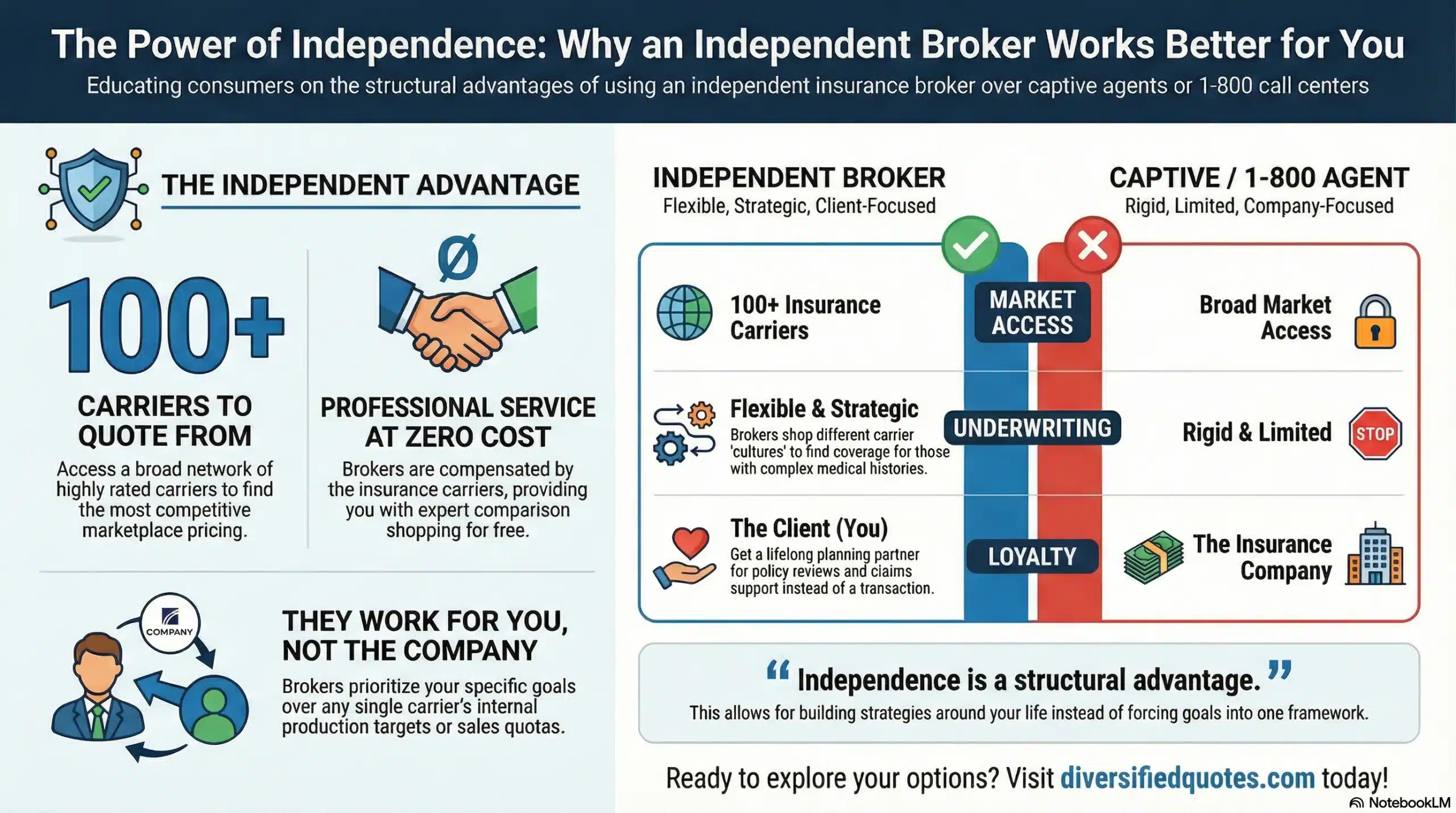
As an Independent Life Insurance Broker, we compare rates across 100+ carriers and prescreen every application before submission.
Life Insurance for High Risk Occupations

Jason Stolz CLTC, CRPC, DIA, CAA
When you apply for life insurance with a high-risk occupation, a hazardous hobby, an aviation history, or a complex medical background, underwriting typically assigns you to a risk class such as Preferred, Standard, or a Table rating. In some cases, however, the insurer uses a more precise pricing adjustment known as a flat extra — an additional dollar charge per $1,000 of coverage added on top of your base premium when there is a clearly defined, measurable risk that cannot be fully addressed through a percentage-based rating alone. Rather than increasing your entire premium proportionally, the carrier isolates the specific exposure and prices it separately, reflecting a calculated actuarial estimate of the additional mortality risk associated with that specific hazard.
At Diversified Insurance Brokers, we regularly work with applicants who receive flat extras due to occupational hazards, medical history, aviation involvement, or high-risk activities. We also regularly succeed in reducing or restructuring those offers by carefully positioning the case with the most favorable carrier before the formal application is submitted. Understanding how flat extras work, what drives them, and what options exist for managing or reducing them is the foundation of strategic high-risk life insurance placement.
Received a Flat Extra Offer?
We’ll review your underwriting decision, compare multiple carriers, and work to reduce or limit the surcharge.
Request a Flat Extra ReviewQuestions? Call 800-533-5969
Flat Extra vs. Table Rating: Understanding the Difference
Two distinct underwriting mechanisms price elevated risk in life insurance: table ratings and flat extras. Both result in higher-than-standard premiums, but they work differently, apply to different types of risk, and interact with coverage amount decisions differently. Some applicants receive both simultaneously — for example, a pilot with mild hypertension might receive a table rating for the cardiovascular risk and a separate flat extra for the aviation exposure, because these are genuinely distinct risks that the carrier prices through different mechanisms.
How Table Ratings Work
A table rating increases the premium by a percentage above the standard rate and is typically used for health-related risk. Each table represents a 25% increase above standard at most carriers. The key characteristic is proportionality — the same percentage surcharge applies regardless of face amount.
| Table Rating | % of Standard Premium | Common Causes |
|---|---|---|
| Table 2 | 150% of standard | Mild chronic condition, slightly impaired labs |
| Table 4 | 200% of standard | Managed cardiovascular history, moderate diabetes |
| Table 6 | 250% of standard | Multiple conditions, higher-risk health profile |
| Table 8 | 300% of standard | Serious condition, near the limit of insurability |
How Flat Extras Work
A flat extra adds a fixed dollar amount per $1,000 of coverage and is used for specific, quantifiable hazards that are somewhat independent of the applicant’s overall health profile — occupational exposures, aviation, or hazardous activities. The surcharge scales directly with face amount, not with the base premium.
| Coverage Amount | Flat Extra ($3/thousand) | Flat Extra ($5/thousand) | Flat Extra ($7.50/thousand) |
|---|---|---|---|
| $250,000 | $750/yr | $1,250/yr | $1,875/yr |
| $500,000 | $1,500/yr | $2,500/yr | $3,750/yr |
| $1,000,000 | $3,000/yr | $5,000/yr | $7,500/yr |
| $2,000,000 | $6,000/yr | $10,000/yr | $15,000/yr |
Table Rating vs. Flat Extra: Side-by-Side Comparison
| Feature | Table Rating | Flat Extra |
|---|---|---|
| How it’s calculated | Percentage above standard premium | Fixed dollar amount per $1,000 of coverage |
| Scales with face amount? | Proportionally (same % regardless of size) | Directly (larger policy = larger flat extra cost) |
| Typical risk type | Health-related — chronic conditions, impaired labs, cardiovascular history | Specific hazards — occupation, aviation, hazardous hobbies, discrete medical events |
| Duration | Usually permanent unless condition resolves | Temporary or permanent depending on the hazard |
| Can both apply? | Yes — a pilot with hypertension may receive a table rating for the cardiovascular risk and a separate flat extra for aviation exposure | |
How Flat Extras Are Calculated — and Why Face Amount Matters
The flat extra rate — typically expressed as a dollar amount per $1,000 of coverage — is determined by the carrier’s actuarial assessment of the additional annual mortality risk associated with the specific hazard. The range of flat extras in the market extends from as little as $1 per $1,000 for mild or limited hazard exposures to $10, $15, or even higher per $1,000 for serious or ongoing high-risk exposures. Common flat extra amounts for occupational risks fall in the $2.50 to $7.50 per $1,000 range depending on the specific hazard and the carrier’s underwriting appetite.
The scaling effect of flat extras is the most important practical dimension to understand. As the table below illustrates, the same flat extra rate produces very different annual additional costs depending on the coverage amount requested.
| Coverage Amount | Flat Extra ($5 per $1,000) | Additional Annual Cost |
|---|---|---|
| $250,000 | $5 × 250 units | $1,250 per year |
| $500,000 | $5 × 500 units | $2,500 per year |
| $1,000,000 | $5 × 1,000 units | $5,000 per year |
| $2,000,000 | $5 × 2,000 units | $10,000 per year |
This scaling effect is why face amount strategy matters for high-risk applicants. Adjusting coverage amounts, layering multiple smaller policies across different carriers, or using a combination of fully underwritten policies (with the flat extra) and simplified issue policies (for an additional layer without the flat extra) can sometimes produce better total coverage at lower total cost than a single large policy carrying a large flat extra. Reviewing how life insurance pricing works alongside the flat extra mechanics helps frame the full premium structure and where reduction strategies have the most impact.
Temporary vs. Permanent Flat Extras
One of the most important distinctions in flat extra underwriting is whether the surcharge is temporary or permanent. This distinction is often not clearly communicated to applicants when an offer is presented, yet it has enormous implications for the long-term cost of the policy.
Temporary flat extras are assessed for a defined period and automatically fall off the policy when that period ends, without requiring a new application or medical review. Common temporary flat extra durations range from two to ten years, depending on the specific risk being addressed and the carrier’s assessment of how that risk evolves over time. Medical flat extras are often temporary: an applicant who receives a flat extra following a recent cancer diagnosis in favorable remission may have a five-year temporary flat extra that automatically ends when the remission period has demonstrated sustained stability. An applicant with a recent cardiac event may have a three- to five-year flat extra that drops when the post-event recovery period is complete. After the temporary period ends, the premium reverts to the base rate without the flat extra surcharge, and no action is typically required from the insured.
Permanent flat extras remain for the life of the policy because the underlying risk that caused them is ongoing and unlikely to resolve. Occupational flat extras are commonly permanent for active workers — a commercial fisherman’s flat extra reflects ongoing occupational exposure that persists as long as they are working in that occupation. Aviation flat extras are often permanent for active pilots. If the risk does resolve — an applicant retires from a hazardous occupation, stops flying, or stops participating in a hazardous activity — the policy may be eligible for reconsideration, either through the existing carrier or through a new application to a different carrier that can evaluate the case without the previously applicable risk factor.
Confirming whether a specific flat extra is temporary or permanent at the time of application is essential. An applicant who assumes a flat extra is temporary and plans to enjoy lower premiums after several years — only to discover it is a permanent surcharge — faces a materially different financial reality than they expected. Asking the carrier or broker to explicitly confirm the flat extra duration and what triggers its removal (or confirm that it is permanent) is straightforward and important.
Occupations and Activities That Commonly Trigger Flat Extras
Flat extras are most frequently applied when the risk is specific, identifiable, and actuarially quantifiable. The most common triggers in the life insurance market include:
Aviation exposure is one of the most precisely underwritten risk factors in life insurance. Carriers distinguish between commercial airline pilots (typically covered at standard or minimal flat extra due to safety records and regulatory oversight), private recreational pilots (more variable underwriting based on hours, aircraft type, flight conditions, and certification level), corporate pilots, crop dusters, test pilots, and military aviators. The same pilot certificate in different operational contexts can produce very different flat extra assessments across carriers. Our dedicated resource on life insurance for aviation covers the specific underwriting dimensions for different aviation roles.
High-risk occupations — logging professionals, commercial fishermen, structural ironworkers, offshore oil workers, roofing contractors, and certain mining and construction roles — frequently receive occupational flat extras reflecting their elevated accident mortality risk. The specific duty description matters: a logging company owner who works primarily in an office environment may be evaluated very differently from a field logger performing physical tree-felling work. Accurate, detailed duty description — including time allocation between office and field work — can meaningfully affect the flat extra assessed or whether a flat extra is assessed at all.
Hazardous recreational activities are underwritten based on frequency, certification level, and specific conditions of participation. Scuba diving flat extras depend on depth limits, dive type (recreational vs. technical vs. commercial), frequency, and certification. Skydiving flat extras depend on jump frequency, formation type, and whether activities include accelerated freefall or competition. Rock climbing and mountain climbing flat extras reflect altitude, technical difficulty, and whether expeditions include high-altitude mountaineering above defined elevation thresholds. Providing detailed, accurate descriptions of activity parameters produces more precise — and often more favorable — flat extra assessments than vague or incomplete disclosures.
Medical history may produce temporary flat extras for applicants with recent diagnoses in favorable remission, recent procedures with good prognoses, or specific conditions where additional risk exists during a defined recovery period. These medical flat extras are distinct from table ratings — while table ratings reflect ongoing chronic conditions priced into the overall risk class, temporary medical flat extras address specific discrete risk periods that are expected to resolve. Applications involving recent cancer history or cardiac procedures often involve temporary flat extras during defined remission or recovery windows.
How to Reduce or Restructure a Flat Extra Offer
Receiving a flat extra offer from one carrier does not mean every carrier would assess the same flat extra — or any flat extra at all — for the same risk profile. Carrier variation in flat extra pricing is substantial, and strategic carrier selection is the most powerful tool for reducing the cost impact of occupational or avocational flat extras.
Different carriers have different underwriting appetites for specific risks. A carrier that specializes in aviation underwriting may assess a lower flat extra — or structure it as a temporary surcharge — for a private pilot who carries a more general surcharge at carriers without specialized aviation underwriting experience. A carrier with significant experience in offshore oil industry placements may view the risk more favorably than a carrier encountering this occupational profile infrequently. An independent broker who tracks which carriers are currently most competitive for specific flat extra situations can direct the case to the carrier most likely to produce the best offer before any formal application creates an MIB record.
Policy structure can also reduce total flat extra cost. Because flat extras scale with face amount, layering coverage across multiple policies can sometimes reduce total premium when different carriers are used for each layer. A $1,000,000 total coverage need might be met with a $500,000 policy at one carrier (with a flat extra) and a $500,000 simplified issue policy at another carrier (without a flat extra), if simplified issue qualification is available for the specific health profile. The total flat extra cost is applied only to the $500,000 fully underwritten policy rather than the full $1,000,000 need. This structuring strategy requires careful evaluation of whether simplified issue coverage is available and at what premium, but it can produce meaningful savings when flat extras are large and face amounts are high.
For temporary flat extras, requesting reconsideration when the flat extra period ends — or when circumstances change materially — can result in premium reduction without a new application at some carriers, or in a new application to a different carrier at standard rates when the risk factor that produced the flat extra no longer applies. A pilot who has stopped flying, a diver who has transitioned to less intensive participation, or a medical applicant who has completed a defined remission period can often obtain better offers by either revisiting the existing carrier or applying fresh to a carrier that will evaluate the current — rather than historical — risk profile.
The MIB Record Consideration for High-Risk Applicants
The Medical Information Bureau (MIB) maintains records of information disclosed on life insurance applications, including adverse underwriting decisions such as flat extra offers, table ratings, and declines. These records are reviewed by underwriters at subsequent carriers when new applications are submitted, which means a flat extra offer from one carrier — if it reflects on an MIB record — may influence the next carrier’s assessment of the same applicant.
This is one of the most important practical reasons to use an experienced independent broker for high-risk life insurance placement. Submitting applications sequentially to multiple carriers, hoping that the next one will be more favorable, creates an accumulating MIB record that can work against the applicant. An independent broker who pre-screens the health profile against multiple carriers’ underwriting guidelines — identifying the most favorable carrier before any formal application is submitted — reduces the probability of unnecessary MIB entries. For occupational and avocational flat extras, the pre-screening process involves confirming with underwriters (on a pre-submission, informal basis) how each carrier would treat the specific occupation or activity before the formal application creates any record. This approach maximizes the probability of a favorable first formal application rather than discovering through adverse experience which carrier is most favorable.
Compare Life Insurance Premiums Instantly
Use the tool below to see how base underwriting classes affect premium across coverage amounts and term lengths. The calculator provides baseline pricing — your actual premium, including any applicable flat extra, is determined through underwriting after the formal application process.
See Real-Term Rates Side by Side
Life Insurance Quoter
Let’s Strengthen Your Underwriting Outcome
If you’ve been assigned a flat extra, we may be able to reduce the amount, limit the duration, or restructure coverage to lower total cost.
Contact Diversified Insurance BrokersQuestions? Call 800-533-5969
High-Risk & Specialized Underwriting Topics
Life Insurance Planning Fundamentals
High-Risk Occupation & Activity Guides
Financial Protection Essentials
Disability coverage for high-risk workers, specialized underwriting resources, and income protection strategies.
Compare Term Life Insurance Lengths
Explore different term periods to find coverage that best matches your timeline and budget.
Talk With an Advisor Today
Choose how you’d like to connect—call or message us, then book a time that works for you.
Schedule here:
calendly.com/jason-dibcompanies/diversified-quotes
Licensed in all 50 states • Fiduciary, family-owned since 1980
FAQs: Life Insurance for High-Risk Occupations
Can I get life insurance if my job is considered high risk?
Yes — coverage is available for most high-risk occupations, though the premium may include a flat extra surcharge or a table rating that reflects the elevated risk associated with your specific duties. Approval and pricing depend on your exact occupational duties, how much time is spent in hazardous activities versus office or administrative work, which specific hazards are present, and which carrier you apply with. Some carriers have underwriting experience and established rate structures for specific high-risk occupations; others are less familiar with those risks and may price them more conservatively or decline to offer coverage at all.
The most important insight for high-risk occupation applicants is that carrier selection is the single largest variable in the outcome — more so than the specific occupation itself. A carrier that regularly underwrites offshore oil workers, logging professionals, or commercial fishermen has actuarial data and pricing structures calibrated to those risks. Applying to a carrier without that experience produces either a more conservative flat extra or a decline, even when the actual risk profile is entirely insurable at the right carrier. Working with an independent broker who tracks carrier underwriting appetites for specific occupations prevents unnecessary declines and ensures the case reaches carriers most likely to offer favorable terms.
What is a flat extra in life insurance?
A flat extra is an additional dollar charge per $1,000 of coverage added to the base premium to price a specific, discrete risk that cannot be fully addressed through the standard underwriting classification system. Unlike a table rating — which increases the entire premium by a percentage above standard — a flat extra adds a fixed dollar amount that scales directly with the face amount requested. A $5 per $1,000 flat extra adds $2,500 to the annual premium on a $500,000 policy and $5,000 on a $1,000,000 policy.
Flat extras are used when the elevated risk is identifiable, quantifiable, and somewhat independent of the applicant’s overall health profile — occupational hazards, aviation exposure, high-risk recreational activities, or specific medical situations where a defined additional risk exists during a discrete period. They represent the carrier’s willingness to insure the risk at an adjusted price rather than decline coverage entirely. A flat extra is not a decline — it is a priced acceptance of the specific hazard.
What occupations are often considered high risk?
Common high-risk occupations in life insurance underwriting include logging professionals, commercial fishermen, structural ironworkers, offshore oil and gas workers, commercial divers, roofing contractors, certain mining and excavation workers, maritime professionals, private pilots and aviation specialists, commercial long-haul truck drivers, and some military and contractor roles in hazardous international environments. Law enforcement officers and firefighters may receive surcharges at some carriers depending on the specific duties and jurisdiction.
Within each occupation, the specific duties performed and the time allocation between hazardous field work and safer office or administrative work significantly affect underwriting outcomes. A construction company owner who manages operations primarily from an office environment may receive standard or near-standard pricing, while a field worker in the same industry performing hands-on hazardous labor receives a more significant surcharge. Accurate duty description — specifying the percentage of time in different work activities, the specific hazards encountered, and any safety training and certifications held — produces the most precise underwriting assessment and often produces better outcomes than a vague occupational title that triggers maximum conservatism from underwriters unfamiliar with the specific role’s day-to-day reality.
How do carriers evaluate risk for high-risk jobs?
Life insurance underwriters evaluate high-risk occupations through a multi-factor assessment that includes the specific duties performed, the frequency and nature of hazardous exposures, the work environment (heights, confined spaces, offshore, remote locations), the presence of safety controls, training and certification levels, regulatory oversight of the industry, the applicant’s years of experience in the occupation, and the company’s claims history for similar occupational profiles. The evaluation is not simply “this person has a dangerous job” — it is an attempt to quantify the additional annual mortality risk associated with the specific combination of duties and conditions, then price that risk through an appropriate flat extra or table rating.
The evaluation also considers how the occupation interacts with health history. An applicant with a high-risk occupation and health factors that already produce a table rating may receive both a table rating and an occupational flat extra, since the insurer treats these as distinct and additive risks. An applicant whose occupation is high-risk but whose overall health profile is excellent may receive only the occupational flat extra with no table rating, reflecting that the occupational risk is discrete and the underlying health profile does not compound it. The interaction between occupational and health underwriting is one reason pre-screening with an experienced independent broker before formal application produces better outcomes than submitting blindly.
Are flat extras temporary or permanent?
Flat extras can be either temporary or permanent, and the distinction has significant long-term cost implications. Temporary flat extras are assessed for a defined period — commonly two to ten years — and automatically fall off the policy when that period ends without requiring a new application. Medical flat extras for recent diagnoses in favorable remission are often temporary: a post-cancer flat extra may last five years and then automatically expire if no recurrence occurs. Cardiac procedure flat extras may last three to five years following successful recovery documentation.
Permanent flat extras remain for the life of the policy because the underlying risk persists. Occupational flat extras for active high-risk workers are typically permanent as long as the occupation continues. Aviation flat extras for active pilots are commonly permanent. If the risk changes materially — an applicant retires from a hazardous occupation, stops flying, or stops participating in a hazardous activity — the policy may be eligible for reconsideration at the existing carrier or for a new application to a different carrier that evaluates the current risk profile without the previously applicable hazard. Confirming at application whether a flat extra is temporary or permanent, and what events would trigger its removal, is straightforward and important due diligence that significantly affects the long-term economics of the policy.
What types of life insurance are available for high-risk workers?
Most high-risk workers can access both term and permanent life insurance through the fully underwritten market, with premiums that include an appropriate occupational flat extra or table rating. Term coverage is typically the most cost-efficient solution for high-risk workers seeking large death benefits for income replacement, mortgage protection, or family security — even with a flat extra, term premiums are generally manageable relative to the coverage provided. Permanent coverage is available for high-risk workers when the planning need is long-term — business continuity, estate planning, or a lifelong dependent — though the combination of permanent premium and occupational flat extra requires careful budget evaluation.
For workers whose occupations or health histories make fully underwritten coverage unavailable or excessively priced, simplified issue term and permanent policies can provide coverage with fewer underwriting requirements, typically for smaller benefit amounts and at higher premiums per dollar of coverage than fully underwritten alternatives. Simplified issue policies do not ask the health or occupational questions that produce flat extras in the standard market, making them accessible to applicants who cannot obtain favorable terms through fully underwritten placement. An independent broker can evaluate whether the specific high-risk profile qualifies for competitive fully underwritten coverage or whether simplified issue provides a better combination of cost and coverage access for the specific situation.
How can I improve my approval chances and reduce flat extra cost?
Several strategies consistently improve underwriting outcomes for high-risk occupation life insurance applicants. Accurate, detailed duty description that distinguishes hazardous field work from office or administrative duties — including specific percentage allocations of time — prevents underwriters from applying maximum conservatism based on a vague occupational title. Safety training certifications, safety record documentation, and professional organization memberships that reflect a safety-conscious approach to a hazardous occupation all provide evidence that the actuarial risk associated with the occupation is on the lower end of the range for similar workers.
Managing personal risk factors outside of the occupation — tobacco use, elevated blood pressure, overweight — prevents compounding of occupational flat extras with table ratings for health factors that the applicant can influence. But the single most impactful strategy for high-risk occupation applicants is working with an experienced independent broker who can pre-screen the specific occupational profile against multiple carriers’ underwriting guidelines before any formal application is submitted. This pre-screening identifies which carriers are most favorable for the specific occupation, what flat extra amount is most likely from each, and whether any carriers would offer standard or near-standard pricing without a flat extra for the specific duties described. Reaching the right carrier first — rather than discovering the most favorable carrier after several applications have created MIB records — is the fundamental advantage of experienced independent brokerage for high-risk occupation life insurance.
Can I reduce my flat extra if my occupational situation changes?
In many cases, yes — when the risk that caused the flat extra materially changes or resolves, options exist for reducing or eliminating the surcharge. A worker who retires from a hazardous occupation, an active pilot who stops flying, or a recreational diver who discontinues high-risk diving activities may be eligible to request flat extra reconsideration from the existing carrier by documenting the change in circumstances. Some carriers accommodate these changes through a policy rider or endorsement that removes the flat extra upon satisfactory documentation; others require a new application.
When the existing carrier is not able to reconsider or remove the flat extra despite changed circumstances, a new application to a different carrier that can evaluate the current — rather than historical — risk profile may produce standard-rate coverage without any flat extra surcharge. For applicants with temporary flat extras, confirming when the automatic expiration date occurs and verifying that the flat extra is removed as scheduled is important — if the flat extra remains on the policy beyond its documented expiration date, the carrier should be notified to correct the premium calculation. An experienced independent broker who reviews the policy at flat extra milestones and advocates for appropriate premium adjustment when circumstances change provides ongoing value beyond the initial policy placement.
Browse all Life Insurance for High Risk Occupation Guides
About the Author:
Jason Stolz, CLTC, CRPC, DIA, CAA and Chief Underwriter at Diversified Insurance Brokers (NPN 20471358), is a senior insurance and retirement professional with more than 25 years of real-world experience helping individuals, families, and business owners protect their income, assets, and long-term financial stability. As a long-time partner of the nationally licensed independent agency Diversified Insurance Brokers, Jason provides trusted guidance across multiple specialties—including fixed and indexed annuities, long-term care planning, personal and business disability insurance, life insurance solutions, Group Health, Travel Medical and Evacuation Insurance, and short-term health coverage. Diversified Insurance Brokers maintains active contracts with over 100 highly rated insurance carriers, ensuring clients have access to a broad and competitive marketplace.
His practical, education-first approach has earned recognition in publications such as VoyageATL, and contributions from his agency featured in Kiplinger and GoBankingRates— highlighting his commitment to financial clarity and client-focused planning. Drawing on deep product knowledge and years of hands-on field experience, Jason helps clients evaluate carriers, compare strategies, and build retirement and protection plans that are both secure and cost-efficient. Visitors who want to explore current annuity rates and compare options across multiple insurers can also use this annuity quote and comparison tool.
Explore All Life Insurance Options: Browse our complete Life Insurance guide — covering term life, high risk, business life insurance, and planning strategies from 100+ carriers.
Last Reviewed: June 14, 2026 |
Reviewed by: Jason Stolz, CLTC, CRPC, DIA, CAA
Chief Underwriter, Diversified Insurance Brokers, Inc. | NPN: 20471358 | Diversified Insurance Brokers, Inc. — Licensed in all 50 states
Fact Checked by: Tonia Pettitt, CMIP©
Medicare Specialist, Diversified Insurance Brokers, Inc. | NPN: 14374308 | Diversified Insurance Brokers, Inc. — Licensed in all 50 states
Did you find this content helpful? Leave us a Google review — it helps others find trustworthy guidance too.
Editorial Standards: Diversified Insurance Brokers maintains rigorous editorial standards to ensure accuracy, clarity, and independence in all content. Learn more about our editorial standards and commitment to transparency.
