
25-Year Term Life Insurance
25-Year Term Life Insurance

Jason Stolz CLTC, CRPC, DIA, CAA
25 year term life insurance is the standard term length that most precisely covers the financial exposure window of households that have outgrown the 20-year term but do not need — or cannot comfortably afford — the full premium commitment of a 30-year policy. The reason 25-year term exists as a widely available standard option alongside 10, 15, 20, and 30-year terms is that a meaningful segment of the life insurance-buying population has obligations that fall squarely in the “more than 20, less than 30” range. Parents of toddlers and young children who started families in their mid-to-late 30s, homeowners with newer 25-year mortgages, mid-career professionals who need income-replacement protection through their planned retirement at 65, and families with upcoming college expenses followed by additional years of partial financial support — all of these households share a genuine 25-year protection horizon that the most popular standard term (20 years) does not fully cover and that the longest standard term (30 years) substantially over-delivers.
The pricing efficiency argument for 25 year term life insurance is concrete: it is typically approximately 15 to 20% less expensive than equivalent 30-year term coverage for the same applicant at the same health class (this is approximate — actual carrier quotes vary). That premium differential, sustained over a full coverage period, represents meaningful savings that can be redirected toward retirement savings, debt payoff, or household operating costs without sacrificing the five additional years of coverage that make 25-year the better choice over a 20-year policy for these specific households. At Diversified Insurance Brokers, Jason Stolz, CLTC, CRPC, DIA, CAA helps applicants evaluate whether 25 year term life insurance is the right duration for their specific obligations — comparing it against both shorter and longer standard alternatives and positioning applications for the best possible underwriting outcome across our 100+ carrier marketplace. Our resource on how does life insurance work covers the term life framework, and our resource on best term life insurance policy covers the selection criteria for matching term length to actual household obligations.
See Real-Term Rates Side by Side
Life Insurance Quoter
Compare 25 Year Term Life Insurance Options
We confirm which carriers are most competitive for your age and health profile, compare 25-year term against 20-year and 30-year standard alternatives, and structure your application for the strongest possible underwriting outcome.
Request My 25 Year Term QuoteHow 25 Year Term Life Insurance Works
25 year term life insurance is a level-premium, fixed-death-benefit policy providing pure life insurance protection for exactly twenty-five years from the policy issue date. The premium is set at policy issue based on the underwriting class assigned and remains guaranteed and level throughout the full twenty-five-year period regardless of any health changes that occur during the term. If the insured dies during the twenty-five years, the carrier pays the full death benefit to named beneficiaries, typically income-tax-free under current federal tax law. If the insured outlives the term, the policy expires with no cash value and no return of premiums paid. Most policies include an annual renewal provision after the level period at sharply increasing rates, and many include a conversion privilege allowing exchange to permanent coverage during a defined window without new medical underwriting.
As a widely available standard term — listed alongside 10, 15, 20, and 30 years by most major carriers and independent brokers as a primary option — 25 year term life insurance benefits from broad carrier competition and the resulting availability of underwriting guidelines, conversion provisions, and pricing structures across a large number of insurers. Unlike non-standard custom terms (16, 17, 18, 22, 23, 24 years), 25-year term does not require a carrier with a specialty custom-term product line. It is available from the same major carriers that offer 20-year and 30-year coverage, giving applicants full access to the competitive marketplace when selecting this duration.
2025 Sample 25 Year Term Life Insurance Rates by Age
| Age / Profile | $250K Male (approx./mo.) |
$250K Female (approx./mo.) |
$500K Male (approx./mo.) |
$500K Female (approx./mo.) |
vs. 20-Year (same profile) |
vs. 30-Year (same profile) |
|---|---|---|---|---|---|---|
| Age 30, Preferred Non-Smoker | ~$22 | ~$18 | ~$38 | ~$30 | ~$8-12/mo. more than 20-year | ~$8-15/mo. less than 30-year |
| Age 35, Preferred Non-Smoker | ~$27 | ~$22 | ~$48 | ~$38 | ~$10-15/mo. more than 20-year | ~$10-18/mo. less than 30-year |
| Age 40, Preferred Non-Smoker | ~$37 | ~$29 | ~$65 | ~$51 | ~$15-20/mo. more than 20-year | ~$12-20/mo. less than 30-year |
| Age 45, Preferred Non-Smoker | ~$58 | ~$45 | ~$100 | ~$78 | ~$20-30/mo. more than 20-year | ~$15-25/mo. less than 30-year |
| Age 50, Preferred Non-Smoker | ~$95 | ~$72 | ~$168 | ~$128 | ~$30-45/mo. more than 20-year | ~$20-35/mo. less than 30-year |
| Age 40, Standard Non-Smoker | ~$52 | ~$41 | ~$90 | ~$72 | ~35-45% above preferred class rates at same age/coverage | |
| Age 40, Tobacco User | ~$130 | ~$98 | ~$235 | ~$178 | ~3-4x preferred non-smoker rates at same age/coverage | |
The rate table’s comparison columns confirm the core pricing efficiency argument for 25 year term life insurance. The 15-to-20% discount below 30-year pricing is substantial — at age 40 preferred male, that differential is approximately $12-20 per month for $500,000 of coverage, or $2,880 to $4,800 over the full twenty-five-year period. For applicants whose obligations genuinely conclude by year twenty-five, this represents real savings achieved without accepting any coverage gap. Our resource on life insurance rates provides broader rate context across term lengths, and our resource on best life insurance rates covers the carrier selection strategies that produce competitive pricing for specific applicant profiles.
Why 25 Year Term Life Insurance Is a Genuinely Distinct Choice
The critique that 25 year term life insurance is simply “splitting the difference” between 20-year and 30-year standard terms misses what actually drives households to this specific duration. The twenty-five-year window is not an arbitrary midpoint — it is the span that covers two of the most common multi-decade household financial obligations simultaneously and completely: a mortgage with 25 years remaining and a dependent child who is approaching full financial independence in their mid-twenties.
For a family that purchased a home five years ago on a 30-year mortgage — with exactly 25 years of payments remaining — and that has a five-year-old child who will reach full financial independence at approximately age 30 — the twenty-five-year term covers both obligations exactly. The mortgage is paid off. The child is well past financial independence. The household’s retirement savings has had twenty-five years of additional contributions and growth. At year twenty-five, the life insurance need that justified the policy has dissolved almost entirely, and the household no longer needs the coverage the policy provided. A 30-year policy extends coverage five years past this resolution for an unnecessary additional premium cost; a 20-year policy expires five years before both obligations are resolved, creating a re-application requirement at an older age with potentially changed health.
This is not a “split the difference” calculation — it is a precision match between a specific household’s dual-obligation horizon and the coverage duration that exactly satisfies it. Our resource on 20 year term life insurance covers the shorter standard alternative for households whose obligations resolve within twenty years, and our resource on 30 year term life insurance covers the longer standard alternative for households with obligations extending into a third decade.
Who Is 25 Year Term Life Insurance Best For?
25 year term life insurance is the most appropriate coverage structure for households whose primary financial obligations — mortgage protection, child dependency coverage, income replacement — extend meaningfully past the twenty-year mark but are expected to be substantially resolved within twenty-five years. Five specific scenarios generate this alignment with consistent frequency.
Parents of young children ages three to seven represent the most common demographic for 25 year term life insurance. A parent of a five-year-old purchasing 25-year term today will have coverage through the child’s 30th year — well past any reasonable definition of financial independence. A parent of a three-year-old will be protected through the child’s 28th year. This coverage depth allows parents to plan around the full dependency window — including graduate school, early career financial instability, and the years when adult children may still receive parental financial support — without committing to the thirty-year premium commitment that would be required for equivalent long-horizon protection from the longest standard term. Our resource on life insurance for new parents covers how young families should approach term length decisions with the complete dependency window in mind, and our resource on life insurance for single parents covers how single-income households should approach the heightened stakes of the income-replacement planning decision.
Homeowners with a new 25-year mortgage represent a direct and precise alignment with 25 year term life insurance. A 25-year mortgage is not uncommon — particularly for buyers who want to reduce the total interest cost of a 30-year loan, accelerate payoff, or purchase a home in their 40s or 50s with a shorter repayment timeline. When the mortgage term is exactly 25 years, a 25-year term policy aligned to the remaining balance covers the mortgage obligation completely without over-coverage or gap. Our resource on mortgage protection vs term life insurance covers how traditional term life compares to dedicated mortgage protection products for this mortgage-alignment use case.
Mid-career professionals planning retirement at age 65 who are currently 40 years old need exactly 25 years of income-replacement protection through their remaining working years. A 40-year-old purchasing 25 year term life insurance is covered through age 65 — the conventional full retirement age threshold, the point at which Social Security benefits become available, and the age by which most mid-career professionals expect retirement savings to provide full income replacement. This precise “40 to 65” alignment makes 25 year term life insurance a particularly natural choice for this demographic. A 20-year policy expires at age 60 — five years before retirement, when the household may still depend significantly on employment income. A 30-year policy extends coverage to age 70 — five years into retirement, when the income-replacement need that justified the original policy has been fully replaced by retirement income streams.
Late-start parents who had children in their late 30s or early 40s represent a fourth strong fit. A parent who was 38 when their child was born is 43 years old when the child is five — precisely the age at which 25 year term life insurance with a $500,000 face amount costs approximately $100 per month for a preferred non-smoker male. A 30-year policy for the same parent extends coverage to age 73, well past the typical retirement transition and into a period when life insurance needs are dramatically reduced. A 20-year policy expires when the child is 25 — a reasonable independence milestone, but one that may not account for graduate school, early-career income instability, or the extended financial support that many families provide into the late 20s.
Business owners with buy-sell agreements, key-person coverage needs, or business loan obligations running twenty-five years represent a fifth strong fit. Long-term business partnerships and commercial real estate loans often extend into 25-year horizons, and the life insurance protecting those obligations should match the business timeline precisely. Our resource on buy-sell life insurance for business and our resource on key man policy for business cover the business life insurance framework that generates these longer planning horizons.
25 Year vs. 20 Year Term — The Five-Year Difference That Defines the Obligation Horizon
The comparison between 25 year term life insurance and the standard 20-year alternative is the most important decision for applicants evaluating this term length, because the two standard options differ by exactly the distance — five years — that separates households whose obligations resolve cleanly in twenty years from those whose obligations persist into their mid-twenties. The question is not “which is better” in an abstract sense but rather “which more precisely covers the actual obligations being insured.”
For a 40-year-old with a five-year-old child and 25 years of mortgage payments remaining, 20-year term creates two problems simultaneously: it expires when the child is 25 (a reasonable milestone but one that may underestimate the actual dependency window for a child with graduate school plans) and it expires five years before the mortgage is paid off, leaving a coverage gap during the final five mortgage years when the household is presumably still paying and benefiting from protection. 25 year term life insurance eliminates both gaps at a premium cost of approximately $15-20 per month more for $500,000 of coverage at this profile — a modest increment for five additional years of guaranteed protection that eliminates both gaps.
The five-year increment also protects against an underappreciated risk: health change during the coverage period. A household that purchases 20-year term intending to re-apply at year twenty for additional coverage if needed is making an implicit bet that health will remain stable enough for competitive re-application at age 60. For many applicants, health at 60 is meaningfully different from health at 40 — managed conditions appear, medication histories accumulate, and underwriting outcomes shift. Locking in 25 years of coverage at today’s health class eliminates the need for that re-application and the health-change risk that comes with it. Our resource on at what age should you stop buying term life insurance covers how the coverage-need horizon should drive these timing decisions at different life stages.
25 Year vs. 30 Year Term — When Five Fewer Years Saves Meaningful Money
Published industry research indicates that 25 year term life insurance typically costs approximately 15 to 20% less than equivalent 30-year term coverage for the same applicant at the same health class. At age 40, preferred non-smoker male, $500,000 coverage, that differential is approximately $12 to $20 per month — roughly $3,600 to $6,000 over a 25-year coverage period. For households whose obligations genuinely conclude by year twenty-five, this represents real premium savings with no coverage sacrifice during the years that actually matter.
The case for choosing 25 year term over 30-year term is strongest when the applicant can identify specifically why year twenty-five through year thirty would represent “over-coverage” — coverage for a period when the household’s financial picture is expected to be sufficiently self-sustaining that the death benefit would provide windfall rather than necessary protection. For a 40-year-old whose mortgage will be paid off in 25 years, whose children will be financially independent by their mid-to-late twenties, and whose retirement savings will reach full strength by age 65 — a 30-year policy extending coverage to age 70 delivers five years of coverage during a retirement period when life insurance typically serves a legacy or estate function rather than an income-replacement function. For households that want legacy or estate coverage, permanent life insurance is generally more appropriate than term. Our resource on how whole life insurance works covers the permanent alternative for households whose need extends beyond term coverage.
What Determines Your 25 Year Term Life Insurance Rate?
25 year term life insurance rates are determined by the same underwriting process that applies across all term lengths: carriers evaluate the applicant’s mortality risk during the twenty-five-year coverage window and assign a health class that determines the premium for the requested face amount. The primary rating factors — age, tobacco status, overall health and medical history, build and weight, family medical history, driving record, and the face amount requested — interact with the longer coverage window to produce a premium structure that is meaningfully higher than shorter terms but reflects the economic reality of a twenty-five-year mortality commitment.
Age at application is the most impactful controllable factor over a twenty-five-year term. Each year of additional age at purchase increases the baseline premium because the statistical mortality probability during any twenty-five-year window increases with age. This age-compounding effect is especially significant for 25-year term compared to 20-year term: the five additional years of coverage at older ages carry progressively higher actuarial cost, which is why the premium increment from 20-year to 25-year is larger than the increment from 15-year to 20-year at the same age. The practical implication is that the financial case for purchasing 25 year term life insurance “now rather than later” is stronger than for shorter terms — every year of delay locks in a higher base rate for all twenty-five years of coverage.
Health class assignment produces the largest premium variation at any given age. Our resource on life insurance with pre-existing conditions covers how managed health conditions affect underwriting class assignment and which factors most influence where applicants with health history land. Our resource on how to get the best life insurance rates covers the carrier selection and application preparation strategies that produce the strongest underwriting outcomes. Our resource on life insurance for smokers covers tobacco underwriting specifically, which typically produces the largest single premium differential at any term length.
Underwriting Paths for 25 Year Term Life Insurance
25 year term life insurance applications are available through both traditional fully underwritten paths (which may include a paramedical examination with blood draw, urinalysis, and basic health measurements) and accelerated underwriting paths (which use data sources to approve coverage without a physical exam). The broad carrier availability of 25-year term as a standard option means that accelerated underwriting programs at major carriers typically extend to this term length without restriction — unlike some custom non-standard terms where underwriting path options may be more limited.
For applicants under 50 requesting face amounts within standard accelerated underwriting limits, exam-free approval in days rather than weeks is frequently available with no meaningful premium disadvantage. For higher face amounts, older applicants, or profiles where the full medical picture benefits from traditional lab and vitals documentation, the traditional path may produce a better health class assignment. Our resource on no-exam life insurance covers the accelerated underwriting landscape in full, and our resource on what is a life insurance exam covers what the traditional underwriting examination involves for applicants navigating that path.
Conversion and the End-of-Term Plan for 25 Year Term
Many 25 year term life insurance policies include a conversion privilege — the contractual right to exchange the term policy for a permanent policy from the same carrier without new medical underwriting during a defined conversion window. For a twenty-five-year term, the conversion right is particularly meaningful because the coverage period extends well into the age range (50s and 60s) when health changes are most common and when re-application for coverage becomes most expensive. An insured who develops a significant health condition at year fifteen of a 25-year term and determines at year twenty-four that permanent coverage is needed can convert within the allowed conversion window without facing the adverse underwriting impact of the intervening health change.
Conversion deadlines vary by carrier: some allow conversion throughout the full twenty-five-year level period, while others restrict the conversion window to the first ten to fifteen years or require conversion before a defined maximum age (often 65 or 70). The permanent products available for conversion also vary. Our resource on convert term to permanent life insurance covers conversion mechanics, deadlines, and carrier variation in detail. Our resource on what is guaranteed universal life insurance covers the most common permanent conversion destination for applicants seeking lifelong guaranteed coverage after converting from a term policy.
Coverage Amount for 25 Year Term Life Insurance
Coverage amount selection for 25 year term life insurance follows the same household-needs analysis that applies to all term lengths, but the twenty-five-year horizon adds a planning dimension that shorter terms do not require: how will the household’s financial needs evolve over the full coverage period, and does the face amount adequately address both today’s needs and the needs that will exist in year ten, year fifteen, and year twenty when the household’s financial picture has evolved substantially?
The income replacement calculation should account for the full income stream that would be lost and the number of years over which that income would need to be replaced — generally through the surviving spouse’s working years and until retirement savings reaches full self-sustaining strength. The debt payoff component covers the outstanding mortgage balance and any other obligations that would strain the surviving household. Our resource on term life insurance calculator provides a structured needs-analysis tool, and our resource on how to protect your family with the right life insurance policy covers the broader framework for coverage amount selection.
Laddering 25 Year Term With Shorter Coverage
25 year term life insurance works effectively as the longer-duration anchor in a laddering strategy — paired with a shorter-term policy (typically 10 or 15 years) that provides additional coverage during the early years when obligations are at their maximum. A household with a $500,000 mortgage, two young children, and a significant income-replacement need might purchase a $600,000 25-year term as the core coverage and a $400,000 10-year term for additional early-period protection. During the first decade — when the mortgage balance is highest and children are youngest — combined coverage is $1,000,000. After year ten, the 10-year policy expires and coverage steps down to $600,000 — still appropriate for the reduced but still-active obligation as the mortgage is partly paid and children approach mid-adolescence. Our resource on laddering strategies covers the layering logic that applies across financial planning products.
Get Your Best 25 Year Term Life Insurance Options
We identify the carriers most competitive for your age and health profile, confirm whether 25-year precisely matches your household’s obligation timeline, and compare pricing against 20-year and 30-year standard alternatives so you choose with confidence.
Request My 25 Year Term QuoteFinancial Protection Essentials
Connect 25 year term life insurance to related coverage guides, underwriting resources, and income protection planning tools.
Compare Term Life Insurance Lengths
Explore different term periods to find coverage that best matches your timeline and budget.
Talk With an Advisor Today
Choose how you’d like to connect—call or message us, then book a time that works for you.
Schedule here:
calendly.com/jason-dibcompanies/diversified-quotes
Licensed in all 50 states • Fiduciary, family-owned since 1980
Frequently Asked Questions: 25 Year Term Life Insurance
What is 25 year term life insurance and how does it work?
25 year term life insurance provides a fixed death benefit and guaranteed level premiums for exactly twenty-five years from the policy issue date. The premium remains unchanged throughout the coverage period regardless of health changes. If the insured dies during the twenty-five years, the carrier pays the full death benefit to named beneficiaries, typically income-tax-free. If the insured outlives the term, the policy expires with no cash value. Most policies include a conversion privilege allowing exchange to permanent coverage without new medical underwriting, and an annual renewal provision after the level period at sharply increasing rates. 25-year term is a standard widely available option from most major carriers — available from the same carriers that offer 20-year and 30-year coverage without requiring specialty custom-term underwriting.
Who is 25 year term life insurance best for?
25 year term life insurance is best for: parents of young children ages 3-7 who want income-replacement protection through their child’s complete financial independence in their mid-to-late twenties; homeowners with a 25-year mortgage providing exact debt-payoff alignment; mid-career professionals aged 40 who want protection through planned retirement at 65; late-start parents who had children in their late 30s and need protection well into their 60s; and business owners with buy-sell or key-person obligations running twenty-five years. It is the practical choice when obligations genuinely extend past the 20-year mark but are expected to be substantially resolved before thirty years.
How does 25 year term life insurance pricing compare to 20-year and 30-year?
Published industry data indicates 25-year term typically costs approximately 40% more than equivalent 20-year term and approximately 15-20% less than equivalent 30-year term for the same applicant at the same health class. At age 40 preferred non-smoker male, $500,000 coverage, the approximate differences are $15-20 per month more than 20-year and $12-20 per month less than 30-year. Over the full 25-year coverage period, the savings relative to a 30-year policy can total $3,600-$6,000 for households whose obligations genuinely resolve by year twenty-five. These are approximate benchmarks — actual carrier quotes vary by carrier, health class, state, and face amount.
Should I choose 25 year term or 30-year term?
Choose 25-year term when obligations genuinely resolve by year twenty-five — mortgage paid off, children financially independent, retirement income established. Choose 30-year when: children are under three and you want coverage well into their 30s; the mortgage will still have balance at year twenty-five; you are purchasing in your early-to-mid 30s and want to lock in current health rates for the full working-career horizon; or business obligations extend beyond twenty-five years. The 15-20% premium savings of 25-year versus 30-year is real and meaningful when the obligation genuinely ends before year thirty, but it is not worth accepting a coverage gap for households whose obligations genuinely extend into a third decade.
Can I convert a 25 year term policy to permanent coverage?
Many 25 year term life insurance policies include a conversion privilege allowing exchange to a permanent policy from the same carrier without new medical underwriting during a defined conversion window. The conversion uses the insured’s age at conversion but not current health as the basis for the permanent premium — meaning a policyholder who develops a health condition during the twenty-five years can still access permanent coverage at their original health class, at rates reflecting age at conversion rather than the intervening health change. Conversion deadlines and eligible permanent products vary by carrier. Evaluating conversion provisions at initial policy selection is important for applicants who want to preserve the permanent coverage option regardless of future health changes.
What is the “40 to 65” alignment and why does it make 25 year term ideal for mid-career buyers?
A 40-year-old purchasing 25 year term life insurance today will be exactly 65 when the policy expires — the conventional full retirement age, the year Social Security benefits become available at maximum rate, and the age by which most mid-career professionals expect retirement savings to fully replace employment income. This “40 to 65” alignment means the coverage window matches the remaining working-career income-replacement need exactly: the policy is active when employment income is essential and expires when retirement income takes over. A 20-year policy for the same 40-year-old expires at 60 — five years before retirement, when employment income may still be the household’s primary financial foundation. A 30-year policy expires at 70 — five years into retirement, when coverage serves a legacy rather than income-replacement function.
About the Author:
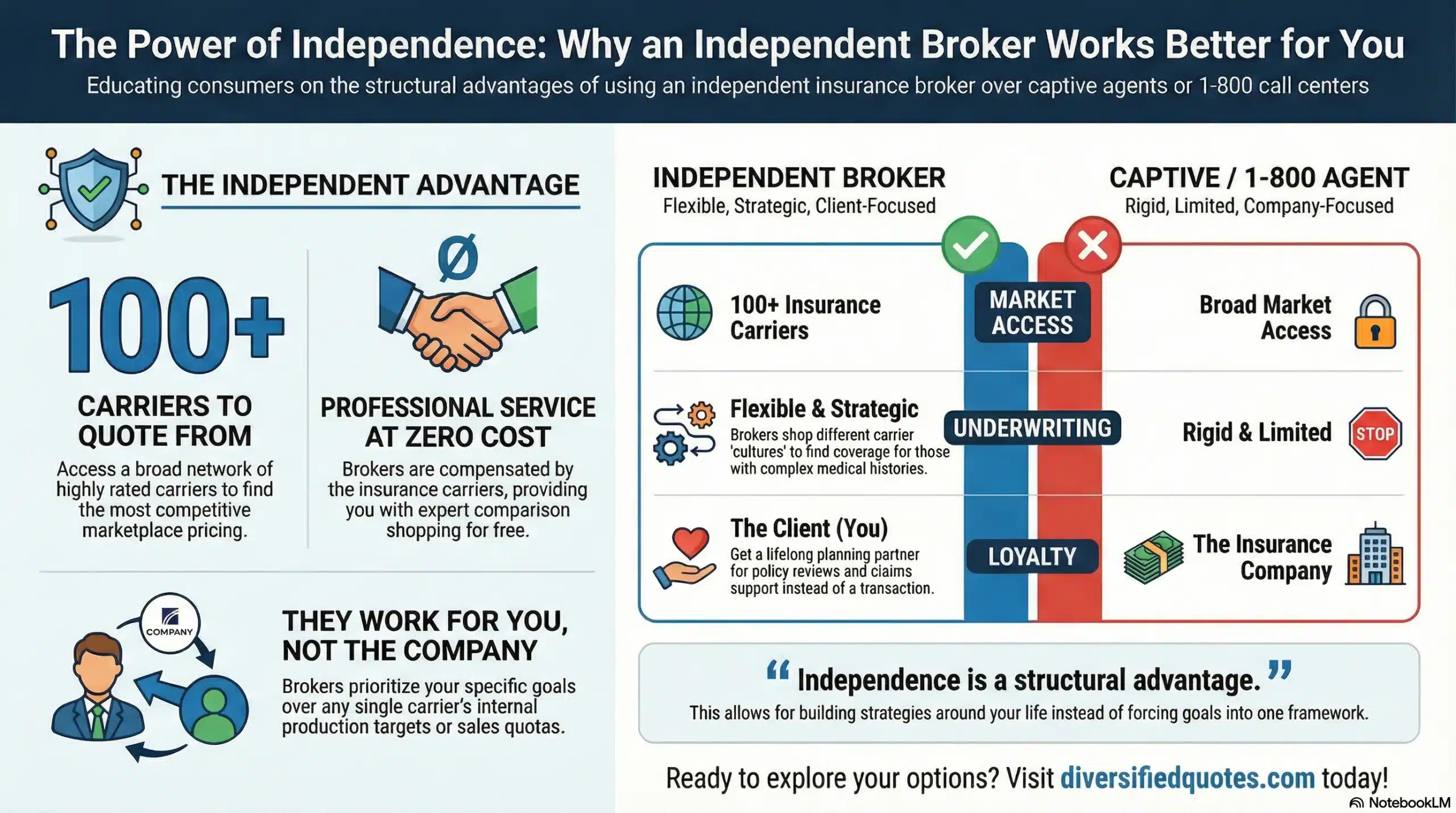
Jason Stolz, CLTC, CRPC, DIA, CAA and Chief Underwriter at Diversified Insurance Brokers (NPN 20471358), is a senior insurance and retirement professional with more than 25 years of real-world experience helping individuals, families, and business owners protect their income, assets, and long-term financial stability. As a long-time partner of the nationally licensed independent agency Diversified Insurance Brokers, Jason provides trusted guidance across multiple specialties—including fixed and indexed annuities, long-term care planning, personal and business disability insurance, life insurance solutions, Group Health, Travel Medical and Evacuation Insurance, and short-term health coverage. Diversified Insurance Brokers maintains active contracts with over 100 highly rated insurance carriers, ensuring clients have access to a broad and competitive marketplace.
His practical, education-first approach has earned recognition in publications such as VoyageATL, and contributions from his agency featured in Kiplinger and GoBankingRates— highlighting his commitment to financial clarity and client-focused planning. Drawing on deep product knowledge and years of hands-on field experience, Jason helps clients evaluate carriers, compare strategies, and build retirement and protection plans that are both secure and cost-efficient. Visitors who want to explore current annuity rates and compare options across multiple insurers can also use this annuity quote and comparison tool.
Explore More Life Insurance Options: Browse our complete guide to How Life Insurance Works — covering term life, whole life, final expense, annuity alternatives & more from 100+ carriers.
Last Reviewed: May 25, 2026 |
Reviewed by: Jason Stolz, CLTC, CRPC, DIA, CAA
Chief Underwriter, Diversified Insurance Brokers, Inc. | NPN: 20471358 | Diversified Insurance Brokers, Inc. — Licensed in all 50 states
Fact Checked by: Tonia Pettitt, CMIP©
Medicare Specialist, Diversified Insurance Brokers, Inc. | NPN: 14374308 | Diversified Insurance Brokers, Inc. — Licensed in all 50 states
Did you find this content helpful? Leave us a Google review — it helps others find trustworthy guidance too.
Editorial Standards: Diversified Insurance Brokers maintains rigorous editorial standards to ensure accuracy, clarity, and independence in all content. Learn more about our editorial standards and commitment to transparency.
