
How to Protect Your Family with the Right Life Insurance Policy
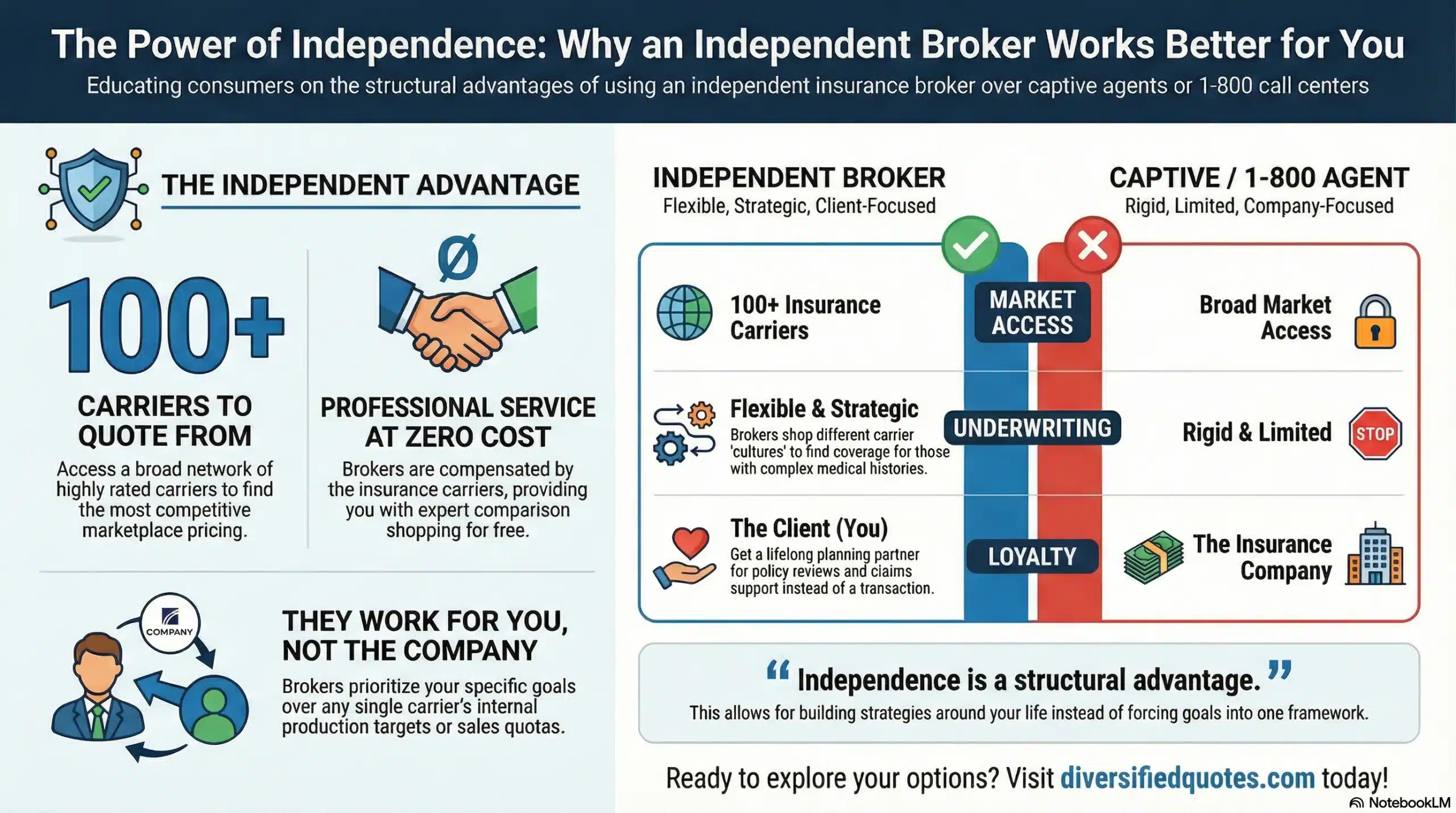
As an Independent Life Insurance Broker, we compare rates across 100+ carriers and prescreen every application before submission.
How to Protect Your Family with the Right Life Insurance Policy
Life insurance is not just about a death benefit — it is about protecting everything you have worked for and ensuring your family’s financial stability no matter what happens. At its core, life insurance is a risk management tool, but when structured properly it becomes a strategic financial asset that can serve multiple functions simultaneously across different life stages and planning objectives. Whether your priority is income replacement, debt elimination, college funding, estate planning, business continuity, or supplemental retirement income, the right policy can provide clarity, leverage, and peace of mind for decades. The challenge for most families is not whether they need coverage — it is determining what type of coverage fits their stage of life, health profile, financial obligations, and long-term objectives, then selecting the right carrier and underwriting path to secure it at the best available terms.

For many families, the first and most urgent goal is income protection. If you are the primary earner in your household, your income supports housing, food, utilities, childcare, healthcare, and long-term savings. Without a death benefit to replace that income, the household’s financial foundation disappears overnight. A properly structured term policy can replace that income during your highest-earning and highest-obligation years at a cost that most families can sustain. Tools like our Term Life Insurance Calculator help you estimate appropriate coverage amounts based on income, debts, dependent count, and financial goals. For additional context on how to size coverage appropriately before selecting a policy, our resource on how much life insurance you need walks through the layered calculation approach that accounts for real household obligations rather than generic income multiples.
Get a Customized Life Insurance Review
We assess your income needs, debt obligations, retirement plans, and estate objectives to ensure every dollar of premium serves a defined purpose.
Request Your Personalized Quote & Strategy SessionTerm Life Insurance: Protection Matched to Your Obligation Timeline
Term coverage is often ideal for mortgage protection, raising children, covering business loan obligations during peak liability years, or protecting income during the period when a household is most financially vulnerable. A healthy 45-year-old male, for example, may qualify for a $1,000,000 twenty-year term policy for less than $100 per month — providing substantial financial leverage for a manageable monthly cost. The key to maximizing that leverage is selecting the right term length, the right face amount, and the right carrier for the specific health profile — all decisions where underwriting strategy matters as much as the initial premium comparison. For households comparing term coverage to mortgage-specific products, our resource on mortgage protection vs. term life insurance clarifies how each approach aligns with different protection objectives. For an overview of what makes a term structure well-designed across different life stages, our resource on the best term life insurance policy provides a useful framework before committing to a specific structure.
One of the most effective and underused term strategies is policy laddering — purchasing two or more term policies with different face amounts and different term lengths that together create a coverage profile matched to the actual shape of the household’s financial obligations. A large 20-year policy covers the period when obligations are highest, while a smaller 10-year layer covers the near-term pressure years when childcare, early mortgage payoff, and income dependency are most acute. As the shorter layer expires, coverage steps down to the longer policy’s face amount — matching the natural reduction in financial obligations over time. Our resource on the life insurance laddering guide explains this strategy in detail and when it produces better outcomes than a single large policy.
Life Insurance Quoter
See Real-Term Rates Side by Side
Permanent Life Insurance: Long-Term Guarantees and Cash Value
Life insurance planning does not stop with term coverage. Permanent policies — including whole life and indexed universal life — introduce a different dimension: lifetime guarantees and cash value accumulation that can serve as a financial asset alongside the protection function. Through tax-deferred growth inside the policy’s cash value account, a properly designed permanent policy can build internal value over time that may be accessed through policy loans under the right structure. That access can create supplemental retirement income, liquidity for large opportunities or expenses, or emergency financial reserves without the restrictions of qualified retirement accounts and without triggering the taxable event that most other asset withdrawals produce. To understand how permanent life insurance works structurally before comparing it to term, our resource on how a whole life insurance policy works provides the foundational mechanics. For a broader overview of all policy categories and how they serve different planning functions, our Life Insurance Services page explains how these products are designed and where each type fits within a household’s overall financial plan.
For households evaluating whether permanent coverage makes sense alongside a term policy, understanding the relationship between the two types — and when adding a permanent layer produces better long-term outcomes than a single large term policy — is important context. Many families benefit from a combination: a large term policy for maximum income replacement during the highest-obligation years, and a smaller permanent policy for lifetime protection, cash value accumulation, and legacy purposes. Our resource on whether life insurance is a good investment examines this question from the perspective of how permanent coverage’s financial functions compare to other asset classes and planning tools.
Legacy Planning, Estate Liquidity, and Business Protection
Permanent life insurance can serve as a powerful legacy planning tool. Unlike term coverage, which expires at the end of the level period, permanent insurance remains in force for the insured’s lifetime as long as it is funded appropriately — making it valuable for estate liquidity, inheritance equalization across heirs, and charitable planning. Families with complex assets — real estate holdings, investment portfolios, or privately held businesses — often use permanent life insurance to create immediate, tax-free liquidity at the time of death. That liquidity can prevent forced asset sales, allow time for orderly estate settlement, and preserve generational wealth across the transition. For a focused explanation of how life insurance integrates with estate planning, our resource on the role of life insurance in modern estate planning covers the key strategies in detail.
Business owners face an additional set of insurance needs that personal coverage alone cannot address. Key-person protection ensures that the business can survive and stabilize financially if a critical employee or owner dies. Buy-sell agreements funded by life insurance create a defined mechanism for ownership transitions — ensuring the surviving owner can purchase the deceased partner’s interest at a fair price without creating a financial crisis for either the business or the decedent’s family. Our resource on buy-sell life insurance explains how these agreements work and how they are structured across different business ownership arrangements. For the key-person dimension specifically, our resource on key person life insurance for executives covers the valuation approach and carrier considerations for those policies.
Underwriting Strategy: How Health History Affects Coverage and Cost
Choosing the right policy involves more than selecting a product type — it requires underwriting strategy. Health history, occupation, lifestyle habits, build, medications, and financial documentation all influence both the pricing class the applicant receives and whether the application is approved at all. Individuals working in elevated-risk environments may benefit from reviewing our resource on life insurance for high-risk occupations to understand how carrier positioning differs for occupations that standard markets treat more cautiously. For applicants with chronic conditions, past diagnoses, or prescription histories that might concern a generalist underwriter, our experience placing life insurance with pre-existing conditions across carriers with varying underwriting appetites consistently produces better outcomes than submitting to a single carrier without prior carrier screening.
For applicants who have been previously declined or rated up, the independent market frequently offers meaningfully better outcomes. Different carriers evaluate the same medical profile with different underwriting guidelines, and a condition that creates significant problems at one carrier may be treated at a standard or near-standard class at another carrier in the same competitive tier. Our resource on life insurance with a prior decline explains the practical options and the strategy for repositioning an application after an initial rejection. For applicants whose health history includes specific conditions, our high-risk life insurance resources cover individual conditions in depth — from life insurance for diabetes to life insurance for heart disease — so you understand what to expect in underwriting before the application is submitted.
Affordability, Premium Optimization, and Group vs. Individual Coverage
Many families assume life insurance is expensive, yet term policies often provide substantial death benefits at premiums that represent a modest fraction of what the coverage protects. The real financial risk is not the premium — it is being underinsured or misaligned with the household’s actual obligations. Overpaying for features that are not needed can strain cash flow and create sustainability risk; underfunding permanent policies may jeopardize long-term guarantees that the plan was built around. Proper design ensures that premiums match objectives — whether the goal is maximum death benefit protection, accelerated cash value accumulation, balanced performance across both, or a specific conversion or laddering strategy. For a transparent overview of what life insurance actually costs at different ages and health classes, our resource on how much life insurance costs provides realistic premium benchmarks before the application process begins.
Understanding the differences between employer-sponsored group coverage and individually owned policies is critical for anyone whose household finances depend on life insurance remaining continuously in force. Group coverage through an employer terminates when employment ends — for any reason, at any age — and conversion options are typically more expensive and more limited than simply purchasing individual coverage from the beginning. Individual policies remain in force as long as premiums are paid regardless of employment status, and they can be structured with beneficiary designations and ownership terms that group coverage cannot replicate. Our resource on group vs. individual life insurance explains these structural differences and why individual coverage is typically the stronger compliance and protection tool for obligations that must remain in force through career changes. For families thinking about life insurance as part of a broader financial plan that also includes guaranteed income for retirement, our resource on current annuity rates provides context on how guaranteed income strategies complement permanent life planning at different stages of wealth accumulation.
Coordinating Life Insurance With the Broader Retirement and Protection Plan
A well-designed life insurance strategy does not exist in isolation — it coordinates with disability income protection, long-term care planning, annuity-based retirement income, and estate planning to create a comprehensive household protection structure. The risk of death is one dimension of financial planning; the risk of becoming disabled and unable to work is statistically more likely during working years and requires its own protection layer. Our resource on disability insurance services explains how income protection coverage complements life insurance by addressing the living version of the same income risk. For households thinking about long-term care as a retirement planning issue, our resource on hybrid life insurance with long-term care benefits explains how some permanent life policies combine death benefit protection with care coverage in a single contract — addressing two major retirement risks without paying premiums on two entirely separate policies.
Life insurance can also complement retirement and annuity income strategies in ways that improve the overall plan’s efficiency. While annuities focus on guaranteed income that cannot be outlived, life insurance emphasizes legacy creation and protection of assets that the surviving family would otherwise need to replace. Coordinating both can strengthen the retirement plan by ensuring that essential income needs are covered by a guaranteed income stream while the death benefit provides an additional financial backstop for the family. For parents specifically focused on protecting children during the years of maximum dependency, our resources on life insurance for parents with young children and life insurance for new parents address the specific coverage decisions and timing considerations that matter most during the early family-building years.
Financial Protection Essentials
Life insurance planning resources for income protection, estate planning, business coverage, and specialized situations.
Talk With an Advisor Today
Choose how you’d like to connect—call or message us, then book a time that works for you.
Schedule here:
calendly.com/jason-dibcompanies/diversified-quotes
Licensed in all 50 states • Fiduciary, family-owned since 1980
FAQs: Choosing the Right Life Insurance Policy
The right policy type depends on what financial job you are asking the insurance to do and over what time period. Term life insurance is designed for temporary needs with a defined end date — income replacement during working years, mortgage protection through payoff, child dependency coverage through independence, or business loan coverage through repayment. It provides the maximum death benefit for the lowest premium during the coverage period, but accumulates no cash value and expires when the term ends. Permanent life insurance — whole life, indexed universal life, or guaranteed universal life — is designed for lifetime protection needs and for situations where cash value accumulation, supplemental retirement income access, or estate planning functions add value alongside the death benefit. Most households benefit most from one of three structures: term only for maximum income replacement during the highest-obligation years; a combination of term plus a smaller permanent policy for both protection and long-term financial functions; or permanent only when the planning objective is specifically lifetime coverage with cash value. Our resource on life insurance in retirement helps clarify the long-term uses that extend beyond the working years.
The most important factors to evaluate before selecting a policy are: the specific financial obligations you need the death benefit to replace or fund (income, mortgage, childcare, education, business obligations), the period over which those obligations exist (which determines the appropriate term length or whether permanent coverage is more appropriate), your budget for sustainable premium payments over that period, your health profile and how it will interact with underwriting at different carriers, and whether you want cash value accumulation as a secondary function alongside protection. After those primary factors are clear, secondary considerations include rider availability, conversion provisions, carrier financial strength, and how the policy coordinates with existing coverage from employers or other individual policies. Reviewing common life insurance mistakes can help you avoid the most frequent misalignments between what people purchase and what they actually need. For a structured process to determine the right coverage amount before evaluating policy type, our resource on how much life insurance you need provides a layered calculation approach.
Term life insurance is often the right primary coverage structure for families in their working years, particularly for households whose highest financial vulnerability — income dependence, active mortgage, young children, business obligations — has a defined end date. During those years, term provides the most efficient use of premium dollars: the largest death benefit for the lowest cost, matched to the period when that protection is most critical. However, term alone may not address all of a family’s long-term financial planning needs. It does not build cash value, does not provide access to tax-advantaged funds, does not remain in force past the term period regardless of changed circumstances, and does not serve legacy or estate planning objectives that extend beyond the working years. Many families use a combination — a large term policy for the primary income replacement function plus a smaller permanent policy for lifetime protection, cash value, and estate planning — to address both the protection priority and the long-term financial planning objectives simultaneously. Whether term alone is sufficient depends on whether your planning objectives extend beyond the coverage period and whether the cash value and lifetime features of permanent coverage serve purposes that justify the additional premium.
Permanent life insurance makes more sense than term — or as a complement to term — in several specific situations. When the need for a death benefit is genuinely lifelong rather than time-limited, permanent coverage prevents the coverage gap that occurs when a term policy expires and the insured either cannot qualify for new coverage or must accept substantially higher premiums at an older age. When cash value accumulation with tax-deferred growth and loan access is a meaningful planning objective — supplemental retirement income, liquidity for large expenses, or access to funds that doesn’t create taxable income when structured correctly — permanent coverage adds financial functions that term cannot provide. In estate planning contexts where the death benefit is intended to create liquidity for estate taxes, equalize inheritance across heirs, or fund a charitable legacy, permanent coverage’s lifelong nature is essential because the need for the benefit exists regardless of when death occurs. For business planning purposes — buy-sell agreements, key-person protection, or executive compensation structures — permanent coverage also serves functions that term cannot. Our resource on life insurance strategies the wealthy use covers several of these advanced applications in practical terms.
Many advisors use 10 to 20 times annual income as a starting guideline, but the right coverage amount for any specific household depends on the specific obligations that need to be funded rather than a generic multiplier. A more accurate approach layers the obligations: the present value of remaining income replacement years for dependents, outstanding mortgage balance and other debts that would fall to the estate, education funding for children at projected costs, childcare and household services that would need to be replaced, final expenses and estate settlement costs, and any business-related obligations. From that total, subtract existing financial resources that would be available — other life insurance, liquid savings, and investment assets that a surviving spouse could access — to identify the true coverage gap. Our life insurance calculator provides a quick estimate of appropriate coverage amounts, and our resource on how much life insurance you need walks through the full layered calculation. For high-income earners whose income replacement need is substantial, our resource on life insurance for high-income earners covers the additional considerations around large face amounts and carrier capacity.
Yes, and owning multiple life insurance policies is a deliberate strategy for many households rather than simply an accumulation of separate decisions. The most common multi-policy approach combines a large term policy for maximum income replacement during the highest-obligation period with a smaller permanent policy for lifetime coverage, cash value, and estate or legacy planning purposes. This combination allows the household to allocate premium dollars efficiently — using lower-cost term coverage for the bulk of the protection need while the smaller permanent policy builds long-term financial value at a manageable premium. Another common multi-policy approach is laddering — purchasing two term policies with different face amounts and different term lengths that create a coverage profile matched to the natural tapering of financial obligations over time. A $1,000,000 20-year policy combined with a $500,000 10-year policy, for example, provides $1,500,000 of combined coverage during the highest-obligation early years and $1,000,000 of coverage for the remaining period when obligations have partially reduced. Both approaches use multiple policies intentionally to align coverage with real financial obligations more precisely and cost-effectively than a single policy could achieve.
Health has a profound effect on both whether an application is approved and what underwriting class and premium the approved policy carries. Carriers evaluate age, current health metrics (blood pressure, cholesterol, A1C, weight relative to height), medical history, prescription medications, family history of specific conditions, tobacco use, driving record, and for certain products, occupational risk. The underwriting class assigned — from Preferred Plus through Standard to various rated or table-rated classes — determines the premium, and the difference between underwriting classes can be substantial on identical coverage amounts. Conditions like controlled hypertension, well-managed type 2 diabetes, stable mental health history, or past surgeries with complete recovery may be viewed very differently across carriers, which is why carrier selection based on underwriting appetite for the specific profile is as important as the initial premium comparison. Our resource on life insurance with pre-existing conditions provides detailed context on how specific conditions are evaluated. For applicants whose health has improved significantly since a previous policy was purchased, a policy review may reveal that a better underwriting class and lower premium are available with a replacement strategy.
A prior decline from one carrier does not mean coverage is unavailable — it means that carrier’s underwriting guidelines did not accommodate the specific profile at the time of application. Different carriers evaluate the same medical histories, build profiles, and lifestyle factors with meaningfully different underwriting outcomes, and a condition that results in a decline or significant rating at one carrier may be acceptable at a standard or near-standard class at another carrier in the same competitive tier. Working with an independent broker who has working knowledge of multiple carriers’ underwriting tendencies — and who can pre-screen a profile informally before submitting a formal application — consistently produces better outcomes for applicants with complex health histories than submitting blind to a single carrier based on advertised rates. Our resource on life insurance with a prior decline explains the practical next steps and the strategy for repositioning after a prior rejection. For applicants who may not qualify for traditional underwriting, guaranteed issue and simplified issue options through our high-risk life insurance resources may provide a path to coverage.
Absolutely — comparing multiple carriers is not just advisable but essential for making an informed life insurance decision, because rates, underwriting guidelines, and product features vary substantially across carriers even for applicants with identical demographics and health profiles. The carrier that quotes the lowest rate for a Preferred Plus healthy 35-year-old may not be the carrier that treats a specific health condition most favorably at Standard class. The carrier with the most competitive 20-year term premium may have more restrictive conversion provisions than a carrier with a slightly higher premium but stronger long-term flexibility options. Independent comparison across multiple carriers simultaneously — rather than sequentially approaching one carrier at a time — produces better outcomes and prevents the common experience of finding a better carrier after having already submitted to a less favorable one. Our life insurance calculator provides an initial rate comparison across carriers instantly, while our advisory process adds the underwriting strategy layer that determines which carrier is most appropriate for your specific profile rather than simply which carrier shows the lowest advertised rate.
About the Author:
Jason Stolz, CLTC, CRPC, DIA, CAA and Chief Underwriter at Diversified Insurance Brokers (NPN 20471358), is a senior insurance and retirement professional with more than 25 years of real-world experience helping individuals, families, and business owners protect their income, assets, and long-term financial stability. As a long-time partner of the nationally licensed independent agency Diversified Insurance Brokers, Jason provides trusted guidance across multiple specialties—including fixed and indexed annuities, long-term care planning, personal and business disability insurance, life insurance solutions, Group Health, Travel Medical and Evacuation Insurance, and short-term health coverage. Diversified Insurance Brokers maintains active contracts with over 100 highly rated insurance carriers, ensuring clients have access to a broad and competitive marketplace.
His practical, education-first approach has earned recognition in publications such as VoyageATL, and contributions from his agency featured in Kiplinger and GoBankingRates— highlighting his commitment to financial clarity and client-focused planning. Drawing on deep product knowledge and years of hands-on field experience, Jason helps clients evaluate carriers, compare strategies, and build retirement and protection plans that are both secure and cost-efficient. Visitors who want to explore current annuity rates and compare options across multiple insurers can also use this annuity quote and comparison tool.
Explore More Life Insurance Options: Browse our complete guide to Life Insurance Ownership & Policy Management — covering reviewing, selling & understanding your existing policy, riders, taxes & claims from 100+ carriers.
Last Reviewed: May 12, 2026 |
Reviewed by: Jason Stolz, CLTC, CRPC, DIA, CAA
Chief Underwriter, Diversified Insurance Brokers, Inc. | NPN: 20471358 | Diversified Insurance Brokers, Inc. — Licensed in all 50 states
Fact Checked by: Tonia Pettitt, CMIP©
Medicare Specialist, Diversified Insurance Brokers, Inc. | NPN: 14374308 | Diversified Insurance Brokers, Inc. — Licensed in all 50 states
Did you find this content helpful? Leave us a Google review — it helps others find trustworthy guidance too.
Editorial Standards: Diversified Insurance Brokers maintains rigorous editorial standards to ensure accuracy, clarity, and independence in all content. Learn more about our editorial standards and commitment to transparency.
