
Key Person Insurance for Business
Key Person Insurance for Business

Jason Stolz CLTC, CRPC, DIA, CAA
Key person insurance for business is one of the most practical and strategic risk management tools a company can put in place — and one of the most commonly deferred until a crisis makes the absence of it obvious. When a founder, top producer, rainmaker, technical expert, managing partner, or operational leader suddenly passes away or becomes disabled, the financial consequences ripple through revenue, lending relationships, contracts, and employee morale almost immediately. Many businesses operate with a handful of individuals who drive a disproportionate share of income, decision-making authority, and client trust. If that person is gone tomorrow, would the company experience a temporary inconvenience — or a genuine financial crisis? Key person insurance exists to ensure it is the former. At Diversified Insurance Brokers, Jason Stolz, CLTC, CRPC, DIA, CAA, works with more than 100 top-rated carriers to help companies structure coverage that protects cash flow, stabilizes lender confidence, and preserves long-term enterprise value. This is not personal life insurance for a family. It is business-owned protection designed to keep the company standing during its most vulnerable transition moments.
At its core, key person insurance — sometimes called key man insurance — is a life insurance or disability insurance policy that the business purchases on the life of a critical employee or owner. The company owns the policy, pays the premiums, and is named beneficiary. If the insured key individual dies, the death benefit is paid directly to the business. If disability coverage is included and the insured becomes unable to work, the company receives financial support to offset lost productivity or revenue disruption during the transition period. This structure is fundamentally different from ownership transition planning. If the primary concern is transferring shares or partnership interests between co-owners after a death, that purpose is served by a buy-sell agreement rather than by key person coverage. Comparing key person vs. buy-sell insurance clarifies the distinction: both use life insurance as the funding vehicle, but the purpose, ownership structure, and payout mechanics are entirely different. Key person coverage protects operational continuity. Buy-sell coverage protects ownership transfer. A business that needs both should have both — structured separately, documented separately, and designed for their respective purposes.
The case for key person insurance often becomes most vivid through specific scenarios. A construction firm where one partner personally secures 70% of the contracts. A medical practice built around a single specialist whose credentials and referral relationships drive the entire patient pipeline. A manufacturing company where one engineer understands proprietary processes that no one else in the organization fully grasps. A financial firm where one advisor holds the majority of client relationships built over two decades. In each case, the loss of that individual does not merely create a personnel gap — it creates an immediate revenue disruption that unfolds against a backdrop of fixed expenses that do not pause. Payroll, lease obligations, debt service, equipment financing, and vendor contracts all continue while the business absorbs the shock and attempts to execute a transition plan. Key person insurance creates an immediate pool of liquidity so the company can continue paying those obligations, fund a search for a replacement, reassure lenders and clients, and execute the transition without desperation. It buys time, and time is frequently the most valuable resource in any crisis.
Start Your Key Person Insurance Review
Why Lenders, Investors, and Partners Care About Key Person Coverage
The financial protection key person insurance provides is not only internal. Investors, lenders, and strategic partners frequently view key person coverage as a sign of mature governance and responsible business planning — and in many cases they require it as a condition of doing business. Banks routinely require key person insurance as part of loan underwriting when the borrower’s ability to repay depends substantially on the continued involvement of a specific individual. If a company carries meaningful debt and that debt’s repayment capacity is concentrated in one person’s productivity, a lender’s insistence on key person coverage reflects a legitimate assessment of the credit risk. Having coverage already in place before financing discussions begin can improve negotiating leverage, accelerate approvals, and demonstrate to lenders that the business has thought about continuity rather than depending on a single point of failure without mitigation.
Private equity investors and strategic acquirers evaluate key person risk as part of due diligence. A company whose enterprise value is concentrated in the skills, relationships, or knowledge of one or two individuals carries a discount relative to a business whose operations are systematized and whose key relationships are institutionalized. Key person insurance does not eliminate that concentration risk — but it demonstrates awareness of it and provides a funded bridge that reduces the financial consequences of the worst-case scenario. That demonstration of risk awareness is itself a governance signal that sophisticated counterparties evaluate positively. Understanding structural differences between business-owned policies and individual or group-owned coverage matters when evaluating the full picture — group vs. individual life insurance covers those structural differences for businesses evaluating whether employer-sponsored plans provide any meaningful overlap with dedicated key person coverage.
How Much Key Person Insurance a Business Actually Needs
Determining the right coverage amount requires more analytical work than applying a simple multiple of the key employee’s compensation — an approach that is commonly used as a shortcut but frequently understates or overstates actual exposure. A more accurate framework evaluates several dimensions simultaneously: projected lost profits during a realistic transition period, recruitment and executive search costs for a replacement, the training and ramp time before a new hire produces at the level of the departed individual, contract risk from clients or customers who may not transfer their relationship to a successor, and any debt obligations the key individual’s performance was implicitly supporting. Mapping those financial consequences to a realistic transition timeline — six months, one year, two years — produces a coverage target that reflects real-world risk rather than a proxy metric.
| Coverage Factor | What It Represents | Why It Matters |
|---|---|---|
| Lost Revenue / Profit | Revenue attributable to the key person multiplied by the realistic transition period | The largest component for most businesses — fixed expenses continue while revenue drops |
| Replacement Costs | Executive search fees, signing bonuses, relocation, onboarding, and ramp time | Finding and training a replacement at the same level can cost $200,000–$500,000+ for senior roles |
| Debt Obligations | Loan balances personally guaranteed or whose repayment depends on revenue the key person generates | Lenders may accelerate obligations or tighten credit lines when a key person dies — coverage absorbs that shock |
| Contract and Client Risk | Revenue from clients or contracts tied to the key person’s personal relationship rather than the institution | Relationship-dependent revenue may not transfer — coverage should account for the realistic attrition risk |
| Disability Coverage | Monthly benefit replacing the economic contribution of the key person if disabled rather than deceased | Disability is statistically more likely than death at most working ages — key person disability insurance and business overhead disability insurance address this separately from life coverage |
The benefits of key person insurance at a detailed level — including how coverage interacts with business valuation, credit underwriting, and retention strategy — are covered in depth at the full benefits of key person insurance guide. For executives who require coverage specifically matched to their role and compensation level, key person life insurance for executives covers how underwriting and benefit design differ for C-suite and senior leadership applications. For situations involving unusual risk profiles, high coverage amounts, or specialty underwriting requirements, key person life insurance through Lloyd’s of London covers how surplus lines markets handle coverage that standard carriers cannot accommodate.
Term vs. Permanent Coverage — Choosing the Right Structure
Choosing between term and permanent coverage for a key person policy depends on the nature of the risk window and the company’s long-term planning objectives. Term insurance is often the right choice when the exposure is tied to a specific growth phase, a loan duration, or a defined expansion cycle. It provides high death benefits at considerably lower cost than permanent coverage and can be matched to 10-, 15-, or 20-year planning horizons that align with the business’s trajectory. A startup that depends heavily on its founder during the critical first decade, a company servicing a 15-year commercial real estate loan, or a professional services firm mid-way through a planned ownership transition are all situations where term coverage matched to the risk window produces the most efficient protection per premium dollar.
Permanent coverage may be more appropriate when the key individual is foundational to the company’s identity over a longer horizon, when the business wants to build cash value as a corporate asset alongside the death benefit protection, or when executive retention and compensation planning objectives are part of the structure. Some businesses incorporate permanent life insurance into executive compensation arrangements — executive bonus 162 plans are one example of how permanent life insurance can serve both a retention incentive and a key person protection purpose simultaneously. If a term policy has been in place and circumstances have changed to warrant permanent coverage, converting term to permanent life insurance without new underwriting is an option worth evaluating before the conversion privilege window closes. For businesses evaluating coverage for partners specifically, partnership buy-sell agreement insurance and buy-sell life insurance cover how those structures integrate with or run parallel to key person coverage in multi-owner business arrangements.
Underwriting, Ownership Structure, and Documentation
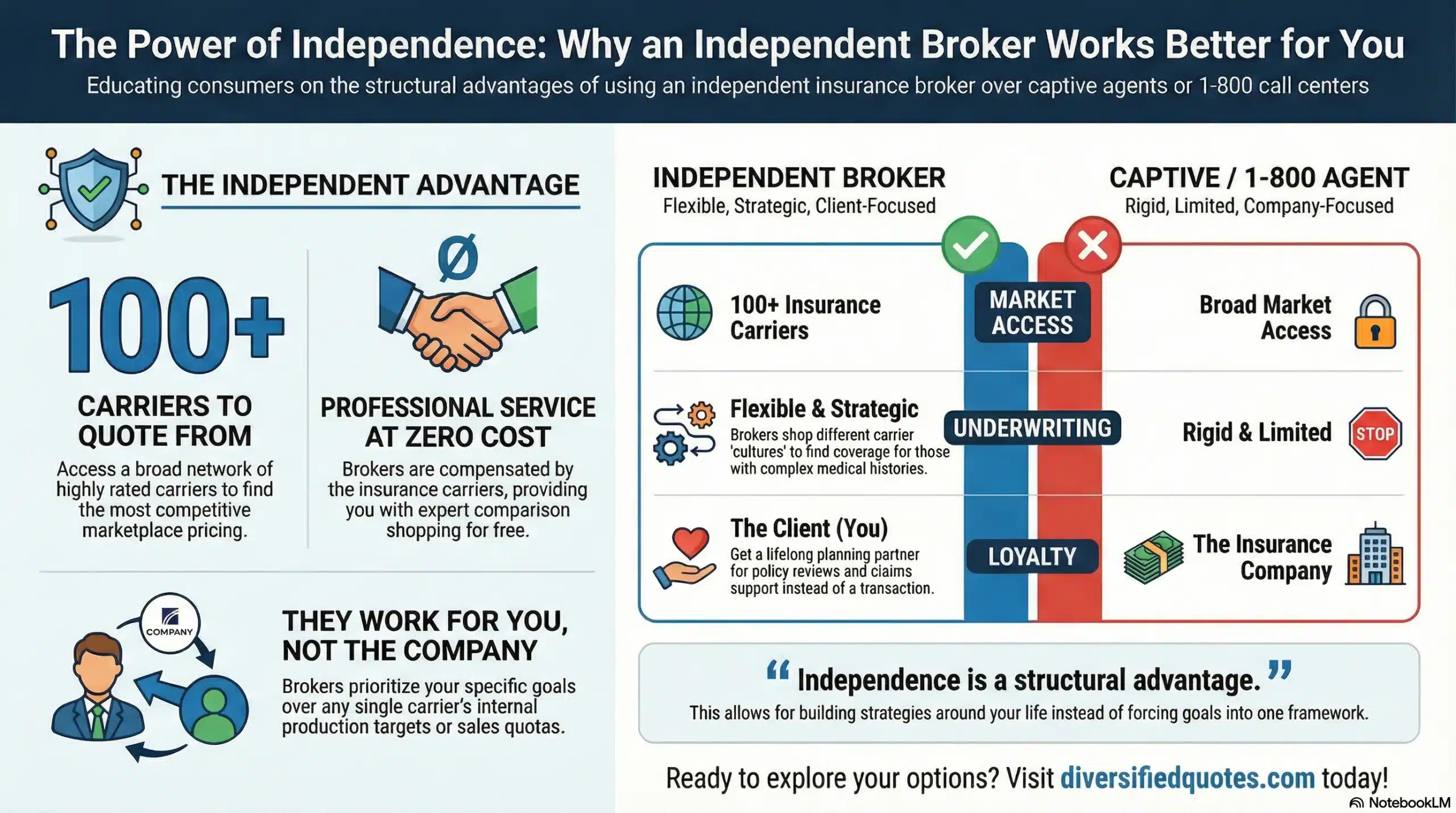
Underwriting for key person insurance follows the same health and lifestyle evaluation as individual life insurance, with the business’s insurable interest in the key person serving as the legal foundation for the policy. Health history, lifestyle factors, age, and occupational risks all influence carrier selection and pricing — and because different carriers assess the same risk profile with different underwriting philosophies, working with an independent broker who can route the application to the most appropriate carrier produces meaningfully better outcomes than approaching a single company. If the proposed insured has medical complexity, life insurance with pre-existing conditions covers how specialty underwriters approach cases that standard carriers decline or table at elevated premiums. Approval certainty matters as much as price when the business is counting on the coverage to issue — a quote that never becomes a policy provides no protection.
Ownership structure and documentation must be handled carefully to ensure the policy serves its intended purpose and avoids complications later. The business typically owns the policy and names itself beneficiary, but written consent from the insured employee or owner is legally required before a business can purchase coverage on their life. The policy agreement should clearly document what happens if the insured leaves the company, retires, or sells their ownership interest — whether the policy transfers to the insured, is assigned to new ownership, or is surrendered. Clear, written agreements established at the time of policy issue prevent the disputes and ambiguities that arise when these questions are addressed only after a triggering event. For businesses that also want dedicated coverage for key person disability risk — which is statistically more likely than death at most working ages — buy-sell disability insurance and guaranteed issue group disability insurance address the income replacement dimension that life-only key person coverage does not cover.
See Real-Term Rates Side by Side
Life Insurance Quoter
Protect Revenue. Protect Stability. Protect Your Team.
Compare key person insurance from 100+ top-rated carriers — aligned to real revenue exposure, lender requirements, and business continuity goals.
Get Your Key Person Insurance Quote
Questions? Call 800-533-5969
Talk With an Advisor Today
Choose how you’d like to connect—call or message us, then book a time that works for you.
Schedule here:
calendly.com/jason-dibcompanies/diversified-quotes
Licensed in all 50 states • Fiduciary, family-owned since 1980
Frequently Asked Questions: Key Person Insurance for Business
What is key person insurance and how does it work?
Key person insurance is a life insurance or disability insurance policy that a business purchases on the life of a critical employee or owner. The business owns the policy, pays the premiums, and is named as the beneficiary. If the insured key individual dies, the death benefit is paid directly to the company — providing immediate liquidity that the business can use to cover lost revenue, pay fixed expenses, fund a replacement search, reassure lenders and clients, and execute a transition plan without financial desperation. If disability coverage is included and the insured becomes unable to work, the business receives a monthly benefit to offset the economic impact of that person’s absence. The policy is entirely separate from any personal life insurance the key individual may carry for their own family — this is business-owned coverage serving a business purpose, structured and documented as such from the beginning.
What is the difference between key person insurance and buy-sell insurance?
Both use life insurance as the funding vehicle, but they serve entirely different purposes and are structured differently. Key person insurance protects the business’s operational continuity and financial stability when a critical individual is lost — the death benefit flows to the company to cover lost revenue, transition costs, debt obligations, and stakeholder reassurance. Buy-sell insurance funds the transfer of ownership interests between partners or co-owners when one of them dies or becomes disabled — the death benefit flows to the surviving owners to purchase the deceased’s share at an agreed-upon price, preventing the estate or heirs from becoming unwanted business partners. A company can and often should have both: key person coverage protecting operations, and buy-sell coverage protecting ownership structure. They are separate policies with separate purposes, separate ownership structures, and separate beneficiaries. Conflating them or expecting one to serve both purposes creates coverage gaps that only become obvious when a triggering event occurs.
How much key person insurance does a business need?
The right coverage amount is based on a financial impact analysis rather than a simple multiple of compensation. The analysis should model projected lost revenue during the realistic transition period, the costs of recruiting and training a replacement (including search fees, signing bonuses, and ramp time before the new hire produces at the departed individual’s level), contract or client attrition risk attributable to the key person’s personal relationships, and any debt obligations whose repayment capacity depended on that individual’s productivity. Mapping those financial impacts to a realistic transition timeline — six months, one year, two years — produces a coverage target that reflects actual exposure. For businesses with lender requirements, the coverage amount may also need to satisfy specific thresholds set by the lending institution as a condition of financing or ongoing credit line maintenance.
Should the key person policy be term or permanent?
The choice depends on the nature of the risk window and the business’s long-term planning objectives. Term insurance is typically the right choice when the exposure is tied to a specific time horizon — a loan duration, a growth phase, a planned ownership transition, or a period when the business is disproportionately dependent on one individual. Term provides the highest death benefit at the lowest premium cost and can be matched to 10-, 15-, or 20-year planning horizons. Permanent coverage is appropriate when the key individual is expected to be foundational to the company’s operations indefinitely, when the business wants to build cash value as a corporate asset alongside the death benefit, or when executive compensation or retention planning objectives are part of the policy structure. Some businesses start with term coverage and convert to permanent as circumstances evolve — conversion rights in term policies allow that transition without new medical underwriting, making it important to evaluate conversion options at the time of initial purchase rather than after the conversion window has closed.
What happens to the key person policy if the insured leaves the company?
What happens when the insured leaves is determined by the policy ownership structure and any agreements established between the business and the insured at the time of issue — not by default contract terms. Without a written agreement, the business generally retains ownership of the policy and can continue it, surrender it, or sell it. In some cases, the departing key person may have a right to purchase the policy from the company — particularly in situations where the coverage was part of an executive compensation or retention arrangement that included a transfer provision. In partner or closely held company situations, the policy treatment should be addressed explicitly in the buyout agreement or partnership agreement rather than left to be resolved after the separation. Establishing these provisions in writing at the time of policy issue is far simpler than negotiating them after a departure, retirement, or ownership change — when incentives and relationships are often more complicated.
About the Author:
Jason Stolz, CLTC, CRPC, DIA, CAA and Chief Underwriter at Diversified Insurance Brokers (NPN 20471358), is a senior insurance and retirement professional with more than 25 years of real-world experience helping individuals, families, and business owners protect their income, assets, and long-term financial stability. As a long-time partner of the nationally licensed independent agency Diversified Insurance Brokers, Jason provides trusted guidance across multiple specialties—including fixed and indexed annuities, long-term care planning, personal and business disability insurance, life insurance solutions, Group Health, Travel Medical and Evacuation Insurance, and short-term health coverage. Diversified Insurance Brokers maintains active contracts with over 100 highly rated insurance carriers, ensuring clients have access to a broad and competitive marketplace.
His practical, education-first approach has earned recognition in publications such as VoyageATL, and contributions from his agency featured in Kiplinger and GoBankingRates— highlighting his commitment to financial clarity and client-focused planning. Drawing on deep product knowledge and years of hands-on field experience, Jason helps clients evaluate carriers, compare strategies, and build retirement and protection plans that are both secure and cost-efficient. Visitors who want to explore current annuity rates and compare options across multiple insurers can also use this annuity quote and comparison tool.
Browse More Resources: Return to our complete Life Insurance Special Topics guide — covering permanent life, estate planning, key person, IUL, infinite banking & special needs.
Last Reviewed: June 14, 2026 |
Reviewed by: Jason Stolz, CLTC, CRPC, DIA, CAA
Chief Underwriter, Diversified Insurance Brokers, Inc. | NPN: 20471358 | Diversified Insurance Brokers, Inc. — Licensed in all 50 states
Fact Checked by: Tonia Pettitt, CMIP©
Medicare Specialist, Diversified Insurance Brokers, Inc. | NPN: 14374308 | Diversified Insurance Brokers, Inc. — Licensed in all 50 states
Did you find this content helpful? Leave us a Google review — it helps others find trustworthy guidance too.
Editorial Standards: Diversified Insurance Brokers maintains rigorous editorial standards to ensure accuracy, clarity, and independence in all content. Learn more about our editorial standards and commitment to transparency.
