
Disability Income Insurance for Software Developers
As an Independent Disability Insurance Broker, we have access to exclusive discounts and negotiated pricing most captive agents can’t offer — see the full breakdown near the end of this page.
Disability Income Insurance for Software Developers

Jason Stolz CLTC, CRPC, DIA, CAA
Software developers produce income through something that cannot be easily seen, measured, or replaced by a colleague: the specific combination of technical knowledge, analytical reasoning, and sustained cognitive performance required to design, write, debug, and architect complex systems. When illness or injury disrupts those capabilities — through neurological conditions, severe mental health conditions, chronic pain affecting concentration, vision problems, or repetitive strain — the income disappears quickly. Unlike physical labor jobs where modified duty sometimes allows a partial return, a developer who cannot write code, architect solutions, or sustain the cognitive load of technical work is functionally unable to perform their job regardless of how capable they may appear in other respects. That specificity of income dependency is why disability income insurance is arguably more important for software developers than most people in the profession initially assume. The disability insurance services available to technology professionals cover this specific risk, and the income protection insurance framework covers how individual policies are structured for cognitive-dependent professionals.
There is genuine good news for software developers seeking disability coverage: the occupation typically rates in the highest available occupational classes across most major carriers. Because software development is primarily cognitive, does not involve significant physical hazard, and has a well-documented income history that makes underwriting straightforward, insurers generally offer their most competitive definitions, longest available benefit periods, and lowest premium rates per dollar of benefit to software developers and engineers. The practical implication is that the coverage software developers need — true own-occupation protection to age 65 — is accessible at a lower premium rate than most professionals in other fields pay for equivalent protection. The challenge is not the availability of coverage but making sure the policy is designed correctly so the definition actually reflects what software development requires, and that the benefit amount addresses the real financial exposure. The disability insurance by occupation framework covers how occupational class affects available definitions, benefit amounts, and carrier selection across professional disciplines.
Compare Disability Insurance for Software Developers
We compare options across 100+ carriers and structure coverage around the cognitive demands, income trajectory, and employment structure of software development careers.
Request Disability Insurance OptionsDisability Insurance for Software Developers — Occupational Profile, Risk Factors, and Key Coverage Decisions
| Coverage Dimension | The Software Developer Reality | What the Right Design Looks Like |
|---|---|---|
| Occupational class | Software developers and engineers typically rate in the highest available occupational classes — reflecting the cognitive nature of the work, low physical hazard, and clean claims history; this produces the most competitive premium rates and access to the strongest definitions | The application should accurately describe actual duties — system design, coding, debugging, architecture, technical leadership — not simply “computer work”; correct occupational description ensures the best available class is assigned at the most favorable carrier |
| Definition of disability | Carriers frequently characterize software development as “sedentary desk work” and argue that a developer who cannot code but can perform administrative or general office tasks is not disabled; without own-occupation language, this argument can defeat a legitimate cognitive disability claim | True own-occupation coverage tied to the material duties of software development specifically — not just “computer use” or “office work”; benefits when you cannot perform the analytical, technical, and problem-solving functions that define the role, even if other work remains theoretically possible |
| Group plan gap | Tech company group LTD plans often cap monthly benefits at $8,000-$15,000; a senior developer or staff engineer earning $200,000-$400,000+ annually faces severe underinsurance under most employer group plans, which also cap benefits and base them on base salary rather than total compensation | Individual supplemental policy that fills the gap between the group cap and actual documented income; benefits from individually owned policies with after-tax premiums are generally tax-free — improving the effective replacement ratio relative to employer-paid group plan benefits that are typically taxable |
| Income growth and FIO rider | Software development careers frequently involve rapid compensation growth — entry-level salaries in the $80,000-$120,000 range commonly reach $200,000-$400,000+ by mid-career without new underwriting being required; coverage purchased at early career income may significantly underinsure the developer at peak earnings if FIO is not used | Future Increase Option (FIO) rider allows benefit amounts to expand as income grows without new medical underwriting; securing coverage early with FIO locks in the right to increase benefits even if health changes between application and peak earning years — one of the most valuable riders for early-career tech professionals |
| Contractor and 1099 employment | Many software developers work as freelancers, independent contractors, or through their own LLC; these arrangements typically provide no employer disability coverage, no paid leave, and no short-term disability benefit — the individual policy is the entire income protection plan with no employer baseline underneath it | Individual LTD sized to actual documented net income; income documentation through tax returns and Schedule C; shorter elimination period if savings are limited (no employer bridge); potentially BOE coverage if operating a formal development consultancy with fixed business overhead |
| Mental health coverage terms | Mental health conditions — depression, anxiety, burnout, ADHD — are among the most common causes of cognitive disability in high-pressure technology work; most group LTD plans cap mental/nervous benefits at 24 months, which is insufficient for serious mental health conditions that may require extended recovery | Individual policies with unlimited mental/nervous benefit periods — matching the physical disability benefit period — provide the sustained protection that serious cognitive disability claims require; own-occupation language that covers cognitive impairment regardless of cause ensures mental health conditions trigger benefits when they genuinely prevent software development work |
Why Cognitive Disability Is the Primary Risk — Not Physical Injury
The disability risks that most realistically threaten a software developer’s career are not physical injuries — they are conditions that impair the cognitive capabilities that software work requires. Writing and reviewing code, designing system architectures, debugging complex interactions across multiple components, and maintaining the sustained analytical attention that production software demands are all high-order cognitive functions. They can be genuinely and meaningfully impaired by clinical depression that eliminates concentration and motivation, anxiety disorders that prevent the calm analytical focus that debugging and design require, burnout that compromises both output quality and professional reliability, neurological conditions affecting memory and processing speed, chronic migraines that render extended screen work impossible, or ADHD that may be manageable with medication but becomes disabling when medication stops working effectively. All of these conditions can end a software development career while leaving the person physically capable of other activities — which is precisely why the disability definition determines whether a legitimate claim produces benefits or a denial.
Physical risks are not absent from software development careers. Carpal tunnel syndrome and repetitive strain injuries from extended typing affect a meaningful number of developers over the course of a career, especially those who type thousands of lines of code daily across multi-year tenures. Chronic back and neck conditions from prolonged sedentary postures are among the most common musculoskeletal complaints in desk-based professions. Vision problems and eye strain from sustained high-resolution screen work can become career-limiting when severe. These physical conditions often impair cognitive performance indirectly through pain and fatigue — a developer with a severe back condition who cannot sit comfortably at a workstation has a functional disability even if the condition appears “physical” rather than cognitive. The disability claims landscape for software developers thus spans both direct cognitive impairment and physical conditions that indirectly prevent sustained cognitive performance. The disability insurance for white-collar professionals framework covers how these cognitive-dependence claims play out across knowledge-worker occupations. Neighboring technology and engineering professions — computer engineers and scientists and engineers more broadly — face identical definitional challenges and the same premium advantages from the highest occupational class designation.
Why Own-Occupation Coverage Is Non-Negotiable
The disability definition is the single most important policy feature for a software developer, and the specific language matters more than most buyers initially appreciate. Carriers evaluating a cognitive disability claim involving a software developer have a documented pattern of arguing that the developer could still perform “office work” or “administrative tasks” — work that does not require the specific technical and analytical capabilities that make software development a high-value profession. Under any-occupation language, that argument wins: if the developer can theoretically do some form of desk-based work, benefits may be denied. Under true own-occupation disability coverage, the policy evaluates whether the developer can perform the material duties of software development specifically — not whether they could theoretically perform work in some other capacity. This distinction is the difference between a compensated claim and a denial for many of the most realistic disability scenarios software developers face. The same definitional principle applies across cognitive professional disciplines: accountants and CPAs face identical “you can still do desk work” denial arguments when cognitive conditions prevent their specific analytical work, and attorneys face the same challenge when cognitive impairment prevents sustained legal analysis and advocacy. The lesson across all these professions is consistent: the definition must track the specific duties of the role, not the general category of “computer work” or “professional work.”
The Group Plan Gap — Where Tech Company Coverage Falls Short
Many software developers working at technology companies have access to employer-sponsored long-term disability coverage. The existence of a group LTD benefit does not mean the coverage is adequate. Technology company group LTD plans typically cap monthly benefits at a fixed maximum — often $8,000-$15,000 per month — regardless of the employee’s actual compensation. A senior developer earning $250,000 in total compensation (base + bonus + equity) receives the same $10,000 monthly cap as an entry-level employee earning $90,000. That cap represents a dramatically different income replacement percentage depending on actual earnings. Beyond the cap, group LTD plans based on employer-paid premiums produce benefits that are taxable as ordinary income when received — meaning the effective replacement ratio is further reduced by the recipient’s marginal tax rate. High income disability insurance covers the group plan gap framework in detail, and disability insurance for high earners and business owners covers the supplemental strategy for professionals where total compensation significantly exceeds what standard group plans protect.
Contractors, Freelancers, and the Self-Employed Developer
A substantial portion of the software development workforce operates outside traditional employment. Freelance developers, independent contractors working on project engagements, developers operating through their own LLC, and consultants who bill clients directly all share the same fundamental exposure: no employer disability coverage exists as a safety net. When a contractor cannot work, income stops immediately. There is no employer short-term disability benefit, no paid leave, no team to absorb project responsibilities during recovery. Disability insurance for 1099 workers covers the income documentation and benefit sizing considerations for developers earning through 1099 income streams, and disability insurance for independent contractors covers the structural planning differences when individual policies must function as the complete — not supplemental — income protection plan. Self-employed disability insurance covers the Schedule C income documentation process, and disability insurance for consultants covers the freelance technical consulting engagement structure where project-based income creates variable year-to-year documentation challenges. For developers who lead teams or hold leadership positions in their own consulting practice, the executive disability insurance framework covers how income protection scales with responsibility and compensation level.
Policy Design — Benefit Period, Elimination Period, and Riders
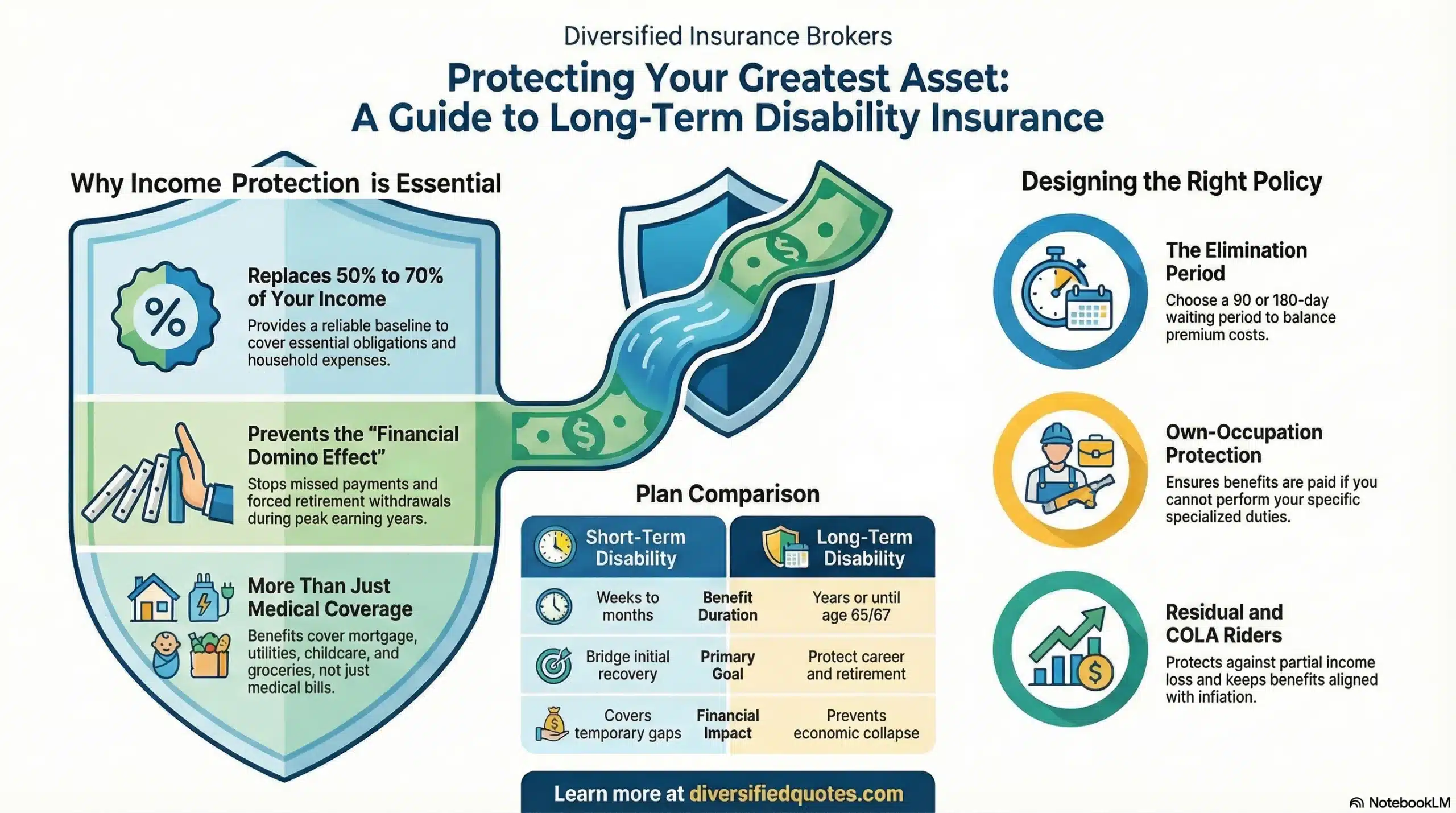
The benefit period for a software developer’s primary disability policy should extend to retirement age. Long-term disability insurance with a to-age-65 or to-age-67 benefit period is the appropriate foundation — a career-ending disability beginning at age 32 could span 33 years, and any shorter benefit period leaves massive financial exposure uncovered. The elimination period should reflect available bridge resources: developers with strong emergency reserves can absorb a 90-day EP; contractors with no employer bridge and limited savings should consider 30-60 day periods to avoid a financial crisis during the initial recovery phase. The rider set that adds the most long-term value for software developers includes the future increase option — essential given the rapid income growth trajectory of software careers — the residual disability rider for partial recovery periods where productivity is meaningfully reduced but work has not stopped entirely, and the COLA rider for long-term claim inflation protection. The full rider framework is at disability insurance riders explained. Benefits from individually owned policies with after-tax premiums are generally tax-free — the full tax treatment context is at are disability insurance payments taxable. The benefit sizing calculation for tech professionals with variable comp including equity is at how much disability insurance do I need.
Early Career and the Cost of Waiting
The best time to purchase individual disability insurance is early in a software development career — before any health history creates underwriting complications and while premiums are at their career-long low point. Premium rates for individual LTD policies are locked in at the issue age and do not increase simply because the policyholder ages within the contract. A developer who purchases at age 25 will pay the same premium at age 35 as they did at issue — a significant long-term financial advantage. The FIO rider purchased at age 25 at an entry-level income protects the right to expand coverage as compensation grows to senior, staff, or principal engineer levels without new medical underwriting — which becomes critical if health events occur between the initial purchase and the income levels that warrant higher benefit amounts. Disability insurance for new professionals covers the early-career planning framework, including how to structure initial coverage during the first years of a tech career. Working with an independent disability insurance broker provides carrier comparison access that matters for tech professionals — different carriers evaluate software development duties and compensation structures differently, and the best outcome on carrier selection comes from comparing the full market rather than applying to one carrier directly. For developers who have already received a quote and want an independent evaluation, get a 2nd opinion on your disability insurance quote covers the review process.
Talk With an Advisor Today
Choose how you’d like to connect—call or message us, then book a time that works for you.
Schedule here:
calendly.com/jason-dibcompanies/diversified-quotes
Licensed in all 50 states • Fiduciary, family-owned since 1980
FAQs: Disability Income Insurance for Software Developers
What occupational class do software developers typically qualify for?
Software developers and engineers typically qualify for the highest available occupational classes across most major disability insurance carriers. The profession is classified as low-risk because the work is primarily cognitive, does not involve significant physical hazard, and has a clean historical claims profile. This top-tier classification produces the most competitive premium rates, access to true own-occupation definitions, to-age-65 benefit periods, and the full rider menu. It is one of the strongest occupational classification positions available in individual disability insurance — better than most healthcare professions and essentially all physical trade occupations.
Why does own-occupation coverage matter specifically for software developers?
Disability carriers frequently characterize software development as “sedentary desk work” and argue in claims that a developer who cannot code but could perform administrative or general office tasks is not disabled. Under any-occupation language, that argument can defeat a legitimate cognitive disability claim. Under true own-occupation coverage, the policy evaluates whether you can perform the material duties of software development specifically — design, architecture, coding, debugging, technical leadership — not whether you could theoretically do some other form of office work. This distinction determines whether mental health conditions, neurological impairment, or other cognitive disabilities that end a development career produce paid benefits or a denial.
My tech company has group LTD — is that enough?
For many software developers earning $150,000-$400,000 or more, employer group LTD is not sufficient as the only income protection. Most group plans cap monthly benefits at $8,000-$15,000 regardless of actual compensation — a $250,000 earner with a $10,000 group cap receives only 48% replacement at that cap, far below the 60-70% typically targeted. Group plan benefits from employer-paid premiums are also generally taxable as ordinary income, further reducing the effective replacement ratio. Individual supplemental coverage fills the income gap, produces tax-free benefits, and remains portable when employment changes.
What if I work as a freelance or contract developer with 1099 income?
Freelance and contract developers have no employer disability safety net — the individual policy is the entire income protection plan. Income documentation for 1099 developers requires two to three years of tax returns showing consistent net earnings. Variable income from project to project is typically averaged to establish a benefit baseline. Shorter elimination periods may be appropriate if savings cannot bridge a 90-day gap without employer-paid sick leave or short-term disability as backup. When income includes both W-2 from a primary employer and 1099 from side projects, the combined income picture should inform the total benefit amount requested across all coverage.
Why is the future increase option especially important for early-career developers?
Software development careers commonly see income growth from $80,000-$120,000 at entry level to $200,000-$400,000 or more at senior and principal levels without requiring new jobs or career changes — just tenure and skill development. A policy purchased at entry-level income without a Future Increase Option creates coverage that becomes proportionally less adequate each year income grows. The FIO rider allows the benefit amount to expand as income rises without new medical underwriting — meaning if a health event occurs between the initial purchase and peak earnings, the coverage can still grow to reflect the higher income. Purchasing at age 25 or early in the career and using the FIO to expand coverage as compensation grows is significantly more cost-effective than applying for additional coverage later at a higher age with potential health complications.
About the Author:
Jason Stolz, CLTC, CRPC, DIA, CAA and Chief Underwriter at Diversified Insurance Brokers (NPN 20471358), is a senior insurance and retirement professional with more than 25 years of real-world experience helping individuals, families, and business owners protect their income, assets, and long-term financial stability. As a long-time partner of the nationally licensed independent agency Diversified Insurance Brokers, Jason provides trusted guidance across multiple specialties—including fixed and indexed annuities, long-term care planning, personal and business disability insurance, life insurance solutions, Group Health, Travel Medical and Evacuation Insurance, and short-term health coverage. Diversified Insurance Brokers maintains active contracts with over 100 highly rated insurance carriers, ensuring clients have access to a broad and competitive marketplace.
His practical, education-first approach has earned recognition in publications such as VoyageATL, and contributions from his agency featured in Kiplinger and GoBankingRates— highlighting his commitment to financial clarity and client-focused planning. Drawing on deep product knowledge and years of hands-on field experience, Jason helps clients evaluate carriers, compare strategies, and build retirement and protection plans that are both secure and cost-efficient. Visitors who want to explore current annuity rates and compare options across multiple insurers can also use this annuity quote and comparison tool.
Explore More Disability Insurance Options: Browse our complete guide to Disability Insurance for Technology, Science & Education — covering software developers, engineers, scientists, teachers, architects & researchers from 100+ carriers.
Last Reviewed: June 6, 2026 |
Reviewed by: Jason Stolz, CLTC, CRPC, DIA, CAA
Chief Underwriter, Diversified Insurance Brokers, Inc. | NPN: 20471358 | Diversified Insurance Brokers, Inc. — Licensed in all 50 states
Fact Checked by: Tonia Pettitt, CMIP©
Medicare Specialist, Diversified Insurance Brokers, Inc. | NPN: 14374308 | Diversified Insurance Brokers, Inc. — Licensed in all 50 states
Did you find this content helpful? Leave us a Google review — it helps others find trustworthy guidance too.
Editorial Standards: Diversified Insurance Brokers maintains rigorous editorial standards to ensure accuracy, clarity, and independence in all content. Learn more about our editorial standards and commitment to transparency.
