
Disability Insurance for Engineers
As an Independent Disability Insurance Broker, we have access to exclusive discounts and negotiated pricing most captive agents can’t offer — see the full breakdown near the end of this page.
Disability Insurance for Engineers

Jason Stolz CLTC, CRPC, DIA, CAA
Disability insurance for engineers is a critical component of financial planning for professionals who have invested years of specialized education, technical training, and career development to earn incomes that reflect the high value their expertise commands. Whether you are a civil engineer designing infrastructure, a mechanical engineer developing industrial systems, an electrical engineer working on power or electronics, a software engineer building complex digital architecture, a structural engineer responsible for the safety of built environments, a chemical engineer managing process systems, or any other licensed or practicing engineering professional — your income is tied to the specialized analytical and technical capabilities that only your specific engineering background provides.
Engineering is among the most financially rewarding professional career paths available in the American workforce. Median annual salaries across engineering specializations typically range from the high five figures for entry-level positions to well above $150,000 for experienced licensed professionals in high-demand specializations. A Professional Engineering license — which requires a four-year accredited engineering degree, passage of the Fundamentals of Engineering examination, several years of supervised practice, and passage of the Principles and Practice of Engineering examination — further elevates earning potential and represents one of the most significant professional investments any engineer makes in their career. Disability insurance for engineers is the financial tool that protects that investment and the income it generates.
At Diversified Insurance Brokers, we help engineers across all specializations structure disability insurance coverage that reflects the specific nature of their work, their occupational classification, and the income their engineering expertise produces. A properly designed disability policy for an engineer is not a generic product — it is a precisely calibrated income protection tool built around how each engineer actually works and what conditions would actually impair their ability to practice their profession.
Protect Your Engineering Income
Compare disability insurance options designed for civil engineers, mechanical engineers, electrical engineers, software engineers, and all engineering professionals.
How Engineering Work Varies — and Why It Matters for Disability Insurance
Disability insurance for engineers begins with a clear understanding that “engineer” is not a single occupational profile but a broad professional category spanning dozens of specializations with meaningfully different work environments, physical demands, and disability risk profiles. The disability insurance planning needs of a software engineer who works entirely from an office or home workstation differ substantially from those of a civil engineer who spends significant time on construction sites, a petroleum engineer who works in industrial and field settings, or a structural engineer who conducts field inspections of infrastructure projects.
This distinction is not merely theoretical — it directly affects how disability insurance carriers classify engineering professionals and the policy features, premium costs, and maximum benefit amounts available to each. Disability insurance carriers assign occupational class ratings based primarily on the nature of actual work duties and the percentage of time spent in different environments. An engineer whose duties are entirely office-based — designing, modeling, analyzing, and communicating from a computer workstation — typically qualifies for the most favorable 3A to 4A occupational tier, providing access to strong own-occupation definitions, high maximum benefit amounts, and competitive premium rates. An engineer who spends more than 25% of working time in the field, on construction sites, in industrial facilities, or in laboratory environments will typically receive a less favorable classification that reflects the physical and environmental hazards of those settings.
The practical implication for engineers evaluating disability insurance is that presenting occupational duties accurately and completely — with precise detail about the percentage of office versus field versus laboratory time — is essential for securing the most favorable available classification. This is one of the most impactful services an experienced independent broker provides, because different carriers evaluate the same engineering role differently, and identifying which carrier provides the most favorable classification for a specific engineer’s duty mix can produce meaningful differences in both premium cost and policy features. Our resource on own-occupation disability insurance explained provides the foundational context for understanding how the policy definition that protects engineers’ specialized professional income actually works.
The Disability Risks Facing Engineers — Cognitive, Physical, and Field Hazard Dimensions
The disability risk profile for engineers spans three distinct dimensions — cognitive, musculoskeletal, and field hazard — and understanding each dimension is essential for structuring disability insurance for engineers that actually responds to the conditions most likely to interrupt an engineering career.
The cognitive dimension dominates the disability risk profile for office-based engineers. The BLS Occupational Requirements Survey documents that 47.1% of architecture and engineering occupations require problem-solving more than once per day — the highest frequency measured across the occupational categories surveyed. Engineering work is fundamentally an exercise in sustained, complex analytical thinking: modeling systems, solving multi-variable technical problems, interpreting data, evaluating design options against safety and performance criteria, and communicating technical findings with precision. Any condition that impairs this sustained analytical capacity — traumatic brain injury, stroke, neurological conditions including multiple sclerosis, significant mental health disorders such as major depression, or chronic conditions that produce cognitive fatigue — can disable an engineer from performing their professional duties even without producing any physical limitation. This cognitive disability risk is the most underappreciated income protection vulnerability for the engineering profession and the dimension that makes own-occupation disability coverage most essential for engineers whose analytical expertise defines their professional value.
Musculoskeletal conditions represent the most prevalent disability category for engineers who perform significant computer workstation work. Civil engineers, structural engineers, mechanical engineers, and software engineers all spend substantial time at computer workstations performing CAD modeling, simulation, data analysis, and documentation. The sustained seated postures, sustained screen use, and sustained keyboard and mouse operation that characterize office-based engineering work create cumulative musculoskeletal health consequences — cervical spine conditions, lumbar disc problems, carpal tunnel syndrome, and repetitive strain conditions — that develop over an engineering career and can eventually impair the ability to perform extended computer-based engineering work. The musculoskeletal disability risk facing engineers in computer-intensive roles is directly parallel to that documented across other computer-intensive professions, including draftsmen and CAD professionals whose sustained precision computer work creates comparable occupational health exposure.
Field hazard exposure adds a third disability risk dimension for engineers whose duties include site visits, field inspections, laboratory work, or on-site project management. Civil engineers inspecting construction sites, structural engineers conducting bridge or building inspections, chemical engineers working in process plant environments, petroleum engineers working at drilling operations, and environmental engineers conducting field sampling all face physical hazard exposure — falls, equipment hazards, chemical exposures, and industrial accident risk — that office-based engineers do not. For engineers with significant field work components, disability insurance must address both the cognitive income protection of specialized technical expertise and the physical injury risk of field operations.
Why Own-Occupation Disability Coverage Is the Foundation for Engineers
The own-occupation definition of disability is the single most important policy feature for any engineer evaluating disability insurance options. It pays benefits when a condition prevents the engineer from performing the material duties of their specific engineering role — regardless of whether they could theoretically perform other less technically demanding or less highly compensated work. This distinction is directly relevant to how engineering disabilities actually manifest.
A civil engineer who sustains traumatic brain injury producing impaired spatial reasoning and engineering calculation ability may retain the ability to perform many non-engineering jobs. Under an any-occupation policy, disability benefits would be denied. Under an own-occupation policy, the genuine inability to perform civil engineering work at a professional standard is recognized as the occupational disability it is, and benefits are paid accordingly — preserving the income protection for which the engineer has invested years of education and career development.
Similarly, a software engineer whose carpal tunnel syndrome prevents sustained keyboard and mouse operation may technically be capable of work that does not require continuous typing. A mechanical engineer whose multiple sclerosis progresses to the point where sustained analytical concentration is impossible may retain the ability to perform simpler, lower-demand tasks. In both cases, an any-occupation policy provides no meaningful income protection, while an own-occupation policy recognizes the genuine occupational disability and provides the benefits the engineer purchased the policy to receive. For engineers with advanced degrees, professional licensure, and decade-long career investments that have produced specialized high-income expertise, the own-occupation definition is not optional — it is the foundation on which all other disability insurance planning rests.
The PE License Dimension — How Professional Licensure Creates Unique Disability Exposure
Engineers who hold Professional Engineering licenses face a disability dimension that non-licensed engineers do not: the potential for a health condition to result in loss of professional licensure that legally prevents them from practicing as a PE, regardless of their overall health status. State PE license requirements include provisions related to mental and physical fitness to practice, and conditions that impair the judgment, cognitive function, or physical capabilities required for the safe exercise of professional engineering responsibilities can affect licensure status.
For a PE whose stamp on engineering documents carries legal significance — and whose professional practice depends on the legal authority to practice professional engineering — a condition that results in loss or suspension of the PE license is a career-ending disability even if the engineer retains sufficient capability for other types of employment. A well-structured own-occupation disability policy recognizes this licensing-dependent disability scenario: if a condition prevents the PE from legally or safely practicing professional engineering, the income replacement that follows should not be contingent on the engineer also being unable to perform any other occupation whatsoever.
The licensing dimension also affects the future increase option rider decision for engineers early in their careers. An engineer who earns their PE license and experiences significant income growth as a result of that licensure should have disability coverage that keeps pace with their growing insurable income — and a future increase option rider secured early allows benefit amounts to increase as income grows without requiring new medical underwriting. Conditions that develop over a career cannot prevent future coverage increases if this rider is in place from the beginning. Understanding how own-occupation coverage works in practice for licensed professionals is covered thoroughly in our resource on own-occupation disability insurance for professional license holders.
Engineering Specializations and Their Disability Insurance Considerations
While the core disability insurance principles apply across all engineering disciplines, specific specializations carry distinct considerations worth understanding for any engineer evaluating their income protection needs.
Civil and structural engineers who perform regular site inspections, construction observation, or field investigation work face a dual occupational risk profile — the cognitive demands of engineering analysis combined with the physical hazard exposure of construction and infrastructure environments. The occupational class assigned to a civil engineer depends significantly on how much time is spent in the field versus office, and civil engineers with heavy field schedules may find that presenting their duties accurately to multiple carriers produces meaningfully different classification outcomes. The field inspection component adds fall risk, equipment hazard exposure, and construction site injury risk to the baseline cognitive disability exposure of the engineering profession.
Software and systems engineers who work entirely in office or remote environments are among the most favorably classified engineering professionals for disability insurance purposes. Their work is entirely cognitive and computer-based, placing them at the high end of engineering occupational classifications and giving them access to the strongest available policy features and benefit amounts. Their disability risk profile focuses on cognitive impairment, repetitive strain conditions from sustained computer work, and mental health conditions from the high-demand, deadline-intensive environments of technology-sector engineering employment.
Chemical, environmental, and petroleum engineers may work in environments involving chemical exposure, industrial process hazards, and field operations in remote or challenging locations. These specializations may require careful discussion with an independent broker to ensure the occupational classification accurately reflects actual duty composition and to identify carriers whose underwriting guidelines most favorably treat the mix of office and field or laboratory duties that characterizes these roles. The income protection needs of engineers in field-intensive specializations mirror those of other professionals whose careers combine professional cognitive work with physical site exposure, including economists and field science professionals managing both cognitive and field disability risk.
Case Study: Structural Engineer Earning $125,000 Per Year
Consider a structural engineer with a PE license, earning $125,000 annually at a mid-sized engineering consulting firm. Following a moderate traumatic brain injury sustained in an automobile accident, this engineer experiences persistent post-concussive symptoms including impaired spatial reasoning, calculation difficulties, and severe concentration deficits that prevent the sustained complex structural analysis their role requires. After nine months of recovery with partial neurological improvement, the engineer’s treating neurologist advises they cannot safely resume the cognitive demands of structural engineering practice and recommends return to only limited cognitive activity.
| Scenario | Without Disability Insurance | With Disability Insurance |
|---|---|---|
| Monthly Income During Disability | $0 after employer sick leave exhausted | $6,250–$7,500 |
| 12-Month Total Income | $0 | $75,000–$90,000 |
| Career and PE License Impact | Financial pressure may force premature return, risking safety and career | Full recovery supported on medical timeline without financial crisis |
| Long-Term Financial Outcome | Savings depleted, student loan obligations at risk, retirement savings halted | Financial stability maintained, long-term career and financial goals preserved |
Traumatic brain injury is not a remote disability scenario for engineers — it can happen to anyone, at any time, in any circumstance outside the engineering office. For an engineer whose specialized analytical expertise has been developed over years of education and practice, the cognitive consequences of a TBI are directly career-threatening in a way they are not for professionals whose work involves physical rather than cognitive output. Disability insurance for engineers ensures that this scenario does not simultaneously produce a financial crisis that adds additional pressure to an already difficult recovery.
Employer Group Plans vs. Individual Disability Insurance for Engineers
Many engineers employed by engineering firms, technology companies, government agencies, and large industrial organizations have access to employer-sponsored group long-term disability plans as part of their benefits packages. These plans provide a valuable baseline of protection — but they carry significant limitations that make supplemental individual disability insurance an important consideration for virtually every engineer whose income is meaningful to their financial life.
Group disability plans typically replace 60% or less of base salary and often exclude bonus compensation, overtime, and other supplemental income that many engineers earn as part of total compensation. They terminate when employment ends — providing no protection during career transitions, layoffs, or disability-related employment separations. And many group plans include own-occupation definitions that convert to any-occupation standards after two years of disability — potentially denying continued benefits to an engineer who remains unable to perform engineering work but could theoretically perform other employment.
For consulting engineers, independent engineering contractors, and self-employed engineering professionals who have no employer group plan at all, individual disability insurance is not a supplement — it is the only income protection available outside of Social Security Disability Insurance. Independent engineering consultants managing their own practices have the same self-employment income documentation and business overhead expense considerations as other self-employed professionals, including questions about how Schedule C income is documented for underwriting purposes. Our guide on how independent contractors document income for disability insurance provides a parallel framework for self-employed engineering professionals navigating these planning questions.
Key Policy Features for Engineer Disability Insurance
Disability insurance for engineers should incorporate several specific policy provisions that address the realities of high-income specialized technical professional careers. The non-cancelable and guaranteed renewable provision locks in premium rates and coverage terms for the life of the policy — preventing the carrier from increasing premiums or altering coverage as the engineer ages or accumulates health history. For an engineer who secures a policy in their late twenties or early thirties and locks in favorable rates, this provision ensures those rates remain stable across a thirty or forty-year career.
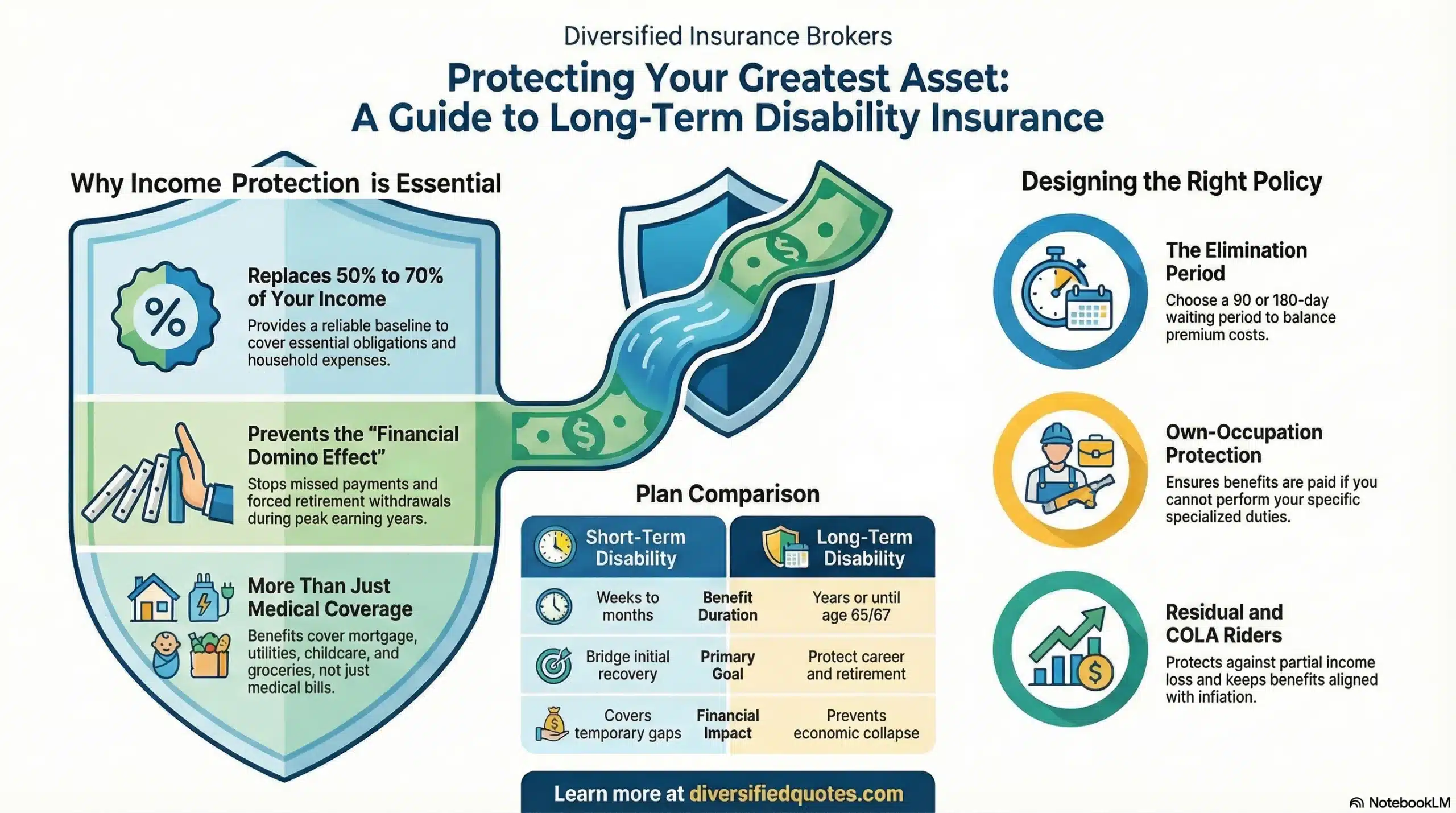
A residual disability rider pays proportional benefits when a condition reduces an engineer’s productive output without eliminating the ability to work entirely. An engineer recovering from a significant mental health episode, a neurological event, or a musculoskeletal condition affecting sustained computer use may return to work at reduced capacity — fewer analytical hours, reduced project load, limited complex problem-solving — earning proportionally less without being totally disabled. Our full resource on how residual disability benefits work explains how this coverage fills the gap between total disability and full return to normal engineering productivity.
The elimination period calibration and COLA rider selection complete the policy structure. Our guide on how disability insurance elimination periods work helps engineers match the waiting period to their available financial reserves. Our resource on disability income insurance with a COLA rider explains why inflation protection matters for engineers who may face extended disability periods and whose monthly benefit needs to maintain real purchasing power across the full duration of a claim. Short-term disability options that complement long-term coverage are also worth understanding — our guide on how to buy short-term disability insurance provides context for the initial income protection period before long-term benefits begin.
Why Engineers Should Work with an Independent Disability Insurance Broker
Disability insurance policy outcomes for engineers vary meaningfully between carriers based on how each company evaluates engineering specializations, what field work percentages trigger occupational class changes, and what maximum benefit amounts are available for each classification tier. An independent broker who understands engineering occupational classifications, who knows which carriers are most favorable for specific engineering duty profiles, and who can structure policy provisions around the specific disability risks of each engineering specialization produces materially better coverage outcomes than a standard retail application.
At Diversified Insurance Brokers, we evaluate options across multiple carriers for every engineer we work with — comparing occupational class assignments, policy definitions, rider options, and premium structures across the full marketplace to identify the coverage that provides the most meaningful financial protection for each individual engineer’s professional and financial situation. For engineers early in their careers who are considering the future increase option and COLA rider selections that will define their coverage across a full working life, the guidance of an experienced independent broker is particularly valuable. Our dedicated resource on why independent disability insurance brokers matter explains the full value of this approach for high-income technical professionals.
Final Thoughts on Disability Insurance for Engineers
Engineers invest more in professional preparation than almost any other professional category — four-year technical degrees, graduate education in many cases, years of supervised practice, professional licensure examinations, and ongoing professional development across a career of continuous technical advancement. That investment produces some of the most valuable specialized expertise in the American economy and some of the highest incomes available to working professionals without medical degrees.
Disability insurance for engineers is the financial protection that ensures a health event — whether a TBI from an automobile accident, a musculoskeletal condition from years of engineering workstation use, a progressive neurological condition, or a mental health disorder from sustained high-demand technical work — does not permanently erase the returns on that investment. A well-structured policy provides the income replacement that allows an engineer to recover from any disabling condition from a position of financial stability rather than financial crisis.
Related Pages
Talk With an Advisor Today
Choose how you’d like to connect—call or message us, then book a time that works for you.
Schedule here:
calendly.com/jason-dibcompanies/diversified-quotes
Licensed in all 50 states • Fiduciary, family-owned since 1980
Disability Insurance for Engineers FAQs
The occupational class assigned to an engineer depends primarily on the nature of their actual work duties — specifically the percentage of time spent in office versus field, laboratory, or industrial environments. Engineers who work entirely or predominantly in an office setting — designing, modeling, analyzing, and communicating from a computer workstation with minimal field time — typically receive a 3A or 4A occupational classification, which is among the most favorable available in the disability insurance market. This favorable classification provides access to strong own-occupation definitions, high maximum monthly benefit amounts, competitive premium rates, and the full range of supplemental riders. Engineers who spend more than roughly 25% of their time in field environments, construction sites, industrial facilities, or laboratories typically receive a lower classification that reflects the additional physical and environmental hazard exposure of those settings. Since different carriers apply these percentage thresholds differently, working with an independent broker to compare classifications across multiple carriers simultaneously is essential for securing the best available terms for each engineer’s specific duty profile.
Office-based engineers face a disability risk profile centered on cognitive and musculoskeletal conditions rather than physical hazards. The BLS Occupational Requirements Survey documents that 47.1% of architecture and engineering occupations require problem-solving more than once per day — the highest frequency across surveyed occupational categories — confirming the cognitive intensity of engineering work. Any condition that impairs sustained analytical thinking, complex problem-solving capacity, mathematical and spatial reasoning, or technical communication can disable an engineer from performing their professional duties. Traumatic brain injury, stroke, multiple sclerosis, significant mental health disorders including major depression, and chronic conditions producing cognitive fatigue all fall into this category. Musculoskeletal conditions from sustained computer workstation use — cervical spine conditions, lumbar disc problems, carpal tunnel syndrome, and repetitive strain injuries — represent the most prevalent category of disabling conditions for engineers whose work is primarily computer-based. For a parallel on how cognitive disability risk affects other computer-intensive professionals, see our page on disability insurance for draftsmen.
Own-occupation disability insurance pays benefits when a condition prevents an engineer from performing the material duties of their specific engineering role — regardless of whether they could theoretically perform other less technically demanding work. This distinction is directly relevant to how engineering disabilities actually manifest. A structural engineer whose TBI produces impaired spatial reasoning and calculation difficulty may retain the ability to perform non-engineering jobs. Under any-occupation coverage, disability benefits would be denied. Under own-occupation coverage, the genuine inability to perform structural engineering is recognized as the occupational disability it is, and benefits are paid. For engineers who have invested years in specialized education and career development to earn engineering incomes, the any-occupation definition provides almost no meaningful income protection for the cognitive conditions most likely to disable a working engineer. Own-occupation coverage is the only definition that actually protects the specialized professional income engineers have worked to build. Our resource on own-occupation disability insurance explained covers this in full detail.
A Professional Engineering license creates both an income premium and a unique disability dimension for licensed engineers. The PE license legally authorizes engineers to sign and seal engineering documents and to take professional responsibility for engineering work — a privilege that directly supports higher compensation and greater professional authority. However, PE licenses carry professional fitness requirements, and conditions that impair the judgment, cognitive function, or physical capabilities required for the safe exercise of professional engineering responsibilities can affect licensure status. A condition that results in loss or suspension of a PE license ends the engineer’s ability to practice as a PE regardless of their overall health, constituting a genuine occupational disability even if other work remains theoretically possible. A well-structured own-occupation disability policy recognizes this licensing-dependent disability scenario. PE license holders should also consider the future increase option rider, which allows coverage to increase with growing PE-level income without new medical underwriting — ensuring coverage keeps pace with career earnings growth over a full engineering career.
In most cases, no. Employer group disability plans provide a valuable baseline but carry significant limitations for engineers with meaningful incomes. Group plans typically replace 60% or less of base salary and frequently exclude bonus compensation, overtime, and other supplemental income that many engineers earn as part of total compensation. Group plans terminate when employment ends — providing no protection during job transitions or disability-related separations. Many group plans also include own-occupation definitions that expire after two years, shifting to any-occupation standards that may deny continued benefits to an engineer who remains unable to perform engineering work but could theoretically do other employment. For engineers earning $100,000 or more annually, the income protection gap between a group plan and comprehensive individual coverage can be substantial and financially consequential. Supplemental individual disability insurance — owned personally by the engineer, portable across employers, and calibrated to actual total compensation — fills these gaps and provides the comprehensive protection that engineering income deserves.
Residual disability coverage pays proportional benefits when a disabling condition reduces an engineer’s productive output and earnings without eliminating the ability to work entirely. An engineer recovering from a significant mental health episode, a neurological event, or a musculoskeletal condition may return to work at reduced capacity — fewer analytical hours, limited complex project work, reduced client engagement — earning proportionally less than their pre-disability income without being totally disabled. Without a residual disability rider, a total-disability-only policy pays nothing during this partial recovery period. A residual rider supplements reduced earnings proportionally throughout the return-to-full-capacity arc, providing continuous financial support from the onset of disability through full return to normal engineering productivity. For engineers whose most likely disabling conditions — cognitive impairment, mental health disorders, musculoskeletal conditions — often produce gradual functional limitations rather than sudden complete incapacity, this rider is essential. Our full resource on how residual disability insurance benefits work covers this protection in detail.
Many individual disability insurance policies provide coverage for mental health conditions including major depression, anxiety disorders, and burnout-related illness when those conditions prevent performing occupational duties. For engineers working in high-pressure technology, consulting, and infrastructure sectors under sustained deadline and performance demands, mental health conditions represent a genuine and documentable career disability risk. Coverage terms vary significantly between carriers — some policies provide full benefits for mental health disabilities throughout the benefit period, while others limit mental health claims to 24 months. For engineers evaluating disability insurance options, reviewing the specific mental health benefit period provisions of any policy before purchase is important. A policy that limits mental health benefits to 24 months may leave an engineer who develops a major depressive disorder or anxiety condition without benefit coverage precisely when a longer-term claim is needed. At Diversified Insurance Brokers, we evaluate mental health coverage provisions specifically when structuring disability insurance for engineering professionals.
Most employed engineers with access to employer sick leave and emergency financial reserves are well-served by a 90-day elimination period, which meaningfully reduces premiums without creating unmanageable financial hardship during the waiting period. An engineer with six months of emergency savings and employer sick leave covering the first several weeks of a disability can bridge a 90-day elimination period comfortably. Senior engineers with significant savings and investment assets may comfortably accept even longer elimination periods of 180 days. Self-employed engineering consultants with no employer sick pay and income dependent entirely on client billings should evaluate shorter 30 or 60-day elimination periods more seriously — the immediate income cessation of a self-employment disability makes the waiting period a period of zero income that must be sustained from savings alone. Our full guide on how elimination periods work provides the framework for matching this decision to individual financial circumstances.
A cost-of-living adjustment rider increases the monthly disability benefit amount annually during a claim period, preserving the real purchasing power of benefits across an extended disability. For an engineer who experiences a long-term or permanent disability from a serious TBI, progressive neurological condition, or severe mental health disorder, a benefit amount that is adequate at the onset of disability loses meaningful real value over years without COLA protection. The COLA rider ensures the benefit maintains its effective purchasing power across the full duration of an extended claim. For engineers early in their careers who are building comprehensive long-term disability policies designed to protect them across a full working life, including a COLA rider is an important investment in the long-term adequacy of their coverage. Our resource on disability income insurance with a COLA rider explains how this inflation protection works and why it matters for extended engineering disability scenarios.
The best time is as early as possible in an engineering career — ideally in the first years of professional practice, before any health conditions have accumulated in the medical record. Disability insurance premiums are based in part on age and health status at the time of application, and engineers who apply in their late twenties or early thirties secure the most comprehensive coverage at the most favorable rates. More importantly, securing a future increase option rider early in the career allows benefit amounts to grow with engineering income — from entry-level salaries through PE-licensed senior compensation levels — without requiring new medical underwriting. Any conditions that develop before application can result in exclusion riders or restricted policy terms. Applying early ensures that the full spectrum of potential engineering career disabilities is covered from the beginning, with the ability to increase coverage as income grows over a full career. The non-cancelable and guaranteed renewable provision locks in those favorable early-career rates for the life of the policy.
An independent broker has access to multiple disability insurance carriers and can compare occupational class assignments, policy definitions, mental health benefit provisions, rider options, and premium structures across the full marketplace. For engineers, the differences between carriers in how they evaluate field time percentages, how they classify specific engineering specializations, and what maximum benefit amounts they offer for each occupational tier can produce substantially different real-world coverage outcomes. A captive agent representing a single carrier can only present that company’s approach. At Diversified Insurance Brokers, we evaluate the full competitive landscape and structure disability coverage that is genuinely calibrated to how each engineer works, what their specific disability risk profile involves, and what policy features provide the most meaningful protection for the engineering income they have invested years in building. Our resource on why independent disability insurance brokers matter explains this value for high-income technical professionals in full detail.
About the Author:
Jason Stolz, CLTC, CRPC, DIA, CAA and Chief Underwriter at Diversified Insurance Brokers (NPN 20471358), is a senior insurance and retirement professional with more than 25 years of real-world experience helping individuals, families, and business owners protect their income, assets, and long-term financial stability. As a long-time partner of the nationally licensed independent agency Diversified Insurance Brokers, Jason provides trusted guidance across multiple specialties—including fixed and indexed annuities, long-term care planning, personal and business disability insurance, life insurance solutions, Group Health, Travel Medical and Evacuation Insurance, and short-term health coverage. Diversified Insurance Brokers maintains active contracts with over 100 highly rated insurance carriers, ensuring clients have access to a broad and competitive marketplace.
His practical, education-first approach has earned recognition in publications such as VoyageATL, and contributions from his agency featured in Kiplinger and GoBankingRates— highlighting his commitment to financial clarity and client-focused planning. Drawing on deep product knowledge and years of hands-on field experience, Jason helps clients evaluate carriers, compare strategies, and build retirement and protection plans that are both secure and cost-efficient. Visitors who want to explore current annuity rates and compare options across multiple insurers can also use this annuity quote and comparison tool.
Explore More Disability Insurance Options: Browse our complete guide to Disability Insurance for Technology, Science & Education — covering software developers, engineers, scientists, teachers, architects & researchers from 100+ carriers.
Last Reviewed: June 7, 2026 |
Reviewed by: Jason Stolz, CLTC, CRPC, DIA, CAA
Chief Underwriter, Diversified Insurance Brokers, Inc. | NPN: 20471358 | Diversified Insurance Brokers, Inc. — Licensed in all 50 states
Fact Checked by: Tonia Pettitt, CMIP©
Medicare Specialist, Diversified Insurance Brokers, Inc. | NPN: 14374308 | Diversified Insurance Brokers, Inc. — Licensed in all 50 states
Did you find this content helpful? Leave us a Google review — it helps others find trustworthy guidance too.
Editorial Standards: Diversified Insurance Brokers maintains rigorous editorial standards to ensure accuracy, clarity, and independence in all content. Learn more about our editorial standards and commitment to transparency.
