
Disability Insurance for Daycare Workers
As an Independent Disability Insurance Broker, we have access to exclusive discounts and negotiated pricing most captive agents can’t offer — see the full breakdown near the end of this page.
Disability Insurance for Daycare Workers

Jason Stolz CLTC, CRPC, DIA, CAA
Daycare workers and childcare professionals carry an occupational health burden that their compensation rarely reflects — and that the disability insurance market equally rarely addresses with the specificity the profession deserves. Occupational health research published by the University of Massachusetts Lowell’s Center for the Promotion of Health in the New England Workplace documents that the prevalence of back and neck or shoulder discomfort among childcare workers is 43 to 61 percent and 25 to 35.4 percent respectively, driven by the physically demanding combination of frequent lifting, bending, stooping, squatting, reaching, and carrying that caring for young children requires throughout every working day. A cross-sectional study in peer-reviewed medical literature found that 56 percent of childcare workers surveyed were at risk of burnout and 58 percent reported musculoskeletal symptoms — a dual burden of physical and psychological occupational health risk that the profession’s compensation does not offset. Bureau of Labor Statistics data places the median wage for childcare workers at approximately $37,000 annually, with only about one in five childcare workers having employer-sponsored health coverage. The economic profile of the childcare workforce — lower wages, limited benefits, and high rates of self-employment through home daycare operations — makes disability income protection both more consequential and less accessible than in higher-income professions. Disability insurance for daycare workers is income protection designed to fit the specific financial reality of the childcare profession, not the high-earner professional template that most disability insurance marketing addresses.
At Diversified Insurance Brokers, Jason Stolz, CLTC, CRPC, DIA, CAA works with daycare center employees who may or may not have access to group disability benefits, directors and lead teachers at childcare centers with management responsibilities, and the substantial population of home daycare operators and family childcare providers who are entirely self-employed, carry no employer benefit baseline, and generate their income entirely from their own daily presence and physical capacity to care for the children enrolled in their programs. The disability insurance planning conversation for a home daycare operator who runs a licensed family childcare business differs fundamentally from the conversation for an employee at a large corporate childcare center — and both require specific attention to the physical and psychological disability pathways that childcare work specifically creates.
Compare Disability Insurance for Daycare Workers
We review coverage options across 100+ carriers and identify the policy structure that fits your childcare income, employment setting, and occupational risk profile.
Daycare Worker Disability Risk — Physical Demands, Infectious Exposure, Burnout, and the Income Protection Gap
| Risk Category | Research and Work Context | Resulting Disability Risk | Coverage Status | DI Coverage Gap |
|---|---|---|---|---|
| Musculoskeletal disorders from physical childcare demands | UMass Lowell occupational health research documents 43–61% back discomfort prevalence; lifting and carrying children above 20 kg daily was significantly associated with neck and shoulder pain; ergonomic exposures include frequent lifting, bending, stooping, squatting, reaching, and carrying throughout the workday | Chronic lower back syndrome, herniated disc, rotator cuff conditions, knee degeneration — progressive conditions that can eventually prevent the sustained physical demands of childcare work | Only about 20% of childcare workers have employer-sponsored benefits; cumulative musculoskeletal conditions disputed in workers’ comp; self-employed home providers carry no automatic protection | Major gap for the approximately 80% without benefits; individual DI covers qualifying disability from musculoskeletal conditions regardless of gradual-onset nature |
| Burnout and mental health disability | Peer-reviewed cross-sectional study documents 56% of childcare workers at risk of burnout; research identifies effort-reward imbalance, undervaluation of work, and psychosocial stress as key drivers; burnout is specifically identified as an occupational hazard of childcare work in academic literature | Disabling anxiety, depression, or burnout preventing sustained child supervision, emotional regulation, and the sustained attention demands of caring for multiple young children | Not covered by workers’ comp; group plans where available cap mental/nervous benefits at 24 months; most daycare workers have no group plan at all | Full gap for most daycare workers; individual DI with unlimited mental health benefit period is the only protection against extended mental health disability |
| Infectious disease exposure | Occupational health research identifies infectious disease as one of the most common health and safety risks for childcare workers; daycare environments concentrate communicable disease transmission from unvaccinated or pre-symptomatic children in close physical contact; Hepatitis A/B, rubella, varicella, cytomegalovirus, and other childhood infections present documented occupational exposure risk | Serious infectious illness requiring extended recovery; complications from occupationally acquired infection during pregnancy; chronic sequelae from infections contracted in childcare settings | Occupational disease provisions for employees with documented exposures; self-employed home providers unprotected; most daycare workers lack any coverage for illness-based disability | Significant gap for illness-based disability from infectious conditions; individual DI covers qualifying disability from any cause |
| Noise exposure and hearing | Occupational health research on daycare and preschool environments identifies high-pitched noise from children as a documented occupational exposure; noise levels in childcare settings can exceed recommended levels during active play periods | Occupational noise-induced hearing conditions developing gradually from sustained high-noise childcare environments across a career | Gradual hearing conditions outside workers’ comp discrete-incident framework; self-employed home providers entirely unprotected | Gap for noise-related occupational conditions; individual DI covers qualifying disability from any cause without requiring incident documentation |
| Home daycare operator business exposure | Family childcare providers who operate licensed home daycare businesses are entirely self-employed; their disability simultaneously eliminates personal income and threatens the licensed childcare business — state licensing fees, liability insurance, food program participation, and any contracted family obligations continue regardless of the provider’s health | Complete income loss with continued business overhead; potential loss of daycare license if operations cannot continue; enrolled families must find alternative care creating client relationship disruption | Zero workers’ comp protection; no employer benefits of any kind; individual DI is the entire protection system | Complete gap; individual DI plus potential small-business overhead coverage together address the full financial exposure |
| Illness-based disability (non-occupational) | Cancer, cardiac events, and other serious health events — independent of childcare work — that eliminate the ability to provide sustained daily childcare | Extended inability to supervise children, perform physical childcare duties, and maintain the continuous presence that daycare operations require | Not covered by workers’ comp; most daycare workers have no group LTD; illness-based disability produces complete income loss | Approximately 90% of long-term disabilities are illness-based; complete gap for approximately 80% of daycare workers without employer benefits |
The table documents what makes daycare worker disability risk distinctive: a profession where occupational health research documents high rates of both physical and psychological occupational illness, where compensation is among the lowest for any caring profession in the American economy, and where the benefit access rate is documented at approximately 20 percent — meaning approximately four out of every five childcare workers carry no employer-provided disability protection of any kind. The disability insurance conversation for a daycare worker is therefore not about supplementing inadequate group coverage — it is about establishing the only income protection that exists.
The Physical Demands of Daily Childcare — What the Research Documents
The occupational health literature on childcare work is specific and consistent about the physical demands that drive musculoskeletal disorder rates in the profession. UMass Lowell’s occupational health research identifies the ergonomic exposures in childcare work as including frequent lifting, bending, stooping, squatting, reaching, and carrying throughout the working day — noting specifically that activities causing musculoskeletal strain include lifting and carrying children, pushing and pulling strollers, carrying diapers and supply bags, and moving furniture and play equipment. Research demonstrates that caring for infants requiring daily lifting of children above 20 kilograms was significantly associated with neck and shoulder pain. Back pain prevalence documented at up to 61 percent of childcare workers, and neck and shoulder discomfort at up to 35.4 percent, reflects the cumulative loading of sustained physical childcare across full working days repeated across a caregiving career.
The disability implications of these documented conditions for a daycare worker are specific and severe. A daycare worker who develops a disabling lumbar disc condition or a rotator cuff tear that prevents the sustained lifting, carrying, and physical floor-level activities that infant and toddler care requires has experienced a genuine occupational disability — one that eliminates the specific physical capacity to perform childcare work even if other less physically demanding employment might theoretically be possible. Own-occupation disability insurance specifically pays when the insured cannot perform the material duties of their specific occupation — childcare — even if theoretically capable of other work. This is the policy definition that protects a daycare worker’s income when the physical demands of the job have produced the musculoskeletal conditions those demands predictably generate. Long-term disability insurance addresses the extended recovery and permanent disability scenarios that serious back conditions and musculoskeletal injuries produce — income replacement during the months or years that disability prevents return to childcare work. Short-term disability insurance addresses the immediate recovery period following acute injuries or surgery before long-term coverage activates. For daycare workers who want straightforward coverage for accidental injuries without navigating complex medical underwriting, accident-only disability income insurance provides an accessible entry point at lower premium costs, though it covers accidental injury only rather than the full range of illness and injury causes.
Burnout and Mental Health — The Psychological Occupational Hazard of Childcare Work
The peer-reviewed occupational health literature on childcare worker burnout is both extensive and consistent. Burnout was specifically identified as an occupational hazard of childcare work as early as the 1970s, and more recent cross-sectional research continues to document that 56 percent of childcare workers are at risk of burnout, with key drivers including subjective noise exposure, overcommitment, psychosocial stress from effort-reward imbalance, and the social devaluation of caregiving work that the profession’s compensation profile reflects. Research identifies that childcare positions often offer low wages, no benefits, and can require unpaid overtime — factors that combine with the sustained emotional demands of caring for young children to create the occupational conditions that produce high burnout rates.
A daycare worker who develops a disabling depressive condition or anxiety disorder from occupational burnout that prevents sustained child supervision, emotional regulation, and the physical and attentional demands of daily childcare has experienced a genuine occupational disability. Workers’ comp provides zero coverage for mental health disability. The group long-term disability plan that the approximately 20 percent of childcare workers with employer benefits may have typically caps mental and nervous condition benefits at 24 months — providing two years of income replacement for what research documents as a profession with systematically elevated burnout risk. Individual disability insurance with unlimited mental health benefit periods fills this gap for the daycare worker whose burnout or psychiatric condition requires more than two years of recovery before return to sustained childcare is possible. Disability insurance for care professionals covers how mental health disability pathways are evaluated for workers in emotionally demanding caregiving occupations with documented burnout risk.
The Benefit Access Crisis in Childcare — Why Most Daycare Workers Start at Zero
The Economic Policy Institute documents that only approximately 20.7 percent of childcare workers have employer-sponsored health coverage — a figure that closely parallels the benefit access picture for disability coverage in the industry. BLS data confirms that average weekly wages for child daycare services are approximately 60 percent less than the national average, and that childcare workers are among the lowest paid workers in the United States. The structural reality is that the overwhelming majority of daycare workers are not inadequately covered by group disability plans — they are not covered at all. The employer group LTD plan that might cap benefits too low or impose a 24-month mental health limit is not a planning problem for a daycare worker at a small center that provides no group plan. The planning problem is establishing any income protection from zero.
For these workers — the majority of the childcare workforce — the relevant question is not how to supplement existing group coverage but how to build an individual disability insurance structure that actually fits a childcare worker’s income and budget. Why daycare workers buy disability insurance is answered most directly by calculating what happens to the household during an extended disability: at median childcare wages, a disability event produces an immediate household financial crisis without any income floor. Whether disability insurance is worth the cost for a daycare worker earning at the childcare median is answered by the math: the premium for an appropriately sized individual policy — sized to the childcare worker’s actual documented income rather than a high-earner template — is typically a small fraction of the monthly benefit it would pay during a disability, and the household financial consequence of an uninsured disability at any income level is the same: crisis.
Home Daycare Operators — The Self-Employed Provider’s Complete Coverage Gap
Licensed family childcare home providers occupy the most vulnerable disability exposure position in the childcare workforce — entirely self-employed, generating income from the children enrolled in their licensed home program, and carrying none of the employer benefit baseline, workers’ comp protection, or group plan access that center employment may occasionally provide. When a home daycare operator becomes disabled, two simultaneous financial crises emerge: personal income from the program stops, and the business obligations of the licensed operation — state licensing renewal fees, CACFP food program participation obligations, liability insurance premiums, and the operational costs of maintaining a licensed childcare environment — continue.
The 1099-earning family childcare provider needs individual disability insurance as the entire income protection system. Income documentation uses Schedule C and business income records. The maximum approvable monthly benefit is calculated as a percentage of documented net earned income, making complete income documentation directly determinative of the benefit ceiling. Disability insurance for self-employed childcare providers is fully available — individual policies are accessible to the self-employed specifically because they carry no employer benefit baseline — and the application process is generally straightforward for a healthy applicant with documented business income. For home daycare operators with multiple enrolled families and significant licensing and overhead infrastructure, the parallel consideration of whether the fixed costs of the licensed operation warrant small-business overhead coverage is worth discussing with a broker who understands the family childcare business structure.
Policy Design and Affordability — Building Coverage That Fits Childcare Wages
The disability insurance conversation for daycare workers is shaped by the income reality of the profession: the policy design that serves a physician earning $400,000 annually does not serve a childcare worker earning $32,000, not because coverage is unavailable but because the appropriate benefit amount, premium structure, and coverage features are different. How much disability insurance a daycare worker needs is determined by household financial obligations during a disability period — the rent or mortgage, the utilities, the food costs, and any debt service including student loans from early childhood education credentials. The benefit amount should replace the income that actually supports the household, sized at roughly 60 percent of documented earned income, tax-free when premiums are paid personally.
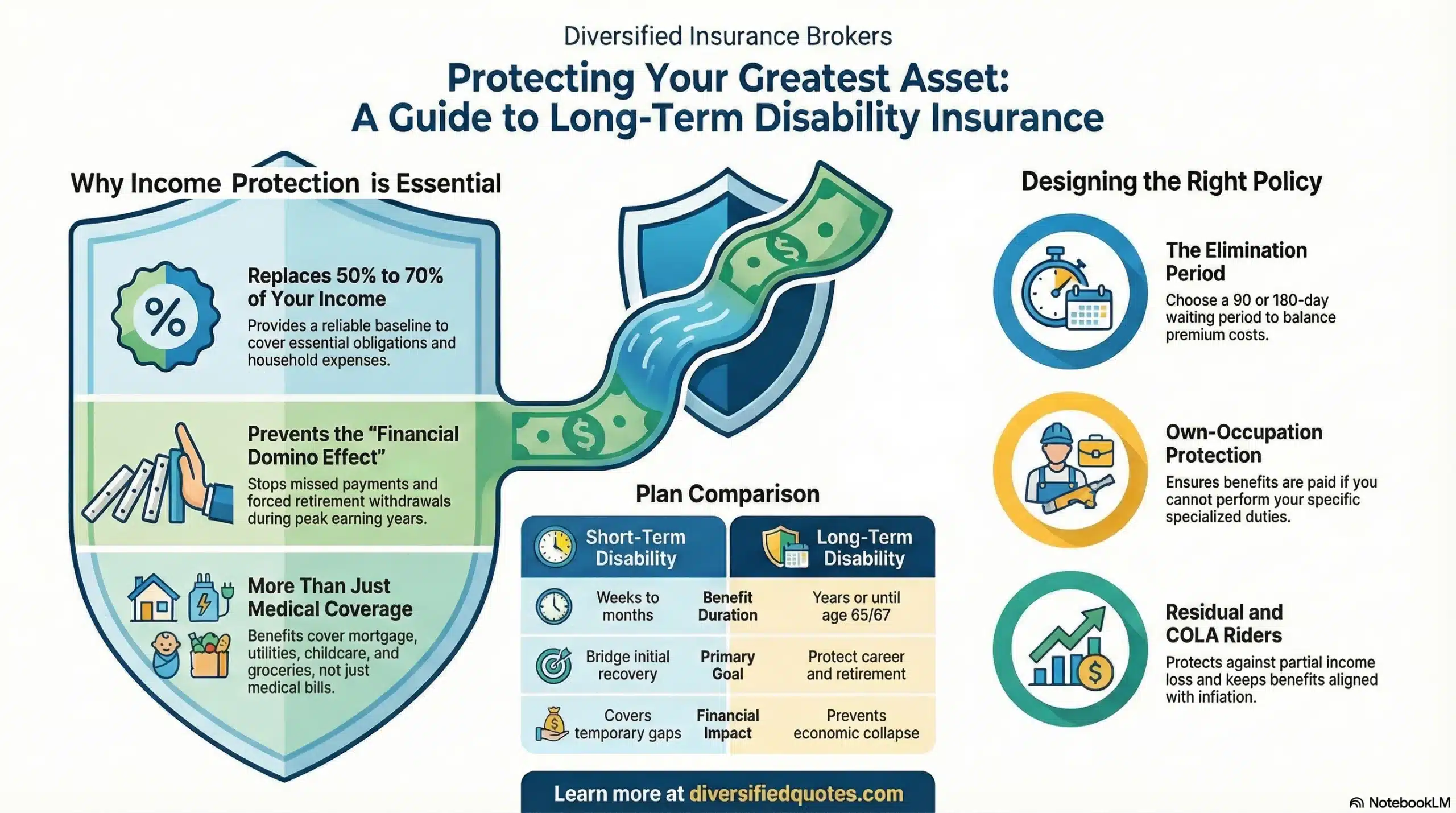
Affordability is a genuine planning consideration at childcare wages. The levers available to manage premium cost while maintaining adequate protection are the elimination period — a 90-day period produces lower premiums than 30 days, and a daycare worker with three months of emergency reserves can appropriately select the longer period — and the benefit period, where a 5-year or to-age-65 benefit period is priced differently and reflects different realistic disability scenarios. Getting the best disability insurance rates for a daycare worker means applying while health is genuinely clean — before the musculoskeletal conditions that childcare’s physical demands can produce over years of practice appear on a health record — at the youngest available age with the lowest available premium rates. How to buy disability insurance online makes the application process accessible for childcare workers whose schedules do not accommodate traditional in-person brokerage appointments, and no-exam disability insurance provides a streamlined approval path at benefit amounts appropriate for childcare income levels. Guarantee issue disability insurance is worth exploring for daycare workers whose health history creates underwriting complexity. Disability insurance with pre-existing conditions is available for daycare workers with documented back or other musculoskeletal histories, typically through partial exclusion riders rather than outright declines. The future increase option is valuable for early-career daycare workers and those building toward director or center-ownership roles where income may grow — preserving the favorable health-based underwriting terms of an early purchase through future benefit increases as career and income develop.
Get Your Daycare Worker Disability Insurance Review
We compare coverage options across 100+ carriers and identify the policy structure that actually fits childcare income and employment settings — not a high-earner template.
Talk With an Advisor Today
Choose how you’d like to connect—call or message us, then book a time that works for you.
Schedule here:
calendly.com/jason-dibcompanies/diversified-quotes
Licensed in all 50 states • Fiduciary, family-owned since 1980
FAQs: Disability Insurance for Daycare Workers
Can daycare workers actually afford disability insurance on childcare wages?
Yes — and the key to making it affordable is sizing the policy correctly to childcare income rather than using a high-earner template. A disability insurance policy for a daycare worker earning at the childcare median should be sized to replace approximately 60 percent of that actual documented income — a benefit amount that is much smaller than a physician’s policy and priced correspondingly lower. The absolute dollar premiums for individual disability insurance sized to childcare wages are meaningfully lower than premiums for high-income professional policies, because the benefit amount, not just the percentage, drives the premium calculation.
The most effective premium management tools for daycare workers on limited budgets are the elimination period and the choice of coverage scope. Selecting a 90-day elimination period rather than a 30-day period — appropriate for a daycare worker who can maintain three months of emergency reserves — produces a meaningfully lower annual premium for the same monthly benefit. How much disability insurance costs for a daycare worker is best understood through actual comparison across carriers rather than through assumptions — whether disability insurance is expensive for any specific daycare worker depends on their age, health profile, benefit amount, and the carrier comparison process that an independent broker facilitates. A daycare worker who has never priced disability insurance specifically may find it more accessible than assumed when the policy is sized appropriately to actual income rather than industry-wide standard benefit amounts.
Are disability insurance benefits taxable for a daycare worker?
For daycare workers who purchase individual disability insurance personally and pay premiums with after-tax personal income, monthly disability benefits received during a qualifying disability are generally received income-tax-free. This is the outcome for most daycare workers who purchase coverage individually — and it is particularly meaningful at childcare wage levels, where the household has less financial flexibility to absorb a tax reduction on disability benefits during a period when income has already been eliminated by the disability. Whether disability insurance payments are taxable affects benefit sizing: for a tax-free individually purchased policy, the benefit amount should cover actual after-tax take-home income; for a taxable employer-paid group plan benefit, the gross benefit must be larger to deliver equivalent household purchasing power.
For the minority of daycare workers employed at centers that provide group LTD benefits with employer-paid premiums, the resulting disability benefits are typically taxable as ordinary income. Self-employed home daycare operators who deduct disability insurance premiums as a business expense should confirm the tax treatment with a tax professional, as the business deduction may affect whether benefits received during a claim are taxable income. The tax-free character of personally purchased individual disability benefits — delivering the full stated monthly benefit to the household during a disability period — is one of the most valuable financial features of individual disability insurance at any income level, and particularly at childcare wage levels where every dollar of benefit matters.
I run a home daycare — how does disability insurance work for me as a self-employed provider?
As a self-employed licensed family childcare provider, individual disability insurance is the entire protection system — not a supplement to something else, but the only income replacement mechanism available when a health event prevents you from running your program. The application process for self-employed providers uses Schedule C and business income documentation to establish the income basis for the benefit calculation. Most carriers require one to two years of Schedule C documentation showing the net earned income from the home daycare operation, and the maximum approvable monthly benefit is calculated as approximately 60 percent of documented net earned income.
The home daycare context creates two specific planning considerations beyond the personal income layer. First, the business continuity question: when you cannot operate, enrolled families leave — and rebuilding enrollment when you return requires time and marketing that may produce a recovery period where income remains below your pre-disability level even after you are medically able to return. The residual disability benefit provision addresses this realistic scenario — if you return to operating at partial capacity or enrollment and earn less than your pre-disability income, a residual benefit pays proportionally based on the actual income loss from partial disability. Second, the licensing continuity question: maintaining your state childcare license during an extended disability involves licensing fees and renewal requirements that continue regardless of your operating status. Discussing whether a small business overhead provision makes sense for your specific licensed operation — to cover licensing costs, liability insurance, and any contractual obligations during a disability period — with an independent broker produces a more complete picture of the protection architecture your home daycare situation actually requires.
My center doesn’t offer disability insurance — what are my options?
The approximately 80 percent of childcare workers without employer-provided disability benefits have several individual market options available that do not depend on employer participation. Individual disability insurance — purchased directly through an independent broker who accesses multiple carriers — is the primary option and provides the most comprehensive protection, including the own-occupation definition, unlimited mental health benefit period, and benefit amounts calibrated to actual documented income that group plans often fail to deliver even when available. How to buy disability insurance online makes the application process accessible for daycare workers whose schedules make traditional appointments difficult.
For daycare workers whose health history makes full individual medical underwriting challenging, guarantee issue disability insurance provides an alternative access point — typically available through professional associations, unions, or employer-group arrangements where underwriting is limited or eliminated in exchange for group participation requirements. The guaranteed issue group disability insurance option is specifically worth exploring for daycare workers who are members of early childhood educator professional associations or advocacy organizations that have negotiated group disability coverage for members. For daycare workers with documented health histories that standard underwriting will rate or exclude, how to choose the right disability insurance policy covers the specific decision framework for selecting among modified offers, guaranteed issue alternatives, and standard market options. A second opinion on any offer received costs nothing and ensures the first quote was genuinely the best available rather than the most convenient.
I hurt my back at work — does workers’ comp cover me as a daycare worker?
If you are employed at a daycare center as an employee, workers’ compensation should cover you for documented acute work-related injuries — including a documented back injury from lifting a child or a fall on the premises. Workers’ comp pays approximately two-thirds of wages up to state maximums for qualifying work-related injuries, providing short-term income replacement during recovery. However, the workers’ comp framework handles the childcare back injury scenario imperfectly in three specific ways that matter for daycare workers.
First, workers’ comp covers only acute documented work incidents — a back injury from a specific lifting event that is reported and documented as a workplace injury. The chronic back condition that develops gradually from years of daily childcare lifting — the scenario the occupational health research documents most commonly — is not a single dated incident and is frequently disputed as non-occupational degeneration rather than a work-related condition. Second, workers’ comp for a home daycare operator who is self-employed provides zero coverage without specific voluntary election, regardless of how the injury occurred. Third, workers’ comp does not cover disability from illness, from burnout, or from the approximately 90 percent of long-term disabling conditions that are not acute workplace injuries. Whether disability insurance is worth having alongside workers’ comp is answered by recognizing that workers’ comp, even where it applies, covers only the acute injury subset of disability risk while leaving chronic musculoskeletal conditions, mental health events, and illness-based disability entirely unaddressed.
I’m a new daycare worker just starting my career — is it worth getting disability insurance this early?
Early career is the most financially optimal time to establish disability insurance protection for all the same reasons that apply across every profession — and for daycare workers specifically, two additional factors make early purchase particularly valuable. First, the physical demands of daily childcare work begin accumulating their musculoskeletal loading from the first day of practice. A new daycare worker in their early twenties whose back and shoulders are genuinely healthy today can purchase comprehensive disability insurance — including full coverage for back and musculoskeletal conditions — without the exclusion riders that a back history generates at underwriting. Each year of daily lifting and childcare physical demands is a year during which that health record accumulates; the window to purchase coverage without musculoskeletal exclusions closes as the occupational loading builds its clinical record.
Second, age-rated premiums mean that a new daycare worker purchasing coverage at 22 or 24 locks in a substantially lower annual premium than one who waits until 35 — for a policy that provides protection across the full remaining working career. The future increase option available on early-career policies allows benefit increases as income grows — whether from cost-of-living increases, professional advancement to lead teacher or director roles, or transition to home daycare operation at higher self-employed income — without new medical underwriting when those increases occur. This preserves the favorable health-based underwriting terms of an early purchase through the full career trajectory rather than requiring a new health evaluation each time income and coverage needs grow. The cost of living adjustment rider adds further protection by automatically increasing benefits during a disability period to maintain purchasing power against inflation — a meaningful feature for a daycare worker whose disability might extend across years where the cost of housing, food, and essential expenses continues to rise regardless of whether income does.
About the Author:
Jason Stolz, CLTC, CRPC, DIA, CAA and Chief Underwriter at Diversified Insurance Brokers (NPN 20471358), is a senior insurance and retirement professional with more than 25 years of real-world experience helping individuals, families, and business owners protect their income, assets, and long-term financial stability. As a long-time partner of the nationally licensed independent agency Diversified Insurance Brokers, Jason provides trusted guidance across multiple specialties—including fixed and indexed annuities, long-term care planning, personal and business disability insurance, life insurance solutions, Group Health, Travel Medical and Evacuation Insurance, and short-term health coverage. Diversified Insurance Brokers maintains active contracts with over 100 highly rated insurance carriers, ensuring clients have access to a broad and competitive marketplace.
His practical, education-first approach has earned recognition in publications such as VoyageATL, and contributions from his agency featured in Kiplinger and GoBankingRates— highlighting his commitment to financial clarity and client-focused planning. Drawing on deep product knowledge and years of hands-on field experience, Jason helps clients evaluate carriers, compare strategies, and build retirement and protection plans that are both secure and cost-efficient. Visitors who want to explore current annuity rates and compare options across multiple insurers can also use this annuity quote and comparison tool.
Explore More Disability Insurance Options: Browse our complete guide to Disability Insurance for Food, Hospitality, Arts & Entertainment — covering chefs, musicians, actors, bartenders, hospitality workers & entertainment professionals from 100+ carriers.
Last Reviewed: June 8, 2026 |
Reviewed by: Jason Stolz, CLTC, CRPC, DIA, CAA
Chief Underwriter, Diversified Insurance Brokers, Inc. | NPN: 20471358 | Diversified Insurance Brokers, Inc. — Licensed in all 50 states
Fact Checked by: Tonia Pettitt, CMIP©
Medicare Specialist, Diversified Insurance Brokers, Inc. | NPN: 14374308 | Diversified Insurance Brokers, Inc. — Licensed in all 50 states
Did you find this content helpful? Leave us a Google review — it helps others find trustworthy guidance too.
Editorial Standards: Diversified Insurance Brokers maintains rigorous editorial standards to ensure accuracy, clarity, and independence in all content. Learn more about our editorial standards and commitment to transparency.
