
Disability Insurance for Cartographers
As an Independent Disability Insurance Broker, we have access to exclusive discounts and negotiated pricing most captive agents can’t offer — see the full breakdown near the end of this page.
Disability Insurance for Cartographers

Jason Stolz CLTC, CRPC, DIA, CAA
Disability insurance for cartographers is income protection for professionals whose careers are built on the intersection of spatial analysis, geographic data science, and precision visual communication — capabilities that depend entirely on sustained cognitive function and the ability to interact with geospatial software, satellite imagery, and complex data systems at a professional level. Modern cartography has become a highly technical field centered on Geographic Information Systems: today’s cartographers design and maintain digital map databases, analyze spatial data for government agencies and engineering firms, produce geospatial visualizations for environmental planning and disaster response, and develop the data infrastructure that supports navigation, infrastructure development, and scientific research. Bureau of Labor Statistics wage data places cartographers and photogrammetrists at a median annual wage of approximately $86,690, with the profession classified under the architecture and engineering category reflecting the technical, analytical nature of the work. Employment growth of 3% through 2033 is projected for the field, with steady demand driven by climate science, disaster preparedness, urban planning, and continued expansion of geospatial data applications across government and private sectors. At Diversified Insurance Brokers, we help cartographers, GIS analysts, photogrammetrists, and geospatial science professionals compare disability coverage designed around the cognitive, analytical, and computer-intensive nature of the work. The income protection insurance framework covers individual policy construction for technical and analytical professionals, and the disability insurance for white-collar professionals context addresses the occupational class framework for computer-based technical careers.
The occupational class for most cartographers reflects the primarily desk-based, computer-intensive, non-hazardous nature of the work — typically in the middle-to-high range, comparable to other technical professional occupations in the architecture, engineering, and physical sciences classification family. This favorable classification produces competitive premium rates and access to strong own-occupation definitions and full benefit period options. The planning imperative is ensuring the own-occupation definition captures the specific analytical and geospatial judgment functions that define cartographic professional work, rather than a generic characterization of “desk work” that misses what actually generates the income. A cartographer who cannot perform the sustained spatial data analysis, GIS platform operation, and precision map production that constitutes professional cartographic practice is disabled from their occupation — even when other non-spatial desk work remains possible. The federal government, state and local government agencies, engineering firms, environmental consulting companies, and private mapping businesses are the primary employers of cartographers, and each presents distinct employer benefit structures that individual coverage may need to address. The disability insurance by occupation framework covers how the analytical professional family is evaluated across the carrier landscape.
Compare Disability Insurance for Cartographers
We compare options across multiple carriers and structure coverage around the analytical, GIS-intensive, and employer-specific context of professional cartography careers.
Disability Insurance for Cartographers — Risk Profile, Employer Structures, and Coverage Design
| Employment Context | Income and Benefit Structure | Individual Coverage Priority |
|---|---|---|
| Federal government (USGS, Census Bureau, military mapping) | Federal employment brings FERS retirement, Federal Employees Group Life Insurance, and OWCP (federal workers’ comp) for work-related injuries; these provide genuine value but cover specific scenarios and have gaps — particularly for non-service-connected disability early in a career before substantial FERS accumulation | Individual coverage supplementing federal provisions; own-occupation definition protecting the specific GIS and cartographic analysis functions; coverage that is individually owned and portable if federal employment changes; understanding of how federal benefits interact with individual policy offsets |
| State and local government | State government employers typically provide group LTD with standard limitations — benefit caps, 24-month own-occupation to any-occupation transition, mental/nervous caps; pension disability provisions vary significantly by state retirement system and service requirements | Individual supplemental coverage above group benefit caps; own-occupation definition that survives beyond 24 months; unlimited mental/nervous benefit period; coverage that doesn’t depend on state retirement system eligibility criteria |
| Engineering and architecture firms | Private sector engineering employers typically provide group LTD as part of a benefits package; cartographers as specialized technical staff may receive better benefits than general employees at some firms; benefit caps and any-occupation transitions after 24 months are standard | Supplemental individual coverage filling income gap above group cap; own-occupation protection beyond the 24-month transition; portable coverage independent of continued employment at the firm |
| Independent GIS/cartography consultants | Many senior cartographers and GIS professionals consult independently for government agencies, environmental firms, and private clients; no employer group LTD; variable project income requiring Schedule C documentation; income may grow substantially as consulting reputation builds | Individual LTD as the complete income protection plan; future increase option for growing consulting income; Schedule C income documentation averaged across 2-3 years; own-occupation reflecting specialized GIS consulting expertise |
| Academic and research positions | University-employed cartographers and geographers have typical academic benefit structures — base salary plus any grant supplements, group LTD with standard 24-month mental/nervous cap, research grant income complexity | Unlimited mental/nervous benefit period for academic professionals with documented elevated behavioral health risk; FIO for early-career academics with lower initial salaries; total documented compensation including grant supplements for benefit sizing |
Cognitive Disability and Geospatial Analytical Function
Professional cartography is fundamentally a cognitive and analytical occupation. The cartographer’s value is in spatial reasoning — the ability to interpret complex datasets, select appropriate projections and scales, make precision editorial decisions about what information to include and how to symbolize it, and communicate spatial relationships through visual design that serves the user’s analytical needs. A cartographer who cannot perform this sustained precision analytical work is disabled from professional cartographic practice, even when gross physical and basic cognitive function remain intact. The conditions most likely to produce this disability are the same ones affecting all knowledge workers: stroke and TBI with spatial processing or visual field deficits, serious depression or anxiety impairing the concentration required for precision data work, progressive neurological conditions affecting visual processing or cognitive function, and any chronic illness producing sustained cognitive fatigue. The cognitive analytical professional disability risk parallel for science professionals working in comparable cognitive domains is addressed at disability insurance for geologists, whose spatial and field analysis work shares the same cognitive professional profile, at disability insurance for engineers whose technical analytical function parallels cartographic precision work, and at disability insurance for architects whose spatial design and visual communication functions directly parallel cartographic practice. The academic employer structure shared by university-employed cartographers is at disability insurance for college professors, and the field science professional context is at disability insurance for agronomists. The broader science professional disability context is at disability insurance for biologists and disability insurance for lab techs.
Policy Design — FIO, Benefit Period, and Early-Career Strategy
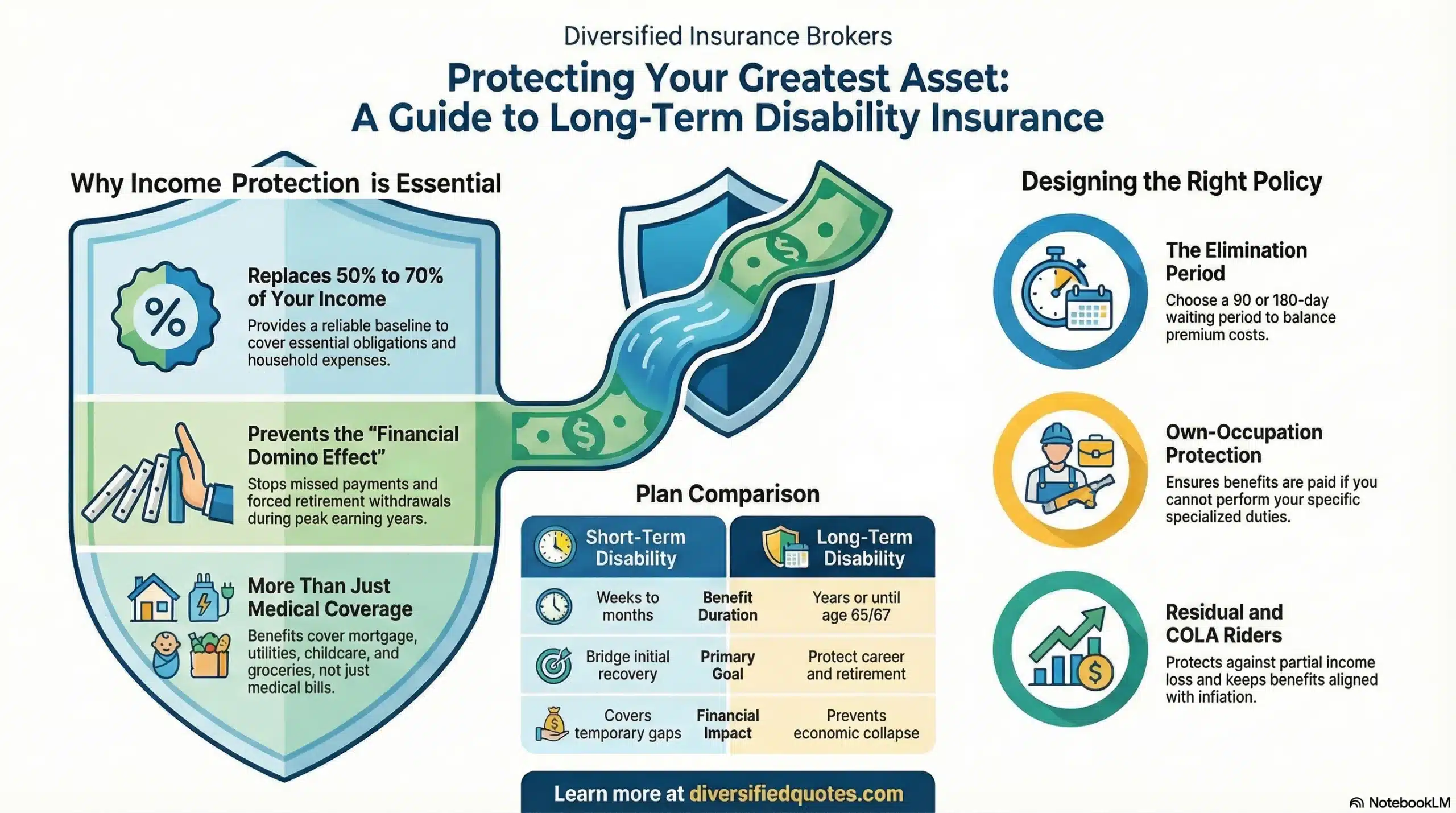
The future increase option is particularly valuable for early-career cartographers and GIS professionals whose income will grow substantially over a technical career trajectory from entry-level analyst to senior specialist to project lead. The FIO preserves the right to expand coverage to reflect that growing income without new medical underwriting — regardless of any health events that occur during the career. The benefit period to age 65 — long-term disability insurance at the full career standard — protects the full specialization investment of a technical mapping and GIS career. The elimination period for employed cartographers with adequate sick leave can comfortably be 90 days; consulting cartographers without employer sick time should evaluate shorter periods. The residual disability rider captures partial income loss when a disability reduces analytical capacity or working hours without fully preventing all work. The full rider framework is at disability insurance riders explained. Tax treatment is at are disability insurance payments taxable. Benefit sizing is at how much disability insurance do I need. No-exam options at lower benefit levels are at no-exam disability insurance. For consulting GIS professionals, the self-employed context is at disability insurance for self-employed and consulting practice coverage at disability insurance for consultants. Early-career strategy is at disability insurance for new professionals. For an independent review of any existing or proposed coverage, get a 2nd opinion on your disability insurance quote covers the full process.
Talk With an Advisor Today
Choose how you’d like to connect—call or message us, then book a time that works for you.
Schedule here:
calendly.com/jason-dibcompanies/diversified-quotes
Licensed in all 50 states • Fiduciary, family-owned since 1980
FAQs: Disability Insurance for Cartographers
What are the primary disability risks for cartographers and GIS professionals?
The primary disability risks for cartographers are cognitive and analytical in nature — conditions that impair the spatial reasoning, precision data analysis, and GIS platform expertise that define professional cartographic work. Stroke and TBI with spatial processing or visual field deficits, serious depression and anxiety impairing concentration required for precision technical work, and progressive neurological conditions affecting visual processing or cognitive function are the most likely career-interrupting disability events. Repetitive strain from sustained keyboard and mouse work — carpal tunnel and related conditions — represents a secondary physical disability risk for computer-intensive cartographic work. Field cartographers and photogrammetrists who do aerial or terrestrial survey work have additional physical exposure from the field component.
What occupational class do cartographers typically receive for disability insurance?
Cartographers and GIS professionals typically receive middle-to-high occupational classes reflecting the primarily desk-based, computer-intensive, non-hazardous nature of professional cartographic work. The classification is comparable to other technical analytical professions in the architecture, engineering, and physical sciences occupational families. This favorable classification produces competitive premium rates and access to strong own-occupation definitions and full benefit period options. The specific class may vary between entirely office-based GIS analysis work and hybrid roles with field survey or photogrammetry components.
Does federal employment provide adequate disability protection for government cartographers?
Federal employment provides genuine value through FERS retirement, OWCP for work-related injuries, and Federal Employees Group Life Insurance. But federal provisions have gaps that individual coverage addresses. FERS disability retirement has service and eligibility requirements and produces benefit amounts that may fall below career income levels. OWCP covers only work-related conditions, leaving illness-based disability outside federal workers’ comp protection. Early-career federal cartographers with limited FERS accumulation have the least protection from federal provisions alone. Individual disability insurance fills these gaps with own-occupation coverage that doesn’t depend on service-connection requirements or retirement system eligibility.
Why is the future increase option important for early-career cartographers?
Early-career GIS analysts and cartographers entering the field typically start at incomes that will grow substantially over a technical career trajectory — from entry-level analyst to senior specialist to project manager or principal GIS professional. The FIO preserves the contractual right to expand coverage to reflect that growing income without new medical underwriting, regardless of any health events that occur during the career. A health condition developing five years into the career could prevent expanding coverage without the FIO in place. Purchasing the maximum available FIO at the initial issue date secures future protection for the career income that hasn’t been earned yet.
How do independent GIS and cartography consultants document income for disability insurance?
Independent GIS and cartography consultants document income through Schedule C tax returns and 1099 forms reflecting active consulting earnings, averaged across two to three years to establish a consistent income baseline. Project-based and contract income naturally fluctuates across years depending on contract volume; multi-year averaging smooths this variability for benefit-sizing purposes. Net Schedule C income after legitimate business expenses is the figure carriers use. Senior consultants with established government agency relationships and consistent contract pipelines often have more documentable income stability than entry-level consulting would suggest.
About the Author:
Jason Stolz, CLTC, CRPC, DIA, CAA and Chief Underwriter at Diversified Insurance Brokers (NPN 20471358), is a senior insurance and retirement professional with more than 25 years of real-world experience helping individuals, families, and business owners protect their income, assets, and long-term financial stability. As a long-time partner of the nationally licensed independent agency Diversified Insurance Brokers, Jason provides trusted guidance across multiple specialties—including fixed and indexed annuities, long-term care planning, personal and business disability insurance, life insurance solutions, Group Health, Travel Medical and Evacuation Insurance, and short-term health coverage. Diversified Insurance Brokers maintains active contracts with over 100 highly rated insurance carriers, ensuring clients have access to a broad and competitive marketplace.
His practical, education-first approach has earned recognition in publications such as VoyageATL, and contributions from his agency featured in Kiplinger and GoBankingRates— highlighting his commitment to financial clarity and client-focused planning. Drawing on deep product knowledge and years of hands-on field experience, Jason helps clients evaluate carriers, compare strategies, and build retirement and protection plans that are both secure and cost-efficient. Visitors who want to explore current annuity rates and compare options across multiple insurers can also use this annuity quote and comparison tool.
Explore More Disability Insurance Options: Browse our complete guide to Disability Insurance for Technology, Science & Education — covering software developers, engineers, scientists, teachers, architects & researchers from 100+ carriers.
Last Reviewed: June 6, 2026 |
Reviewed by: Jason Stolz, CLTC, CRPC, DIA, CAA
Chief Underwriter, Diversified Insurance Brokers, Inc. | NPN: 20471358 | Diversified Insurance Brokers, Inc. — Licensed in all 50 states
Fact Checked by: Tonia Pettitt, CMIP©
Medicare Specialist, Diversified Insurance Brokers, Inc. | NPN: 14374308 | Diversified Insurance Brokers, Inc. — Licensed in all 50 states
Did you find this content helpful? Leave us a Google review — it helps others find trustworthy guidance too.
Editorial Standards: Diversified Insurance Brokers maintains rigorous editorial standards to ensure accuracy, clarity, and independence in all content. Learn more about our editorial standards and commitment to transparency.
