
Disability Insurance for Astronomers
As an Independent Disability Insurance Broker, we have access to exclusive discounts and negotiated pricing most captive agents can’t offer — see the full breakdown near the end of this page.
Disability Insurance for Astronomers

Jason Stolz CLTC, CRPC, DIA, CAA
Disability insurance for astronomers is financial protection for a career built entirely on cognitive capability, analytical precision, and long-term intellectual output. Astronomers process enormous datasets, construct and test theoretical models, operate complex instrumentation, produce peer-reviewed research, and compete for grant funding — all of which require sustained mental clarity at a professional level. Unlike professions where physical capability is the primary income driver, astronomy has essentially no “reduced duty” version of the work that maintains the same career trajectory. An astronomer who cannot perform high-level data analysis, cannot write grant proposals and research papers, or cannot maintain the research output that drives funding and academic advancement is experiencing a career-interrupting disability regardless of how physically capable they appear. The disability insurance services available to scientific and research professionals address this cognitive income risk, and the income protection insurance framework covers how individual policies are structured for knowledge workers whose professional value is inseparable from intellectual performance.
The disability risk profile for astronomers and research scientists is shaped not just by the cognitive demands of the work but by the structural features of academic and research careers that make disability more financially destabilizing than in other professions. Research demonstrates that approximately 36-47% of PhD candidates and early-career researchers experience anxiety or depression at clinically significant levels — well above general population rates. The “publish or perish” culture, highly competitive grant funding environments, precarious multi-year postdoctoral positions, and the psychological weight of extended solo research in remote or isolated environments all create conditions where mental health conditions develop at rates that should concern any astronomer thinking seriously about income protection. At Diversified Insurance Brokers, we help astronomers and research scientists design disability coverage that reflects both the cognitive disability risk that dominates this field and the income structures of academic and grant-funded careers. The disability insurance by occupation framework covers how occupational class is determined for scientific and research professionals.
Compare Disability Insurance for Astronomers
We compare options across 100+ carriers and structure coverage around the research career, grant income, and cognitive demands of scientific professionals.
Request Disability Insurance OptionsDisability Insurance for Astronomers — Occupational Profile, Disability Risks, and Key Coverage Decisions
| Coverage Dimension | The Astronomer Reality | What the Right Design Looks Like |
|---|---|---|
| Occupational class | Astronomers typically qualify for the highest available occupational classes — reflecting the advanced degree requirements, primarily cognitive and analytical nature of the work, and absence of physical hazards; PhD-level research scientists are evaluated similarly to software engineers and other high-education, low-physical-risk professionals | The top occupational class produces access to the strongest own-occupation definitions, to-age-65 benefit periods, and the full rider menu at competitive premium rates; accurately describing the primarily cognitive and research-analytical nature of the work — not any fieldwork or observatory travel components — supports the most favorable classification |
| Mental health and burnout — the primary disability risk | Research across multiple studies consistently finds 36-47% of PhD candidates and early-career researchers experiencing anxiety or depression at clinically significant levels; the “publish or perish” culture, grant competition, career precarity in postdoctoral and early faculty years, and extended isolated work create mental health risk substantially above general population rates | Individual policy with unlimited mental/nervous benefit period matching the physical disability benefit period — not the 24-month cap that most employer group plans impose; own-occupation language covering cognitive impairment from any cause, including mental health conditions, that prevents the research and analytical performance the career requires |
| Grant funding and income structure | Many astronomers depend wholly or partly on competitive grant funding from NSF, NASA, DoE, or private foundations; grant funding can be interrupted by a disability that prevents submitting renewals, maintaining active research output, or meeting performance milestones; postdoctoral positions are term-limited, meaning disability during a postdoc can prevent securing the next position | Benefit sized to documented active earned income (salary plus grant salary components) averaged across available tax years; income documentation for grant-funded researchers requires navigating the distinction between institutional salary and grant-supported salary; coverage that begins protecting income even when grant funding itself is the income that stops |
| Disability definition and the “other work” denial risk | An astronomer who cannot perform high-level data analysis, theoretical modeling, grant writing, or peer-reviewed research output due to cognitive impairment may still be capable of teaching lower-division courses, administrative work, or non-research academic functions; any-occupation language would deny benefits because alternative academic employment exists | Own-occupation coverage tied to the research and analytical functions of the specific scientific practice — not just “academic employment broadly”; an astronomer disabled from research is not adequately protected by coverage that pays only when they cannot perform any academic role at all |
| Observational work and irregular schedules | Observational astronomers conduct telescope runs at ground-based facilities (Hawaii, Chile, Arizona) or through space telescope allocation that require extended night work, disrupted sleep schedules, remote location travel, and sustained alertness during observation windows; cumulative sleep disruption over a career creates health risk distinct from purely desk-based scientific work | Coverage for disability from any cause — including conditions that develop gradually from cumulative occupational factors like sleep disruption; physical risks from observatory travel and remote location work are also covered; the environmental dimension of observational astronomy does not move the occupational class lower but does represent a genuine physical risk layer alongside the primary cognitive exposure |
| Vision and ergonomic risks | Extensive screen-based data analysis, telescope eyepiece use, and computer programming for data reduction creates cumulative strain on vision and upper extremity musculoskeletal systems; carpal tunnel, back, and neck conditions from prolonged sedentary computer work are occupational risks that can reduce research output quality and quantity before completely stopping work | Residual disability rider capturing partial income loss when output capacity is reduced but not eliminated; coverage for any physical disability cause that impairs research performance; applying before conditions develop prevents pre-existing exclusions on the physical risk categories most likely to affect long-career astronomers |
What Astronomers Do and Why Cognitive Performance Drives Income
Astronomers study celestial objects and phenomena through observation, theoretical modeling, computational simulation, and data analysis. Their careers center on producing original scientific knowledge — designing observational campaigns, analyzing spectroscopic and photometric data, developing and testing theoretical models of astrophysical systems, writing grant proposals that fund continued research, and publishing results that advance the field. Most work in academia at research universities or colleges, in government research institutions (NASA centers, national observatories, NOAA), or increasingly in private sector roles at space industry companies. Some combine these paths. The common thread is that income — whether from institutional salary, grant-funded research appointments, or private sector compensation — is directly tied to the ability to maintain intellectual performance at the professional level that generated that income. This parallel to other precision analytical professions is direct: actuaries whose statistical modeling requires the same uncompromised analytical accuracy, economists whose quantitative research output drives academic and policy career advancement, and computer engineers and scientists whose specialized technical capabilities are the direct source of income value all face the same fundamental risk. The disability insurance for white-collar professionals context covers how this cognitive income dependency translates across knowledge-worker professions broadly.
The Mental Health Risk Profile of Scientific Careers
The mental health risk in research and academic careers is a documented and clinically significant concern for working astronomers. Multiple studies across PhD candidate populations find that 36-47% experience clinically significant anxiety or depression — rates substantially above general population baselines. The structural pressures of academic science careers contribute directly: intense competition for a limited number of tenure-track faculty positions, repeated multi-year grant cycles where rejection is far more common than success, the psychological weight of extended focused work on problems that may not yield results for years, and the career instability of postdoctoral positions that extend for 3-6 years or more before permanent positions materialize. These conditions create a professional environment where serious mental health conditions are not an edge case — they are a documented occupational risk at a population level. For disability insurance purposes, this means the mental and nervous condition benefit period is one of the most consequential policy features for astronomers. The 24-month cap that most employer group LTD plans impose is inadequate for serious depressive or anxiety conditions requiring extended treatment and recovery. Individual policies with unlimited mental/nervous benefit periods — matching the physical disability coverage period — provide the sustained protection that the documented mental health risk profile of research careers requires. Science field neighbors facing identical risk profiles are covered at disability insurance for biologists, disability insurance for chemists, and disability insurance for geologists, where the same academic career structure creates the same mental health exposure. Disability insurance for college professors covers the academic employment and tenure-track career structure that is the primary employment context for most astronomers.
Grant Funding, Income Variability, and the Research Career Disability Cascade
The financial consequences of disability for a grant-funded researcher extend well beyond the immediate income interruption. An astronomer who is disabled during an active grant period cannot maintain the research output required to justify continued funding — creating a funding loss event that compounds the income interruption. Grant renewal submissions require research output, institutional support, and active professional engagement; a disability that prevents these activities disrupts not just current income but future income potential. Postdoctoral positions are term-limited, meaning a disability during a postdoc does not simply pause the career — it may prevent completing the position, precluding the competitive hiring process for the next position entirely. Early tenure-track years are similarly high-stakes: missed research output during the pre-tenure period can prevent tenure regardless of the underlying health reason, creating a career discontinuity that salary replacement alone does not address. The grant funding dimension parallels the income documentation challenge for other research professionals: disability insurance for agronomists covers research scientists whose grant-supported fieldwork income requires similar income documentation navigation, and the disability insurance for engineers covering research-oriented technical professionals in analogous academic and government career paths shares the same income structure considerations.
Policy Design for Astronomers and Research Scientists
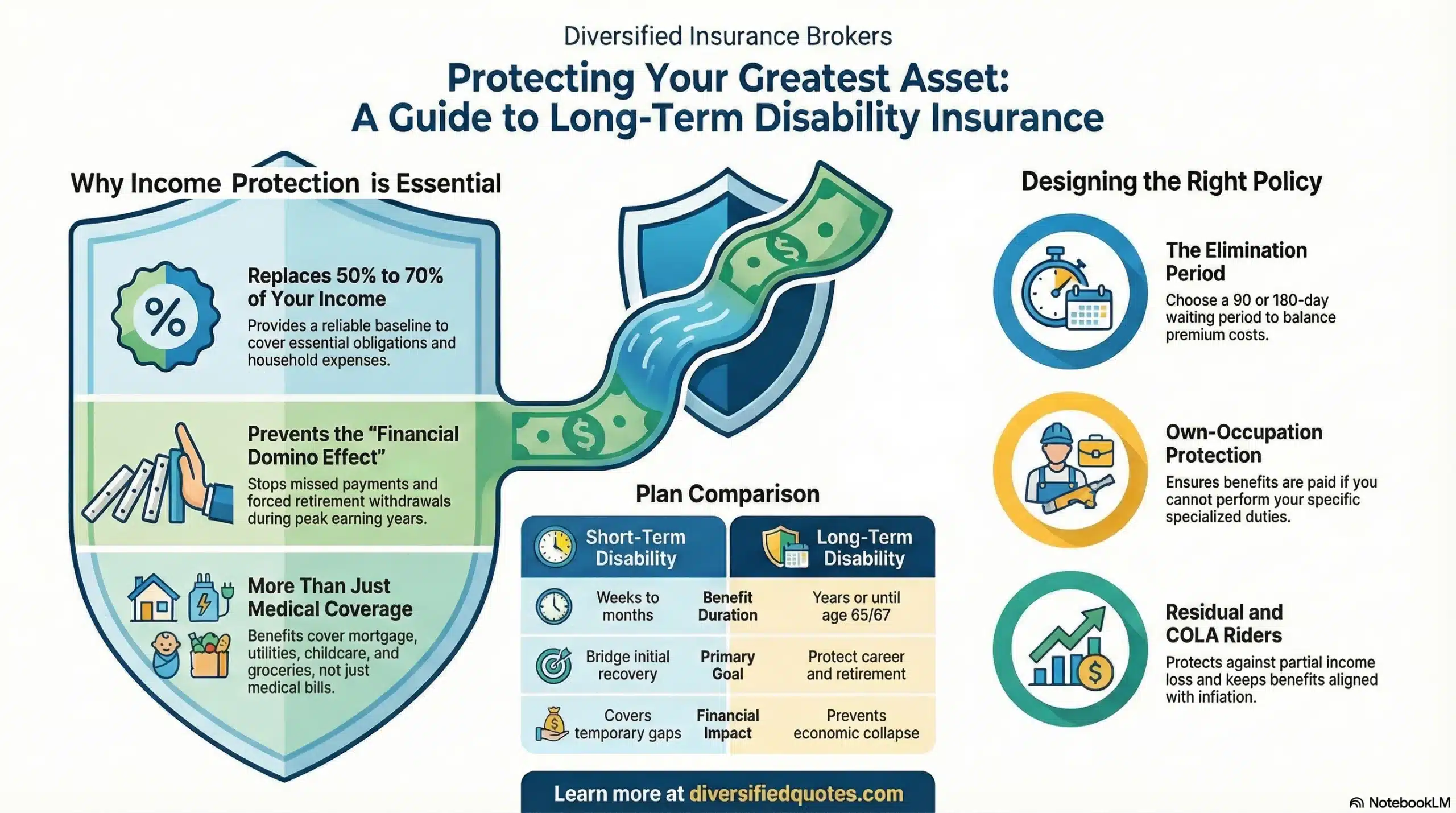
The benefit period for an astronomer’s disability policy should extend to retirement age — long-term disability insurance to age 65 protects against career-ending conditions during decades of research output and grant accumulation. The elimination period should be calibrated against available institutional sick leave (universities typically provide meaningful sick leave for salaried faculty) and personal savings; most full-time faculty can absorb a 90-day EP, while postdoctoral researchers with shorter appointment terms and limited sick leave accruals may benefit from 30-60 day periods. The future increase option is particularly important for early-career astronomers whose income will grow as they progress through postdoctoral, assistant professor, associate professor, and full professor stages — locking in coverage early preserves the right to expand protection as income grows without new medical underwriting. The residual disability rider captures the partial income loss that may occur when cognitive capacity is reduced but not eliminated — the phase during which research output quality and grant success rates decline before a full disability threshold is met. Own-occupation disability coverage ensures that the analytical and research functions of astronomy practice define what disability means, not whether some form of academic employment is theoretically possible. The full rider framework is at disability insurance riders explained. Tax treatment of individually owned policy benefits is at are disability insurance payments taxable. Benefit sizing for research scientists with mixed salary and grant income is at how much disability insurance do I need. For an independent evaluation of any existing or proposed policy, get a 2nd opinion on your disability insurance quote covers the review process. For astronomers and scientists in consulting or contract roles outside traditional employment, disability insurance for self-employed scientists and disability insurance for consultants cover the income documentation considerations for non-salaried research income streams.
Talk With an Advisor Today
Choose how you’d like to connect—call or message us, then book a time that works for you.
Schedule here:
calendly.com/jason-dibcompanies/diversified-quotes
Licensed in all 50 states • Fiduciary, family-owned since 1980
FAQs: Disability Insurance for Astronomers
What occupational class do astronomers typically qualify for?
Astronomers and research scientists typically qualify for the highest available occupational classes across most major disability carriers — reflecting the advanced degree requirements, primarily cognitive and analytical nature of the work, and absence of significant physical hazards. This top-tier classification produces access to the strongest own-occupation definitions, to-age-65 benefit periods, and the full rider menu at competitive premium rates. The favorable occupational class is a genuine advantage of the profession from an insurance standpoint — coverage quality is high and pricing is competitive relative to many other fields.
Is mental health coverage particularly important for astronomers and research scientists?
Yes — research across PhD candidate and early-career researcher populations consistently finds 36-47% experiencing clinically significant anxiety or depression, well above general population rates. The structural pressures of academic science — competitive grant funding, “publish or perish” culture, career precarity in postdoctoral years, and extended focused solo work — create conditions where serious mental health conditions are a documented occupational risk. The 24-month mental/nervous benefit cap in most employer group LTD plans is inadequate for this risk profile. Individual policies with unlimited mental/nervous benefit periods matching the physical disability coverage are particularly important for scientists and researchers.
How does grant funding affect disability insurance for researchers?
Grant funding creates income documentation complexity and a cascading disability risk that salary replacement alone does not fully address. Disability benefits are based on documented active earned income — including grant-supported salary components — averaged across available tax years. When disability prevents completing a funded project or submitting grant renewals, it disrupts not just current income but the future funding pipeline. Individual disability insurance provides income replacement during the disability period; the ongoing grant management and renewal functions that would normally continue cannot be protected by insurance, which is why early career coverage that preserves the financial base for recovery is especially valuable for grant-dependent researchers.
Does the observational astronomy fieldwork — telescope runs, observatory travel — affect my occupational class?
For most observational astronomers, the fieldwork and observatory travel components do not move the occupational class lower because the frequency, nature, and hazard level of that work are minimal relative to a primarily research-analytical career. The classification reflects the dominant occupational profile. The observatory travel and irregular sleep schedule do represent a genuine physical and health risk that disability insurance covers — conditions developing from cumulative sleep disruption, travel stress, or physical work at observatory sites are equally covered by a comprehensive disability policy. Describing the primary duties accurately — research, data analysis, publication, grant work — while noting observational components as secondary activities typically supports the most favorable classification.
When is the best time for an early-career astronomer to purchase disability insurance?
As early as possible — ideally during the postdoctoral years or at the start of a first faculty appointment, before any health conditions develop that could create coverage exclusions. The mental health risk that is elevated in PhD and early postdoctoral years means waiting creates genuine risk that a condition will emerge and limit coverage options. Premiums are lowest at younger ages and lock in at the issue rate. A future increase option rider purchased early preserves the right to expand coverage as income grows through the career progression without new medical underwriting — essential for a profession where income may triple between a postdoc salary and full professor compensation. Early coverage with a FIO is almost always preferable to waiting, even if the initial benefit amount reflects early-career income.
About the Author:
Jason Stolz, CLTC, CRPC, DIA, CAA and Chief Underwriter at Diversified Insurance Brokers (NPN 20471358), is a senior insurance and retirement professional with more than 25 years of real-world experience helping individuals, families, and business owners protect their income, assets, and long-term financial stability. As a long-time partner of the nationally licensed independent agency Diversified Insurance Brokers, Jason provides trusted guidance across multiple specialties—including fixed and indexed annuities, long-term care planning, personal and business disability insurance, life insurance solutions, Group Health, Travel Medical and Evacuation Insurance, and short-term health coverage. Diversified Insurance Brokers maintains active contracts with over 100 highly rated insurance carriers, ensuring clients have access to a broad and competitive marketplace.
His practical, education-first approach has earned recognition in publications such as VoyageATL, and contributions from his agency featured in Kiplinger and GoBankingRates— highlighting his commitment to financial clarity and client-focused planning. Drawing on deep product knowledge and years of hands-on field experience, Jason helps clients evaluate carriers, compare strategies, and build retirement and protection plans that are both secure and cost-efficient. Visitors who want to explore current annuity rates and compare options across multiple insurers can also use this annuity quote and comparison tool.
Explore More Disability Insurance Options: Browse our complete guide to Disability Insurance for Technology, Science & Education — covering software developers, engineers, scientists, teachers, architects & researchers from 100+ carriers.
Last Reviewed: June 6, 2026 |
Reviewed by: Jason Stolz, CLTC, CRPC, DIA, CAA
Chief Underwriter, Diversified Insurance Brokers, Inc. | NPN: 20471358 | Diversified Insurance Brokers, Inc. — Licensed in all 50 states
Fact Checked by: Tonia Pettitt, CMIP©
Medicare Specialist, Diversified Insurance Brokers, Inc. | NPN: 14374308 | Diversified Insurance Brokers, Inc. — Licensed in all 50 states
Did you find this content helpful? Leave us a Google review — it helps others find trustworthy guidance too.
Editorial Standards: Diversified Insurance Brokers maintains rigorous editorial standards to ensure accuracy, clarity, and independence in all content. Learn more about our editorial standards and commitment to transparency.
