
Disability Insurance for Actors and Actresses
As an Independent Disability Insurance Broker, we have access to exclusive discounts and negotiated pricing most captive agents can’t offer — see the full breakdown near the end of this page.
Disability Insurance for Actors and Actresses

Jason Stolz CLTC, CRPC
Acting is one of the few careers where the product and the person are the same thing. The voice that delivers the line, the face that the camera captures, the physical presence that fills the stage — these are not tools the actor uses, they are the actor. When any of those capabilities is impaired by illness or injury, the ability to book and fulfill work is impaired directly, without any modified-duty alternative that preserves income. That immediacy of connection between physical and vocal function and earning capacity is what makes disability insurance planning so consequential for professional performers — and also what creates the income documentation and policy design challenges that distinguish acting from most other occupations. The disability insurance services available to entertainment professionals address the specific income protection challenges actors face, and the income protection insurance framework covers how policies are structured for professionals whose earnings come from project-based contract work rather than a consistent salary.
One of the most important things actors should understand about disability coverage is what their union provides — and what it does not. SAG-AFTRA’s Health Plan provides health insurance coverage that actors must qualify for by earning minimum covered earnings thresholds in a qualifying period. The SAG-AFTRA Plans also provide pension contributions. What they do not provide is disability income replacement — a monthly benefit that replaces earned income when an actor cannot work due to illness or injury. There is no SAG-AFTRA equivalent of a long-term disability policy. That income protection must come from an individually purchased policy, and it must be built around the realities of how acting income is earned: inconsistently, across multiple project types, primarily on 1099 or Schedule C, and in amounts that vary dramatically from year to year. At Diversified Insurance Brokers, we help working actors structure disability coverage that reflects both the income a well-documented acting career produces and the income disruption that a disability would create.
Compare Disability Insurance for Actors & Actresses
We compare options across 100+ carriers and structure coverage around the project-based income, variable earnings, and performance demands of acting careers.
Request Disability Insurance OptionsDisability Insurance for Actors and Actresses — Occupational Profile, Income Documentation, and Coverage Design
| Coverage Dimension | The Acting Career Reality | What the Right Coverage Design Looks Like |
|---|---|---|
| Occupational class and carrier selection | Disability insurance carriers evaluate income stability heavily for acting occupations; some carriers are uncomfortable with the income variability of performance careers and either decline or assign less favorable occupational classes; not every carrier treats acting careers the same way, making carrier comparison essential rather than optional | Working with an independent broker who can identify which carriers have the most favorable underwriting guidelines for established acting professionals — not all carriers apply the same classification or definitions to entertainment occupations, and the difference can be significant in both premium and available policy features |
| Income documentation | Acting income is project-based, flows through multiple income streams (film, television, commercials, voiceover, theater, video games, brand deals), and may vary dramatically year to year; carriers require verified documentation of consistent earned income to support any disability benefit amount | Two to three years of tax returns establishing an average annual acting income; benefit amounts sized to documented average earnings rather than best-year income; actors with consistently documented income across multiple years are in the strongest position to qualify for meaningful benefit amounts at favorable terms |
| Definition of disability | An actor who cannot perform due to injury or illness can theoretically work in retail, food service, or other fields; under any-occupation language, that remaining work capability provides grounds for denying benefits even when the acting career is genuinely disrupted | Own-occupation or modified own-occupation coverage that ties benefits to the ability to perform the duties of an acting career — on-screen presence, physical performance, vocal delivery, audition and booking availability — rather than general work capability; the definition must reflect the performance-specific nature of the income being replaced |
| SAG-AFTRA coverage gap | SAG-AFTRA Plans provide health insurance (requiring minimum covered earnings thresholds) and pension contributions — but do NOT provide disability income replacement; there is no SAG-AFTRA benefit that replaces monthly acting income when an actor cannot work due to illness or injury | Individual disability income policy secured separately from union benefits; not a supplement to an existing union LTD plan — it is the entire income protection plan, making benefit amount sizing and definition quality especially important without a baseline group plan to build on |
| Project-based income and residuals | Acting income does not track with employment status the way salary does — residuals and royalties from past projects may continue during a disability even when no new work is being booked; this income is typically not considered earned income for disability benefit calculation purposes and does not reduce disability benefits in most individual policies | Individual policy benefits are generally not offset by residual income — the monthly benefit pays regardless of passive income from past work; benefit amount should be sized to active earned income replacement needs (living expenses, new income generation) rather than to total income including passive residuals |
| Multiple performance modalities | Many working actors generate income across film, television, commercials, voiceover, video games, theater, and brand work simultaneously; a disability affecting one modality (vocal cord condition preventing voiceover) may not affect others (physical acting), creating partial income disruption rather than total disability | Residual disability coverage that pays proportional benefits when income drops from a qualifying condition affecting some but not all performance modalities; for actors with diversified performance income streams, residual coverage may be the feature that captures the most realistic disability scenarios |
What Can Disable an Acting Career
The conditions that genuinely disrupt acting careers span a wider range than most performers consider when they first think about disability risk. Physical injury is the most visible category — a fall on set, a stage combat sequence that goes wrong, or an injury during filming of an action sequence can produce the kind of acute damage that makes returning to work medically impossible for months. Actors doing physical roles, stage productions, or any work involving choreographed movement or stunt coordination face this risk directly with every production. But the disability profile extends well beyond physical injury. Vocal conditions — nodules, polyps, hemorrhage, or chronic vocal fatigue leading to structural changes — are among the most career-limiting conditions for speaking and singing performers because the voice is the instrument that cannot be replaced or compensated for the way a limb injury sometimes can. A voice actor whose vocal quality is permanently changed by a cord condition, or a stage actor who develops vocal nodules requiring surgical intervention and extended rest, faces a genuine career disruption that medical treatment alone cannot always reverse. Mental health conditions — depression, anxiety, PTSD, and the psychological toll of career instability, rejection, and the performance pressure of high-stakes auditions and productions — account for a significant share of disability claims across all creative and performance professions. The broader entertainment industry disability framework covers how coverage works across all performance and creative roles, and the context of how physical performance careers are protected is illustrated across musicians, dancers, and professional athletes — professions sharing the same fundamental problem of performance-dependent income.
The Own-Occupation Definition and Why It Matters Specifically for Performers
For most actors, the disability definition is the most consequential policy feature — and the one most worth scrutinizing before purchasing. An actor with a serious voice condition, a physical injury that prevents on-screen work, or a mental health condition affecting booking reliability and performance consistency is genuinely disabled within their career — but is almost certainly physically capable of work in other fields. Under any-occupation language, that theoretical alternative work capability is sufficient grounds for claim denial. Under own-occupation disability insurance, the policy evaluates whether you can perform the specific duties of acting — auditioning, performing, sustaining the availability and physical and vocal function that booking and fulfilling roles requires — not whether you could work at a job entirely outside your profession. The practical difference, across a multi-year disability, is the entire value of the coverage. This definitional challenge is not unique to acting: radio and television industry professionals whose on-air presence defines their career value, film and print editors whose technical craft produces income through focused cognitive and manual work, and authors and writers whose creative output drives their earnings all face the same definition quality issue. The disability insurance by occupation resource covers how occupational class and definition availability vary across entertainment and creative professions.
Income Documentation — The Core Qualification Challenge for Actors
The largest practical barrier to disability coverage for most actors is income documentation. Disability insurance carriers require verified income to support benefit amounts — and they evaluate income stability, not just peak earnings. An actor who earns $150,000 in one year followed by $20,000 the next presents a very different underwriting picture than a salaried professional with consistent documentation. The carriers that work best with acting professionals are those with underwriting guidelines that allow for income averaging across two to three years of tax returns, accommodating the natural variability of project-based earnings without penalizing an actor for the gap years that are structurally part of the profession. Actors who are consistently working and consistently documenting income through film, television, and commercial work across multiple tax years are in the strongest position. Disability insurance for 1099 workers covers the income documentation process for contract-based workers, and disability insurance for independent contractors covers how benefit amounts are sized and supported when income comes from multiple project sources without a single employer W-2. The self-employed context and Schedule C documentation process are covered at disability insurance for self-employed. The framework for sizing the right benefit level given variable income is at how much disability insurance do I need.
Residual Benefits and the Partial Income Disruption Pattern
The most common realistic disability scenario for a working actor is not total inability to perform in every modality simultaneously — it is partial disruption of one income stream while others remain possible. A vocal cord condition that prevents voiceover and singing work may leave film and commercial work intact. A knee injury from stage work may sideline a physically demanding role while allowing seated or sedentary performing. A mental health condition may prevent the sustained high-volume booking and availability of peak production periods while allowing reduced engagement. In each of these scenarios, income drops meaningfully without meeting a total disability threshold — and without residual disability coverage, a policy designed around total disability provides no benefit payment during those periods. Residual coverage pays proportional benefits when income drops 20-25%+ from a qualifying condition, capturing the partial income loss that is often more financially consequential in total than a shorter complete stoppage would be.
Policy Design, Underwriting, and Working With the Right Broker
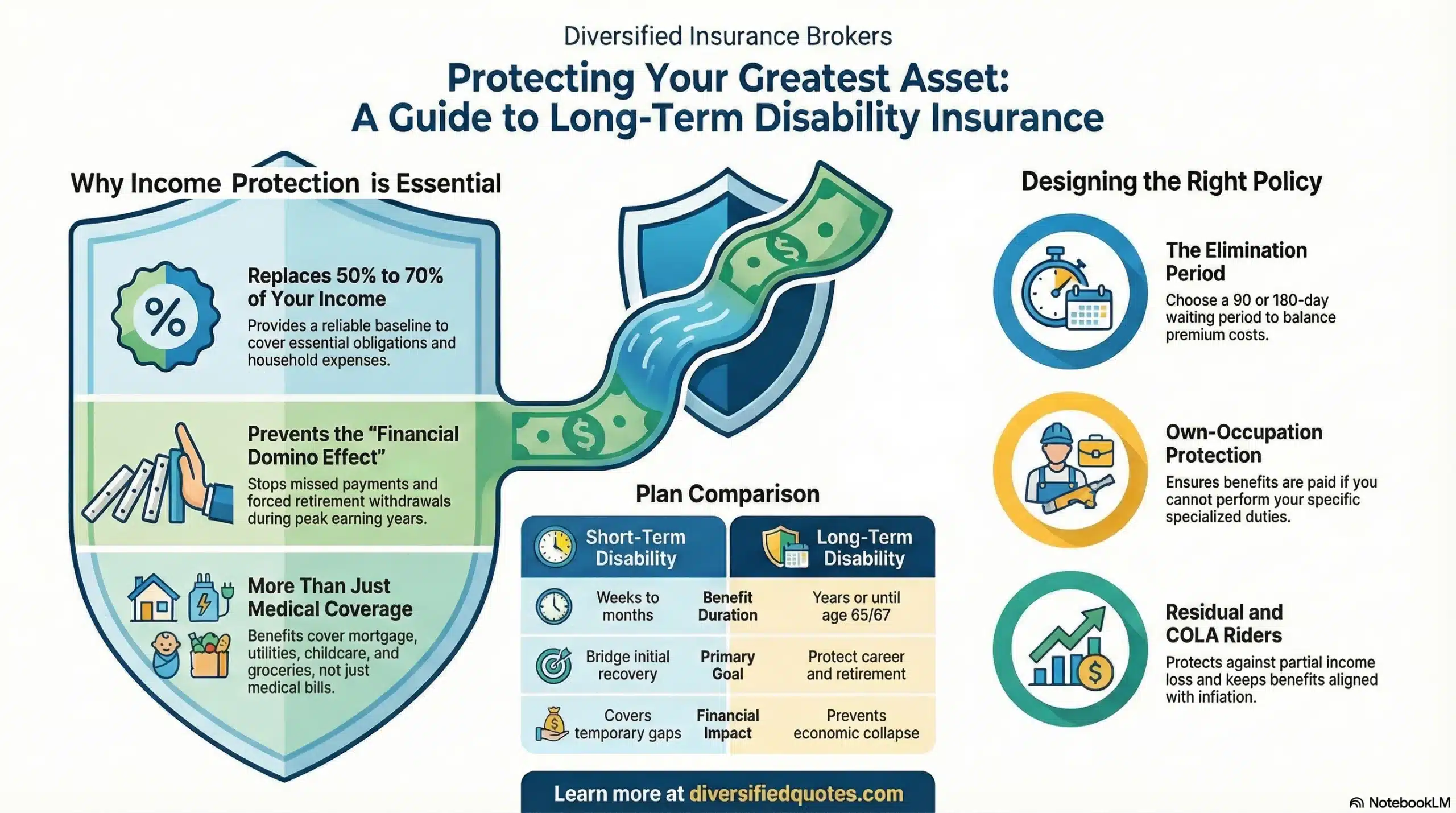
The structure of a disability policy for an actor should reflect both the reality of project-based income and the long career horizon being protected. A to-age-65 benefit period provides the strongest protection against career-ending conditions, and the elimination period should reflect available savings that can bridge the initial gap without project income. The rider framework — including the cost-of-living protection from a COLA rider — adds long-term value for actors who secure coverage early in their careers. Benefits from individually owned policies with after-tax premiums are generally received income-tax-free, covered at are disability insurance payments taxable. The question of what underwriting requires — including whether a medical exam is needed — is covered at does disability insurance require a medical exam, and no-exam disability insurance covers simplified underwriting options for qualified applicants. Because carrier selection matters significantly for entertainment professionals — with meaningfully different underwriting appetite and occupational class assignments across the market — working with an independent disability insurance broker is particularly important in this field. For actors who have received existing quotes or want an evaluation of current coverage before committing, get a 2nd opinion on your disability insurance quote covers the review process.
Talk With an Advisor Today
Choose how you’d like to connect—call or message us, then book a time that works for you.
Schedule here:
calendly.com/jason-dibcompanies/diversified-quotes
Licensed in all 50 states • Fiduciary, family-owned since 1980
FAQs: Disability Insurance for Actors and Actresses
Does SAG-AFTRA provide disability income insurance for actors?
No. SAG-AFTRA Plans provide health insurance coverage (available to members who meet covered earnings thresholds in a qualifying period) and pension contributions — but not disability income replacement. There is no SAG-AFTRA benefit that replaces monthly acting income when a member cannot work due to illness or injury. Individual disability insurance must be purchased independently, and it represents the entire income protection plan rather than a supplement to an existing union LTD benefit. This gap is one of the most common financial oversights for SAG-AFTRA members who assume their union membership includes disability income coverage.
Can actors actually get disability insurance given the income variability of acting careers?
Yes — but income documentation is the determining factor. Disability insurance carriers require verified income to support benefit amounts and evaluate income stability as well as level. Actors with consistently documented acting income across two to three years of tax returns are in the best position to qualify for meaningful benefit amounts. Actors with dramatic year-to-year income swings — or whose acting income is only a small portion of total income from other sources — will have a more limited benefit amount to insure. Not every carrier is equally willing to work with entertainment professionals; some have more favorable underwriting guidelines for established performers than others, which is why independent broker access matters in this field.
What types of disabilities most commonly affect acting careers?
Physical injuries from on-set accidents, stage performance, or action sequences are the most visible category. Vocal conditions — nodules, polyps, hemorrhage, or chronic fatigue leading to structural vocal changes — are among the most career-limiting for speaking and singing performers because the voice cannot be substituted or compensated for the way some physical limitations can be accommodated. Mental health conditions including depression, anxiety, and the psychological effects of career instability and high-pressure performance demands account for a significant share of claims across creative professions. Neurological conditions affecting memory, focus, and performance consistency can also impair booking reliability — a function that is as central to acting income as talent itself.
Do residuals count as income that affects disability benefit payments?
Generally no — in most individual disability policies, passive income from residuals and royalties does not offset or reduce disability benefits, because disability benefits are designed to replace active earned income, not passive income from past work. Residuals continue regardless of whether the actor is working, so they are not considered “income from work” that would trigger benefit offset provisions. This is an important distinction for working actors who have built up a meaningful residual income stream: disability benefits would pay in addition to residual income, providing more complete income replacement during a disability period. Confirm this with the specific policy language, as plan terms vary.
What is the most important policy feature for actors seeking disability insurance?
The disability definition is the most consequential feature. Actors need coverage that ties benefits to the ability to perform their acting specialty — on-screen presence, vocal performance, physical performance, audition and booking availability — rather than to general work capability. Under any-occupation language, an actor who cannot perform but could work elsewhere might be denied benefits entirely. Under own-occupation or specialty-specific coverage, the inability to perform acting duties triggers benefits regardless of theoretical alternative employment. After the definition, carrier selection based on their underwriting appetite for entertainment professionals determines what terms are actually available — making independent broker comparison more important for actors than for most occupations.
About the Author:
Jason Stolz, CLTC, CRPC, DIA, CAA and Chief Underwriter at Diversified Insurance Brokers (NPN 20471358), is a senior insurance and retirement professional with more than 25 years of real-world experience helping individuals, families, and business owners protect their income, assets, and long-term financial stability. As a long-time partner of the nationally licensed independent agency Diversified Insurance Brokers, Jason provides trusted guidance across multiple specialties—including fixed and indexed annuities, long-term care planning, personal and business disability insurance, life insurance solutions, Group Health, Travel Medical and Evacuation Insurance, and short-term health coverage. Diversified Insurance Brokers maintains active contracts with over 100 highly rated insurance carriers, ensuring clients have access to a broad and competitive marketplace.
His practical, education-first approach has earned recognition in publications such as VoyageATL, and contributions from his agency featured in Kiplinger and GoBankingRates— highlighting his commitment to financial clarity and client-focused planning. Drawing on deep product knowledge and years of hands-on field experience, Jason helps clients evaluate carriers, compare strategies, and build retirement and protection plans that are both secure and cost-efficient. Visitors who want to explore current annuity rates and compare options across multiple insurers can also use this annuity quote and comparison tool.
Explore More Disability Insurance Options: Browse our complete guide to Disability Insurance for Food, Hospitality, Arts & Entertainment — covering chefs, musicians, actors, bartenders, hospitality workers & entertainment professionals from 100+ carriers.
Last Reviewed: October 9, 2026 |
Reviewed by: Jason Stolz, CLTC, CRPC, DIA, CAA
Chief Underwriter, Diversified Insurance Brokers, Inc. | NPN: 20471358 | Diversified Insurance Brokers, Inc. — Licensed in all 50 states
Fact Checked by: Tonia Pettitt, CMIP©
Medicare Specialist, Diversified Insurance Brokers, Inc. | NPN: 14374308 | Diversified Insurance Brokers, Inc. — Licensed in all 50 states
Did you find this content helpful? Leave us a Google review — it helps others find trustworthy guidance too.
Editorial Standards: Diversified Insurance Brokers maintains rigorous editorial standards to ensure accuracy, clarity, and independence in all content. Learn more about our editorial standards and commitment to transparency.
