
Disability Insurance for Actuaries
As an Independent Disability Insurance Broker, we have access to exclusive discounts and negotiated pricing most captive agents can’t offer — see the full breakdown near the end of this page.
Disability Insurance for Actuaries

Jason Stolz CLTC, CRPC, DIA, CAA
Actuaries are among the highest-compensated analytical professionals in the United States, and their income is almost entirely dependent on a single, narrow capability: the ability to perform precise, sustained quantitative reasoning at a professional level. Actuarial work — risk modeling, statistical analysis, financial forecasting, reserve calculations, pricing, catastrophe analysis — requires not just general intelligence but a specific form of cognitive precision that cannot be replicated at reduced capacity. A surgeon who develops a hand tremor cannot perform surgery but may be able to consult. An actuary who develops impaired working memory, reduced processing speed, or inability to sustain concentrated analytical focus for extended periods cannot perform actuarial work at all — not at reduced capacity, not part-time, and not through administrative compensation. This cognitive specificity is what makes disability insurance both unusually important and unusually nuanced for actuaries. Our resource on own occupation disability insurance covers the definition language that determines whether cognitive impairment of this type triggers a benefit, and our resource on disability insurance for white collar professionals covers the broader professional DI framework that applies across the white collar category. Unlike the daily physical risks that drive DI for tradespeople — covered in our separate resource on disability insurance for electricians — actuarial disability risk is dominated by conditions that are invisible, gradual, and specifically targeted at the exact cognitive function that drives actuarial career value.
The financial stakes of disability for an actuary are amplified by the credential investment and the income trajectory that credentials unlock. The path to fellowship — Fellow of the Society of Actuaries (FSA) or Fellow of the Casualty Actuarial Society (FCAS) — typically involves 7-10 years of passing rigorous professional examinations while working, with each credential milestone triggering meaningful salary increases. An actuary in the exam-passing years earns between $65,000 and $130,000 depending on exams passed and experience level. A credentialed Associate (ASA or ACAS) earns $120,000-$200,000. A credentialed Fellow in an experienced senior or leadership role earns $150,000-$500,000 or more, with bonuses becoming a significant component at senior levels especially in consulting and financial services. The disability risk is not only the income lost at the current salary level — it is the loss of the entire future salary trajectory that the credential investment was building toward. An actuary disabled at age 32 while working through their final fellowship exams faces not only loss of current income but loss of the career arc those exams were designed to build. Our resource on disability insurance future insurability rider covers the FIO rider mechanism that addresses this specific planning consideration, and our resource on high-income disability insurance covers the coverage design framework for professionals whose income trajectory significantly exceeds their current salary.
Actuaries typically qualify for the most favorable occupational classification tier available in disability insurance — commonly designated 5A or 6A depending on the carrier — because actuarial work is almost entirely indoor, desk-based, professional, and low in physical hazard. This favorable classification produces the lowest available premium rates for a given benefit amount, and it also enables access to the strongest own-occupation definitions, the broadest rider availability, and the highest non-cancelable, guaranteed renewable policy structures available in the individual DI market. The combination of favorable rates and strong contract access makes disability insurance unusually cost-efficient for actuaries relative to the income protection provided. Our resource on disability insurance for high earners and business owners covers the coverage design considerations for senior actuaries with complex income structures, and our resource on how much disability insurance do I need covers the income replacement methodology.
Get Disability Insurance Quotes for Actuaries
We compare true own-occupation policies from the carriers that specialize in professional income protection — including definitions, riders, and pricing designed for the analytical career profile.
Actuary Disability Risk Profile — Impairment Types and Their Impact on Actuarial Work
Understanding how different disability types specifically affect actuarial job performance is the foundation for designing a policy that actually protects what matters most. The table below maps common disability categories against their functional impact on core actuarial duties.
| Disability Type | Impact on Core Actuarial Duties | Income Effect | Key DI Policy Consideration |
|---|---|---|---|
| Cognitive/neurological impairment (TBI, stroke, neurological disease) | Directly prevents actuarial work — complex modeling, statistical reasoning, and financial forecasting require intact working memory, processing speed, and numerical precision that neurological impairment specifically compromises | Total loss of actuarial earning capacity; no fallback role offers comparable compensation | True own-occupation definition essential — without it, carrier may argue capability to work in non-actuarial roles after 24 months |
| Severe depression, anxiety, burnout, or PTSD | Impairs sustained concentration, motivation, decision-making under pressure, and the cognitive endurance required for extended actuarial analysis; exam performance and complex modeling both degrade significantly | Often results in reduced productivity, inability to meet actuarial output standards, or complete career disruption in severe cases | Mental and nervous condition benefits are limited to 24 months in most individual DI policies — a significant gap for career-disrupting episodes; verify mental health benefit period before purchasing |
| Vision impairment | Actuaries work extensively with large datasets, spreadsheet models, actuarial software, and dense numerical outputs — sustained screen work is the primary mode of actuarial output; significant vision impairment directly limits professional capacity | Reduction in productivity and output quality; severe impairment makes data-intensive actuarial work impossible | Residual disability benefit particularly relevant — partial vision impairment often reduces but does not eliminate actuarial capacity, requiring partial benefit rather than total benefit |
| Repetitive strain injury (carpal tunnel, tendinitis) | Actuarial work requires extended keyboard use, data entry, and computer operation; bilateral wrist or hand conditions significantly limit work output speed and duration; unilateral injury reduces but does not eliminate capacity | Typically a partial disability scenario — reduced productivity and extended work hours rather than complete inability | Residual/partial disability rider is the primary applicable benefit; total disability unlikely from RSI alone; the 20% income reduction threshold for most residual riders is the key trigger to understand |
| Chronic fatigue syndrome, long COVID, or similar stamina conditions | Actuarial work requires sustained concentration across long analytical sessions — fatigue conditions that limit sustained cognitive effort directly reduce actuarial output even when the actuary appears physically capable of being at a desk | Often produces a sustained partial disability — the actuary can work some hours but cannot maintain the productivity required for full actuarial output; income loss may be 30-60% of prior earnings | Own-occupation definition critical — chronic fatigue specifically impairs actuarial performance while leaving the person technically capable of other, less demanding cognitive work; residual rider covers the income reduction scenario |
| Back, neck, or musculoskeletal conditions affecting desk work | Actuaries work in seated desk environments for extended periods; severe back or neck conditions that prevent sustained sitting limit workday duration and productivity; commuting limitations add additional burden | Typically a partial disability scenario — reduced daily work hours leading to reduced output and income | Residual benefit most applicable; total disability from musculoskeletal conditions unlikely for a profession that does not require physical activity; COLA rider valuable if impairment is long-duration |
The impact descriptions above reflect general patterns for actuarial work and are illustrative rather than exhaustive. Individual policy benefits, definitions, and limitations vary by carrier. Mental and nervous condition benefit periods are contract-specific and are not standardized across carriers. Always review specific policy language before purchase.
The Own-Occupation Definition — Why Actuaries Cannot Compromise on This
For most physical professionals, the own-occupation question is about whether you can work at your specific trade even if you could work a desk job. For actuaries, the question is almost the inverse: can you perform at actuarial standards even if you could technically sit at a desk? The own-occupation definition protects actuaries against the scenario where cognitive or sensory impairment prevents actuarial work while leaving the person able to perform other work — administrative roles, general business analysis, teaching, or any number of occupations for which an actuary might be reasonably suited by education and training. A policy with an any-occupation definition after 24 months will stop paying benefits the moment the carrier can argue that the impaired actuary is capable of being gainfully employed elsewhere, regardless of whether that “elsewhere” pays $40,000 or $400,000. True own-occupation language maintained through the benefit period ensures benefits continue as long as the specific actuarial occupation cannot be performed at the standard required, regardless of whether other work is possible. For a credentialed Fellow with 12 years of professional investment, that standard is non-negotiable. Our resource on own occupation disability insurance covers the definition spectrum and how to evaluate any specific policy’s language.
The FIO Rider — The Most Strategically Valuable Feature for Exam-Stage Actuaries
The future increase option (FIO) rider is arguably the most important policy feature for actuaries who are still working through their exam sequence. An actuary in years two through seven of their career is typically earning $70,000-$130,000 — a fraction of what they will earn as a credentialed Fellow. At the time of the original policy application, the insurable income base reflects current earnings, and the policy benefit is sized accordingly. Without the FIO rider, any attempt to increase coverage as income grows at credential milestones will require new medical underwriting — exposing the actuary to the risk that a new health condition developed during the credential timeline would prevent an increase, leaving coverage permanently undersized relative to actual income. With the FIO rider, coverage can be increased at defined option exercise dates without any new medical underwriting, regardless of health changes since the policy was issued. The rider locks in insurability at the time when health is typically optimal — early in the career — and allows coverage to grow alongside the credential-driven income trajectory. Our resource on disability insurance future insurability rider covers the exercise mechanics and option schedule in detail.
The Mental and Nervous Limitation — The Most Underappreciated Gap in Actuary DI
One of the least-discussed but most consequential policy limitations for analytically demanding professions is the mental and nervous condition benefit cap. Most individual disability insurance policies — including strong own-occupation contracts — limit benefits for disabilities arising from mental or nervous conditions, including depression, anxiety, PTSD, burnout, and substance abuse, to a maximum of 24 months of benefit payments over the lifetime of the policy. This limitation exists for every type of disability claim attributable to these conditions, regardless of the policy’s otherwise strong definition language. For actuaries, this matters specifically because the actuarial profession operates under significant intellectual pressure: long exam preparation periods, high-stakes model deliverables, deadline-driven production environments, and career milestones that demand sustained performance over years. Depression, anxiety, and career-related burnout are genuine occupational risks for analytical professionals, and a 24-month benefit limit may be grossly inadequate for a disabling mental health episode that prevents return to actuarial work for two, four, or more years. Understanding this limitation before purchasing allows buyers to evaluate whether additional planning — savings cushion, supplemental coverage, or other mechanisms — can address the gap the policy cannot fill. Our resource on residual disability insurance benefits explained covers partial benefit mechanics that also apply to mental health claims where the actuary is working at reduced capacity.
Designing the Right Policy Across Actuarial Career Stages
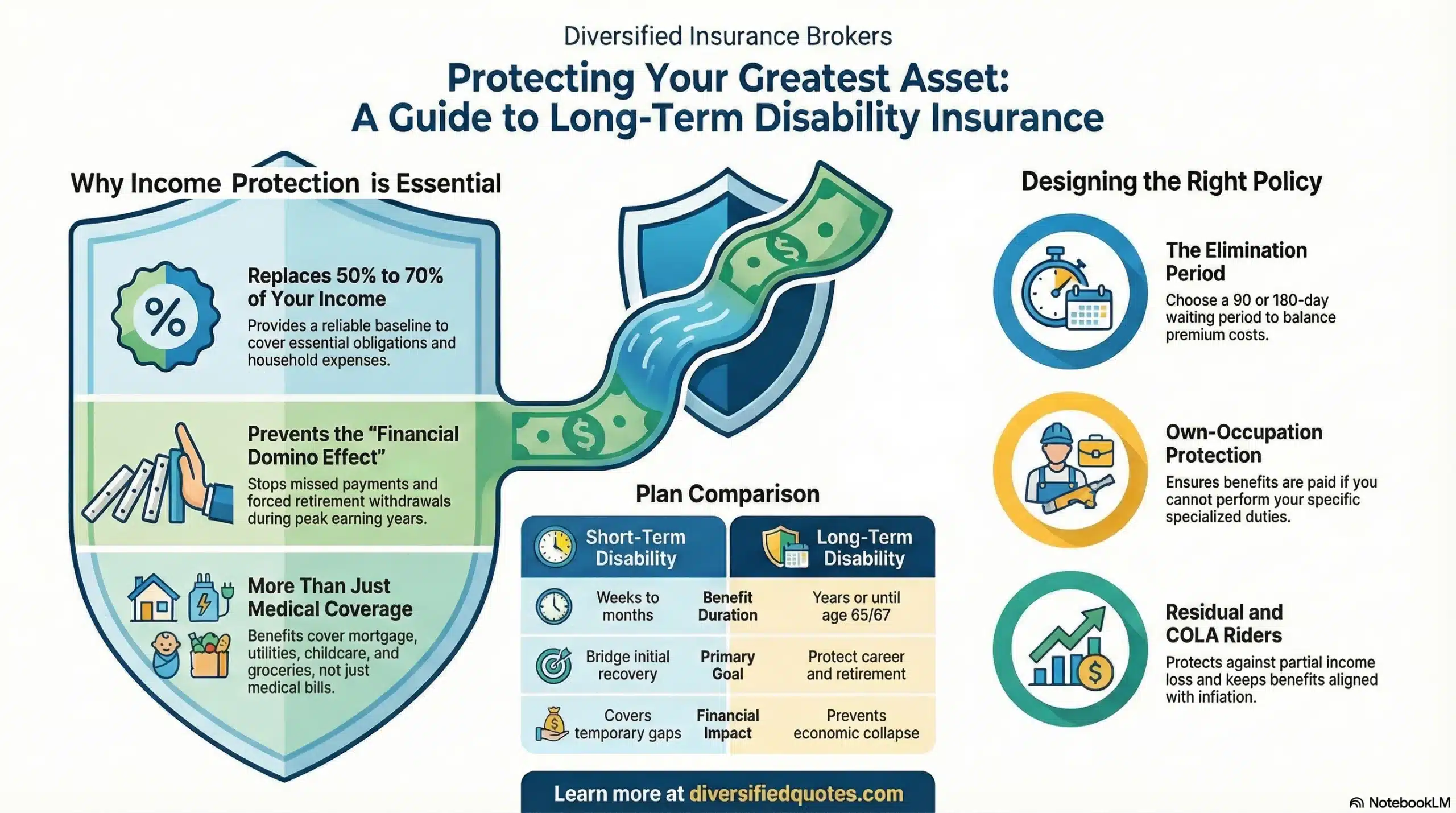
The optimal disability insurance design for an actuary changes significantly across career stages. Early-career exam-stage actuaries should prioritize obtaining the policy when health is optimal, securing true own-occupation language, adding the FIO rider to enable future benefit increases without re-underwriting, and establishing a benefit period extending to age 65 (or 67 for younger actuaries who have more years until Social Security full retirement age). The elimination period — the waiting period before benefits begin — should align with any emergency savings or employer short-term disability coverage; 90 days is most common for professionals with adequate reserves. Mid-career credentialed actuaries who have achieved ACAS, ASA, or are approaching FCAS/FSA should exercise FIO rider options as income grows, evaluate whether the current benefit amount still reflects 60-70% of total compensation including bonuses, and consider whether COLA rider coverage adequately protects long-duration claim value. Senior actuaries and chief actuaries in leadership roles should confirm coverage of variable compensation components (performance bonuses, profit-sharing) and evaluate whether individual policy stacks appropriately above any employer group LTD that may exist. Our resources on disability insurance elimination periods explained, disability income insurance with COLA, and residual disability insurance benefits explained cover each of these design elements. Our resource on disability insurance riders explained covers all rider types comprehensively. Our resources on are disability insurance payments taxable, what is the primary reason people buy disability insurance, how much does disability insurance cost, is disability insurance worth it, disability insurance services, and get a 2nd opinion on your disability insurance quote complete the planning toolkit.
Talk With an Advisor Today
Choose how you’d like to connect—call or message us, then book a time that works for you.
Schedule here:
calendly.com/jason-dibcompanies/diversified-quotes
Licensed in all 50 states • Fiduciary, family-owned since 1980
FAQs: Disability Insurance for Actuaries
What occupation class do actuaries typically qualify for in disability insurance?
Actuaries typically qualify for the highest occupational classification available — commonly designated 5A or 6A depending on the carrier. This top-tier class reflects the fact that actuarial work is entirely indoor, desk-based, professional, and carries negligible physical hazard. The benefit of this classification is threefold: it produces the lowest available premium rates for a given benefit amount, it enables access to the strongest own-occupation policy definitions, and it allows the broadest rider availability. For actuaries, high occupation class combined with early purchase and good health can make disability insurance coverage both comprehensive and cost-efficient relative to the income protection provided.
Why is the own-occupation definition especially important for actuaries?
Actuarial work requires a specific form of cognitive precision — sustained quantitative reasoning, statistical modeling, and financial analysis at a professional standard — that cannot be performed at reduced capacity. If cognitive or neurological impairment prevents an actuary from performing at actuarial standards, the person may still be technically capable of other kinds of work. Without true own-occupation language, a carrier can terminate benefits after 24 months by arguing that the impaired actuary is capable of being gainfully employed in another occupation for which they are educated and trained. True own-occupation language ensures benefits continue as long as the specific actuarial occupation cannot be performed, regardless of whether other lower-compensating work is possible.
Why should exam-stage actuaries prioritize the FIO rider?
The future increase option rider allows an actuary to purchase additional disability coverage as income grows without new medical underwriting. An actuary in the exam-passing years earns a fraction of their eventual credentialed salary — often 60-70% less than they will earn as a credentialed Fellow. Coverage sized to current income will be dramatically undersized relative to future income. The FIO rider locks in insurability at the time of the original application — when health is typically optimal — and allows the benefit to grow at credential milestones without re-underwriting. If a health condition develops during the credential timeline, the FIO allows increases that would otherwise be impossible. Without the FIO, coverage remains capped at the level that was appropriate for the exam-era salary permanently.
Are mental health disability benefits limited in actuary DI policies?
Yes — most individual disability insurance policies limit benefits for mental and nervous conditions (depression, anxiety, PTSD, burnout, and similar conditions) to a maximum of 24 months of benefit payments over the policy lifetime. This limitation applies regardless of how severe the condition is or how long it actually prevents work. For actuaries working in high-pressure analytical environments, mental health conditions represent a genuine occupational risk, and the 24-month cap may be inadequate for episodes that prevent return to actuarial work for longer periods. This limitation should be clearly understood before purchasing — it is standard in most individual DI policies and should factor into overall financial planning for career disruption risk.
Does disability insurance for actuaries cover partial disability from cognitive or chronic conditions?
Yes — with a residual or partial disability rider. Many actuarial disability scenarios do not produce total inability to work but rather sustained reduction in capacity: reduced hours due to fatigue, reduced output due to vision or concentration impairment, reduced billable productivity due to cognitive slowdown. Without a residual rider, a policy pays nothing for these scenarios — the actuary must meet the total disability threshold to receive any benefit. With a residual rider, benefits are payable when earned income has declined by a qualifying percentage (typically 20% or more) due to disability, even while the actuary continues to work. The benefit is proportional to the income loss, providing meaningful financial support in the most common professional disability scenario.
About the Author:
Jason Stolz, CLTC, CRPC, DIA, CAA and Chief Underwriter at Diversified Insurance Brokers (NPN 20471358), is a senior insurance and retirement professional with more than 25 years of real-world experience helping individuals, families, and business owners protect their income, assets, and long-term financial stability. As a long-time partner of the nationally licensed independent agency Diversified Insurance Brokers, Jason provides trusted guidance across multiple specialties—including fixed and indexed annuities, long-term care planning, personal and business disability insurance, life insurance solutions, Group Health, Travel Medical and Evacuation Insurance, and short-term health coverage. Diversified Insurance Brokers maintains active contracts with over 100 highly rated insurance carriers, ensuring clients have access to a broad and competitive marketplace.
His practical, education-first approach has earned recognition in publications such as VoyageATL, and contributions from his agency featured in Kiplinger and GoBankingRates— highlighting his commitment to financial clarity and client-focused planning. Drawing on deep product knowledge and years of hands-on field experience, Jason helps clients evaluate carriers, compare strategies, and build retirement and protection plans that are both secure and cost-efficient. Visitors who want to explore current annuity rates and compare options across multiple insurers can also use this annuity quote and comparison tool.
Explore More Disability Insurance Options: Browse our complete guide to Disability Insurance for Legal, Finance & White Collar Professionals — covering attorneys, accountants, bankers, executives, financial planners & business professionals from 100+ carriers.
Last Reviewed: June 5, 2026 |
Reviewed by: Jason Stolz, CLTC, CRPC, DIA, CAA
Chief Underwriter, Diversified Insurance Brokers, Inc. | NPN: 20471358 | Diversified Insurance Brokers, Inc. — Licensed in all 50 states
Fact Checked by: Tonia Pettitt, CMIP©
Medicare Specialist, Diversified Insurance Brokers, Inc. | NPN: 14374308 | Diversified Insurance Brokers, Inc. — Licensed in all 50 states
Did you find this content helpful? Leave us a Google review — it helps others find trustworthy guidance too.
Editorial Standards: Diversified Insurance Brokers maintains rigorous editorial standards to ensure accuracy, clarity, and independence in all content. Learn more about our editorial standards and commitment to transparency.
