
Disability Income Insurance for Attorneys
As an Independent Disability Insurance Broker, we have access to exclusive discounts and negotiated pricing most captive agents can’t offer — see the full breakdown near the end of this page.
Disability Income Insurance for Attorneys

Jason Stolz CLTC, CRPC, DIA, CAA
Disability income insurance for attorneys is income protection built around a career structure that most group disability plans were not designed to handle. Attorney income is tied to billable hours, contingency outcomes, case settlements, partner distributions, and client relationship productivity — all of which require sustained cognitive performance at a professional level. A health event that limits the attorney’s ability to research, analyze, write, advise, negotiate, or argue produces an immediate and direct income consequence, because legal income is a function of production capacity, not seniority or title. At Diversified Insurance Brokers, we help attorneys at every career stage — associates, solo practitioners, partners, in-house counsel, and firm owners — compare and structure disability coverage that reflects how legal careers actually generate income. The broader income protection insurance framework covers how individual policies are built for high-earning professionals whose income is tied to performance output rather than guaranteed salary.
Most attorneys first encounter disability coverage through an employer group plan or through the ABA group disability plan available as a membership benefit. Both are worth understanding — but both carry structural limitations that matter significantly for mid-career and senior attorneys. The ABA group disability plan caps benefits well below what high-earning attorneys actually earn, uses broad legal professional definitions rather than practice-specific language, and lacks critical riders for partial disability and income growth. Employer group plans share the same definitional weaknesses and add the risk that coverage ends with employment. A 2026 analysis confirms that attorneys earning above $200,000 should treat any group plan as a supplement, not a primary income protection strategy. Individual own-occupation coverage fills the specific gaps that group plans leave — higher benefit amounts tied to actual documented income, definitions that protect the specific practice specialty, unlimited mental/nervous benefit periods, and policy ownership that follows the attorney regardless of employer changes. The disability insurance by occupation framework covers how most carriers place attorneys at the highest available occupational class, reflecting the cognitive, non-hazardous nature of legal practice.
Compare Disability Insurance for Attorneys
We compare individual policy definitions, benefit amounts, and riders across multiple top-rated carriers based on your practice type, income structure, and firm role.
Request Attorney Disability QuotesDisability Income Insurance for Attorneys — Practice Settings, Coverage Gaps, and Policy Design
| Practice Setting | Typical Benefit Structure | Key Gaps and Individual Coverage Priority |
|---|---|---|
| Large firm associate | Employer group LTD typically at 60% of base salary; monthly benefit cap $8,000-$15,000 regardless of base; employer-paid premiums mean benefits may be taxable; definitions typically broad and use any-occupation standard after 24 months | Income gap between group cap and actual salary for high-earning associates; own-occupation definition that lapses at 24 months; law school debt ($118,000-$158,000 average) creates real financial exposure during recovery; individual supplement covering gap above group cap with own-occupation language |
| Partner / equity partner | Group plan if maintained by firm; partnership distributions may not be covered as “salary” under group plan definitions; partner income often substantially exceeds group plan caps; some firms self-insure disability benefits with variable reliability | Largest income protection gap — partner income of $300K-$600K+ is largely uncovered by group plan caps; own-occupation definitions must distinguish the specific practice area (litigation vs. transactional, for example); individual own-occupation policy sized to documented total compensation including distributions |
| Solo practitioner / small firm owner | No employer group plan baseline; solo attorneys have no disability safety net other than individually purchased coverage; SSDI average of approximately $1,630/month is far below what most solo practitioners need to maintain their practice and personal obligations | Individual LTD as the complete income protection plan; BOE coverage for practice overhead; individual own-occupation definition; benefit sized to documented net Schedule C income averaged across 2-3 years; elimination period matched to available savings |
| In-house counsel | Employer group LTD at corporate benefit levels; may be more generous than law firm group coverage; typically still subject to benefit caps and the 24-month own-occupation to any-occupation transition | Individual supplemental coverage above group cap; own-occupation language specific to legal practice rather than generic “office work”; coverage that is individually owned and portable if the corporate employer changes |
| Contingency fee attorney | Income is entirely contingency-based — variable, tied to case outcomes rather than hourly billing; income may spike in years of successful verdicts and be minimal in years of active pre-trial litigation; standard group plan caps based on a consistent salary baseline don’t apply to contingency income patterns | Benefit sizing from averaged Schedule C income across 2-3 years of tax returns; residual disability rider for partial capacity loss when case load must be reduced without completely stopping work; own-occupation language covering the trial preparation and advocacy functions that drive contingency income |
The Own-Occupation Definition — Why Practice Specificity Matters for Attorneys
Attorneys qualify for the highest occupational class available from most disability carriers — reflecting the cognitive, non-hazardous, office-based nature of legal work and the historically favorable claims experience of the profession. This top-class status makes coverage competitively priced and gives access to the strongest available definitions. The planning imperative is ensuring those definitions are practice-specific enough to actually protect the attorney’s legal income. An attorney whose cognitive impairment from depression, neurological disease, or burnout prevents them from performing complex litigation research, writing persuasive briefs, conducting depositions, or arguing in court is disabled from the practice of law — even if they could theoretically perform administrative tasks. Under any-occupation language, the existence of those alternative possibilities provides grounds to deny benefits. Under true own-occupation coverage that distinguishes the material duties of the specific legal practice, the same cognitive impairment is clearly compensable. The documented pattern of carriers mischaracterizing legal work as generic “office work” to deny claims mirrors the auditor and physician disability claim patterns: carriers minimize occupational complexity when it serves their financial interest at claim time. Own-occupation language that is specific enough to describe what the attorney actually does — trial advocacy, transactional drafting, corporate counseling, or regulatory practice — is the defense. The parallel high-earning professional facing the identical definitional challenge is covered at disability income insurance for doctors and physicians, where specialty-specific own-occupation language is equally critical. For disability insurance for judges and disability insurance for paralegals, the same legal profession disability planning context applies with role-specific variations.
Mental Health, Burnout, and the 24-Month Group Plan Failure
Mental health disability in legal practice — burnout, major depression, anxiety disorders, and substance use disorders — is documented as a genuine occupational hazard, particularly in high-pressure practice environments. Law is a profession with documented elevated rates of depression and substance use disorder relative to the general population, driven by deadline pressure, adversarial professional culture, high-stakes consequences of error, and the sustained psychological weight of clients in difficult situations. The financial planning implication is direct: the 24-month mental/nervous benefit cap that most group employer plans and the ABA group plan impose is inadequate for serious conditions requiring extended treatment and recovery. A partner who experiences a serious depressive episode requiring 18-24 months of treatment and gradual return to practice needs a benefit period that matches recovery timelines — not one that terminates precisely when the condition is most difficult to overcome. Individual disability insurance with unlimited mental/nervous benefit periods matching physical coverage provides the sustained protection that the documented behavioral health risk profile of legal practice requires. The partnership-level career and financial planning framework for this specific issue is at disability insurance for executives and disability insurance for high earners and business owners. The analytical and financial professional disability planning parallel — where the same cognitive disability documentation challenge and mental health coverage gap appear — is at disability insurance for auditors, disability insurance for financial planners, and disability insurance for white-collar professionals.
Business Overhead, Key Person, and Firm Protection
Attorneys who own or operate their own practices face the same two-layer disability planning need as other professional practice owners: personal income replacement AND business overhead protection. Business overhead disability insurance reimburses the fixed costs of running a law practice — office rent, staff salaries, malpractice insurance premiums, bar dues, software subscriptions, and professional memberships — during a disability period when revenue drops but overhead continues. The companion disability business overhead expense resource covers the BOE design specifics for professional practice owners. For law firms with multiple partners, key person disability insurance addresses the firm-level income impact when a principal rainmaker or managing partner is disabled. Solo practitioners and small firm attorneys who operate as self-employed professionals or 1099 contractors through their own entities start coverage planning from the foundation of individual LTD as the complete income protection plan with no employer layer beneath it. Consulting attorneys and contract counsel face the same documentation approach at disability insurance for consultants.
Policy Design for Attorneys
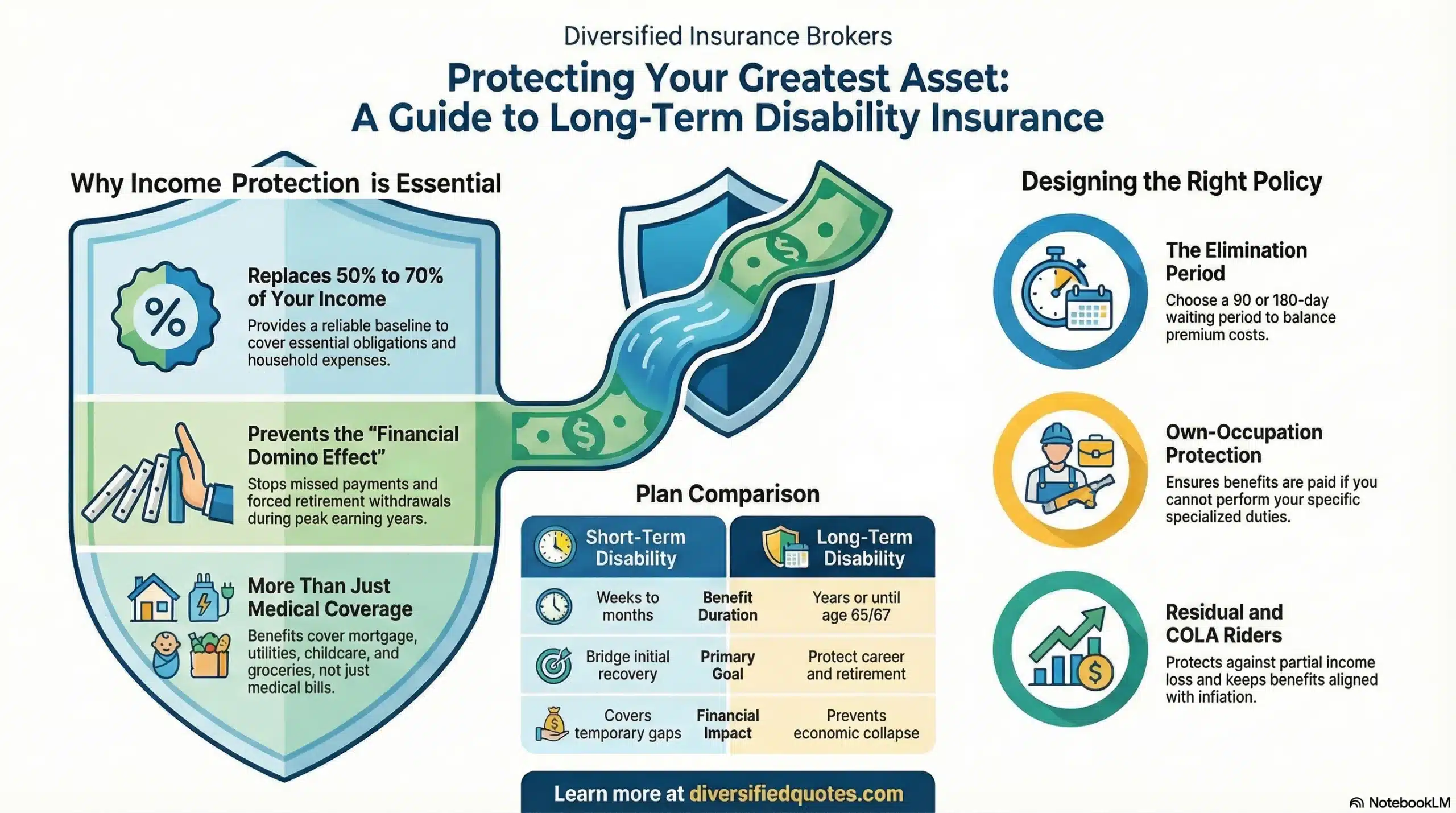
The benefit period to age 65 — long-term disability insurance at the full career-length standard — protects the full trajectory of a legal career that compounds income over decades of client relationship development and specialization. The elimination period for employed attorneys with adequate savings or employer sick leave may comfortably be 90 days; for solo practitioners with no employer sick pay, shorter elimination periods are often appropriate. The future increase option is particularly critical for associates and early-career attorneys whose income will grow substantially through the partner track — securing the right to protect future higher income without new medical underwriting regardless of health changes during the career. The residual disability rider captures partial income loss when the attorney can work at reduced capacity — reduced billable hours, smaller caseload, or limited court appearances — without meeting a total disability threshold. The COLA rider protects purchasing power for long-duration benefits. Tax treatment of benefits from individually owned policies — generally received income-tax-free with after-tax premium payment, versus taxable benefits from employer-paid group plans — is at are disability insurance payments taxable. Benefit sizing for variable attorney income including bonuses and distributions is at how much disability insurance do I need. The full rider framework is at disability insurance riders explained. For an independent evaluation of any existing group coverage or proposed individual policy, get a 2nd opinion on your disability insurance quote covers the review process. The case for working with an independent disability insurance broker is especially strong for attorneys where carrier selection, definition language, and practice-specific occupational description together determine both the coverage quality and the premium outcome.
Talk With an Advisor Today
Choose how you’d like to connect—call or message us, then book a time that works for you.
Schedule here:
calendly.com/jason-dibcompanies/diversified-quotes
Licensed in all 50 states • Fiduciary, family-owned since 1980
FAQs: Disability Income Insurance for Attorneys
What occupational class do attorneys typically qualify for?
Most disability insurance carriers place attorneys in their highest available occupational class — reflecting the cognitive, office-based nature of legal practice, the advanced education requirements, and historically favorable claims experience for the profession. This produces the most competitive premium rates and access to the strongest own-occupation definitions and to-age-65 benefit periods. The favorable classification means the coverage investment for attorneys should focus on definition quality, benefit amount, and rider selection rather than on occupational class negotiation — that advantage is largely pre-built into where the profession sits in carrier underwriting.
Is the ABA disability plan sufficient for most attorneys?
The ABA disability plan provides accessible baseline coverage with simplified underwriting and is genuinely valuable for early-career attorneys with health conditions or for those building toward full individual coverage. But it caps benefits well below what high-earning attorneys actually need to replace their income, uses broad legal professional definitions rather than practice-specific language, lacks the critical residual disability and future increase option riders, and ties coverage to ABA membership. Attorneys earning above $200,000 should treat the ABA plan as a supplement, not a primary income protection strategy. Individual own-occupation coverage addresses all three gaps.
Why does own-occupation definition matter so much for attorneys?
An attorney whose cognitive impairment prevents performing complex legal analysis, writing, advocacy, or client counseling is disabled from the practice of law — but may still be capable of administrative tasks or non-legal work. Under any-occupation language, that remaining capability provides grounds to deny disability benefits. Own-occupation coverage evaluates whether the attorney can perform the material duties of their specific legal practice — litigation, transactional drafting, corporate counseling — not whether any form of employment remains possible. The distinction between litigation and transactional practice also matters: an attorney disabled from courtroom advocacy may still be capable of document review, which some broad definitions would treat as rendering them “not disabled.” Specialty-specific own-occupation language closes this gap.
How is disability insurance for partner-level income structured?
Partners and equity partners face the largest income protection gap because partner distributions and equity compensation typically exceed group plan benefit caps by a substantial margin. Individual disability insurance sized to total documented compensation — base draws plus partnership distributions — addresses this gap. The future increase option is critical for partners in income-growth phases: it preserves the right to expand coverage as partnership income grows without new medical underwriting. The residual disability rider captures partial income loss when disability reduces production capacity below full billable output without meeting a total disability threshold — a common early-phase disability pattern for attorneys who reduce workload while recovering.
Does burnout or depression qualify as a disability for an attorney?
Individual disability insurance with comprehensive mental/nervous coverage protects against depression, anxiety disorders, burnout producing genuine functional impairment, and substance use disorders when these conditions genuinely prevent the attorney from performing the material duties of legal practice. The critical coverage distinction from group plans is the benefit period: most group LTD plans cap mental/nervous benefits at 24 months. Individual policies with unlimited mental/nervous benefit periods provide sustained coverage for the conditions most specifically documented as occupational health risks in legal practice. Documenting a behavioral health disability claim requires clear demonstration of how the specific condition impairs the legal practice functions — analytical capacity, writing ability, client interaction capability — not just general daily functioning.
About the Author:
Jason Stolz, CLTC, CRPC, DIA, CAA and Chief Underwriter at Diversified Insurance Brokers (NPN 20471358), is a senior insurance and retirement professional with more than 25 years of real-world experience helping individuals, families, and business owners protect their income, assets, and long-term financial stability. As a long-time partner of the nationally licensed independent agency Diversified Insurance Brokers, Jason provides trusted guidance across multiple specialties—including fixed and indexed annuities, long-term care planning, personal and business disability insurance, life insurance solutions, Group Health, Travel Medical and Evacuation Insurance, and short-term health coverage. Diversified Insurance Brokers maintains active contracts with over 100 highly rated insurance carriers, ensuring clients have access to a broad and competitive marketplace.
His practical, education-first approach has earned recognition in publications such as VoyageATL, and contributions from his agency featured in Kiplinger and GoBankingRates— highlighting his commitment to financial clarity and client-focused planning. Drawing on deep product knowledge and years of hands-on field experience, Jason helps clients evaluate carriers, compare strategies, and build retirement and protection plans that are both secure and cost-efficient. Visitors who want to explore current annuity rates and compare options across multiple insurers can also use this annuity quote and comparison tool.
Explore More Disability Insurance Options: Browse our complete guide to Disability Insurance for Legal, Finance & White Collar Professionals — covering attorneys, accountants, bankers, executives, financial planners & business professionals from 100+ carriers.
Last Reviewed: June 6, 2026 |
Reviewed by: Jason Stolz, CLTC, CRPC, DIA, CAA
Chief Underwriter, Diversified Insurance Brokers, Inc. | NPN: 20471358 | Diversified Insurance Brokers, Inc. — Licensed in all 50 states
Fact Checked by: Tonia Pettitt, CMIP©
Medicare Specialist, Diversified Insurance Brokers, Inc. | NPN: 14374308 | Diversified Insurance Brokers, Inc. — Licensed in all 50 states
Did you find this content helpful? Leave us a Google review — it helps others find trustworthy guidance too.
Editorial Standards: Diversified Insurance Brokers maintains rigorous editorial standards to ensure accuracy, clarity, and independence in all content. Learn more about our editorial standards and commitment to transparency.
