
Disability Insurance for Bankers
As an Independent Disability Insurance Broker, we have access to exclusive discounts and negotiated pricing most captive agents can’t offer — see the full breakdown near the end of this page.
Disability Insurance for Bankers

Jason Stolz CLTC, CRPC
Disability insurance for bankers is a critical component of financial planning for professionals whose income depends on cognitive performance, decision-making ability, and consistent execution in a high-stakes environment. Whether you work in retail banking, commercial lending, private banking, investment banking, or financial analysis, your ability to earn is directly tied to your mental clarity, communication skills, and sustained productivity. Unlike physically intensive professions, banking roles are often perceived as lower risk — but the reality is that bankers face a different and often underestimated type of income exposure, one centered around cognitive function, stress management, performance consistency, and the complex relationship between health and compensation in roles where both salary and variable pay depend on measurable output. If an illness, neurological condition, mental health challenge, or serious physical event affects your ability to think clearly, analyze information, execute transactions, or interact effectively with clients and counterparties, your income can be impacted immediately and significantly. At Diversified Insurance Brokers, we help banking professionals structure disability insurance policies that reflect the unique risks of knowledge-based, performance-driven careers — ensuring that if your ability to work is interrupted, your financial stability remains intact while you recover.
Protect Your Income as a Banking Professional
Compare disability insurance options designed for finance, lending, and investment professionals.
Request Disability Insurance OptionsQuestions? Call 800-533-5969
What Banking Professionals Actually Do — and Why It Creates Real Disability Risk
The banking profession encompasses a wide range of roles that differ significantly in daily responsibilities, risk exposure, and compensation structure. Understanding those differences is the starting point for understanding disability risk in banking — because the specific way a banker’s income can be disrupted by a health event depends on which type of banking they practice, which functions are central to their role, and how much of their compensation is fixed versus performance-dependent.
Retail banking professionals — branch managers, loan officers, relationship bankers, and consumer lending specialists — work in client-facing roles that require consistent interpersonal performance, the ability to manage high volumes of client interactions, and reliable execution of transaction processing and compliance procedures. A condition that affects sustained attention, short-term memory, emotional regulation, or the ability to manage multiple simultaneous client conversations can directly impair performance in these roles. Retail banking managers carry responsibility for branch performance metrics, staff oversight, compliance adherence, and sales outcomes — and their compensation often includes performance bonuses tied to those metrics. A disability that reduces management effectiveness even modestly can affect both the fixed and variable components of their total compensation.
Commercial banking and credit professionals — commercial loan officers, credit analysts, underwriters, and relationship managers — perform deeply analytical work that requires the sustained ability to evaluate complex financial statements, assess business risk, structure credit facilities, and maintain ongoing client relationships through transaction cycles. Commercial bankers routinely manage portfolios of loans involving millions of dollars in exposure and must apply consistent credit judgment under time pressure and regulatory scrutiny. Conditions that affect analytical speed, judgment quality, the ability to process and retain complex financial information, or the interpersonal capacity to manage client negotiations can directly impair the commercial banker’s effectiveness and the quality of their credit decisions — with downstream consequences both for the institution and for the banker’s own performance evaluation and compensation.
Investment banking and capital markets professionals operate in one of the most cognitively demanding and time-pressured environments in finance. Analysts, associates, directors, and managing directors in investment banking divisions work on M&A transactions, capital raises, and advisory mandates that require sustained intellectual performance across extended periods — often 80 to 100 hours per week during active deal processes. The financial impact of even a temporary cognitive impairment during an active transaction can be significant: a managing director whose judgment, analytical capacity, or client-facing performance is compromised during a critical deal phase can lose the transaction, damage the client relationship, and undermine their standing within a culture where performance and reputation are the primary currencies of career advancement. Variable compensation in investment banking — bonuses that can represent 50% to 200% or more of base salary — is directly tied to deal execution quality and relationship production, creating maximum exposure when performance is affected by health.
Private banking and wealth management professionals — private bankers, trust officers, wealth advisors, and portfolio managers serving high-net-worth clients — build careers on long-term client relationships and the consistent demonstration of financial sophistication. In these roles, the client relationship itself is the primary asset: a private banker with a book of relationships representing hundreds of millions in assets under management has built an income stream whose sustainability depends entirely on their continued ability to maintain those relationships through personalized service, investment insight, and the trust that comes from years of consistent high-quality engagement. A disability that affects memory, communication, emotional regulation, or professional presence — even if the banker remains technically capable of performing financial analysis — can erode client confidence and trigger client attrition that directly and permanently reduces compensation.
Risk management, compliance, and regulatory banking professionals work in roles where precision, regulatory knowledge, analytical consistency, and attention to detail are the primary competencies. These professionals manage complex regulatory frameworks, conduct audits, assess model risk, and maintain compliance programs that affect the entire institution’s regulatory standing. A cognitive condition that reduces analytical accuracy, affects judgment about regulatory requirements, or impairs the ability to manage complex multi-stakeholder processes can create significant professional and institutional risk — and can quickly affect the banker’s standing and compensation in roles where reputation for reliability is paramount.
The Cognitive Disability Risk That Bankers Underestimate
The most prevalent disability risk for banking professionals is not physical injury — it is cognitive and neurological impairment from a range of conditions that directly affect the mental performance their work requires. Bankers typically carry life insurance appropriate for their income level and may have some employer group disability coverage, but many have not seriously evaluated the specific ways in which health conditions affect cognitive performance — and therefore income — in their particular roles. The perception that “desk work is safe” obscures the genuine and substantial disability risk profile of the profession.
Stroke is one of the most significant disability risks for working-age professionals in any high-stress career, and banking’s sustained cognitive demand and stress profile places practitioners in a risk category that warrants serious attention. Stroke can cause lasting cognitive impairments — in language, memory, executive function, spatial reasoning, or emotional regulation — that may not constitute total physical incapacity but can fundamentally impair the specific cognitive capabilities banking requires. A commercial banker who experiences aphasia affecting their ability to articulate credit analysis in client meetings, or a private banker whose executive function is affected in ways that impair complex relationship management, faces a genuine occupational disability even if they retain physical mobility and can perform basic daily activities.
Traumatic brain injury from vehicle accidents, falls, or other events can produce similar cognitive impairments with variable recovery trajectories. Mild to moderate TBI can produce lasting effects on processing speed, memory consolidation, and emotional regulation that are particularly disabling in high-cognitive-demand roles where precision and sustained performance are non-negotiable. Severe depression and anxiety disorders, when they reach clinical severity, can impair concentration, decision quality, emotional regulation, and the interpersonal consistency that client-facing banking roles require. These are not marginal risks — they are among the most common disabling conditions across all age groups and income levels, and the banking profession’s stress environment represents a meaningful contributing factor.
Neurological conditions including multiple sclerosis, Parkinson’s disease, and progressive cognitive conditions present a different temporal profile — often producing gradual but cumulative impairment over months and years rather than a single acute event. For banking professionals in their 40s and 50s, the risk of a gradually progressive neurological condition producing occupational disability during peak earning years is real and statistically meaningful. Disability insurance that addresses gradual onset disability — through residual coverage that pays as income declines rather than requiring total inability to work before any benefit triggers — is particularly important for these profiles.
Stress, Burnout, and the Mental Health Disability Risk in Banking
The banking industry operates at a pace and pressure level that is among the most sustained in any professional sector. Long hours, high-stakes decisions, performance-driven cultures, regulatory pressure, client expectation management, and organizational complexity create a cumulative stress load that, when unmanaged over years, can produce clinical-level burnout, anxiety disorders, and depression that meet the functional limitation criteria for disability claims under well-structured policies.
Burnout in banking is not simply feeling tired — at its clinical extreme, it produces cognitive impairment, emotional dysregulation, depersonalization, and severe reduction in professional effectiveness that can require extended leave and treatment before any meaningful recovery of function. A managing director who develops severe burnout during a period of sustained deal pressure may require months or years of treatment and recovery time, during which their ability to maintain client relationships, execute transactions, and deliver the performance their compensation depends on is severely compromised. For bankers in variable compensation structures, this reduction in performance translates almost immediately into reduced bonus income even before a formal disability claim is made.
Clinical depression and anxiety disorders are recognized by disability insurance carriers as covered conditions when they produce the functional limitations that meet the policy’s disability definition. For bankers, the functional limitations that matter are not whether the individual can perform basic daily activities but whether they can perform the specific cognitive, analytical, and interpersonal demands of their banking role at the level required for their performance expectations. A disability policy with a strong own-occupation definition — covering the banker’s inability to perform the material and substantial duties of their specific banking role — addresses this distinction correctly, while a weaker any-occupation definition may fail to pay when a banker can technically perform some type of work but cannot function at the level their banking career requires.
Mental health coverage provisions deserve specific attention when bankers compare disability insurance policies. Some carriers impose a 24-month benefit period cap on mental health and nervous condition claims — meaning that even when a policy covers mental health disabilities in principle, it terminates mental health benefits after 24 months regardless of the beneficiary’s ongoing disability status. For banking professionals whose most realistic disability scenario involves a mental health condition, selecting a policy without this 24-month limitation — or understanding exactly what limitation applies — is a critical policy selection consideration. Our resource on why working with an independent disability insurance broker matters explains how carrier-specific knowledge of these provisions is one of the primary advantages of independent comparison over single-carrier application processes.
How Banking Income Is Actually Structured — and Why It Creates Complex Coverage Needs
Banking compensation is among the most complex of any professional category from a disability insurance perspective, because the relationship between total compensation and disability benefit calculation is not always straightforward. Understanding how banking income is structured — and how different income components interact with disability insurance benefit calculations — is essential for designing coverage that genuinely replaces what is lost when a disability occurs.
Base salary is the most straightforward component. For most banking roles, base salary represents a defined annual amount that is contractual and does not vary with performance within a given year. Disability insurance benefit calculations typically start with base salary, and carriers use income documentation (W-2s, tax returns, pay stubs) to verify and establish the maximum insurable benefit amount. For retail banking and commercial banking professionals whose income is primarily salary-based with modest performance incentives, this calculation produces a benefit amount that reasonably reflects their income exposure.
For investment bankers, private bankers, and other professionals where bonuses and incentive compensation represent a substantial or dominant portion of total compensation, the base salary alone dramatically understates actual income. An investment banking managing director whose base salary is $250,000 but whose total compensation including bonus reaches $800,000 or more in a productive year is not adequately insured by a policy calculated only on the base salary. Most carriers have mechanisms for including documented variable income — typically averaging two to three years of total W-2 compensation — in the benefit calculation, but the documentation and underwriting process for high-variable-income applications requires specific preparation. Carriers also impose maximum monthly benefit amounts, and for very high-income bankers, the maximum available monthly benefit may not fully replace total compensation even with optimal underwriting.
Stock options, equity grants, carried interest for private equity roles, and deferred compensation components create additional complexity. These forms of compensation are generally not included in disability benefit calculations — they are investment or deferred earnings rather than current earned income — which means that a banker whose total wealth accumulation plan depends substantially on equity compensation has a different disability planning picture than one whose income is primarily cash compensation. Understanding what disability insurance protects versus what it does not protect is important for banking professionals with complex total compensation structures.
The Employer Group Coverage Gap for Employed Bankers
Many bankers employed by financial institutions have access to employer-sponsored group long-term disability coverage as part of their benefits package. Understanding what this coverage actually provides — and where its significant limitations create genuine financial exposure — is essential for any banker who intends to rely on it as the primary disability protection for their career income.
Standard group long-term disability policies replace 60% of base salary, subject to a monthly maximum benefit. For a commercial banker earning $150,000 in base salary with $60,000 in annual bonus, the group policy at 60% of base produces a monthly benefit of $7,500 — replacing the base salary component but providing no replacement for the $60,000 bonus component. At the time of a disability, total income exposure is $210,000 annually but the group policy covers only $90,000 annually (60% of base) — leaving a 57% gap in income replacement. For investment bankers and others with even larger variable compensation components relative to base salary, this gap is proportionally larger and potentially catastrophic.
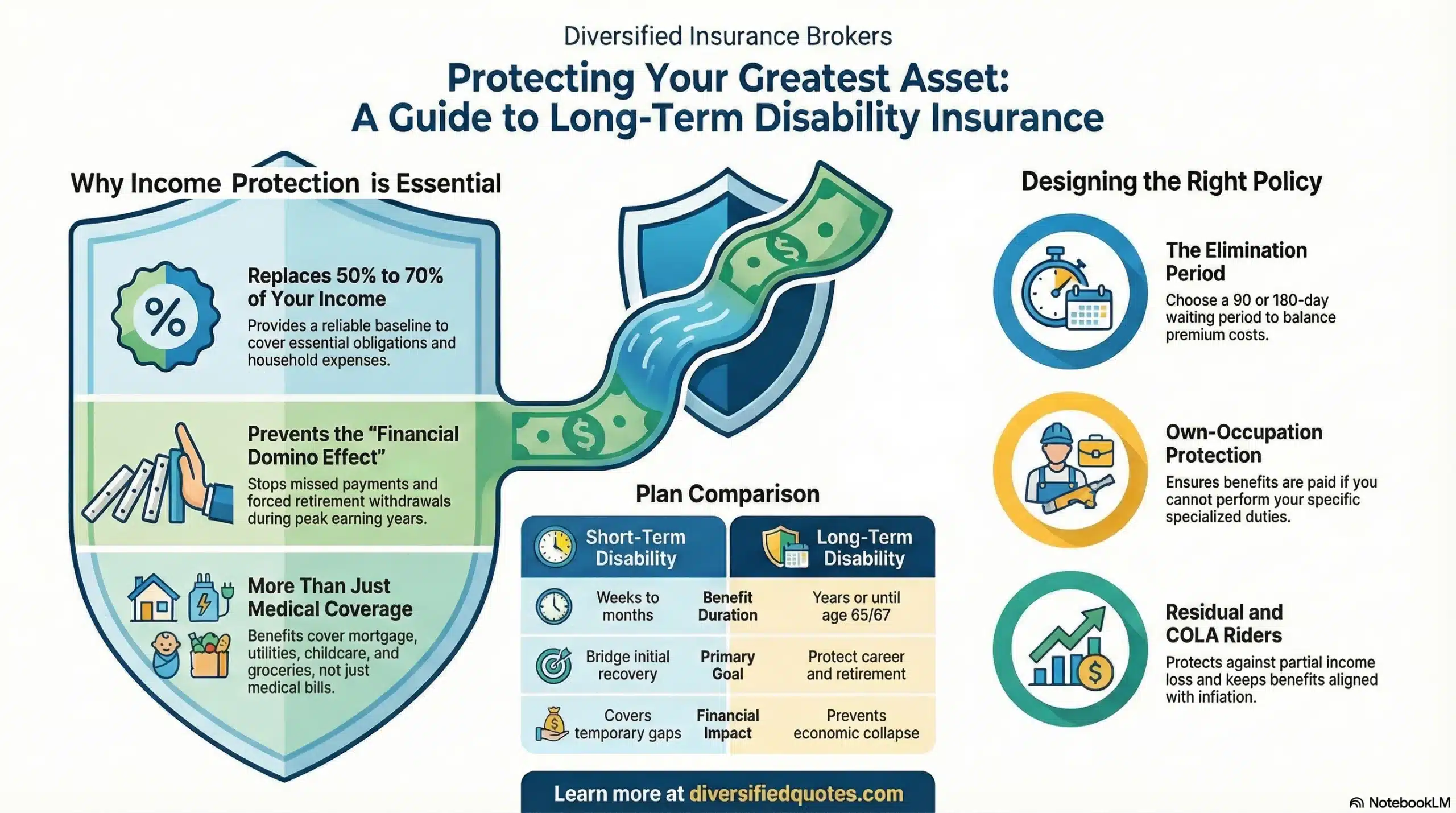
The disability definition in most group policies is another critical limitation. Standard group LTD policies use an own-occupation definition for the first 24 months of a claim — paying benefits when the insured cannot perform the duties of their own occupation. After 24 months, the definition transitions to an any-occupation standard — paying benefits only when the insured cannot perform any occupation for which they are reasonably suited by education, training, or experience. For a banker with decades of financial education, analytical experience, and professional credentials, the any-occupation standard applied after 24 months may determine that they can perform a lower-level financial analysis role, a consulting role, or another professional position — terminating benefits even when their banking career income has been permanently disrupted and their prior compensation level is unrecoverable without the specific professional capacity the disability impaired.
Group policies are also not portable. When employment ends — whether due to voluntary departure, organizational restructuring, merger activity, or any other reason — the group policy ends. A banker who leaves their institution after 15 years and attempts to replace their group coverage with individual coverage at age 50 faces full underwriting at that age, with health changes that accumulated over the intervening years potentially producing exclusion riders, table ratings, or outright declines. The most effective disability insurance strategy for employed bankers is to establish individual coverage while young and healthy — when the occupation class is favorable, underwriting is clean, and future increase options can be purchased at the original underwriting — rather than relying on group coverage that can disappear with an employment change.
The Own-Occupation Disability Definition: Why It Is Especially Important for Bankers
The disability definition in an individual disability insurance policy is the single most consequential contract provision for any banking professional, because it determines what must be true about the banker’s functional capacity before the policy pays. A strong own-occupation definition protects the banker’s specific occupational income; a weak any-occupation definition offers far less protection and is more likely to fail in the realistic scenarios where banking income is actually lost to disability.
Under a true own-occupation disability definition, a banker is considered disabled — and entitled to benefits — when they cannot perform the material and substantial duties of their specific occupation as a banker, regardless of whether they could perform some other type of work. An investment banking managing director whose condition prevents them from maintaining the analytical performance, client relationship management, and transaction execution their role requires would receive benefits under own-occupation coverage even if they could theoretically perform a lower-intensity financial analysis role. The policy protects the income associated with the specific professional capacity, not just the ability to work at any level.
Under an any-occupation definition, the same managing director would receive no benefit if the carrier determined they could perform any other occupation consistent with their education and experience — even if that occupation pays $80,000 per year versus the $800,000 their banking career was generating. The functional and financial gap this creates is enormous, and it is precisely why own-occupation coverage is the most important single policy feature for high-income professionals whose income is tied to specialized expertise and performance. Our resource on own-occupation disability insurance covers the mechanics of how this definition is written and applied in real claim scenarios, and why the specific language matters as much as the presence of “own-occupation” terminology in the marketing description.
Banking professionals typically qualify for excellent occupation classes in disability underwriting — usually Class 5 or Class 6 (the most favorable tiers) — because of the non-physical, professional nature of the work. This favorable classification means that own-occupation definitions are available, benefit periods to age 65 or 67 are standard, and residual and future increase riders can typically be included. This is one of the most significant disability insurance advantages banking professionals have relative to physically demanding occupations, and it should be leveraged by structuring the most comprehensive available policy design rather than purchasing minimal coverage that underutilizes the favorable classification.
Variable Compensation Documentation: Getting the Benefit Amount Right
For bankers with significant variable compensation, the benefit amount determination is the most important underwriting conversation to get right before any application is submitted. The benefit amount sets the maximum monthly disability benefit that will be paid during a claim — and a benefit amount that does not reflect total compensation leaves the banker with income gaps that can make a disability financially devastating even when they have insurance.
Carriers determine the maximum insurable benefit using a formula applied to documented earned income. The formula typically allows 60% to 70% of average annual income for the two or three most recent years. For a banker earning $300,000 in a high-performance year and $180,000 in a lower-performance year, the carrier may average to $240,000 and allow a maximum benefit of approximately $13,000 to $14,000 per month. If the banker’s most recent year was the $180,000 year and the application is submitted based only on the most recent year, the available maximum benefit may be lower than it would be if the documentation presented the full multi-year income picture effectively.
Working with an advisor who understands how to present variable income documentation to maximize the available benefit amount — including how to organize W-2s, 1099s, and supporting compensation documentation from different years — is particularly valuable for bankers with significant year-to-year compensation variability. Carrier-specific income calculation approaches also vary: some carriers use the higher of recent years’ average, some use a two-year average, and some have specific rules for including or excluding bonus, commissions, and incentive components. Understanding these differences before selecting the carrier — rather than discovering them during underwriting — produces better coverage outcomes for bankers with complex compensation.
Residual Disability Coverage: Essential for Performance-Driven Compensation
Residual disability coverage — also called partial disability coverage — pays a proportionate benefit when a disability reduces income without eliminating the ability to work entirely. For bankers, residual coverage is not a supplemental feature — it is a core coverage mechanism that addresses the most common ways banking income is actually disrupted by health events.
Most banking disabilities do not produce immediate, total, permanent inability to work. Instead, they produce a period of reduced capacity during which the banker may still be showing up, attending meetings, and performing some functions, while their cognitive performance, analytical speed, relationship maintenance quality, or executive presence is measurably impaired relative to their pre-disability standard. The result is reduced deal flow, lower performance evaluations, reduced bonus, client relationship degradation, and income decline — without the clear “total disability” event that a total-disability-only policy requires to trigger a benefit.
A banker returning from cancer treatment who can work 6 hours per day instead of 12, whose cognitive performance is affected by treatment side effects that reduce analytical precision, or whose client-facing capacity is temporarily limited while managing ongoing treatment — is experiencing real income loss without total disability. A private banker managing a depression episode who maintains formal employment but whose client relationship quality and new business development capacity is materially impaired is experiencing real bonus income reduction without formal leave. Residual coverage pays a benefit proportionate to the documented income reduction, providing financial support throughout the recovery period rather than only at its most extreme point. Our resource on residual disability insurance benefits explained covers how these calculations work and how to confirm the residual rider is structured correctly in a specific policy.
Future Increase Options: Protecting Insurability During a Long Banking Career
Banking careers are long, income growth trajectories are steep, and health histories accumulate over time. The combination of these three facts makes the future increase option (FIO) — also called a guaranteed insurability rider or future purchase option — one of the most valuable additions to a disability insurance policy for a banker at any career stage.
A future increase option grants the right to increase the monthly disability benefit at defined future dates or upon qualifying income events without submitting to new medical underwriting. The increases are based on financial underwriting — confirming that income has grown to justify the higher benefit amount — but health status at the time of the increase is irrelevant. This matters enormously for a banker who purchases disability insurance at age 30 with a $6,000 monthly benefit appropriate for their current income, but whose income grows to justify a $15,000 monthly benefit by age 40. If they develop a chronic health condition at age 36 that would otherwise prevent them from obtaining additional coverage — or that would produce exclusion riders covering the condition — the future increase option allows them to increase to $15,000 per month at option exercise dates without the health condition being evaluated.
The future increase option is an insurance policy on insurability — purchased at the beginning of the career when health is pristine, it protects the ability to expand coverage throughout the career regardless of what health changes occur in the intervening years. For banking professionals who expect their income to grow substantially, this option is among the highest-value components available in any disability policy and should be specifically requested when designing coverage.
Policy Design for Banking Professionals: Key Elements to Structure Correctly
Disability insurance for bankers should be built around the specific income structure, career risk profile, and financial planning priorities of the individual professional. The document draft’s framework is the right starting point — but each design element requires deliberate calibration to the banker’s actual situation.
The benefit amount should reflect documented total compensation as comprehensively as the carrier’s income calculation rules allow. For base-salary-dominant income, this is relatively straightforward. For bonus-heavy compensation structures, it requires multi-year documentation and carrier-specific income calculation knowledge. Maximizing the available benefit amount within the carrier’s rules is almost always the correct approach for high-income banking professionals, because the variable compensation that is most at risk is also the compensation component that most requires replacement.
The elimination period — the waiting period between disability onset and first benefit payment — should be calibrated to the banker’s actual financial reserves and the speed with which income decline would create financial pressure. Bankers with strong liquid reserves and stable fixed expenses may reasonably choose a 90-day elimination period, allowing the lower premium of the longer wait to reduce overall coverage cost. Bankers with significant fixed household obligations, substantial mortgage debt, or modest liquid reserves relative to monthly expenses should consider a 60-day or even 30-day elimination period, particularly if variable compensation disruption could produce immediate income decline even before formal leave begins.
The benefit period should extend to age 65 or 67. Banking is a long career, and peak earning years are concentrated in the 40s, 50s, and early 60s. A disability occurring at age 45 that terminates a banking career produces income loss lasting 20 or more years — a 5-year benefit period addresses only a fraction of that exposure. To-age benefit periods provide the protection that a long-career professional actually needs.
The own-occupation definition should be confirmed in the policy language — not assumed from marketing descriptions. The specific wording of the disability definition, and whether it applies for the full benefit period or only for the first 24 months, must be confirmed in the actual contract. COLA (cost of living adjustment) riders ensure that a benefit paid over many years maintains purchasing power as inflation erodes fixed dollar amounts. For a banker receiving a $10,000 monthly benefit over a 15-year disability claim, a 3% annual COLA produces a meaningfully higher real purchasing power than the same benefit without adjustment.
How Diversified Insurance Brokers Helps Banking Professionals
As an independent agency, Diversified Insurance Brokers compares disability insurance options across multiple carriers to identify the combination of definition strength, benefit design, and premium that best fits each banking professional’s specific occupation, income structure, and coverage priorities. For bankers whose favorable occupation classification creates access to the strongest available policy provisions, this comparison process ensures the available advantages are fully utilized rather than defaulted to a basic policy that undersells the coverage potential of a premium occupation class.
We help banking professionals understand how their variable compensation interacts with benefit amount calculations, which carriers offer the strongest own-occupation definitions without mental health benefit period limitations, how to structure future increase options to protect insurability through a long career, and how to coordinate individual coverage with employer group benefits to fill the gaps that group coverage consistently leaves for high-income banking professionals. We also help with the timing decision — applying while health is favorable and before the health history that accumulates in a demanding career creates underwriting complications. For a broader view of how independent comparison benefits professionals in any knowledge-based, high-income role, our resource on why working with an independent disability insurance broker matters covers the practical advantages in detail.
Get Disability Insurance Quotes for Bankers
We compare options across carriers for banking and finance professionals to find the right combination of coverage and value.
Get Disability Insurance QuotesQuestions? Call 800-533-5969
Financial Protection Essentials
Talk With an Advisor Today
Choose how you’d like to connect—call or message us, then book a time that works for you.
Schedule here:
calendly.com/jason-dibcompanies/diversified-quotes
Licensed in all 50 states • Fiduciary, family-owned since 1980
Disability Insurance for Bankers FAQs
Yes — bankers typically qualify for disability insurance and often receive favorable occupation class ratings because banking is classified as a white-collar, non-physical profession. Favorable occupation classes generally mean lower premiums and access to stronger policy definitions, including own-occupation language that pays benefits when you cannot perform the specific duties of your banking role even if you could work in a different capacity. The underwriting process for banking professionals evaluates income level, employment structure, and health history — similar to any professional disability application — and the non-physical nature of the work typically results in more competitive rates than would apply to physically demanding occupations.
The most important aspect of qualifying well as a banker is accurate income documentation, particularly for professionals whose total compensation includes significant bonus or commission components. Disability insurance benefit amounts are tied to documented income, and ensuring that total compensation — not just base salary — is reflected in the benefit amount calculation requires presenting income documentation in a way that captures the full picture. Tax returns, employment agreements that document bonus structures, and W-2s that reflect total annual compensation are all commonly used to support benefit amount requests that reflect actual income exposure for banking professionals.
The most significant disability risks for banking professionals center on cognitive performance and mental health rather than physical injury. Banking requires sustained concentration, rapid information processing, sound judgment under pressure, and consistent communication — all of which can be affected by conditions such as burnout, anxiety, depression, neurological conditions, or serious illness. These conditions can reduce productivity and performance measurably even when they do not completely prevent work, which is why partial disability coverage is particularly valuable for banking professionals whose income includes variable components tied to performance outcomes.
Stress-related conditions are a significant risk given the demanding work environment in many banking roles — long hours, high expectations, deadline pressure, and the weight of financial responsibility. Chronic stress can develop into conditions that affect both physical and mental health in ways that limit the ability to perform at the level banking roles require. Career-specific risks also include reputational and relationship damage that can compound the financial impact of a disability — even a temporary absence from high-level client-facing roles can affect business development momentum in ways that take time to rebuild. Disability insurance protects the income stream while recovery occurs, reducing the financial pressure that would otherwise force premature return before full capacity is restored.
Yes — many disability insurance policies can be structured to reflect total compensation, including bonuses and performance incentives, not just base salary. This matters because for many banking professionals, bonuses represent a meaningful — sometimes majority — share of total annual income. A policy that only replaces 60 percent of base salary may provide far less than 60 percent of actual income replacement if total compensation is significantly higher than base salary alone. Documenting and insuring total income requires presenting the right documentation — typically two or more years of tax returns that reflect total W-2 income including all compensation components.
Carriers have limits on how much of variable income they will insure, and approaches to averaging bonus income vary across carriers. Some use a two-year average, others use different methodologies. For bankers with particularly high bonus-to-base ratios or commission-heavy structures, working with an independent broker who understands how different carriers approach variable income documentation produces better coverage outcomes than applying to a single carrier without this comparison. Maximizing the insured benefit amount for total compensation — not just base salary — is one of the most important design decisions for banking professionals purchasing disability insurance.
Employer-provided group disability coverage is often insufficient for banking professionals for several interrelated reasons. First, group plans typically cap monthly benefits at a defined maximum — often $5,000 to $10,000 per month — that falls far short of actual income replacement needs for professionals with higher compensation. Second, group plan benefits may be taxable depending on how premiums are paid, reducing the effective replacement ratio further. Third, group coverage is not portable, meaning it ends when employment ends — precisely the time when coverage may be most valuable if a disability affects career continuity.
Group plans also typically use broader disability definitions — often shifting from own-occupation to any-occupation language after a defined period — which can reduce benefit eligibility for banking professionals who could technically perform some work but cannot perform their specific banking role. Individual disability insurance addresses all of these gaps: it is portable, it can be sized to reflect total compensation, it can maintain own-occupation language for the full benefit period, and it is typically purchased with after-tax premiums making benefits income-tax-free. For most banking professionals, the appropriate structure is individual disability insurance that supplements rather than replaces group coverage, with the individual policy sized to bridge the gap between what the group plan provides and what total income replacement actually requires.
Yes — residual or partial disability coverage provides proportionate income replacement when a disability reduces but does not eliminate the ability to work. For banking professionals, this is particularly important because many conditions that affect cognitive performance or energy levels do not result in complete inability to work — they reduce effectiveness, limit working hours, affect the quality of client interactions, or impair the judgment and focus that drive performance-based compensation. A partial disability that reduces a banker’s productivity by 40 percent may reduce total compensation by a similar or even greater proportion through lower bonus outcomes, but a policy without residual coverage may not trigger any benefit at all because the banker technically continues working.
Residual disability coverage triggers when income has declined by a defined minimum percentage — typically 20 to 25 percent — due to a covered disability, and pays a proportionate benefit based on the percentage of income loss. For banking professionals with variable compensation structures, this benefit can be particularly valuable because it responds to the realistic disability scenarios that affect knowledge workers — not just the complete inability to work that rarely characterizes cognitive or stress-related conditions. Confirming the residual disability provision when comparing policies ensures the coverage responds to how disabilities actually manifest in professional roles, not just in physical or catastrophic scenarios.
The best time for banking professionals to apply for disability insurance is while healthy and actively working — before any health changes occur that could affect eligibility, result in exclusion riders, or increase premiums through table ratings. Age is a continuous driver of disability insurance rates, and the favorable occupation class that banking typically receives is most valuable when combined with favorable health underwriting that comes from applying while in good health. A banker who purchases coverage in their early career years locks in lower rates for the full duration of the policy and establishes insurability before the stress-related health conditions that are not uncommon in demanding banking environments begin to appear in medical records.
Future increase option riders, which allow benefit increases without new medical underwriting at defined intervals as income grows, are most valuable when purchased early — because they protect the right to increase coverage even if health changes occur in the intervening years. For a banking professional whose income is expected to grow significantly through career progression, this rider can be one of the most valuable features in the initial policy. The combination of early purchase, favorable rates, comprehensive definition language, and built-in flexibility for future income growth represents the strongest overall disability insurance position a banking professional can achieve — and it is most accessible at the beginning of the career rather than later when health, income complexity, and policy needs have all evolved.
About the Author:
Jason Stolz, CLTC, CRPC, DIA, CAA and Chief Underwriter at Diversified Insurance Brokers (NPN 20471358), is a senior insurance and retirement professional with more than 25 years of real-world experience helping individuals, families, and business owners protect their income, assets, and long-term financial stability. As a long-time partner of the nationally licensed independent agency Diversified Insurance Brokers, Jason provides trusted guidance across multiple specialties—including fixed and indexed annuities, long-term care planning, personal and business disability insurance, life insurance solutions, Group Health, Travel Medical and Evacuation Insurance, and short-term health coverage. Diversified Insurance Brokers maintains active contracts with over 100 highly rated insurance carriers, ensuring clients have access to a broad and competitive marketplace.
His practical, education-first approach has earned recognition in publications such as VoyageATL, and contributions from his agency featured in Kiplinger and GoBankingRates— highlighting his commitment to financial clarity and client-focused planning. Drawing on deep product knowledge and years of hands-on field experience, Jason helps clients evaluate carriers, compare strategies, and build retirement and protection plans that are both secure and cost-efficient. Visitors who want to explore current annuity rates and compare options across multiple insurers can also use this annuity quote and comparison tool.
Explore More Disability Insurance Options: Browse our complete guide to Disability Insurance for Legal, Finance & White Collar Professionals — covering attorneys, accountants, bankers, executives, financial planners & business professionals from 100+ carriers.
Last Reviewed: May 12, 2026 |
Reviewed by: Jason Stolz, CLTC, CRPC, DIA, CAA
Chief Underwriter, Diversified Insurance Brokers, Inc. | NPN: 20471358 | Diversified Insurance Brokers, Inc. — Licensed in all 50 states
Fact Checked by: Tonia Pettitt, CMIP©
Medicare Specialist, Diversified Insurance Brokers, Inc. | NPN: 14374308 | Diversified Insurance Brokers, Inc. — Licensed in all 50 states
Did you find this content helpful? Leave us a Google review — it helps others find trustworthy guidance too.
Editorial Standards: Diversified Insurance Brokers maintains rigorous editorial standards to ensure accuracy, clarity, and independence in all content. Learn more about our editorial standards and commitment to transparency.
