
Disability Insurance for Assessors
As an Independent Disability Insurance Broker, we have access to exclusive discounts and negotiated pricing most captive agents can’t offer — see the full breakdown near the end of this page.
Disability Insurance for Assessors

Jason Stolz CLTC, CRPC, DIA, CAA
Disability insurance for assessors addresses an income risk that is easy to underestimate precisely because the profession appears to straddle two worlds: part analytical desk work, part physical field inspection. Property assessors, tax assessors, insurance loss adjustors, and valuation specialists all combine the intellectual demands of accurate valuation judgment with the physical requirements of being present at properties, climbing stairs, navigating crawlspaces, and traveling between dozens of locations per day. A disability that impairs either dimension — physical mobility that limits field work or cognitive accuracy that compromises valuation quality and reporting — can interrupt income without the assessor ever reaching a threshold of “completely unable to work” that inadequate group policies require. At Diversified Insurance Brokers, we help assessors and valuation professionals design disability coverage that reflects this hybrid professional profile. The disability insurance services available to assessment and appraisal professionals address this dual exposure, and the broader income protection insurance framework covers how individual policies are built for professionals whose work spans both physical and analytical functions.
The coverage planning for assessors has become more consequential with the documented 2026 trend of insurers using artificial intelligence to flag group LTD claims at the 24-month transition point — the moment when most group long-term disability policies switch from an own-occupation standard to an any-occupation standard. For assessors classified by carriers under generic “business and financial operations” or “real estate” categories rather than the specific combination of field inspection and analytical duties their work actually involves, this transition creates a meaningful denial risk even when the disabling condition has not improved. Courts have increasingly reversed these denials when the actual occupational duties were clearly documented — confirming that how the job is described in both the application and the claim is critically important for this profession. Individual own-occupation policies that maintain the correct standard for the assessor’s full career are the protection that eliminates this 24-month vulnerability. The disability insurance by occupation framework covers how this classification challenge applies across professional roles with hybrid physical and analytical components.
Compare Disability Insurance for Assessors
We compare options across 100+ carriers and structure coverage around the specific inspection duties, analytical functions, and income structure of assessment and valuation professionals.
Disability Insurance for Assessors — Coverage Dimensions, Risk Factors, and Key Decisions
| Coverage Dimension | The Assessor Reality | What the Right Design Looks Like |
|---|---|---|
| Occupational class — the hybrid challenge | Assessors occupy a middle occupational class reflecting the hybrid nature of the work; the analytical and reporting functions favor higher classifications, while the physical field inspection duties prevent the top-tier classification available to pure desk professionals; the actual class assigned depends significantly on how the balance of field versus office duties is described in the application | Accurate description of actual duty breakdown — the proportion of time spent on field inspections versus office analysis and reporting — supports the best available class; assessors who primarily do analysis and reporting with limited field work may qualify for a more favorable class than those doing primarily physical inspections; carrier comparison through an independent broker identifies the most favorable evaluation for the specific duty mix |
| Disability definition — the 24-month transition risk | Most group LTD plans transition from own-occupation to any-occupation standards at 24 months; carriers use AI systems to flag claims at this transition point; assessors classified generically as “office workers” or “real estate professionals” by group plan carriers face mischaracterization denials when their field inspection duties make the any-occupation standard inappropriate; courts reversed denials in 2025-2026 cases when actual occupational duties were properly documented | Individual own-occupation policy that maintains the own-occupation standard for the full benefit period — not just 24 months; definition tied to the specific duties of assessment work — property inspection, valuation analysis, regulatory compliance reporting — not generic “business and financial” work; eliminates the 24-month transition vulnerability entirely |
| Physical risks from field inspection | Property inspections involve walking multiple properties daily, climbing stairs, navigating crawlspaces and attics, traversing uneven terrain at construction sites or damaged properties, and extensive vehicle travel between locations; slips and falls at inspection sites, back and knee conditions from repetitive stair climbing and uneven surface navigation, and vehicle accidents from high daily mileage all represent physical disability risks specific to fieldwork-intensive assessors | Coverage for disability from any cause — physical injury and illness equally; residual disability rider capturing partial income loss when reduced mobility limits daily inspection volume but doesn’t completely prevent work; benefit sized to both the physical inspection production capacity and the analytical output capacity that together constitute full income |
| Cognitive and analytical risks | Accurate valuations require sustained analytical attention, regulatory knowledge, and professional judgment; errors in assessments carry financial and legal consequences through appeals and professional liability; cognitive impairment from any cause — neurological conditions, mental health conditions, medication side effects — can produce professionally unacceptable valuation work even when the person appears functional in other respects | Own-occupation coverage that includes cognitive performance as a component of professional function; unlimited mental/nervous benefit period in individual policies (not the 24-month group plan cap); coverage for conditions affecting the analytical precision that accurate assessment work requires |
| Government employee vs. independent assessor gap | Municipal and county property tax assessors are typically government employees with salary and some pension disability provisions — but like other government workers, those provisions have gaps in amount, duration, and definition; insurance adjusters and independent fee appraisers/assessors are often 1099 contractors or self-employed with no employer backup whatsoever | Government assessors: individual policy filling the gap between pension disability provisions and actual income; own-occupation language that government pension standards often do not provide. Independent assessors and adjusters: individual LTD policy as the complete income protection plan — not a supplement; income documented through tax returns averaged across available years |
| Income structure — salary, volume, and contract variability | Municipal assessors typically receive stable salaries; independent fee appraisers earn per-assessment or contract income that fluctuates with market activity and economic cycles; insurance adjusters often earn a mix of salary and case-volume compensation; income variability creates documentation challenges and means that disability has an immediate income impact without the employer paycheck buffer | Benefit sized to documented net earned income averaged across two to three tax years; volume-based and contract income is averaged rather than using peak-production years; elimination period matched to available bridge resources — government assessors with sick leave may absorb 90 days, while independent assessors with limited savings benefit from shorter periods |
What Assessors Do and Why Disability Affects Both Dimensions of Income
Assessors evaluate property, assets, damage, or risk to produce accurate valuations that carry official, financial, and sometimes legal weight. Property tax assessors determine the taxable value of real estate for municipal revenue purposes. Insurance loss adjustors inspect damage and assess claim amounts. Real estate appraisers evaluate market value for lending and transaction purposes. Valuation specialists assess business assets, equipment, and specialized property. Each role combines physical presence at the subject of assessment — requiring mobility, travel, and physical inspection capability — with the analytical function of producing accurate professional judgments that meet regulatory and professional standards. The closest parallel occupation in terms of this hybrid risk profile is the real estate appraiser, whose income is equally driven by both fieldwork and analytical output. Home and building inspectors share the field inspection risk profile directly, and insurance investigators and adjustors share both the inspection component and the claim valuation analytical function. The disability insurance for white-collar professionals framework covers how the analytical valuation and reporting component is evaluated for occupational class purposes.
The 24-Month Transition Risk — Why Group Coverage Fails Assessors
The most consequential group LTD plan limitation for assessors is not the benefit cap — it is the definition transition that most group plans execute at 24 months. For the first two years of a claim, most group plans evaluate disability using an own-occupation or modified own-occupation standard. After 24 months, they switch to an any-occupation standard — asking whether the disabled person can perform any job for which they are reasonably suited by education and experience. For assessors, this transition creates a specific vulnerability: a carrier that characterized the job as “business and financial operations” desk work at application may argue at 24 months that an assessor with a knee injury or back condition — who genuinely cannot perform the physical field inspection component of the work — could still do generic office or financial analysis roles. The any-occupation standard in a 2026 environment where carriers are using AI systems to flag claims at this transition point makes this denial risk more systematic, not less. Individual own-occupation policies that maintain the correct professional standard for the assessor’s specific duties for the full benefit period eliminate this transition entirely. The own-occupation disability insurance framework covers why this definitional protection is the most important feature for professionals with specialized duties that group plans routinely mischaracterize.
Government Assessors, Municipal Employees, and the Benefit Gap
Many property tax assessors and government valuation professionals work as salaried municipal, county, or state employees with the baseline benefit structure that government employment provides. Like other government workers — the benefit gap situation that parallels insurance investigators at government agencies and property managers in government housing authorities — these assessors have pension disability provisions and potential workers’ compensation coverage. But government disability provisions typically apply any-occupation standards, cap benefits at defined percentages of salary, and do not extend coverage to the full career the way an individual policy does. Individual supplemental coverage fills the gap between what government provisions provide and what full income replacement actually requires. For independent fee assessors and insurance adjustors working as self-employed professionals, 1099 contractors, or independent contractors, the individual policy is the entire income protection plan with no employer layer underneath. The real estate investors and real estate agents whose income is tied to the same property markets as assessors share the same self-employed and variable-income coverage planning considerations.
Policy Design for Assessment and Valuation Professionals
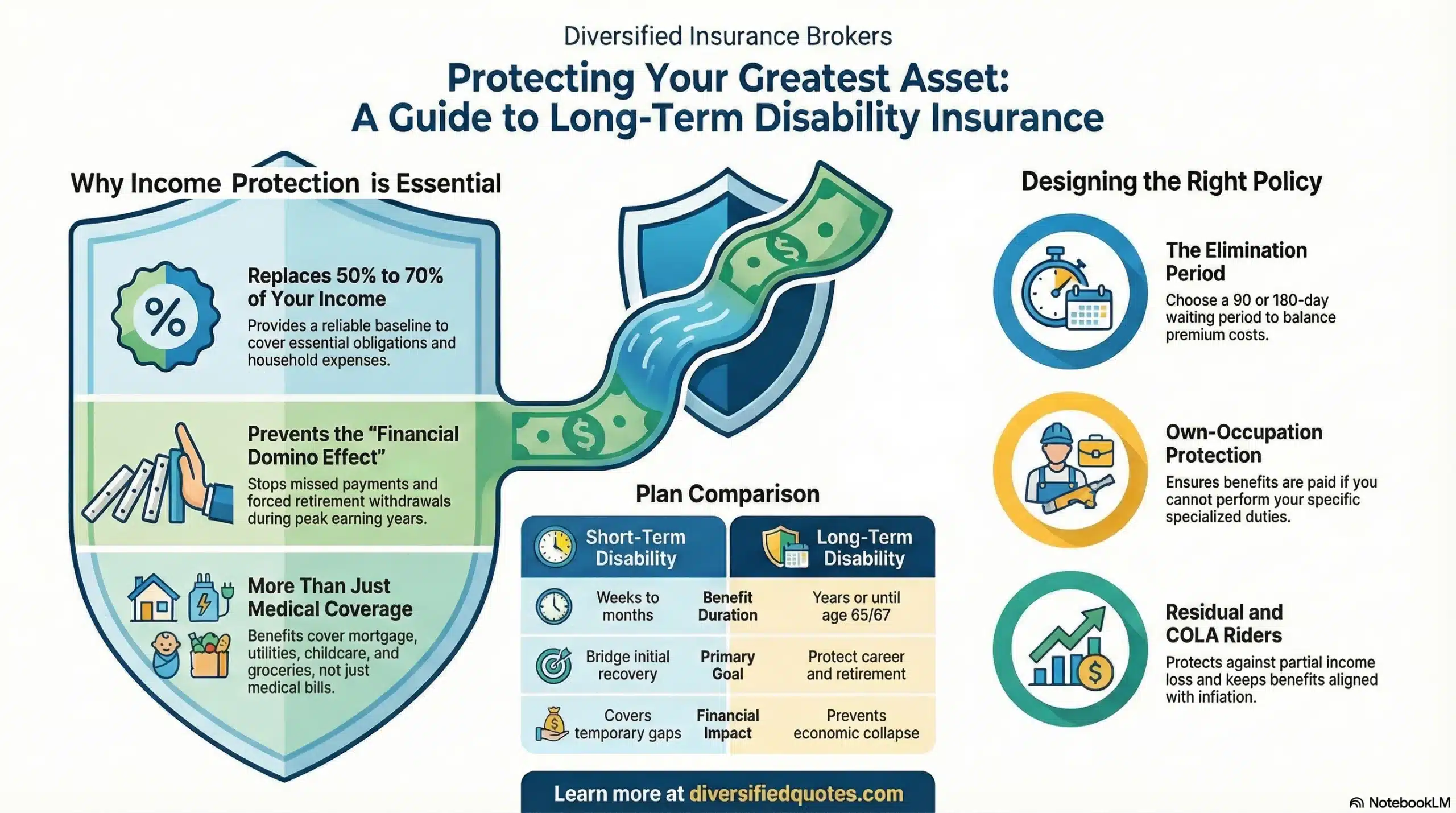
The benefit period should extend to retirement age — long-term disability insurance to age 65 ensures career-long protection against conditions that permanently prevent assessment work. The elimination period should be calibrated against available sick leave or savings; government assessors with meaningful sick leave accruals may comfortably absorb a standard 90-day EP, while independent assessors with no employer sick pay should consider 30-60 day periods. The residual disability rider is particularly valuable for assessors whose physical limitations may reduce daily inspection volume without completely eliminating the ability to work — the most realistic disability scenario for this profession involves partial capacity loss rather than total inability. The full rider framework is at disability insurance riders explained. The tax treatment of individually owned policy benefits — generally received income-tax-free when premiums are paid personally after tax — is at are disability insurance payments taxable. The benefit sizing calculation for assessors with variable volume-based income is at how much disability insurance do I need. The analytical precision parallel — professions like actuaries, economists, and private investigators whose income depends on the specific analytical capabilities their profession requires — all benefit from the same own-occupation definitional protection. For an independent evaluation of any existing or proposed policy, get a 2nd opinion on your disability insurance quote covers the review process.
Talk With an Advisor Today
Choose how you’d like to connect—call or message us, then book a time that works for you.
Schedule here:
calendly.com/jason-dibcompanies/diversified-quotes
Licensed in all 50 states • Fiduciary, family-owned since 1980
FAQs: Disability Insurance for Assessors
What occupational class do assessors typically qualify for?
Assessors typically fall in a middle occupational class that reflects the hybrid nature of the work — better than manual laborers because of the analytical and reporting functions, but generally not at the top tier available to pure desk professionals because of the physical field inspection requirements. The specific class assigned depends significantly on how the actual duty balance is described: assessors who primarily do analytical valuation and reporting with limited field work may qualify for a more favorable class than those doing primarily physical inspections daily. Independent broker comparison helps identify which carrier evaluates the specific duty profile most favorably for the individual assessor’s actual work structure.
What is the 24-month transition risk for assessors with group LTD coverage?
Most group LTD plans switch from an own-occupation standard to an any-occupation standard at 24 months of disability. For assessors, this creates a significant denial risk: a carrier that characterized the job generically as “office work” or “business and financial operations” may argue at 24 months that an assessor who cannot perform field inspections due to a physical condition could still do general desk or financial analysis work — meeting the any-occupation standard. In 2026, 71% of insurers use AI in claims decisions, which has increased the rate at which claims are flagged and denied at this transition point. Individual own-occupation policies that maintain the correct professional standard for the full benefit period eliminate this vulnerability entirely.
Do government/municipal assessors need individual disability insurance if they have government benefits?
Yes, for most government assessors. Government pension disability provisions apply any-occupation standards, cap benefits at defined percentages of salary that may fall well below actual income needs, and may require the employee to be disabled from “any occupation” — not just assessment work — before benefits are payable. Individual supplemental coverage fills the gap between what government provisions actually provide and what full income replacement requires. Government disability provisions should be reviewed specifically before determining how much individual coverage is needed to address the real financial exposure.
What are the most realistic disability scenarios for assessors?
The most realistic physical disability scenarios involve the field inspection component: back conditions from repetitive stair climbing and walking uneven terrain at properties, knee injuries that limit mobility across multiple daily site visits, and vehicle accidents from high daily mileage between inspection locations. Slips and falls at inspection sites — particularly at damaged properties, construction sites, or properties with uneven terrain — represent a consistent acute injury risk. For cognitive disability, stress-related conditions, depression, anxiety, and neurological conditions affecting judgment and analytical accuracy all represent realistic threats to the valuation quality that assessment work requires. The most common disability outcome for assessors is partial capacity loss — reduced inspection volume or analytical quality — rather than complete inability to work, making the residual disability rider particularly valuable.
How does income documentation work for independent or fee-based assessors?
Independent and fee-based assessors document income through tax returns — typically Schedule C for sole proprietors or business returns for LLC and S-corporation structures. Carriers require two to three years of returns to establish a consistent net income baseline, averaging across years to account for variability in assessment volume, market activity, and economic cycles. The net income figure — gross assessment fees and commissions minus documented business expenses — is used for benefit sizing, not gross revenue. For insurance adjusters on a hybrid salary-plus-commission structure, the total documented earned income from all sources is averaged. Independent assessors with variable year-to-year income should work with an independent broker experienced in self-employed income documentation to ensure the benefit amount accurately reflects actual financial exposure.
About the Author:
Jason Stolz, CLTC, CRPC, DIA, CAA and Chief Underwriter at Diversified Insurance Brokers (NPN 20471358), is a senior insurance and retirement professional with more than 25 years of real-world experience helping individuals, families, and business owners protect their income, assets, and long-term financial stability. As a long-time partner of the nationally licensed independent agency Diversified Insurance Brokers, Jason provides trusted guidance across multiple specialties—including fixed and indexed annuities, long-term care planning, personal and business disability insurance, life insurance solutions, Group Health, Travel Medical and Evacuation Insurance, and short-term health coverage. Diversified Insurance Brokers maintains active contracts with over 100 highly rated insurance carriers, ensuring clients have access to a broad and competitive marketplace.
His practical, education-first approach has earned recognition in publications such as VoyageATL, and contributions from his agency featured in Kiplinger and GoBankingRates— highlighting his commitment to financial clarity and client-focused planning. Drawing on deep product knowledge and years of hands-on field experience, Jason helps clients evaluate carriers, compare strategies, and build retirement and protection plans that are both secure and cost-efficient. Visitors who want to explore current annuity rates and compare options across multiple insurers can also use this annuity quote and comparison tool.
Explore More Disability Insurance Options: Browse our complete guide to Disability Insurance for Legal, Finance & White Collar Professionals — covering attorneys, accountants, bankers, executives, financial planners & business professionals from 100+ carriers.
Last Reviewed: June 6, 2026 |
Reviewed by: Jason Stolz, CLTC, CRPC, DIA, CAA
Chief Underwriter, Diversified Insurance Brokers, Inc. | NPN: 20471358 | Diversified Insurance Brokers, Inc. — Licensed in all 50 states
Fact Checked by: Tonia Pettitt, CMIP©
Medicare Specialist, Diversified Insurance Brokers, Inc. | NPN: 14374308 | Diversified Insurance Brokers, Inc. — Licensed in all 50 states
Did you find this content helpful? Leave us a Google review — it helps others find trustworthy guidance too.
Editorial Standards: Diversified Insurance Brokers maintains rigorous editorial standards to ensure accuracy, clarity, and independence in all content. Learn more about our editorial standards and commitment to transparency.
