
Disability Insurance for Agronomist
As an Independent Disability Insurance Broker, we have access to exclusive discounts and negotiated pricing most captive agents can’t offer — see the full breakdown near the end of this page.
Disability Insurance for Agronomist

Jason Stolz CLTC, CRPC, DIA, CAA
Agronomy sits at a professional intersection that most disability insurance buyers do not fit neatly into: it requires both intellectual expertise and consistent physical field presence, combining the analytical demands of a scientific profession with the environmental exposure and physical activity of outdoor fieldwork. An agronomist’s value to clients — whether farmers, seed companies, agricultural consultants, crop protection firms, or research institutions — depends on the ability to conduct site visits, collect soil and crop samples, assess field conditions, and translate those observations into precise, actionable recommendations. That work cannot be fully replicated from a desk. A condition that prevents field mobility, limits sustained analytical capability, or forces an extended absence from client operations creates real and immediate income disruption. The disability insurance services available to agricultural science professionals are designed to protect that income, and the income protection insurance framework covers how policies are structured for professionals whose work combines field activity with advisory expertise — a profile that fits most working agronomists closely.
According to Bureau of Labor Statistics data, agricultural and food scientists including agronomists earned a median annual salary of approximately $80,060 as of 2024, with experienced professionals in specialized consulting roles earning $134,830 or more. Many agronomists hold the Certified Crop Adviser (CCA) or Certified Professional Agronomist (CPAg) designation, which represents years of professional investment that generates premium client relationships and income. A disability that interrupts the ability to service those client relationships — even temporarily — can create income loss that significantly outpaces the cost of any protection policy. The risk is amplified for the large share of agronomists who work independently or through small consulting practices, where there is no employer-funded disability coverage to fall back on and no team to absorb workload during recovery. The broader planning context for field-based agricultural professionals is covered at disability insurance for the agriculture industry.
At Diversified Insurance Brokers, we help agronomists and crop science consultants build disability income strategies that reflect the hybrid nature of their work — protecting both the field-active component that requires physical capability and the advisory component that depends on cognitive function and client availability.
Compare Disability Insurance for Agronomists
We compare coverage across 100+ carriers and structure policies around your income, field work profile, and employment arrangement.
Request Disability Insurance OptionsDisability Insurance for Agronomists — Occupational Profile, Risk Factors, and Coverage Design
| Coverage Dimension | How It Applies to Agronomists | What the Right Design Looks Like |
|---|---|---|
| Occupational class | Agronomists typically qualify for occupational class 4 or 5 — reflecting the college-educated professional baseline and primarily advisory/analytical work — which produces favorable premium rates relative to purely physical trades while accounting for the field work component that distinguishes agronomy from pure desk roles | Accurate occupation description on the application — specifying the advisory, consulting, and scientific analysis components of the role alongside field work — ensures the highest available class is assigned; some carriers may classify differently based on the field-to-office work ratio |
| Definition of disability | The hybrid nature of agronomy means a disability affecting field capability — mobility, outdoor physical function, stamina for extended site visits — may leave cognitive consulting capacity intact, and vice versa; the definition determines whether either of these partial impairments triggers benefits | True own-occupation: pays benefits when you cannot perform the material duties of your specific agronomist role — field assessments, soil and crop sampling, client site visits, precision recommendations — even if you could theoretically work in another capacity; residual coverage addresses partial income loss when only some duties are affected |
| Seasonal income patterns | Agronomist income is often concentrated in planting and harvest seasons, when field demand peaks and consulting volume is highest; a disability that strikes during peak season can produce disproportionate annual income loss relative to when it might occur at other times of year | Benefit calculations based on annualized income averaging rather than a single month’s earnings; for self-employed agronomists with variable income, carriers typically require two to three years of tax returns to establish an accurate income baseline for benefit sizing |
| Physical field risks | Field agronomists regularly work on uneven farm terrain, conduct repetitive soil sampling with hand tools, drive significant distances between rural client sites, work in variable weather including summer heat, and handle and are potentially exposed to agricultural chemicals and fertilizers | Coverage for both injury and illness from any cause — not just on-the-job incidents; rural vehicle accident risk from extensive driving between farm sites is a genuine exposure; musculoskeletal conditions from repeated sampling postures and uneven terrain walking are the most common physical disability categories in field science roles |
| Self-employed and consulting structure | Many agronomists work independently or own small consulting practices; there is no employer short-term disability, no employer-funded LTD, and no team to absorb client responsibilities during recovery; the individual policy is the entire income protection plan, not a supplement to existing benefits | Individual LTD sized to actual household and practice obligations; Business Overhead Expense coverage for practice-owning agronomists whose fixed consulting costs — office space, software, vehicle, licensing, professional liability insurance — continue when field work stops |
| Cognitive and analytical risk | Precision agronomy recommendations — soil nutrient plans, crop protection strategies, yield optimization — require sustained analytical accuracy; errors carry meaningful consequences for client operations; conditions affecting cognitive function, sustained concentration, or professional judgment can compromise the advisory role even when physical field capability is intact | Mental and nervous condition coverage with unlimited benefit periods — rather than 24-month group plan caps — protects against cognitive or mental health conditions that prevent professional-level advisory work; own-occupation language should cover the analytical advisory function as part of the defined occupational duties |
How Agronomists Are Classified and Why It Affects Coverage
Disability insurance carriers assign occupational classes that determine the quality of available policy definitions, available benefit amounts, and premium pricing. Agronomists — as college-educated professionals whose work is primarily advisory, analytical, and consulting-driven — typically qualify for the 4th or 5th occupational class, which represents favorable rates and access to strong own-occupation definitions. This is meaningfully better than purely physical outdoor or agricultural trade roles, and reflects the professional and scientific character of the work. The full occupational classification framework that applies across all professions is covered at disability insurance by occupation. The classification sits in the same general range as other field-based science professionals — geologists who conduct site surveys and field sampling, biologists who work across both laboratory and field environments, and botanists whose plant science work combines outdoor field assessment with analytical reporting. The broader professional coverage framework for scientific and advisory roles is at disability insurance for white-collar professionals.
The Own-Occupation Definition — Why It Matters for Field Advisory Professionals
The disability definition determines whether a condition that genuinely disrupts an agronomist’s career produces benefit payments or a denial. For a profession that combines field physical work with professional advisory responsibility, the distinction matters in two directions. A physical condition — a back injury, knee problem, or mobility limitation — that prevents the field-visit component of agronomic practice may still leave the agronomist capable of desk-based consulting or teaching, which under any-occupation language could justify a denial. A cognitive or stress-related condition that prevents the precision advisory work may leave the person physically capable of other employment, with the same result under broader definitions. True own-occupation disability coverage pays benefits when the agronomist cannot perform the material duties of their specific role — field site assessments, soil and crop sampling and analysis, client advisory work, and precision recommendations — regardless of what other work remains theoretically possible. This is the same definition principle that neighboring agricultural and field science professionals depend on: horticulturists whose client advisory work requires physical plant evaluation, veterinarians in agricultural practice whose clinical work requires physical capacity, and forest and park rangers whose outdoor field responsibilities cannot be replicated from a sedentary role.
Physical Risk in Agricultural Field Work
The physical exposure of agronomy field work is real and consistent across the career. Uneven terrain on working farms — plowed fields, rutted access roads, sloped terrain between test plots — creates a fall and ankle injury exposure with every site visit. Repetitive soil sampling using core samplers and augers requires repeated kneeling, bending, and torque motions that accumulate musculoskeletal stress across years of practice. Rural driving between farm client sites represents one of the more consistent but underappreciated injury risks: agronomists in active consulting practices may drive tens of thousands of rural miles annually, with the accident risk that comes with rural roads, farm vehicle crossings, and variable road conditions. Chemical exposure from agrochemical field environments — fertilizers, herbicides, pesticides, fungicides — creates both acute and chronic health exposure depending on the type and frequency of contact. Summer heat and sun exposure during peak season field work creates heat-related illness risk during the most intensive work periods of the year. These risks parallel the exposure profile of other agricultural field professionals — farm operators who face similar terrain and chemical exposure, and chemists who carry chemical exposure risk in different professional settings. The key coverage principle is that disability from any cause — field injury, illness, vehicle accident, or health condition — is covered under a comprehensive individual policy.
Residual Disability and How Recovery Actually Works
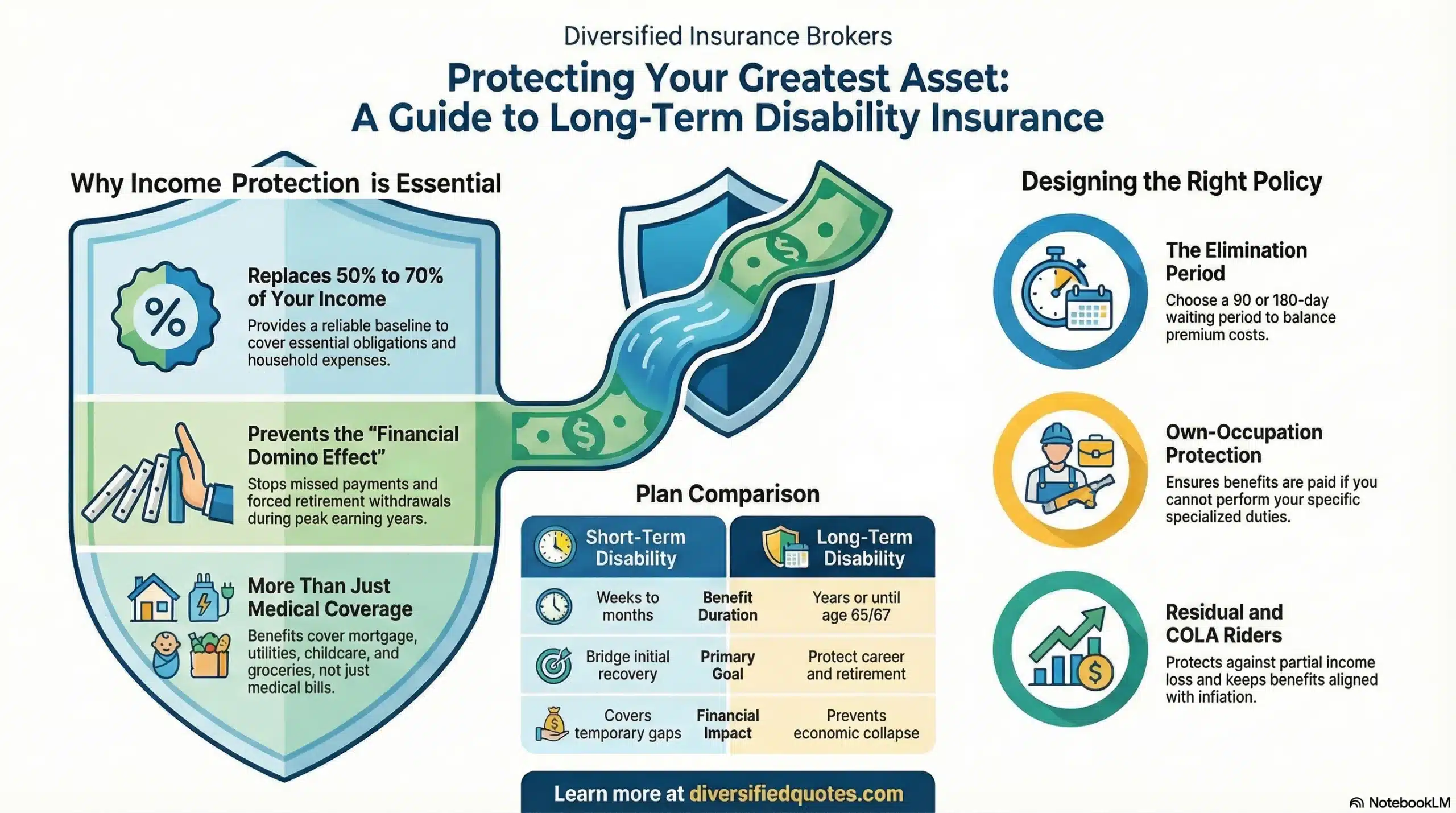
Most disability claims for field science professionals do not follow an all-or-nothing pattern. A back condition that limits terrain walking may still allow office and client call consulting. A knee injury may allow reduced field work at lower volume while some income continues. A stress-related condition may allow lighter client loads while full-capacity recovery is underway. In each scenario, income drops — sometimes significantly — without reaching the total disability threshold. The residual disability rider pays proportional benefits when income drops 20-25%+ from a qualifying condition, covering the partial recovery phase that is often the longest and most financially stressful period of a disability event for self-employed professionals. For an independent agronomist whose consulting income is directly tied to field and client capacity, the residual rider is frequently more valuable in practice than total disability coverage — because it addresses the real-world partial disruption pattern, not only the extreme scenario of complete inability to work.
Policy Design — Elimination Periods, Benefit Periods, and Riders
The elimination period for an agronomist’s policy should reflect available cash reserves and the seasonal income pattern: a back injury during harvest season produces immediate income impact, while the same injury during a slower period may be bridgeable for longer before benefits become critical. Most agronomists working independently should consider 90-day elimination periods as a reasonable balance between affordability and practical cash-flow protection. The benefit period should extend to retirement age — long-term disability insurance with a to-age-65 or to-age-67 benefit period provides protection against career-ending conditions that a 2- or 5-year benefit cap would leave fully exposed. The rider package that adds the most value for agronomists includes the cost-of-living adjustment rider for long-duration claims, the future increase option for early-career professionals whose income is still growing, and the residual rider discussed above. The full rider landscape is at disability insurance riders explained.
Independent Consultants and Practice-Owning Agronomists
For agronomists who operate their own consulting practice or work as independent contractors, the disability exposure extends beyond personal income. Fixed practice costs — vehicle leases or payments used for farm travel, professional liability insurance, software subscriptions, office or lab space, CCA or CPAg certification maintenance fees — continue regardless of whether client work is being performed. A personal LTD policy covers household income. Business overhead disability insurance covers documented fixed practice costs during a disability period, keeping the consulting operation from deteriorating while recovery occurs. For self-employed agronomists whose income documentation comes from Schedule C or Schedule F rather than a W-2, the application process requires two to three years of tax returns and an income averaging methodology to establish the right benefit amount — how much disability insurance do I need covers this sizing process. Benefits from individually owned policies paid with after-tax dollars are generally received income-tax-free, a meaningful advantage for independent consultants in higher tax brackets — the full breakdown is at are disability insurance payments taxable. For independent agronomists who have received an existing quote or want an evaluation of current coverage before committing, get a 2nd opinion on your disability insurance quote covers what an independent review involves.
Talk With an Advisor Today
Choose how you’d like to connect—call or message us, then book a time that works for you.
Schedule here:
calendly.com/jason-dibcompanies/diversified-quotes
Licensed in all 50 states • Fiduciary, family-owned since 1980
FAQs: Disability Insurance for Agronomists
What occupational class do agronomists typically qualify for?
Most agronomists qualify for occupational class 4 or 5, reflecting the college-educated professional and primarily advisory/analytical nature of the work. This is meaningfully more favorable than purely physical or trade occupations, and it produces access to better policy definitions and more competitive premium rates. The specific class depends on the carrier and on how the application describes the ratio of field work to office and consulting work — accurately representing the professional advisory and scientific analysis components of the role typically supports the highest available classification.
What physical risks do agronomists face that could lead to a disability?
The most common physical disability risks for agronomists include falls and ankle injuries on uneven farm terrain during site visits, musculoskeletal conditions from repetitive soil sampling postures (kneeling, bending, torque from core samplers and augers), vehicle accidents from extensive rural driving between client farms, heat-related illness during peak summer field season, and chemical exposure from agrochemical field environments. These risks accumulate across a career of intensive field work and can produce gradual onset conditions — back and knee problems in particular — that limit field capacity before forcing complete inability to work.
Do independent consulting agronomists need different coverage than salaried employees?
Yes — significantly. Independent agronomists and consulting practice owners have no employer disability coverage as a fallback, making the individual policy the entire income protection plan. Self-employed agronomists also carry fixed business overhead costs — vehicle, professional liability insurance, software, licensing, office — that continue during disability and are not covered by a personal LTD policy. A Business Overhead Expense policy addresses that second layer. Income documentation for self-employed applicants requires two to three years of tax returns rather than a W-2, and benefit sizing must account for income variability across seasons and business cycles.
Why is residual disability coverage especially important for agronomists?
Most agronomist disabilities involve partial rather than total impairment — a back condition that limits terrain walking but allows office consulting, a knee injury that reduces field capacity while some client work continues, or a health condition that permits lighter engagement during recovery. In all of these scenarios, income drops meaningfully without meeting the total disability threshold, and a policy without residual coverage provides no benefit payment during that partial recovery phase. For self-employed agronomists whose income directly tracks field and client availability, residual coverage is frequently the feature that produces actual financial support during the realistic recovery pattern for common injury types.
How much disability insurance does an agronomist typically need?
Coverage should be sized to actual monthly essential expenses — mortgage or rent, vehicle, household utilities, debt service, professional overhead obligations, and family costs — rather than to a generic income percentage. Median agronomist income of approximately $80,000 annually, with experienced consultants earning significantly more, means individual policies sized to 60-70% of gross income typically produce $4,000-$6,500 or more in monthly benefit. Benefits from individually owned policies paid with after-tax premiums are generally received income-tax-free, which improves the effective replacement ratio relative to the gross benefit amount.
About the Author:
Jason Stolz, CLTC, CRPC, DIA, CAA and Chief Underwriter at Diversified Insurance Brokers (NPN 20471358), is a senior insurance and retirement professional with more than 25 years of real-world experience helping individuals, families, and business owners protect their income, assets, and long-term financial stability. As a long-time partner of the nationally licensed independent agency Diversified Insurance Brokers, Jason provides trusted guidance across multiple specialties—including fixed and indexed annuities, long-term care planning, personal and business disability insurance, life insurance solutions, Group Health, Travel Medical and Evacuation Insurance, and short-term health coverage. Diversified Insurance Brokers maintains active contracts with over 100 highly rated insurance carriers, ensuring clients have access to a broad and competitive marketplace.
His practical, education-first approach has earned recognition in publications such as VoyageATL, and contributions from his agency featured in Kiplinger and GoBankingRates— highlighting his commitment to financial clarity and client-focused planning. Drawing on deep product knowledge and years of hands-on field experience, Jason helps clients evaluate carriers, compare strategies, and build retirement and protection plans that are both secure and cost-efficient. Visitors who want to explore current annuity rates and compare options across multiple insurers can also use this annuity quote and comparison tool.
Explore More Disability Insurance Options: Browse our complete guide to Disability Insurance for Agriculture, Natural Resources & Outdoor Industries — covering farmers, ranchers, fishermen, foresters, miners, oil & gas workers & outdoor industries from 100+ carriers.
Last Reviewed: June 6, 2026 |
Reviewed by: Jason Stolz, CLTC, CRPC, DIA, CAA
Chief Underwriter, Diversified Insurance Brokers, Inc. | NPN: 20471358 | Diversified Insurance Brokers, Inc. — Licensed in all 50 states
Fact Checked by: Tonia Pettitt, CMIP©
Medicare Specialist, Diversified Insurance Brokers, Inc. | NPN: 14374308 | Diversified Insurance Brokers, Inc. — Licensed in all 50 states
Did you find this content helpful? Leave us a Google review — it helps others find trustworthy guidance too.
Editorial Standards: Diversified Insurance Brokers maintains rigorous editorial standards to ensure accuracy, clarity, and independence in all content. Learn more about our editorial standards and commitment to transparency.
