
Disability Insurance for Geologists
As an Independent Disability Insurance Broker, we have access to exclusive discounts and negotiated pricing most captive agents can’t offer — see the full breakdown near the end of this page.
Disability Insurance for Geologists

Jason Stolz CLTC, CRPC, DIA, CAA
Disability insurance for geologists is an important and often overlooked income protection planning area for earth science professionals whose working conditions, income structures, and occupational hazard exposures vary dramatically across the spectrum of geological practice — from pure office-based consulting and academic research at highly favorable disability insurance classifications to active field geology in oil and gas extraction, mining, and environmental remediation settings where hazard profiles are among the most serious in any professional occupation. Whether you work as a petroleum geologist supporting exploration and production operations in the oil and gas industry, conduct environmental geology investigations at contaminated site remediations, perform mining geology in underground or surface mine settings, provide geotechnical consulting for civil engineering projects, work in academic or governmental geological research with significant field components, or consult independently as a licensed professional geologist — your income depends on your ability to continue performing the specific analytical, technical, and field work that defines your professional practice.
The disability insurance planning context for geologists is more nuanced than for most professions because the profession spans such a wide range of actual working conditions and hazard exposures. A petroleum geologist spending the majority of their career in office-based reservoir modeling and interpretation work for an energy company occupies a fundamentally different occupational risk profile from a field geologist conducting geological mapping in remote mountain terrain, a mining geologist working underground in an active mine, or an environmental geologist working on contaminated site investigations with chemical exposure. Disability insurance classification, premium rates, policy availability, and coverage terms vary significantly based on which of these professional modes a geologist actually performs — making accurate occupational duty presentation and experienced independent broker guidance essential for securing appropriate coverage at the most favorable available terms.
At Diversified Insurance Brokers, we help geologists across all practice settings — petroleum geology, mining geology, environmental geology, geotechnical consulting, academic research, and independent consulting — structure disability insurance coverage that accurately reflects their specific professional duties, income structure, and the disability risks most relevant to how they actually work.
Protect Your Geological Professional Income
Compare disability insurance options designed for geologists across all practice settings — petroleum, mining, environmental, geotechnical, research, and independent consulting.
The Occupational Classification Spectrum for Geologists
One of the most practically important facts about disability insurance for geologists is that occupational classification — which determines premium rates, available policy features, and benefit period options — varies significantly based on the actual duties a geologist performs rather than the job title alone. Disability insurance underwriting specifically evaluates what a geologist does in practice, not merely the professional credential they hold.
Geologists whose work is primarily office-based — conducting data interpretation, modeling, reporting, consulting, and analysis with minimal fieldwork — typically receive favorable occupational classifications that provide access to strong own-occupation definitions, competitive premium rates, and benefit periods extending to age 65 or later. Published occupational classification guidance specifically identifies that field geologists with no hazardous work involved can be classified at the 2A tier, while geologists whose office consulting or analytical functions are their primary duty may qualify for even more favorable classifications approaching those available to engineers and other technical professionals in predominantly office-based analytical work.
Geologists whose work involves significant active fieldwork — particularly in oil and gas extraction environments, mining settings, or remote terrain investigations — face different underwriting considerations that reflect the genuine hazard exposure of those field environments. For these professionals, accurate and strategic duty description is essential for achieving the most favorable available classification rather than an unnecessarily restrictive one that over-weights the hazardous field component relative to the total professional duty profile. This classification nuance is directly parallel to the distinction faced by other scientific and engineering professionals whose classification varies based on actual duty split between office and field work, including engineers whose disability insurance classification depends critically on the office-versus-field split in their actual duties.
Petroleum Geologists — Oil and Gas Field Hazards and Income Protection
Petroleum geologists working in active oil and gas extraction environments face occupational hazard exposures that are among the most serious in any professional science context. Published research documents that the oil and gas extraction industry has a fatality rate 7 times higher than general industry and 2.5 times higher than the construction industry — an extraordinary hazard level for an industry that employs a significant share of active petroleum geologists who work on-site at drilling operations, well sites, and production facilities.
OSHA specifically identifies highway vehicle crashes as the leading cause of oil and gas extraction worker fatalities — accounting for roughly 4 in 10 deaths in the industry. Wells are frequently located in remote areas requiring long-distance travel on rural roads and field access routes that present substantially more hazardous driving conditions than urban and suburban roadways. A petroleum geologist conducting regular well site visits, traveling between production facilities, and commuting to remote exploration sites accumulates substantial vehicle travel risk that is specific to the field dimensions of their professional practice.
Chemical exposure hazards in oil and gas field settings affect geologists who conduct sampling, core analysis, and on-site investigation work. NIOSH specifically identifies crystalline silica exposure from hydraulic fracturing operations as a documented occupational health hazard at levels exceeding occupational health standards for workers in active fracking site environments. Benzene exposure, hydrogen sulfide, and other hydrocarbon-associated chemical hazards create occupational illness risk for geologists who work in close proximity to production equipment and drilling operations. The long-latency respiratory and chemical illness disability risks facing petroleum geologists from field chemical exposure parallel those documented in other sustained field chemical exposure contexts, including chemists and analytical scientists managing occupational chemical exposure disability risk in field and laboratory environments.
Mining Geologists — Underground and Surface Mine Hazard Exposure
Mining geologists who work in active mine environments — whether underground hard rock or coal mines, surface open pit operations, or quarry environments — face occupational hazard conditions that represent the most hazardous extreme of the geological practice spectrum. The International Labour Organization documents that mining accounts for approximately 8% of fatal accidents at work globally while representing only 1% of the global workforce — a fatality burden that reflects the genuine and severe hazards of mine environments.
Mining occupational health hazards specifically documented in the AIHA and NIOSH literature include crystalline silica dust generating progressive silicosis risk, pneumoconiosis from coal and mineral dust exposure, noise-induced hearing loss from drilling and blasting operations, heavy metal contamination from mine mineral processing, whole-body vibration from heavy equipment operation, musculoskeletal disorders from manual rock handling and confined space work, and the acute injury risks of working in environments with active blasting, ground instability, and large mobile equipment. A mining geologist who develops disabling silicosis from career silica dust exposure — a progressive and irreversible lung disease — faces a genuine long-latency occupational disability that individual disability insurance specifically covers regardless of how many years after initial dust exposure the disabling illness develops.
The mine environment disability risk facing mining geologists — combining long-latency occupational illness from mineral dust exposure with acute injury risk from mine operations — creates a multi-dimensional disability planning challenge that requires experienced broker guidance to address effectively. The biological hazard disability risk from sustained mineral and chemical exposure parallels documented outcomes in other extreme occupational exposure contexts, including biological researchers and field scientists managing occupational illness risk from sustained environmental and chemical exposure.
Environmental and Field Geologists — Remote Terrain and Contamination Site Risks
Environmental geologists and field geologists conducting site investigations, geological mapping, and sample collection work in remote and challenging terrain face a different but equally genuine set of disability risks — combining the acute physical injury risk of outdoor fieldwork in remote locations with chemical exposure risk at contaminated site investigations and the vehicle travel risk associated with accessing remote field sites.
Falls and physical injuries during field geological work are a documented occupational hazard for geologists conducting geological mapping and sample collection in steep terrain, cliff and outcrop exposures, and structurally complex geological settings that require navigating challenging physical environments to access exposures. A field geologist conducting geological mapping in mountain terrain faces the same fall and terrain navigation physical injury risks that affect other remote outdoor professionals — and the remote location of that fieldwork means that emergency medical response, when needed, may be significantly delayed.
Contaminated site environmental geologists face chemical exposure risk from the full range of industrial contaminants present at remediation sites — volatile organic compounds, heavy metals, pesticides, and other hazardous materials that represent occupational health hazards requiring appropriate personal protective equipment and exposure monitoring. Long-term health consequences from contaminated site chemical exposure represent a genuine long-latency disability risk for environmental geologists who conduct investigation work at sites with significant contamination burdens. The remote terrain physical injury risk and contaminated site chemical exposure disability risk facing field geologists parallel those documented for other scientific field professionals working in challenging outdoor environments, including agricultural and land management professionals managing remote outdoor occupational disability risk.
The Income Structure of Geological Practice — Employed, Consulting, and Academic Geologists
Disability insurance planning for geologists also requires understanding the income structure of geological practice, which varies significantly across employment contexts and has important implications for both the type of coverage most appropriate and the income documentation needed for underwriting.
Geologists employed by oil and gas companies, mining companies, and consulting firms typically receive W-2 income and may have access to employer group long-term disability coverage as part of their employment benefits package. For these employed geologists, the planning question is whether employer group coverage adequately protects their full professional income — including bonuses, field allowances, and other supplemental compensation that group plans typically exclude — and whether the group plan’s own-occupation definition provides genuine field geology practice protection rather than converting to an any-occupation standard after two years of disability.
Independent consulting geologists and self-employed geological consultants face the sharper version of the disability insurance need: Schedule C self-employment income that stops entirely when a disability prevents consulting work, with no employer group plan, no sick pay, and no institutional safety net. Individual disability insurance is the only meaningful income protection for this population, and the income documentation for Schedule C geological consulting income requires specific handling to ensure the benefit amount reflects genuine professional earning capacity rather than a tax-minimized net income figure. The self-employment income protection planning needs of independent consulting geologists closely parallel those of other self-employed scientific and technical consulting professionals, including actuaries and independent technical consultants managing self-employment income protection and disability coverage.
Academic geologists at universities and research institutions typically have access to university employee group disability plans and may have TIAA-CREF or similar defined contribution retirement plans — but the same group plan coverage limitations apply: benefit amounts calculated on base salary excluding research stipends and consulting income, own-occupation definitions that may not protect specialized research and field geology duties, and portability limitations when career moves occur. For academic geologists with significant consulting income alongside institutional salary, coordinating group and individual coverage to protect total compensation requires specific planning attention.
Case Study: Petroleum Geologist Earning $145,000 Per Year
Consider a petroleum geologist employed by a mid-sized exploration and production company, earning $145,000 annually including base salary and field-related supplemental compensation. This geologist conducts regular well site visits and on-site geological supervision of drilling operations. Following a serious vehicle accident on a remote field access road — documented as the leading cause of oil and gas worker fatality — this geologist sustains spinal trauma and traumatic brain injury requiring nine months of rehabilitation during which active field geology work is medically prohibited.
| Scenario | Employer Group Plan Only | Group Plan + Individual Supplement |
|---|---|---|
| Monthly Benefit During Disability | ~$5,500 (60% of base salary; field supplements excluded) | ~$5,500 group + $2,800–$3,500 individual supplement |
| Field Supplement Income Protected | $0 — entirely excluded from group benefit calculation | Individual policy calibrated to total professional compensation |
| 9-Month Total Income | ~$49,500 | ~$74,700–$81,000 |
| Own-Occupation Protection After Year 2 | Shifts to any-occupation — field geology disability may not qualify | Individual own-occupation definition maintained for full benefit period |
Vehicle accidents on remote access roads to well sites and exploration locations are the leading cause of oil and gas industry fatalities — and the non-fatal vehicle accidents producing serious spinal and traumatic brain injuries represent a corresponding and predictable disability event for field-active petroleum geologists. Disability insurance for geologists ensures that a field accident does not also become a financial crisis during a recovery period that may require months before return to active geological field work is medically appropriate.
The Offshore and Remote Assignment Dimension
Some petroleum and marine geologists work on offshore drilling platforms, research vessels, and remote international assignments — contexts that create additional disability risk dimensions beyond standard onshore field geology hazards. Offshore platform work involves the combination of marine environment hazards, drilling operation proximity risks, helicopter transport to and from the platform, and the remote medical response limitations of an offshore location where evacuation to shore-based medical care may require hours in adverse weather.
Remote international geological assignments — particularly in developing regions with limited medical infrastructure — create a specific disability planning consideration: the quality of emergency medical care available during the initial hours and days following a serious injury or acute illness is directly relevant to both immediate medical outcomes and long-term disability consequences. A geologist injured or acutely ill in a remote international field assignment may face medical evacuation to a major medical center as the first step in their care — a process that can take 24 to 72 hours — during which the quality of initial treatment significantly influences recovery trajectory and long-term functional outcome. The remote assignment and offshore disability risk that some geologists face parallels the extreme remote medical access challenges documented for other professionals in geographically isolated extreme environments, including professional divers and marine operations professionals managing disability risk in remote and extreme maritime environments.
Key Policy Features for Geologist Disability Insurance
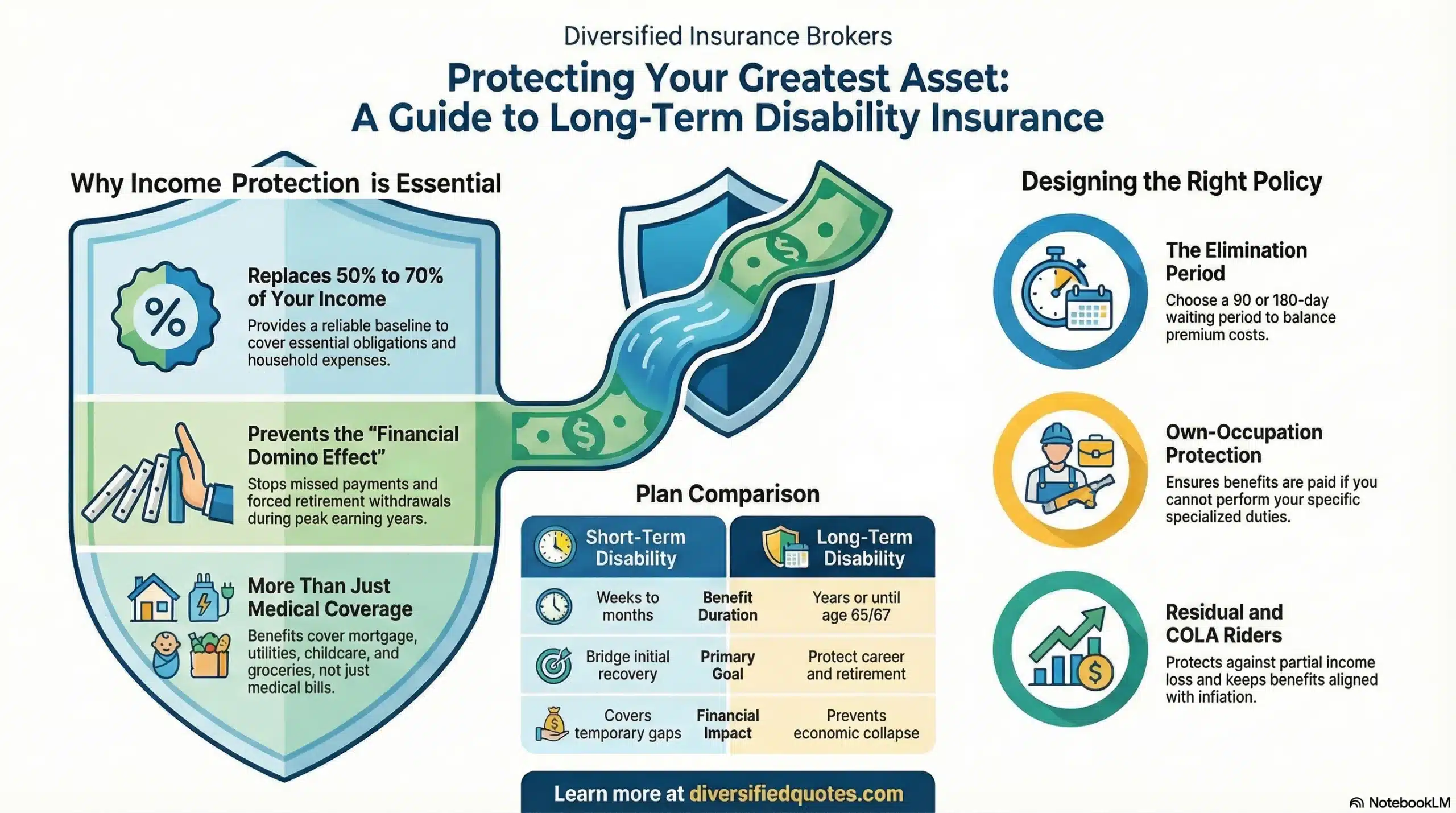
Disability insurance for geologists should incorporate policy provisions appropriate to the specific practice context of the individual geologist — with features calibrated to the field versus office duty balance, employment versus consulting income structure, and the specific disability risks relevant to their geological practice setting. The own-occupation definition is foundational — ensuring that a geologist who cannot perform the specific analytical, interpretive, or field duties of their geological practice receives disability benefits regardless of theoretical capacity for other less specialized work. Our comprehensive resource on own-occupation disability insurance explained covers how this definition protects geological professional income from the conditions most likely to disable a working geologist.
A residual disability rider is important for geologists whose conditions may reduce professional capacity without eliminating it entirely — a petroleum geologist who can perform office-based geological interpretation but cannot manage the physical demands of active well site visits and field sampling earns reduced effective income without being totally disabled. Our resource on how residual disability insurance benefits work explains how partial disability coverage provides proportional income support during these field-to-office capacity transitions. The elimination period should be calibrated to available financial reserves and any employer coverage — our guide on how disability insurance elimination periods work provides the complete framework. A cost-of-living adjustment rider preserves real benefit value across extended disability periods — our resource on disability income insurance with a COLA rider explains this protection. For geologists exploring short-term coverage options alongside long-term disability insurance, our guide on how to buy short-term disability insurance covers the complete income protection picture.
Specialized Geological Roles and Disability Insurance Considerations
The geological profession encompasses a range of specialized roles that carry distinct disability insurance considerations beyond the general framework. Geotechnical engineers and engineering geologists whose work involves construction site investigation, slope stability analysis, and geohazard assessment may work in physically challenging field environments while also holding professional engineering licenses that affect occupational classification. Hydrogeologists conducting well installation and groundwater monitoring in remote locations face physical field demands and chemical sampling exposure that differ from office-based groundwater modeling work.
Geophysicists conducting seismic survey operations — particularly land-based seismic field operations involving remote access, heavy equipment, and significant physical outdoor work — face a distinct occupational risk profile from geophysicists who work in data processing and interpretation roles. Remote sensing and GIS geologists whose work is entirely computer and data based occupy a fundamentally different disability risk and classification landscape from their field-active colleagues. For geologists whose professional work spans multiple of these roles — which is common in consulting geology practice — presenting the accurate duty split to underwriters is essential for achieving the most favorable classification available for the actual professional profile. The duty-based classification complexity facing geologists parallels that documented for other multi-role scientific professionals, including computer engineers and scientists whose disability classification depends on the office-versus-field-versus-laboratory duty balance of their actual work.
Aviation Transport and Helicopter Access Risk for Remote Geologists
Some field geologists — particularly those working in remote petroleum exploration, mining exploration, and glaciological or polar research settings — access work sites by helicopter or small fixed-wing aircraft. Helicopter transport to remote field camps, drilling locations, and geological field sites introduces aviation accident risk as a specific disability and mortality exposure that is distinct from the professional geological work itself but that is an inherent part of the professional practice for geologists assigned to these remote settings. Aviation accidents in remote terrain — where rescue and medical response are significantly delayed — produce outcomes that are disproportionately severe compared to accidents in accessible locations. The aviation transport disability risk facing some remote field geologists parallels that documented for other professional aviation transport users, including pilots and aviation professionals managing aviation accident disability risk in remote and extreme operational environments.
Why Geologists Need an Independent Disability Insurance Broker
Disability insurance for geologists requires duty-specific occupational classification expertise, knowledge of how different geological practice settings affect carrier underwriting approaches, understanding of both employed and consulting geological income documentation, and the ability to identify the carriers and policy structures most appropriate for each geologist’s specific professional situation. A standard retail disability insurance application is not optimized for the geological profession’s classification nuances, and a general insurance agent unfamiliar with the field-versus-office duty split consideration that defines geological occupational classification will not present a geologist’s professional profile in the way most likely to achieve the most favorable available terms.
At Diversified Insurance Brokers, we work with geologists across all practice settings and specializations to structure disability coverage that accurately reflects how individual geologists earn, what conditions would actually prevent them from performing their specific geological professional duties, and what policy features provide the most meaningful financial protection for their professional and personal situation. Our dedicated resource on why independent disability insurance brokers matter explains the full value of this approach for scientific professionals with complex occupational duty profiles. And our resource on whether disability insurance is worth the investment provides the foundational financial rationale that applies with particular force to geological professionals who may have invested years in specialized education and professional development whose financial return depends entirely on their continued ability to practice.
Final Thoughts on Disability Insurance for Geologists
Geologists contribute essential scientific expertise to some of the most economically and environmentally significant industries in the global economy — guiding resource extraction, protecting groundwater systems, assessing geohazards, and advancing our understanding of the planet’s structure and history. The professional income that represents the return on years of advanced geological education and field experience training depends on the ability to continue practicing — and whether a geologist works in a favorable office-based classification or in the more hazardous field environments of oil and gas, mining, or environmental remediation, the financial consequences of a disabling injury or illness are immediate and significant.
Disability insurance for geologists — structured around an accurate occupational duty assessment, calibrated to total professional compensation, built with an own-occupation definition that genuinely protects geological practice income, and supported by residual disability coverage for the partial capacity transitions that many geological disabilities produce — provides the income security that ensures a geological career-building investment is protected against the disability scenarios that the profession’s unique combination of professional and field demands creates.
Related Pages
Talk With an Advisor Today
Choose how you’d like to connect—call or message us, then book a time that works for you.
Schedule here:
calendly.com/jason-dibcompanies/diversified-quotes
Licensed in all 50 states • Fiduciary, family-owned since 1980
Disability Insurance for Geologists FAQs
Occupational classification for geologists varies significantly based on actual duties performed rather than professional title — a fundamental point that has major implications for premium rates, available policy features, and benefit period options. Published disability insurance occupational classification guidance specifically identifies field geologists with no hazardous work as classifiable at the 2A tier. Geologists whose work is primarily office-based analytical, interpretive, and consulting work may qualify for more favorable classifications approaching those available to engineers in purely office and consulting roles. Active field geologists in oil and gas extraction, mining, or environmental remediation settings receive less favorable classifications reflecting the genuine hazard exposure of those work environments. The critical underwriting principle is that classification is determined by the most hazardous duty performed — meaning that a geologist who performs both office analytical work and active oil and gas field work will be classified based on the field component rather than the office component of their duties. Accurately documenting the full duty split — including what percentage of time is spent in office versus field settings and what specific activities the field work involves — is essential for achieving the most favorable available classification for any geologist’s specific professional profile. For context on how duty-based classification works for technical and scientific professionals, see our page on disability insurance for economists and professional technical analysts managing occupational classification effectively.
Petroleum geologists who work in active oil and gas extraction environments face disability risks drawn from one of the most hazardous industrial contexts in the American economy. The oil and gas extraction industry has a fatality rate 7 times higher than general industry and 2.5 times higher than the construction industry — and petroleum geologists who conduct regular well site visits and drilling supervision work are present in this hazardous environment as a regular part of their professional practice. Vehicle accidents on remote access roads to well sites are the leading cause of oil and gas industry fatality, accounting for roughly 4 in 10 deaths — representing a significant acute disability risk for geologists who drive to remote field locations regularly. Chemical exposure hazards at active drilling and production sites — including crystalline silica from hydraulic fracturing, benzene, hydrogen sulfide, and other hydrocarbon-associated chemicals — create occupational illness risk for geologists who work in close proximity to drilling and production equipment. Falls from elevated platforms and equipment at well sites and production facilities represent acute injury risk. And the remote location of much oil and gas field work means that when injuries occur, emergency medical response may be significantly delayed, compounding the medical severity of serious incidents.
Employer group disability plans provide a meaningful baseline for employed geologists but typically leave income protection gaps that individual supplemental coverage specifically addresses. Group long-term disability plans typically replace 60% to 66.67% of base salary and explicitly exclude field allowances, bonuses, overtime, and other supplemental compensation that petroleum and mining geologists frequently receive as part of total compensation in energy and mining industry employment. Many group plans include own-occupation definitions that shift to any-occupation standards after two years — meaning a geologist who is permanently unable to perform active field geology work but could theoretically perform desk-based analytical work may have benefits discontinued. For petroleum geologists whose field work constitutes a meaningful part of both their professional value and their total compensation, this any-occupation conversion is particularly consequential. Individual supplemental disability insurance maintains own-occupation protection for the full benefit period, covers total compensation including field supplements, and remains in force independently of employment status and changes between employers — filling the specific gaps that group coverage leaves open for geologists in active field roles.
Independent consulting geologists — who operate as self-employed professional geologists providing consulting services to energy companies, mining operations, engineering firms, environmental clients, and government agencies — face the acute version of the disability insurance need: when a disability prevents consulting work, professional income stops entirely with no employer group plan, no sick pay, and no institutional safety net of any kind. Individual disability insurance is the only meaningful income protection available for this population. The income documentation for self-employed geological consulting income uses Schedule C or K-1 tax documentation, and the specific way consulting income is presented to underwriters significantly affects the benefit amount available — a point that requires experienced broker guidance to optimize. For consulting geologists whose gross revenues are reduced by business expenses before net income is calculated, working with a broker who understands how to present consulting business income most favorably to underwriters is important for ensuring the benefit amount reflects genuine professional earning capacity. Consulting geologists who also have variable income from multiple project engagements benefit from a benefit amount calculation approach that reflects the full pattern of consulting income rather than a single atypical year. For context on disability insurance for self-employed scientific and technical consultants, see our page on disability insurance for scientific and technical consulting professionals managing self-employment income protection.
Own-occupation disability insurance pays benefits when a disabling condition prevents a geologist from performing the specific duties of their geological professional practice — field investigation work, geological interpretation and analysis, sample collection and testing, geological mapping, subsurface geological modeling, or any other combination of duties specific to their professional role — regardless of whether they could theoretically perform other less specialized work outside geology. Any-occupation coverage only pays if the geologist cannot perform virtually any gainful employment. A petroleum geologist whose traumatic brain injury from a vehicle accident prevents the sustained technical analytical work and field judgment that geological practice requires but who could theoretically perform simple administrative work would receive no any-occupation benefits — while an own-occupation policy recognizes the genuine inability to continue geological professional practice and pays accordingly. For a geologist who has invested years in advanced geological education, technical training, and professional experience development whose value is specific to geological practice, the own-occupation definition is the provision that makes disability insurance genuinely meaningful rather than merely theoretical income protection for extreme scenarios.
Yes — individual disability insurance covers disability from any cause including long-latency occupational illness when the condition meets the policy’s definition of disability. A mining geologist who develops progressive silicosis from career silica dust exposure in mine environments qualifies for disability benefits when the respiratory disease reaches a severity that prevents performing geological professional duties — regardless of how many years after initial mine dust exposure the disabling illness develops. Pneumoconiosis from coal or mineral dust exposure, noise-induced hearing loss affecting professional communication capacity, and other long-latency occupational health conditions common in mine environments all qualify for disability benefits when they produce the functional limitations that define disability under the policy terms. The critical planning implication for mining geologists is timing of application: applying for disability insurance before any respiratory health findings, audiology results, or other occupational health changes from mine environment exposure have been documented in the medical record is essential for ensuring comprehensive coverage without exclusion riders for the very conditions most likely to produce long-latency disability in mine geology practice. Applying early in a career ensures that occupational health consequences that develop later are covered rather than excluded.
Residual disability coverage pays proportional benefits when a disabling condition reduces a geologist’s professional capacity and income without completely eliminating the ability to work. A geologist whose vehicle accident injuries prevent active field work but who can continue performing office-based geological interpretation, modeling, and reporting has a genuine partial disability — income may be reduced because field consulting premiums and field allowances are lost, but the ability to perform office geological work remains intact. Without a residual disability rider, a total-disability-only policy pays nothing during this partial capacity period. A residual rider supplements reduced geological consulting or employment income proportionally throughout the period of reduced field capacity, providing continuous financial support during the transition from full professional capacity to the residual office-based capacity that remains. For geologists whose most likely disabling conditions — vehicle accident injuries, musculoskeletal conditions, vision or cognitive changes — may reduce field capacity while leaving office-based analytical capacity intact, the residual rider is essential for the policy to function as genuine income protection throughout the recovery and transition period. For context on how residual coverage applies to technical professionals with mixed office-and-field duty profiles, see our page on disability insurance for technical and analytical professionals requiring comprehensive partial disability protection.
Academic geologists at universities and research institutions face a distinct disability insurance planning context that combines the relatively favorable occupational classification of professional scientific work with income structures and institutional benefits that have specific gaps. University group long-term disability plans are available but typically calculate benefits on base academic salary — excluding research grant stipends, consulting income, field research allowances, and other income streams that contribute to total professional compensation. Many academic geologists have consulting income alongside their university salary that is entirely unprotected by the university group plan. Research travel and international fieldwork create hazard exposures that are not adequately reflected in the university’s group coverage structure. And university group plans share the own-occupation to any-occupation conversion risk after two years that affects all group disability programs. Individual supplemental coverage structured to cover total professional compensation — including consulting and research supplemental income alongside the university base salary component — provides the complete income protection that academic geological practice requires. For academic geologists whose research involves remote international field expeditions, the disability planning context also includes the remote medical access dimension that requires specific policy provisions to address adequately.
Elimination period selection for geologists depends on employment status and available financial resources. Employed geologists who have employer short-term disability coverage and accumulated sick leave may comfortably manage a 90-day elimination period on an individual supplemental policy — using employer sick leave and short-term disability income to bridge the waiting period before individual long-term disability benefits activate. Independent consulting geologists with no employer coverage and consulting income that stops immediately when disability prevents professional work should evaluate 30 or 60-day elimination periods more carefully, since the financial urgency of a self-employment disability begins on day one with no institutional bridge income. For geologists in the higher-income petroleum and mining industry contexts, the elimination period decision should also account for personal financial reserves relative to household obligations — a petroleum geologist with substantial savings may comfortably manage a 90-day period, while a consulting geologist with higher operating costs and variable quarterly income should evaluate whether 30 or 60 days provides more appropriate financial protection at the beginning of a disability event.
The best time for a geologist to apply for disability insurance is as early as possible in their geological career — ideally upon completing graduate geological education and entering professional practice, before any occupational health consequences from field work, chemical exposure, or physical fieldwork demands have accumulated in the medical record. Disability insurance premiums are based in part on age and health status at the time of application, and younger geologists in excellent health secure the most comprehensive coverage at the most favorable rates. Long-latency conditions from field chemical exposure — respiratory changes from silica or hydrocarbon exposure, audiology changes from mine noise exposure — and musculoskeletal conditions from sustained field physical work can result in exclusion riders or restricted terms if documented at application. Applying before these occupational health consequences develop ensures they are covered under an existing policy when they eventually appear. The non-cancelable and guaranteed renewable provision locks in the early-career health rating for the policy’s entire duration. A future increase option rider secured early also allows benefit amounts to grow with professional geological income as salary and consulting income increase over a career, without requiring new medical underwriting when health conditions may have changed from years of professional fieldwork. For context on the financial rationale for early career disability insurance for scientific and technical professionals, see our page on disability insurance for high-income professionals managing long-term income protection and early career coverage decisions.
An independent broker accesses multiple disability insurance carriers and compares how each evaluates the specific duty profile of a geologist’s practice — including the office-versus-field duty split that determines occupational classification, the income documentation approach appropriate for the employment or consulting income structure, and the policy features most relevant to the specific disability risks of their geological practice setting. For geologists whose professional work spans both office and field components, the difference between carriers in how they classify the field component and how they weight the overall duty profile produces meaningfully different classification outcomes, premium rates, and policy feature availability. A captive agent representing a single carrier can only present that company’s approach. At Diversified Insurance Brokers, we evaluate the full competitive marketplace for every geologist we work with, identify the carriers whose classification approach and policy terms most favorably accommodate the specific duty profile and income structure of each geologist’s individual practice, and structure coverage genuinely calibrated to how that geologist earns their professional income and what conditions would most likely affect their specific ability to continue practicing geology.
About the Author:
Jason Stolz, CLTC, CRPC, DIA, CAA and Chief Underwriter at Diversified Insurance Brokers (NPN 20471358), is a senior insurance and retirement professional with more than 25 years of real-world experience helping individuals, families, and business owners protect their income, assets, and long-term financial stability. As a long-time partner of the nationally licensed independent agency Diversified Insurance Brokers, Jason provides trusted guidance across multiple specialties—including fixed and indexed annuities, long-term care planning, personal and business disability insurance, life insurance solutions, Group Health, Travel Medical and Evacuation Insurance, and short-term health coverage. Diversified Insurance Brokers maintains active contracts with over 100 highly rated insurance carriers, ensuring clients have access to a broad and competitive marketplace.
His practical, education-first approach has earned recognition in publications such as VoyageATL, and contributions from his agency featured in Kiplinger and GoBankingRates— highlighting his commitment to financial clarity and client-focused planning. Drawing on deep product knowledge and years of hands-on field experience, Jason helps clients evaluate carriers, compare strategies, and build retirement and protection plans that are both secure and cost-efficient. Visitors who want to explore current annuity rates and compare options across multiple insurers can also use this annuity quote and comparison tool.
Explore More Disability Insurance Options: Browse our complete guide to Disability Insurance for Technology, Science & Education — covering software developers, engineers, scientists, teachers, architects & researchers from 100+ carriers.
Last Reviewed: June 8, 2026 |
Reviewed by: Jason Stolz, CLTC, CRPC, DIA, CAA
Chief Underwriter, Diversified Insurance Brokers, Inc. | NPN: 20471358 | Diversified Insurance Brokers, Inc. — Licensed in all 50 states
Fact Checked by: Tonia Pettitt, CMIP©
Medicare Specialist, Diversified Insurance Brokers, Inc. | NPN: 14374308 | Diversified Insurance Brokers, Inc. — Licensed in all 50 states
Did you find this content helpful? Leave us a Google review — it helps others find trustworthy guidance too.
Editorial Standards: Diversified Insurance Brokers maintains rigorous editorial standards to ensure accuracy, clarity, and independence in all content. Learn more about our editorial standards and commitment to transparency.
